

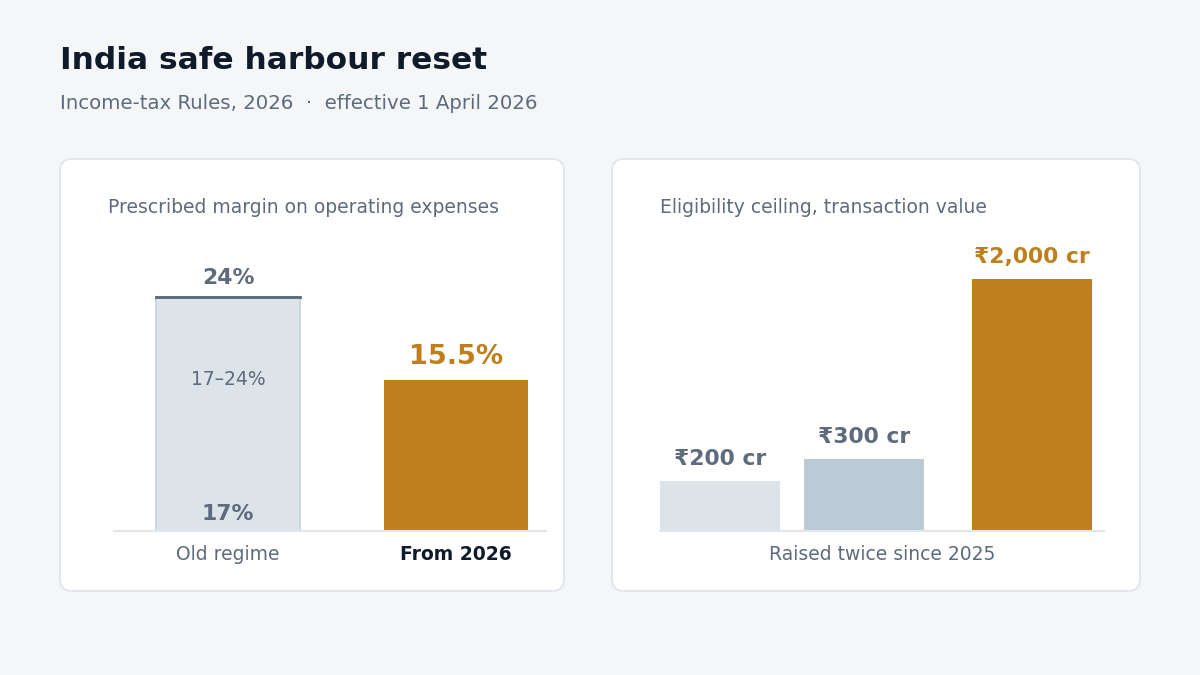
India rewrote the rulebook this year, and most GCC finance teams are still pricing to the old one. From 1 April 2026, the Income-tax Rules, 2026 collapsed four separate service categories software development, ITeS, KPO and software-related contract R&D into a single “information technology services” bucket with one prescribed margin of 15.5% on operating expenses, replacing a range that ran from 17% to 24%.
The eligibility ceiling moved from ₹300 crore to ₹2,000 crore of annual transaction value. That single change pulled tens of thousands of crores of captive revenue into a regime that was previously reserved for small centres.
If your India entity bills its parent on cost-plus, transfer pricing for GCC operations is no longer a back-office filing exercise handled by a local consultant in October. It is a five-year capital allocation decision with a binding lock-in, a dispute-resolution trade-off, and a measurable effect on group effective tax rate.
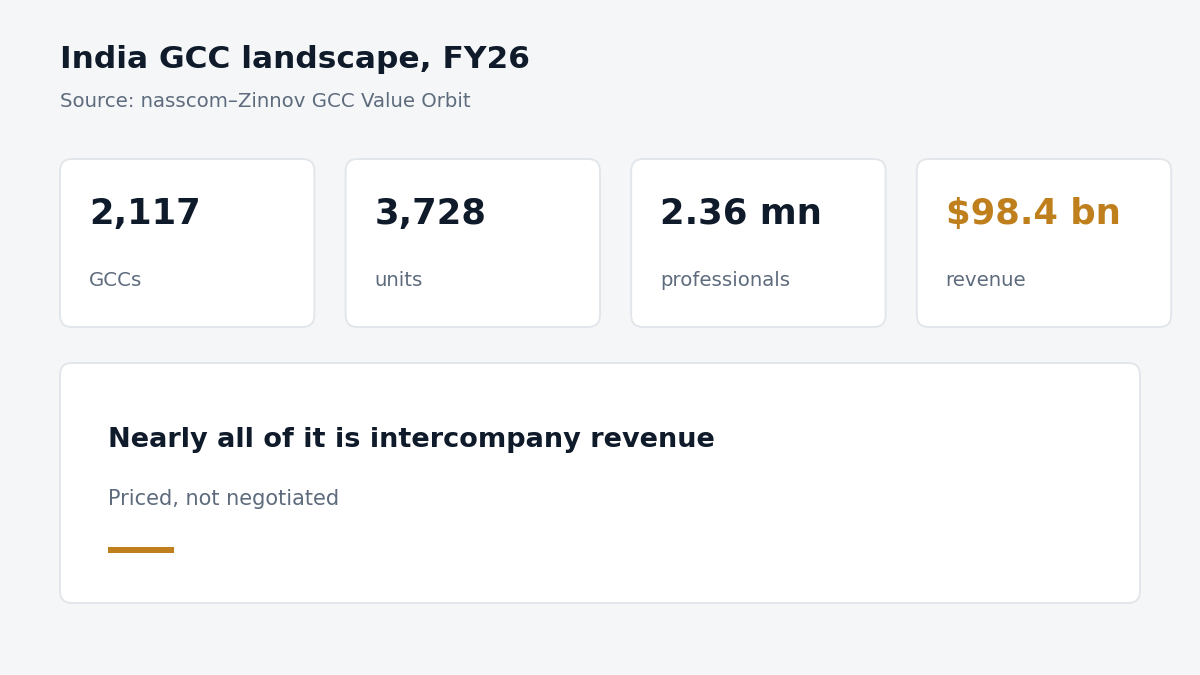
India now hosts 2,117 GCCs across 3,728 units, employing 2.36 million people and generating $98.4 billion in revenue in FY26, per the nasscom–Zinnov GCC Value Orbit report. Nearly all of that revenue is intercompany revenue priced, not negotiated.
The uncomfortable part: the markup most centres use was set on day one, copied from a benchmarking study of a different company, and never revisited as the mandate changed from ticket resolution to product ownership. Meanwhile the Transfer Pricing Officer has watched the same centre’s job postings shift from support engineers to platform architects. That gap between what the entity is paid for and what it actually does is where most transfer pricing for GCC adjustments come from.
TL;DR
This guide covers how to set, document and defend the intercompany price your India centre charges its parent. It is written for CFOs, group tax leads and GCC heads who are either standing up a new entity or inheriting one whose pricing has drifted.
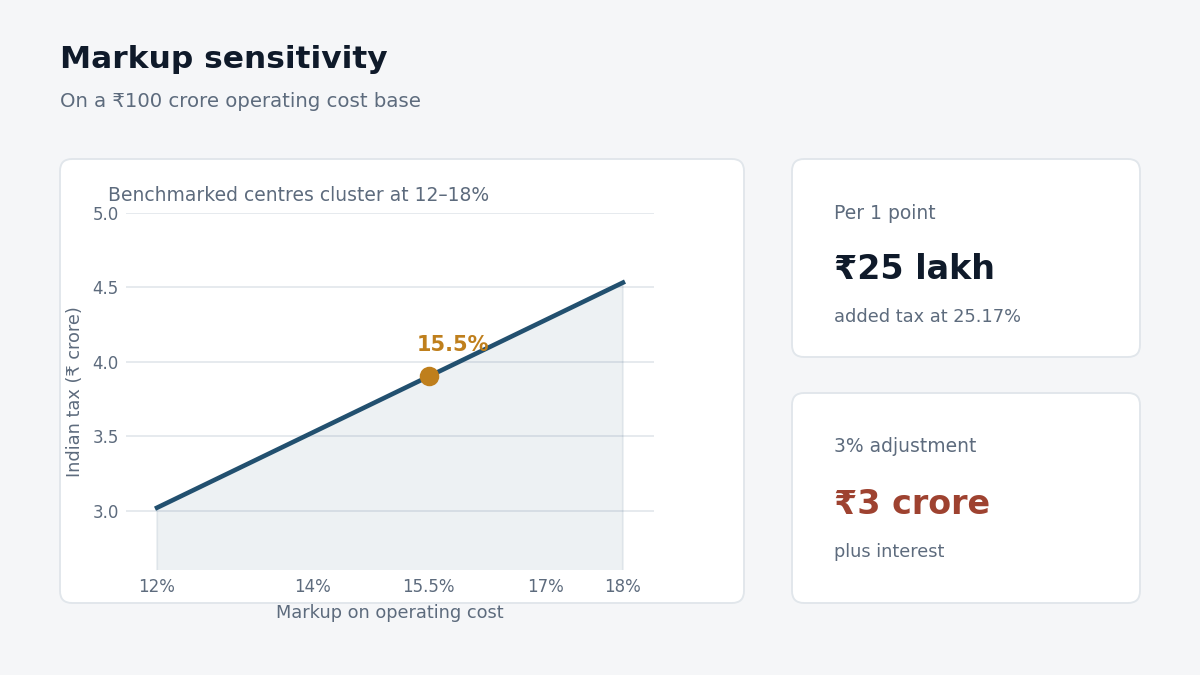
Here is the number that matters: India's 2026 safe harbour prescribes a 15.5% markup on operating costs, down from the 17–24% band, and the eligibility threshold jumped from ₹300 crore to ₹2,000 crore. On a ₹100 crore cost base, a two-percentage-point markup difference moves roughly ₹2 crore of taxable income about ₹50 lakh of Indian tax at the 25.17% concessional rate.
By the end you will be able to decide between safe harbour, an annual benchmarking study and an Advance Pricing Agreement India route, build a cost base that survives scrutiny, and spot the three cost items that trigger most adjustments the levers that make transfer pricing for GCC operations either routine or expensive.
What is transfer pricing for GCC entities?
Transfer pricing for GCC entities is the method used to set and justify the price an India-based captive charges its overseas parent for services rendered. Because both sides are associated enterprises, Indian law requires the price to reflect arm’s length pricing that an independent provider would have charged for the same functions, assets and risks.
In practice, almost every Indian captive uses a cost-plus model: total operating cost, plus a markup, invoiced monthly to the parent. The markup is the entire argument, and every other choice in transfer pricing for GCC documentation method, comparables, adjustments follows from it.
Building a defensible transfer pricing for GCC model
This is the operational core. Get the sequence right and the annual compliance becomes mechanical; get it wrong and every year is a fresh negotiation.
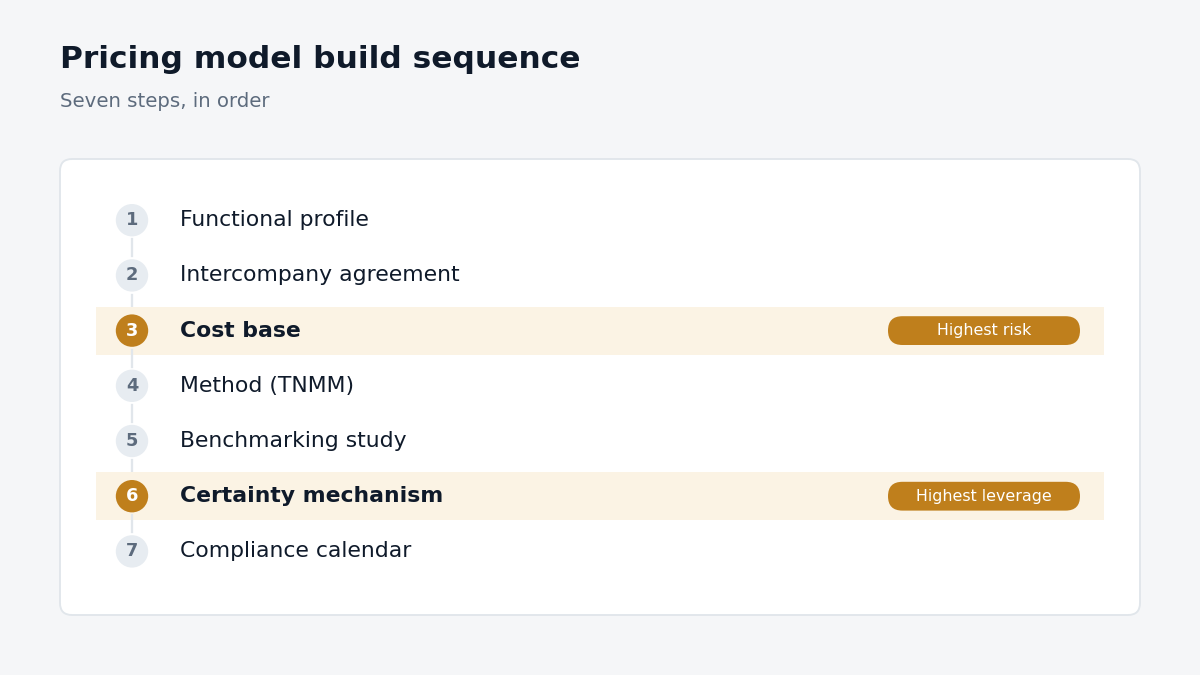
The seven-step process
- Fix the functional profile in writing. Document functions, assets and risks (FAR) honestly: who owns IP, who bears market risk, who signs off on product roadmaps. A “low-risk service provider” characterisation is the basis for cost-plus, and it collapses if your India leadership is making global product decisions.
- Draft the intercompany service agreement before the first invoice. It must name the services, the cost base definition, the markup, the billing frequency and the true-up mechanism. Retrofitting an agreement after two years of invoices is a red flag an officer will find.
- Define the cost base line by line. State explicitly which costs are marked up and which are treated as pass-through, and why. Ambiguity here is the single biggest source of adjustments.
- Select the method. The transactional net margin method (TNMM) with OP/OC as the profit level indicator is the default for transfer pricing India IT services engagements, because comparable data for Indian software and ITeS providers is reasonably deep.
- Run or buy the benchmarking study. Screen comparables on turnover, related-party revenue, functional similarity and persistent losses. Apply working capital and, where defensible, capacity utilisation adjustments.
- Choose your certainty mechanism. Safe harbour, annual benchmarking, block assessment, or an APA. This is the highest-leverage decision in transfer pricing for GCC planning, and the framework below sets out the trade-offs.
- Lock the compliance calendar. Under the new rules, the accountant’s report moves to Form 48 (replacing Form 3CEB) and the safe harbour election is filed on Form 49. Master File and CbCR obligations sit separately and are frequently missed by first-year entities.
What the 2026 safe harbour actually changed
The safe harbour rules India regime under the Income-tax Rules, 2026 is a different instrument from its predecessor, not a rate cut. KPMG’s summary captures the mechanics: one consolidated IT services category, a 15.5% margin on operating expenses, and a threshold raised from ₹300 crore itself only lifted from ₹200 crore by CBDT Notification No. 21/2025 to ₹2,000 crore.
Three conditions deserve board-level attention. The election runs as a multi-year block rather than year by year, with the revenue threshold tested in the first year. Withdrawal is restricted to a narrow window after year one. And accepting safe harbour forecloses Mutual Agreement Procedure relief for those transactions, which matters if the parent sits in a treaty country where the counter-adjustment is the whole point.
For a US or UK parent facing double taxation on an Indian adjustment, giving up MAP access to save a benchmarking study is usually a bad trade. For a centre under ₹150 crore in annual billing with a stable mandate, it usually isn’t. Either way, that election fixes your transfer pricing for GCC exposure for the length of the block.
Where the markup number actually comes from
The prescribed 15.5% is a ceiling of convenience, not a market rate. Independent benchmarking for a straightforward software development captive has historically supported margins in a similar band, which is why so many centres land between 12% and 18% but the defensible number in any transfer pricing for GCC analysis depends on your comparable set, not on what your peer disclosed.
The GCC cost plus markup should also move as the mandate moves. A centre that has taken on product ownership, customer-facing accountability or R&D risk is no longer a routine service provider, and continuing to price it as one invites a functional-recharacterisation argument that is far more expensive than a margin dispute.
This is the moment where hiring decisions and tax positions intersect: the year you start to hire machine learning engineers and platform owners rather than support staff is the year your FAR analysis needs rewriting.
Cost implications you can actually plan around
Run the arithmetic before the audit does. On a ₹100 crore operating cost base, every one percentage point of markup is ₹1 crore of additional Indian taxable income and roughly ₹25 lakh of tax at the 25.17% concessional rate. A 3% adjustment on that base is a ₹3 crore hit, plus interest which is why transfer pricing for GCC modelling belongs in the annual operating plan, not the year-end close.
Watch the secondary adjustment rules as well. Where a primary adjustment exceeds the prescribed threshold and the excess money isn’t repatriated to India within the prescribed window, imputed interest accrues a cash cost layered on top of the tax. Budget for the compliance stack too: a credible benchmarking study, the accountant’s certificate and local file typically run in the low single-digit lakhs annually for a mid-sized centre, while an APA is a materially larger multi-year professional-fee commitment.
What this looks like in practice
Illustrative, drawn from recurring patterns across GCC build-outs rather than a single named engagement.
Pattern one the recharacterisation trap. A mid-market SaaS parent set up a 40-person India centre priced at cost-plus, then moved global roadmap ownership to Bengaluru over two years without touching the agreement. The functional profile in the transfer pricing documentation still described a low-risk back-office provider.
The fix rewriting the FAR analysis, re-benchmarking, and re-papering the intercompany agreement took roughly a quarter, and would have taken a week if the transfer pricing for GCC documentation had been refreshed at the point the mandate changed.
Pattern two the cost base clean-up. A healthtech GCC was recharging group tooling and cloud spend to India as pass-through with no markup, while its own India-side infrastructure hiring ran through a separate cost centre. Reconstructing a single, documented cost base before the first assessment year closed removed the largest exposure on the balance sheet without changing the headline markup at all. Centres that plan their infrastructure ramp and their cost base together have the same conversation that decides when to hire cloud engineers to avoid this entirely.
Decision framework: four routes to certainty
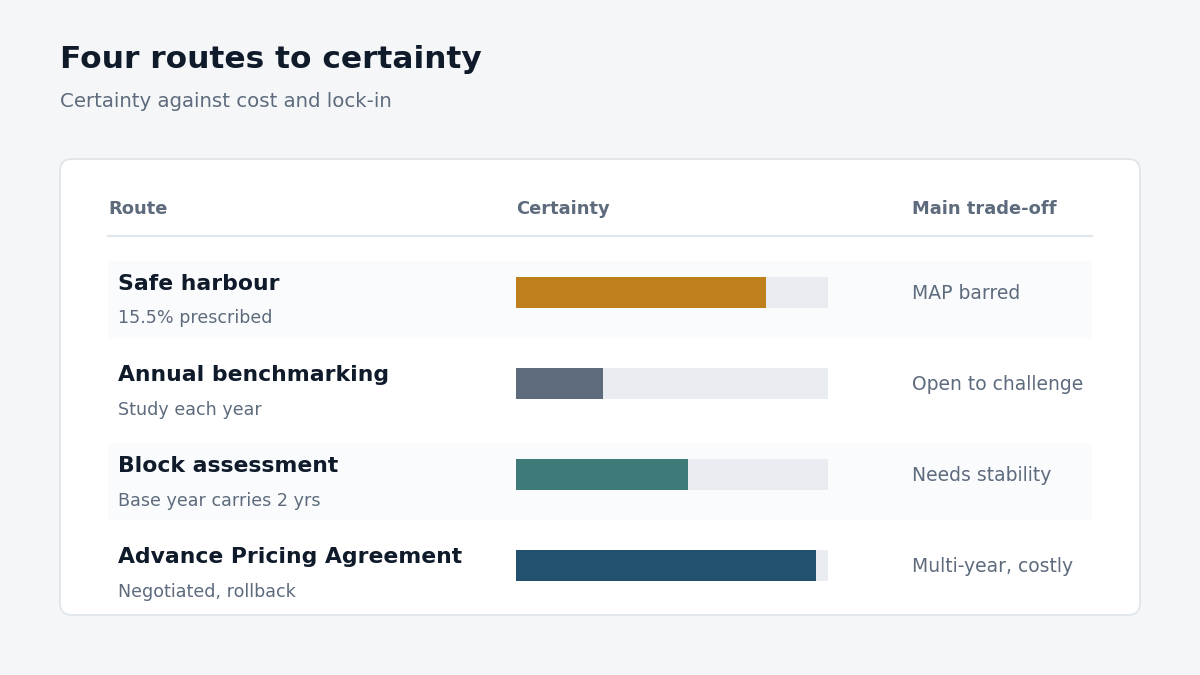
| Route | Best for | Certainty | Main cost |
| Safe harbour (15.5%) | Centres under the threshold with a stable, routine mandate | High, but MAP is barred | Margin may exceed your economics; multi-year lock-in |
| Annual benchmarking (TNMM) | Centres wanting flexibility as the mandate evolves | Low open to annual challenge | Study cost each year plus dispute risk |
| Block TP assessment | Stable models seeking relief from repetitive audits | Medium the base-year ALP carries forward two years | Requires genuinely unchanged transactions and method |
| Advance Pricing Agreement (unilateral or bilateral) | Large centres, treaty-country parents, complex IP | Highest, including rollback | Multi-year timeline and significant professional fees |
The block route is the most under-used option in transfer pricing for GCC planning and deserves more attention than it gets. Grant Thornton notes that the Finance Act, 2025 introduced block transfer pricing assessment, letting an ALP determination apply to similar transactions in the following two years at the taxpayer’s option, a middle path between annual exposure and a five-year safe harbour commitment.
What most teams get wrong
The common failure isn’t a wrong percentage. It’s treating the intercompany price as an accounting output rather than a description of the business. Pricing is a claim about what your India entity does, and transfer pricing for GCC filings are read that way. If the claim and the org chart disagree, the org chart wins in an assessment.
The second failure is optimising for the lowest defensible markup. Shaving two points to improve group effective tax rate buys a rounding error and costs years of dispute, penalty exposure and management attention and under the new rules it can cost MAP access as well.
The third is sequencing. Entity structure, hiring plan, cost base design and arm’s length pricing GCC documentation get decided by four different people at four different times, then reconciled retroactively by whoever files the return. In every engagement where the pricing model was designed alongside the hiring plan, the first-year assessment was uneventful. That sequencing is the difference between a transfer pricing for the GCC position you defend and one you explain.
Before you commit to a five-year position
Few decisions get locked in this early and revisited this rarely. Transfer pricing for GCC entities is set once and lived with for years, which is exactly why it deserves the same scrutiny as the site selection and hiring plan sitting beside it. If you are standing up a global capability center or inheriting one whose pricing has drifted from its mandate, pressure-test the functional profile, the cost base and the markup together before the first invoice, not after the first notice.
Supersourcing has run GCC setup and scale engagements across fintech, healthtech and enterprise SaaS for over a decade, and our IT consulting services team works alongside your tax advisers on the operating-model side of these decisions: entity design, hiring sequencing, and the cost structure your pricing model has to describe.
Talk it through before you file: supersourcing.com/contact-us or mayank@engineerbabu.com.
FAQ
What markup do GCCs in India charge their parent company?
Most India captives operate on cost-plus, and the safe harbour benchmark for the consolidated IT services category is now 15.5% on operating expenses. Independently benchmarked centres commonly land in a similar band, though the defensible figure depends entirely on your comparable set and functional profile, not on peer disclosure.
What are the safe harbour rules in India for IT services?
They let an eligible taxpayer adopt a prescribed margin that the tax authority accepts without detailed scrutiny. Under the Income-tax Rules, 2026, software development, ITeS, KPO and software-related contract R&D sit in one category at 15.5% of operating expenses, with eligibility capped at ₹2,000 crore of transaction value tested in the first year of the block.
Is safe harbour better than an APA?
Safe harbour is faster, cheaper and administratively simple, but it locks you into a prescribed margin and removes Mutual Agreement Procedure access for covered transactions. An APA costs more and takes longer, but negotiates a margin fitted to your facts and can be rolled back to prior years. Size, parent jurisdiction and mandate stability decide which transfer pricing for GCC route fits.
What happens if a GCC’s markup is too low?
The Transfer Pricing Officer proposes an adjustment, increasing Indian taxable income by the shortfall, with interest and potential penalty exposure. Where the primary adjustment crosses the prescribed threshold and the cash isn’t repatriated within the prescribed window, secondary adjustment provisions impute additional interest income.
Do ESOP and pass-through costs go into the GCC cost base?
Pass-through treatment must be justified transaction by transaction and documented in the intercompany agreement; group recharges routinely get pulled into the marked-up cost base on assessment. ESOP cross-charges for India employees remain a contested area and depend heavily on agreement drafting and evidence of benefit.
When should we revisit our transfer pricing for the GCC model?
Any time the functional profile changes: new IP ownership, product accountability shifting to India, a new business line, or a headcount mix that moves from delivery to architecture. Reviewing the model in the same quarter the mandate changes is cheap; reconstructing it during an assessment is not. If you’re at that inflection point, a structured review of your GCC setup services roadmap and pricing position together is the practical next step.
Does a GCC need a benchmarking study every year if it opts for safe harbour?
No, that’s the operational appeal. The election replaces the annual benchmarking cycle for covered transactions, though local file documentation, the accountant’s report and Master File or CbCR obligations continue to apply for the entity’s other international transactions.
