

Most India centre business cases are built on one number: the fully loaded cost per engineer versus the cost at headquarters. That number is usually right. What sits next to it in the model is usually blank, because gcc fund repatriation india planning is treated as a finance chore for year three rather than a design decision in month one.
That blank line is expensive. Getting capital into India is close to frictionless for technology and IT-enabled services. Getting profit back out is a taxed, documented, sequenced process where the cost is set years earlier by choices most teams make casually: the instrument the parent funds the entity with, the markup written into the intercompany agreement, and whether anyone collected a Tax Residency Certificate before the board declared a dividend.
The rulebook also changed underneath everyone on 1 April 2026. The Income-tax Act, 2025 replaced the 1961 Act, folding withholding on payments to non-residents from the old Section 195 into Section 393(2). The remittance forms were renumbered: Form 15CA became Form 145, Form 15CB became Form 146, and Form 10F became Form 41. Buyback consideration moved out of dividend treatment and back into capital gains. Any repatriation playbook written before February 2026 now cites sections and forms that will fail portal validation.
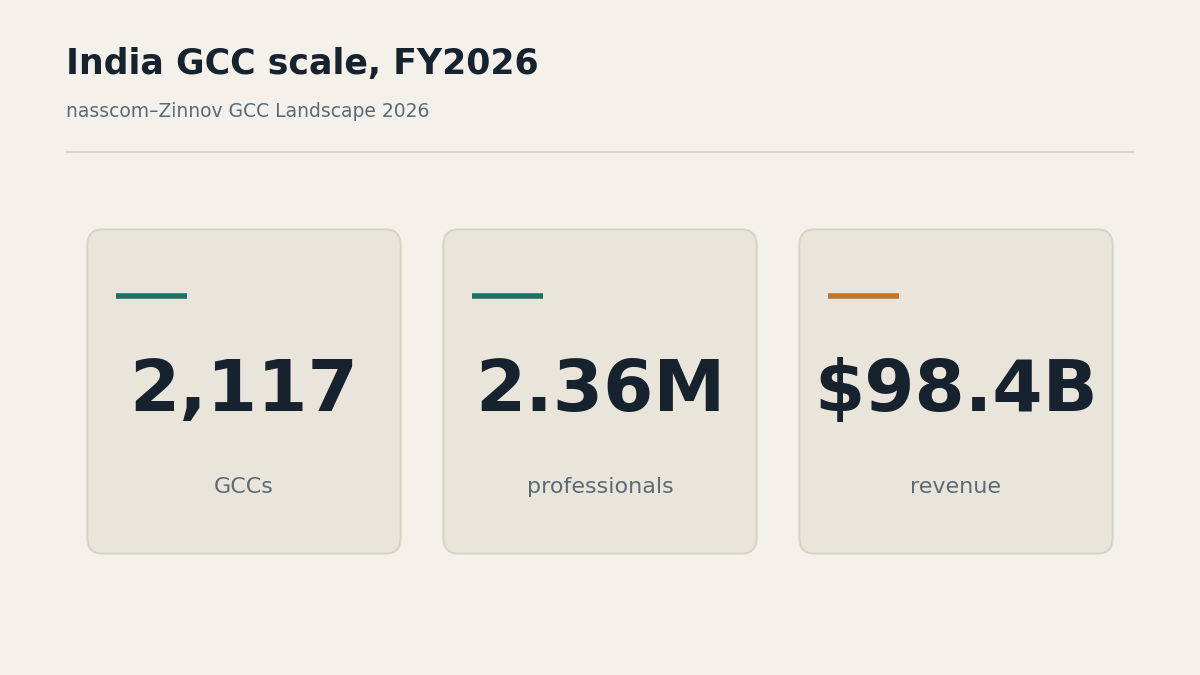
India ended FY2026 with 2,117 GCCs employing 2.36 million professionals and generating USD 98.4 billion in revenue, per the Nasscom-Zinnov GCC Landscape 2026 report. Nearly a hundred billion dollars of value is created inside India each year by entities whose parents sit outside it.
Every one of those parents has a repatriation mechanism, and the gap between a well-designed one and a default one is measured in single-digit percentages of the entire cost base.
TL;DR
This guide covers how money legally enters and leaves an India-based capability centre. It is written for CFOs, finance controllers and GCC leads who have already approved the headcount plan and now need the cash mechanics to hold up.
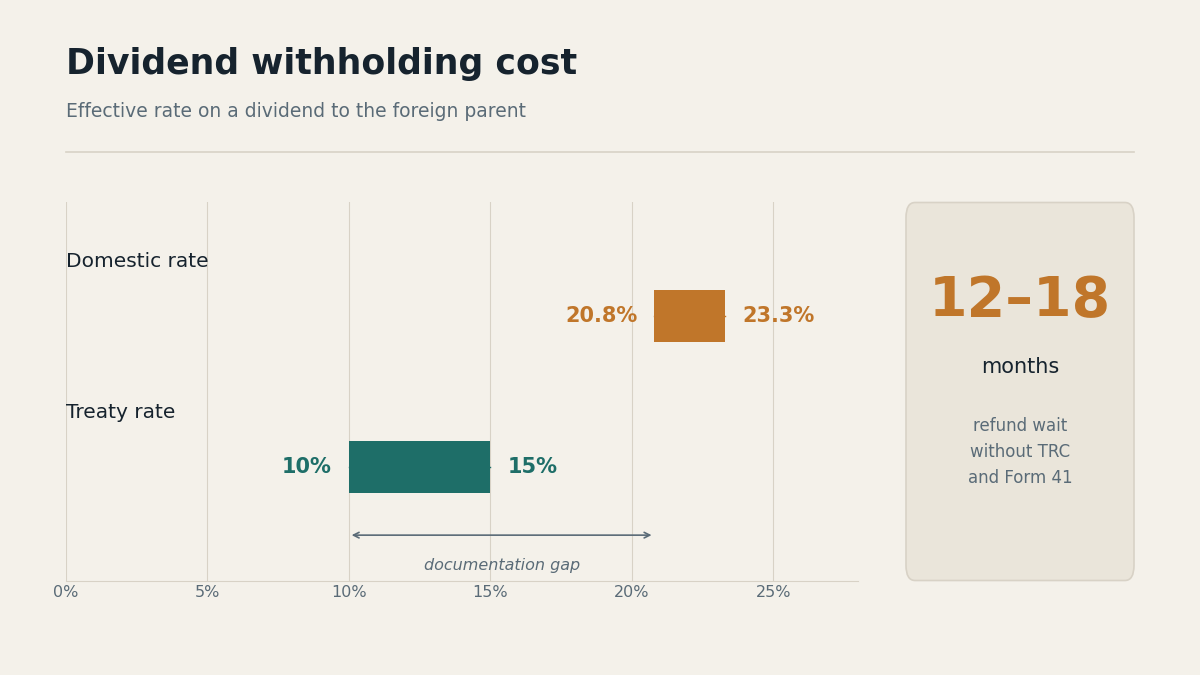
The number to hold on to: the domestic withholding rate on a dividend to a foreign parent is 20% plus surcharge and cess, an effective 20.8% to 23.3%. Most treaties cut that to 10-15%, but only if the paperwork exists before the payment. Teams that skip it wait 12-18 months for a refund.
By the end you will be able to pick a funding instrument, sequence your gcc banking setup correctly, choose between a dividend and a service fee on cost, and know which of the two your India entity should have been using since its first invoice.
What is GCC fund repatriation India?
GCC fund repatriation India is the regulated process by which a foreign parent moves profits, service fees or capital out of its Indian global capability center and back to its home jurisdiction. It runs through an authorised dealer bank under FEMA, 1999, and carries withholding tax under the Income-tax Act, 2025.
Money in is easy. Money out is where the cost lives.
Foreign direct investment into IT and IT-enabled services sits at 100% under the automatic route. No approval, no waiting period, no sector cap. A parent can wire share application money on a Monday and have a funded Indian subsidiary inside the same quarter.
The asymmetry appears on the way out. A dividend paid to a non-resident shareholder attracts withholding at 20% plus applicable surcharge and 4% health and education cess, an effective 20.8% to 23.3% depending on the amount. Dividends are paid from post-tax profit and are not deductible for the Indian company, so the parent is looking at 25% corporate tax followed by another 21%-odd at the door.
A double tax avoidance agreement usually reduces that withholding to 10-15%. The condition is documentary, not economic. Without a valid Tax Residency Certificate and Form 41 in the Indian entity’s hands before the remittance, the bank withholds at the domestic rate. The parent’s remedy is to file an Indian tax return and claim a refund, which in practice ties up the difference for 12 to 18 months.
Two more constraints shape the calendar. Dividends can only be declared out of distributable surplus, so an entity that ran at break-even for two years has nothing to distribute regardless of how much cash is in the account.
And every outward remittance above ₹5 lakh needs Form 145 and a chartered accountant’s certificate in Form 146 before the bank releases funds. Board resolution to money-in-the-parent’s-account typically runs 10-20 business days when the documentation is clean.
FDI routes India: fund the entity so it can pay you back
Choose the instrument on the basis of how profit will eventually leave, not on which is fastest to close. This is where a decision made for convenience in month one becomes a permanent tax cost.
Automatic route or government route
Technology, software development, ITeS and most IT consulting services activities are fully automatic. The exception that catches acquirers rather than greenfield builders is Press Note 3 (2020): any investor with a beneficial owner in a land-border country needs prior government approval.
Press Note 2 (2026) narrowed this in May 2026, permitting indirect investment under the automatic route where China or Hong Kong shareholding stays at or below 10%. If the parent has a pan-Asian cap table, this is a diligence item before incorporation, not after.
Equity, ECB, or a branch
Equity is the default and the cleanest for a long-horizon centre. Dividends are not deductible, so the equity route accepts economic double taxation in exchange for simplicity.
An external commercial borrowing from the parent inverts that. Interest is deductible against Indian taxable income and is generally withheld at 10-15% under treaty, which makes debt structurally more efficient than equity for pulling cash out.
The ceiling is thin capitalisation: interest paid to an associated enterprise is deductible only up to 30% of EBITDA or ₹1 crore, whichever is higher, with excess carried forward for eight assessment years. A thin-margin cost-plus entity hits that cap faster than the model expects.
A branch or project office avoids the dividend layer entirely but is taxed at the higher foreign-company rate and cannot hold IP cleanly. For a captive center setup india intended to own product work, a private limited subsidiary remains the right vehicle in almost every engagement.
The gcc banking setup sequence
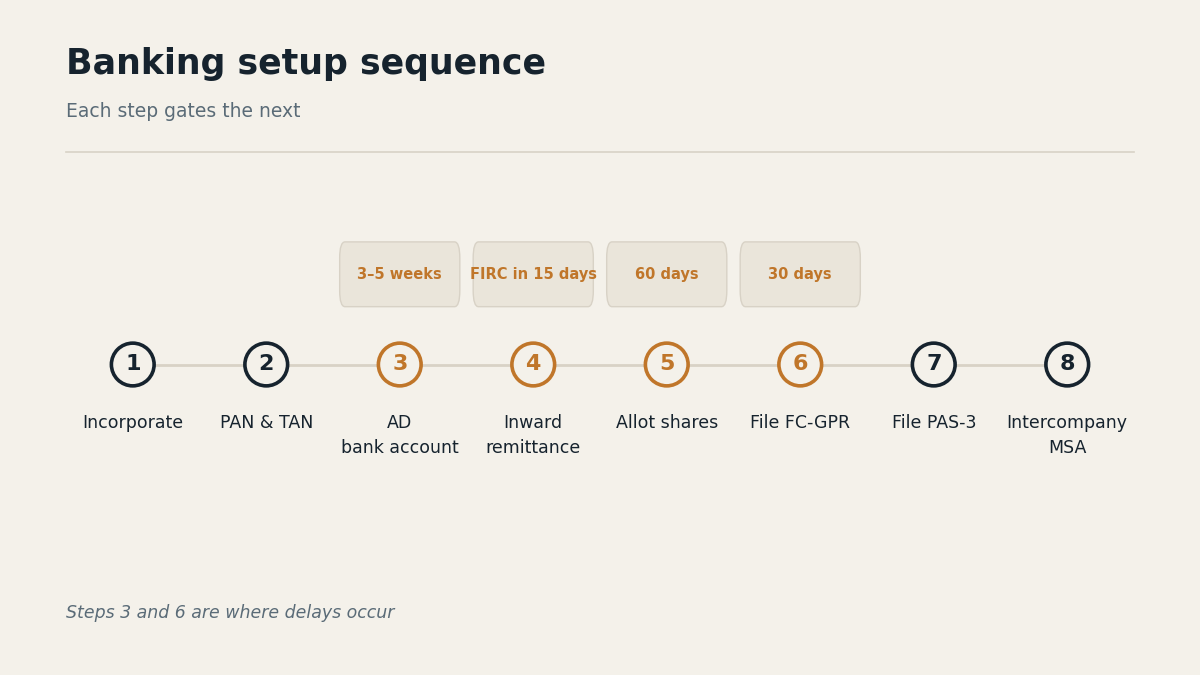
Run these in order. Each step gates the next, and steps 3 and 6 are where delays actually happen.
- Incorporate via SPICe+, with at least one director who is resident in India. This is a Companies Act requirement and it is also what unlocks bank KYC.
- Obtain PAN and TAN. TAN is needed before any withholding, including on the first payroll run.
- Open the AD Category-I bank account and complete corporate KYC on the parent, including apostilled constitutional documents. Budget three to five weeks for a first-time foreign parent.
- Receive the inward remittance under the correct purpose code as share application money, and collect the FIRC and KYC report from the bank within about 15 days.
- Allot shares within 60 days of receiving funds, at or above fair value certified by a merchant banker or chartered accountant. Miss the window and the money must be refunded within 15 days.
- File Form FC-GPR on the RBI FIRMS portal within 30 days of allotment, after registering the Entity Master Form. The clock runs from allotment, not receipt. Late filing needs a Late Submission Fee before the AD bank will process it.
- File PAS-3 with the MCA and issue share certificates.
- Sign the intercompany services agreement and fix the markup before the first invoice. Then diarise the annual FLA return by 15 July.
Dividend repatriation rules and the four other ways money leaves
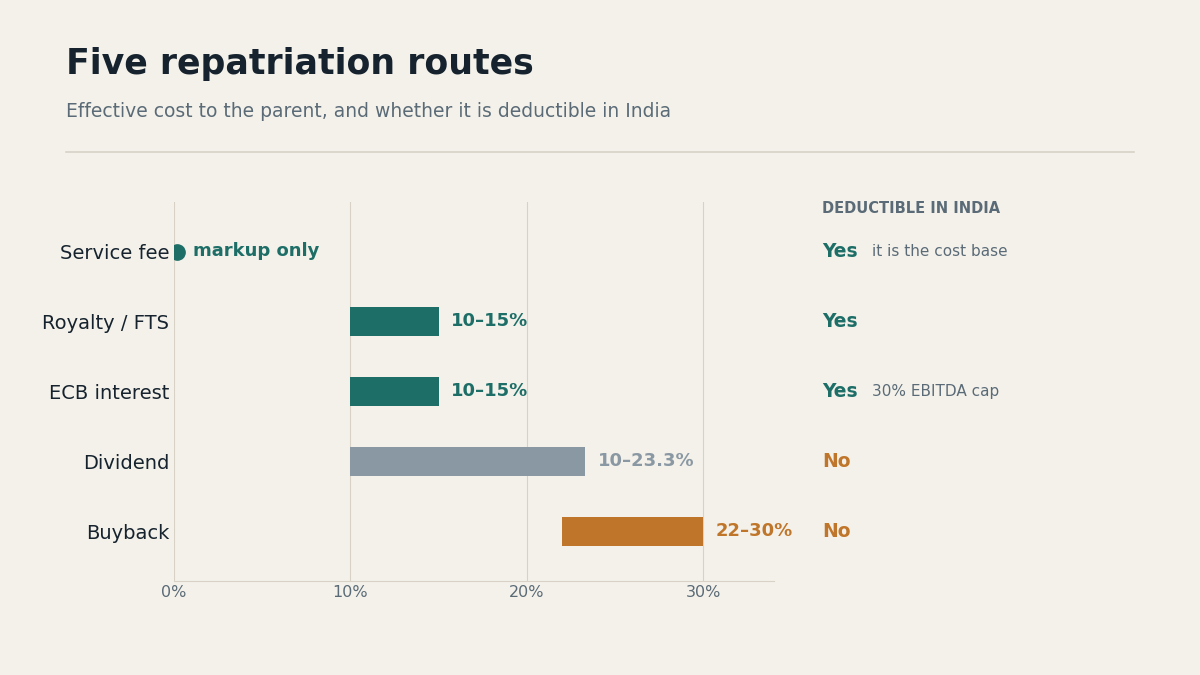
There are five practical routes to repatriate profits from India. Most mature centres use two of them simultaneously.
Route 1: Dividend
The straightforward option. Freely repatriable as a current account transaction, no RBI approval, 20% plus surcharge and cess domestically or 10-15% under most treaties. Interim dividends by board resolution are available in India without waiting for the annual audit, which is a genuine cash-flow advantage over several comparable jurisdictions.
Route 2: Service fees at a cost-plus markup
This is the workhorse and it is not really “repatriation” at all. The India entity invoices the parent monthly for services rendered at cost plus a markup, so cash leaves continuously as an operating expense rather than annually as a distribution. No withholding on business income where there is no permanent establishment issue, and the fee is deductible for the parent.
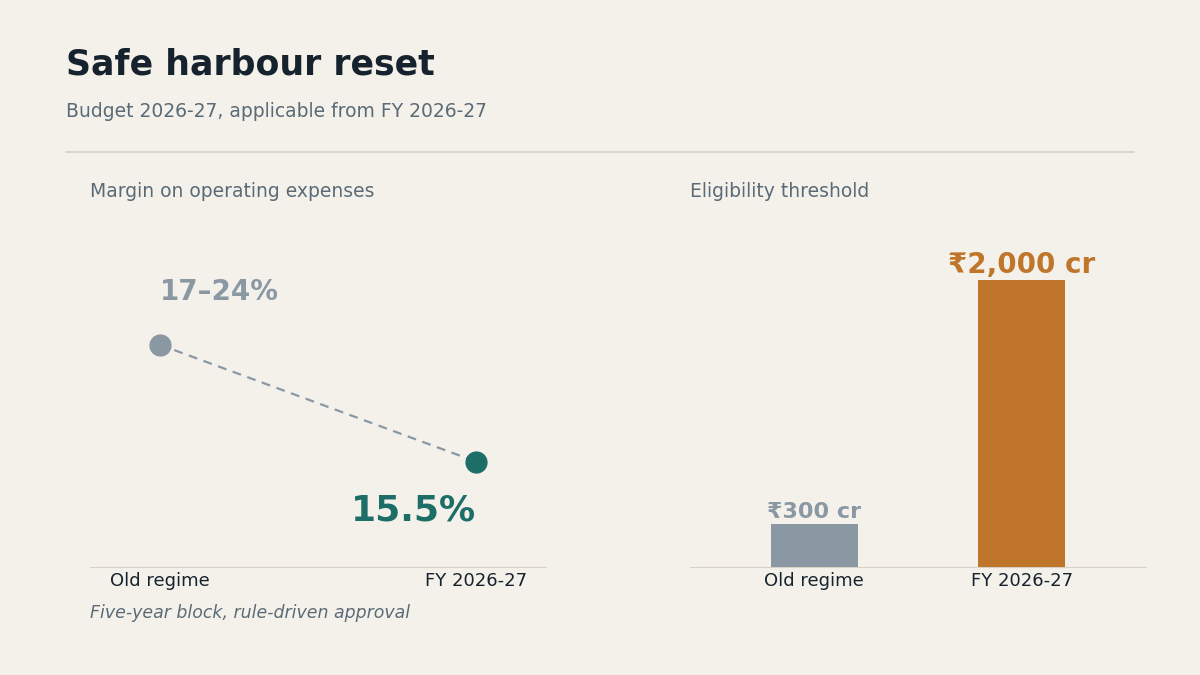
The markup is a transfer pricing question and the answer got much simpler in 2026. Budget 2026-27 clubbed software development, ITeS, KPO and contract R&D into a single “IT Services” category with a uniform safe harbour margin of 15.5% of operating expenses and raised the eligibility threshold from ₹300 crore to ₹2,000 crore.
Approval is rule-driven with no officer examination, the option is exercised in Form 49 with CEO or CMD certification, and it locks in for a five-year block from FY 2026-27. For any centre under ₹2,000 crore of intercompany revenue, that is five years of transfer pricing certainty for the cost of one form.
Two consequences worth internalising. First, 15.5% is below the 17-24% margins the old regime demanded, so most captives are now over-remunerating themselves relative to safe harbour. Second, because the margin is calculated on operating expenses, every rupee of Indian cost carries the markup with it. Whether you hire cloud engineers onto the India payroll or leave them at headquarters changes both the cost base and the taxable profit.
Route 3: Royalty and fees for technical services
Available under the automatic route with no cap, deductible in India, and withheld at treaty rates. It fits where the parent genuinely licenses IP or provides technical support to India. It fits badly where the India entity is the one creating the IP, which is the direction most GCCs are moving. Reverse-charge GST on imported services applies and is usually creditable.
Route 4: Buyback and capital reduction
Read this one carefully because it inverted this year. From 1 April 2026, buyback consideration is taxed as capital gains rather than deemed dividend, with an additional tax bringing the effective rate to roughly 22% for domestic-company promoters and 30% for other promoters. A wholly-owning foreign parent is a promoter.
The buyback route that looked attractive in 2025 is now the most expensive way to return surplus capital for most foreign parents. Capital reduction under Section 66 remains viable but needs NCLT approval and six to nine months.
Route 5: ECB interest
Covered above. Efficient, deductible, capped by the 30% EBITDA thin-capitalisation limit.
What this looks like in practice
Healthtech parent, US, 40-engineer centre. The entity was funded as equity and invoiced the parent at a markup set by the parent’s own controller with no benchmarking study. Two years in, the markup sat well above the safe harbour band, meaning the centre was paying Indian corporate tax on profit it did not need to book. Re-papering the intercompany agreement to the safe harbour margin and moving from annual dividends to monthly service invoicing removed the dividend withholding layer entirely for ongoing profit. The remaining retained earnings were released as one final dividend.
Fintech parent, UK, scale-up from 12 to 55 engineers in two quarters. The constraint was not tax. The parent had budgeted a six-month ramp and discovered that its bank KYC, FC-GPR filing and first payroll cycle all needed a resident director who had not yet been appointed. Running GCC setup services and hiring in parallel rather than in sequence compressed the ramp: shortlists for platform and hire DevOps engineers roles were interview-ready in 7-10 working days while the banking and FEMA track ran alongside it, instead of the hiring track waiting on the banking one.
Dividend or service fee: how to choose
| Route | Effective cost to parent | Deductible in India | Cadence | Best for |
| Dividend | 10-15% treaty, 20.8-23.3% domestic | No | Annual or interim | Releasing accumulated retained earnings |
| Service fee (cost-plus) | Indian corporate tax on the markup only | Yes, it is the cost base | Monthly | Ongoing operating repatriation |
| Royalty / FTS | 10-15% treaty withholding | Yes | Per agreement | Genuine parent-owned IP licensing |
| ECB interest | 10-15% treaty withholding | Yes, capped at 30% EBITDA | Quarterly or semi-annual | Parent-funded capex-heavy builds |
| Buyback | ~22-30% effective from 1 Apr 2026 | No | One-off | Rarely optimal now |
The practical answer for a services-only centre: run route 2 continuously and route 1 occasionally. Treat routes 3 to 5 as structural decisions that need counsel, not as levers to pull mid-year.
What most teams get wrong
The markup in the intercompany agreement is not a finance formality to settle after the team is hired. It sets the taxable base for the entire life of the centre, and it is nearly impossible to revise downward without inviting a transfer pricing challenge in the earlier years. Set it before the first invoice, not after the first audit.
Three failure patterns show up repeatedly in engagements:
The wrong purpose code on the first wire. Money that arrives coded as an advance against service exports rather than share application money cannot be cleanly converted to equity. Unwinding it means a refund, a re-remittance, and an FC-GPR clock that restarts.
The TRC that arrives after the board meeting. Treaty rates are documentary. A parent that declares a dividend in March and requests the Tax Residency Certificate in April has already lost the rate difference to a refund claim.
No resident director at incorporation. Every Indian company needs one, and until there is one, bank KYC stalls, board resolutions cannot be passed cleanly, and the FEMA filing chain cannot start. It is a two-line statutory requirement that regularly costs first-time parents four to six weeks, and it sits alongside a longer list of legal documents required for GCCs in India that is worth checking before incorporation rather than after.
Pressure-test your structure before you commit
If you are standing up an India centre or already running one and want a second read on the funding instrument, the markup and the repatriation calendar, it is worth doing that before the next board resolution rather than after the next assessment. Supersourcing has GCC setup and scale engagements across fintech, healthtech, e-commerce and enterprise SaaS, and the finance track and the hiring track almost always need to run in parallel rather than in sequence.
Send the current intercompany agreement and cap table structure to mayank@engineerbabu.com or start at supersourcing.com/contact-us. Bring your gcc fund repatriation india questions with the numbers attached; the conversation is more useful that way.
FAQ
Is GCC fund repatriation India legal, and does it need RBI approval?
Yes and no, respectively. Repatriation of dividends, service fees, royalties and interest is permitted under FEMA, 1999 as a current account transaction and needs no RBI approval where the entity is compliant. What it needs is documentation: the withholding deposited, Form 145 and Form 146 filed, and the AD Category-I bank satisfied.
How much withholding tax applies on a dividend paid to a foreign parent company in India?
The domestic rate is 20% plus applicable surcharge and 4% cess, an effective 20.8% to 23.3%. A treaty typically brings it to 10-15%, and where the treaty rate applies, surcharge and cess are not added on top. Eligibility requires a valid Tax Residency Certificate and Form 41 before the payment date.
How long does it take to repatriate money from India?
For a dividend, 10-20 business days from board resolution to funds landing, assuming the TRC, Form 41, TDS challan and Form 146 certificate are ready. For monthly service invoicing, it moves at ordinary commercial payment terms. Capital reduction through the NCLT runs six to nine months.
Can a GCC pay its parents a royalty?
Yes, under the automatic route with no cap. Whether it should is a separate question. If the India centre is generating the IP, a royalty flowing outward is difficult to defend on audit and undermines the entity’s own valuation.
What is a reasonable cost-plus markup for a captive centre in India?
From FY 2026-27, 15.5% of operating expenses is the notified safe harbour margin for the consolidated IT Services category, available where intercompany revenue is within ₹2,000 crore. Adopting it gives a five-year block of certainty without a benchmarking study. Higher markups are defensible but need documentation.
We already have an India entity. Is it worth reviewing the structure now?
The 1 April 2026 transition makes this the natural moment. Section references, remittance forms, buyback treatment and safe harbour margins all changed in the same window, so most existing intercompany agreements and repatriation calendars are now citing superseded provisions. A structure review is cheaper than a refund claim.
