

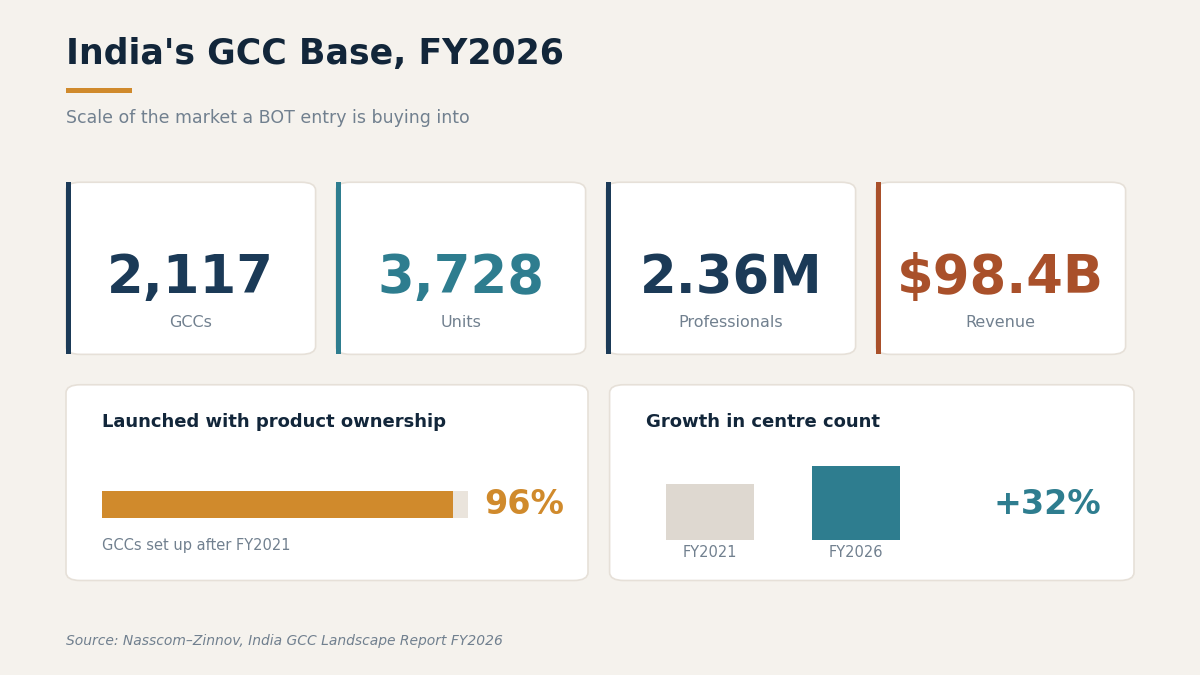
Ninety-six percent of Global Capability Centres established in India after FY2021 launched with product or portfolio ownership from day one, rather than climbing the old crawl-walk-run ladder from back-office support upward. That single number rewrites the entry question. The old debate was whether to offshore at all. The new one is how fast you can stand up a centre that owns real product scope and who carries the risk while you get there.
India now hosts 2,117 GCCs across 3,728 units, employing 2.36 million professionals and generating an estimated $98.4 billion in revenue, up 32% in centre count since FY2021.
That growth has a shadow side that rarely makes the press release: the failure rate of first-time, self-managed India entries. Entity incorporation, payroll infrastructure, statutory registrations, a real estate lease, a talent brand nobody has heard of, and a hiring engine all built simultaneously, by a team that has never done it, usually while the sponsoring executive is nine time zones away. Understanding how the BOT model works for GCC builds is, for most enterprises, a question about sequencing risk rather than a question about cost.
Build-Operate-Transfer answers it by splitting the problem in two. Someone who has already solved the setup problem solves it again, on their balance sheet and their licences, and runs the centre against your KPIs until it is provably stable. Then it becomes your entity, employees, IP, and all at a price you agreed to before anyone signed anything.
Done well, it is the shortest defensible path from “the board approved India” to “we own a captive centre.” Done badly, it is a three-year outsourcing contract with the word “transfer” printed on the cover and no mechanism behind it. The difference is entirely in the clauses, the pricing formula, and the governance cadence which is what the rest of this guide is about.
TL;DR
This guide explains how the BOT model works for GCC setups, end to end: the three phases, what happens inside each one, what it costs, and what the contract must say. It is written for the person who has to defend the entry model to a board or a CFO heads of engineering, COOs, and GCC sponsors evaluating India for the first time.
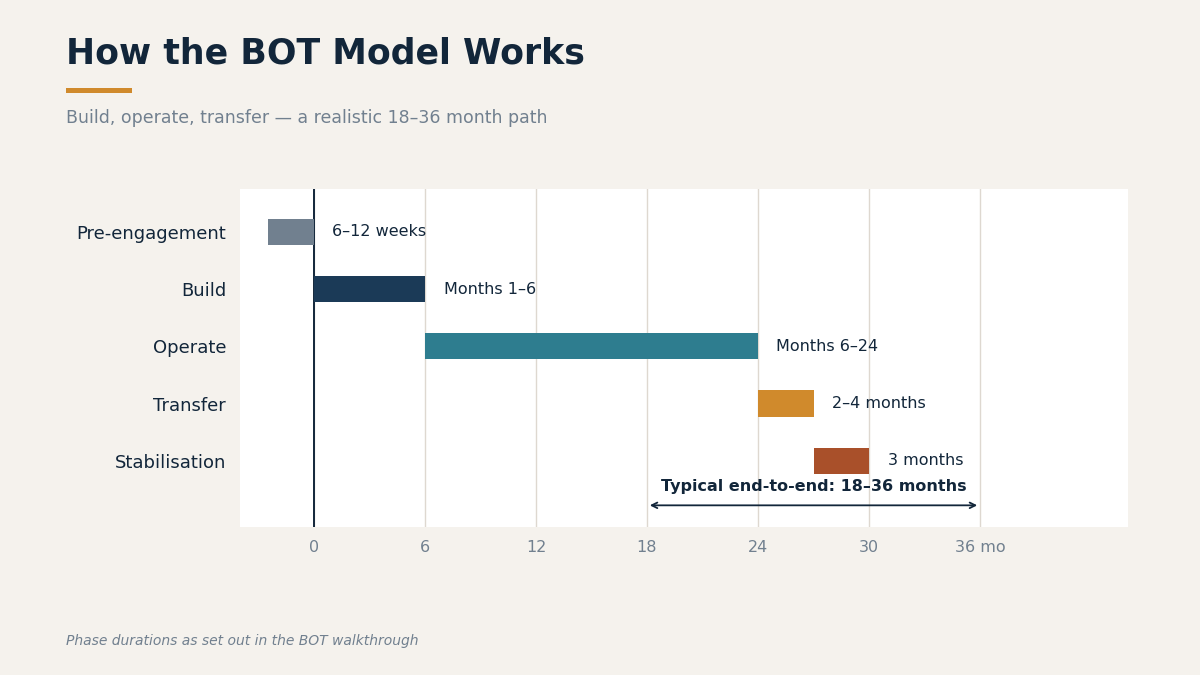
The headline number: a realistic build operate transfer GCC programme runs 18 to 36 months from kickoff to handover, with first hires productive in 6 to 12 weeks but the transfer fee, which almost nobody negotiates properly, can swing the total cost of the deal by 20 to 40%. That one clause matters more than the monthly rate you spend three months haggling over.
By the end you will be able to price a BOT deal against a direct setup, write a requirements brief a partner can actually bid on, spot the four contract terms that decide whether you end up owning anything, and run the transfer itself without losing the team you just spent two years building.
What Is the BOT Model for GCCs?
The BOT model for GCCs is a three-phase arrangement in which a specialist partner incorporates the entity, hires the team, and operates the centre against your KPIs for a fixed period then transfers the legal entity, employees, and intellectual property to you at a pre-agreed price. You end up owning a captive centre you did not have to build yourself.
The structure is borrowed from infrastructure public-private partnerships, where a private operator builds a road or a port, runs it through a defined concession period, and hands it to the state. A BOT model offshore center applies the same risk transfer to people and processes instead of concrete.
What it is not, and is routinely confused with:
- Not outsourcing. In outsourcing, the vendor owns the team permanently and sells you an outcome. In BOT, ownership is contractually scheduled to change hands. If there is no dated transfer mechanism, it is not BOT.
- Not staff augmentation. Augmentation gives you contracted individuals inside your existing structure. BOT gives you an entity, a leadership layer, statutory registrations, and a going concern.
- Not an Employer of Record (EOR). An EOR employs people on your behalf indefinitely and never transfers an entity. EOR is a payroll instrument; BOT is an ownership pathway.
- Not a guarantee of a cheaper centre. BOT usually costs more than direct setup in absolute rupees. What it buys is compressed time and transferred execution risk.
Why Build Operate Transfer GCC Deals Are Getting Signed Faster
Concrete outcomes a BOT decision moves:
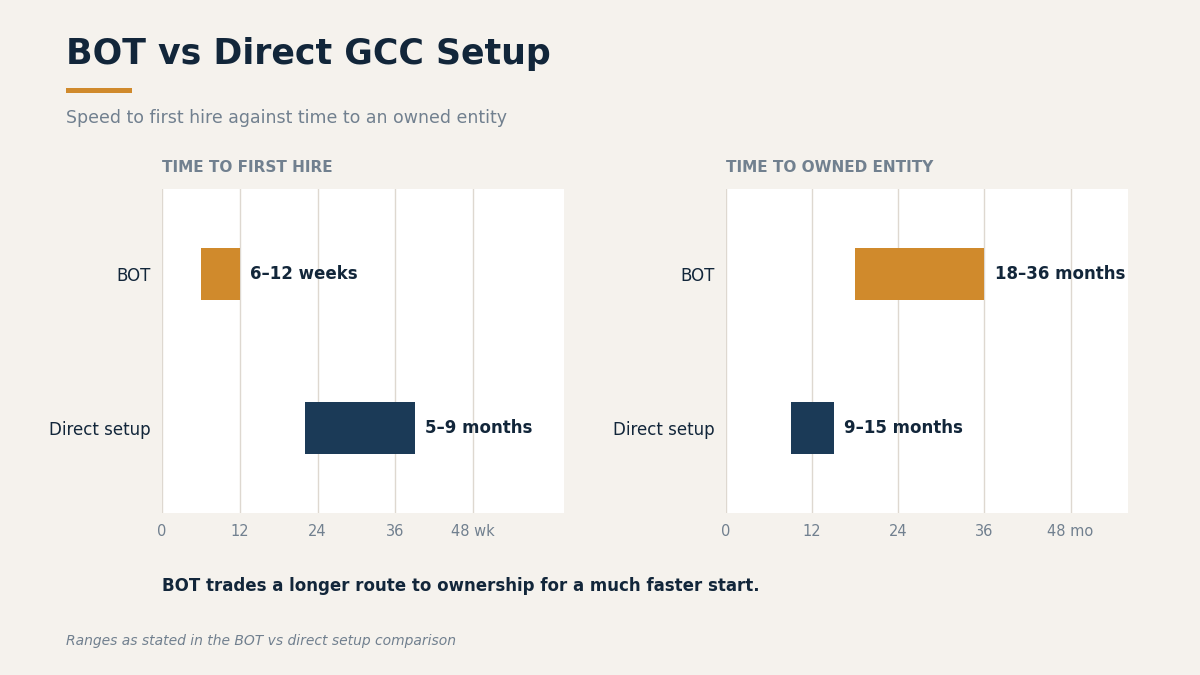
- Time to be a productive engineer. A partner with existing infrastructure typically fields a first pod in 6–12 weeks. A cold, self-managed entry generally reaches the same point in 5–9 months, because incorporation, banking, payroll setup, and employer-brand-from-zero hiring run in sequence, not parallel.
- Capital profile. BOT converts a lumpy CapEx-and-legal-fees entry into a monthly OpEx line for the first 18–24 months. For a CFO who has not yet approved a permanent India balance sheet, this is often the entire argument.
- Execution risk transfer. During the operating phase, statutory non-compliance, wrong-hire cost, and lease exposure sit with the partner. That is worth real money. An early leadership mis-hire in a 40-person centre can cost 4–6 months of ramp.
- Ownership at the end. Unlike outsourcing, the arbitrage compounds to you. Once transferred, you run at fully loaded internal cost with no vendor margin, and the IP, the codebase, and the institutional knowledge sit inside a company you own.
- Optionality. A well-drafted agreement lets you transfer early if the centre outperforms, extend if your entity readiness slips, or walk with a defined exit cost if the thesis fails.
The honest framing: BOT does not make an India centre cheap. It makes an India centre predictable, and it lets you buy the expensive learning curve from someone who has already paid for it.
The Complete BOT Walkthrough: From Board Approval to Owned Entity
This is the operational core. Six phases, in order, with what actually happens inside each one.
Phase 1 Defining the mandate, scope, and budget bands
Everything downstream is determined here. A vague brief produces a vague centre.
The 6-question build charter. Answer these in writing before you talk to a single partner:
- What work moves? Name the specific products, services, or functions “the payments dedicated development team and the internal tooling group,” not “engineering.”
- What is a steady-state headcount, and by when? A 25-person centre and a 250-person centre are structurally different deals with different partner shortlists.
- What roles, at what seniority mix? Specify the ratio. A centre that is 80% mid-level with no principal engineers will not own product scope regardless of what the mandate says.
- Where? Tier-1 (Bengaluru, Hyderabad, Pune, NCR) buys talent density at a premium. Tier-2 (Coimbatore, Indore, Ahmedabad, Kochi) buys 15–30% lower comp and materially lower attrition, at the cost of a thinner senior pool.
- When do you want to own it? Your target transfer date drives the concession period, which drives the pricing.
- What does “successful” look like at transfer? Define it as a measurable state: attrition below X%, Y% of roles filled, Z sprints delivered at agreed velocity, all statutory filings clean.
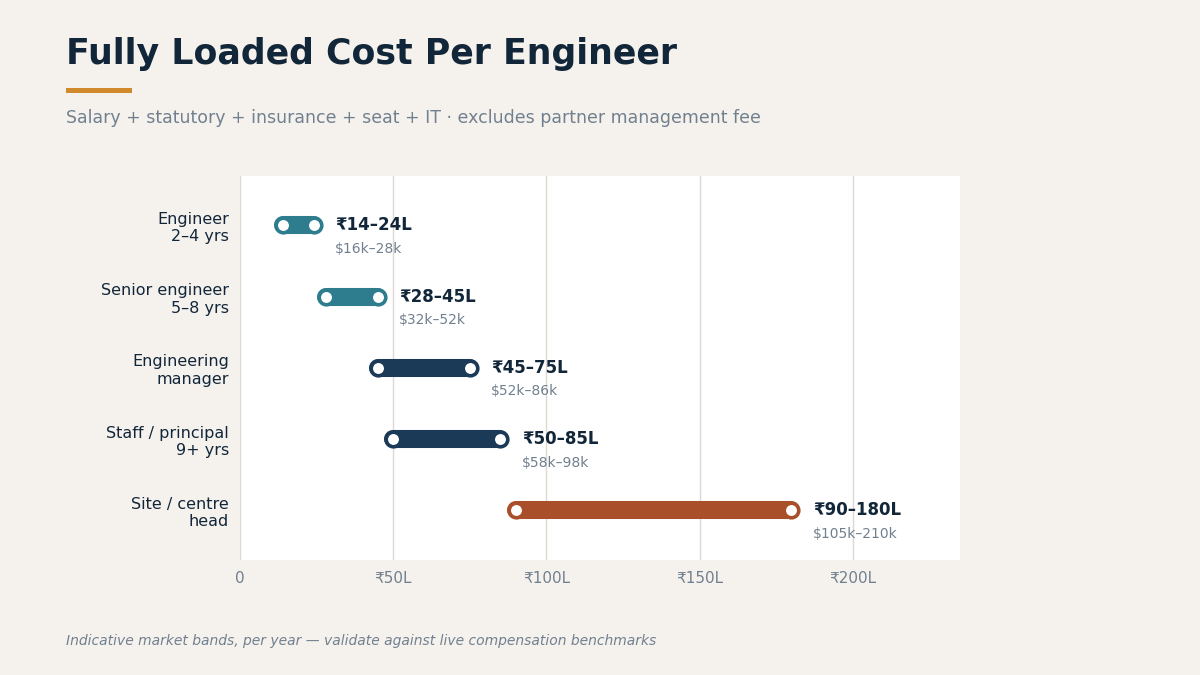
Budget bands to model at this stage (fully loaded, per engineer, per year validate against live comp benchmarks, these are market ranges, not quotes):
| Role band | India fully loaded (₹/yr) | Approx (US$/yr) |
| Engineer, 2–4 yrs | ₹14–24 lakh | $16k–28k |
| Senior engineer, 5–8 yrs | ₹28–45 lakh | $32k–52k |
| Staff / principal, 9+ yrs | ₹50–85 lakh | $58k–98k |
| Engineering manager | ₹45–75 lakh | $52k–86k |
| Site / centre head | ₹90 lakh–1.8 cr | $105k–210k |
“Fully loaded” here means salary + employer statutory contributions + insurance + seat + IT. It excludes the partner’s management fee, which is a separate line see Phase 3.
Do not skip: the leadership hire. The single strongest predictor of whether a GCC survives transfer is whether a credible site leader was hired in the first 90 days rather than the last 90. Partners will offer to “cover leadership from our side during operation.” That is convenient and it is a trap see the section on what teams get wrong.
Phase 2 Partner selection and vetting
You are not buying an IT staffing vendor. You are buying an organisation that will hold your entity, your payroll, and your IP for two years, and then hand them over cleanly. Vet accordingly.
The 9-point BOT partner diligence checklist:
- Completed transfers, not signed BOTs. Ask how many BOT engagements they have actually transferred to client ownership, and ask for two references from transferred clients. Anyone can start one.
- Entity model. Will the GCC sit in a dedicated SPV, or inside the partner’s existing operating company? A dedicated SPV transfers cleanly. A carve-out from a shared entity is slower, messier, and can trigger tax and licensing complications.
- IP chain of custody. Employee-level IP assignment must flow to you from day one, not to the partner with a promise to reassign later. Ask to see the employment contract template.
- Hiring engine evidence. Time-to-shortlist, offer-to-join ratio, 90-day retention of placed candidates. Ask for the numbers, not adjectives.
- Statutory track record. PF, ESI, GST, TDS, and Shops & Establishments filings for the last eight quarters, clean and on time.
- Financial standing. They will hold your entity. If they enter insolvency mid-concession, your team’s contracts and your data are inside their corporate structure. Ask for audited financials and negotiate step-in rights.
- Attrition inside their own delivery organisation. A partner with 35% internal attrition will not build you a stable centre.
- Governance model. Named engagement lead, escalation path, reporting cadence in the contract, not the pitch deck.
- Transfer readiness playbook. Ask them to walk you through their last transfer, week by week. Vagueness here is disqualifying.
Phase 3 The BOT agreement structure
This phase is where the deal is actually won or lost. Everything else is execution.
A workable BOT agreement structure has four documents, not one:
- Master Services Agreement (MSA) scope, service levels, governance, term, and the concession period.
- Transfer Agreement (or a transfer schedule inside the MSA) the mechanism, trigger, price formula, and closing conditions.
- IP and confidentiality deed assignment of all work products to the client entity, effective from creation, with employee-level assignment flowing through.
- Employee transfer schedule who transfers, on what terms, with what continuity of service.
The 8 clauses to negotiate hardest:
- Transfer price formula. Fix it at signature. Common structures: a multiple of the monthly management fee (typically 3–12 months), a per-transferred-head fee, or a declining schedule that reduces the longer the operating phase runs. The declining schedule aligns incentives best; it rewards the partner for a fast, stable build rather than a long tenancy.
- Transfer trigger and window. Client-side call option, exercisable within a defined window, with a notice period (60–120 days is typical). Avoid mutual-consent triggers; they hand the partner a veto.
- Early transfer right. If the centre stabilises at month 14 instead of month 24, you should be able to take it, at a defined price. Partners will price this. Pay it.
- Exit and termination-for-convenience. What it costs to walk without transferring, and what you take with you data, documentation, and the right to hire the team directly.
- Non-solicit carve-out. The partner’s standard non-solicit must explicitly exclude the GCC team from the transfer date. This is missed astonishingly often.
- IP assignment timing. Effective from creation, assigned to the client entity, with a warranty that every employee and contractor has executed an assignment.
- Step-in and escrow rights. Access to payroll data, employee records, and source repositories if the partner defaults or enters insolvency.
- Employee continuity terms. Transferring employees keep tenure, PF continuity, and gratuity accrual. Who funds accrued gratuity at transfer is a real number settled in the contract, not in a spreadsheet argument at month 23.
Pricing models you will be offered:
| Model | How it works | Best when |
| Cost-plus | Actual costs + fixed % markup (commonly 15–30%) | You want full cost transparency and audit rights |
| Fixed per-seat | Flat monthly rate per FTE by role band | Headcount is stable and predictable |
| Hybrid | Fixed setup fee + cost-plus during operate | Most common for 50+ person centres |
Cost-plus with open-book audit rights is the strongest position for a client who intends to transfer, because it makes the fully loaded cost visible from day one which is exactly the number you will need to model the post-transfer run rate.
Phase 4 Build and onboarding: the first 90 days
The build phase runs roughly months 1–6, though the first cohort should be delivering well before the end of it.
Weeks 1–4 Foundation (partner-led):
- Entity or SPV incorporation, PAN/TAN, bank account, FEMA-compliant capital infusion
- GST, Shops & Establishments, PF and ESI registrations
- Office secured plug-and-play or managed space, typically ₹18,000–35,000 per seat per month in Tier-1, materially less in Tier-2
- Role scorecards signed off; sourcing pipeline opened
Weeks 3–8 Founding cohort:
- Site lead or first engineering manager hired first, not last
- First 5–10 engineers sourced, screened, and offered. A functioning pipeline yields an interview-ready shortlist in 7–10 working days per role; anything beyond three weeks signals a sourcing problem, not a market problem
- Client-side technical panel involved in final rounds from the very first hire non-negotiable, and the most common corner cut
Weeks 6–12 Onboarding and first delivery:
- Laptops, VPN, SSO, repository access, and security clearance completed before day one, not during week one
- A named onboarding buddy on the client side per new hire
- First sprint contributions inside week 3; first independently owned feature by week 8
- Communication cadence locked: daily async standup, twice-weekly overlap window, weekly delivery review
The onboarding friction nobody plans for: access provisioning. In roughly the majority of engagements, the first two weeks of a new GCC’s productive capacity are lost to the client’s own IT security process laptop procurement, VPN certificates, SSO group membership, and third-party tool licences. Start the security and access workstream at contract signature, not at candidate acceptance. It is the cheapest week you will ever save.
If reliability, deployment tooling, or infrastructure automation are in scope, the founding cohort needs at least one senior platform person; teams that defer the decision to hire DevOps engineers until after the product engineers are in place typically lose 4–6 weeks to environment and pipeline setup that the product team then has to do badly.
Phase 5 Operate: governance, KPIs, and proving stability
The operating phase runs 12–24 months. Its purpose is not to deliver work, it is to prove the centre can deliver work without the partner. Structure it that way from month one.
Governance cadence that works:
| Forum | Frequency | Participants | Decides |
| Delivery standup | Daily (async) | Team + client lead | Blockers |
| Sprint review | Bi-weekly | Team + product owner | Scope, velocity |
| Operations review | Monthly | Site lead + partner engagement lead + client sponsor | Hiring, attrition, cost |
| Governance council | Quarterly | Executive sponsors both sides | Transfer readiness, scope changes |
The KPIs that matter for transfer readiness track these from month one, because they become the transfer readiness test:
- Attrition (annualised). Target under 15%. Above 20% and the centre is not stable enough to transfer.
- Time-to-fill by role band. Rising time-to-fill is the earliest indicator of an employer-brand problem you will inherit.
- Delivery velocity and predictability. Not raw output variance. A team that commits and delivers within ±10% is transferable.
- Percentage of decisions made in-centre. The single best maturity signal. If every non-trivial call still escalates to headquarters, you are transferring a delivery pod, not a capability centre.
- Bench and backfill time. How fast a departure is replaced without delivery impact.
- Statutory compliance clean-sheet. Every filing on time, every quarter. You are inheriting the liability.
The 3-day rule: any operational issue that is not resolved within three working days at the site level must be escalated to the monthly operations review with a named owner. Centres drift into dependency when small unresolved issues quietly get routed back to headquarters and dependency is the thing that makes transfer fail.
What to insist on during operation: client-side technical leadership must remain embedded. The moment the client stops attending sprint reviews, the centre becomes an outsourcing arrangement in practice regardless of what the contract says, and the transfer becomes a handover of strangers.
Phase 6 Transfer: the mechanics of taking ownership
The transfer itself takes 2–4 months of preparation and execution. It is a project with its own plan, not an event.
The transfer runbook, in sequence:
- T-120 days Readiness assessment. Score the centre against the transfer criteria defined in Phase 1. Document gaps and assign owners. If attrition or leadership gaps fail the test, this is when you decide to extend, not at T-14.
- T-120 days Serve notice. Exercise the call option per the contract window.
- T-90 days Valuation and consideration. Apply the pre-agreed formula. Reconcile the working capital position, accrued gratuity, leave encashment liability, and any prepaid facilities costs. This reconciliation is where unpriced deals turn ugly; with a formula it is arithmetic.
- T-90 days Legal workstream. Share transfer or business transfer agreement, regulatory filings, board resolutions, bank account and signatory changes, licence and registration transfers.
- T-60 days Employee communication. This is the part that determines whether you get a team or a building. Employees learn about the change of employer from a joint client-and-partner communication, not a rumour. Offer letters from the new entity go out with terms at parity or better, explicit tenure continuity, unchanged PF account continuity, and clear answers on gratuity accrual.
- T-45 days Individual conversations. Every senior person gets a 1:1 with client leadership. Retention risk concentrates in the top 15% of the team; treat it as a named-person exercise, not a broadcast.
- T-30 days Systems and vendor novation. Payroll provider, insurance, facilities, IT services, software licences. Each one is a separate contract that needs assigning.
- T-0 Cutover. New entity payroll runs, access and admin rights migrate, the partner’s engagement team steps back to an agreed support role.
- T+90 days Stabilisation support. Contract a defined post-transfer support window from the partner. Three months is standard, and worth paying for.
Retention is the real KPI of a transfer. A well-run handover keeps the overwhelming majority of the team, because employees experience continuity of manager, project, seat, and comp. A badly run one where people find out late, terms are ambiguous, or gratuity continuity is unclear can trigger a departure wave in the exact quarter you can least afford one.
Phase 7 After the transfer: scaling or unwinding
Ownership is the beginning of the operating problem, not the end of it.
In the first 6 months post-transfer, you own:
- Payroll, statutory filings, and audit either in-house or through a retained compliance provider
- The employer brand in a local market where you are now a direct competitor for talent
- Career pathing. A GCC that offers no promotion ladder loses its best people in year two, and there is no partner to backfill them
- Transfer pricing documentation and intercompany agreements as an ongoing obligation
If you need to scale: the hiring engine that built the centre is no longer yours by default. Decide before transfer whether you build an internal talent acquisition function, retain the partner on an RPO basis, or run a hybrid. Most centres under 100 people are better served by a retained arrangement than by hiring two internal recruiters.
If you need to unwind: the exit clause negotiated in Phase 3 is the only thing that matters. Voluntary winding up of an Indian entity is a 9–18 month process with employee settlement obligations. Know that number before you sign, not after.
What This Looks Like in Practice
A note on sourcing: the scenarios below are drawn from patterns across GCC and scaled-hiring engagements and are anonymised at the client’s level of detail. Where a metric is a verifiable programme-level figure, it is labelled as such. Nothing here is a reconstructed press release.
Fintech scale-up, 40-engineer centre, Bengaluru. Founding cohort of eight one engineering manager, two senior backend engineers, five mid-level with an interview-ready shortlist per role delivered inside the standard 7–10 working day cycle. The decisive choice was hiring the manager first: by month four, the manager was running the hiring loop, which removed the client’s technical panel from 60% of interviews and made the centre self-propagating well before the transfer window opened.
Healthtech platform, 25-person engineering and QA centre, Tier-2 city. Location selection drove the outcome more than partner selection. Comp bands ran roughly 20–25% below Bengaluru equivalents and annualised attrition stayed in single digits, a combination that shortened the operating phase because transfer readiness criteria on stability were met early. The trade-off was real: senior architect-level roles took materially longer to fill and two were ultimately hired out of Bengaluru on a hybrid arrangement.
Enterprise SaaS, staff augmentation converted to a captive. A 15-person augmented team that had been delivering for 14 months was restructured into a BOT arrangement with a defined transfer at month 12, rather than starting a new build. The transfer completed with the delivery team intact. The lesson generalises: an existing, well-performing augmented team is the lowest-risk seed for a GCC, provided the contract is restructured to create employee-level IP assignment and a priced transfer mechanism before anyone starts calling it a capability centre.
Across 10+ years and 527+ delivered projects, the pattern Supersourcing sees hold regardless of centre size is the same one: teams that hire leadership in the first quarter transfer successfully; teams that borrow leadership from the partner until month 20 usually do not.
BOT vs Direct GCC Setup vs the Alternatives
The BOT vs direct GCC setup comparison is usually framed as cost. It is really a trade between speed, control, and who carries execution risk.
The 5-question decision test. Answer these honestly:
- Do you want to own an entity in India in three years? No → BOT is the wrong instrument. Use augmentation or managed services and stop paying for a transfer you will never exercise.
- Do you already have an Indian legal entity and a working payroll? Yes → direct setup is probably faster and cheaper; you have already paid the entry cost.
- Is your steady-state headcount above 25 and below 500? This is BOT’s efficiency band. Below 25, the fixed overhead of an entity rarely pays back. Above 500, you likely have the internal muscle to build directly.
- Is your board approving OpEx or CapEx? OpEx-only mandates make greenfield structurally difficult and NOT structurally easy.
- Is your timeline driven by a hard external commitment? A product launch or a cost commitment inside 6 months rules out greenfield on arithmetic alone.
Three or more answers pointing toward BOT means the model fits. One or two means you are probably buying a transfer option you will never use and paying for it monthly.
What Most Teams Get Wrong About BOT
The core mistake: treating BOT as a procurement decision about a monthly rate, when it is a governance decision about a transfer. Buyers spend three months negotiating a 6% difference in the management fee and fifteen minutes on the transfer clause then discover at month 22 that “transfer on mutually agreed terms” gives them no leverage at all over a partner holding their entity, their team, and their production access.
Four more failure patterns worth naming:
- Borrowing leadership from the partner. It is offered as a convenience and it feels efficient. But the site lead is the person who holds the team’s loyalty, knows the hiring market, and makes the centre self-governing. If that person is on the partner’s payroll at transfer, you are inheriting a team with no leader and the partner has every incentive to keep them.
- Letting the operating phase drift. Every extension is individually reasonable: a scope change, a hiring shortfall, a reorganisation at headquarters. Cumulatively they turn a 24-month BOT into a five-year outsourcing contract. Put a hard outer date in the MSA with an automatic price step-down after it.
- Optimising the centre for cost instead of ownership. Cheaper mid-level hires make the monthly invoice look good and produce a centre that cannot make its own technical decisions. Percentage-of-decisions-made-in-centre is the metric that predicts transfer success; cost per head is not.
- Treating the transfer as a legal event. Legal is the smallest workstream. Employee communication, manager continuity, and gratuity clarity determine whether you keep the team. Budget more attention to the T-60 communication plan than to the share transfer paperwork.
Cost and Timeline Reality Check
Public content on this topic is conspicuously vague about numbers. Here are usable ranges. Treat them as market bands to model against, then validate with live quotes actual costs vary significantly by city, seniority mix, and facility standard.
Timeline by phase
| Phase | Duration | Milestone |
| Pre-engagement (charter, partner selection, contracting) | 6–12 weeks | MSA + transfer agreement signed |
| Build | Months 1–6 | Entity live, founding cohort delivering |
| Operate | Months 6–24 | Steady state, transfer readiness criteria met |
| Transfer | 2–4 months | Entity, employees, IP in client ownership |
| Post-transfer stabilisation | 3 months | Partner support tapers to zero |
| Total | 18–36 months |
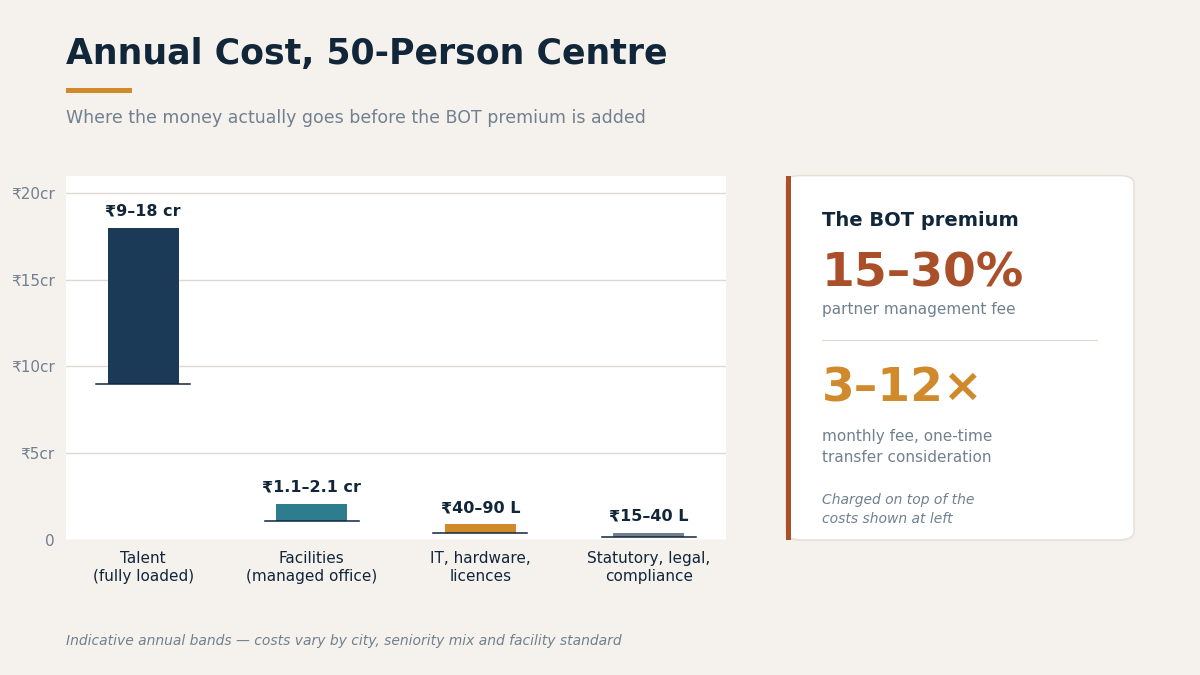
Cost components for a 50-person centre (indicative annual bands)
| Component | Range | Notes |
| Talent (fully loaded) | ₹9–18 crore / $1.05M–2.1M | Dominant line; driven by seniority mix |
| Facilities (managed office) | ₹1.1–2.1 crore / $130k–245k | ₹18k–35k per seat/month, Tier-1 |
| IT, hardware, licences | ₹40–90 lakh / $46k–105k | Higher for data-sensitive workloads |
| Statutory, legal, compliance | ₹15–40 lakh / $17k–46k | Ongoing, post-incorporation |
| Partner management fee | 15–30% of the above | The BOT premium |
| Transfer consideration | 3–12× monthly management fee | One-time, at handover |
What drives cost up
- Senior-heavy mix (principal engineers and architects can be 3–4× a mid-level engineer)
- Tier-1 metro location, premium Grade-A facilities
- Regulated-industry compliance (BFSI, healthcare data residency, SOC 2 / HIPAA controls)
- Aggressive ramp hiring 40 people in 8 weeks costs more per head than hiring 40 in 20
- Vague scope, which produces rework and rehiring
What drives cost down
- Tier-2 location: 15–30% lower comp, lower attrition, roughly half the real estate cost
- A balanced pyramid rather than a top-heavy one
- Longer, staged ramp with a proven founding cohort
- Cost-plus pricing with open-book audit rights instead of an opaque per-seat rate
- Converting an existing, performing augmented team into the founding cohort
The number most models miss: post-transfer run rate. Once the partner’s 15–30% management fee falls away, your ongoing cost drops but you pick up internal compliance, talent acquisition, and facilities overhead that typically adds back 8–15%. Net saving is real but smaller than the headline. Model it before you sign, because it is the number that justifies the transfer premium to your CFO.
Where to Take This Next
If you are mid-decision, the most useful next step is not a vendor pitch, it is pressure-testing your own build charter. Take the six questions from Phase 1, answer them in writing, and model the fully loaded cost for your specific seniority mix and target city. If the answers point clearly to ownership within three years and 25–250 seats, BOT is likely the right instrument and the conversation becomes about the transfer clause. If they do not, you will save yourself a substantial premium by finding that out now.
For teams that want a second opinion on the charter before it goes to a board scope, location, seniority mix, realistic cost bands, and whether BOT actually beats a direct setup in your case a scoping conversation with people who have run these engagements is usually a better use of an hour than another comparison article. Supersourcing’s IT consulting services team works through exactly this evaluation with enterprises entering India, including the cases where the honest answer is that a GCC is not the right structure yet.
One next step: book a scoping conversation and bring your draft build charter. No obligation to proceed, and you will leave with a cost view either way.
Frequently Asked Questions
How long does a BOT engagement take end to end?
Plan for 18–36 months. Build runs roughly six months to a delivering founding cohort, operation runs 12–24 months to prove stability, and the transfer itself takes 2–4 months of preparation and execution. Compressing below 18 months is possible only when the operating phase inherits an already-performing team rather than starting cold.
How is the BOT transfer fee calculated?
Most commonly as a multiple of the monthly management fee typically 3 to 12 months or as a per-transferred-head fee. The strongest structure is a declining schedule that reduces the longer the operating phase runs, because it rewards the partner for building fast and stable rather than for staying. Fix the formula at signature.
What happens to employees when a GCC transfers?
They receive employment offers from your new entity, ideally at parity or better, with continuity of tenure, PF account, and gratuity accrual. Handled properly joint communication at T-60, 1:1s with senior staff at T-45, clear benefit continuity the large majority of teams transfer intact. Handled late or ambiguously, attrition spikes in the worst possible quarter.
Who owns the IP during the operating phase?
You should, from the moment of creation. Insist on employee-level IP assignment flowing directly to your entity in every employment contract from day one, not a partner-held assignment with a promise to reassign at transfer. Ask to review the actual contract template during diligence, not the summary in the proposal.
Is BOT cheaper than direct GCC setup?
Usually not in absolute rupees you are paying a 15–30% management fee plus a transfer consideration. What BOT buys is time (first hires in 6–12 weeks versus 5–9 months) and transferred execution risk during the highest-risk period. If you already have an Indian entity and payroll, direct setup is generally both cheaper and faster.
Can you exit a BOT contract without transferring?
Yes, if you negotiated it. A termination-for-convenience clause should define the exit fee, notice period, what data and documentation you take with you, and critically a carve-out from the partner’s non-solicit so you can hire the team directly. Without those terms, exiting means walking away from the team you built.
Can an existing staff augmentation team be converted into a GCC?
Often the lowest-risk path. A team that has been delivering for 12+ months is already culturally aligned and technically ramped. The conversion work is contractual: restructured to create employee-level IP assignment, a defined transfer mechanism with a priced formula, and a governance layer. Worth a scoping conversation before assuming you need to start fresh.
How do we know if we’re ready to run the centre ourselves?
Four tests: attrition under 15% annualised, time-to-fill stable or improving, delivery variance within ±10% of commitment, and the majority of technical decisions being made in-centre rather than escalated. If those hold for two consecutive quarters, you are ready. If they do not, extending the operating phase of a transfer into an unstable centre transfers the instability to you.
