

A 200-person Series B startup and a 12,000-employee GCC delivery center both type “top RPO companies in India” into Google every quarter and nearly every list on page one treats them as the same buyer. They aren’t. A startup needs 12 tech hires closed before the next funding milestone; an enterprise needs 2,000 hires standardized across six cities with compliance sign-off at every stage. Most comparison lists rank vendors by client-logo count and years in business, not by the one variable that actually predicts whether the engagement works: fit to your hiring stage.
According to NASSCOM’s 2026 Strategic Review, India’s technology sector added a net 135,000 jobs in FY26 alone, pushing direct tech sector employment toward roughly 6 million a hiring volume that internal HR teams increasingly cannot absorb without outside recruitment infrastructure.
This guide breaks down the real differences between the top RPO companies in India not by marketing copy, but by size-fit, delivery model, and pricing structure so you can shortlist correctly the first time, instead of three months into a mismatched contract. It also covers the pricing structures vendors rarely explain upfront, the compliance clause most buyers skip, and the exit terms that determine whether switching providers later costs you a quarter or a week.
TL;DR
This guide is for HR leaders, founders, and TA heads trying to shortlist the top RPO companies in India whether you're hiring 10 engineers a quarter or scaling a 2,000-person GCC team. Instead of a generic best-of ranking, it compares RPO service providers in India by pricing model, delivery structure, and size-fit.
The number to remember: most RPO engagements fail not on sourcing quality but on a size mismatch. A hiring cycle that should take 7-10 working days routinely stretches past six weeks when an enterprise-built delivery model gets applied to a 50-person startup, or vice versa.
By the end, you'll be able to map your own hiring stage to the right category of provider, ask the three questions that expose a weak SLA before you sign, and know which red flags mean you should walk away.
What Is RPO (Recruitment Process Outsourcing)?
Recruitment Process Outsourcing (RPO) is a hiring model where an employer transfers ownership of all or part of its recruitment function sourcing, screening, interview coordination, offer management to an external provider that operates as an extension of the internal HR team, usually under volume-based or outcome-based contracts rather than per-placement fees.
The Core Problem: Most Teams Match on Brand, Not on Fit
Most buyers shortlist RPO firms in India the way they’d shortlist a SaaS tool by badges and client logos on the homepage. That approach misses the variable that actually predicts whether the engagement works: whether the provider’s delivery model matches your hiring stage.
An enterprise-grade RPO firm built for 3,000-plus annual hires runs on standardized workflows, layered governance, and multi-week onboarding exactly what a large GCC needs, and exactly what buries a 60-person startup in a process it doesn’t have the volume to justify. A lean, founder-led RPO team built for startup speed can close 10-15 tech roles in 7-10 working days, but usually can’t absorb a 500-hire annual mandate without quietly subcontracting it.
Most teams underestimate this mismatch by 3-4x in cost terms. A startup paying enterprise-model retainer fees for a handful of monthly hires routinely spends three to four times what a project RPO or on-demand RPO engagement would cost for the same output.
How to Actually Evaluate RPO Vendors in India
Evaluating these providers comes down to three variables that most buyers never ask about directly in the first call: pricing structure, delivery model, and exit terms and a fourth, compliance, that only surfaces once something goes wrong.
RPO Pricing Models in India, Explained
Three pricing structures dominate the market, and mixing them up is the single most common negotiation mistake:
- Full-cycle RPO a flat management fee plus a per-hire cost, covering sourcing through onboarding. Best for 200+ annual hires where predictable unit economics matter more than speed on any one role.
- Project RPO a fixed-scope engagement for a defined hiring surge (a new office, a product launch, a GCC ramp-up), priced for the project rather than the year.
- On-demand RPO pay-as-you-go recruiter capacity, billed monthly, with no long-term retainer. This is where most startups and mid-market teams actually belong, even though enterprise-style full-cycle contracts get pitched to them by default.
Delivery Model: Onshore, Offshore, and Hybrid
Ask exactly where your recruiters sit and how many other accounts they touch. A shared-bandwidth model where one recruiter splits time across four or five client accounts is the most common reason time-to-fill creeps past the promised window. Dedicated account teams cost more per month but almost always beat shared pools on quality of hire and consistency, because the recruiter actually learns your hiring bar instead of pattern-matching keywords.
Compliance and Data Handling: The Clause Most Buyers Skip
Every candidate a provider sources touches personal data resumes, salary history, background-check results and most RPO contracts in India say almost nothing specific about where that data sits once the engagement ends. Ask directly whether candidate data is deleted, returned, or retained after offboarding, and whether the provider’s own sub-vendors (background verification agencies, assessment platforms) are named and bound under the same NDA.
This matters more once a contract touches regulated sectors. A BFSI or healthtech client hiring through an RPO partner inherits that partner’s data-handling posture for audit purposes, so a vague clause here isn’t a legal footnote; it’s a downstream compliance gap that shows up during your own client or investor due diligence, not the vendor’s.
The 5-Step Vendor Evaluation Checklist
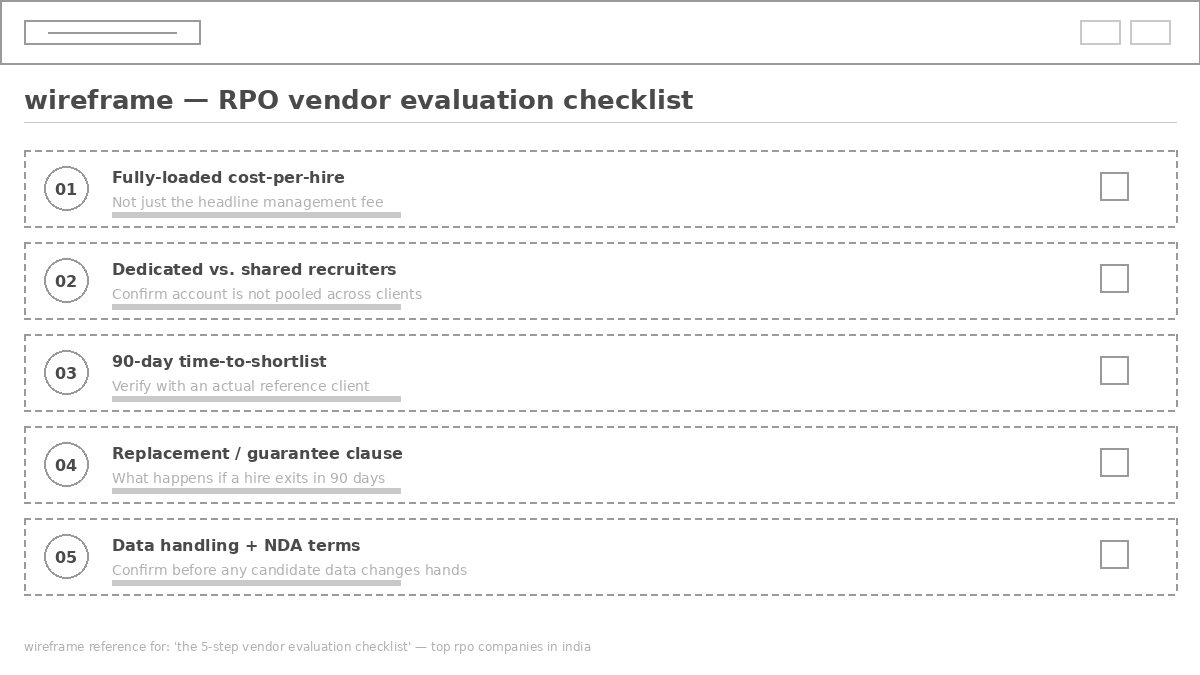
- Ask for the fully-loaded cost-per-hire, not just the headline management fee.
- Confirm whether recruiters are dedicated to your account or shared across clients.
- Check the average time from job description to interview-ready shortlist over the last 90 days, with a client reference.
- Review the replacement or guarantee clause what happens if a placed hire exits or underperforms within 90 days.
- Confirm data handling and NDA-backed IP protection terms before any candidate data changes hands.
Case Studies: RPO in Real-World Use
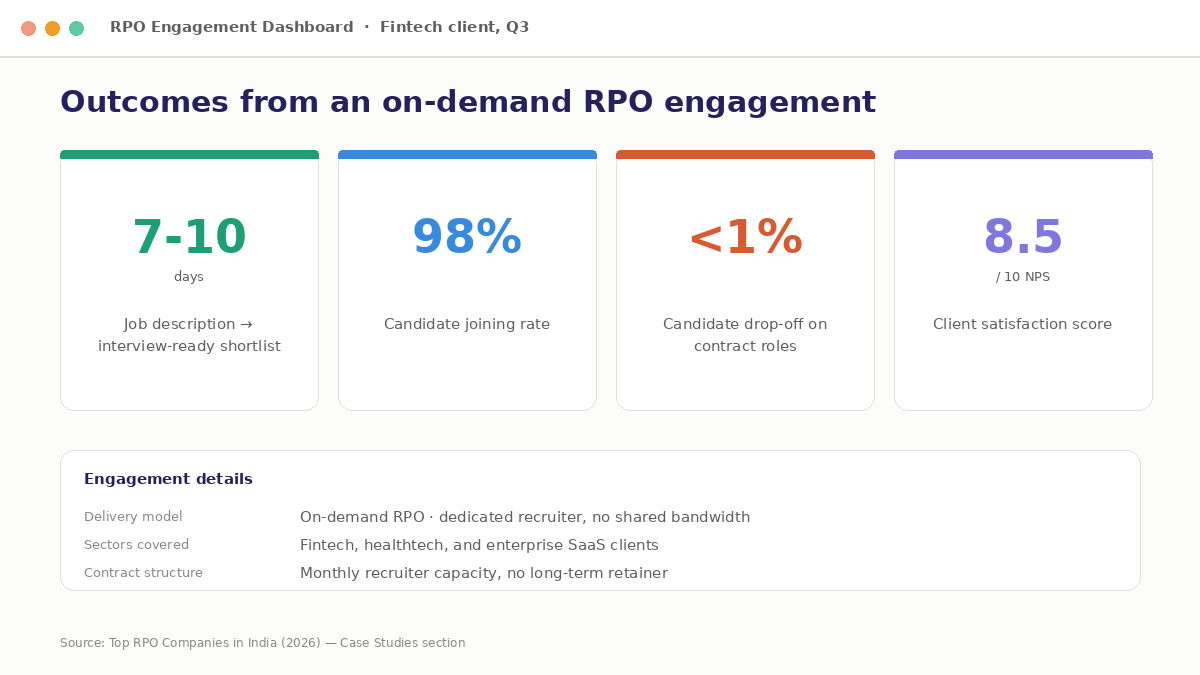
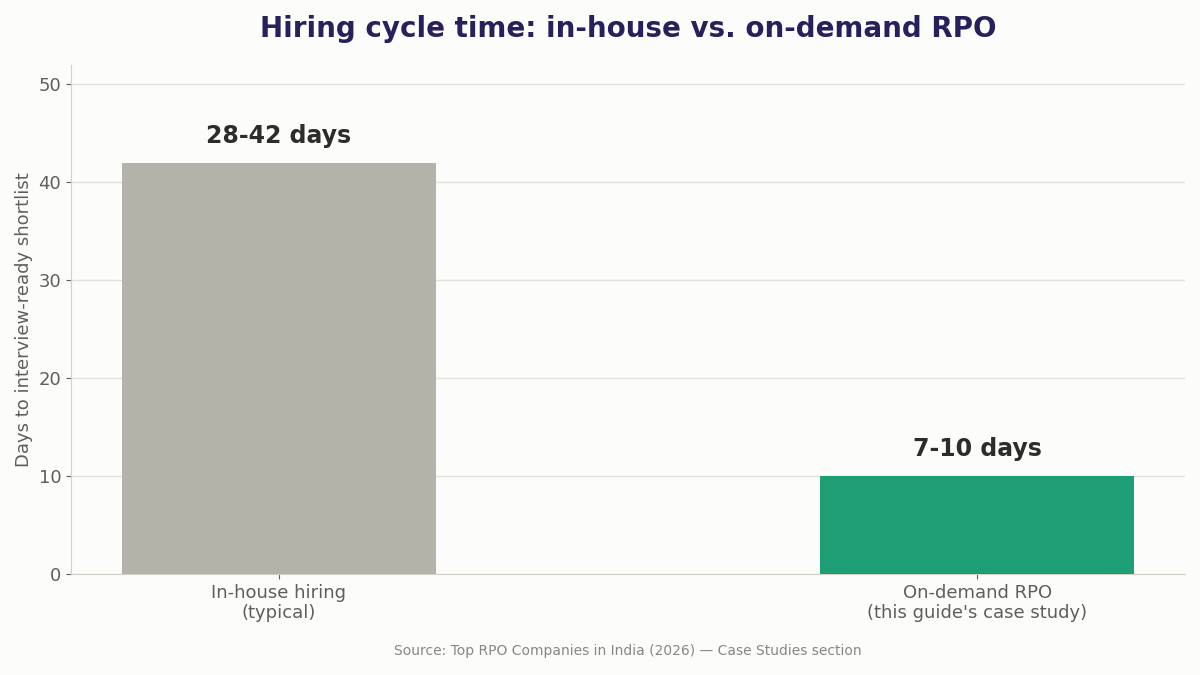
A fintech company scaling its engineering org moved from an in-house hiring cycle typically running 4-6 weeks to an on-demand RPO model that delivers interview-ready shortlists in roughly 7-10 working days. Across a multi-quarter engagement spanning fintech, healthtech, and enterprise SaaS clients including Razorpay, Chargebee, and Apollo Hospitals, this delivery model has held a 98% candidate joining rate with under 1% drop-off on contract roles.
A mid-market SaaS company evaluating enterprise RPO providers in India for a 40-person expansion found the opposite problem: three of the four vendors it shortlisted quoted full-cycle retainer pricing designed for 500+ hire volumes. Switching the RFP to a project-RPO scope cut the quoted cost by roughly half, without changing the sourcing quality on offer.
Top RPO Companies in India: The 2026 Comparison
Not every name on a “best of” list is chasing the same buyer. When founders and TA heads search for the top RPO companies in India, they’re usually mixing three very different categories into one list: global staffing conglomerates, pure-play RPO specialists, and boutique offshore providers.
Here’s how the field actually breaks down by size-fit, so you can skip straight to the row that matches your hiring stage.
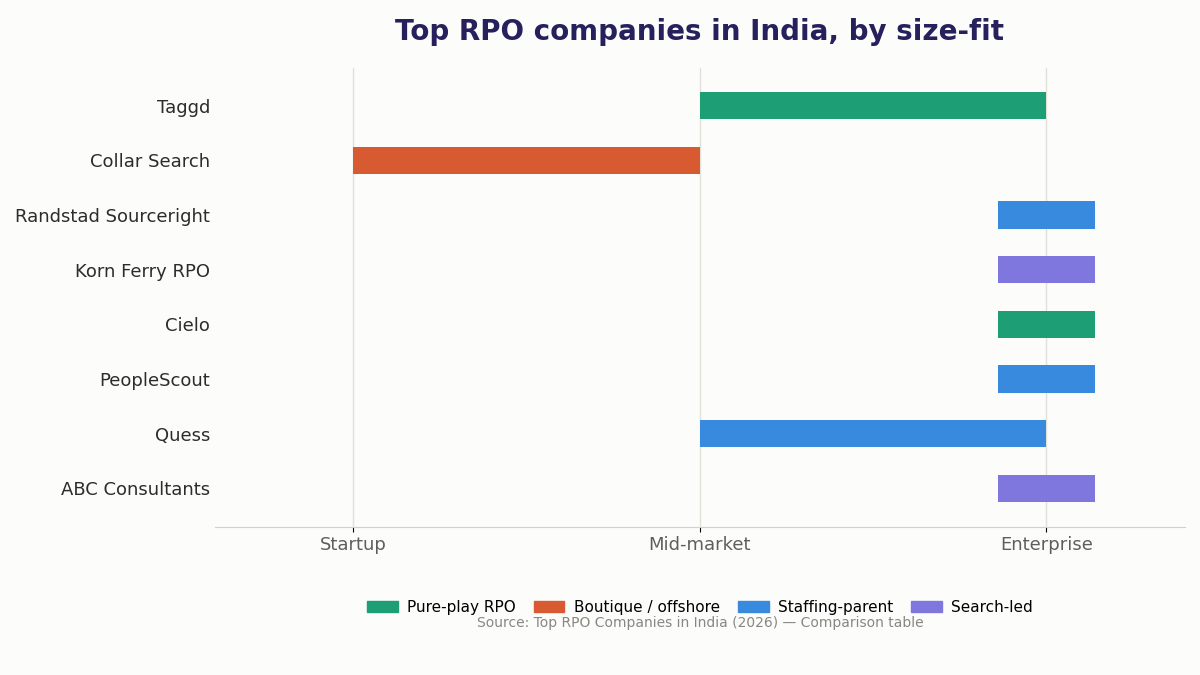
| Provider | Best Size-Fit | Delivery Model | Standout For |
| Tagged | Mid-market to enterprise | AI-native, dedicated pods | GCC and semiconductor hiring, PeopleStrong-backed talent platform |
| Collar Search | Startup to mid-market | Offshore, on-demand and partial-cycle | Lean IT staffing and contingent RPO for leaner budgets |
| Randstad Sourceright | Enterprise | Global MSP + RPO combined | Multi-country total talent management for MNCs |
| Korn Ferry RPO | Enterprise | Consultative, embedded in broader HR advisory | Executive-adjacent and specialized professional hiring |
| Cielo | Enterprise | Global full-cycle, employer branding-led | Large-scale employer brand and candidate experience programs |
| PeopleScout | Enterprise | High-volume, MSP-integrated | Retail, BFSI, and seasonal bulk-hiring surges |
| Quess | Mid-market to enterprise | General staffing plus RPO, NSE-listed scale | Blue-collar and high-volume workforce deployment |
| ABC Consultants | Enterprise | Retained and contingent search | Leadership and senior management search since 1969 |
Among best RPO companies in India, the pattern worth noting is that pure-play RPO specialists (Cielo, Taggd) tend to out-perform on employer branding and candidate experience, while staffing-parent firms (Quess, Randstad, PeopleScout) out-perform on raw volume and compliance infrastructure across states. Boutique and offshore providers (Collar Search) win on cost-efficiency for lean hiring plans.
Supersourcing sits in the AI-sourced, dedicated-account model built specifically for the startup-to-mid-market gap; this comparison keeps surfacing.
What Most Teams Get Wrong
The biggest red flag in an RPO pitch rarely shows up in the pricing sheet it shows up in the first call. A provider who won’t name a fully-loaded cost-per-hire, and instead redirects to “it depends on scope,” is usually structured around a shared-bandwidth pool that gets allocated after the contract is signed, not before.
The second pattern: teams treat recruitment outsourcing companies in India as interchangeable with staffing agencies. They aren’t. An IT staffing agency fills a role and moves on; an RPO provider owns the process, the employer-brand messaging, and usually the compliance trail, on an ongoing basis. Confusing the two leads buyers to negotiate the wrong contract terms for fixed placement fees instead of a delivery SLA.
The third, and most expensive, mistake: skipping the exit clause. Most RPO contracts run 12-24 months, and the transition-out terms data handoff, candidate pipeline ownership, notice period matter as much as the onboarding terms. Teams that only negotiate the start of the relationship routinely get stuck mid-contract with a provider that isn’t delivering, because the exit costs more than staying.
A fourth pattern shows up specifically when buyers compare the top RPO companies in India side by side: they weight brand recognition and years-in-market far above delivery-team continuity. A provider with two decades of history can still rotate your dedicated recruiter every quarter; ask how long the average account team stays assigned to a single client before treating tenure as a trust signal.
Where This Leaves Your Shortlist
None of the eight providers above is universally “best” ; that’s the whole point of a size-fit framework over a ranked list. An enterprise GCC running 2,000+ annual hires and a 60-person startup closing 12 roles a quarter are solving different problems, and the right partner looks different for each. Match your actual hiring volume and delivery-model needs first; let brand recognition break ties last, not decide the shortlist.
The three checks worth running before any contract gets signed: the fully-loaded cost-per-hire (not the headline fee), whether recruiters are dedicated or shared across accounts, and the exit terms for data and candidate-pipeline handoff. Skip any of those three, and the mismatch shows up three to six months in usually as a hiring cycle that quietly slips from 7-10 days back toward 4-6 weeks.
If you’re pressure-testing your own RPO shortlist before signing anything, Supersourcing has run this evaluation process across 527+ engagements spanning fintech, healthtech, e-commerce, and enterprise SaaS. Reach out at mayank@engineerbabu.com or start at supersourcing.com/contact-us worth doing before you sign a 12-month contract, not after.
FAQs
What is RPO in recruitment?
RPO, or Recruitment Process Outsourcing, is when a company hands over all or part of its hiring function sourcing, screening, coordination, sometimes onboarding to an external partner that operates under the client’s employer brand, typically billed on volume or outcomes rather than per placement.
How much does RPO cost in India?
Pricing varies by model: on-demand RPO typically runs on a monthly recruiter-capacity fee, project RPO is scoped per hiring surge, and full-cycle RPO combines a management fee with a per-hire cost. Always ask for the fully-loaded number, not just the headline rate, since add-ons for background checks and tooling often sit outside the quoted fee.
What’s the difference between RPO and a staffing agency?
A staffing agency is transactional; it fills a role and the relationship resets each time. An RPO provider embeds into your hiring process on an ongoing basis, often managing employer branding, reporting, and compliance alongside sourcing, under a longer-term contract structured around outcomes rather than individual placements.
Which is the best RPO company for startups in India?
Among the top RPO companies in India, startups generally do better with on-demand or project-scoped providers built for lean teams rather than enterprise-grade full-cycle vendors, since the latter’s pricing and process overhead are built for 200+ annual hire volumes. Collar Search and boutique, AI-sourced providers tend to fit this stage better than the global enterprise names.
How do you choose an RPO partner in India?
Start with your actual annual hiring volume and growth timeline, not the vendor’s brand recognition. Match that volume to a pricing model (on-demand, project, or full-cycle), then verify dedicated-versus-shared recruiter capacity and a 90-day time-to-shortlist track record with a reference client before signing anything.
How long does RPO onboarding typically take?
A lean, dedicated-account RPO setup can start delivering interview-ready shortlists within 7-10 working days of a signed scope, once role requirements and interview panels are confirmed. Enterprise-grade, multi-country RPO programs with governance layers and ATS integrations typically take 4-8 weeks to fully ramp before hitting steady-state hiring throughput across all locations.
Is RPO worth it for a small or early-stage company?
It depends on hiring volume and internal bandwidth, not headcount alone. A 50-person startup hiring 15-20 roles a year, without a dedicated internal recruiter, usually gets more value from a lean on-demand RPO engagement than from building an in-house function from scratch provided the pricing model matches that lower volume rather than an enterprise retainer.
