

India’s tech industry will close FY26 at $315 billion in revenue, growing 6.1%, while headcount grows just 2.3%, a net addition of roughly 135,000 people against a base of nearly 6 million.
Read those two numbers together and the 2026 pricing story falls out of them. Revenue is growing almost three times faster than headcount, so the incremental dollar is going to fewer, more expensive people. A single blended “India developer rate” is now useless as a budgeting input, and any IT staffing rate card india buyers rely on has to be read by role and experience band rather than as an average.
The market has split into two lanes. Commodity stacks, basic frontend, manual QA, L1 support are flat to declining in real terms, because supply is deep and AI tooling has compressed the low end of the work. Specialist lanes platform engineering, data, applied AI, security are repricing upward every two quarters, because 250,000-odd AI and ML professionals is a large pool globally but a thin one against current enterprise demand.
Salaries across India are projected to rise 9.1% in 2026, up from 8.9% in 2025, with attrition easing to 17.1% Aon’s Annual Salary Increase and Turnover Survey 2025-26 India, covering 1,400+ organisations across 45 industries.
That 9.1% matters more than it looks: it is the number a vendor quotes back at you in month ten, asking for a mid-contract revision. If your MSA has no escalation cap, you have already agreed to it.
Everything below is written from the buy side. Not what an engineer in Bengaluru earns what a line item in your 2026 headcount budget should say. That is the only lens this IT staffing rate card india applies.
TL;DR
This IT staffing rate card india is built for anyone budgeting contract engineering capacity in India in 2026 founders scoping a first offshore pod, finance leads modelling a three-year people cost, and procurement teams pressure-testing a vendor quote line by line.
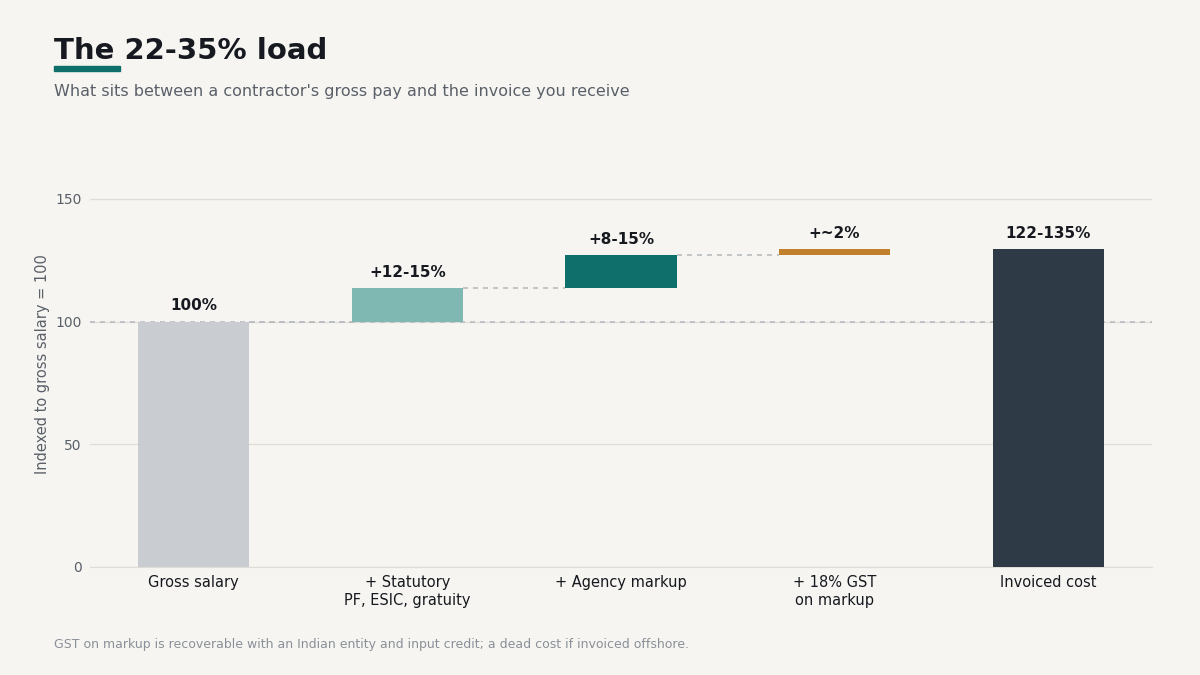
The single number worth remembering: the gap between a contractor's gross pay and what you are invoiced is typically 22% to 35%, once statutory employer cost, agency markup and 18% GST on the markup are stacked. Most budgets we see are built on the gross figure and break at the first invoice.
By the end you will be able to read any IT staffing rate card india a vendor sends you, price 11 roles across four experience bands, apply the right city-tier multiplier, and tell the difference between a domestic bill rate and an export bill rate for the same engineer which is where the widest india contract developer bill rates spreads hide.
What an IT staffing rate card India actually contains
An IT staffing rate card India is a schedule of billable rates for contract engineering roles, organised by skill, experience band and delivery city. It states what the buyer is invoiced per month or per hour inclusive of statutory employer cost and agency markup and is distinct from salary data, which describes what the engineer receives.
That distinction is the whole document. Salary benchmarks answer “what should we pay this person.” An IT staffing rate card india answers “what will we be charged for this seat.” The two numbers are separated by a load factor, and confusing them is the most common budgeting error in offshore scoping.
The 22-35% you didn’t budget: real contract engineer cost india
Most India headcount models start with a gross monthly salary pulled from a salary aggregator and add a round 15% for “overheads.” The actual stack has four layers, and it compounds.
Layer one statutory employer cost. Provident fund, ESIC, gratuity accrual, professional tax and LWF add roughly 12-15% above gross for most salary bands. Not 40%, as some Western-authored guides claim, but not trivial.
Layer two agency markup. For straightforward contract IT staffing on common stacks, markup on gross typically runs in the high single digits to mid-teens. Niche skills, short durations and single-seat contracts sit at the top of that band because the vendor carries sourcing cost with no volume to amortise it against.
Layer three GST. 18% applies to the markup component of a staffing invoice. Recoverable if you have an Indian entity and input credit. A dead cost if you are invoicing offshore and cannot claim it.
Layer four the unquoted items. Device and VPN provisioning, notice-period buyout when you need someone in three weeks instead of two months, background verification for regulated clients, bench cost during the ramp gap. Rarely more than 2-3% of a 12-month contract but these are the line items that turn a signed budget into a change request.
Stack all four and the contract engineer cost india buyers actually see on an invoice lands 22% to 35% above the gross figure the budget was built on. That load is also why an IT staffing rate card in India reads high against salary data and why it is the only number worth budgeting against. On a ten-person pod at ₹1.4L average gross, that is a variance of roughly ₹47L over a year.
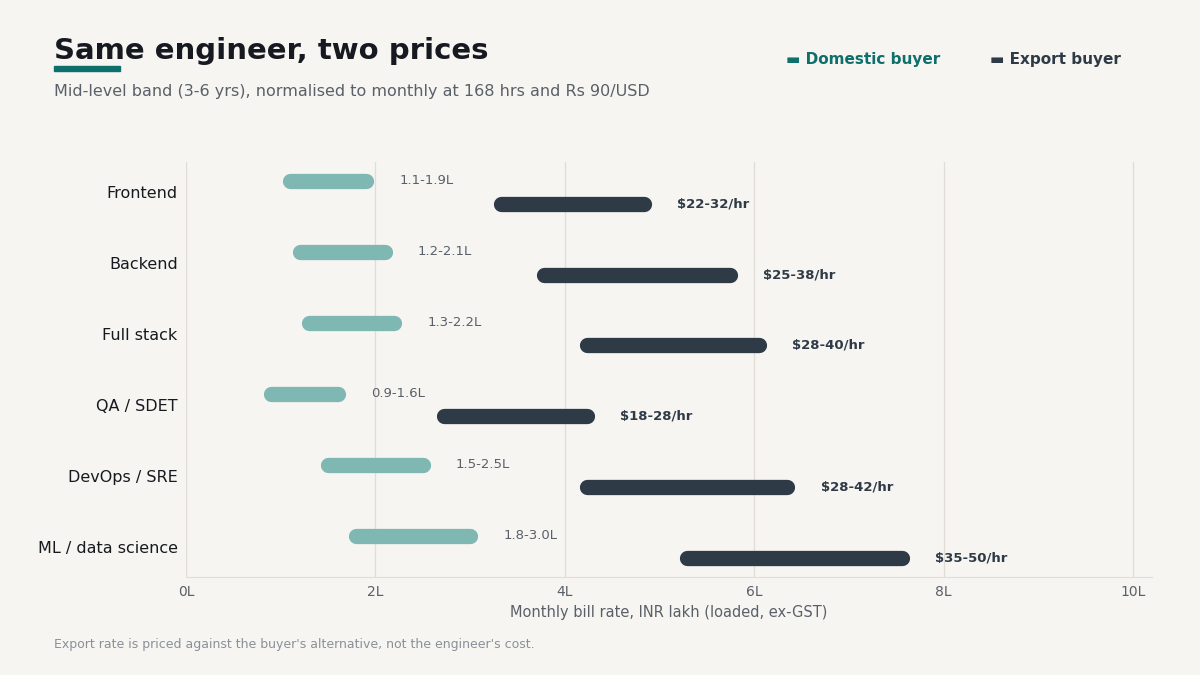
The 2026 rate card: india contract developer bill rates by role and band
The table below is the core of this IT staffing rate card india: 11 roles, four experience bands, both pricing lanes. Two conventions first, because they determine whether the numbers are usable.
Convention one: domestic and export rates are different prices for the same engineer. A mid-level backend engineer in Pune billed to an Indian enterprise buyer and the same engineer billed to a US buyer through an offshore staff augmentation contract do not carry the same rate. The export rate is typically 2-3x the domestic rate, because it is priced against the buyer’s alternative, a US contractor, at $90-150/hr, not against the engineer’s cost. Both numbers are in the table below.
Convention two: these are bands, not quotes. Each cell is a benchmark range compiled from live 2026 vendor quotes and published rate cards, the window inside which a defensible quote should fall. A quote outside the band isn’t automatically wrong, but it needs an explanation, and asking for one is the highest-leverage thing procurement does all quarter.
it staffing rates by role india, by experience band
IT staffing rate card india, 2026 bands. Format in each cell: domestic monthly bill rate (₹) · export bill rate ($/hr). Domestic figures are loaded and exclude GST. Export figures assume a full-time dedicated seat at ~168 billable hours per month, tier-1 delivery city.
| Role | 0-2 yrs | 3-6 yrs | 7-10 yrs | 10+ / lead |
| Frontend (React, Angular, Vue) | ₹0.55-0.90L · $14-20 | ₹1.10-1.90L · $22-32 | ₹2.00-3.10L · $32-45 | ₹3.00-4.50L · $45-60 |
| Backend (Java, Node, Python, .NET) | ₹0.60-0.95L · $15-22 | ₹1.20-2.10L · $25-38 | ₹2.20-3.40L · $38-52 | ₹3.40-5.00L · $50-70 |
| Full stack (MERN, MEAN) | ₹0.65-1.00L · $16-24 | ₹1.30-2.20L · $28-40 | ₹2.30-3.60L · $40-55 | ₹3.50-5.20L · $52-72 |
| Mobile (React Native, Flutter, iOS, Android) | ₹0.60-0.95L · $15-22 | ₹1.20-2.00L · $24-35 | ₹2.10-3.30L · $35-50 | ₹3.20-4.80L · $48-65 |
| QA / SDET automation | ₹0.45-0.75L · $12-18 | ₹0.90-1.60L · $18-28 | ₹1.70-2.60L · $28-40 | ₹2.60-3.80L · $38-52 |
| DevOps / SRE / cloud | ₹0.70-1.10L · $18-26 | ₹1.50-2.50L · $28-42 | ₹2.60-4.00L · $42-60 | ₹4.00-6.50L · $55-85 |
| Data engineering | ₹0.70-1.10L · $18-26 | ₹1.40-2.40L · $28-40 | ₹2.50-3.80L · $40-58 | ₹3.80-5.80L · $55-80 |
| ML engineering / data science | ₹0.85-1.30L · $22-32 | ₹1.80-3.00L · $35-50 | ₹3.00-4.80L · $50-75 | ₹4.80-7.00L · $70-95 |
| Applied GenAI / LLM engineering | ₹2.20-3.60L · $40-60 | ₹3.60-6.00L · $60-95 | ₹6.00-9.00L · $85-130 | |
| Security / AppSec | ₹0.70-1.10L · $18-26 | ₹1.60-2.60L · $30-45 | ₹2.80-4.20L · $45-65 | ₹4.20-6.00L · $60-85 |
| Enterprise platforms (Salesforce, SAP, ServiceNow) | ₹0.75-1.20L · $20-28 | ₹1.60-2.80L · $30-45 | ₹2.80-4.50L · $45-70 | ₹4.50-6.80L · $65-90 |
Three patterns in this year’s IT staffing rate card india are worth naming. The 0-2 year row compressing AI-assisted development has absorbed a meaningful share of the work that used to justify a junior seat, and buyers are converting those seats into mid-level ones rather than paying less for juniors.
The GenAI row has no junior band at all, because nobody is credibly selling a fresher as an LLM engineer in 2026. And the spread inside the 3-6 year band is the widest on the card: a 70-90% gap between floor and ceiling, driven almost entirely by whether the engineer has shipped production systems or only worked inside someone else’s framework.
Offshore contractor rates india: city tier multipliers
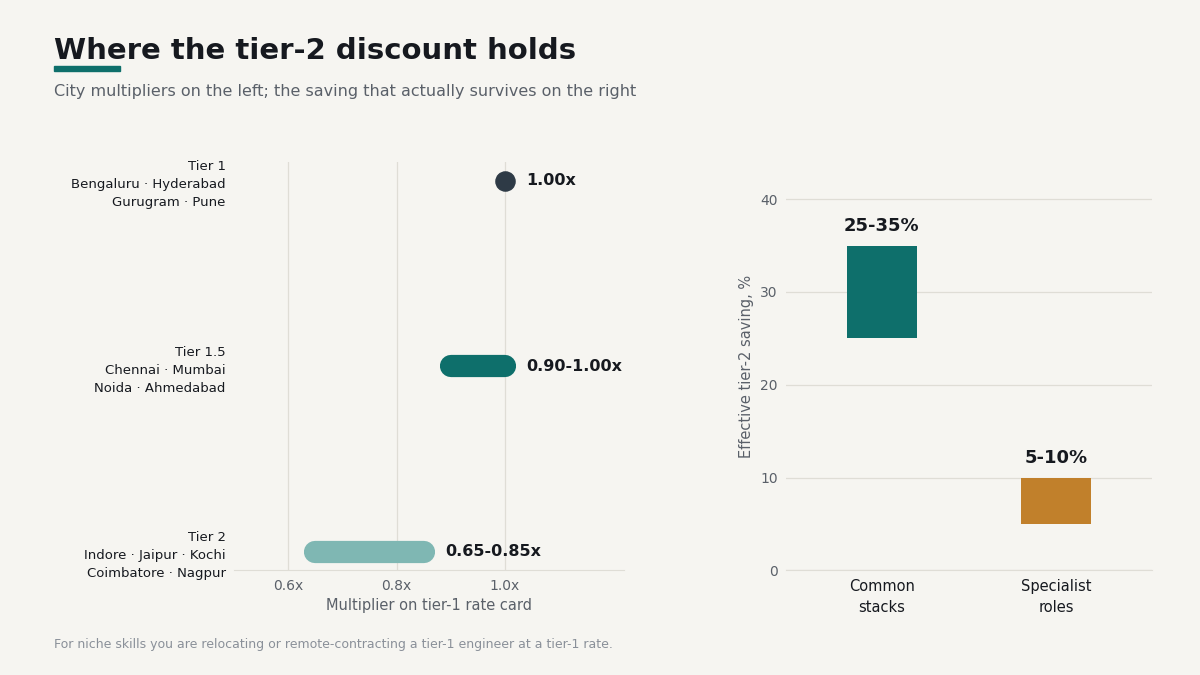
Every figure in the IT staffing rate card india table above assumes tier-1 delivery. Apply these multipliers to move it.
| Tier | Cities | Multiplier | Notes |
| Tier 1 | Bengaluru, Hyderabad, Gurugram, Pune | 1.00x | Baseline. Deepest supply, highest counter-offer risk |
| Tier 1.5 | Chennai, Mumbai, Noida, Ahmedabad | 0.90-1.00x | Mumbai runs at or above baseline for BFSI and fintech stacks |
| Tier 2 | Indore, Jaipur, Coimbatore, Kochi, Bhubaneswar, Nagpur | 0.65-0.85x | Discount holds for common stacks only |
The tier-2 discount is real and it is also frequently oversold. It holds for common stacks where local supply genuinely exists. It collapses for niche skills, because you are not hiring a tier-2 engineer, you are relocating or remote-contracting a tier-1 engineer and paying a tier-1 rate with extra coordination overhead. In engagements we’ve run, the effective tier-2 saving on specialist roles is closer to 5-10% than the 25-35% a city-tier table implies.
Tier-2 also cuts both ways on attrition: fewer competing employers means lower voluntary exits on common stacks, but a thinner local market means replacements take longer to source so the replacement SLA matters more, not less.
How to build an india bill rate benchmark in five steps
A defensible india bill rate benchmark takes about a week to assemble, saves a percentage point or two on every contract for the next two years, and is the only way to use an IT staffing rate card india without over-trusting it.
- Fix the unit first. Decide whether you are benchmarking monthly loaded cost or hourly bill rate, and lock the billable-hours assumption (160 vs 168 vs 184 hours changes the hourly figure by up to 15% on identical monthly spend).
- Pull three quotes per role, not one. Request line-item quotes that separate gross, statutory, markup and GST. A vendor who will only quote a single blended number is telling you something about the margin inside it.
- Normalise for city and duration. Convert every quote to the tier-1 baseline using the multipliers above, and to a common contract length a 12-month commitment typically prices 10-15% below a 3-month one.
- Score the band, not the number. Place each quote against the role’s floor and ceiling. Anything in the bottom quartile warrants a question about who is actually being placed; anything in the top quartile warrants a question about what protection you are buying.
- Write the escalation clause before you sign. Cap mid-contract revisions at a stated percentage tied to a published index. With market salaries projected at +9.1% for 2026, an uncapped clause is an open-ended liability.
What this looks like in live engagements
Enterprise SaaS, 9 contract seats, two cities. The client’s internal budget used gross salary plus 15% rather than a loaded IT staffing rate card india band; rebuilding it at 22-35% load moved the annual figure by roughly ₹40L before a single interview happened. Shortlists landed inside the standard 7-10 working day window and joining held at the 98% rate we track across contract placements which matters, because a 90% joining rate on nine seats means one re-run of the entire cycle.
Fintech platform, specialist data and cloud roles. Across the fintech segment of our client roster which includes Razorpay, Paytm and Chargebee the recurring pattern is that the first quote for senior cloud and data roles comes in below the benchmark band, and the resume presented does not match the resume that starts. Insisting on named-candidate placement with a written replacement SLA moved the quote up by a mid-single-digit percentage and removed the more expensive failure mode entirely. Contract drop-off across these roles has stayed under 1%.
Contract staffing, managed pod, or GCC payroll: a decision framework
An IT staffing rate card in India only tells you the price of a seat. Which vehicle you buy the seat through changes your total cost more than a few dollars an hour ever will.
| Model | Effective cost per seat | Best for | Main risk |
| Contract IT staffing | Rate card baseline | 3-12 month capacity gaps, burst demand, roles you can supervise directly | You carry the management overhead; quality varies by vendor bench |
| Managed pod / dedicated team | 10-20% above baseline | Scopes you can define but don’t want to run day to day | Accountability blurs if you don’t own the backlog |
| Employer of record | 5-15% above baseline | One or two hires, no Indian entity, need speed | Not economic past roughly 15-20 seats |
| GCC on own payroll | 20-35% below baseline at steady state | 50+ seats, multi-year horizon, IP-critical roadmap | 9-18 months and real capital before the arbitrage appears |
The crossover is usually between 20 and 40 seats. Below that, staffing or EOR wins on speed and flexibility. Above it, running a global capability center on your own payroll is materially cheaper per seat but only once you’ve absorbed the setup cost, and only if you can staff an India leadership layer that doesn’t need daily direction from headquarters.
What most teams get wrong
The most expensive mistake is not overpaying on the rate. It is benchmarking an IT staffing rate card india against salary data and concluding the vendor is taking 200% margin. The bill rate includes statutory cost, sourcing, replacement risk, compliance and GST. Dedicated teams that argue the rate down to near-salary levels get exactly what they paid for: a bench candidate, no replacement guarantee, and a re-run of the search in month four.
Three more patterns from engagements we’ve run:
Negotiating the rate instead of the terms. A 6% rate reduction is worth far less than a 10-day replacement SLA, named-candidate placement, and an escalation cap. Rate is the number procurement is measured on; terms are the number that determines whether the project ships.
Treating notice period as a scheduling detail. Standard notice in India is 30 days for junior and mid roles and up to 60 for seniors. If your project starts in three weeks, someone is buying that notice out, and it will appear either as a one-time charge or as a candidate who accepts and then doesn’t join. Ask which before you sign.
Assuming AI-driven productivity should lower the rate. It lowers the number of seats, not the price of the remaining ones. Revenue growing at 6.1% against 2.3% headcount growth is exactly what that looks like at industry scale and it is why specialist bands on this card moved up, not down, this year.
Before you sign the quote
If you’re building a 2026 India headcount budget or holding three vendor quotes that don’t reconcile, the useful next step is to pressure-test them against live placement data rather than a published IT staffing rate card india average.
Supersourcing has run this benchmarking exercise across enterprise and high-growth engagements for a decade, including contract IT staffing for specialist roles where the band is widest, hire DevOps engineers and hire Generative AI developers are the two where quotes vary most from vendor to vendor.
Send the roles, seniority, city and duration to mayank@engineerbabu.com, or start here. You’ll get an itemised, line-by-line view you can benchmark against any other vendor with no obligation to buy a seat.
FAQ
How much does a contract developer cost per month in India in 2026?
For a domestic contract, a mid-level engineer with 3-6 years of experience typically pays ₹1.1L to ₹2.2L per month, depending on stack and city. The same engineer placed on an offshore contract to a US or UK buyer bills roughly $25-40 per hour. Both figures exclude GST and assume a full-time dedicated seat.
What markup do IT staffing agencies charge in India?
Markup on gross salary generally runs from the high single digits to the mid-teens for common stacks, with 18% GST applied on the markup. Niche skills, single-seat contracts and durations under three months sit at the upper end. Any IT staffing rate card in India worth using shows markup as a separate line; a vendor who won’t break it out is worth a second conversation.
Why is the bill rate higher than the salary?
The bill rate carries costs the salary doesn’t: provident fund, ESIC and gratuity, background verification, sourcing and replacement risk, compliance under CLRA, and GST. Any IT staffing rate card india procurement teams benchmark against salary aggregator data will look inflated for this reason the two numbers measure different things.
Do tier-2 cities actually reduce contract engineer cost?
For common stacks, yes expect 15-35% below tier-1 rates in cities like Indore, Coimbatore or Jaipur. For specialist roles in data, cloud, security or applied AI, the saving typically narrows to 5-10%, because supply for those skills is still concentrated in tier-1 metros regardless of where the contract is signed. Apply the multiplier to the IT staffing rate card india band rather than assuming a flat discount.
Is contract staffing cheaper than in-house hiring in India?
Over a 3-12 month horizon, usually yes, once you account for recruitment cost, benefits, notice obligations and the cost of a seat sitting empty. Past roughly 20-40 seats on a multi-year roadmap, own-payroll or GCC models become cheaper per seat. The crossover depends more on your horizon than your headcount.
How fast can a contract engineer start in India?
For bench-ready common stacks in tier-1 cities, 5-10 working days to an interview-ready shortlist is a realistic standard; niche skills or tier-2 locations run 3-6 weeks. The variable that usually breaks the timeline is notice-period buyout, not sourcing to clarify who funds it before the offer goes out.
How do I sanity-check a quote I’ve already received?
Convert it to the tier-1 monthly baseline using the multipliers above, place it against the role’s band in the IT staffing rate card india above, and ask the vendor to itemise gross, statutory, markup and GST. If the quote sits below the band floor, ask who is being placed and what the replacement terms are. Below-band pricing is usually a bench placement or a bait-and-switch, not a discount.
