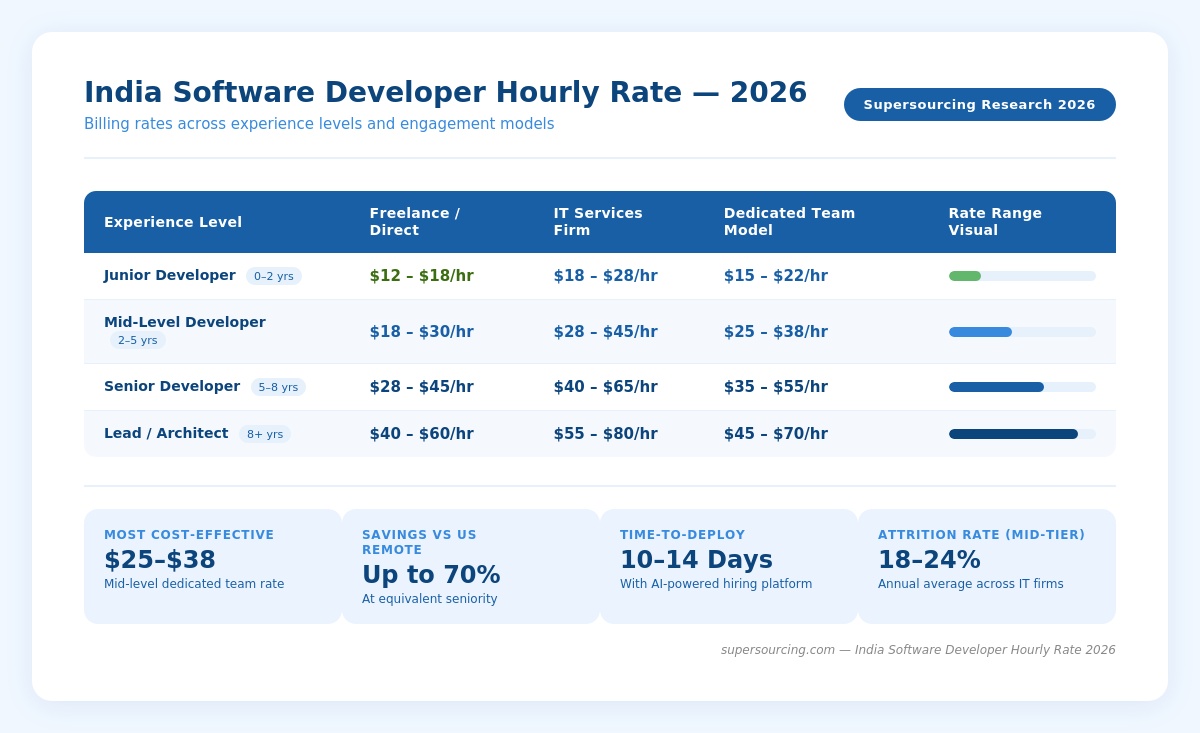
Why Most Rate Cards Lie
Most enterprise buyers reviewing offshore pricing assume the quoted rate is the final cost. It isn’t. What looks like a simple hourly rate often hides multiple layers—employer costs, vendor margins, FX exposure, and contractual escalations that significantly change the real spend over time.
Indian IT Staff Augmentation Rates are frequently misunderstood because rate cards rarely reflect the true total cost of hiring and retaining talent through vendors. The gap between perceived cost and actual spend comes from how pricing is structured, not just what is quoted upfront.
The market itself is expanding rapidly: according to Statista IT Outsourcing Market Forecast, global IT outsourcing is projected to exceed $580 billion by 2027, with India remaining the largest delivery hub—driving continued demand and pricing complexity in staff augmentation models.
This guide breaks down every layer behind Indian IT staff augmentation pricing—so you understand what you’re actually paying, where costs increase over time, and how to benchmark rates accurately against real market data.
TL;DR Rates at a Glance
| Role | India Rate | US Equivalent | Annual Saving Per FTE |
| Salesforce Tech Architect (CTA-track) | $75–115/hr | $175–250/hr | $187K–$280K |
| SAP S/4HANA FICO Lead | $70–105/hr | $160–230/hr | $182K–$260K |
| ServiceNow CTA | $80–120/hr | $180–260/hr | $187K–$291K |
| Workday Integration Lead | $65–95/hr | $150–210/hr | $176K–$239K |
| Databricks Lead Data Engineer | $58–88/hr | $145–200/hr | $181K–$234K |
| GenAI / LLM Architect | $85–135/hr | $200–300/hr | $239K–$343K |
| Cloud Solutions Architect AWS/Azure Pro | $65–95/hr | $150–210/hr | $176K–$239K |
| Kubernetes / Platform Engineer, Senior | $55–82/hr | $130–185/hr | $156K–$215K |
| IAM Architect SailPoint/CyberArk | $70–105/hr | $155–220/hr | $176K–$239K |
| Guidewire Lead Developer | $72–105/hr | $160–230/hr | $182K–$260K |
| Murex / Calypso Senior Consultant | $90–135/hr | $200–290/hr | $228K–$322K |
At a 20-engineer team on enterprise stacks, the blended annual saving versus equivalent US hiring runs $3.5M–$5.2M. That's not a rounding error. That's a product line.
These are 2026 Supersourcing pipeline medians across 1,200+ active placements. Section 4 breaks each role down by seniority level, experience signals, and how to verify what's claimed.
How the Cost Stack Works
Four layers sit between an engineer’s salary and your invoice. Most buyers only see the last one.
Engineer Gross CTC (₹)
↓
+ Statutory Employer Burden (18–22%)
↓
+ Vendor Operating Overhead (12–18%)
↓
+ Vendor Margin (18–24%)
↓
= Your Billing Rate ($/hr)
India vs. US the structural reason the saving is real:
In the US, a fully-loaded W-2 employee at $180/hr carries: base salary, payroll taxes (FICA 7.65%), benefits (health, 401K, PTO), recruiter cost, overhead, and firm margin. The structure is identical to India. The salary anchor is 2.5–3x higher. That’s the entire gap.
A Salesforce CTA-track architect in Bangalore with 10 years of experience earns ₹65L (~$67,400). The same profile in Chicago earns $185,000–$220,000 base. Same certification. Same system design depth. Different markets.
The saving is structural, not a signal of lower quality. Section 7 covers this directly.
Rates by Platform: India vs. US, Savings, and How to Verify Experience
Each platform section has three things: the rate table, what the experience claim on a CV actually means, and the specific questions and checks that separate real experience from resume inflation.
Salesforce
India has 196,000+ Salesforce-certified professionals. CTA-track architects, the ones enterprise programs actually need, number under 2,800 actively available. That scarcity sits in the rate. But even at the top of the range, the savings versus a US hire is material.
| Level | Experience | India Rate | US Equivalent | Annual Saving |
| Junior Developer | 2–4 yr | $22–35/hr | $65–90/hr | $89K–$114K |
| Mid Developer | 4–7 yr | $35–58/hr | $95–130/hr | $125K–$150K |
| Senior Developer | 7–10 yr | $58–80/hr | $140–180/hr | $170K–$208K |
| Tech Lead / Architect | 8–12 yr | $75–115/hr | $175–250/hr | $187K–$280K |
| CTA / Principal Architect | 12+ yr | $115–160/hr | $250–350/hr | $280K–$395K |
What “8 years Salesforce” on a CV actually means:
Eight years on Salesforce can mean anything from eight years of actual multi-cloud architecture to eight years of declarative configuration with no code ownership. The years tell you nothing by themselves. Here’s what does:
Verify this before you interview:
- Go to trailhead.salesforce.com/credentials/verification. Enter the candidate’s name. Check for System Architect and Application Architect credentials; these are the prerequisites for CTA-track. A claimed CTA-track architect with neither is not CTA-track.
- Check the credential dates. Salesforce introduced major Data Cloud and Agentforce certifications in 2023–2024. An architect who hasn’t updated their credential stack since 2021 has a knowledge gap on current platform direction.
Ask this in the interview:
- “Walk me through every full-cycle Salesforce implementation you’ve led, client vertical, org complexity, your specific role, and go-live year.” Real CTA-track architects answer in under 60 seconds with three or four specific engagements. Candidates with inflated CVs generalize immediately.
- “How does Salesforce Data Cloud’s identity resolution model handle conflicting email addresses across channels?” Candidates who’ve implemented Data Cloud answer with specific merge rule logic. Candidates who’ve read about it answer with marketing language.
- “What’s your governor limit strategy for a high-volume B2C org processing 500K records daily?” A real architect describes their async processing approach, batch Apex design, and platform event architecture. A resume-inflated candidate says “I follow Salesforce best practices.”
Red flags on the CV:
- “Led implementation” on a project lasting under 8 months no Salesforce implementation of meaningful complexity goes live in under 8 months
- Multiple certifications with no Superbadge completions Superbadges require hands-on work, not exam prep
- “Salesforce CPQ experience” without a CPQ Specialist credential CPQ is a separate certification; many candidates list CPQ experience from sitting in meetings, not building it
From the deal floor: A NYSE-listed healthcare technology company replaced two US-based Salesforce architects ($195/hr blended) with two India-based CTA-track architects ($105/hr blended). Year-1 saving: $374K. Delivery velocity in sprints 3–12: identical. The India architects were stronger on data architecture, a function of the volume and multi-org complexity of projects India teams typically handle at scale.
Red flag: Any vendor quoting a Salesforce “Architect” under $55/hr is misrepresenting seniority or paying below-market CTC. Below-market CTC means that engineer is being recruited by your competitors right now.
SAP S/4HANA
SAP talent concentrates in Pune and Bangalore. FICO and SD leads are the deepest pool. Basis and ABAP OO at senior level are genuinely scarce except 25–40 day sourcing timelines for leads.
| Level | Experience | India Rate | US Equivalent | Annual Saving |
| Consultant | 3–6 yr | $28–45/hr | $85–115/hr | $119K–$145K |
| Senior Consultant | 6–9 yr | $45–68/hr | $120–160/hr | $156K–$191K |
| Lead Consultant | 9–12 yr | $70–105/hr | $160–230/hr | $182K–$260K |
| Solution Architect | 12–16 yr | $105–145/hr | $220–300/hr | $239K–$322K |
| Program / Engagement Manager | 14+ yr | $120–165/hr | $250–350/hr | $270K–$385K |
What “SAP S/4HANA Lead” on a CV actually means:
The most common misrepresentation in India SAP hiring: ECC 6.0 experience presented as S/4HANA experience. The platforms share terminology but have fundamental architectural differences Universal Journal, simplified data model, embedded analytics. A consultant who’s spent 10 years on ECC and done a 3-month S/4HANA training is not an S/4HANA Lead.
Verify this before you interview:
- Go to certifications.sap.com. Enter the candidate’s name and certificate ID. Look specifically for C_S4FI_2023 (SAP S/4HANA Finance) or C_TS4FI_2023 not the older C_TFIN52 which is ECC-based. The version number in the cert code tells you which platform they’re certified on.
- Check LinkedIn for the specific company names where they claim S/4HANA experience. Then check those companies on Google. Did those companies actually run S/4HANA projects? Several large Indian IT services firms ran S/4HANA “projects” that were actually Activate methodology training programs, not live implementations.
Ask this in the interview:
- “What’s the difference between how document splitting works in ECC 6.0 versus S/4HANA Universal Journal?” A real FICO lead answers without hesitation they describe the shift from the old document structure to ACDOCA and what that means for balance sheet reporting. An ECC consultant who read the S/4HANA documentation says something vague about “simplified accounting.”
- “Walk me through your approach to SAP Readiness Check and the Simplification Item Catalog for a brownfield migration.” Real S/4HANA leads have run Readiness Check and can name specific simplification items that impacted their prior migration. Candidates who’ve never done a brownfield describe it theoretically.
- “How did you approach the RFC-to-API migration on your last integration project?” An experienced lead describes the specific middleware whether they used BTP Integration Suite, PI/PO, or third-party iPaaS and why. A candidate without real integration experience says “we followed SAP’s recommended approach.”
Red flags on the CV:
- “S/4HANA experience” with an ECC-version SAP certification code
- Go-live dates that coincide with when the company claims to have “started” the project no SAP go-live happens in the first 6 months
- “RISE with SAP experience” on a project that started before 2021 RISE wasn’t available before then
Supersourcing Index: Across 340 SAP engagements in the Supersourcing GCC Benchmark 2026, Indian SAP S/4HANA leads delivered brownfield migrations averaging 4% under budget and 6 days ahead of planned go-live. The primary predictor of on-time delivery was version-specific S/4HANA experience not years of SAP experience overall.
Red flag: Any vendor quoting an “SAP S/4HANA Lead” without being able to produce a version-specific SAP certification within 24 hours is presenting an ECC consultant at S/4HANA rates.
ServiceNow
ServiceNow CTAs are among the scarcest enterprise architects in India under 400 active practitioners nationwide. That scarcity is real and sits in the rate.
| Level | Experience | India Rate | US Equivalent | Annual Saving |
| Developer | 2–5 yr | $26–42/hr | $75–105/hr | $101K–$131K |
| Senior Developer | 5–8 yr | $42–65/hr | $110–150/hr | $141K–$176K |
| Technical Architect | 7–10 yr | $65–100/hr | $155–210/hr | $187K–$228K |
| CTA | 10–14 yr | $95–130/hr | $200–275/hr | $218K–$301K |
| Platform Architect / Principal | 14+ yr | $125–165/hr | $260–350/hr | $280K–$385K |
What “ServiceNow Architect” on a CV actually means:
ServiceNow has a formal certification hierarchy: Certified System Administrator → Certified Application Developer → Certified Implementation Specialist (module-specific) → Certified Technical Architect. Many candidates describe themselves as “architects” after achieving CIS certifications. CIS is a module-level credential, not an architecture credential. The CTA exam is a separate, significantly harder qualification.
Verify this before you interview:
- Go to nowlearning.servicenow.com. Search the candidate’s credential ID. The CTA credential appears separately from CIS credentials. Under 400 active CTAs in India means if a vendor claims they have five CTAs on the bench, ask for all five credential IDs. Verify all five. Expect at least two to be CIS-level, not CTA.
- Check the version of ServiceNow the candidate claims experience on. ServiceNow releases twice a year Tokyo, Utah, Vancouver, Washington, Xanadu. A candidate whose last project was in Paris (released 2020) has missed four years of platform evolution including significant Flow Designer, ITOM Visibility, and AI Search changes.
Ask this in the interview:
- “Describe your MID Server topology design for a 30,000-device ITOM Visibility environment.” Real ITOM architects describe horizontal vs. vertical scaling decisions, cluster configuration, and specific probe/sensor considerations for the device types in scope. Candidates who’ve watched demos describe MID Servers generically.
- “When do you choose Flow Designer over Workflow Editor, and what are the upgrade safety implications of each?” The correct answer references ServiceNow’s “upgrade safe” guidance, the fact that Workflow Editor is legacy and being deprecated, and the specific scenarios where Flow Designer’s limitations require workarounds. A surface-level answer says “Flow Designer is the newer, better option.”
- “How do you handle the Now Platform’s lifecycle event framework for onboarding across multiple countries with different legal requirements?” A real HRSD architect describes the specific lifecycle event triggers, the document acknowledgment framework, and how they’ve handled multi-jurisdiction compliance. A demo-environment candidate describes the standard onboarding flow without mentioning compliance complexity.
Red flags on the CV:
- “CTA” listed without a verifiable credential ID
- “ITOM experience” on a project that was purely ITSM ITOM and ITSM are different modules requiring different architecture knowledge
- ServiceNow experience that stops at ITSM on a platform with 26 product lines, a claimed “platform architect” who has only done ITSM is a module specialist
From the deal floor: A US-based financial services company was presented with a “ServiceNow CTA” at $110/hr. The credential verification at nowlearning.servicenow.com returned a CIS-ITSM credential not a CTA. The vendor had misrepresented the candidate’s qualification level. The actual CTA they needed took 22 days to source and came in at $125/hr. The 22-day wait was worth it. A $15/hr gap over 2,000 hours is $30,000. A misqualified architect on an enterprise ITSM program is $3M in rework.
Workday
Workday HCM and Financials lead clusters in Hyderabad and Bangalore. Workday Extend and Studio specialists are genuinely thin, expect to pay the top of range and allow 30–45 day sourcing timelines.
| Level | Experience | India Rate | US Equivalent | Annual Saving |
| Consultant | 3–6 yr | $26–42/hr | $80–110/hr | $112K–$141K |
| Senior Consultant | 6–9 yr | $42–65/hr | $115–155/hr | $151K–$187K |
| Integration Lead | 7–10 yr | $65–95/hr | $150–210/hr | $176K–$239K |
| Solution Architect | 10–14 yr | $95–130/hr | $200–270/hr | $218K–$291K |
| Principal / Engagement Lead | 14+ yr | $125–160/hr | $250–330/hr | $260K–$353K |
What “Workday HCM experience” on a CV actually means:
Workday experience ranges from sitting in client workshops as a note-taker to owning the full business process design and configuration. The platform has a formal certification program but Workday doesn’t publish a public verification registry credentials are verified through the Workday Pro certification partner network or directly through Workday. This creates more CV inflation risk than other platforms.
Verify this before you interview:
- Ask the candidate for their Workday Pro certification documentation and the name of the Workday implementation partner they were certified through. Cross-check the partner name against Workday’s official partner directory at workday.com/en-us/partners. If the partner isn’t in the directory, the certification pathway was non-standard.
- Check the specific modules claimed. Workday HCM, Financials, Payroll, Extend, and Studio are different skill sets. A candidate with HCM experience presenting as a “Workday architect” without Financials or integration experience is a specialist, not an architect.
Ask this in the interview:
- “Walk me through your approach to designing a Workday integration for a real-time payroll sync to a third-party payroll provider.” A real integration lead describes the Workday Studio vs. EIB vs. Core Connector decision, the specific XSLT transformation logic, and how they handle error handling and reprocessing. A candidate without real integration experience describes the integration at a functional level without the technical layer.
- “How does Workday’s tenant model affect your approach to testing what’s your strategy for sandboxes, implementation tenants, and production?” A real consultant knows the Workday tenant hierarchy and the specific limitations of sandbox vs. implementation tenant testing. A demo-environment candidate describes testing generically.
- “What changed between Workday’s 2022R1 and 2024R2 releases that affected your HCM configuration approach?” Any active Workday practitioner tracks release updates Workday releases twice a year and changes affect active configurations. A candidate who can’t name a specific 2023 or 2024 change hasn’t been working on Workday actively.
Red flags on the CV:
- “Workday implementation” with no named implementation partner Workday implementations must go through certified partners; a company that implemented Workday without a named partner either used a subcontractor or the candidate wasn’t on the implementation
- “Workday Extend experience” without being able to describe Workday’s programming framework Extend is a custom application development platform that requires specific technical skills separate from functional HCM
- Multiple Workday “projects” all at the same company Workday is typically implemented once per company; multiple “projects” at one client usually means ongoing support, not new implementations
Databricks
Databricks talent concentrates in Bangalore. The platform’s rapid growth since 2021 means the market has both genuinely expert practitioners and a large population of candidates who completed Databricks courses and added it to their CV.
| Level | Experience | India Rate | US Equivalent | Annual Saving |
| Data Engineer | 2–4 yr | $28–45/hr | $90–120/hr | $129K–$156K |
| Senior Data Engineer | 4–7 yr | $45–68/hr | $120–165/hr | $156K–$202K |
| Lead Data Engineer | 6–10 yr | $58–88/hr | $145–200/hr | $181K–$234K |
| Data Architect | 8–12 yr | $82–118/hr | $175–240/hr | $192K–$254K |
| Principal / Platform Architect | 12+ yr | $110–145/hr | $220–300/hr | $228K–$322K |
What “Databricks certified” on a CV actually means:
Databricks has two primary certifications: Databricks Certified Associate Developer and Databricks Certified Professional. The Associate is entry-level; it tests basic PySpark and notebook usage. The Professional tests advanced optimization, streaming, and architecture. Many candidates list “Databricks certified” without specifying which level. Most hold Associate.
Verify this before you interview:
- Go to credentials.databricks.com. Enter the candidate’s name or badge URL. Check whether the credential is Associate or Professional. For a Lead Data Engineer role, Associate-level certification is insufficient. Also check Unity Catalog certification Databricks introduced Unity Catalog in 2022 and it’s now the governance standard; candidates without Unity Catalog experience have a gap on any post-2022 architecture.
- Check LinkedIn for the specific projects listed. Databricks project claims are frequently inflated by candidates who worked on adjacent ETL pipelines that touched Databricks notebooks without owning the architecture.
Ask this in the interview:
- “Walk me through your medallion architecture design for a streaming ingestion use case Bronze, Silver, Gold layer schema decisions, schema evolution approach, and how you handle late-arriving data.” A real Lead Data Engineer answers this with specific decisions: whether they used Delta Live Tables or manual Delta tables, how they handled schema evolution using Delta’s schema evolution mode vs. explicit schema enforcement, and their approach to watermarking for late data. A course-completion candidate describes the medallion architecture conceptually without making any real decisions.
- “How does Unity Catalog’s metastore architecture change your approach to data governance compared to Hive metastore?” The correct answer describes the three-level namespace (catalog/schema/table), the difference in permission inheritance, and why Unity Catalog’s centralized governance model matters for multi-workspace environments. A candidate who says “Unity Catalog is newer and better” without describing the architecture doesn’t understand it.
- “What’s your approach to optimizing a slow Delta table query? Walk me through your diagnostic process.” A real architect describes Z-ordering, data skipping, partition analysis via DESCRIBE DETAIL, and file compaction via OPTIMIZE. A candidate without production experience describes query optimization generically.
Red flags on the CV:
- “Databricks experience” with only an Associate certification for a Lead role
- “Spark optimization experience” without being able to describe the Catalyst optimizer or Tungsten execution engine these are the underlying frameworks; real Spark engineers know them
- Delta Lake experience claimed before 2019 Delta Lake was open-sourced in 2019; earlier “Delta” claims are misrepresented
GenAI / LLM Engineering
This is where CV inflation is most rampant. Everyone added “GenAI” to their resume in 2023–2024. The difference between someone who built a production RAG pipeline serving 50,000 daily users and someone who completed a LangChain tutorial is enormous. The rate difference should reflect that. Often it doesn’t.
| Level | Experience | India Rate | US Equivalent | Annual Saving |
| ML / AI Engineer | 2–4 yr | $35–55/hr | $100–140/hr | $135K–$176K |
| Senior AI Engineer | 4–7 yr | $55–82/hr | $140–190/hr | $176K–$224K |
| GenAI / LLM Architect | 5–8 yr | $85–135/hr | $200–300/hr | $239K–$343K |
| AI Platform Engineer | 6–10 yr | $75–115/hr | $175–250/hr | $208K–$280K |
| Principal AI Architect | 10+ yr | $120–165/hr | $250–350/hr | $270K–$385K |
What “GenAI experience” on a CV actually means:
There is no single GenAI certification standard as of 2026. AWS, Google, and Microsoft all offer AI/ML certifications, but none specifically validates production LLM deployment experience. This means verification is entirely interview-dependent. The questions below are the only reliable filter.
Verify this before you interview:
- Check the candidate’s GitHub profile. GenAI engineers have public or portfolio code. Look for: RAG pipeline implementations with chunking and retrieval logic, fine-tuning scripts with dataset preparation, LLM evaluation frameworks, or agentic workflow implementations. A candidate without any public code for a claimed “LLM Architect” role is a red flag.
- Ask for the names of production systems they’ve deployed LLMs into, not internal prototypes, not hackathon projects, actual user-facing systems with load. Then ask the company size and daily active users. These details are verifiable against LinkedIn and the company’s product documentation.
Ask this in the interview:
- “Describe your RAG pipeline architecture chunking strategy, embedding model selection, vector store choice, and how you evaluate retrieval quality.” Real architects make specific decisions: chunk size (and why they chose 512 tokens vs. 1024), overlap percentage, whether they use semantic chunking or fixed-size, which embedding model and why (OpenAI ada-002 vs. a fine-tuned model vs. a local model), vector store choice (Pinecone vs. Weaviate vs. pgvector and the tradeoffs), and how they measure retrieval precision and recall. Tutorial candidates describe RAG at a conceptual level without making any of these decisions.
- “How do you handle tool call failures and retry logic in a multi-agent orchestration system?” A real agentic AI engineer describes their error handling framework whether they use circuit breakers, exponential backoff, fallback tools, or human-in-the-loop escalation. A candidate who’s only built demos says something about “error handling” without describing the specific mechanism.
- “What latency and cost optimization techniques have you used for serving LLM responses in a user-facing product at scale?” Real architects discuss: model quantization (INT8/INT4), KV cache optimization, request batching, prompt caching (available on Anthropic and OpenAI APIs), streaming responses, and the cost/latency tradeoff between GPT-4 and smaller models. A candidate without production experience cannot answer this specifically.
Red flags on the CV:
- “LLM Architect” with no GitHub, no named production system, and no specific model names real practitioners name the models they’ve worked with (GPT-4, Claude 3, Llama 3, Mistral, Gemini Pro)
- “Fine-tuning experience” without being able to describe dataset preparation, loss function monitoring, or evaluation methodology fine-tuning without these is running someone else’s script
- “Agentic AI experience” from 2021 the modern agentic AI frameworks (LangGraph, AutoGen, CrewAI) didn’t exist before 2023; earlier “agent” experience is a different paradigm
From the deal floor: A US-based enterprise software company interviewed 12 candidates across three vendors for a “GenAI Architect” role at $90–110/hr. Of the 12, nine could describe RAG conceptually. Three could describe their specific chunking strategy and embedding model choice. One could discuss KV cache optimization and request batching for production scale. They hired that one. The other 11 were AI engineers who’d read the documentation. The rate difference between a documentation reader and a production architect is $0 on most rate cards. It’s not $0 in delivery.
IAM (Identity and Access Management)
IAM architects are consistently undersourced. Enterprises assume IAM is a niche it’s not. Every enterprise security program needs IAM, and the platform-specific depth required (SailPoint, CyberArk, Okta, Ping, ForgeRock, Saviynt) means a “general IAM” background rarely fits.
| Level | Experience | India Rate | US Equivalent | Annual Saving |
| IAM Engineer | 3–6 yr | $30–48/hr | $90–120/hr | $125K–$150K |
| Senior IAM Engineer | 6–9 yr | $48–72/hr | $120–165/hr | $150K–$192K |
| IAM Architect | 7–10 yr | $70–105/hr | $155–220/hr | $176K–$239K |
| Principal IAM Architect | 10–14 yr | $100–140/hr | $210–290/hr | $228K–$312K |
| Zero Trust / CISO Advisory | 14+ yr | $130–175/hr | $270–370/hr | $291K–$405K |
What “IAM Architect” on a CV actually means:
IAM is a broad term covering everything from Active Directory administration to Zero Trust architecture design. A candidate who’s managed AD group policies for 8 years is not an IAM architect. The platform specificity is what matters. SailPoint IdentityNow is different from CyberArk PAM is different from Okta is different from Saviynt. A candidate with one platform claiming “broad IAM experience” has one platform.
Verify this before you interview:
- SailPoint: Check for SailPoint IdentityNow Certified Engineer or IdentityIQ Professional certification. SailPoint maintains a partner and certification directory. Ask for the candidate’s certification ID.
- Okta: Verify at okta.com/learning three levels exist: Certified Professional, Certified Consultant, Certified Architect. Level matters. Most “Okta architects” hold Professional or Consultant, not Architect.
- CyberArk: Verify at cyberark.com/certification. Look specifically for CyberArk Defender and Sentry certifications for operational roles, and CyberArk Guardian for architecture roles.
- Saviynt: Saviynt’s certification program is newer verified through Saviynt’s partner portal.
Ask this in the interview:
- “How do you design a joiner-mover-leaver lifecycle across a hybrid AD/cloud environment in SailPoint IdentityNow?” A real SailPoint architect describes the specific source connectors, the correlation configuration, role lifecycle events, and the provisioning policy design. A candidate who’s done SailPoint demos describes the lifecycle conceptually without the configuration detail.
- “Walk me through your approach to onboarding privileged accounts for a cloud-native environment in CyberArk PAM.” A real CyberArk architect describes the Safe model, the Central Policy Manager configuration, the Privileged Session Manager setup for cloud accounts, and how they handle secret rotation for service accounts. A candidate who’s done CyberArk training describes the general PAM framework.
- “How do you design a Zero Trust network access policy for an organization with both managed and BYOD devices?” A real Zero Trust architect describes the policy engine logic device posture assessment, identity-based conditional access, microsegmentation approach, and how they handle the BYOD risk profile specifically. A buzzword-level candidate says “Zero Trust means verify everyone every time” without describing any implementation specifics.
Red flags on the CV:
- “Zero Trust architect” without experience on a specific ZTNA platform (Zscaler, Prisma Access, Cloudflare Access, or similar)
- “IAM architect” with only Active Directory experience AD administration is not IAM architecture
- Multiple IAM platforms claimed at architect level genuine depth on SailPoint and CyberArk and Okta at architect level in under 10 years of experience is rare; more likely the candidate has implementation-level exposure to each
Guidewire
Guidewire talent concentrates in Pune. The pool is genuinely thin. Guidewire’s market is P&C insurance, which is a specialist vertical. A Senior Guidewire Developer with PolicyCenter and BillingCenter production experience is among the scarcest profiles in India enterprise staffing.
| Level | Experience | India Rate | US Equivalent | Annual Saving |
| Guidewire Developer | 3–6 yr | $32–52/hr | $95–130/hr | $135K–$161K |
| Senior Developer | 6–9 yr | $52–80/hr | $130–175/hr | $161K–$197K |
| Lead Developer | 8–12 yr | $72–105/hr | $160–230/hr | $182K–$260K |
| Solution Architect | 10–14 yr | $100–140/hr | $200–280/hr | $208K–$291K |
| Principal Architect | 14+ yr | $130–170/hr | $250–340/hr | $249K–$354K |
What “Guidewire experience” on a CV actually means:
Guidewire has three core products PolicyCenter, BillingCenter, ClaimCenter plus the InsuranceSuite integration layer and Guidewire Cloud. Experience on one product does not transfer cleanly to the others. A PolicyCenter developer who’s never touched ClaimCenter is not a “Guidewire developer” for a ClaimCenter implementation.
Verify this before you interview:
- Guidewire’s ACE (Ace Certification for Engineers) program has platform-specific certifications. Ask for the candidate’s Guidewire ACE certification and which product it covers.
- Ask for the specific PolicyCenter or ClaimCenter version the candidate worked on. Guidewire Cloud (running on GCP) is architecturally different from on-premise Guidewire installations; a developer whose experience is entirely on-premise will have a learning curve on cloud-hosted configurations.
Ask this in the interview:
- “Walk me through your approach to a complex rate table implementation in PolicyCenter. How do you structure the rate routines and handle the interaction between coverage terms and rating factors?” A real Guidewire developer describes the Rate Table configuration, the PCF customization for UI changes, and the Gosu scripting for rating logic. A developer with superficial experience describes the rating architecture generically.
- “How have you handled data migration into Guidewire? What’s your approach to the data conversion framework?” Real migration experience involves describing the DC tool (Guidewire’s data conversion framework), the staging table design, and how they handled the validation and reconciliation process. A candidate without migration experience describes data migration generically.
- “What’s the difference between a configurable and a non-configurable Guidewire customization, and why does it matter for upgrade planning?” A real senior developer explains that non-configurable customizations (direct Java extensions) create upgrade risk, while configurable customizations (PCF, Gosu in designated extension points) are upgrade-safe. A developer who hasn’t thought about upgrades says they “always follow Guidewire’s guidelines.”
Murex / Capital Markets Platforms
Murex, Calypso, and Temenos consultants represent the highest rate tier in India enterprise staffing. The community is small, concentrated in Gurgaon and Mumbai, and almost entirely composed of practitioners who came from large banks or capital markets firms.
| Level | Experience | India Rate | US Equivalent | Annual Saving |
| Functional Consultant | 4–7 yr | $45–70/hr | $120–165/hr | $156K–$197K |
| Senior Consultant | 7–10 yr | $70–105/hr | $165–230/hr | $197K–$260K |
| Lead Consultant | 10–14 yr | $100–140/hr | $210–290/hr | $228K–$312K |
| Solution Architect | 14–18 yr | $130–175/hr | $270–370/hr | $291K–$405K |
| Principal / Program Lead | 18+ yr | $160–210/hr | $320–420/hr | $333K–$437K |
What “Murex experience” on a CV actually means:
Murex MX.3 covers trading, risk, and post-trade processing. A Murex consultant who has only worked on the front-office trading module has a fundamentally different skill set from one who’s implemented the risk and collateral management modules. The rate difference should reflect this. It often doesn’t.
Verify this before you interview:
- Ask for the specific Murex modules the candidate has implemented MX.3 Trading, Risk, Operations, Collateral, Accounting. Then ask for the asset classes they’ve covered rates, credit, FX, equities, commodities. The intersection of module and asset class is what matters for your specific implementation.
- Ask for the client name (or anonymized description) and the approximate number of users on the production system. Real Murex implementations serve 50–500 traders with real P&L consequences. Training-environment experience is different.
Ask this in the interview:
- “Walk me through your approach to implementing a CVA/DVA calculation in Murex for an OTC derivatives portfolio.” A real risk consultant describes the specific MX.3 configuration, the market data simulation setup, the netting set configuration, the counterparty credit risk framework. A candidate with functional knowledge but no risk module experience describes CVA/DVA conceptually without the Murex-specific implementation detail.
- “How do you handle end-of-day processing and reconciliation in Murex? What are the key failure points and how do you monitor them?” A real operations consultant describes the specific batch sequences, the accounting gateway reconciliation, and how they’ve handled failed batches in production. A candidate without production experience describes the EOD process theoretically.
From the deal floor: A UK-headquartered global bank needed a Murex Lead for a rates desk implementation. A vendor presented a candidate at $105/hr claiming 12 years of Murex experience. Verification revealed 12 years of Murex 9 of which were on the FX module. The rates desk implementation required specific MX.3 rates pricing configuration the candidate had never done. The correct candidate, with rates-specific Murex experience, came in at $125/hr. The $20/hr premium was $41,600 over a 12-month engagement. The alternative was a rates desk implementation led by someone learning rates pricing on the job.
Employer Burden: The Math Buyers Skip
Every vendor billing rate embeds statutory employer contributions that buyers rarely see itemized. Here’s exactly what they are.
| Item | Rate | Statutory Basis |
| Provident Fund (employer) | 12% of basic salary | Employees’ Provident Funds Act, 1952 |
| ESIC (employer) | 3.25% of gross wages | Employees’ State Insurance Act, 1948 |
| Gratuity provision | ~4.8% of basic (actuarial) | Payment of Gratuity Act, 1972 |
| Professional Tax | ₹200/month (state-dependent) | State legislation |
| Labour Welfare Fund | ₹6–36/year | State LWF Acts |
| Bonus Act provision | 8.33–20% of eligible salary | Payment of Bonus Act, 1965 |
Effective employer burden: 18–22% on top of CTC.
A vendor quoting “CTC + 15%” is either undercounting their own cost base or passing the shortfall into attrition hiring below-market and replacing when engineers leave for better pay.
The math on a Senior Salesforce Developer:
Gross CTC: ₹52L (~$53,900)
Employer burden (20%): ₹10.4L (~$10,800)
Total employment cost: ₹62.4L (~$64,700)
Vendor overhead (15%): ~$9,700
Vendor margin (20%): ~$14,900
Fully-loaded annual cost: ~$89,300
Equivalent hourly rate (2,080 hrs): ~$43/hr
That math produces $43/hr for a Senior Developer. The rate table shows $58–80/hr for that level. The gap is seniority: a true senior with 7–10 years of production experience commands a higher CTC than the floor. Any vendor quoting a Senior Developer at $35/hr is either billing a mid-level developer as senior or the CTC is below market and the engineer will leave within 12 months.
What Vendor Margin Actually Looks Like
Enterprise augmentation margins at Supersourcing’s scale run 18–24%. Boutique vendors claim 12–14%. Here’s why the difference is smaller than it appears and where it actually matters.
Why boutique margins look lower:
Boutique vendors with claimed 12% margins typically have higher bench costs (smaller pool means more idle capacity), higher attrition replacement costs (fewer resources to absorb churn), and lower compliance infrastructure (which creates risk the client eventually pays for). The 12% margin claim is often real on paper. The total cost of the engagement is not lower.
Where margin reinvestment actually shows up:
At Supersourcing’s margin level, the difference in outcomes is visible in three places: the quality of bench maintained for specialized roles (which shortens time-to-fill and improves first-pass hire quality), the attrition replacement guarantee in the MSA (which only works if the vendor has bench to draw on), and the compliance infrastructure (ISO 27001 maintenance, DPA legal support, CERT-In incident response capability) that the client never has to build.
From the deal floor: A UK-headquartered global bank’s Head of Sourcing found their incumbent vendor billing a Murex Senior Consultant at $88/hr. Independent verification showed engineer CTC of ₹58L (~$60,200 at current rates). After employer burden (20%) and margin, the correct billing rate should have been approximately $102/hr. The vendor had been running a silent margin expansion for 18 months lowering engineer CTC relative to billing rate, not raising the billing rate. An audit rights clause in the MSA would have caught it within 90 days. They didn’t have one.
Quality Is Not the Trade-off
The assumption buried in most India rate conversations: lower cost means lower quality. It doesn’t and the data is clear on this.
Why the quality is comparable:
Enterprise platform certifications are globally standardized. A Salesforce CTA in Bangalore passed the same exam as a CTA in San Francisco. An SAP S/4HANA FICO Lead certified on C_S4FI_2023 completed the same certification program regardless of geography. The credential is the credential.
The project complexity is comparable. India’s top Bangalore-based Salesforce practices have implemented Data Cloud for Fortune 500 retailers, built CPQ configurations for global manufacturing companies, and run APAC-wide Service Cloud rollouts. The complexity of what India teams handle multi-org, multi-cloud, multi-region programs at enterprise scale matches or exceeds what US-based contractors typically work on.
The institutional knowledge is deep. TCS, Infosys, and Wipro SAP CoEs in Pune have collectively delivered hundreds of S/4HANA migrations for Fortune 500 clients. The average FICO lead at a top Indian IT firm has worked on 5–8 full-cycle implementations. Their US equivalent, at 3x the rate, often has 2–4.
Where quality differences do appear:
Communication and stakeholder management. Senior India architects are technically strong. They sometimes underinvest in proactive stakeholder communication surfacing risks, escalating blockers, managing executive-level relationships. This is a manageable gap with the right governance model (dedicated Delivery Lead, weekly cadence, clear escalation matrix) and a meaningful risk for buyers who assume the India team will operate like an embedded US team without structural support.
Time zone overlap. 5.5 hours between IST and US Eastern, 10.5 hours between IST and US Pacific. Same-day collaboration is possible but requires intentional overlap windows. Buyers who assume a full 8-hour overlap will be disappointed.
These are operational challenges, not quality signals. The engineer’s technical output is the same. The delivery model needs design.
Supersourcing Index: Among Supersourcing enterprise clients who ran a satisfaction benchmark comparing their India team output against prior US-based contractor output on the same platform, 71% rated technical quality as equivalent or superior. The primary satisfaction gap was communication proactivity which improved materially after structured governance was introduced. (Supersourcing GCC Benchmark 2026, n=86 clients.)
How City Affects Your Rate
The same role in different Indian cities carries a 10–18% rate difference. The difference reflects local talent market depth, cost of living, and demand concentration.
| City | Premium / Discount vs. Bangalore | Best For | Sourcing Timeline Impact |
| Bangalore | Baseline | Salesforce, GenAI, Cloud, Platform Engineering, Databricks | Baseline |
| Pune | –8 to –12% | SAP S/4HANA, Guidewire, Oracle, Pega | Faster for SAP/Guidewire, slower for Cloud/GenAI |
| Hyderabad | –5 to –10% | ServiceNow, Microsoft Dynamics, Workday | Comparable to Bangalore for ServiceNow |
| Gurgaon | –5 to –8% | Murex, Calypso, Temenos, capital markets | Faster for BFSI platforms, slower for Cloud |
| Chennai | –10 to –15% | Oracle Financials, mainframe modernization, BFSI core banking | Slower overall shallower enterprise stack pool |
| Mumbai | +5 to +10% | BFSI, capital markets but limited tech talent base | Slowest sourcing Mumbai is a business city, not an IT city |
The city selection mistake buyers make:
Choosing a city for real estate cost reasons and then trying to source a ServiceNow CTA or Databricks architect there. Chennai is 15% cheaper than Bangalore. It also has a fraction of the Databricks architect pool. The rate saving is real. The sourcing timeline and quality drop is also real and more expensive than the rate saving.
Match your city to your stack. If your stack doesn’t appear in a city’s “Best For” column, the rate discount is not worth the hiring friction.
Engagement Model Changes Your Number
The billing rate is only part of the cost picture. The engagement model changes the total.
| Model | Rate Impact | Total Cost Impact |
| Staff Augmentation | Baseline billing rate | Highest per-engineer cost long-term vendor margin in perpetuity |
| BOT (Operate Phase) | 8–12% below staff aug rate lower vendor margin during operate phase | Medium setup fee amortized over operate phase |
| Captive GCC (post-transfer) | No billing rate direct CTC + employer burden + your overhead | Lowest per-engineer cost at scale but requires India operational capability |
| Hybrid (BOT + staff aug for niche roles) | Blended core team on BOT rate, specialists on staff aug rate | Often optimal for 40–80 engineer teams |
The crossover point where captive GCC becomes cheaper than staff augmentation is typically year 2.5 to 3.5, at 50+ engineers, per Supersourcing’s GCC Benchmark 2026. Before that crossover, the setup cost and compliance overhead of captive exceeds the vendor margin saving.
How to Verify You’re Not Being Overcharged
The Rate Audit Five Steps
Step 1 Request the CTC disclosure.
Ask your vendor to disclose the gross CTC of each engineer billed to your account. Some vendors will refuse. Refusal is itself a signal. Vendors with nothing to hide share it. Frame it as a standard audit right which should be in your MSA.
Step 2 Apply the employer burden.
Add 20% to the disclosed CTC to get total employment cost. That’s your floor the minimum the vendor is paying before overhead and margin.
Step 3 Apply standard overhead and margin.
Add 15% overhead and 20% margin to total employment cost. Compared to your actual billing rate. If your billing rate is more than 15% above the result, ask for the line-item explanation.
Step 4 Benchmark against the Supersourcing Index.
Compare your current rates against the rate table in Section 2. Same role, same seniority, same city. If you’re paying more than 15% above benchmark, request a rate review.
Step 5 Check the escalation clause.
Pull your MSA and find the rate escalation clause. It should specify: annual CPI-linked escalation cap (typically 8–12% for India), a notice period for any escalation (30 days minimum), and a client approval requirement for escalations above the cap. If your MSA has no escalation cap, your billing rate is unilaterally variable.
Red flag: Any vendor who responds to a CTC disclosure request with “that’s proprietary information” is protecting a margin expansion you haven’t agreed to. This is the most common signal that a rate audit would reveal an unfavorable number.
Rate Negotiation: What Works, What Doesn’t
What works:
Volume commitment. Vendors price lower for buyers who commit to 20+ engineers over 12+ months. The bench risk drops when volume is predictable. A 10% rate reduction is realistic for a committed volume of 30+ engineers.
Rate lock with escalation cap. A 3-year rate lock with 8% annual CTC escalation cap is standard in well-structured MSAs. Vendors accept it because it provides revenue predictability. Buyers benefit because it protects against the 15–20% annual CTC inflation that Indian tech talent markets have seen since 2022.
Dedicated bench commitment. For specialized roles (Murex, Guidewire, ServiceNow CTA), ask the vendor to maintain a dedicated bench for your account 1–2 pre-vetted candidates held in reserve. In exchange, offer a bench fee of $500–$1,000/month per reserved candidate. This reduces your sourcing timeline and gives the vendor predictable revenue for the bench cost.
What doesn’t work:
Demanding rates below market and expecting senior talent. A buyer who insists on $55/hr for a Databricks Lead will get a Databricks Senior Engineer if the vendor is honest or a Databricks Mid-level presented as a Lead if they’re not. The rate table in Section 2 reflects market reality. Negotiating below it shifts the cost to quality.
Comparing India rates to Eastern Europe or Latin America without adjusting for stack depth. Poland and Romania have strong Cloud and Java talent. They do not have comparable Murex, Guidewire, or SAP S/4HANA depth. The rate comparison is only valid if the talent pool is equivalent.
When Rates Go Wrong
Silent Margin Expansion
The most common rate problem isn’t the initial rate, it’s what happens after month 12. Vendors who win on competitive rates sometimes recover margin by lowering engineer CTC at renewal while maintaining billing rates. The engineer’s quality drops because the CTC is below market. You don’t see it in your invoice. You see it in sprint velocity.
How to catch it: Annual CTC disclosure requests. If engineer CTC is flat or declining while your billing rate is unchanged or increasing, the margin has expanded.
Seniority Deflation
The second most common problem: a vendor replaces a senior engineer (who left) with a mid-level engineer at the same billing rate. The substitution is technically compliant if your SOW says “qualified resources” rather than “individually approved resources.” Section 9 of Guide 1 covers the contract fix.
How to catch it: Run the 5-step experience verification in Section 4 of this guide on any new resource, not just initial hires.
Rate Escalation Without Notice
Vendors exercising unilateral rate increases citing “market conditions” without the contractual right to do so. This happens most often at SOW renewal when the vendor knows the buyer has invested in onboarding the existing team and switching costs are high.
How to catch it: Before signing any SOW renewal, check whether an escalation notice was served per the MSA requirements. No notice, no escalation right.
From the deal floor: A US-based healthcare IT services company running six Indian vendors across 94 engineers discovered during a consolidation exercise that three vendors had applied rate escalations averaging 14% over 18 months without serving formal notice per their MSAs. Total unauthorized billing above contracted rates: $380K. Recovery via audit rights clause: $310K. The remaining $70K was absorbed as the cost of a contested negotiation. The audit rights clause was in two of the three MSAs. The third MSA had no audit rights.
The Supersourcing Vendor Scorecard
| # | Criterion | Weight | Score (1–5) | Weighted |
| RATE TRANSPARENCY | ||||
| 1 | CTC disclosed on request not “proprietary” | 6% | – | – |
| 2 | Employer burden itemized in rate explanation | 5% | – | – |
| 3 | Margin documented and fixed for engagement term | 5% | – | – |
| 4 | Rate escalation cap annual, documented in MSA | 5% | – | – |
| 5 | Audit rights clause in MSA | 4% | – | – |
| TALENT QUALITY | ||||
| 6 | Certification verification registry-level | 5% | – | – |
| 7 | Version-specific experience documented per candidate | 5% | – | – |
| 8 | Experience verified via direct questioning not just CV | 5% | – | – |
| 9 | Attrition rate on enterprise engagements data not claims | 4% | – | – |
| 10 | Replacement SLA if engineer rolls off | 4% | – | – |
| 11 | Backchannel references independently sourced | 4% | – | – |
| COMMERCIAL | ||||
| 12 | Volume discount structure for 20+ engineers | 3% | – | – |
| 13 | Dedicated bench commitment for specialist roles | 3% | – | – |
| 14 | Rate lock available for 2–3 year terms | 3% | – | – |
| 15 | Invoice process itemized, monthly, within agreed terms | 2% | – | – |
| COMPLIANCE | ||||
| 16 | ISO 27001:2022 current, registry-verified | 4% | – | – |
| 17 | DPDP Act §10 DPA available immediately | 3% | – | – |
| 18 | GDPR Art. 28(3) DPA available immediately | 3% | – | – |
| 19 | MCA filing Active, recent annual return | 3% | – | – |
| 20 | CERT-In 6-hour notification in DPA | 2% | – | – |
| CONTRACT | ||||
| 21 | IP Assignment Deed per engineer, at commencement | 4% | – | – |
| 22 | Non-solicitation bidirectional with liquidated damages | 3% | – | – |
| 23 | Individual resource approval in SOW | 4% | – | – |
| 24 | Substitution notice requirement 14 days written | 3% | – | – |
| DELIVERY | ||||
| 25 | Dedicated Delivery Lead not shared PM | 3% | – | – |
| 26 | City presence matches your target stack | 3% | – | – |
| 27 | Do they tell you what you don’t want to hear? | 2% | – | – |
| TOTAL | 100% | – | – |
Above 4.0: preferred vendor. 3.0–3.9: conditional with documented exceptions. Below 3.0: don’t engage.
Questions Buyers Actually Ask
Why is the India rate for a GenAI Architect so high compared to a Salesforce Developer?
Supply and demand. GenAI architects with production LLM deployment experience are genuinely scarce worldwide including in India. The Bangalore market for senior GenAI talent is competitive with US rates because US companies are also hiring remotely from that pool. The Salesforce developer pool is deeper, so rates reflect more competition for talent.
Can I get a blended rate for a mixed team of senior and mid-level engineers?
Yes, and most enterprise buyers do. A blended rate across a 20-engineer team of 6 architects, 10 senior developers, and 4 mid-level typically runs $68–82/hr depending on stack. Negotiate the blended rate upfront and document the headcount mix it assumes. If the mix shifts toward seniors, the blended rate should adjust.
What happens to my billing rate if the rupee weakens significantly against the dollar?
Nothing, in most MSAs billing rates are quoted in USD and the FX risk sits with the vendor. However, if you’re evaluating a captive GCC model or a BOT post-transfer, you pay CTC in rupees. A weaker rupee is a cost saving for you in that model. A stronger rupee which India has seen in 2026 is a cost increase.
Is a lower rate always a red flag?
Not always. Junior roles quoted below the rate table may reflect genuine junior talent at appropriate rates. The red flag is a senior role quoted at junior rates, a Salesforce CTA at $50/hr or a Databricks Lead at $40/hr. Those rates cannot support the CTC required to hire genuinely senior talent. Something is being misrepresented.
How do I handle rate increases when an engineer gets promoted?
Negotiate a promotion framework in the SOW: if an engineer’s market value increases due to certification or seniority, the vendor can request a rate increase with 30 days notice, subject to a cap (typically 15% per promotion event and no more than once every 12 months). Without this clause, vendors either absorb the cost and lose the engineer or raise rates unilaterally.
What’s the difference in rate between Bangalore and Pune for SAP talent?
8–12% lower in Pune for equivalent SAP seniority, reflecting lower cost of living and slightly less competition for SAP talent from non-SAP employers. For a Lead SAP FICO Consultant at $95/hr in Bangalore, expect $84–$87/hr in Pune for equivalent profile.
Should I pay a premium for engineers with US client experience?
Often yes, and it’s usually worth it for senior roles that require direct client communication. Engineers with 2+ years of US client experience, regular video calls, stakeholder presentations, sprint reviews with US business users have a communication sophistication that is measurably different and worth a 5–10% premium on the billing rate.
What is a bench fee and should I pay one?
A bench fee is a monthly retainer paid to a vendor to hold pre-vetted candidates in reserve for your account. For scarce roles Murex leads, Guidewire architects, ServiceNow CTAs a bench fee of $500–$1,000/candidate/month is reasonable. It reduces your sourcing timeline from 30+ days to under 10 for that role. For common roles, it’s unnecessary.
How do I know if a vendor is paying their engineers market CTC?
Ask for CTC disclosure. If refused, check Glassdoor and LinkedIn Salary for the role and city. If the vendor’s billing rate math (backward from your invoice rate) implies a CTC below Glassdoor’s 25th percentile for that role, they’re underpaying. Underpaid engineers leave. You pay the replacement cost in productivity loss even if the vendor absorbs the sourcing cost.
What’s the typical notice period for a senior Indian engineer leaving the vendor?
60–90 days for engineers earning above ₹30L CTC. This is standard market practice and legally standard in Indian employment contracts. A vendor who claims they can replace a departing senior engineer in 15 days either has bench or is counting the engineer as “replaced” before the replacement is productive.
Can I negotiate a price reduction if I extend the contract term?
Yes. A 2-year commitment typically yields 8–12% below a rolling monthly rate. A 3-year commitment with volume commitment yields 12–18%. The vendor’s benefit is revenue predictability and reduced bench cost. Your benefit is rate certainty and priority access to the bench.
What’s the impact on rate if I require ISO 27001-certified vendors only?
Negligible 1–3% at most. ISO 27001 is a cost of doing business for enterprise staffing vendors. Vendors who don’t hold it are removing themselves from enterprise procurement, not offering a cost saving. Any vendor who cites ISO 27001 compliance as a rate premium is overcharging.
Is there a meaningful rate difference between AWS and Azure architects in India?
Minimal within 5% for equivalent seniority. Both platforms have large certified communities in Bangalore. GCP architects command a slight premium (5–8%) because the pool is smaller. Multi-cloud architects genuinely certified on two or more platforms at Professional level command a 10–15% premium and are worth it for programs that span multiple cloud providers.
How often should I benchmark my rates?
Annually at minimum. India’s senior tech talent market has seen 15–20% annual CTC inflation in high-demand stacks since 2022. A rate locked in 2023 that hasn’t been reviewed since is likely 20–30% below current market for GenAI and Cloud roles, which means either your vendor is absorbing a margin squeeze (and will push to renegotiate) or they’ve quietly downgraded the talent to protect margin. Annual benchmarking keeps both sides honest.
Is Supersourcing the right vendor for a 3-person Salesforce team?
Probably not. Our model is built for 20+ engineer enterprise engagements with governance requirements. For 3 engineers, a boutique Salesforce staffing firm or an EOR direct hire is faster and more cost-efficient. We’d rather say that than win a mandate we’ll underserve.
Closing
The rate card your vendor sent you is a starting point. This guide is the framework for knowing whether it’s honest.
The savings versus US hiring is real $3.5M–$5.2M annually at a 20-engineer team on enterprise stacks. The quality is comparable when the experience is properly verified. The risk is in the gap between what a CV claims and what an engineer has actually done in production and in the four layers of cost that sit between an engineer’s salary and your invoice.
Both gaps close with the right questions and the right contract language. Section 4 has the questions. Section 10 has the contract checks.
If you want to run your current vendor’s rates against the Supersourcing Index 2026, or get a rate card for a specific stack and city combination, that’s a 20-minute conversation.
Request the Supersourcing Index 2026 Rate Card → https://supersourcing.com/contact-us/
No pitch. Just the numbers.


When Rates Go Wrong