

The Expensive Mistake Most AI Founders Make in the First 60 Days
Every week I review hiring briefs from US-based AI product companies. The pattern is almost identical: “We need 2–3 LLM developers, strong Python, experience with OpenAI APIs, available in 2 weeks.” That brief will cost you 4–6 months of wasted runway.
The problem isn’t the skills listed. The problem is what’s missing — no mention of RAG architecture, no clarity on whether they need fine-tuning or prompt engineering expertise, no distinction between LLM integration developers and LLM infrastructure developers. These are not the same role. Hiring the wrong one means rebuilding at month 3.
What makes this gap more expensive in 2026 is the pace at which AI adoption is accelerating. According to McKinsey’s 2026 Global AI Report, over 65% of organizations in the US are now actively using generative AI in at least one core business function, yet a majority report talent mismatch—not talent shortage—as their biggest blocker to scaling AI systems. That means most companies aren’t failing to hire—they’re failing to hire the right kind of LLM expertise.
I’ve seen this collapse 14 times in the last two years across AI product companies ranging from $2M seed-stage to $40M Series B. The fix isn’t a better job description. It’s understanding exactly what kind of LLM talent your product actually needs before you post anything.
Supersourcing is an AI-powered hiring and IT services company. The team has built and staffed AI products for companies across fintech, healthcare, enterprise SaaS, and consumer apps. This is what I’ve learned.
What “Hire LLM Developers for AI Product Companies USA” Actually Means in 2026
Hiring LLM developers for an AI product company in the USA means sourcing engineers who can design, build, evaluate, and maintain systems powered by large language models — including retrieval-augmented generation (RAG) pipelines, fine-tuned model deployments, prompt engineering frameworks, and LLM orchestration layers.
This is not the same as hiring a data scientist or a general AI/ML engineer. The skill overlap is maybe 40%. The rest is completely different — vector databases, embedding models, context window management, token optimization, LLM evaluation frameworks, and production reliability patterns specific to non-deterministic systems.
The market hasn’t caught up to this distinction yet. Most hiring managers, recruiters, and even many engineering leads are still conflating roles that require fundamentally different technical backgrounds. That’s your first expensive mistake waiting to happen.
 The Four LLM Developer Profiles — and Which One Your Product Actually Needs
 The Four LLM Developer Profiles — and Which One Your Product Actually Needs
Most job postings describe a unicorn that doesn’t exist. Here’s how I actually categorize LLM talent after evaluating 2,000+ engineers through the Supersourcing platform:
- LLM Application Engineer — Builds AI-powered features on top of foundation models. Primary skills: LangChain, LlamaIndex, OpenAI/Anthropic APIs, prompt engineering, RAG implementation. This is what 70% of AI product companies actually need at seed and Series A stage.
- LLM Infrastructure Engineer — Handles model serving, inference optimization, latency reduction, GPU cost management, and deployment pipelines. Primary skills: vLLM, TensorRT, Triton, ONNX, quantization. You need this when you’re at scale — not before.
- ML/Fine-tuning Engineer — Custom model training, domain adaptation, RLHF pipelines, evaluation frameworks. Primary skills: PyTorch, Hugging Face Transformers, PEFT/LoRA, dataset curation. Most companies reach for this too early. Fine-tuning before product-market fit is almost always the wrong call.
- LLM Evaluation & Safety Engineer — Builds eval harnesses, red-teaming frameworks, hallucination detection, and output quality pipelines. Primary skills: RAGAS, DeepEval, custom evals, responsible AI tooling. Critically underinvested in by companies that then spend 6 months debugging quality issues in production.
Before you write a job description, answer this: Which of these four do you actually need right now?
What Does It Cost to Hire LLM Developers for a US AI Product Company?
This is where most companies get blindsided — and where vague advice from blogs actually hurts them.
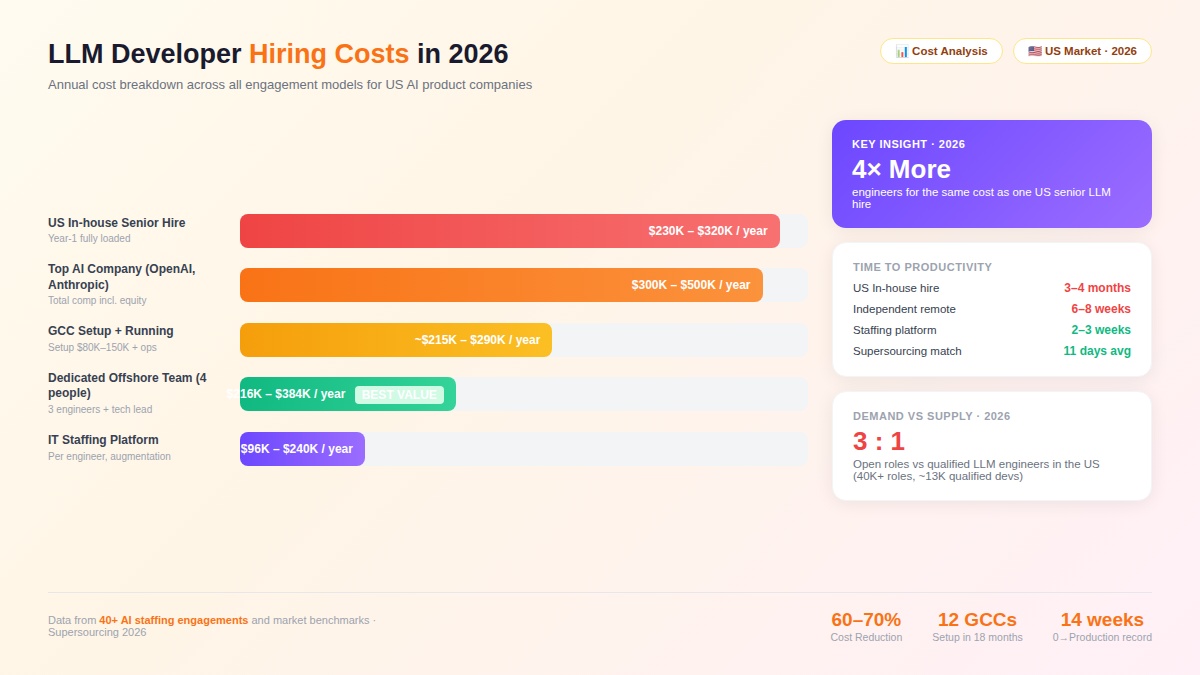
Fully loaded annual cost for a senior LLM developer in the US (full-time, in-house): $180,000–$260,000. That’s the base salary alone. Add benefits, equity, recruiter fees (20-25% of first-year salary), and onboarding time, and you’re looking at $230,000–$320,000 in year-one cost per hire.
For a dedicated LLM development team via a IT staffing or GCC model — 3 engineers, 1 tech lead, part-time DevOps — the Supersourcing team typically delivers this at $18,000–$32,000/month depending on seniority mix and engagement model. That’s $216,000–$384,000 annually for a 4-person team versus $230,000–$320,000 for a single US hire.
The math becomes obvious. The question isn’t cost. The question is quality, reliability, and time-to-productivity.
Here’s what the Supersourcing team has benchmarked across 40+ AI product staffing engagements: teams sourced through AI-powered vetting are productive within 2-3 weeks versus 6-8 weeks for independently hired remote talent. The delta is structured onboarding, pre-validated technical depth, and cultural fit filtering that most companies skip.
The Technical Stack You Should Be Evaluating Candidates On
Most technical screens for LLM developers are testing the wrong things. They’re running generic Python challenges or asking about transformer architecture at a theoretical level. Here’s what actually predicts production performance:
- RAG Pipeline Design — Can they build a retrieval-augmented generation system that handles chunking strategy, embedding model selection, vector store design (Pinecone, Weaviate, pgvector), and retrieval quality evaluation? This is table-stakes for any LLM application developer.
- Context Window Management — Do they understand how to handle long-context scenarios, when to summarize vs. retrieve, and how to optimize token usage without degrading output quality? At $15–$60 per million tokens for premium models, engineers who waste context cost real money.
- Evaluation Framework Design — Can they build an evaluation harness for your specific use case? Not just run RAGAS out of the box, but design task-specific metrics, golden dataset curation, and regression testing for LLM output quality.
- LLM Orchestration — Proficiency with LangChain, LangGraph, LlamaIndex, or custom orchestration. Do they understand when to use agents versus simple chains? Do they know the failure modes of agentic systems?
- Production Reliability Patterns — Caching strategies, fallback models, rate limit handling, structured output enforcement (Pydantic, Instructor), and monitoring (LangSmith, Helicone, Langfuse). An LLM in a notebook is not an LLM in production.
When the Supersourcing team built Brillio’s enterprise digital transformation tooling — a multi-tenant LLM system handling 200+ concurrent enterprise workflows — the critical failure point in the initial vendor selection wasn’t model knowledge. It was the complete absence of production reliability thinking. Three months of rework because the first team couldn’t handle rate limits, fallbacks, and output consistency at scale.
Why the US AI Product Market Has a Specific Hiring Problem Right Now
 Why the US AI Product Market Has a Specific Hiring Problem Right Now
The demand-supply mismatch for LLM talent in the United States is unlike anything I’ve seen in 14 years of building technology products.
There are roughly 12,000–15,000 engineers in the US who would qualify as “senior LLM developer” by any rigorous definition. There are 40,000+ open roles targeting this profile. That’s a 3:1 demand-to-supply ratio, and it’s been widening since early 2023.
The consequence: companies either overpay dramatically for mediocre talent, wait 4-6 months to close hires, or settle for engineers who’ve done one LLM side project and list “LangChain” on their resume.
The practical solution for most AI product companies — especially those pre-Series B — is a hybrid model: one US-based LLM tech lead who owns architecture and stakeholder communication, supported by a dedicated team of 2-4 LLM engineers who own implementation. This structure cuts your talent acquisition cost by 60-70% while maintaining the US timezone presence that most enterprise customers expect.
Supersourcing vendor partners with companies like Wipro and Virtusa use exactly this structure for their AI practice delivery. It works. The Kargo.tech team scaled their LLM-powered logistics product from 0 to production in 14 weeks using this model.
Build vs. Buy vs. Staff: The Decision Framework
If you’re an AI product company evaluating your LLM talent strategy, here’s how I’d frame the decision:
| Approach | Best For | Time to Productivity | Annual Cost Range | Risk Level |
| US In-house Hire | Post-Series B, enterprise sales | 3-4 months | $230K–$320K per head | High (mis-hire risk) |
| Freelance/Contractor | Prototype, 1-3 month projects | 2-4 weeks | $15K–$40K per month | Medium |
| Dedicated Offshore Team | Seed to Series B, sustained development | 2-3 weeks | $18K–$35K per month | Low-Medium |
| GCC Setup | Post-Series B, long-term IP ownership | 3-6 months to operationalize | $80K–$150K setup + running costs | Medium (setup complexity) |
| IT Staffing via Platform | Specific skill gaps, augmentation | 1-2 weeks | $8K–$20K per month per engineer | Low |
The GCC model — Global Capability Center — is increasingly attractive for AI product companies that have hit product-market fit and need to protect model training data, fine-tuning infrastructure, and proprietary evaluation datasets under their own legal entity. The Supersourcing team has set up 12 GCCs specifically for AI product companies over the last 18 months. The setup timeline is 90-120 days when done with an experienced partner versus 6-9 months when companies try to navigate Indian entity registration, labor compliance, and talent infrastructure independently.
What Most Companies Get Wrong When Hiring LLM Developers
This is the pattern I see most consistently, and it’s the one that costs the most money.
Mistake 1: Hiring for LLM knowledge instead of systems thinking.
LLM APIs are not complex. Calling OpenAI or Anthropic takes 20 lines of code. Building a system that does it reliably at scale, handles context correctly, evaluates output quality, manages costs, and doesn’t hallucinate into your customer’s face — that requires deep systems thinking. The best LLM developers I’ve worked with came from distributed systems or backend engineering backgrounds, not research backgrounds.
Mistake 2: Skipping the evaluation layer entirely.
70% of AI product companies I talk to have no systematic way to evaluate whether their LLM outputs are getting better or worse over time. They ship a prompt change and hope. This is operationally equivalent to deploying code without tests. It catches up with you — always — when you scale, change models, or face an edge case in production.
Mistake 3: Confusing “AI experience” with “LLM experience.”
Someone who’s built recommendation systems using collaborative filtering or trained image classifiers is not automatically qualified for LLM application development. The skills overlap at the Python layer and stop there. Always screen specifically for RAG, embedding pipelines, LLM orchestration, and production deployment of generative AI systems.
Mistake 4: Underestimating the compliance layer for US enterprise products.
If your AI product touches enterprise customers in the US, you have SOC 2, GDPR (for any EU user data), and increasingly AI-specific regulatory concerns to navigate. LLM developers building enterprise products need to understand data residency, PII handling in context windows, and logging/audit requirements. Most “AI developer” profiles have never thought about this.
How to Structure Your LLM Developer Hiring Process
 How to Structure Your LLM Developer Hiring Process
Based on 500+ AI product placements, here’s the process that produces the best outcomes in the shortest time:
- Define the product architecture first. What’s the LLM actually doing? RAG over documents? Agentic workflows? Code generation? Customer support automation? The answer dictates which profile you need and which technical skills are non-negotiable.
- Write a skills matrix, not a job description. List the 5-7 specific technical capabilities that are required versus nice-to-have. RAG pipeline design: required. Fine-tuning experience: nice-to-have. This prevents you from filtering out good candidates on irrelevant criteria.
- Design a take-home technical assessment around your actual use case. Give candidates a simplified version of the problem your product is solving. You learn more from 4 hours of real work than from any interview. Typical assessment: build a basic RAG system over a provided document set, with scoring rubrics for chunking strategy, retrieval quality, and evaluation methodology.
- Evaluate production thinking explicitly. In the technical interview, ask them to walk through how they’d handle model provider outages, how they’d detect output quality degradation, and how they’d manage token costs at 10x current volume. These questions separate engineers who’ve shipped from engineers who’ve prototyped.
- Check references on AI-specific work only. A strong reference on a traditional backend project tells you nothing about LLM development capability. Ask reference contacts specifically about the candidate’s work on generative AI systems.
Frequently Asked Questions
 Frequently Asked Questions
1. What’s the difference between hiring an LLM developer and an AI/ML engineer?
LLM developers specialize in building applications on top of large language models — RAG systems, prompt engineering, LLM orchestration, and production AI pipelines. AI/ML engineers have broader scope including traditional machine learning, model training, and data engineering. For most AI product companies building on top of foundation models like GPT-4, Claude, or Llama, LLM application development skills are what you actually need. The overlap is real but partial — an ML engineer without LLM-specific experience will have a 2-3 month ramp time to become productive on LLM application work.
2. How long does it take to hire a qualified LLM developer in the USA?
For in-house US hiring, expect 3-5 months from job post to first productive week. The pipeline is thin, competition is intense, and mis-hires are common because most interviewers don’t have deep enough LLM knowledge to screen effectively. Through a staffing platform with pre-vetted talent pools, that timeline compresses to 2-4 weeks. The Supersourcing AI-powered hiring platform has matched LLM engineers to AI product companies in an average of 11 days for dedicated team configurations.
3. Should I hire full-time LLM developers or use a dedicated team model?
Full-time US hiring makes sense post-Series B when you have consistent, long-term development needs and the budget to compete for top talent. For seed and Series A companies, a dedicated offshore team model — 3-5 engineers engaged full-time exclusively on your product — delivers 80% of the value at 30-40% of the cost. The risk of in-house hiring at early stages isn’t just cost; it’s the 4-6 month runway burn if a hire doesn’t work out.
4. What should I pay an LLM developer in 2026?
Senior LLM developers in the US command $160,000–$220,000 base salary. At top AI companies (OpenAI, Anthropic, Google DeepMind), total compensation reaches $300,000–$500,000. For dedicated offshore LLM development teams through a staffing model, fully loaded team costs run $18,000–$35,000/month for a 3-4 person team. RPO-model engagements for building your own internal LLM team run $8,000–$15,000/month for the talent sourcing and vetting function.
5. What tech stack should LLM developers know in 2026?
Core requirements: Python, LangChain or LlamaIndex, OpenAI/Anthropic/Gemini API integration, vector databases (Pinecone, Weaviate, pgvector, Chroma), embedding models, RAG architecture. Production requirements: evaluation frameworks (RAGAS, DeepEval), monitoring tools (LangSmith, Helicone), structured outputs (Instructor, Outlines), containerized deployment (Docker, Kubernetes), and cloud AI services (AWS Bedrock, Azure OpenAI, Google Vertex AI). Fine-tuning stack (Hugging Face, PEFT, LoRA) is valuable but not required for most product roles.
4. How do I evaluate whether an LLM developer is actually experienced vs. just familiar with the tools?
Ask them to describe a specific RAG system they’ve built — what chunking strategy they used, how they chose the embedding model, what evaluation methodology they implemented. Ask how they handled a specific production failure — a hallucination bug, a latency spike, a context overflow. Experienced engineers have war stories. Developers who’ve only done tutorials give you theory. The production experience gap is the single most predictive signal.
5. Can a US AI product company work effectively with an offshore LLM development team?
Yes — with the right structure. The model that works: a US-based technical lead or product manager owns requirements and architecture, and an offshore team of 2-4 LLM engineers owns implementation with daily async standups and biweekly sync calls. The Pennywise and Kargo.tech engagements both ran on exactly this structure. The failure mode is when US founders try to manage offshore developers without dedicated technical leadership on their side — then the communication overhead kills velocity.
6. What should I look for in a staffing partner for LLM developers?
Track record building and shipping AI products — not just placing engineers. AI-specific technical screening capability (most generalist IT services firms don’t have LLM engineers on their assessment teams). Transparent replacement guarantees if the engagement doesn’t work. And direct founder access — when architecture decisions need to be made fast, you want to be able to escalate to someone who’s actually shipped LLM products, not an account manager reading from a service catalog.
What This Looks Like in Practice: A Real Architecture Decision
When the Supersourcing team helped build Open Money’s fintech banking and settlement platform, the initial requirement was “AI-powered fraud detection.” Three conversations in, the actual requirement was an LLM-based transaction narrative understanding system — categorizing transactions, detecting anomalies, and generating plain-language explanations for compliance reporting.
Those are completely different technical problems requiring completely different profiles. The first is a traditional ML classification problem. The second is an LLM application engineering problem requiring RAG over regulatory documents, structured output generation, and a robust evaluation framework.
Getting that distinction right at the start saved 4 months of misdirected development.
That’s what I mean when I say the brief you write determines the outcome you get. Spend more time on the architecture decision than the job description. The right team for the wrong problem costs more than the wrong team.
Before You Post That Job Description
If you’re evaluating LLM developer hiring for your AI product company and want to think through the architecture decisions before you commit to a model — in-house, staffed, GCC, or a combination — I’m usually the one on those calls.
No sales team. No account manager. Just a direct conversation about what your product actually needs and whether Supersourcing is the right fit to help you build it.
Mayank Pratap is the Co-founder of Supersourcing, an AI-powered hiring and IT services company. He has 14 years of experience building technology products and has personally led 500+ product development and staffing engagements across fintech, enterprise SaaS, healthcare, and AI. Supersourcing is a vendor partner with Wipro, Virtusa, and Impetus, and operates dedicated AI hiring, IT staffing, RPO, and GCC setup practices.
