

By 2026, enterprise IT buyers are no longer choosing outsourcing models to save money. First they’re choosing them to get access to engineers they simply cannot hire fast enough on their own. Gartner’s own 2026 predictions research points to a structural, not cyclical, imbalance between IT talent demand and supply, one severe enough that “enterprises will spend more money to retain fewer staff and will turn to IT services firms to fill in the gaps.” That single shift from cost arbitrage to capacity arbitrage is why the dedicated development team model has moved from a niche staffing option to the default structure for any product team scaling past its founding engineers.
Global spending on IT services is projected to climb from an estimated $1.72 trillion in 2025 to roughly $1.87 trillion in 2026, according to Statista’s IT services market forecast, a signal that enterprises are accelerating external delivery capacity, not retreating from it, even as internal hiring tightens. [Source: Statista]
This guide is written for engineering leaders, founders, and procurement teams who already know they need more development capacity and are now deciding how to structure it. It walks through the entire lifecycle from defining requirements to exiting the engagement with real cost bands, contract terms, and the operational details that separate a well-run dedicated team from an expensive mistake.
The confusion usually starts with terminology. “Dedicated team,” “staff augmentation,” and “managed services” get used interchangeably in vendor pitch decks, and the differences only become visible once a contract is signed and the first sprint starts underperforming. That’s the expensive way to learn the distinction. This guide exists so you learn it before you sign anything. By the time you finish it, you should be able to read any vendor’s proposal and immediately tell whether what’s on offer is genuinely a dedicated development team model or a relabeled version of something else.
TL;DR
This guide explains the dedicated development team model end-to-end: what it is, how it's priced, how it compares to staff augmentation and in-house hiring, and the exact sequence to follow from your first requirements document to a fully ramped, delivering team. It's written for CTOs, engineering managers, and founders who are past the "should we outsource" question and now need to execute the decision correctly.
The single number to hold onto: a properly structured dedicated team can be interview-ready in 7–10 working days from a finalized job description, and fully productive within 2–4 weeks of onboarding far faster than the 6–10 weeks a typical in-house senior engineering hire takes from job posting to accepted offer. Cost bands run $40,000–$70,000 per engineer per year for offshore dedicated hires in India, roughly 40–60% below equivalent onshore salary-plus-overhead costs.
By the end, you'll be able to build your own requirements briefly, evaluate a vendor's vetting process, negotiate the IP and replacement terms that actually matter, and run the reporting cadence that keeps a remote dedicated team accountable without needing to relearn any of this the hard way on your first engagement.
What Is the Dedicated Development Team Model?
The dedicated development team model is an engagement structure in which a vendor assembles a team of engineers, a QA function, and typically a project manager who works exclusively on one client’s product, for the full duration of the contract, while the vendor’s company handles recruitment, payroll, infrastructure, and HR administration.
It is not:
- Staff augmentation, where individual contractors are slotted into an existing client-managed team without a dedicated delivery structure or account ownership.
- Project-based (fixed-price) outsourcing, where a vendor delivers a defined scope of work and disbands the team at completion, rather than maintaining continuity on an evolving product.
- A freelance marketplace hire, where there is no shared bench, no backup coverage, and typically no formal IP assignment infrastructure.
The distinction matters because each of these structures allocates risk differently. In a dedicated development team model, the vendor absorbs recruitment risk, payroll administration, local compliance, and bench management; the client retains product direction, sprint planning, and technical review. In staff augmentation, the client absorbs almost all of that management overhead and simply borrows headcount. In project-based outsourcing, the vendor absorbs delivery risk against a fixed scope, but the client gives up flexibility to change direction mid-engagement without renegotiating price.
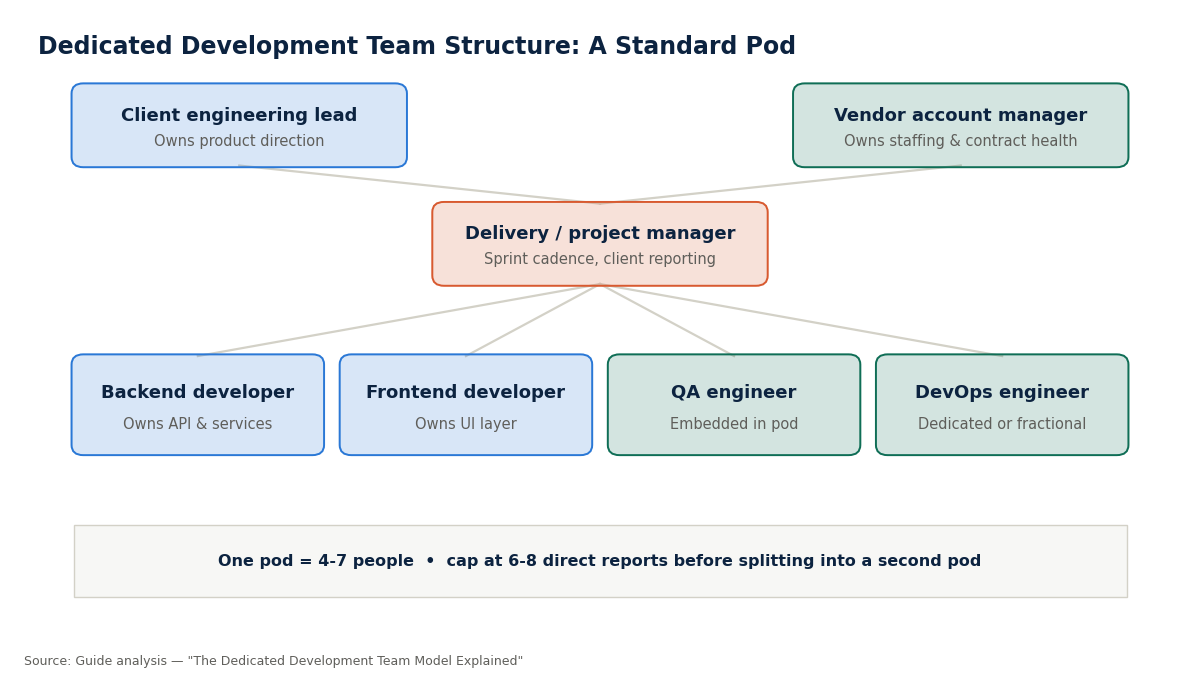
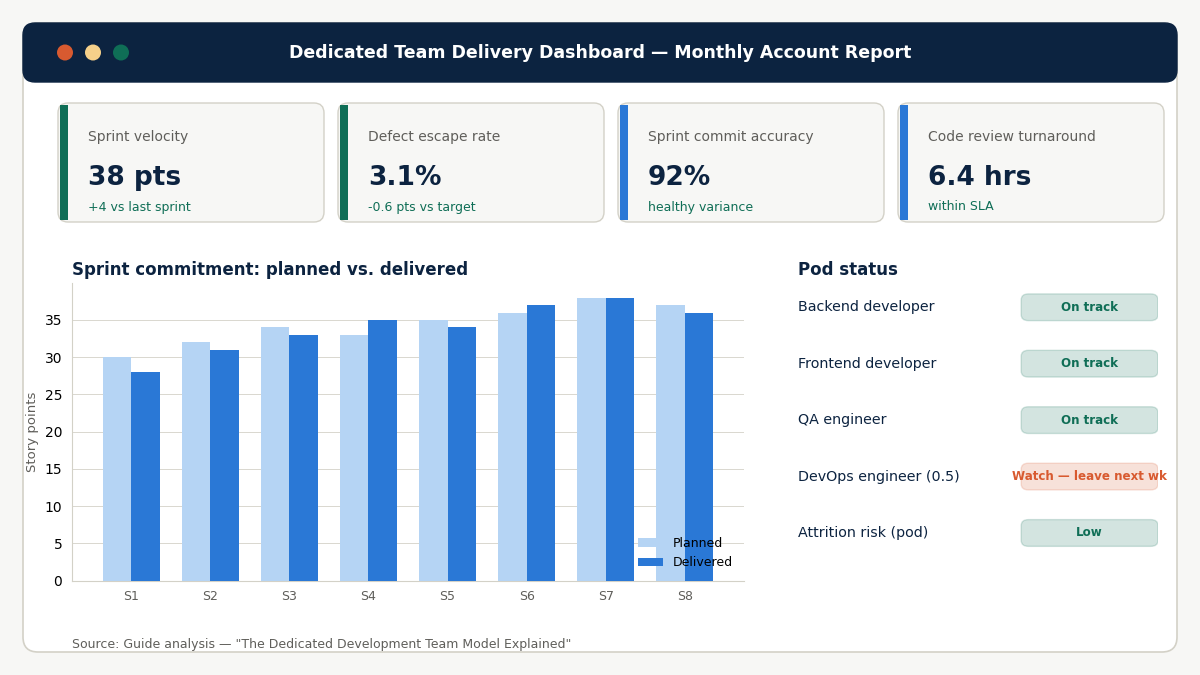
A typical dedicated team is organized in “pods” , small, cross-functional units of 4–7 people rather than a single undifferentiated headcount pool. A standard pod includes a delivery or project manager who owns sprint cadence and client reporting, two to four developers matched to the required stack (frontend, backend, or full-stack depending on scope), a QA engineer embedded in the same pod rather than shared across five unrelated projects, and either a dedicated or fractional DevOps engineer depending on release frequency. Larger engagements simply add pods rather than inflating a single team past the point where a project manager can meaningfully track individual output; most experienced delivery managers cap a single pod’s direct reports at 6–8 people before splitting it.
Reporting lines in a well-run dedicated team model are dual-threaded by design: the pod’s project manager reports operationally to the client’s engineering lead on delivery status, while also reporting administratively to the vendor’s account manager on staffing, attrition risk, and contract health. This is the structural reason a dedicated team can maintain continuity even if the vendor loses an unrelated account; the client-facing reporting line is largely insulated from vendor-side account churn, unlike staff augmentation, where an individual contractor’s continuity depends entirely on that one person’s personal retention.
Why the Dedicated Team Model Matters: The Business Case
The decision to use a dedicated development team model affects four measurable business outcomes not “efficiency” in the abstract, but specific, budgetable line items.
- Cost predictability: A dedicated team runs on a fixed monthly or annual rate per role, which is easier to forecast against a product roadmap than variable contractor invoices or the recruiting-plus-severance risk of in-house hiring.
- Speed to capacity: A vetted dedicated team can typically be assembled and made interview-ready in 7–10 working days, versus 6–10 weeks for a comparable in-house senior hire in a competitive market.
- Reduced hiring risk: Reputable providers offer a replacement guarantee (commonly 7–10 days) if a placed engineer isn’t a fit a cost the buyer would otherwise absorb entirely through a failed direct hire and a restarted search.
- Continuity of institutional knowledge: Unlike project-based outsourcing, the same engineers remain on the product release after release, which matters for anything with a multi-year roadmap; most SaaS platforms, fintech products, and healthtech systems fall into this category.
- Access to skills that are locally scarce or expensive: Specialized roles machine learning engineers, DevOps engineers, senior cloud engineers are frequently unavailable at budget in tier-1 startup hubs but available at strong technical depth in offshore hubs like India.
- Lower headcount-related risk exposure: A dedicated team engagement typically carries no severance liability, no long-term benefits obligation, and no local employment-law exposure for the client, since the vendor remains the legal employer of record throughout the contract.
- Faster response to roadmap volatility: Because pods can be resized at contract renewal points rather than requiring a full hiring-and-severance cycle, a dedicated team model gives product organizations more flexibility to flex capacity up ahead of a major release and back down afterward than an all-in-house structure allows.
These outcomes compound over a multi-year engagement. A team that starts as a single 4-person pod solving a narrow backend bottleneck frequently expands into 2–3 pods covering backend, mobile, and data within 18–24 months and the organizations that plan for that growth path from the outset (rather than treating the first pod as a one-off) get meaningfully better pricing and continuity than those who restart vendor evaluation from scratch every time they need to scale.
The Core Problem Most Buyers Face Before Choosing a Model
Most engineering leaders underestimate three things when they first consider a dedicated development team model, and each one compounds if left uncorrected.
Underestimating vetting depth. Teams that skip a structured technical assessment typically discover skill gaps only after the first sprint by which point 3–4 weeks of velocity have already been lost. A rigorous vetting process (technical screen, live coding or system-design round, communication assessment) catches this before contract signature, not after.
Underestimating onboarding friction. Buyers frequently assume a dedicated team is “plug and play” from day one. In practice, access provisioning, tooling setup, and codebase familiarization alone can consume the first 3–5 working days if not planned for and skipping this planning is the single most common reason for a dedicated team’s first sprint underdelivers.
Underestimating contract specificity. Vague SOWs around IP ownership, replacement terms, and exit clauses are the top source of disputes six months into an engagement, not pricing disagreements, which is what most buyers spend the most negotiating time on.
Underestimating the true comparison baseline. Buyers frequently compare a dedicated team’s monthly rate against a developer’s take-home salary alone, without adding in the fully loaded cost of an in-house hire recruiter fees, benefits, payroll taxes, equipment, office overhead, and the productivity cost of the 6–10 week search itself. Once fully loaded, most teams underestimate true in-house cost by roughly 1.4 — 1.8x the base salary figure, which is exactly the range that makes a dedicated development team model look artificially expensive on a like-for-like comparison until the full math is done.
Underestimating attrition risk on the vendor side. Even in a well-run dedicated team, individual engineer attrition happens. The difference between a good and a bad vendor relationship is whether that attrition is absorbed by a maintained bench with a fast, guaranteed replacement, or whether it becomes the client’s problem to solve from scratch. This is precisely why the replacement guarantee terms in Phase 3 below deserve more scrutiny than most buyers give them.
The Walkthrough: From Scratch to a Fully Running Dedicated Team
This section covers the complete lifecycle of setting up and running a dedicated development team model engagement from your first internal requirements conversation to the point where you’re either scaling the team or winding it down. Each phase below includes at least one checklist you can use directly.
Phase 1 Defining Requirements (Scope, Skills, Timeline, Budget)
Before contacting any vendor, nail down four things internally. Skipping this step is the most common reason a dedicated team engagement starts slow.
Scope definition checklist:
- What product surface is this team responsible for (a specific module, the whole backend, mobile app, data platform)?
- What is the expected engagement length? Is this a 6-month sprint or a multi-year build?
- What existing systems, codebases, or third-party integrations will the team inherit?
- What decision authority does the team have (can they propose architecture changes, or only implement specified tickets)?
Skill and role mapping. A typical dedicated team for a mid-sized SaaS product includes a mix of the following, sized to the product’s complexity:
| Role | Typical ratio (per 5-person pod) | Approx. annual cost band (offshore, India) |
| Project/Delivery Manager | 1 (often shared across 2 pods) | $18,000–$30,000 |
| Senior Backend Developer | 1–2 | $30,000–$55,000 |
| Frontend Developer | 1 | $25,000–$45,000 |
| QA Engineer | 1 | $20,000–$35,000 |
| DevOps Engineer | 0.5 (often shared) | $35,000–$60,000 |
These bands reflect typical offshore India market rates for mid-to-senior talent as of 2026; specialized roles like machine learning engineers or senior cloud engineers run above this range, often $50,000–$90,000 annually.
Budget banding. As a planning heuristic: a 5-person dedicated pod (1 PM, 2 developers, 1 QA, 0.5 DevOps shared) typically runs $130,000–$220,000 per year all-in at offshore India rates roughly 45–65% of the fully loaded cost of an equivalent onshore US team.
Timeline definition. Alongside budget, define the engagement horizon explicitly before sourcing starts: a 6-month engagement, a 12-month renewable contract, or an open-ended multi-year build. This single decision changes vendor pricing (annual commitments typically price 10–15% below quarter-to-quarter engagements), affects which engineers a vendor is willing to place (senior talent is understandably reluctant to join a team with a 3-month horizon), and determines how much onboarding investment is worth making on both sides.
A completed requirements brief should answer, in writing, before you contact a single vendor:
- Product surface and expected scope of ownership
- Required tech stack and any non-negotiable tooling constraints
- Target team size and role mix
- Engagement length and renewal expectations
- Budget band per role (use the table above as a starting anchor)
- Decision-making authority the team will hold
- Internal point of contact who will run day-to-day standups
Vendors consistently deliver faster, better-matched shortlists when this brief exists in writing versus a verbal scoping call; it’s the single highest-leverage document in the entire dedicated development team model process, and it costs nothing but internal time to produce.
Phase 2 Sourcing & Vetting
This is where most of the model’s real risk lives. A weak vetting process is invisible until sprint two.
What good technical screening looks like:
- A resume/portfolio review against the specific tech stack, not a generic “full stack” filter.
- A live technical round system design for senior roles, a scoped coding exercise for mid-level roles.
- A communication and English-proficiency assessment specific to daily standups and async documentation, not just interview fluency.
- A culture/working-style interview conducted by someone who will actually manage the account, not a generalist recruiter.
Red flags to watch for during vendor evaluation:
- The vendor cannot show you a sample technical assessment rubric before you sign.
- Candidate profiles arrive within hours of a request with no stated bench or prior project history a sign of a thin, reactive talent pool rather than a maintained bench.
- The vendor is vague about attrition rate or won’t disclose it at all.
- No dedicated account manager is named before the contract signature you’re being sold to a shared support queue.
A provider surfacing candidates from a genuinely vetted, top-tier talent pool (commonly marketed as sourcing from the top 2% of vetted talent) with a 7–10 working day turnaround from job description to interview-ready shortlist is a reasonable benchmark to hold any vendor to.
What “cultural evaluation” should actually mean. This phrase gets used loosely, but in a genuine dedicated team vetting process it covers three concrete things: whether the candidate has prior experience working with an overlapping-timezone client team (not just any remote work), whether they can produce written async updates clearly (a sample Slack-style update during the interview is a reasonable test), and whether their prior project history shows sustained tenure on a single product rather than a pattern of 3–4 month stints the latter is a leading indicator of attrition risk on your own engagement.
Vetting depth should scale with seniority and role criticality. A junior QA hire warrants a lighter technical bar than a senior backend engineer who will own architecture decisions but the communication and reliability bar should stay consistent across every role in the pod, since a single weak communicator can slow an entire pod’s standup cadence regardless of their individual coding output.
Phase 3 Engagement Models & Contracts
This is the phase where “dedicated team” earns or loses its name in the actual paperwork.
Dedicated team vs. every other model checklist:
- ✅ Team works exclusively on your product, full-time, for the contract duration
- ✅ Vendor names a dedicated account manager before signature
- ✅ Contract specifies IP assignment (all code, designs, and documentation transfer to you, not the vendor)
- ✅ NDA covers both the company and named individual engineers
- ✅ A replacement clause exists (7–10 days is a reasonable standard) if a placed engineer isn’t a fit
- ✅ Billing is per-role, per-month (or annual), not hourly hourly billing is the tell of disguised staff augmentation
- ❌ If any of the above is missing, you likely have staff augmentation with dedicated-team pricing
IP and NDA terms that actually matter: Insist on explicit source-code ownership transfer language, not just “confidentiality.” Many disputes stem from contracts that protect confidential information but never explicitly assign code IP to the client. Ask for source code escrow or direct repository ownership from day one rather than delivery-only handoff at contract end.
Billing models compared. Within the dedicated team pricing model itself, two structures are common:
- Fixed monthly rate per role, the standard for genuine dedicated teams, priced per seniority band regardless of hours logged, so long as agreed sprint commitments are met. This is what enables the cost predictability covered earlier.
- Time-and-materials with a dedicated allocation hours are still tracked and invoiced, but the same named individuals are guaranteed exclusively to your account. This is more common in engagements where scope is still evolving month to month and a fixed monthly rate would misprice the risk on either side.
Neither is inherently wrong, but a vendor who can’t clearly explain which one you’re signing or who blends the two without disclosure is a sign to slow down before signature.
Notice period and lock-in. A reasonable dedicated team contract specifies a 30-day notice period for either party to end the engagement or resize the pod, protecting the client from indefinite lock-in while giving the vendor enough runway to redeploy engineers elsewhere. Contracts with 90-day-plus notice periods or automatic renewal clauses without an opt-out window are worth pushing back on.
Phase 4 Onboarding & Ramp-Up
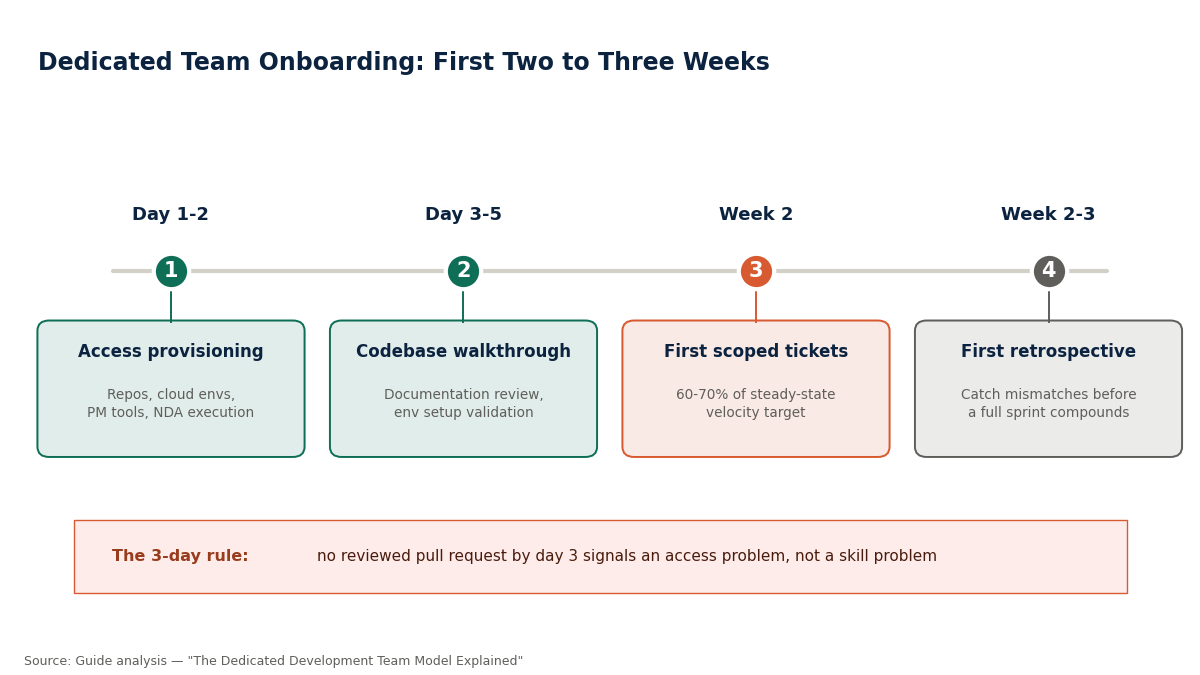
A realistic first-two-weeks sequence, rather than a vague “ramp-up period”:
- Day 1–2: Access provisioning (repos, cloud environments, project management tools, communication channels), NDA execution for individual engineers if not already covered at company level.
- Day 3–5: Codebase walkthrough sessions with existing team members, documentation review, environment setup validation.
- Week 2: First scoped tickets assigned at reduced velocity expectations (60–70% of eventual steady-state output is a realistic target, not 100%).
- End of Week 2 / Week 3: First retrospective this is the checkpoint to catch communication or skill mismatches before they compound into a full sprint.
Communication cadence to establish immediately: daily standup (async or live, timezone-dependent), weekly sprint planning, a shared Slack/Teams channel with the client’s core team (not just the vendor’s PM), and a defined escalation path for blockers.
The 3-day rule: if a new dedicated team hasn’t merged a single reviewed pull request or completed a test cycle within their first 3 working days, that’s the earliest reliable signal of an onboarding or access problem not a skill problem and it’s worth raising immediately rather than waiting for the week-2 retrospective. Most onboarding friction traces back to slow access provisioning (waiting on IT for repository or cloud permissions) rather than the engineers themselves.
Tooling checklist for day one: version control access with correct branch permissions, project management tool seat (Jira, Linear, or equivalent), communication platform access with the right channels already created, staging/dev environment credentials, and a documented “getting started” runbook ideally written before the team’s first day, not assembled reactively once they’re already blocked.
Buyers scaling a specific function during this phase for example, standing up a data or ML capability alongside an existing web team often extend the same onboarding sequence to a second wave of specialized hires rather than restarting the process from zero.
Phase 5 Managing Delivery
Once ramped, the team should operate on a predictable reporting rhythm:
- Sprint-level: velocity tracking, burndown visibility, demo at sprint close.
- Monthly: delivery report from the dedicated account manager covering attrition risk, upcoming leave, and any scope changes.
- Quarterly: a business review is the team composition still right for the current roadmap, or does it need to flex up or down?
KPIs worth tracking beyond velocity: code review turnaround time, defect escape rate (bugs found in production vs. QA), and sprint commitment accuracy (planned vs. delivered story points). A dedicated account manager structure rather than shared support is what makes this reporting cadence enforceable instead of aspirational.
Red flag during delivery: if monthly reports consistently show 100% sprint commitment accuracy with zero variance, that’s more often a sign of sandbagged sprint planning (the team under-committing to guarantee a clean report) than genuinely flawless execution a healthy dedicated team’s velocity should show some natural variance sprint to sprint, and a good account manager will surface that variance honestly rather than smoothing it out of the report.
Escalation structure that works: a three-tier path pod-level blockers go to the project manager same-day, delivery-quality concerns go to the dedicated account manager within 48 hours, and contractual or commercial issues go to a named account owner above the account manager. Vendors who route every issue type through a single generic support inbox are effectively running staff augmentation with a dedicated-team price tag, regardless of what the contract calls the engagement.
Phase 6 Scaling or Exiting
Scaling up: Adding headcount to an existing dedicated pod should follow the same vetting rigor as the original hire and resist the temptation to fast-track “just one more developer” without the technical round, since this is where quality erosion typically starts.
Exiting well: A clean offboarding clause should specify: final code and documentation handoff format, knowledge-transfer session count (2–3 sessions minimum for anything running longer than 6 months), and a defined notice period (30 days is standard) so you’re not left without coverage mid-sprint.
Signs it’s time to scale a dedicated pod rather than add a second vendor: the existing team consistently clears its sprint backlog with capacity to spare, the roadmap has grown to cover a genuinely separate product surface (e.g., a new mobile app alongside an existing web platform), or the current pod’s project manager is already informally coordinating with a second, unofficial group of contractors a sign the real headcount need has outgrown the contracted scope.
Signs it’s time to exit rather than scale: the product surface the team was hired for has been descoped or sunset, the roadmap has shifted toward work requiring a fundamentally different skill set that isn’t a natural extension of the current pod, or the account’s escalation pattern has shown the vendor consistently missing replacement-guarantee commitments at which point the contract terms negotiated in Phase 3 determine how cleanly that exit happens.
If you’re specifically scaling backend capacity during this phase, this is typically also where teams evaluate whether to hire Node.js developers or expand frontend capacity through hiring dedicated React developers rather than restructuring the whole pod. Infrastructure-heavy scale-ups more often need to hire DevOps engineers to keep release cadence stable as the pod grows.
Case Studies: The Dedicated Team Model in Practice
Fintech scale-up hiring pattern (Paytm-scale engineering growth). Fast-growing fintech platforms scaling engineering headcount into the hundreds typically hit the same bottleneck: internal recruiting can’t source and vet specialized backend and compliance-adjacent engineering talent fast enough to match product velocity. In engagements of this scale, a dedicated-team structure with a parallel vetting pipeline is what closes the gap without slowing product releases. The model absorbs the hiring surge that a single internal TA team can’t handle alone.
Consumer tech engineering scale (Swiggy-pattern hypergrowth hiring). Consumer platforms scaling through hypergrowth phases commonly need to stand up multiple engineering pods simultaneously mobile, backend, and data while maintaining a consistent bar. The dedicated-team model’s advantage here is running parallel vetting pipelines per pod without diluting technical screening standards under time pressure, which is the typical failure mode when hypergrowth teams try to hire fully in-house on a compressed timeline.
Fintech/SMB software engineering hiring (OkCredit-pattern). Product-led fintech and SMB software companies often need lean, senior-heavy pods rather than large teams a small dedicated pod of 3–5 senior engineers with strong ownership, rather than a large junior-heavy team, tends to match the pace and ambiguity of an early-to-growth-stage product roadmap better than a bigger, more process-heavy structure.
Dedicated Team vs. Every Other Model: The Decision Framework
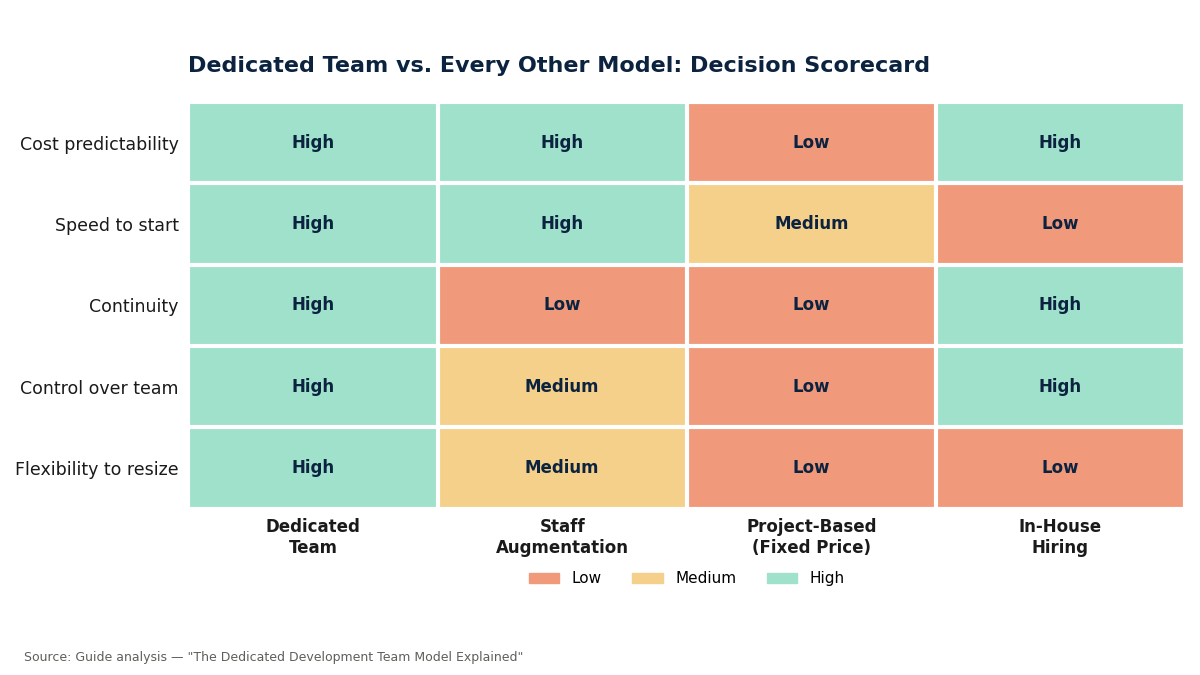
| Factor | Dedicated Team | Staff Augmentation | Project-Based (Fixed Price) | In-House Hiring |
| Cost predictability | High (fixed monthly/role) | Medium (hourly variance) | High (fixed scope price) | Low (salary + benefits + attrition risk) |
| Speed to start | 7–10 working days | 5–10 working days | 2–4 weeks (scoping-dependent) | 6–10+ weeks |
| Continuity/institutional knowledge | High | Low–Medium | Low (team disbands at delivery) | Highest |
| Control over team composition | High (client-approved hires) | Medium | Low (vendor staffs internally) | Highest |
| Best for | Long-term products, evolving roadmaps | Short-term skill gaps in an existing team | Well-defined, bounded scope | Core IP, long-horizon strategic roles |
| Risk if mismanaged | Underused capacity if scope is unclear | Coordination overhead, shadow IT | Scope creep disputes | Slow time-to-capacity, high fixed cost |
When the dedicated team model wins: long-term products with an evolving roadmap, teams that need continuity across multiple release cycles, and organizations that want cost predictability without the overhead of direct employment in another country.
When it doesn’t: a single, narrowly-scoped project with a hard end date (project-based outsourcing is usually cheaper and simpler), or a role so core to strategic IP that only a direct, equity-holding hire makes sense.
A simple test to apply your own scope against: if you can’t confidently describe what this team will be building in month 9 of the engagement, you likely have a project-based scope, not a dedicated-team scope and pricing it as the latter will cost more than it needs to. Conversely, if the honest answer is “we don’t fully know yet, because the roadmap will evolve with user feedback,” that ambiguity is precisely what the dedicated team model is built to absorb, since the team’s staffing and cadence don’t depend on a fixed, upfront scope document the way a fixed-price contract does.
Staff augmentation earns its place in a narrower set of situations than either of the two poles above: when an existing, well-functioning in-house team needs to temporarily borrow one or two specific skills (a security audit specialist, a short-term migration engineer) without restructuring how the team is managed. Reaching for staff augmentation to solve a broader, ongoing capacity gap is the most common way organizations end up with the coordination overhead of the model without the continuity benefits of either a dedicated team or a direct hire.
What Most Teams Get Wrong
The single most common mistake: treating the dedicated team model as a way to avoid management, rather than a way to change who does the recruiting. Teams that get the best results still run their own sprint planning, still do their own code review culture-setting, and still treat the dedicated engineers as core team members in every practical sense the vendor’s job is sourcing, HR administration, and backup coverage, not day-to-day technical leadership (unless a tech lead role is explicitly scoped and paid for as part of the pod).
A second pattern: buyers negotiate hardest on the number that matters least. Most negotiation time goes into shaving 5–10% off the monthly rate, while the replacement clause, IP assignment language, and notice period the terms that actually determine whether a bad hire costs you two weeks or two months get a single read-through. Typically, the contracts that cause the fewest problems eighteen months in are the ones where the buyer spent more time on the SOW’s IP and replacement clauses than on the rate card.
A third pattern specific to offshore engagements: assuming timezone overlap will sort itself out. It doesn’t, unless a specific overlap window (commonly 3–4 hours of live daily overlap for India-US engagements) is written into the onboarding plan and protected on both sides’ calendars from week one.
Cost & Timeline Reality Check
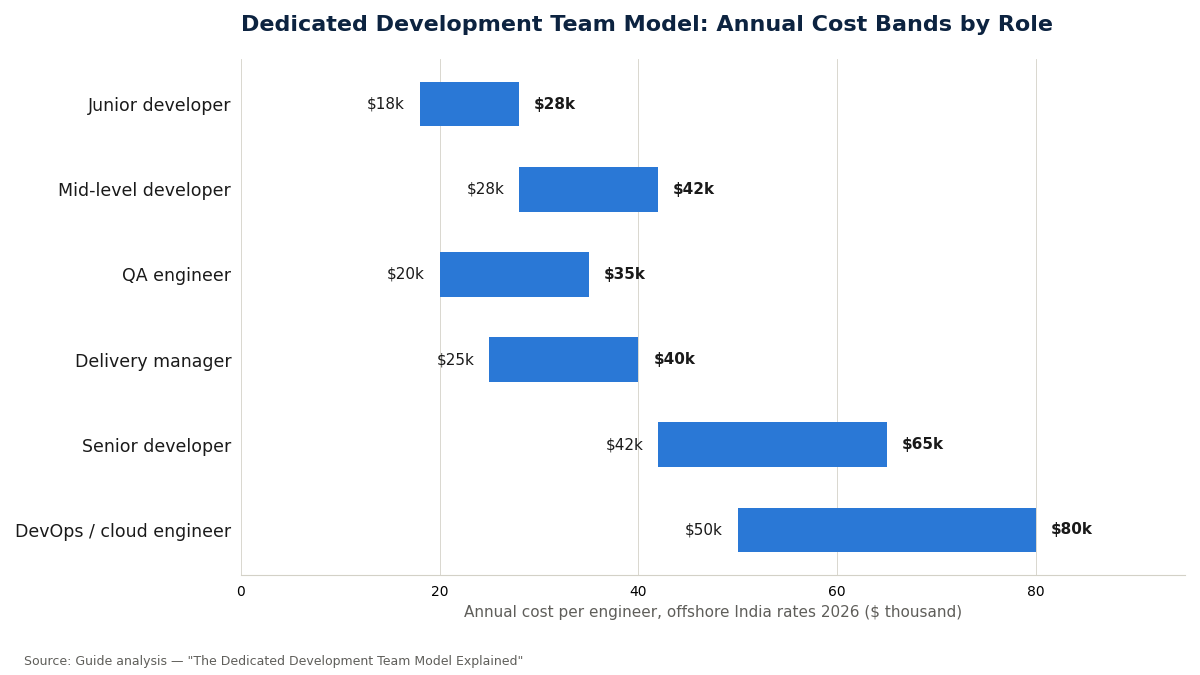
Cost tiers (annual, per engineer, offshore India rates, 2026 bands):
- Junior developer (0–2 years): $18,000–$28,000
- Mid-level developer (3–5 years): $28,000–$42,000
- Senior developer (6+ years): $42,000–$65,000
- DevOps / Cloud engineer (senior): $50,000–$80,000
- QA engineer: $20,000–$35,000
- Dedicated Project/Delivery Manager: $25,000–$40,000
What drives costs up: specialized skills (ML, blockchain, SAP), compressed timelines that require premium sourcing, and higher seniority ratios within the pod.
What drives costs down: longer contract commitments (annual vs. quarterly), a broader skill-match window (open to adjacent tech stacks), and batching multiple roles into a single sourcing cycle rather than hiring one-off.
Typical timelines by scenario:
- Single mid-level developer, common stack (Node.js, React, Python): 7–10 working days to shortlist, 2–3 weeks to first productive sprint.
- Full 5-person pod, mixed seniority: 10–15 working days to fully staffed, 3–4 weeks to steady-state velocity.
- Specialized/rare skill (senior ML engineer, niche compliance stack): 3–5 weeks to shortlist, given a smaller qualified talent pool.
What’s typically included in the quoted rate: recruitment and vetting cost, payroll and statutory compliance in the engineer’s home country, standard hardware/laptop provisioning, HR administration, and the account management layer covered in Phase 5.
What’s typically excluded, and worth clarifying upfront: premium/specialized tooling licenses specific to your stack, any travel for on-site visits, and in some but not all contracts the project manager’s time if it’s billed as a shared resource across multiple client pods rather than dedicated to yours alone.
Always ask a prospective vendor to itemize which of these fall inside versus outside the quoted rate before comparing two proposals on price alone, since an apparently cheaper quote that excludes PM time or compliance overhead often isn’t cheaper once those gaps are filled in.
A note on geography-driven cost variance. The bands above reflect India as a sourcing hub, currently one of the largest offshore talent pools for this model globally but nearshore hubs (Eastern Europe, Latin America) typically run 20–40% higher than India on a like-for-like seniority basis while offering closer timezone overlap for US and EU clients. Neither is universally “better” ; the right choice depends on how much timezone overlap your delivery cadence actually requires versus how much of the cost differential you’re willing to trade for it.
Where to Go From Here
If you’re mid-decision between a dedicated development team model and staff augmentation, the fastest way to de-risk the choice is to get a role-by-role cost and timeline estimate against your actual scope, not a generic rate card. If you’re specifically scoping a GCC-style long-term captive setup rather than a vendor-managed pod, that’s a different cost and governance conversation worth having separately via GCC setup services before you commit to either path; broader hiring pipeline support is covered under IT staffing services.
Supersourcing’s delivery team has run this exact playbook across fintech, healthtech, and e-commerce engagements for over a decade, sourcing from a vetted top-2% talent pool with a 7–10 working day shortlist turnaround and a 7–10 day replacement guarantee built into every contract. If you have a scope defined and want a straight cost-and-timeline estimate rather than a sales pitch, book a consultation and bring your requirements brief from Phase 1; that’s the fastest way to get a number you can actually plan against.
Frequently Asked Questions
What is a dedicated development team model?
It’s an engagement structure where a vendor provides a team of engineers, QA, and typically a project manager who work exclusively on one client’s product for the engagement’s duration, while the vendor handles recruitment, payroll, and infrastructure distinct from staff augmentation or project-based outsourcing.
How much does a dedicated development team cost?
Offshore India rates typically run $18,000–$80,000 per engineer per year depending on seniority and specialization, with a standard 5-person pod (PM, two developers, QA, shared DevOps) landing around $130,000–$220,000 annually all-in.
What’s the difference between a dedicated team and staff augmentation?
A dedicated team has its own account management, works exclusively on your roadmap, and is billed per-role rather than hourly; staff augmentation places individual contractors into your existing team structure without that dedicated delivery layer.
How long does it take to onboard a dedicated development team?
Sourcing and shortlisting typically takes 7–10 working days; full productive ramp-up to steady-state velocity takes another 2–4 weeks depending on codebase complexity and team size.
Who owns the IP and code when you hire a dedicated team?
In a properly structured contract, all code, documentation, and designs are assigned to the client; this must be explicit IP assignment language in the SOW, not just a general confidentiality clause.
What roles are included in a dedicated development team?
Typically a project or delivery manager, one or more developers matched to the required stack, a QA engineer, and shared or dedicated DevOps support, scaled to the product’s complexity.
Is a dedicated team better than building in-house?
It depends on the role’s strategic weight: dedicated teams win on speed and cost predictability for execution-heavy roles, while core strategic or founding technical roles usually still warrant a direct in-house hire.
What happens if a dedicated team member isn’t a fit?
Reputable providers include a replacement guarantee commonly 7–10 days to source and onboard a replacement at no additional cost, which should be written explicitly into the contract before signature, not assumed.
