

India crossed 2,117 global capability centers this year. The median first-year budget for those centers was wrong not by a rounding error, but by the two or three line items that never make it onto the first version of the spreadsheet.
The pattern is consistent enough to predict. Finance models payroll, rent, and laptops, arrives at a number, and gets sign-off. Then the transfer pricing markup lands, the security deposit turns out to be six months instead of three, and the first cohort’s notice periods push revenue-generating headcount ten weeks past the plan. The budget didn’t fail because India got expensive. It failed because the model had four line items when it needed fourteen.
India’s GCC ecosystem reached 2,117 centers across 3,728 units, USD 98.4 billion in revenue and 2.36 million people in FY2026 32% growth in center count since FY2021.
That scale means the benchmarks are no longer guesswork. There is enough comparable data across entity formation, Grade A office fit-out, statutory compliance, and engineering compensation to build a GCC setup cost India model that survives contact with an actual CFO.
This guide is that model. Every number below is a range, sourced or observed, in both INR and USD. Nothing is averaged into a single misleading figure, because a 50-seat data engineering center in Hyderabad and a 50-seat platform team in Bengaluru do not cost the same thing and the gap between them is the most useful information in this entire document.
TL;DR
This is a line-by-line cost breakdown for enterprises setting up a capability center in India in 2026. It covers one-time capex, recurring opex, and the compliance lines that usually get missed. Written for CFOs, COOs, and engineering leaders who need a defensible number, not a brochure.
On GCC setup cost India, the headline number is this: a 50-seat center runs ₹1.6–3.2 crore (USD 180K–365K) in one-time costs on a lease-and-fit-out route, and ₹32–48 lakh per seat per year (USD 36K–55K) fully loaded once live. The managed-office route cuts one-time spend by roughly 70% and most teams should take it for the first eighteen months.
By the end you will be able to build your own cost to set up gcc india model, stress-test a vendor quote line by line, and know which three numbers in any proposal are the ones actually worth negotiating.
What GCC Setup Cost India Actually Measures
GCC setup cost India is the total capital and operating expenditure required to establish and run a wholly-owned global capability center in India. It splits into one-time costs entity formation, legal, office fit-out, IT hardware, and deposits and recurring costs, including payroll, statutory contributions, rent, tooling, and compliance.
Two things follow from that definition. One-time costs are largely a function of real estate strategy, not headcount. Recurring costs are almost entirely a function of talent mix. Confuse the two and your model will be directionally wrong from day one.
Why Most GCC Setup Budgets Break in Month Four
Nothing goes wrong in month one. Incorporation is fast; a wholly-owned subsidiary typically clears in 15–25 working days, and the automatic FDI route covers the overwhelming majority of sectors, so there’s rarely an approval bottleneck.
Month four is where a gcc setup budget meets reality, and where GCC setup cost India models are usually first proven wrong. Three things converge.
First, the real estate track runs three to four months behind the legal track. Companies receive a CIN inside a month, then spend 90–120 days finding, negotiating, and fitting out space. That is 6–8 weeks of paid-for-nothing time that a parallel plan would have eliminated.
Second, hiring velocity is not the constraint people expect. Sourcing a shortlist of vetted senior engineers takes 7–10 working days in a functioning process. The 60–90 day notice period standard in Indian employment contracts is what actually sets your ramp curve. A January offer is an April joiner.
Third, the transfer pricing markup arrives. Captive centers almost always operate on a cost-plus model, where the India entity bills the parent at cost plus a markup commonly in the 12–18% band for routine service centers. That markup is taxable income in India. Budgets built on raw cost understate the parent’s actual outflow by exactly that margin.
The Line-by-Line Cost to Set Up GCC India Operations
Every GCC setup cost India line below is modeled on a 50-seat engineering center at roughly 4,000 sq ft, the most common first-phase configuration. Conversions use ₹88 to the dollar; adjust for your own rate.
GCC One Time Setup Cost: Entity, Legal, and Registrations
The legal layer is the cheapest part of the build and the one most likely to create downstream cost. Budget it properly.
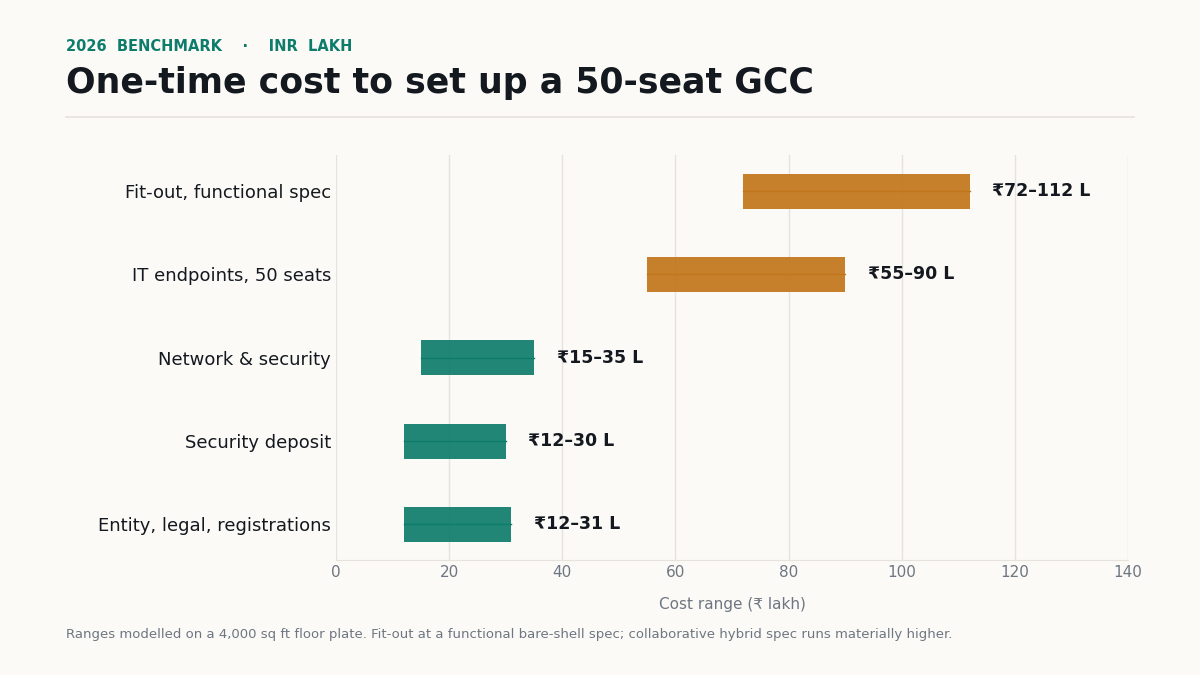
- Incorporation of a wholly-owned subsidiary (CIN, PAN, TAN, DIN, MOA/AOA): ₹2–6 lakh including professional fees
- FEMA and FC-GPR filings for inbound share capital: ₹1–3 lakh
- Statutory registrations GST, Shops & Establishments, Professional Tax, PF, ESIC: ₹1.5–4 lakh
- Employment and IP infrastructure contract templates, IP assignment deeds, POSH policy, employee handbook: ₹3–8 lakh
- Transfer pricing study and documentation setup: ₹4–10 lakh in year one
Total: ₹12–31 lakh (USD 14K–35K) the smallest slice of GCC setup cost India, and the one with the longest tail of consequences. The legal documents required for GCCs in India are not expensive to produce. They are expensive to retrofit, which is what happens when the first ten hires sign contracts without proper IP assignment clauses.
The gcc one time setup cost line dedicated teams most often miss: PF and ESIC registration can take 45–60 days to go live after incorporation. Your first cohort may need to run payroll through an employer of record in the interim. That bridge costs 8–12% of payroll for a month or two.
Real Estate: Deposits and Fit-Out
This is the single largest swing factor in any GCC setup cost India calculation, and it is entirely a choice.
Grade A rents in Bengaluru now clear ₹100 per sq ft per month in prime corridors, with secondary tech corridors at ₹70–120 and Hyderabad and Pune 15–25% below Bengaluru. At 80 sq ft per seat, a 50-seat floor plate is ~4,000 sq ft.
- Security deposit: 3–6 months’ rent = ₹12–30 lakh (USD 14K–34K)
- Bare-shell fit-out, functional spec: ₹1,800–2,800 per sq ft = ₹72 lakh–₹1.12 crore
- Collaborative hybrid spec: Cushman & Wakefield benchmarks Indian markets at ₹5,847–₹6,567 per sq ft (USD 65–73) ₹2.3–2.6 crore for the same floor plate
That three-fold spread between “functional” and “collaborative hybrid” is where most capability center cost india estimates go wrong. Teams benchmark against the premium number and build to the functional one, or the reverse.
The negotiation point is worth knowing: in competitive leasing markets, landlords offer fit-out contributions of ₹300–800 per sq ft or a rent-free period of 2–6 months against a 5+ year commitment. On 4,000 sq ft that is ₹12–32 lakh of recoverable value and it is almost never in the opening term sheet. Ask for it explicitly, priced against the lock-in you’re accepting.
The managed-office alternative bundles rent, fit-out, furniture, connectivity, and facilities at ₹7,000–24,000 per seat per month with a 2–3 month deposit. Zero capex. For a first center under 100 seats, the payback math rarely favors owning the fit-out.
IT, Security, and Infrastructure Capex
- Endpoints laptop, dual monitors, dock, MDM enrollment: ₹1.1–1.8 lakh per seat = ₹55–90 lakh for 50
- Network and security firewall, switching, VPN concentrator, access control, CCTV, UPS/DG allocation: ₹15–35 lakh
- Collaboration and identity stack SSO, endpoint detection, DLP: ₹6,000–15,000 per seat annually
Security architecture is where the build-versus-managed decision has real consequences for GCC setup cost India. If your India entity will handle regulated data, the ISO 27001 and SOC 2 scope extension typically adds ₹15–30 lakh and 4–6 months.
Plan the audit before you sign the lease, not after. Teams that need to hire cloud engineers for infrastructure ownership should hire that role first, not fifteenth the architecture decisions made in month two are the ones you live with.
Recurring Cost: Payroll and Statutory Load
Payroll is 70–85% of steady-state spend. Everything else in GCC setup costs India is noise by comparison.
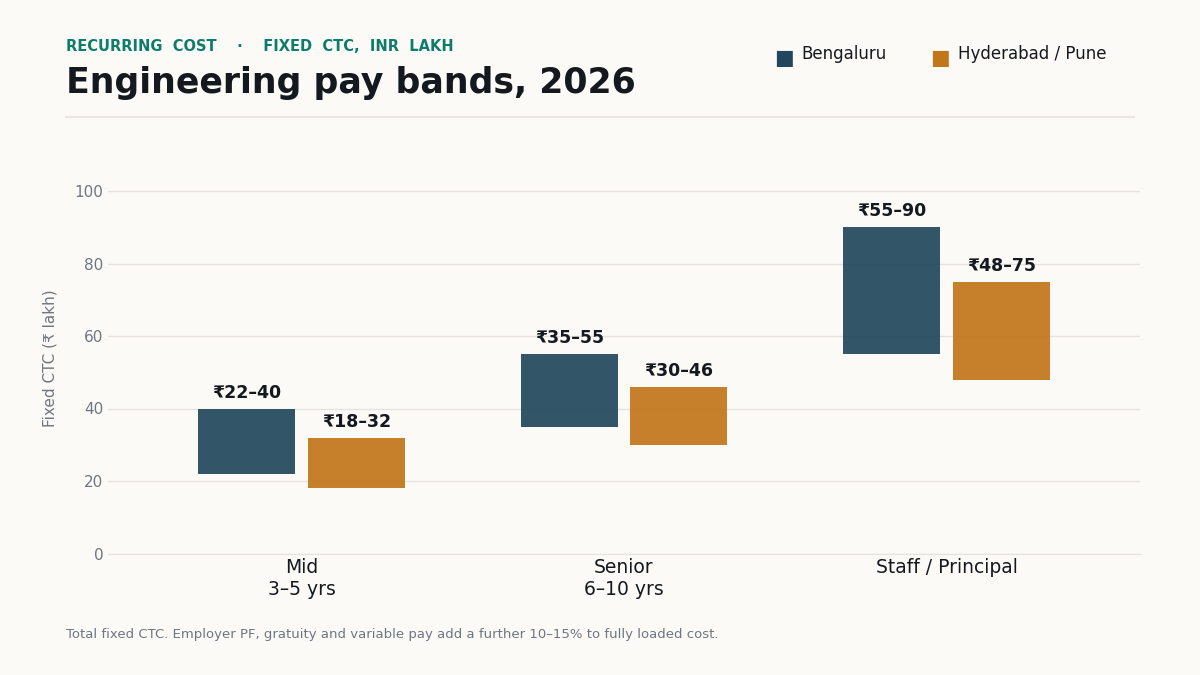
2026 India GCC compensation for engineering roles, total fixed CTC:
| Level | Bengaluru | Hyderabad / Pune |
| Mid (3–5 yrs) | ₹22–40 L | ₹18–32 L |
| Senior (6–10 yrs) | ₹35–55 L | ₹30–46 L |
| Staff / Principal | ₹55–90 L | ₹48–75 L |
| AI/ML specialist | +25–40% premium | +25–40% premium |
On top of fixed CTC, add employer PF (12% of basic), gratuity accrual (~4.81%), group medical and life, and variable pay at 15–25%. Fully loaded cost runs 10–15% above the CTC number you negotiated.
A blended 50-person engineering team says 40% mid, 45% senior, 15% staff lands at roughly ₹13–18 crore per year (USD 1.5 — 2.0 Mn) fully loaded in Bengaluru, and 15–20% less in Hyderabad. Roles like hiring DevOps engineers and SRE sit at the upper end of the senior band because the qualified pool is genuinely thin.
GCC Cost Per Seat: The Number Your CFO Will Ask For
Fold everything together and the gcc cost per seat for an engineering-heavy center lands at ₹32–48 lakh per year (USD 36K–55K) fully loaded payroll, statutory, workspace, tooling, compliance, and amortized capex.
Split the GCC setup cost India per-seat figure by function before quoting it. Support and operations functions run ₹14–24 lakh. Data science and AI teams run ₹55–85 lakh. Quote a single blended per-seat number to a board and you will be defending it for two years.
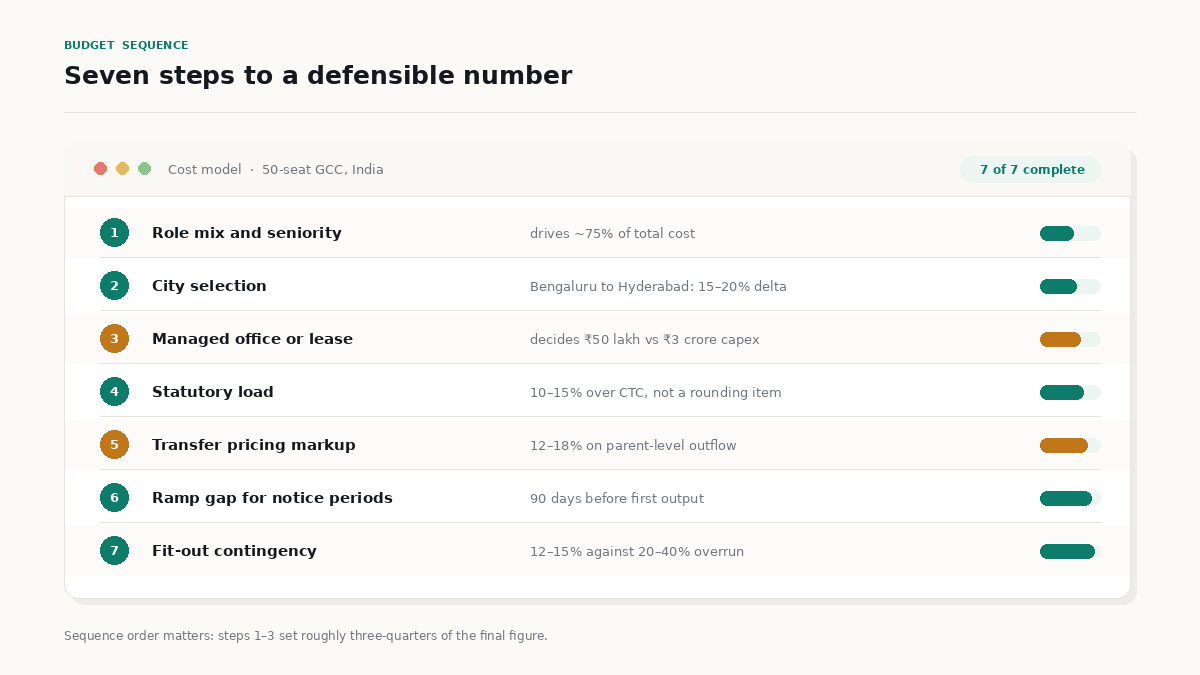
The seven-step sequence for building a defensible number:
- Lock the role mix and seniority distribution before anything else drives 75% of the total.
- Pick the city, then re-run compensation. Bengaluru to Hyderabad is a 15–20% delta on identical roles.
- Choose a managed office or lease. This decides whether year-one capex is ₹50 lakh or ₹3 crore.
- Price statutory load at 10–15% over CTC, not as a rounding item.
- Add the transfer pricing markup 12–18% to model true parent-level outflow.
- Layer a 90-day ramp gap into the hiring plan for notice periods.
- Hold 12–15% contingency against fit-out overrun, which runs 20–40% over budget with alarming regularity.
What This Looks Like in Practice
A US-headquartered fintech scaling an offshore development center for payments infrastructure moved from a two-month sourcing cycle to interview-ready shortlists in 7–10 working days by shifting from generalist recruiters to a dedicated, AI-assisted sourcing pipeline targeting the top 2% of vetted candidates. The material saving wasn’t fee percentage, it was eight weeks of unrealized capacity at roughly ₹40 lakh per month of planned team cost.
A healthtech enterprise building a 35-seat engineering pod ran its first two cohorts on a managed-office footprint while entity registrations completed in parallel, then committed to leased space only in month nine with actual headcount data in hand. The avoided cost was the fit-out they would have built for a team 40% larger than the one they needed; the largest single line in GCC setup cost India, deferred until the data justified it.
Across 527+ delivered IT projects, the consistent pattern in Supersourcing engagements is that a 98% candidate joining rate and sub-1% drop-off on contract roles matter more to a gcc setup budget than headline rate cards because a replaced hire costs a full quarter of ramp, not a recruitment fee.
Build Alone, Partner-Led, or BOT?
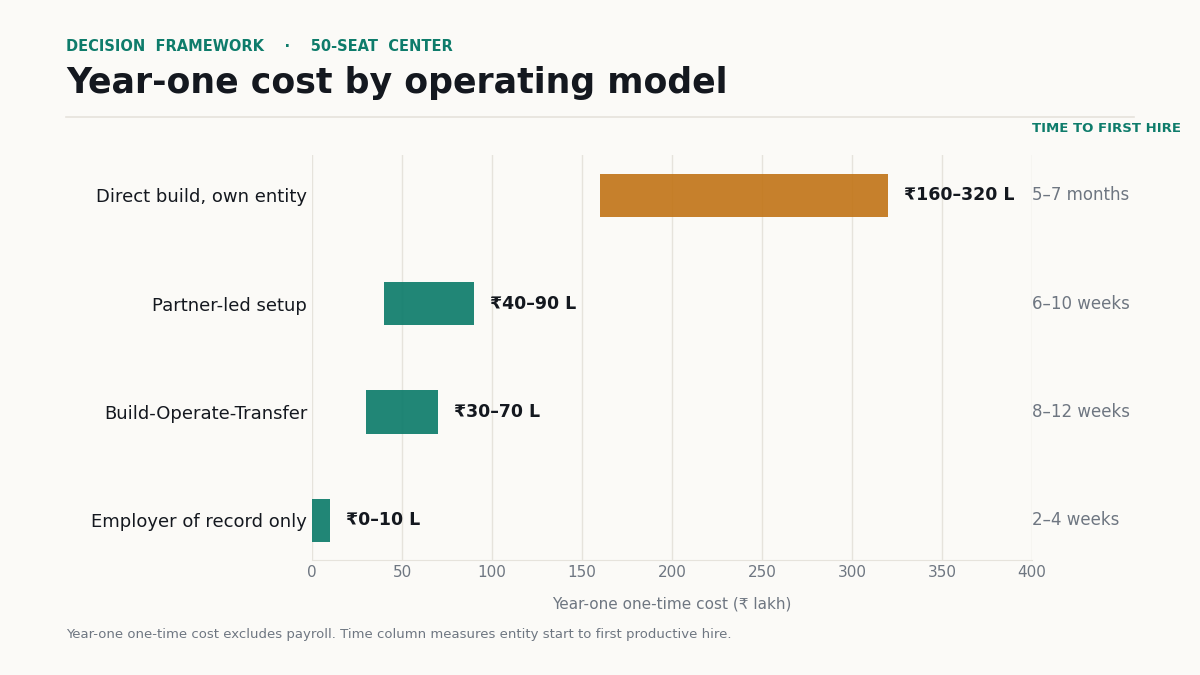
| Model | Time to first hire | Year-1 one-time cost | Best fit |
| Direct build (own entity, own team) | 5–7 months | ₹1.6–3.2 Cr | 200+ seat roadmap, existing India leadership |
| Partner-led (entity yours, hiring + ops outsourced) | 6–10 weeks | ₹40–90 lakh | 25–100 seats, first center, speed priority |
| Build-Operate-Transfer | 8–12 weeks | ₹30–70 lakh + transfer fee | Committed long-term, want optionality on control |
| Employer of record only | 2–4 weeks | Under ₹10 lakh | Under 15 seats, testing the market |
GCC setup cost India varies more by operating model than by city. The decision hinges on one question: do you have an India-based leader who has done this before? If yes, direct build is defensible.
If not, the partner or BOT route buys you that experience for less than the cost of the mistakes. Teams weighing this alongside broader IT consulting services should price the two options on 24-month total cost, not on setup fee.
What Most Teams Get Wrong
Most teams optimize the wrong variable in GCC setup cost India. They negotiate hard on recruitment fees and vendor margin 3–5% of total spend while accepting compensation bands set 20% below market, which drives 25–35% first-year attrition. Replacing a senior engineer costs a full quarter of ramp plus re-hire. Underpaying ten engineers to save ₹40 lakh and losing three of them costs more than the saving, twice over.
The second error is treating cost arbitrage as the business case. It was a valid thesis in 2012. In 2026, with GCC revenue having grown from roughly USD 40 billion in FY2019 to USD 64.6 billion by FY2024 and onward from there, the centers that justify themselves on labor cost alone are the ones that get consolidated in the next downturn. The ones that survive own a product line, a platform, or a P&L.
Before You Commit to a Number
If you’re modeling a GCC setup cost India scenario and want to pressure-test it before a vendor conversation role mix, city, entity route, and the compliance lines that don’t show up until month four it’s worth running your assumptions past a team that has built this repeatedly rather than once.
Send the draft model to mayank@engineerbabu.com or start a conversation at supersourcing.com/contact-us. No pitch deck. We’ll mark up your numbers and tell you which three are wrong.
FAQ
How much does it cost to set up a GCC in India?
GCC setup costs India for a 50-seat center runs ₹1.6 — 3.2 crore (USD 180K–365K) in one-time setup on a lease-and-fit-out route, or ₹40–90 lakh on a managed-office footprint. Recurring cost runs ₹32–48 lakh per seat per year fully loaded for engineering roles. The single biggest variable is real estate strategy, not headcount.
How long does it take to set up a GCC in India?
Entity incorporation takes 15–25 working days. Statutory registrations add 45–60 days. Office identification through fit-out completion runs 90–120 days on a leased floor plate, or 2–3 weeks in a managed office. First productive hire lands at month four to month seven depending on route, largely because of 60–90 day notice periods.
Is a GCC cheaper than outsourcing to an IT services vendor?
Per hour, usually not in year one vendor rates absorb your setup cost across their existing base. A captive center becomes cheaper somewhere between month 18 and month 30 at scale above 40–50 seats, and it delivers retained IP and institutional knowledge that a vendor contract structurally cannot.
What is the minimum team size for a viable GCC in India?
Below 15 seats, an employer of record arrangement is almost always more economical with fixed compliance and facilities overhead doesn’t amortize. The economics turn in favor of an owned entity at roughly 25–30 seats, and clearly favor it past 50.
Which Indian city has the lowest capability center cost?
Hyderabad and Pune run 15–25% below Bengaluru on both compensation and rent, with Chennai and Coimbatore lower still. But Bengaluru holds the deepest senior and AI/ML talent pool. The right question is cost per productive senior hire, not cost per seat. A cheaper city with a six-month search is not cheaper.
Do I need a legal entity, or can I start on an employer of record?
Start on an EOR if you’re testing the market or hiring under 15 people. Move to an owned entity once you need IP assignment under Indian law, statutory optionality, and a cost structure that scales. Running both in parallel during the transition is standard, not a failure of planning.
What’s the fastest way to pressure-test a GCC setup quote?
Ask any vendor for the seven line items above, individually priced, with the transfer pricing markup stated explicitly. Any quote that bundles GCC setup cost India into one figure is hiding either the fit-out assumption or the compensation band. Both are the numbers that matter.
