

The resumes look identical. Both candidates list Python, PyTorch, “deep learning,” and a Kaggle medal. Both have “worked with LLMs.” One of them will ship a production retrieval-augmented generation system in eight weeks. The other will spend three months fine-tuning a model that a well-written prompt would have outperformed on day one and you won’t find out which is which until the budget is gone.
That gap is the single most expensive blind spot in AI hiring right now, and it exists because most teams that hire ML engineers for NLP work evaluate candidates against a generic machine learning checklist. The checklist passes both candidates. The project only survives one of them.
The stakes are no longer niche. Language-centric AI has moved from research curiosity to the fastest-growing layer of the enterprise stack, and the hiring market has not caught up: job descriptions still say “ML engineer,” interview loops still test gradient descent trivia, and language-specific competence tokenization behavior, fine-tuning judgment, evaluation design goes untested entirely.
The global natural language processing market was estimated at $59.70 billion in 2024 and is projected to reach $439.85 billion by 2030, a 38.7% CAGR, one of the steepest growth curves of any enterprise software category.
This guide is the internal playbook we use to vet language-AI talent, made public. It covers the full lifecycle: what an NLP specialist actually knows that a generalist doesn’t, how to scope the role, how to test for the difference in under two hours of interview time, what to pay in India and the US, and how to manage the engagement after the offer is signed. Read it end to end and you should be able to run the entire process yourself or know exactly what to demand from a partner who runs it for you.
TL;DR
This guide is for CTOs, engineering leaders, and founders deciding whether to hire ML engineers for NLP projects or bring in dedicated NLP specialists. It walks through the full process: defining the role, vetting candidates, structuring the contract, onboarding, and managing delivery. It is written for people making a hiring decision in the next quarter, not for students.
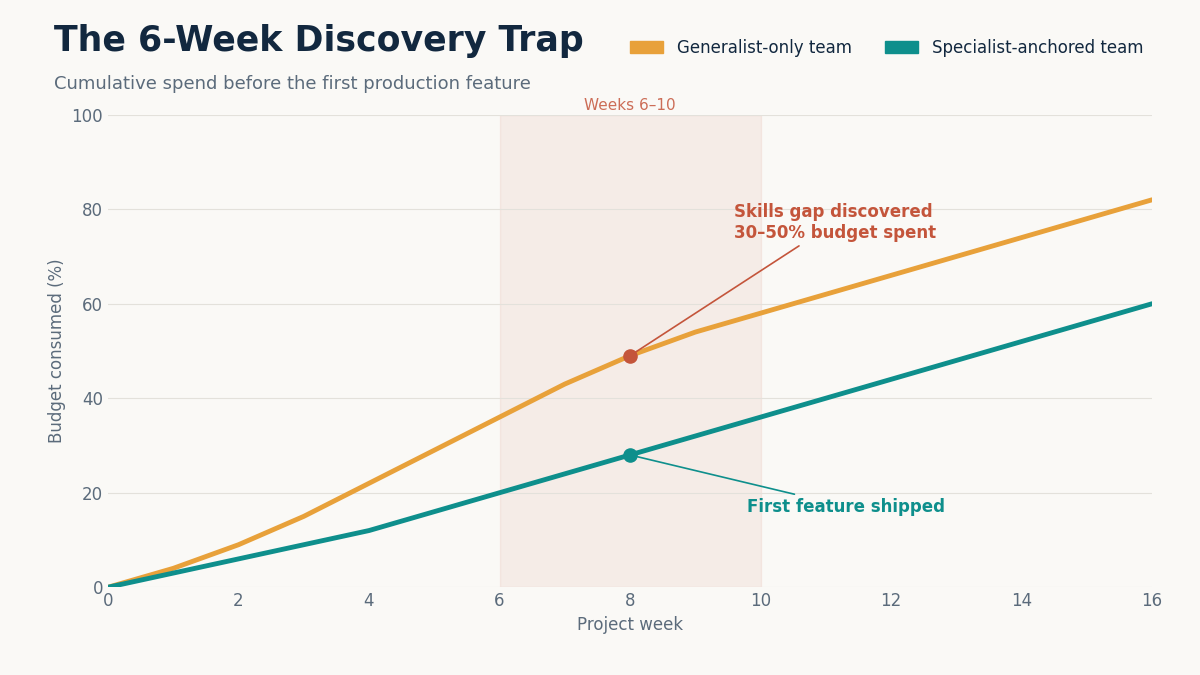
The single most useful number in it: teams that skip specialist vetting typically discover the skills gap 6–10 weeks into the project, after burning 30–50% of the budget on approaches an experienced NLP engineer would have ruled out in the first week. A structured vetting process compresses hiring to 7–10 working days and moves that discovery to before the contract is signed.
By the end, you will be able to write an accurate job scope, run a two-hour evaluation that separates real NLP engineer skills from résumé keywords, benchmark compensation against current market bands, and set up the first 30 days so your hire ships a measurable result before month two.
What Is an NLP Engineer?
An NLP engineer is a machine learning engineer who specializes in systems that process, understand, or generate human language combining core ML skills (modeling, training, deployment) with language-specific expertise in tokenization, transformer architectures, fine-tuning, prompt and retrieval design, and the evaluation of inherently ambiguous text outputs.
What an NLP engineer is not:
- Not a data scientist with a chatbot side project. Data scientists analyze and explain; NLP engineers build and ship production language systems with latency, cost, and reliability constraints.
- Not a prompt engineer. Prompting is one tool in the kit. An NLP engineer also knows when prompting fails and fine-tuning, retrieval, or a smaller custom model is the right call and can execute all three.
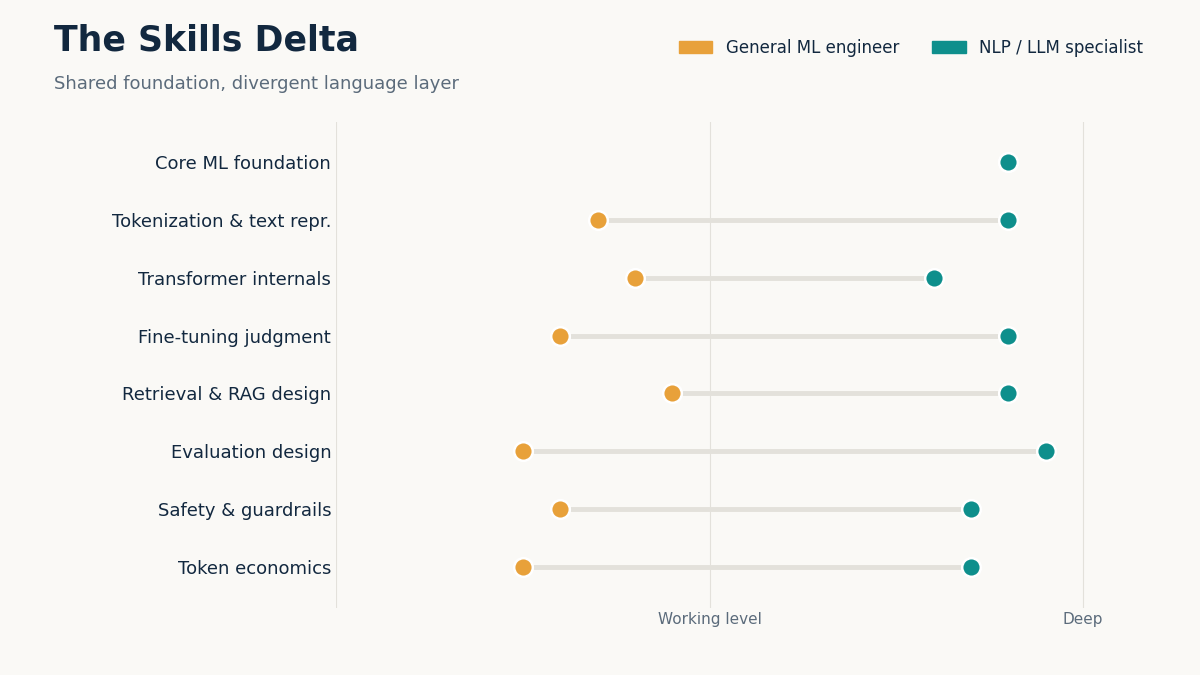
- Not interchangeable with a general ML engineer. The overlap is real (roughly 60–70% of the foundation is shared), but the remaining 30–40% the language-specific layer is exactly where NLP projects live or die. The rest of this guide is about that layer.
Why the Distinction Matters: The Business Case
Getting the specialist-vs-generalist call right is not an academic HR question. It shows up directly in four line items, and the NLP vs ML engineer distinction drives every one of them.
- Budget burn rate. A generalist exploring the LLM landscape by trial and error typically spends 2–3x longer in the experimentation phase. At contract rates of $50–90/hour, an extra 6 weeks of exploration is $12,000–$21,000 of pure discovery cost per engineer before a single production feature ships.
- Cloud and GPU spend. Fine-tuning decisions have hard infrastructure costs. Choosing full fine-tuning where LoRA (a parameter-efficient method) would do can multiply GPU spend 5–10x. Specialists make this call correctly by default; generalists learn it by invoice.
- Time to first ship the feature. In our engagements, teams with at least one genuine NLP specialist ship a first production language feature in 6–10 weeks. Dedicated teams staffed entirely with generalists typically take 4–6 months when they ship at all.
- Risk and rework. Language systems fail in ways tabular ML doesn’t: hallucinations, prompt injection, toxic output, silent quality drift when an upstream model API changes. Specialists build evaluation harnesses and guardrails from week one; generalists usually bolt them on after the first incident.
There’s a broader market reason to take this seriously. McKinsey’s latest State of AI survey finds that 88% of organizations now use AI in at least one business function yet only around 6% are capturing meaningful bottom-line impact. The gap between “we use AI” and “AI moves our EBIT” is, in most cases we’ve seen, a talent-fit gap. The companies in the 6% didn’t just buy tools; they hired people who knew which tools to skip.
The Core Problem: Why Most NLP Hiring Fails Before the Interview
The 6-week discovery trap. The most common failure pattern is depressingly consistent. A team decides to add a language feature: a support copilot, document extraction, semantic search. They assign or hire a strong general ML engineer. Everything looks fine for a month. Then, somewhere in weeks 6–10, three things surface at once:
- Evaluation was never designed. The team has demos, not metrics. Nobody can say whether version 3 is better than version 2 except “it feels better.” Without a labeled evaluation set and an automated harness, every iteration is a coin flip.
- The architecture bet was wrong. The engineer fine-tuned a model when retrieval-augmented generation was the right tool, or built a RAG pipeline when a 200-example fine-tune would have been cheaper and faster. Reversing an architecture bet at week 8 costs 3–4x what making the right bet at week 1 would have.
- Costs don’t scale. The prototype worked on 50 test queries. At production volume, inference costs come in at 4–10x the estimate because nobody thought about token counts, context-window bloat, caching, or model right-sizing.
Most teams underestimate the specialization gap by 3–4x. In scoping calls, hiring managers routinely estimate that “maybe 20% of the work is NLP-specific.” When we decompose the actual project plan with them, language-specific decisions, tokenizer behavior, chunking strategy, embedding model selection, eval design, fine-tuning method, guardrails typically account for 60–80% of the decisions that determine whether the project succeeds. The generalist can execute most of the tasks; the specialist makes most of the calls that matter.
Red flag at the org level: if your job description for an NLP role was produced by copying an ML engineer JD and adding the words “LLM experience a plus,” you are pre-filtering for exactly the wrong candidate pool. The next section fixes that.
The NLP Engineer Skills Map: What Actually Goes in the Job Description
Before the process walkthrough, fix the artifact that shapes everything downstream: the JD. The machine learning engineer vs NLP specialist distinction has to be legible in the posting, or the applicant pool will be 80% generalists and your screeners will drown.
Must-have skills (the specialist layer) list these explicitly:
- Text representation fluency: subword tokenization (BPE, SentencePiece), embedding models, and the ability to debug language- and script-specific failures non-negotiable for any Indian-market product touching code-mixed input.
- Experience fine-tuning large language models with parameter-efficient methods (LoRA/PEFT), including dataset curation and the judgment to know when not to fine-tune.
- Retrieval engineering: chunking strategy, embedding selection, vector database operations, reranking and evidence of maintaining a RAG system under real traffic, not just building one for a demo.
- Evaluation design: constructing labeled eval sets, human rubrics, LLM-as-judge pipelines; understanding where BLEU, ROUGE, and perplexity mislead.
- Production guardrails: hallucination mitigation, prompt-injection defense, content filtering appropriate to the domain.
Shared foundation (screen for it, but don’t let it dominate the JD):
- Python plus the modern stack: PyTorch, Hugging Face Transformers, standard MLOps tooling for training, serving, and monitoring.
- Deployment literacy: containerized inference, latency profiling, quantization and distillation for cost control.
- Ordinary software hygiene: version control, code review, testing specialists who can’t operate inside an engineering team are researchers, and that’s a different hire.
Nice-to-have (genuinely optional don’t inflate these into requirements): multilingual model experience, speech/ASR exposure, agent-framework experience, published benchmarks or open-source contributions.
The one-line litmus test for your draft JD: could a strong general ML engineer read it and honestly believe they’re fully qualified? If yes, rows 1–5 above aren’t explicit enough, and you’ll pay for the ambiguity in screening hours. Teams that hire ML engineers for NLP roles off a generic JD report 30–60% of applicants failing the first portfolio screen; a skills-explicit JD cuts that noise roughly in half before a single interview is booked.
One more market note while calibrating expectations: this talent pool is tightening, not loosening. Statista’s forecast series has the worldwide NLP market compounding at over 25% annually through 2030, and specialist supply is growing far slower than the demand curve. The JD is your first filter and your first pitch senior specialists skim postings the way you skim résumés, and a vague one signals a team that doesn’t know what it’s buying.
How to Hire ML Engineers for NLP Work: The Full Walkthrough
This is the complete lifecycle, from the day you decide you need language-AI talent to the day you scale the team or wind the engagement down. Each phase includes the checklist we actually run. Skip phases at your own risk every one of them exists because a real project broke there.
Phase 1 Defining Requirements: Scope, Skills, Timeline, Budget
Before a single resume is screened, answer four questions in writing. Vague inputs here guarantee a mis-hire.
- Classify the project type. NLP roles are not one role. Match the work to the profile:
- Applied LLM / GenAI product work (copilots, RAG systems, agents): needs strong LLM engineering skills, prompt design, retrieval pipelines, vector databases, function calling, latency and cost optimization.
- Fine-tuning and model adaptation (domain-specific models, instruction tuning): needs hands-on experience with LoRA/PEFT, dataset curation, training infrastructure, and evaluation design.
- Classic NLP pipelines (NER, text classification, sentiment analysis, sequence labeling at scale): needs feature engineering for text, annotation pipeline design, and often multilingual handling.
- NLP platform / MLOps (serving, monitoring, quantization, distillation): closest to a general ML engineer, but with inference-cost and token-economics literacy layered on.
Most real projects blend two of these. Name the primary and secondary profile explicitly in the JD.
- Decide the seniority mix. A workable rule: one senior specialist (6+ years ML, 3+ years language-focused) can direct 2–3 mid-level engineers who may be strong generalists. What does not work is a team of generalists with no specialist anchor that’s the 6-week discovery trap with more salaries attached. If you already hire machine learning engineers for your broader data stack, the pragmatic move is often to add one specialist anchor rather than replace the team.
- Set the timeline honestly. Working benchmarks:
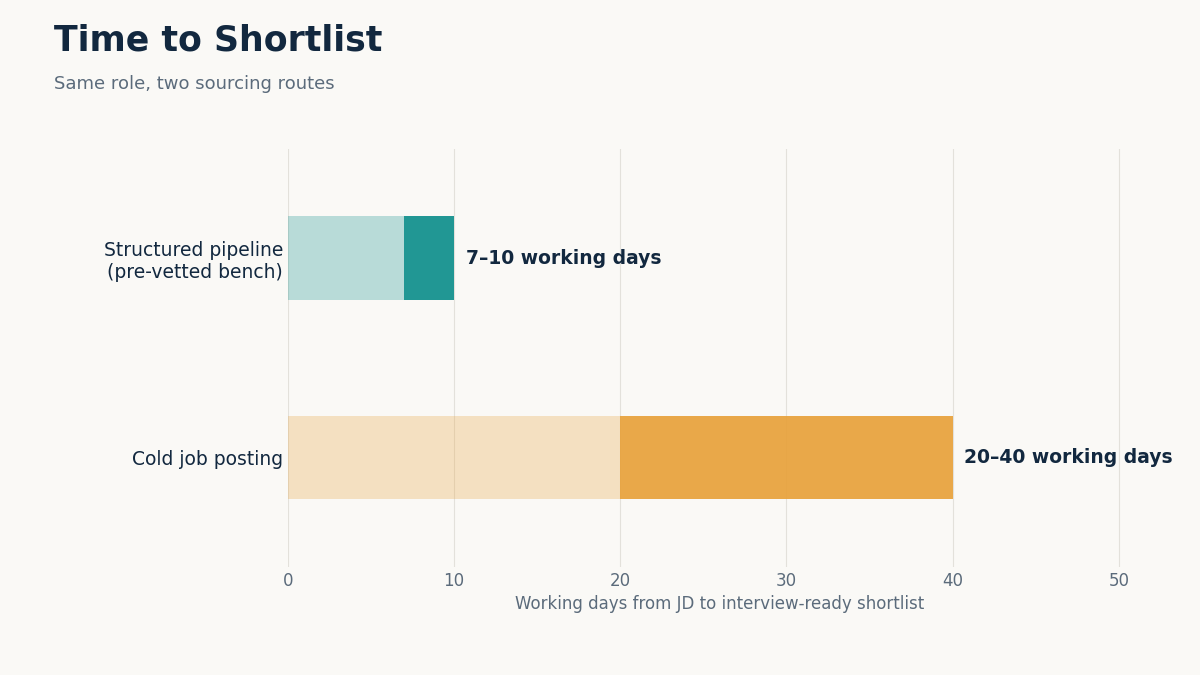
- JD to interview-ready shortlist: 7–10 working days with a structured pipeline; 4–8 weeks via cold job postings.
- Offer to join: 2–4 weeks for contractors; 30–90 days for full-time hires serving notice periods in India.
- Joining the first shipped feature: 6–10 weeks with a specialist; budget double for a generalist learning on the job.
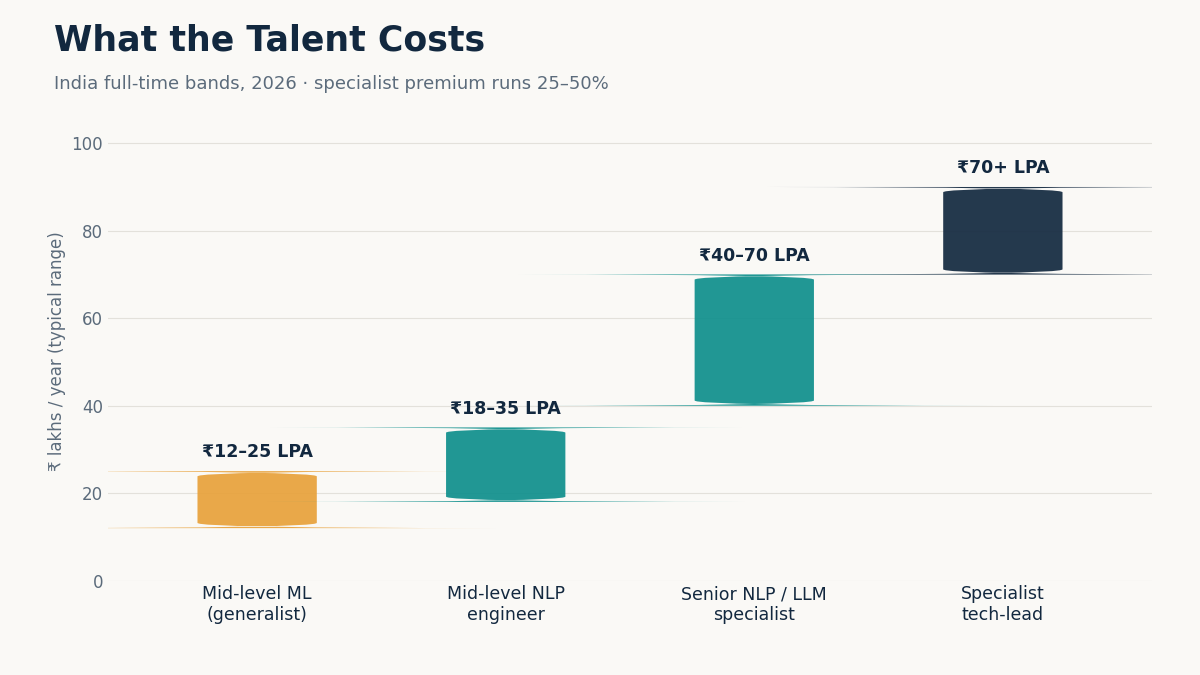
- Fix budget bands before sourcing. (Full cost detail in the Reality Check section below.) As anchors: mid-level NLP engineers in India typically run ₹18–35 lakhs/year full-time or $30–55/hour on contract; senior LLM specialists run ₹40–70 lakhs/year or $55–95/hour. US-based equivalents run roughly 3–4x. If your budget only supports the generalist band, it is usually better to hire one specialist part-time as a technical director than two generalists full-time.
Phase 2 Sourcing & Vetting: What Good Screening Actually Looks Like
This is the phase where the NLP engineer skills gap gets caught or doesn’t. Résumé keywords have near-zero predictive power here, because every ML resume written since 2023 contains the string “LLM.”
The three-layer screen (2.5–3 hours total per serious candidate):
- Layer 1 Portfolio forensics (30 min, async). Ignore the skills list; read the projects. For each language project claimed, look for evidence of decisions: Why this embedding model? Why chunk at 512 tokens? How was quality measured? A candidate who can only describe what they built, not why, was following a tutorial. Genuine specialists volunteer trade-offs unprompted.
- Layer 2 Technical deep-dive (60–75 min, live). Skip algorithm trivia. Probe the language-specific layer with questions generalists reliably miss:
- “Your model handles English fine but breaks on Hindi-English code-mixed input. Walk me through your diagnosis.” (Tests tokenization intuition subword tokenizers like BPE and SentencePiece behave very differently across scripts, and specialists know it.)
- “When would you fine-tune instead of using retrieval? Give me a case where fine-tuning was the wrong call.” (Tests architecture judgment, the single most expensive skill.)
- “Design the evaluation for a customer-support summarizer. What do you measure, and what do BLEU or ROUGE scores miss?” (Tests whether they understand that n-gram metrics correlate poorly with human judgment on generation tasks specialists build LLM-as-judge or human-rubric evals; generalists cite ROUGE and stop.)
- “Our inference bill is 6x the estimate. First three things you check?” (Looking for: context-window bloat, missing caching, model over-sizing, quantization opportunities.)
- Layer 3 Work sample (60–90 min, paid if longer). A small, real task: given a messy document set, design and partially implement a retrieval pipeline, including a written note on chunking strategy and how they’d evaluate it. The written reasoning is worth more than the code.
Red flags that end the process early:
- Every language problem gets the same answer (“fine-tune a model” or, equally, “just prompt GPT”) one-tool thinkers are generalists in costume.
- No evaluation instinct: they describe building systems but can’t describe measuring them.
- Hallucination-blindness: no mention of guardrails, grounding, or failure modes when designing a user-facing system.
- Claims of “training LLMs from scratch” at a company that plainly lacked the computer inflated vocabulary is the most common résumé in this market.
For teams sourcing at volume, this is also where a specialist bench matters: a partner that pre-vets candidates specifically against this layer the way Supersourcing (a LinkedIn Top 20 Startup in 2023 and 2024, and part of the Google for Startups AI Accelerator 2024 cohort) vets before presenting anyone to hire LLM developers collapses Layers 1–2 into work you never have to repeat.
Phase 3 Engagement Models & Contracts
Three viable structures, with honest trade-offs:
| Model | Best for | Typical cost (India talent) | Control | Risk profile |
| Dedicated full-time hire | Core, multi-year language products | ₹18–70 LPA + 15–20% hiring overhead | Highest | Notice periods (30–90 days); mis-hire cost is 6+ months |
| Staff augmentation / dedicated contractor | 6–18 month builds, uncertain long-term scope | $30–95/hour | High (your processes, your standups) | Low replacement clauses shift mis-hire risk to the vendor |
| Project-based / outcome contract | Well-scoped, bounded deliverables (e.g., “migrate classification pipeline to LLM-based extraction”) | $25k–150k+ per project | Lower day-to-day | Scope-change friction; quality depends entirely on vendor vetting |
Contract terms that matter more in NLP than elsewhere:
- IP and data clauses with teeth. Your fine-tuning data and prompt libraries are competitive assets. Contracts should cover NDA-backed IP assignment explicitly including derived artifacts: prompts, eval sets, model weights, annotation guidelines.
- Replacement guarantee. Given how hard this skill set is to verify from a résumé, insist on a defined replacement window. (Ours is 7–10 days if a hire isn’t a fit; anything vaguer than a number is a marketing line, not a guarantee.)
- No shared bandwidth. In staff augmentation, require contractual confirmation that the engineer is dedicated to your account. Fractional attention on a fast-moving LLM project is where quality quietly dies.
- Model and data residency terms. If you’re in fintech or healthtech, specify where customer text may be sent (third-party model APIs vs self-hosted), in the contract, not in a Slack thread later. Established IT staffing services will have standard riders for this; if a vendor looks surprised by the question, that’s your answer.
Phase 4 Onboarding & Ramp-Up: The First Two Weeks
NLP hires ramp differently from general software hires because their first-week bottleneck is data access, not codebase familiarity.
Week 1 checklist:
- Day 1: data access, not just repo access. Sample production text data (anonymized as needed), existing prompts, any labeled datasets. An NLP engineer without data is a very expensive spectator.
- Day 1–2: model/API credentials and budget. API keys with a defined monthly spend cap, GPU access if fine-tuning is in scope. Setting the cap on writing exploration without a budget line is how surprise invoices happen.
- Day 2–3: the “known failures” download. Hand over every embarrassing output, user complaint, and abandoned experiment. Specialists mine failure archives faster than any documentation.
- Day 3–5: baseline evaluation task. First real assignment: build or extend the evaluation set for the current system. This is deliberately not a feature it forces domain immersion and produces the measuring stick every later change will be judged against.
Week 2: the first measurable win. Scope one narrow, shippable improvement, a prompt revision that lifts eval scores, a chunking fix, a caching layer that cuts inference cost. The point is cadence-setting: measured improvement, shipped, in under 14 days.
Communication cadence that works: daily async progress notes, one 30-minute weekly demo against the eval set, and a dedicated account or engineering manager as a single point of contact. Language projects generate more ambiguity than most software work; tight feedback loops are the antidote.
Phase 5 Managing Delivery: KPIs That Aren’t Vibes
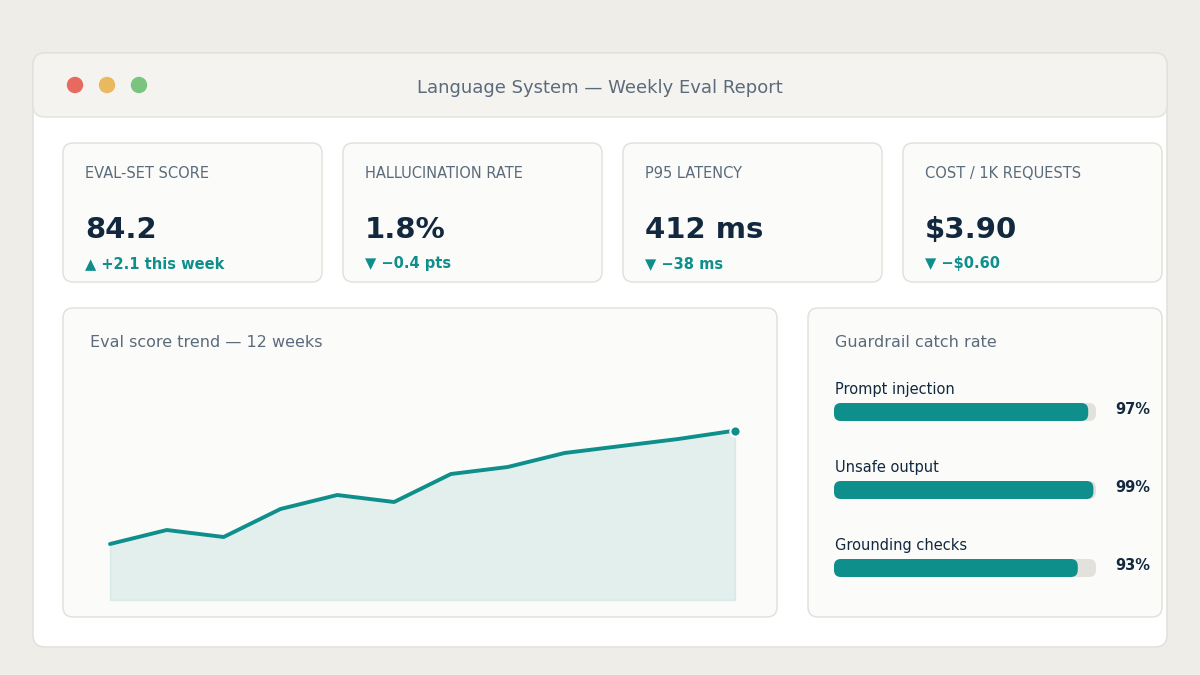
“The chatbot seems better” is not a KPI. Language systems need a two-tier metric structure:
Tier 1 System quality (owned by the engineer):
- Eval-set score trend (task-appropriate: exact-match for extraction, rubric or LLM-as-judge scores for generation, F1 for classification/NER)
- Hallucination / grounding-failure rate on a fixed adversarial set
- p95 inference latency and cost per 1,000 requests
- Guardrail catch rate (prompt-injection and unsafe-output tests)
Tier 2 Business outcomes (owned jointly with product):
- Deflection rate, task-completion rate, or extraction accuracy against human baseline whichever maps to the feature
- User acceptance/thumbs-up rate where the UI captures it
Reporting cadence: weekly eval-score deltas, monthly cost-per-request review, quarterly architecture review (model landscape shifts fast enough that a design that was right in Q1 can be 5x too expensive by Q3). Red flag in delivery: an engineer who resists building the Tier 1 dashboard. Specialists want the scoreboard; it’s what proves their judgment.
Phase 6 Scaling or Exiting
Scaling signals: eval scores plateauing because iteration bandwidth (not ideas) is the constraint; a second language surface on the roadmap; annotation and data-curation work eating >30% of your specialist’s time (hire a mid-level or data-focused engineer under them, not a second senior).
Scaling sequence that works: specialist anchor → mid-level applied engineer → data/annotation support → dedicated eval/QA capacity. Inverting this order (data people first, specialist last) is common and consistently painful.
Exit hygiene: whether ending a contract or an employment relationship, the offboarding checklist for NLP roles has three items general roles don’t:
(1) prompt libraries and eval sets committed to your repos, not personal notebooks;
(2) fine-tuned model weights and training configs transferred with reproduction instructions;
(3) API keys rotated and third-party model accounts audited. Assume nothing is documented until you’ve verified it runs without the departing engineer on the call.
Case Studies: What Specialist-Led Hiring Looks Like in Practice
100+ engineers, hyper-growth timeline Paytm. When Paytm needed to scale engineering hiring by more than a hundred developers, the binding constraint wasn’t candidate volume; it was vetting throughput without quality collapse. A pre-vetted pipeline with role-specific technical screens kept joining rates high while compressing time-to-shortlist to days rather than months. The lesson for NLP project hiring: the screen design, not the sourcing channel, is what protects quality at speed.
Food-delivery scale, specialized roles Swiggy. Swiggy’s hiring scale-up required filling specialized engineering roles where generic screening produced noisy shortlists. Role-calibrated vetting testing candidates against the actual decisions the role demands, the same principle behind the Layer 2 questions in Phase 2 above cut interview-to-offer waste dramatically. For language-AI roles, this calibration matters even more, because the résumé signal is weaker.
Recruitment automation Somnoware. For Somnoware, a healthtech platform, the recruitment process itself was automated and systematized end to end, demonstrating the compounding effect of structured pipelines: consistent screens produce consistent hires, which is precisely the property you want when the skill being screened (language-AI judgment) is expensive to verify ad hoc. Across Supersourcing engagements like these, the aggregate numbers hold up: 527+ delivered IT projects, a 98% candidate joining rate, and under 1% drop-off on contract roles.
NLP vs ML Engineer: The Decision Framework
Two frameworks here, one for the skills question, one for the hiring model question.
Framework 1: The skills delta (what the specialist adds)
| Skill layer | General ML engineer | NLP / LLM specialist |
| Core ML (modeling, training loops, deployment) | ✔ Strong | ✔ Strong (shared foundation) |
| Tokenization & text representation (BPE, SentencePiece, embeddings, multilingual behavior) | Surface familiarity | Deep can debug script- and language-specific failures |
| Transformer internals & attention | Conceptual | Working knowledge knows what context-window and attention behavior imply for cost and quality |
| Fine-tuning judgment (full FT vs LoRA/PEFT vs instruction tuning vs none) | Learns by trial | Decides correctly up front; has run the failure modes before |
| Retrieval & RAG design (chunking, embedding model selection, vector databases, reranking) | Can assemble a tutorial pipeline | Designs for the corpus and query pattern; knows why pipelines silently degrade |
| Evaluation design for language (beyond BLEU/ROUGE/perplexity; human rubrics, LLM-as-judge, adversarial sets) | Weakest area, consistently | Core competency builds the harness in week one |
| Safety & guardrails (hallucination control, prompt injection, content filtering) | Bolted on after incidents | Designed in from the start |
| Token economics (inference cost modeling, caching, quantization, distillation) | Rarely considered pre-launch | Modeled before architecture is chosen |
How to use it: score your project plan’s open decisions against the left column. If most decisions sit in rows 2–8, you need at least one specialist no volume of generalist headcount substitutes.
Framework 2: Build the capability four routes compared
| Route | Speed to competence | Cost profile | Risk | Best when |
| Upskill existing ML team | 4–8 months | Salary + slowed roadmap | High (learning on production budget) | Language features are peripheral, timeline is soft |
| Hire full-time specialist | 1–3 months to join | ₹40–70 LPA senior (India) | Medium (mis-hire = 6+ months) | Language AI is core product, multi-year horizon |
| Dedicated contract specialist | 7–15 working days | $55–95/hour | Low (replacement clauses) | Need senior judgment now; scope may evolve |
| Hybrid: contract anchor + generalist team | 7–15 days + existing team | Anchor rate + current payroll | Lowest overall | Most mid-size teams, most of the time |
The hybrid route is the one most teams should default to and fewest consider: one senior specialist often sourced the way teams hire Generative AI engineers on dedicated contracts directing your existing generalists converts the 60–70% skill overlap from a liability into leverage.
What Most Teams Get Wrong
Pattern-level observations from watching this category of hire succeed and fail repeatedly. These are opinions, but they’re paid-for opinions.
- They hire for model knowledge when the scarce skill is evaluation design. Everyone can call a model API in 2026. Almost nobody can tell you, with numbers, whether last week’s change made the system better. The engineers who move business metrics are the ones who build the measuring instrument first. If your interview loop doesn’t contain a single evaluation-design question, you are testing for the abundant skill and ignoring the scarce one.
- They treat “LLM experience” as binary when it’s actually four different jobs. Prompt-and-integrate, retrieval engineering, fine-tuning/adaptation, and inference optimization are distinct competencies. Candidates strong in one routinely fail in the others. JDs that say “LLM experience required” attract all four profiles and select randomly among them.
- They over-index on research pedigree. A publication record signals research ability, not shipping ability. For product roles, a candidate who has kept a messy RAG system alive under real traffic for a year is usually the stronger hire than one with two workshop papers and no pager duty. The reverse mistake hiring pure builders for genuine research problems is rarer but equally fatal.
- They budget for salaries and forget the iteration budget. An NLP engineer without API/GPU spending room is throttled. Rule of thumb: provision 10–20% of the engineer’s monthly cost as experimentation budget (API calls, GPU hours, annotation). Teams that skip this get engineers who are afraid to run experiments, which defeats the point of hiring judgment.
- They wait too long to put a specialist in the loop. The highest-leverage moment for specialist input is before architecture is chosen exactly when most teams think they’re “not ready to hire yet.” Even 20 hours of senior specialist review at the design stage routinely saves the 3–4x rework cost documented earlier. If you remember one sentence from this guide: buy the judgment before you buy the labor.
Cost & Timeline Reality Check
The section most competing articles skip. All figures are typical market ranges observed across engagements, not quotes; your stack, domain, and seniority mix move you within them.
Compensation bands (2026, typical ranges)
| Profile | India, full-time | India-based contract | US, full-time |
| Mid-level ML engineer (generalist) | ₹12–25 LPA | $25–45/hr | $120k–170k |
| Mid-level NLP engineer | ₹18–35 LPA | $30–55/hr | $140k–190k |
| Senior NLP / LLM specialist | ₹40–70 LPA | $55–95/hr | $180k–260k+ |
| Specialist tech-lead / architect (fractional viable) | ₹70 LPA+ or retainer | $90–140/hr | $250k+ |
The premium is real but smaller than the alternative. The specialist premium over a generalist runs 25–50% at the same seniority. Set against the 2–3x experimentation-time multiple and the 3–4x architecture-rework cost, the premium pays for itself in the first quarter on any project where language is core.
Timeline benchmarks
- Structured pipeline (pre-vetted bench): JD to interview-ready shortlist in 7–10 working days; offer to start in 1–3 weeks for contractors.
- Cold job posting: 4–8 weeks to a comparable shortlist, with 30–60% of “NLP” applicants failing Layer 1 portfolio forensics.
- Full-time in India: add 30–90 days of notice period after offer acceptance plan backward from your project start date, not forward from today.
What drives cost up or down
- Up: regulated-domain data handling (healthtech, fintech), multilingual or code-mixed requirements, self-hosted model mandates, real-time latency targets under ~500ms.
- Down: English-only scope, tolerance for third-party model APIs, batch (non-real-time) workloads, an existing labeled dataset.
If You’re Mid-Decision: The Next Step
You now have the full playbook: the skills delta, the three-layer screen, the contract terms, the cost bands, and the onboarding sequence. If you’re at the stage of turning it into an actual shortlist, the highest-leverage move is a scoping conversation bring your project brief, and pressure-test which profile (applied LLM, fine-tuning, classic pipeline, or hybrid anchor) your roadmap actually needs before any résumés change hands.
Supersourcing runs exactly this process daily: AI-powered sourcing across the top 2% of vetted language-AI talent, NLP-specific technical screens built on the same Layer 1–3 framework in this guide, shortlists in 7–10 working days, dedicated (never shared) engineers, NDA-backed IP protection, and a 7–10 day replacement guarantee if a hire isn’t the fit we said they’d be the standard we’ve held across clients from Razorpay to Apollo Hospitals, and the reason for the 8.5 NPS.
Start the scoping conversation here: supersourcing.com/contact-us no deck, no pitch, just your brief against our vetting framework.
FAQ
Is an NLP engineer the same as a machine learning engineer?
No. They share a foundation roughly 60–70% of core ML skills overlap but NLP engineers add a language-specific layer: tokenization behavior, transformer and fine-tuning judgment, retrieval design, and evaluation of ambiguous text output. On language projects, that layer drives most of the decisions that determine success, which is why the roles aren’t interchangeable despite similar résumés.
Can a general ML engineer work on LLM projects?
Yes, productively under specialist direction. Generalists execute well once architecture, evaluation, and tooling decisions are made. What fails is generalist-only teams making those decisions by trial and error on a production budget. The hybrid model (one specialist anchor directing generalists) is the highest-ROI structure for most teams.
What skills should I test when hiring an NLP engineer?
Four, in priority order: evaluation design (can they measure quality beyond vibes?), architecture judgment (fine-tune vs retrieve vs prompt, with reasoning), tokenization/multilingual intuition (debugging text-specific failures), and token economics (cost modeling before launch). Résumé keywords predict none of these; the scenario questions in Phase 2 of this guide test all four in about an hour.
How much does it cost to hire an NLP engineer in India?
Typical 2026 ranges: ₹18–35 lakhs/year for mid-level, ₹40–70 lakhs/year for senior LLM specialists, or $30–95/hour on dedicated contracts depending on seniority. Add 10–20% of monthly cost as experimentation budget (API and GPU spend). The specialist premium over a generalist is 25–50%, typically recovered within a quarter through avoided rework.
How long does hiring take?
With a pre-vetted specialist pipeline, 7–10 working days from job description to interview-ready shortlist, and contractors can start within 1–3 weeks of offer. Cold job postings typically take 4–8 weeks to produce a comparable shortlist. Full-time hires in India add 30–90 days of notice period after acceptance.
What’s the difference between NLP engineering and LLM engineering?
LLM engineering is the current center of gravity within NLP: building on large pre-trained models via prompting, retrieval, fine-tuning, and agent orchestration. Classic NLP engineering also covers task-specific pipelines NER, classification, sentiment that remain the right tool where latency and cost budgets are tight. Strong hires in 2026 are fluent in both and know when the smaller tool wins.
Should I hire full-time or on contract?
Contract-first is the lower-risk default: you get senior judgment in days, replacement clauses cap mis-hire costs, and you can convert to full-time once the roadmap proves durable. Go straight to full-time only when language AI is the core product and you’re confident in a multi-year scope.
How do I know if my current team can handle it, or whether I need outside vetting help?
Run one test: ask your team to write the evaluation plan for your planned language feature metrics, dataset, pass/fail thresholds in one page. If a credible plan comes back in a week, you likely have the anchor skills in-house. If it doesn’t, that’s the gap, and a 30-minute scoping conversation with a specialist-vetting partner will tell you exactly which profile to bring in before you spend on the wrong one.
