

The average engineering leader can screen a backend developer in a 45-minute call. The same leader, handed a firmware resume full of ARM Cortex-M projects and CAN bus drivers, usually can’t tell a genuine embedded specialist from an Arduino hobbyist and the market knows it. Anyone setting out to hire embedded systems engineers inherits that information gap on day one. It is exactly why embedded roles stay open for 60–90 days while web roles close in three weeks, and why a bad embedded hire routinely costs 6–9 months of product delay instead of the 6–9 weeks a bad web hire costs.
The talent math makes it worse. Software that ships on hardware is exploding, but the people who write it are not. In the Stack Overflow Developer Survey 2024, embedded application developers remain a small single-digit share of professional developers a fraction of the full-stack and backend population even as embedded technologies like Raspberry Pi (39%) and Arduino (30%) top the survey’s new embedded tooling section. Meanwhile every product category from EV chargers to smart medical devices needs firmware written, tested, and certified.
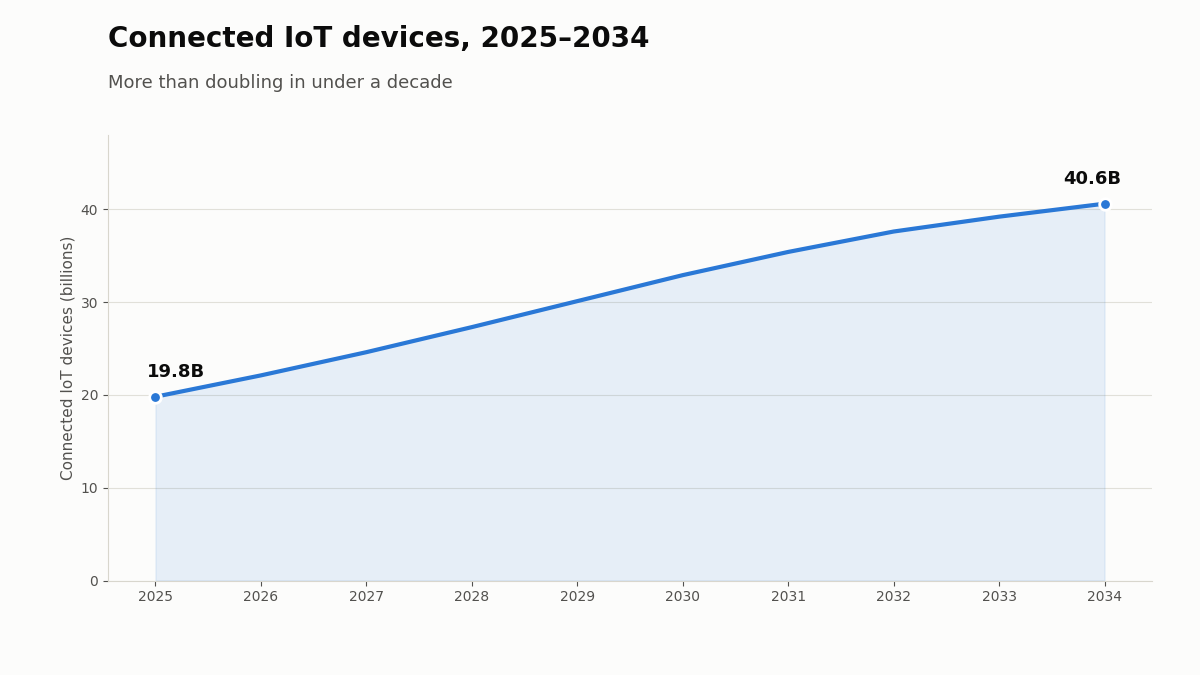
The number of connected IoT devices is forecast to grow from 19.8 billion in 2025 to more than 40.6 billion by 2034 more than doubling in under a decade.
Every one of those devices runs firmware someone had to write. Most of the teams shipping them will need to hire embedded systems engineers without having a single person in-house who can technically evaluate one.
This guide fixes that. It walks the full lifecycle defining the role, budgeting it in ₹ and $, sourcing, screening candidates when you don’t have a hardware background, structuring contracts and IP terms, onboarding around lab hardware, managing delivery, and scaling or exiting cleanly. It is written from a decade of placing engineers into fintech, healthtech, automotive, and IoT teams, and it assumes you want to run this process yourself. Read it start to finish once; after that, use it as a checklist.
TL;DR: Hiring Embedded Systems Engineers in 60 Seconds
Embedded roles take 2-3x longer to fill than web roles, and a bad hire can cost you 6-9 months of product delay. The reason? Most hiring teams can't tell a real firmware engineer from an Arduino hobbyist. This guide fixes that gap.
Inside, you'll get a skills checklist to write sharper job descriptions, a 4-part evaluation framework to vet candidates even with zero hardware background, and real budget bands for India and the US. You'll also find contract clauses firmware hiring specifically needs, an onboarding checklist built around lab hardware, and the delivery KPIs that actually work for embedded teams.
Bottom line: start sourcing 4-5 months before your need date, screen for debugging instinct over protocol lists, and always make your first embedded hire a senior. Read on for the full playbook.
What Is an Embedded Systems Engineer?
An embedded systems engineer is a specialist who designs, writes, and debugs software that runs directly on dedicated hardware microcontrollers, sensors, and custom boards under tight memory, power, and real-time constraints. The role sits on the hardware-software boundary: reading schematics and datasheets on one side, writing C/C++ firmware and drivers on the other.
To keep your job description honest, be clear about what this role is not:
- Not a general software engineer. A backend developer works with gigabytes of RAM and an OS that handles the hardware. An embedded engineer may have 64 KB of RAM, no OS at all, and a bug that only appears when a voltage rail sags.
- Not an electronics or PCB designer. Embedded engineers read schematics and debug boards; they usually don’t design the circuit or route the PCB. If you need board design, that’s a hardware engineer, a different hire.
- Not (necessarily) an “IoT developer.” Many self-described IoT developers work only at the cloud/app layer (MQTT dashboards, mobile apps). If your product needs device drivers, a bootloader, or power optimization, that’s firmware territory.
Related titles you’ll see in sourcing: firmware engineer, embedded software developer, RTOS developer, BSP (board support package) engineer, embedded Linux engineer, device driver developer. The titles overlap heavily; the skills checklist later in this guide matters more than the label.
Embedded Engineer vs Software Engineer: The Hardware-Software Boundary
The embedded engineer vs software engineer distinction is the single most common thing buyers get wrong, so it’s worth 400 words before anything else. Both write code. The resemblance mostly ends there, because embedded work is defined by constraints that application software never sees.
Where the boundary actually sits. An embedded engineer’s day is split between a code editor and physical instruments. They flash firmware onto a board over a JTAG/SWD debugger, watch signals on an oscilloscope or logic analyzer, and cross-reference a 400-page microcontroller datasheet to figure out why a peripheral register isn’t behaving.
When a test fails, the first question isn’t “which line of code?” it’s “is this a software bug, a hardware fault, a timing issue, or a power problem?” That diagnostic instinct across the boundary is the skill you’re actually hiring.
The practical differences that affect your hiring process:
| Dimension | Application software engineer | Embedded systems engineer |
| Runtime environment | OS, containers, cloud; effectively unlimited RAM | Bare-metal or RTOS; 32 KB–1 MB RAM is common |
| Primary languages | Java, Python, JS/TS, Go | C (dominant), C++, growing Rust; assembly at the edges |
| Debugging tools | Logs, breakpoints, APM dashboards | JTAG/SWD, oscilloscopes, logic analyzers, HIL rigs |
| Failure cost | Rollback in minutes | Field recall, bricked devices, safety incidents |
| Update model | CI/CD, deploy daily | OTA updates (if you’re lucky); flash cycles otherwise |
| Talent pool | Very large | Small single-digit % of all developers |
| Typical screening | Algorithms + system design | C fundamentals, concurrency/ISRs, protocol + hardware debugging scenarios |
Why this matters for hiring: if you run your standard LeetCode-style pipeline on embedded candidates, you’ll reject strong firmware engineers (many are average at abstract algorithm puzzles) and pass weak ones (who grind puzzles but have never brought up a board). The interview section later in this guide gives you an evaluation script built for the boundary, not for the web.
Red flag: a job description that lists “React, Node.js, and microcontroller experience” as one role. That’s two roles. Combining them signals to serious embedded candidates that you don’t understand the work, and your best applicants will self-select out.
Why Hiring the Right Embedded Talent Matters: The Business Case
Before the process, the stakes. Embedded hiring decisions move four business levers, and the ranges below reflect what shows up repeatedly across real device programs:
- Time-to-market. Firmware is on the critical path of every hardware launch. A single missing firmware engineer can idle an entire mechanical, electrical, and certification pipeline. Device programs slip 3–6 months more often from firmware under-staffing than from hardware issues.
- Cost of defects. A firmware bug caught after manufacturing means rework, RMAs, or recalls. Industry rules of thumb put a field-discovered embedded defect at 30–100x the cost of one caught in code review. Hiring engineers who write testable, MISRA-aware C is cheap insurance.
- Certification risk. Products touching automotive (ISO 26262), medical (IEC 62304), or industrial (IEC 61508) markets need engineers who have shipped under those standards. Retrofitting compliance onto firmware written without it commonly adds 4–8 months.
- Total economic exposure. McKinsey estimates IoT could enable $5.5–12.6 trillion in global economic value by 2030. The firms capturing that value are the ones that solved device-side engineering capacity early.
The 10x asymmetry: in web development, the gap between an average and a strong hire is productivity. In embedded, the gap is often binary if the product ships or it doesn’t. Very few generalists can debug a hard fault caused by a misconfigured DMA controller. This is why compromising on embedded vetting is more expensive than compromising almost anywhere else in engineering hiring.
The Core Problem: Why Most Embedded Hiring Efforts Fail
Most teams that set out to hire embedded systems engineers fail in predictable, measurable ways. Four patterns account for the majority of failed searches:
- Underestimating scarcity by 3–4x. Leaders budget the same sourcing effort as for a backend role. In practice, for every 100 applicants a backend posting attracts, an equivalent embedded posting attracts 25–35 and a smaller fraction of those are genuinely qualified. Expect to source outbound, not just post and wait.
- Screening with the wrong instrument. Generic coding tests measure the wrong thing. A candidate who aces array-manipulation puzzles may have never written an interrupt service routine, and a HackerRank score says nothing about whether someone can read a timing diagram. Teams that use web-style screens report false-positive rates of 40%+ on embedded hires.
- The verification gap. Hardware claims are hard to check remotely. “Worked on BLE stack integration” can mean architecting the stack or changing one config value. Without structured probing (covered in Phase 2), resume inflation goes undetected until week 6 on the job.
- Timeline denial. In India, senior embedded engineers sit on 60–90 day notice periods, and the best ones receive 3–5 competing offers. A search that starts when the firmware milestone is already at risk is a search that starts 4 months late. The realistic in-house timeline from JD to a productive engineer is 14–20 weeks; teams plan for 6.
The cost of these failures compounds: a mis-hire discovered at month 3 restarts the entire cycle, which means a device program can lose most of a year to one wrong decision. The rest of this guide is the countermeasure.
Embedded Systems Developer Skills: The Complete Checklist
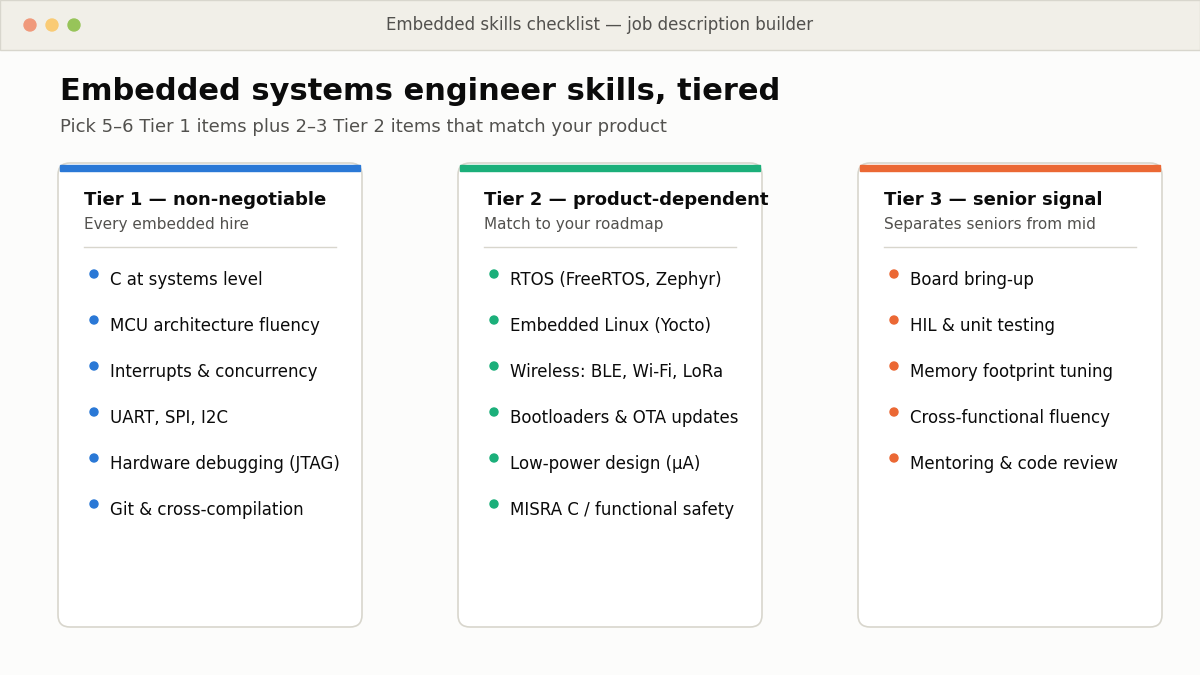
Every serious plan to hire embedded systems engineers starts with a skills map. The embedded systems developer skills below are tiered so you can build a job description in 20 minutes: Tier 1 is non-negotiable for any firmware role, Tier 2 depends on your product, Tier 3 separates seniors from mid-levels.
Tier 1 Non-negotiable core (every embedded hire):
- C programming at a systems level pointers, memory-mapped I/O, volatile and const correctness, bit manipulation, struct packing/alignment, linker scripts. C remains the dominant firmware language; C++ (embedded subset, no exceptions/RTTI) is a strong plus.
- Microcontroller architecture fluency at least one major family hands-on: ARM Cortex-M (STM32, NXP, Nordic), ESP32, TI MSP430, Microchip PIC/AVR, or Renesas. They should explain clock trees, GPIO configuration, and peripheral registers without notes.
- Interrupts and concurrency writing safe ISRs, understanding priority/nesting, race conditions, and what can and can’t be done inside an interrupt context.
- Communication protocols practical (not textbook) experience with UART, SPI, and I2C at minimum; they should be able to describe debugging a misbehaving I2C bus with a logic analyzer.
- Hardware debugging skills are comforted with a JTAG/SWD debugger (ST-Link, J-Link), reading a schematic, probing signals with an oscilloscope or logic analyzer, and interpreting a datasheet or errata sheet.
- Version control and toolchains Git, cross-compilation (GCC ARM, IAR, Keil), build systems (Make/CMake), and flashing/debugging workflows.
Tier 2 Product-dependent (match to your roadmap):
- RTOS experience FreeRTOS, Zephyr, ThreadX, or VxWorks: tasks, queues, semaphores/mutexes, priority inversion, stack sizing. Mandatory if your device does more than one thing at a time.
- Embedded Linux Yocto/Buildroot, device trees, kernel modules, and user-space drivers, for gateway-class or Linux-based products.
- Wireless connectivity BLE, Wi-Fi, LoRa, Zigbee, NB-IoT/LTE-M stacks and their certification quirks.
- Bootloaders and OTA updates secure boot, dual-bank firmware update, rollback protection. Ask specifically; many engineers have only ever flashed via debugger.
- Low-power design sleep modes, wake sources, current profiling. Critical for anything battery-operated.
- Motor control / DSP / sensor fusion for robotics, drones, wearables, and industrial control.
- Functional safety & compliance MISRA C, static analysis (Polyspace, Coverity, PC-lint), ISO 26262 / IEC 62304 / IEC 61508 exposure, DO-178C for aerospace.
Tier 3 Senior differentiators:
- Board bring-up experience: taking a brand-new PCB from “power on, nothing works” to running firmware the strongest single signal of a genuine senior.
- Hardware-in-the-loop (HIL) and unit testing for firmware (Ceedling/Unity, GoogleTest, pytest-based rigs).
- Memory footprint and performance optimization with map-file analysis.
- Cross-functional fluency: negotiating pin assignments with EE teams, flagging schematic issues before fabrication, writing test procedures for manufacturing.
- Mentoring and code review discipline in a regulated codebase.
How to use this checklist: pick 5–6 Tier 1 items plus 2–3 Tier 2 items that match your product, and make everything else “nice to have.” Job descriptions that demand all three tiers at once (“must know FreeRTOS, embedded Linux, DSP, ISO 26262, and BLE”) describe four different people and attract none of them.
The A-to-Z Walkthrough: From First Requirement to Shipped Firmware
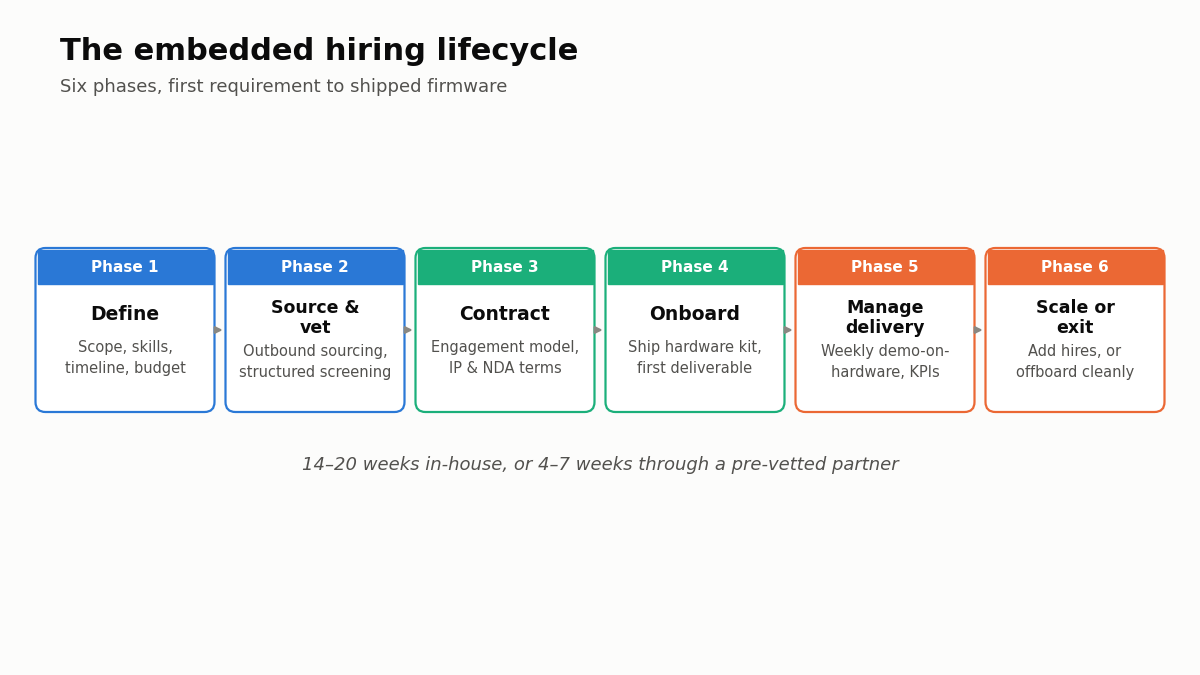
This is the core of the guide: the full lifecycle, phase by phase. Follow it in order and you can run the entire process even as a first-time buyer with no hardware background.
Phase 1 Defining Requirements: Scope, Skills, Timeline, Budget
Every failed embedded search traces back to a fuzzy definition. Before sourcing anything, answer these on one page:
- What layer of the stack is the work? Bare-metal firmware, RTOS-based application, embedded Linux/BSP, or device-adjacent cloud integration. Each is a different candidate pool.
- What hardware platform? Name the MCU family and key peripherals if the board exists. If it doesn’t exist yet, say so you then need someone with board bring-up experience (Tier 3).
- What does “done” look like in 6 months? e.g., “production firmware for our STM32-based controller passing EMC pre-compliance, with OTA update support.”
- Which certifications constrain the code? Medical, automotive, and industrial standards change who you can hire and what they cost (+20–35% on compensation).
- Seniority and team shape. One senior who owns architecture beats two mid-levels with no one to review them. For a first embedded hire, always hire a senior.
- Engagement model preference. Full-time employee, dedicated remote developer, staff augmentation, or project-based Phase 3 gives you the decision framework.
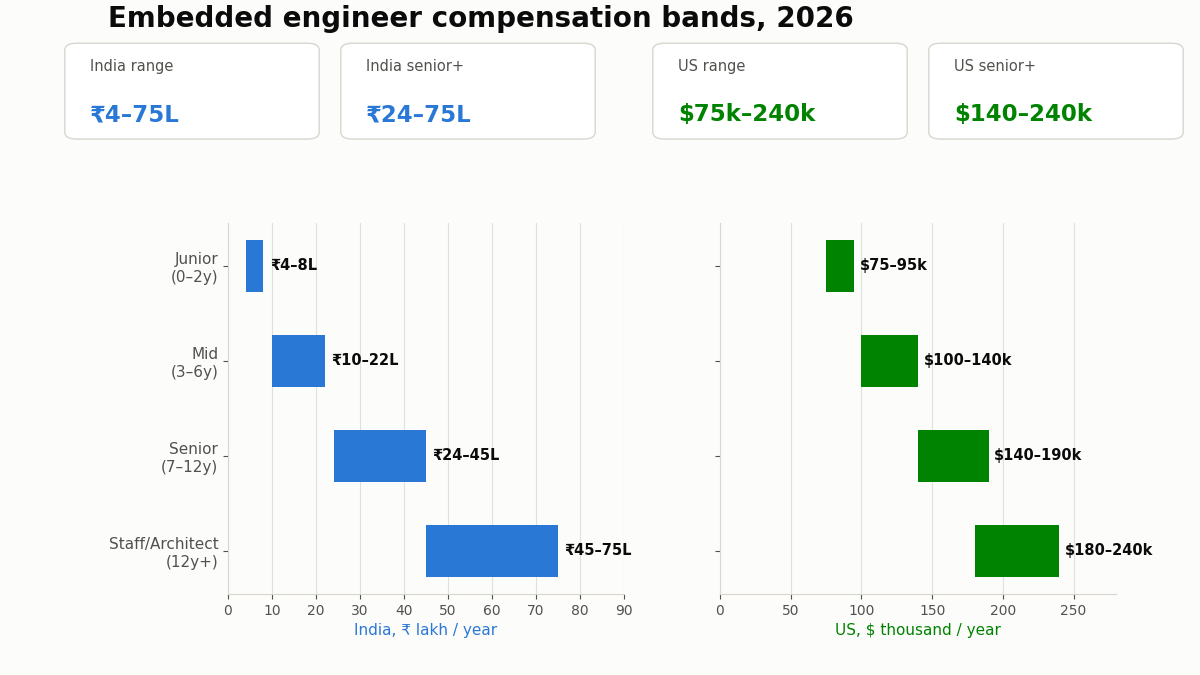
Budget bands to anchor your plan (annual compensation, 2026):
| Seniority | India (₹/year) | US ($/year) | Contract (offshore, $/hr) |
| Junior (0–2 yrs) | ₹4–8 lakhs | $75k–95k | $15–22 |
| Mid (3–6 yrs) | ₹10–22 lakhs | $100k–140k | $22–35 |
| Senior (7–12 yrs) | ₹24–45 lakhs | $140k–190k | $35–55 |
| Staff / Architect (12+ yrs) | ₹45–75 lakhs | $180k–240k+ | $55–80 |
Add 15–30% for niche premiums: functional safety, automotive AUTOSAR, secure boot/cryptography, or embedded Rust. These are directional market bands validating against live offers in your specific niche before finalizing.
The one-week rule: if you can’t produce this one-page definition in a week, you’re not ready to source. Candidates read vagueness as risk, and the good ones have alternatives.
Phase 2 Sourcing and Vetting: Finding Signal in a Thin Market
Firmware developers live or die on outbound sourcing, because the inbound funnel for these roles is 3–4x thinner than for web roles. Where the real candidates are:
- Alumni of semiconductor and device companies (Qualcomm, Bosch, Continental, Texas Instruments, NXP, Samsung R&D, Honeywell, medical device firms) the deepest pool of production-grade firmware talent.
- GitHub/GitLab activity around FreeRTOS, Zephyr, ESP-IDF, and STM32 HAL projects a public driver or board port is worth more than any resume line.
- Embedded-specific communities: EEVblog forums, r/embedded, Zephyr Discord, Embedded Online Conference attendee lists.
- Specialist talent networks that pre-vet for hardware skills an AI-driven sourcing platform that has already screened thousands of embedded profiles can compress this phase from 4–6 weeks to 7–10 working days to an interview-ready shortlist.
Resume screen 10-minute pass/fail signals:
- Named MCU families and toolchains (STM32 + GCC + FreeRTOS), not just “microcontrollers.”
- Verbs that imply the boundary: “brought up,” “debugged with logic analyzer,” “reduced sleep current to 8 µA,” “wrote SPI driver.”
- Shipped products you can look up a device on the market beats five internal prototypes.
- Progression across the stack over time (drivers → subsystems → architecture).
- Red flags: only Arduino/Raspberry Pi hobby work for a senior role; “IoT” experience that’s all cloud-side; every project described at the feature level with zero hardware vocabulary; 8 protocols and 6 RTOSes listed with no depth on any.
How to Evaluate Embedded Engineers Without a Hardware Background
This is the question every non-hardware founder asks, and it has a real answer: you can’t judge the content of embedded expertise, but you can judge its texture. Use this 4-part structure about 90 minutes total per finalist:
- The teardown narrative (20 min). “Pick one shipped project. Walk me from the schematic to production firmware.” Experts narrate in causal chains the sensor was on I2C, we saw bus lockups under EMI, so we added a bus-recovery routine and pull-up changes and volunteer trade-offs unprompted. Inflated resumes produce feature lists, not causal chains. You don’t need to understand every term; you need to hear the reasoning structure and drill “why?” three levels deep. Bluffers run out of levels.
- A constrained take-home (2–3 hrs, paid if senior). Not algorithms. Example: “Given this UART driver skeleton and this excerpt of the MCU datasheet, implement receive with a ring buffer; handle overflow explicitly; state your assumptions.” Have any strong C programmer you trust or a fractional embedded advisor at $100–150/hr for 2 hours review it. What they’re grading: volatile usage, ISR safety, buffer-boundary handling, and whether assumptions were documented.
- The debugging scenario (20 min, verbal). “Our device randomly resets in the field once a day. No debugger attached. How do you find it?” Strong answers form a hypothesis tree: check reset-cause registers, add a crash-dump-to-flash, inspect watchdog config, review stack high-water marks, look at brownout thresholds, and correlate with temperature/battery. Weak answers jump to one guess.
- Reference calls that verify the boundary (2 × 15 min). Ask references to one question that inflated resumes can’t survive: “If the board came back from the fab dead, would you hand it to this person?” Then: “What part of the hardware-software boundary did they not handle?”
Sample embedded systems interview questions (with what “good” sounds like) usable even by a non-technical interviewer as structured probes:
- “What does the volatile keyword do, and when have you been burned by forgetting it?” Good: explains compiler optimization of memory access, gives a real ISR-shared-variable or register story.
- “How would you debug an I2C sensor that stops responding intermittently?” Good: logic analyzer capture, check ACK/NACK, pull-up values, bus capacitance, clock stretching, and a recovery strategy in some diagnostic order.
- “How do you decide task priorities and stack sizes in an RTOS?” Good: rate-monotonic intuition, priority inversion awareness (and mutex priority inheritance), stack high-water-mark measurement rather than guessing.
- “Tell me about a bug that turned out to be hardware, not software.” Good: any true story every real embedded engineer has three. No story is itself a signal.
- “How do you make firmware updatable in the field safely?” Good: dual-bank/A-B partitions, image signing, version rollback rules, power-loss-during-update handling.
Score each answer 1–5 on specificity and causality, not on whether you understood the jargon. Across 5 questions, genuine specialists average 4+; inflated profiles average 2–3 and it is obvious even to a non-expert.
Phase 3 Engagement Models and Contracts
Three viable models, and the contract clauses embedded work specifically needs:
| Model | Best when | Cost profile | Watch out for |
| In-house full-time | Firmware is your core IP for 3+ years | Salary + 25–40% overhead + equipment | 14–20 week ramp incl. notice periods; single-point-of-failure risk |
| Dedicated remote developer | You need 1–4 engineers, long-running, without payroll overhead | Monthly rate, typically 30–50% below onshore total cost | Demand dedicated (no shared bandwidth) and a named account manager |
| Staff augmentation / contract | Bridging a milestone, certification push, or parental-leave gap | Hourly/monthly, flexible exit | Knowledge walks out at exit mandate documentation deliverables |
| Project-based / outsourced build | Well-specified deliverable (e.g., “port firmware to new MCU”) | Fixed bid or milestone-based | Spec changes are expensive; keep architecture review rights |
Contract clauses specific to firmware (checklist):
- IP assignment covering the full artifact set source, linker scripts, build configs, test rigs, schematics annotations, and toolchain/licensing documentation. Firmware without its build environment is half an asset.
- NDA scoped to hardware schematics, BOMs, and unreleased device photos, not just code.
- Open-source hygiene clause firmware pulls in RTOS kernels and vendor HALs; require a license manifest (watch GPL in shippable firmware).
- Escrow or repo-access guarantees for outsourced builds. You own the repo from day one, not at final payment.
- Replacement guarantees reputable partners replace a mis-matched engineer within 7–10 days at no cost; the absence of this clause is itself a signal.
- Hardware logistics terms who ship dev boards and debuggers, who insure lab equipment at a remote engineer’s site, and turnaround expectations when hardware must move.
Phase 4 Onboarding and Ramp-Up: The First Two Weeks
Embedded onboarding has a physical dimension web onboarding doesn’t. A remote firmware engineer without hardware is a very expensive documentation reader.
Before day 1 (the logistics checklist):
- Ship the kit: target board (2 units one will get bricked, that’s normal), J-Link/ST-Link debugger, USB-UART adapter, bench power supply if relevant, and a logic analyzer ($150–400 for a good USB unit; always cheaper than a week of blind debugging).
- Toolchain access: licensed IDE seats (IAR/Keil if you use them, seats run $2k–6k), repo access, CI runners that can build firmware images.
- Documentation drop: schematics (PDF + source), datasheets/errata for the main ICs, memory map, existing architecture notes, and the bug tracker history.
- A “hello board” task: build, flash, and blink within 48 hours. If your build takes new engineers a week, that’s your first fix.
Weeks 1–2 cadence:
- Daily 15-minute sync with whoever knows the product best (even if non-technical) the goal is unblocking hardware/documentation gaps fast.
- First real deliverable in week 2: a small, real bug or driver task that touches the board. Ramp on real work, not slide decks.
- End of week 2: a written back-brief from the engineer “here’s how I understand the system, here are the three biggest risks I see.” This one-pager reliably surfaces both engagement quality and system landmines.
Phase 5 Managing Delivery: KPIs and Cadence That Fit Firmware
Firmware progress is lumpier than web progress. Three quiet days of oscilloscope work can precede one commit that fixes everything. Manage accordingly:
- Cadence: weekly demo-on-hardware (video of the physical device counts), not just Jira updates. “Show it running on the board” is the only status that can’t be faked.
- KPIs that work: milestone burn-down against a hardware-anchored plan, defect escape rate per release, code review turnaround, static-analysis violation trend, RAM/flash headroom (%), and current draw vs. budget for battery products.
- KPIs that backfire: lines of code, commit counts, and story-point velocity compared against your web team’s firmware velocity is structurally lower and comparing them poisons morale.
- Account management structure (for external engineers): insist on a named account manager, a monthly delivery review, and direct communication with the engineer (no relay-through-PM models). Escalation paths should be tested once in month 1, deliberately, before you need them.
- The 3-day rule: any engineer blocked on hardware, access, or a decision for 3+ days is a process failure, not an engineer failure. Track blockers as a first-class metric.
Phase 6 Scaling or Exiting
Scaling up: the second embedded hire is easier than the first; your first senior can now run the technical screens this guide taught you to approximate. Typical scale path: 1 senior → add 1–2 mids at the 4–6 month mark → specialist roles (connectivity, safety, test automation) after that. Teams that need 5+ embedded engineers within a year should evaluate a Global Capability Center model rather than one-off hiring at that volume; an owned offshore team costs 20–35% less per engineer than serial IT staffing.
Replacement: if a hire isn’t working, decide by week 4 the week-2 back-brief and first on-hardware deliverable give you the evidence. With a staffing partner, invoke the replacement clause (7–10 days to a new candidate); in-house, restart sourcing immediately rather than hoping.
Exiting cleanly (offboarding checklist):
- Repo, CI, and cloud access revoked; debugger/board kits returned or written off.
- Build reproducibility test: a different engineer builds a flashable image from a clean checkout using only the written docs. If they can’t, the engagement isn’t done.
- License manifest and toolchain license transfer confirmed.
- Handover doc: architecture, known issues, “tribal knowledge” list, and the top 5 risks in the codebase.
- Final IP assignment confirmation in writing.
RTOS Developer Hiring: A Special Case Worth Its Own Playbook
RTOS developer hiring deserves separate treatment because it’s where mid-level and senior firmware talent genuinely diverge. Any competent embedded engineer can call FreeRTOS APIs; far fewer can architect a multi-task system that stays deterministic under load.
When you actually need an RTOS specialist:
- The device juggles concurrent responsibilities: sensor sampling, a BLE stack, a display, and control loops with real deadlines.
- You’re on Zephyr, ThreadX/Azure RTOS, or a safety-certified kernel (SafeRTOS, certified VxWorks builds) rather than bare-metal superloops.
- You’ve seen symptoms like sporadic hard faults, watchdog resets under load, or “it works until we enable that one task” classic priority-inversion and stack-overflow territory.
What to look for in an RTOS developer’s background (screen in this order):
- Can they explain priority inversion with a real example and the mutex-with-priority-inheritance fix unprompted?
- Have they measured stack usage (high-water marks) rather than guessed sizes?
- Do they reason about ISR-to-task communication correctly (queues/semaphores from ISR context, deferred processing)?
- Have they ported an RTOS to a new board or written a BSP or only consumed one that was already running?
- Zephyr-specific roles: device tree fluency and Kconfig scars are the real tell.
Candidates who clear items 1–3 are solid RTOS application developers. Items 4–5 mark platform-level seniors expect a 15–25% compensation premium and a smaller pool; budget 2–3 extra weeks of sourcing for them.
The Embedded Development Lifecycle at a Glance
Use this as your shared mental model with candidates and vendors. It’s also the map for the infographic below.
From schematic to shipped firmware, the lifecycle runs:
- Requirements & system architecture features, power budget, cost targets, certification constraints.
- Hardware design schematic capture, component selection, PCB layout (the EE’s job your firmware hire reads these outputs).
- Board bring-up first power-on, clock and power-rail validation, “hello world” over a debug UART.
- Driver & BSP development peripherals (GPIO, timers, SPI/I2C/UART, ADC), board support package, bootloader.
- Application firmware RTOS task design or superloop, business logic, connectivity stacks, power management.
- Testing & validation unit tests, HIL rigs, EMC/EMI pre-compliance, environmental and field trials.
- Certification & manufacturing handoff regulatory testing, factory programming, and test fixtures.
- Field lifecycle OTA updates, fleet monitoring, bug triage, and end-of-life planning.
[INFOGRAPHIC “Schematic to Firmware: The Embedded Development Lifecycle”] Horizontal 8-stage flow using the list above; annotate stages 3–6 with a bracket labeled “where your embedded systems engineer lives”; annotate stage 2 “hardware engineer” and stage 8 “firmware + DevOps.” Alt text: “Embedded systems development lifecycle from schematic and board bring-up to firmware, testing, and OTA updates.”
Hiring insight hidden in this map: candidates cluster by which stages they’ve owned. Stage 3–4 experience means platform depth; stage 5-only experience means application-layer work on someone else’s foundation. Match the stages your product needs to the stages on the resume.
Case Studies: What Good Outcomes Look Like
Patterns from real engagements (identifying details anonymized where clients haven’t publicly disclosed the work):
Consumer IoT 4 firmware engineers in 3 weeks, launch protected. A smart-appliance brand lost two of its three firmware engineers to a competitor 14 weeks before a retail launch. Using a pre-vetted embedded talent pool, four ESP32/FreeRTOS engineers were shortlisted in 8 working days and productive on hardware within a month; the launch date held. The decisive factor wasn’t speed alone, it was screening for OTA and Wi-Fi provisioning experience specifically, so ramp time on the actual gap was near zero.
Medical devices IEC 62304 gap closed without a mis-hire. A Class B medical device firm (sleep-diagnostics segment, comparable in profile to healthtech clients like Somnoware on the recruitment-automation side) needed firmware engineers with documented IEC 62304 exposure to a pool their internal recruiters couldn’t reliably identify. Structured vetting against a compliance-specific checklist produced 3 hires with a 100% joining rate and zero replacements over the first year, versus the 40%+ screening false-positive rate their previous generic pipeline produced.
Scale pattern from 1 senior to a 9-person device team in 7 months. An industrial-monitoring company followed the sequence in Phase 6: one staff-level architect first, then paired mid-level driver developers, then a test-automation specialist. Because the architect ran technical screens from month 2, later hiring cycles compressed to 7–10 working days each the same pattern behind Supersourcing’s broader 98% candidate joining rate and <1% contract drop-off across 527+ delivered projects (internal link: /case-studies).
The common thread: in all three, the win came from specificity of vetting (matching checklist to product stage), not from sourcing volume.
Decision Framework: Choosing Your Hiring Path in Four Questions
You’ve seen the engagement models; here’s the decision tree that picks one. Answer honestly and follow the first rule that matches:
- Is firmware your defensible IP for the next 3+ years? → Anchor with at least one in-house or dedicated long-term senior. Never fully outsource your core differentiator.
- Do you need someone productive in under 4 weeks? → In-house hiring is mathematically out (notice periods alone exceed it). Choose dedicated developers or staff augmentation through a partner holding a pre-vetted bench (internal link: /hire-software-developers).
- Is the work a bounded deliverable with a stable spec? (MCU port, driver set, certification prep) → Project-based with milestone payments and repo ownership from day one.
- Will you need 5+ embedded engineers within 12–18 months? → Skip serial hiring; evaluate an RPO engagement or GCC setup where a partner runs the pipeline as a system (internal link: /recruitment-process-outsourcing).
Cross-cutting rules that override the tree:
- The first embedded hire is always senior, regardless of model.
- Regulated products (medical/automotive): at least one hire must have shipped under your specific standard adjacent experience doesn’t transfer cleanly.
- Never accept “shared bandwidth” arrangements for firmware. Context-switching costs are brutal at the hardware boundary; an engineer split across two clients delivers well under half to each.
What Most Teams Get Wrong
Pattern-level truths from watching hundreds of embedded searches succeed and fail the section to screenshot:
They hire for the resume’s protocol list, not for debugging ability. Protocols are learnable in weeks; systematic debugging instinct takes years. Given the choice between a candidate with your exact stack and average diagnostics versus an adjacent stack and elite diagnostics, take the second. Teams almost always take the first, and pay for it at the first hard fault.
They treat the take-home as optional for seniors. Inverted logic. Senior embedded claims are the most expensive to take on faith, and strong seniors respect a well-designed, paid, 2–3 hour exercise. The candidates who refuse any hands-on evaluation are disproportionately the inflated ones.
They interview for computer science, not for constraints. Asking a firmware engineer to invert a binary tree tells you nothing about whether they can fit a feature in 12 KB of flash. Every interview hour spent on abstract algorithms is an hour not spent on ISRs, datasheets, and debugging scenarios and it filters against the exact people you want.
They start sourcing when the milestone is already at risk. Embedded searches must begin 4–5 months before the need date if hiring in-house (or use a bench-backed partner when they can’t). The calendar mistake is the most common one in this entire guide and the least forgivable, because it’s the cheapest to avoid.
They under-invest ₹50k in lab equipment and lose lakhs in debugging time. A logic analyzer, a second dev board, and a decent bench supply cost less than two days of a senior engineer’s loaded cost. Teams that make remote engineers “debug blind” to save on shipping hardware are optimizing the wrong line item.
They benchmark firmware velocity against web velocity. Then they conclude the embedded team is slow, morale craters, and the senior leaves into a market that will re-hire them in two weeks. Firmware is slower by nature of the feedback loop, not by nature of the people.
Cost & Timeline Reality Check
The section with the most competing content skips. Before you hire embedded systems engineers under any model, anchor on concrete ranges and on what moves them.
Total cost to hire (beyond salary):
- In-house, India: recruiting cost of ₹80k–2.5 lakhs per hire (agency fees at 8.33% of CTC, or internal recruiter time), plus ₹40k–1 lakh in lab equipment per engineer, plus 25–40% payroll overhead on CTC.
- In-house, US: $15k–30k recruiting cost per hire; total loaded cost typically 1.25–1.4x base salary.
- Dedicated offshore developer via a partner: all-in monthly rates of roughly $2,800–5,500/month (mid) and $5,500–9,500/month (senior) depending on niche typically 30–50% below onshore loaded cost, with replacement guarantees absorbing mis-hire risk.
- Niche premiums stack: functional safety +20–35%, AUTOSAR +15–25%, embedded security/secure boot +15–25%, embedded Rust +10–20%.
Timeline by scenario (job description → engineer productive on hardware):
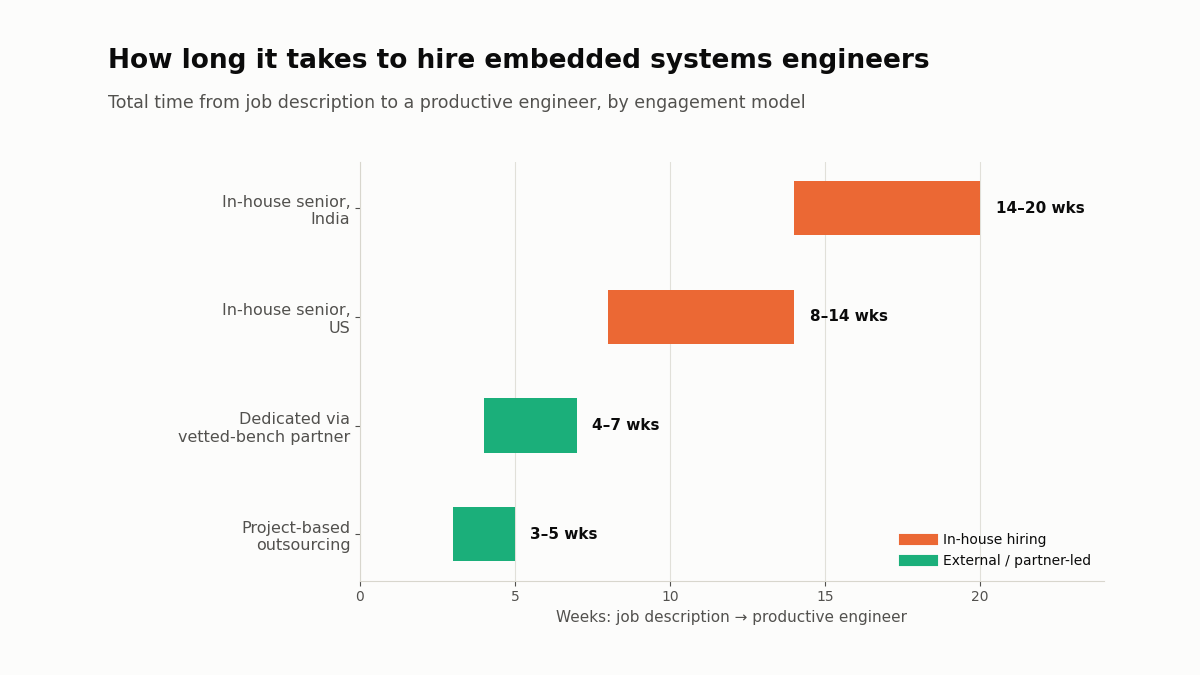
| Scenario | Shortlist | Offer→join | Ramp to productive | Total |
| In-house senior, India | 3–6 weeks | 8–12 weeks (notice periods) | 2–4 weeks | 14–20 weeks |
| In-house senior, US | 4–8 weeks | 2–4 weeks | 2–4 weeks | 8–14 weeks |
| Dedicated developer via vetted-bench partner | 7–10 working days | 0–2 weeks | 2–4 weeks | 4–7 weeks |
| Project-based outsourcing | 1–2 weeks vendor selection | n/a | 1–2 weeks discovery | 3–5 weeks to start |
What drives cost and time up: safety certifications, board bring-up requirements, on-site mandates in tier-2 cities, and JDs that demand three specializations in one head. What drives them down: a crisp one-page requirement (Phase 1), pre-vetted talent pools, flexible seniority on the second hire onward, and paying for the take-home (offer-acceptance rates measurably improve when candidates are treated as professionals).
Rule of thumb for budgeting a first embedded team: one senior + one mid + lab equipment + tooling licenses lands around ₹45–75 lakhs/year all-in (India) or $300k–450k/year (US) before you decide whether a hybrid onshore-architect + offshore-team structure can cut that by a third.
Your Next Step
If you’ve read this far, you’re probably in one of three positions: writing your first embedded job description, staring at a shortlist you can’t confidently evaluate, or watching a firmware milestone slip while a search drags.
Do one thing today: complete the Phase 1 one-page requirement stack layer, MCU platform, six-month definition of done, certification constraints, seniority, budget band. That single page cuts weeks off any path you choose, in-house or external.
And if you’d rather compress the sourcing-and-vetting phases to 7–10 working days against a pre-screened embedded talent pool with dedicated engineers, NDA-backed IP protection, and a written replacement guarantee bring that one-pager to a Supersourcing consultation and pressure-test it with a team that has run this exact playbook across 527+ projects: https://supersourcing.com/contact-us/
No pitch required to use the guide. It works on its own. The consultation is for when you’d rather not run it alone.
FAQ: Hiring Embedded Systems Engineers
What does an embedded systems engineer actually do day to day?
They write and debug C/C++ firmware for microcontroller-based products, working across the hardware-software boundary: implementing drivers and application logic, flashing and debugging over JTAG/SWD, probing signals with logic analyzers, reading datasheets and schematics, and collaborating with electrical engineers on board issues. On mature products, a large share of time goes to testing, power optimization, and field-issue triage rather than new features.
How long does it take to hire a firmware developer?
Plan 14–20 weeks for an in-house senior hire in India (notice periods dominate), 8–14 weeks in the US, and 4–7 weeks end-to-end through a partner with a pre-vetted embedded bench typically 7–10 working days from job description to interview-ready shortlist, plus onboarding. Start any in-house search 4–5 months before the need date.
How much does it cost to hire an embedded systems engineer in India?
Annual compensation runs roughly ₹4–8 lakhs (junior), ₹10–22 lakhs (mid), ₹24–45 lakhs (senior), and ₹45–75 lakhs for staff/architect level, with 15–35% premiums for functional-safety, AUTOSAR, or secure-boot expertise. Dedicated offshore engagement models typically bill $2,800–9,500/month all-in depending on seniority usually 30–50% below onshore loaded cost.
Can I evaluate embedded candidates if I have no hardware background?
Yes by scoring the structure of answers rather than their content. Use a project teardown (“schematic to production, walk me through it”), a paid 2–3 hour driver exercise reviewed by a fractional expert, and a field-failure debugging scenario. Genuine specialists narrate causal chains and hypothesis trees; inflated profiles produce feature lists. The full script is in Phase 2 of this guide.
Is a firmware engineer different from an embedded engineer?
In practice the titles overlap almost completely. “Firmware engineer” usually emphasizes the code that ships on the device; “embedded systems engineer” sometimes implies broader scope (architecture, board bring-up, test rigs). Screen against the skills checklist and lifecycle stages rather than the title the same person may carry either label at different companies.
Should my first embedded hire be full-time or on contract?
Decide on two axes: IP centrality and urgency. If firmware is core IP for 3+ years, anchor with a long-term senior (in-house or dedicated). If you need productivity inside a month, contract/dedicated models are the only realistic path, since in-house notice periods alone exceed that window. Many teams run both: a dedicated senior now, converting or complementing with in-house hires later.
What’s the biggest red flag when screening embedded resumes?
Breadth without depth: six RTOSes and eight protocols listed, but no project described with hardware-level specifics (bus debugging, current draw, memory constraints, bring-up war stories). For senior roles, a portfolio that’s entirely Arduino/Raspberry Pi hobby work is the second-biggest flag; the Stack Overflow survey shows those platforms dominate hobbyist embedded usage, which is exactly why they can’t carry a production claim alone.
What if the engineer I hire doesn’t work out?
Build the exit before you need it. A week-2 written back-brief, a first on-hardware deliverable, and a decision gate at week 4. In-house, that means restarting sourcing immediately for another 3–4 months. Through a staffing partner, a replacement clause should deliver a vetted substitute in 7–10 days at no added cost; if a partner won’t put that in writing, keep looking. If you’re mid-decision and want a second opinion on your requirement sheet, this is the point where a 30-minute consultation earns its time.
