

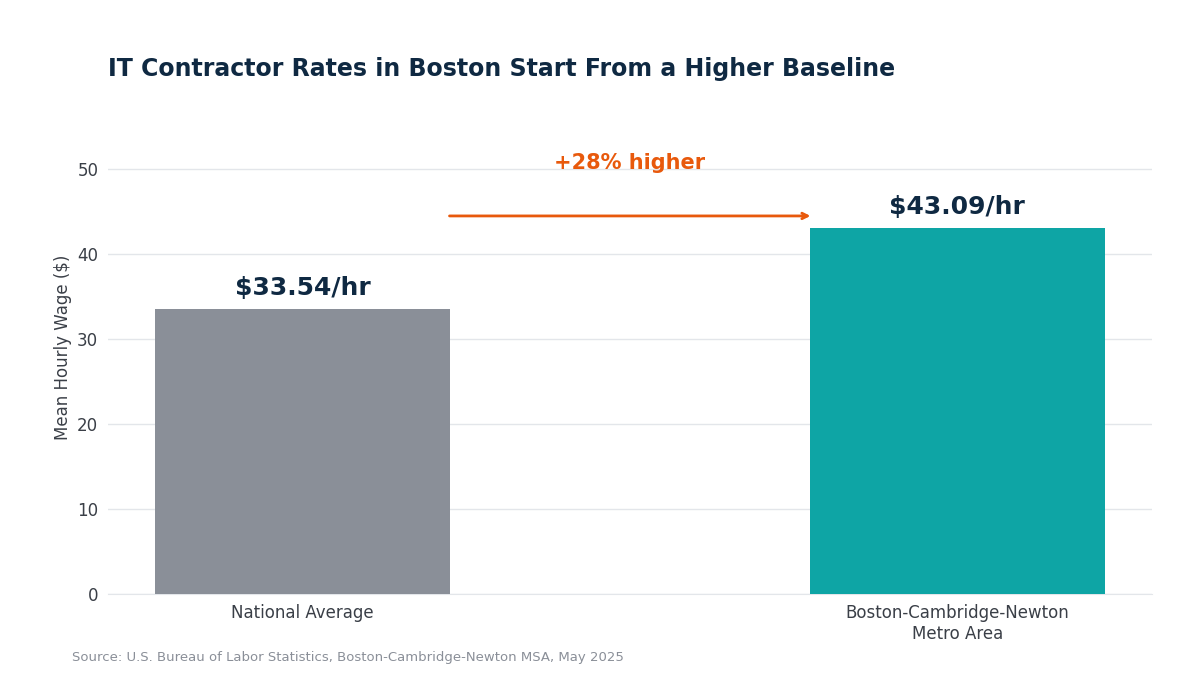
Workers across the Boston-Cambridge-Newton metro area earned a mean hourly wage of $43.09 28% above the nationwide average of $33.54, per the U.S. Bureau of Labor Statistics. For technical contract roles specifically, that gap widens further. A senior software engineer billing on a 1099 or W-2 contract in Boston now runs $75–$110 an hour; the same seniority level in a median-cost metro rarely clears $70.
That gap is exactly where most hiring plans go wrong. Finance teams price a Massachusetts req off a national salary calculator, present a number to the hiring manager, and then watch three straight candidates decline or ghost once a Boston-based recruiter shares the real market rate. IT contractor rates in Boston don’t move in line with the national average; they move with Kendall Square biotech funding rounds, State Street and Fidelity’s engineering headcount, and MIT/Harvard spinout hiring, none of which show up in a generic salary tool.
Robert Half’s 2026 technology salary research points to why: employers are leaning on contract talent specifically because it lets them access specialized skills without committing to full-time headcount when budgets are tight, and the firm projects overall tech salary growth of just 1.6% for 2026 meaning last year’s rate card is close enough to still be useful, but not close enough to bid confidently.
TL;DR:
This guide breaks down what Massachusetts companies actually pay for contract developers, IT consultants, and cloud specialists in 2026, and it's built for hiring managers, founders, and procurement teams who need a defensible number before they open a req.
The headline figure: Boston hourly developer rate benchmarks span roughly $45 to $130 an hour depending on role, seniority, and contract structure, a wider band than most national surveys show, because Massachusetts's talent competition and compliance rules both push rates upward.
By the end, you'll be able to build a role-by-role budget, tell the difference between a contractor's pay rate and what you're actually billed, and decide whether local W-2, local 1099, or an offshore dedicated team is the right structure for the work in front of you.
What Are IT Contractor Rates in Boston?
IT contractor rates in Boston are the hourly or day rates Massachusetts-based companies pay independent technology professionals developers, IT consultants, cloud engineers, QA specialists for fixed-term, project-based work instead of full-time employment. In 2026, these rates typically span $45–$130+ per hour depending on role, seniority, and whether the engagement runs W-2, 1099, or corp-to-corp.
The Core Problem: Why Boston Budgets Miss the Mark
Most Massachusetts hiring managers underestimate Boston hourly developer rate benchmarks by 20–30% because they anchor on national averages instead of MSA-specific data. A national salary tool might show a mid-level backend developer at $55–$65 an hour; the real Boston-market figure for the same seniority regularly lands at $70–$85, driven by biotech, fintech, and healthtech employers competing for the same cloud and data talent pool.
Getting IT contractor rates in Boston wrong at the budgeting stage doesn’t just cost money later it costs weeks, because a req priced 20% under market sits open while recruiters requalify it against reality.
The second, quieter problem is structural: teams quote a contractor’s pay rate of what lands in that person’s account and assume it’s the bill rate they’ll be invoiced. It isn’t. A $60/hour pay rate routed through a staffing agency typically arrives on the client invoice at $78–$90/hour once payroll tax, workers’ comp, and agency margin are layered in. Budget the wrong number and a six-month engagement can run 20%+ over plan before anyone notices.
Massachusetts Developer Rates: The Deep-Dive
How a Boston IT Contractor Bill Rate Actually Gets Built
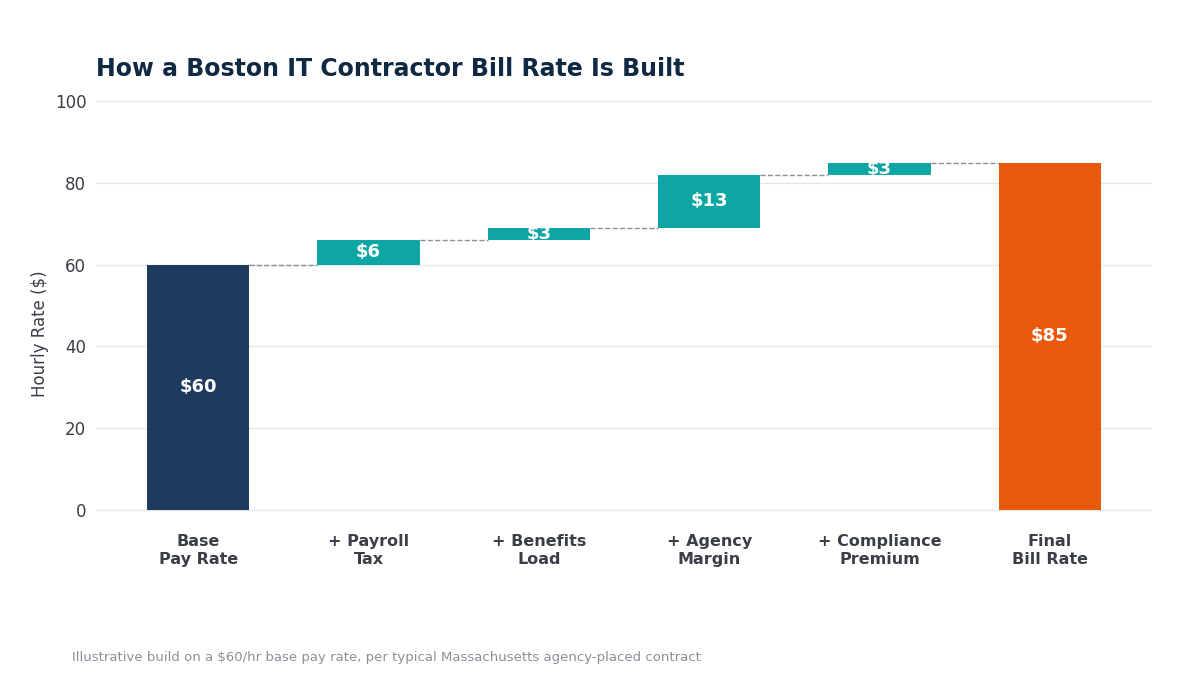
A quoted hourly number is never just “what the person makes.” In a typical Massachusetts contract placement, the bill rate is assembled in this order:
- Base pay rate the contractor’s take-home hourly rate, set by skill, seniority, and specialization.
- Employer-side payroll tax FICA, Massachusetts unemployment insurance, and workers’ compensation, applied on W-2 engagements.
- Benefits load health contributions or PTO accrual, where the engagement includes them.
- Agency or platform margin typically 15–30% on top of pay rate and statutory costs, covering sourcing, vetting, and account management.
- Compliance/risk premium priced into short, ambiguously scoped 1099 work given Massachusetts’s ABC-test exposure; cleaner, longer-scoped engagements usually price lower here.
- The final bill rate is what actually lands on the client invoice, and the number that should anchor your budget, not the base pay rate.
Skipping straight from step 1 to step 6 is the single most common reason a Massachusetts contractor budget blows past plan in month two.
Massachusetts Developer Rates and Boston IT Consultant Cost, by Role
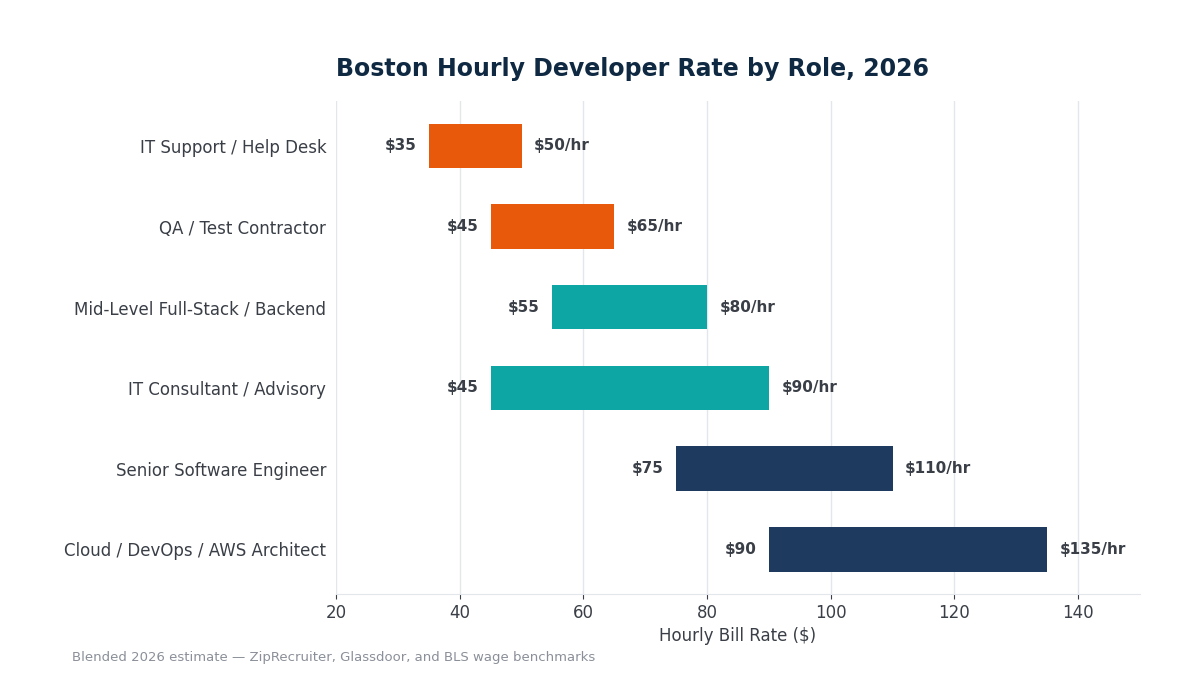
This is where the average hourly rate for a software developer contractor in Boston actually gets specific, and where senior vs junior IT contractor rates in Boston stop being a rule of thumb and start being a real budget line. Blending Massachusetts- and Boston-specific salary and bill-rate data (ZipRecruiter, Glassdoor, and BLS wage benchmarks) into typical 2026 bands, these are the IT contractor rates in Boston teams should actually plan around:
- IT support / help desk contractor: $35–$50/hr
- QA / test contractor: $45–$65/hr
- Mid-level full-stack or backend developer: $55–$80/hr
- Senior software engineer contractor: $75–$110/hr
- IT consultant / advisory: $45–$90/hr this is the working range behind the Boston IT consultant cost question, and it tracks closely with Glassdoor’s Boston IT Consultant data, which puts typical pay between roughly $44 and $75 an hour before agency markup.
- Cloud, DevOps, and AWS architecture specialists: typically bill 15–25% above the generalist senior-developer band. In practice, that puts most Boston engagements asking about hourly rates for AWS architects in the $90–$135/hr range, reflecting the concentration of regulated healthtech and fintech workloads that need cloud architects who already understand HIPAA- and SOC 2-adjacent constraints. Teams filling this kind of role directly often start by looking to hire cloud engineers rather than generalist backend contractors, since the skill overlap with generic full-stack work is smaller than job titles suggest.
These bands sit meaningfully above Robert Half’s national full-time software engineer salary range of roughly $109,250 to $175,500 on an annualized basis consistent with the Boston market premium this guide keeps returning to.
W-2, 1099, and Corp-to-Corp: Why Structure Changes Your Real Cost
The same contractor can cost a Massachusetts employer three different effective rates depending on structure. W-2 through an agency carries the highest visible bill rate but the lowest compliance risk the agency owns classification.
Direct 1099 looks cheapest on paper but carries full ABC-test exposure if the work sits inside your company’s usual course of business, which is exactly where most contract developer and IT consultant roles sit. Corp-to-corp (contractor operates through their own LLC) shifts risk again, but only works cleanly when the contractor genuinely operates an independent business, not when it’s a single person invoicing one client full-time.
This is the detail most national guides skip, and it’s the one that determines whether a “cheaper” MA tech contract rates quote is actually cheaper once legal exposure is priced in.
Why the Boston Market Specifically Runs Hot
The demand side isn’t slowing down. CompTIA’s 2026 State of the Tech Workforce research projects net U.S. tech employment growing 1.9% this year to roughly 9.8 million workers, with tech occupations forecast to add about 128,000 jobs industry-wide in a single year.
Massachusetts captures an outsized share of that growth relative to its population, because Boston’s biotech, fintech, and healthtech employers are drawing from the same regional pipeline as MIT, Harvard, and Northeastern, a pool that isn’t expanding nearly as fast as local demand. That supply-demand gap is the real engine behind MA tech contract rates, more than any single employer’s budget decision.
Case Studies: Boston Contract Hiring in Practice
A Cambridge-based SaaS company priced a senior backend contractor role off a national rate calculator and lost two candidates to competing offers within a week both had quietly benchmarked against real Boston hourly developer rate data before responding. Once the client repriced the role against Massachusetts-specific bands and moved to a structured sourcing process, the seat was filled within a 7–10 working day cycle, and the contractor completed the full six-month engagement without a mid-project drop-off.
A Boston fintech startup brought on a contract data engineer who turned out to be a poor technical fit after two weeks on a live payments project. Because the engagement included a replacement guarantee, the client swapped in a new dedicated engineer within the 7–10 day window at no renegotiation of the master agreement avoiding a second full sourcing cycle that, at typical Boston contractor bill rates, would have cost several weeks of stalled roadmap work.
Comparison Framework: How to Structure Boston IT Contract Work
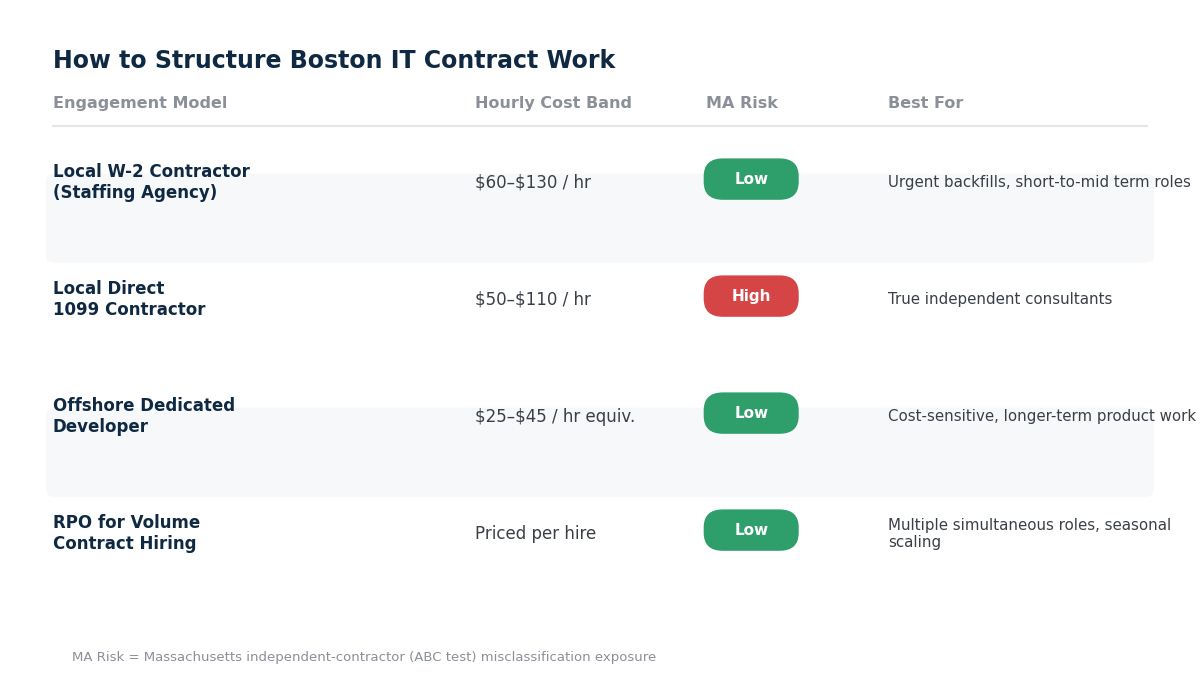
Once you know what IT contractor rates in Boston actually look like by role, the next decision is structural not “what’s the rate” but “what kind of engagement gets you that rate with the least risk”:
| Engagement model | Typical hourly cost band | MA compliance exposure | Best for |
| Local W-2 contractor (staffing agency) | $60–$130/hr | Low agency owns classification | Short-to-mid-term specialist roles, urgent backfills |
| Local direct 1099 contractor | $50–$110/hr (quoted) + legal risk | High full ABC-test exposure | True independent consultants with their own client base |
| Offshore dedicated developer | $25–$45/hr equivalent | Low outside MA jurisdiction | Cost-sensitive, longer-term product work |
| RPO for volume contract hiring | Varies by scope, priced per hire | Low process-managed | Multiple simultaneous contract roles, seasonal scaling |
Teams evaluating the offshore row usually want it framed against local numbers directly: a senior engineer costing $75–$110/hr in Boston is frequently available at a fraction of that through a properly vetted global capability center or dedicated offshore placement though the trade-off is time-zone overlap and onboarding ramp, which local contract IT staffing cost doesn’t carry. Companies filling several contract seats at once, rather than one at a time, typically get better unit economics from structured RPO services than from repeating the sourcing cycle role by role.
What Most Teams Get Wrong
Most Boston hiring managers negotiate the pay rate and never see the bill rate build-up, then react with sticker shock when the invoice arrives 25–35% above what they mentally budgeted. The fix is asking for the fully loaded rate in writing before the engagement starts, not after the first invoice.
A second pattern shows up specifically in Massachusetts: companies write a 1099 contract that looks compliant on paper but scopes the contractor’s day-to-day work identically to a full-time employee’s same standups, same reporting line, same tools, indefinite renewal. That’s precisely the fact pattern Massachusetts’s ABC test is built to catch, and it’s the single most common misclassification red flag we see in contract engagements here, regardless of what the contract itself says.
A third: teams that compare an offshore quote to hire Python developers directly against IT contractor rates in Boston without adjusting for onboarding drag a well-vetted offshore engineer can be productive in days, but a poorly screened one can cost more in ramp time and rework than the local premium would have.
Where to Go From Here
Working out the cost to hire a contract developer in Massachusetts for one role is a five-minute conversation, not a procurement process. If you’re budgeting a Massachusetts contract role and want to pressure-test the number before you post the req, that’s a narrow, answerable question not a sales conversation. Send the role, seniority level, and rough scope to mayank@engineerbabu.com, or look through current engagement models at supersourcing.com. If you’d rather talk through structure first W-2 vs. offshore vs. RPO for a multi-role need, get in touch here, and we’ll benchmark real IT contractor rates in Boston against your specific role before you commit to a number.
FAQ
What is the average hourly rate for an IT contractor in Boston?
Rates vary widely by role and seniority, but most 2026 Boston engagements fall between $45 and $130 an hour. Entry-level and support roles sit at the low end; senior software engineers and cloud architects sit at the high end. The single average often cited by salary sites (around $57–$77/hr) blends across all these role types, so it’s a starting point, not a role-specific number.
How much does an IT consultant cost in Massachusetts?
Boston IT consultant cost typically runs $45–$90 an hour depending on specialization and whether the engagement is advisory or hands-on delivery. Generalist consultants sit toward the lower end; consultants with deep domain expertise in regulated industries like fintech or healthtech command the upper end of that range.
Are IT contractor rates in Boston higher than the national average?
Yes. Boston-area workers overall earn roughly 28% above the national mean hourly wage, and that premium holds for technical contract roles specifically, driven by concentrated demand from biotech, fintech, and healthtech employers competing for the same limited talent pool.
Should you hire a W-2 or 1099 contractor in Massachusetts?
It depends on how independently the person actually operates. If the role mirrors a full-time employee’s day-to-day work set hours, direct oversight, indefinite renewal W-2 through an agency is the lower-risk structure under Massachusetts’s ABC test. True 1099 status fits contractors who run an independent business serving multiple clients.
How do staffing agencies set contractor bill rates in Boston?
Agencies start from the contractor’s base pay rate, then layer in payroll tax, workers’ comp, benefits (on W-2 engagements), and a margin of roughly 15–30% to cover sourcing, vetting, and account management. Massachusetts’s stricter compliance environment adds a modest risk premium on top of that base build.
What’s the difference between a contractor’s pay rate and bill rate?
The pay rate is what the contractor takes home; the bill rate is what your company is invoiced. The gap between them is usually 25–50% covers taxes, benefits, and agency margin. Budgeting off the pay rate instead of the bill rate is the single most common cause of contract-hiring cost overruns.
How long does it take to hire a vetted IT contractor in Boston?
With a structured, pre-vetted sourcing pipeline, a specialized Boston contract role can typically be filled in 7–10 working days from job description to interview-ready shortlist well under the 6–10 weeks a traditional in-house recruiting cycle often takes for the same specialized skill set. If you’re mid-scope on a role and want a second opinion on where it should land, hire contract developers through a pre-vetted pipeline rather than restarting the search from scratch.
