

The fastest-growing segment of India’s Global Capability Center market is no longer the Fortune 500. Between 2024 and 2026, roughly one in three new GCCs set up in India came from mid-sized enterprises companies with $100M–$1B in revenue that, five years ago, would have been told a captive center wasn’t worth the overhead.
The mid market india gcc wave is being driven by a structural change, not a fashion: entry models like GCC-as-a-service and build-operate-transfer have cut the minimum viable scale of an India center from 300+ seats to 20–50, and cut time-to-first-team from 12+ months to roughly 90 days.
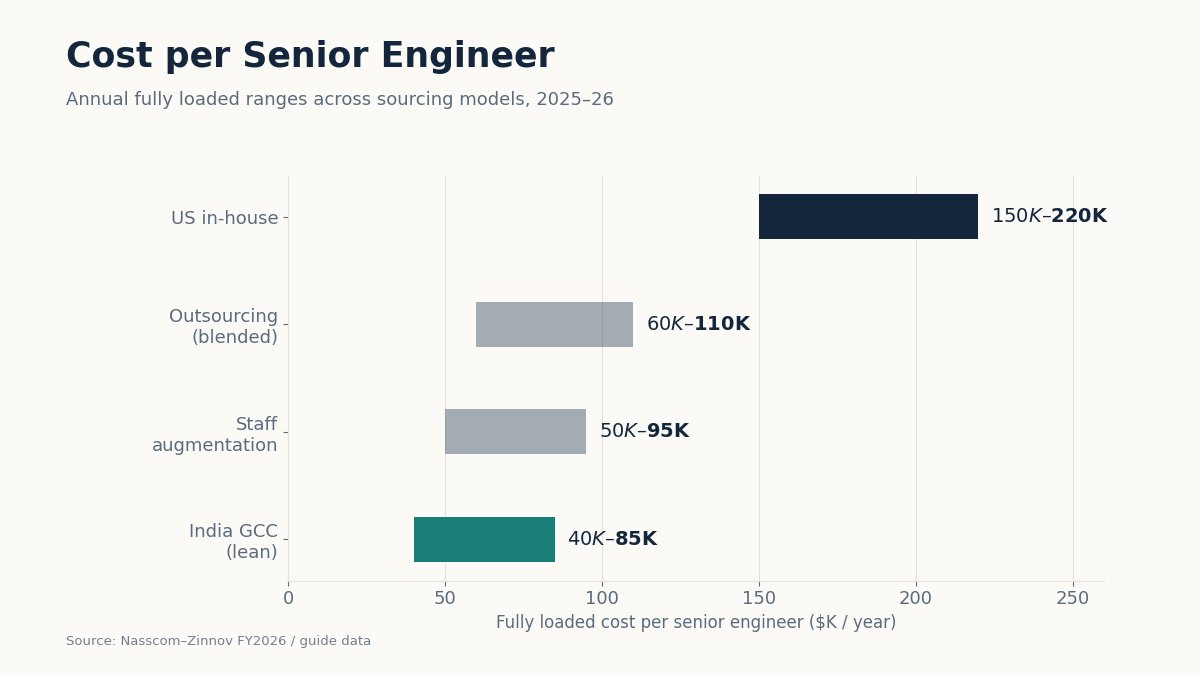
That changes the math for a very specific kind of company. If you run a 150–2,000 person US firm, you’re paying $150K–$220K fully loaded per senior engineer, your open reqs sit unfilled for 60–90 days, and outsourcing has burned you at least once on quality or IP you are now the exact profile India’s GCC ecosystem is being rebuilt to serve.
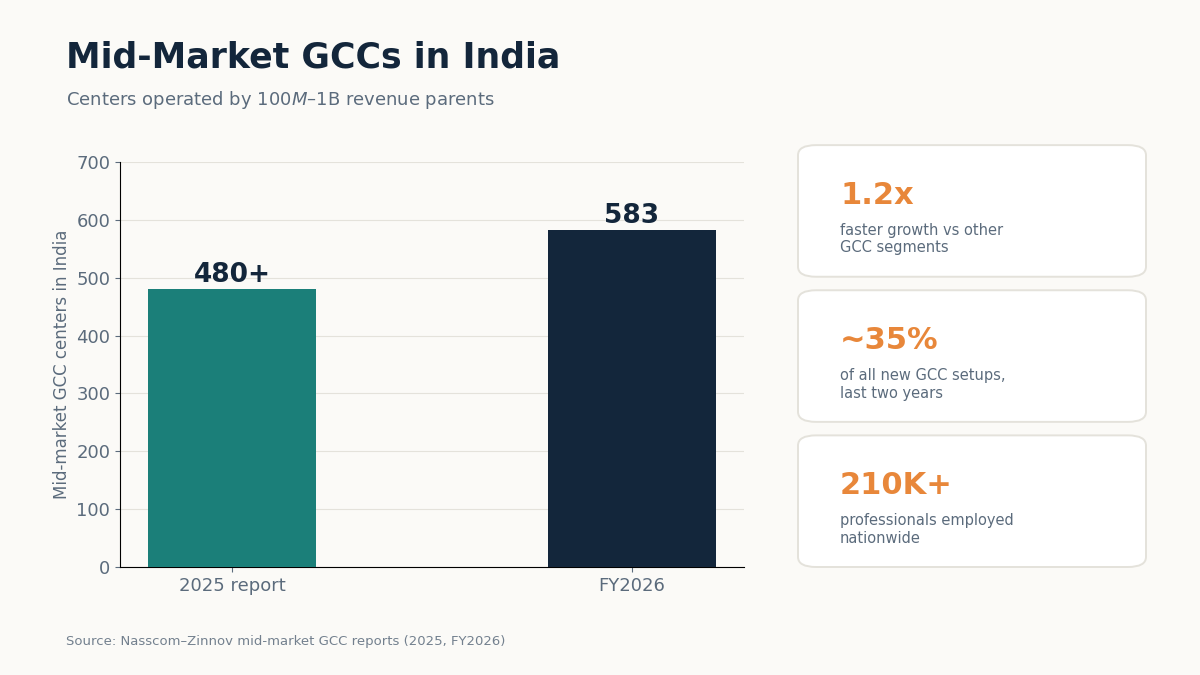
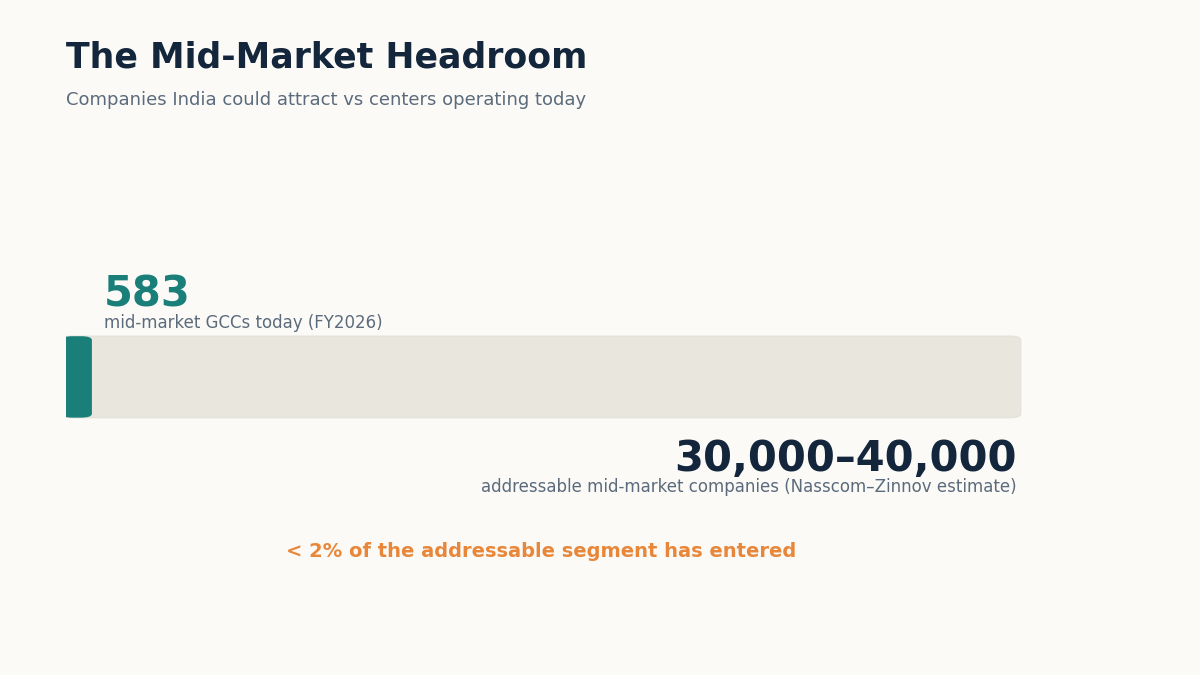
Nasscom and Zinnov estimate that of the 130,000–150,000 mid-market companies globally, India could realistically attract 30,000–40,000 to set up capability centers against just ~480–583 mid-market GCCs operating today. The segment is also growing ~1.2x faster than the rest of the GCC market.
This guide is the full walkthrough: when a lean India center makes sense, what it costs at 10, 50, and 150 seats, which legal structure to pick, how to hire the first pod, what the contracts must say, and how to run the center after the launch photos are taken. Read it end to end and you should be able to execute or confidently decide not to.
TL;DR
This guide is for CTOs, CFOs, and founders at US mid-size companies (roughly $50M–$1B revenue) deciding whether to build a small, owned engineering or operations center in India. It walks through the entire lifecycle: qualification, structure, hiring, contracts, onboarding, governance, and exit.
The single biggest shift: a credible mid-market GCC no longer needs 300 people or 18 months. Current entry models get a compliant 20–50 seat center live in about 90–120 days, at a typical fully loaded cost of $25K–$50K per engineer per year roughly 30–50% below equivalent US cost even after overheads.
By the end, you'll be able to run the qualification test, pick between EOR, BOT, GCC-as-a-service, and direct entity, budget the first 12 months within a defensible range, and avoid the five mistakes that stall most first-time centers.
What Is a Mid-Market India GCC?
A mid-market India GCC is a company-owned (or owned-track) capability center in India, set up by an enterprise with roughly $100M–$1B in global revenue, typically running 20–200 people across engineering, data, product, or operations built lean, with the parent retaining direct control of hiring, IP, and roadmap rather than routing work through a vendor.
What it is not:
- Not outsourcing. In a GCC, the people are your employees (or on a contractual track to become them). Deliverables, code, and IP sit inside your organization, not a vendor’s.
- Not staff augmentation. Staff augments you individuals inside your existing team structure; a GCC is a durable organizational unit with its own site leadership, culture, and charter.
- Not a “nano vendor” arrangement. A 10-person dedicated team at an agency is a useful precursor, but it only becomes a GCC when there’s a defined transfer or ownership path.
One terminology note before going further. Analysts define the mid-market segment by parent revenue ($100M–$1B), but in practice the mid market gcc label describes an operating style as much as a size class: lean org shape, product-heavy mandates, faster leadership elevation, and a bias toward managed or transfer-track structures over day-one owned real estate. That operating style, not the revenue band, is what the rest of this guide teaches.
Why the Mid-Market GCC Math Changed
For two decades the captive center was a big-company product. The reasons it stopped being one are concrete, and each maps to a business outcome you can put in a board deck.
- Cost: Typical fully loaded India engineering cost runs $25K–$50K/year per seat (₹20–42 lakh, including salary, benefits, workspace, and overhead allocation) versus $150K–$220K fully loaded for equivalent US senior talent. Even after a 10–25% management or provider margin in early models, most engagements land at 30–50% net savings at steady state.
- Speed to talent: India’s GCC ecosystem now employs 2.36 million professionals across 2,117 centers, per the Zinnov–Nasscom FY2026 landscape report and it is the world’s largest AI hiring market. For a US mid-market firm, that converts a 60–90 day unfilled req into a 2–3 week offer cycle for most mainstream stacks.
- Entry-model innovation: GCC-as-a-service, managed GCCs, and BOT structures mean you no longer front $500K–$3M of first-year entity, real estate, and compliance cost before hiring your first engineer. First hires can start in 4–8 weeks under an EOR while the longer-term structure is built in parallel.
- IP and risk posture: Unlike outsourcing, an owned center keeps source code, data, and domain knowledge inside your legal perimeter, increasingly a requirement in fintech, healthtech, and anything touching regulated data.
- Proof at scale: GCC economic contribution to India grew from ~$19B in 2015 to $68B+ today, and mid-market centers already make up 27% of all India GCCs, per Deloitte India. You are not the pioneer; you’re the fast follower.
The strategic driver matters as much as the arbitrage. Mid-market GCCs are disproportionately product-engineering and ER&D centers, not back offices. The Nasscom–Zinnov research notes they carry a higher share of global product management talent and deeper niche tech skills than the average large captive. The mid-market center is a capability play with a cost tailwind, not the reverse.
There’s also a timing component worth stating plainly. Talent supply in India currently exceeds mid-market demand 480–583 mid-market centers against an estimated 30,000–40,000 addressable companies which means favorable hiring conditions and provider pricing today.
As the segment fills in over 2026–28, salary bands in contested cities and the negotiating leverage of early entrants will both tighten. Being eighteen months early to a mid-market India GCC is worth real money; being eighteen months late mostly isn’t fatal, but it is measurably more expensive.
The Core Problem: Why Mid-Size Firms Get This Wrong on Their Own
The failure pattern in first-time centers is remarkably consistent, and it is rarely about India. It’s about underestimation in four specific places.
- Timeline optimism (the 3x rule). Teams budget 8 weeks for “incorporation and hiring” because incorporation alone takes 2–4 weeks. In practice, entity + bank account + PF/ESI registrations + transfer pricing setup + first 10 accepted offers reliably runs 4–6 months when self-managed. Most first-timers underestimate end-to-end time by roughly 3x.
- The leadership-first trap. Conventional wisdom says “hire a Site Head first.” For a 20–50 seat center, a $120K–$180K country leader hired before there’s a team to lead burns 6+ months of cost and often quits when asked to do IC work. (More on the alternative in Phase 2.)
- Attrition naïveté. India’s mainstream-stack attrition runs 12–20% annually in well-run centers and 30%+ in badly run ones. Without notice-period planning (30–90 days is standard in India) and pre-agreed backfill SLAs, a 25-person team losing 5 people can stall a roadmap for a quarter.
- Compliance debt. Transfer pricing documentation is mandatory from year one for any related-party billing; penalties run to 2% of transaction value for lapses. DPDP Act (India’s data protection law), PF/gratuity liabilities, and FEMA rules are all manageable but only if structured on day one, not retrofitted in an audit.
None of these is a reason not to build. All four are reasons the build sequence covered next matters more than the build decision.
The Walkthrough: Lean GCC Setup From Zero to Steady State
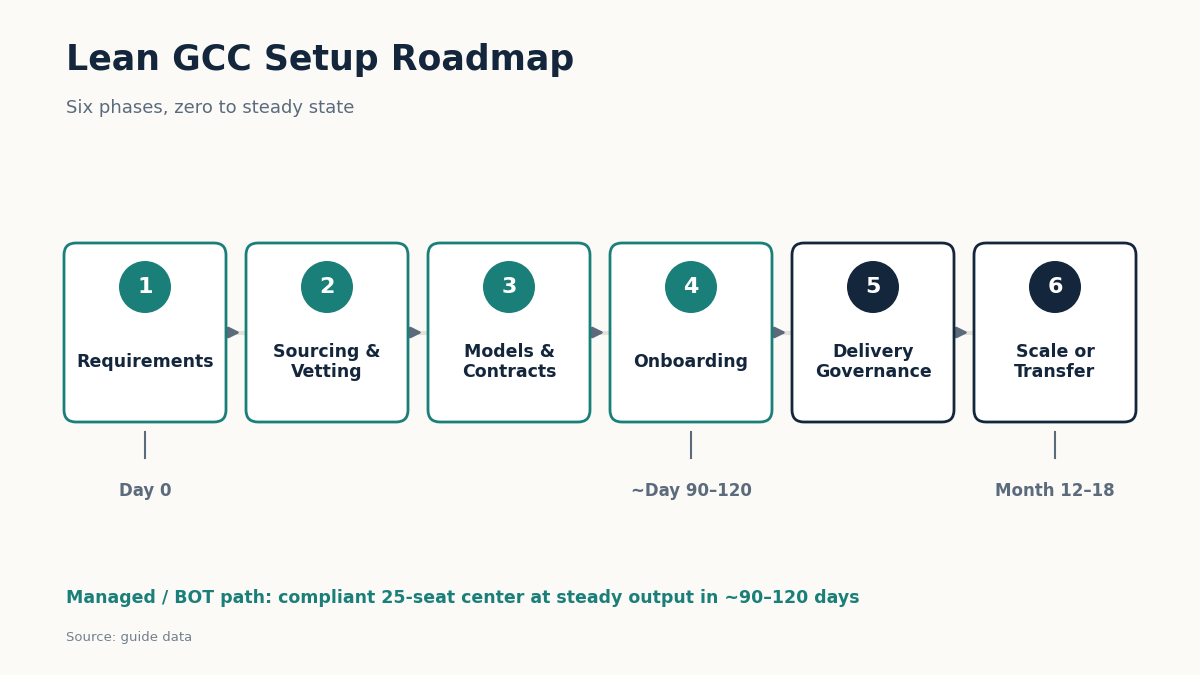
Everything below assumes the lean case. A lean GCC setup 20–75 seats, one city, one or two functions, minimal owned real estate is the configuration in which mid-market economics actually work; the phases scale up, but they don’t scale down well if you start heavy. Work the six phases in order.
Skipping Phase 1 is the single most common cause of Phase 5 pain.
Phase 1 Defining Requirements: Mandate, Scale, Budget
A center without a written mandate becomes an offshore ticket queue within a year. Before talking to any provider, produce a one-page charter answering four questions.
- What does this center own? Name products, platforms, or processes “the data platform and internal tooling,” not “engineering support.” High-ROI first mandates for mid-market centers: product engineering pods, data/analytics, QA automation, DevOps/cloud, and domain-heavy operations (fintech reconciliation, healthcare RCM).
- What’s the 12/24/36-month headcount curve? A defensible lean curve looks like: 8–12 (month 4) → 25–35 (month 12) → 50–75 (month 24). If your 36-month number is under 15, run a dedicated vendor team instead; the entity overhead won’t pay back.
- What’s the budget band? Anchor on fully loaded per-seat cost, not salary alone:
- Mid-level engineer: ₹18–32 lakh/yr salary → $30K–$48K/yr fully loaded
- Senior engineer / lead: ₹35–60 lakh/yr salary → $50K–$85K/yr fully loaded
- QA / support roles: ₹8–18 lakh/yr salary → $15K–$30K/yr fully loaded
- First-year one-time costs (structure-dependent): $60K–$400K for a lean center; $500K–$3M if you go greenfield-entity-with-real-estate from day one.
- Hidden lines first-timers miss: gratuity accruals, 12% employer PF contributions, annual increment budget (8–12%), travel for US↔India exchange visits ($15K–$40K/yr for a lean center), and licenses/tooling priced per-seat in USD.
- Which city and why? Bengaluru and Hyderabad offer the deepest AI/cloud/product talent but the most employer-brand competition. Pune, Chennai, and NCR are strong specialized hubs. Tier-2 cities (Indore, Coimbatore, Jaipur, Ahmedabad) offer 15–30% lower cost and lower attrition, at the price of thinner senior and niche-skill benches. Rule of thumb: pick talent density for your scarcest role, not average cost.
Red flag at this stage: if internal sponsors can’t agree whether the center is a cost play or a capability play, stop. That unresolved question resurfaces as budget fights in month 8.
Phase 2 Sourcing & Vetting the First Team
The first 8–12 hires determine the center’s ceiling. This is also where mid-market firms have a structural disadvantage; nobody in Bengaluru has heard of your brand and where process quality substitutes for brand gravity.
Hire the anchor pod before the executive. The sequence that works: 1–2 staff-level tech leads plus 5–8 senior/mid engineers first, a Site Head or Director only after 15–20 people exist. Leads can be given “head of site” scope on an interim basis. This inverts the Fortune-500 playbook deliberately at 10 people, culture is set by whoever writes the code review comments, not by a country manager.
What good screening looks like for the anchor pod:
- Structured technical evaluation live problem-solving in your actual domain, plus a system-design round for anyone senior. Take-homes alone miss collaboration signals.
- Work-sample over pedigree. Big-brand résumés (large captives, top services firms) predict process fluency, not product ownership. For a lean center you want people who’ve shipped with ambiguity.
- Cultural/communication evaluation with the US team present at minimum one round run by the hiring manager in the US, live, with camera on, at overlap hours. This tests exactly the working condition the hire will live in.
- Reference and continuity checks verify notice periods (30–90 days is normal; plan start dates accordingly) and probe for offer-shopping risk. Multi-offer candidates dropping off at joining is the silent killer of India ramp plans.
Benchmarks to hold a partner to: a strong AI-assisted sourcing process should produce an interview-ready shortlist from the top few percent of the vetted pool in 7–10 working days per role, sustain a 95%+ joining rate on accepted offers, and keep contract-role drop-off under 2–3%.
Supersourcing runs this model at a 98% joining rate and <1% contract drop-off across 527+ delivered projects use numbers of that order as your bar, whoever you work with.) If your infrastructure roadmap is part of the first mandate, it’s also worth pressure-testing a partner’s bench on the hardest role first for instance, asking to see real, recent profiles when you need to hire cloud engineers, since infra talent is where thin benches show fastest.
Red flags in sourcing partners:
- Shortlists in 24 hours (means a recycled database, not fresh vetting)
- No stated joining-rate or drop-off metrics
- Shared-bandwidth staffing (“your” engineers billed across clients)
- Reluctance to let you run your own final technical round
Phase 3 Engagement Models & Contracts
Four structures cover the whole market. Pick based on headcount curve and how certain the India thesis is not on which one a provider happens to sell.
| Model | First hire in | Ownership | Typical cost profile | Best when |
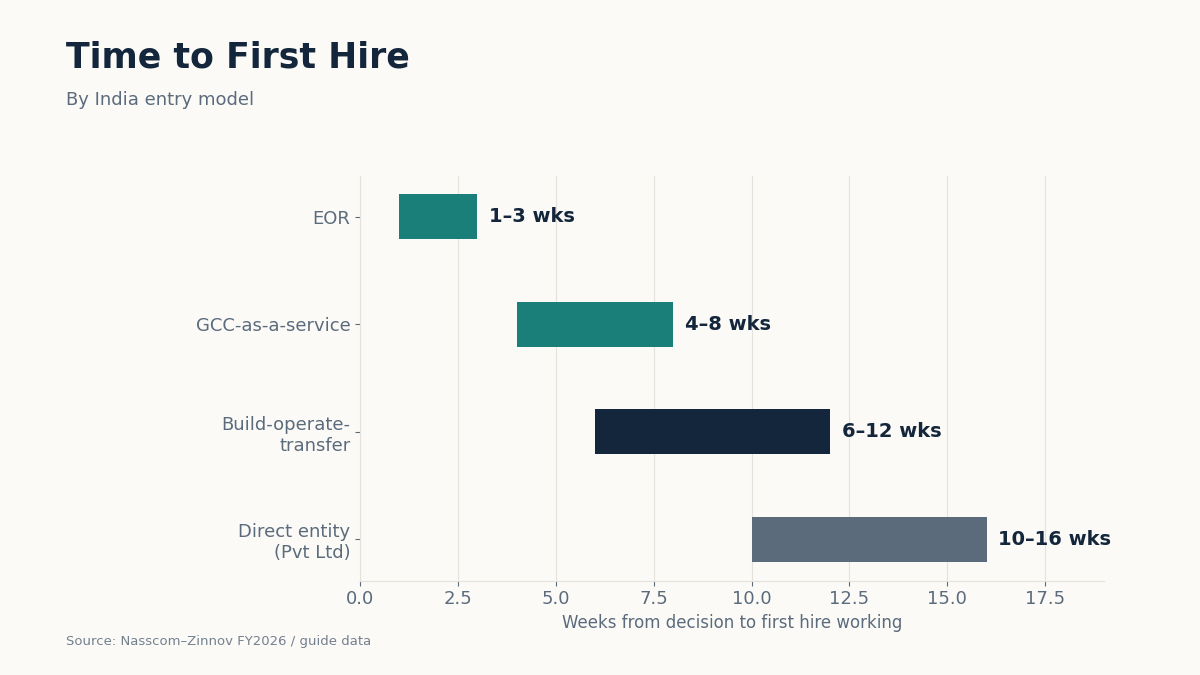
| EOR (employer of record) | 1–3 weeks | Provider employs; you direct | Salary + 8–15% EOR fee | Testing thesis, <15 heads, no entity appetite |
| GCC-as-a-service / managed GCC | 4–8 weeks | Shared ops, your mandate | Per-seat bundled fee; ops offloaded | 15–75 heads, speed > control of ops |
| Build-operate-transfer (BOT) | 6–12 weeks | Provider builds/runs, transfers in 18–36 months | FTE cost + 10–25% management margin; pre-agreed transfer fee | First-time operators wanting an owned end-state without day-one risk |
| Direct entity (Pvt Ltd subsidiary) | 10–16 weeks | Full ownership day one | Lowest steady-state cost; highest setup lift | India experience in-house, 50+ head conviction |
A build operate transfer GCC deserves special attention because it’s the default mid-market path: the provider recruits and operates the center for a defined period, then transfers the entity, team, and assets to you under a contractually fixed plan.
Well-run BOT transfers retain 95%+ of employees through the handover but only if the transfer terms were fixed at signing.
Contract clauses that are non-negotiable, whatever the model:
- IP assignment at creation all work product assignments to the US parent the moment it’s created, not at transfer or contract end. NDA-backed engagement for every individual, not just the provider entity.
- Named-team exclusivity, no shared bandwidth; your engineers work only for you, in writing.
- Replacement SLA a defined replacement window when a hire isn’t a fit. 7–10 working days is a strong market benchmark for staffed roles; 30 days is mediocre; “best efforts” is a no.
- Transfer mechanics (BOT/GCCaaS) pre-priced transfer fee or formula, no per-head “release fees” discovered later, employee-transfer consent process defined, and a data/asset handover checklist as a schedule to the contract.
- Transfer pricing & intercompany agreement cost-plus markup (commonly in the 8–18% band, set with advisors) documented from year one; this is a tax-compliance requirement, not paperwork theater.
- Data protection DPDP Act (India) compliance mapped against your US obligations (SOC 2, HIPAA, GLBA as applicable), with audit rights.
Structuring the entity-versus-EOR sequencing, the transfer-pricing position, and the compliance calendar is where a few hours of specialist IT consulting services up front routinely saves five-figure remediation; later this is the one phase where DIY is a false economy.
Phase 4 Onboarding & Ramp-Up: The First Two Weeks
India onboarding fails in the gap between “offer accepted” and “productive,” and the gap is longer than US teams expect because of notice periods. Run pre-boarding during the 30–90 day notice window: hardware shipped or procured locally, accounts provisioned, a named US buddy assigned, and a 30/60/90 plan written before day one.
Week 1–2 checklist for every joiner:
- Day 1: laptop, SSO, repo, VPN, and comms access all working before noon India time access delays are the #1 reported ramp friction in new centers.
- Day 1–2: product architecture walkthrough recorded (async) + live Q&A at overlap hours.
- Day 3–5: first small PR or process task shipped to production or completion. Momentum beats orientation decks.
- Week 2: joiner presents back their understanding of the system to the US lead surface misunderstandings while they’re cheap.
- Standing cadence set: daily async standup, 2–4 hours of engineered overlap (US morning / India evening is standard for East Coast; US evening / India morning for West), and one weekly live all-hands across sites.
The 3-day rule: if a new joiner hasn’t had a meaningful live interaction with a US counterpart within 3 working days, escalate. Isolation in week one predicts regretted attrition at month six with depressing reliability.
Phase 5 Managing Delivery: Governance That Fits on One Page
Steady-state governance for a lean center should be light and numeric. The pattern that works in most engagements:
- Weekly: delivery review at pod level sprint throughput, blocked items, incident count. Owned by the tech leads, attended by US engineering management.
- Monthly: a KPI scorecard reviewed with the provider/site leadership. Core metrics: velocity or cycle time trend, defect escape rate, attrition (rolling 12-month), open-req aging, joining rate on offers, and cost per seat vs. budget.
- Quarterly: mandate review with the exec sponsor is the center still doing the work in its charter, or has it drifted into overflow ticketing?
Account management structure to insist on: one dedicated (not pooled) account manager on the provider side, one named engineering owner on yours, and a single escalation path with response-time commitments.
Dual reporting lines every India engineer has both a local lead and a US functional owner prevent the “shadow org” problem where the center slowly stops feeling like part of the company.
Attrition management, concretely:
- Track regretted attrition separately; a 12–18% overall rate with near-zero regretted attrition is healthy in India.
- Budget compensation reviews annually with 8–12% typical increments for strong performers; off-cycle corrections for the top 10% are cheaper than backfills.
- Maintain a warm bench: for every critical skill, one pre-vetted profile refreshable within 7–10 days.
Phase 6 Scaling, Transferring, or Exiting
Around month 12–18, one of three paths crystallizes.
- Scale. Add pods against the charter, not opportunistically. Growth from 30 → 75 seats usually justifies moving from managed workspace to a dedicated facility, adding an HR/people lead in-country, and if hiring volume passes ~40 roles/year moving recruitment to a structured RPO services arrangement rather than per-role fees, which typically cuts per-hire cost 20–40% at volume.
- Transfer (BOT execution). Trigger the pre-agreed transfer: entity handover or employee migration to your new subsidiary, asset and contract novation, and a 2–6 month transition period. Success metric: >95% team retention through transfer and zero unplanned cost items both achievable only if Phase 3 contracts were done right.
- Exit. If the thesis didn’t hold, a lean structure is precisely what makes exit survivable: EOR and GCCaaS models wind down in 60–90 days against notice-period and severance obligations, versus 6–12 months and significant cost to close an owned entity. Contractual offboarding terms data return, IP confirmation, non-solicit boundaries should have been fixed at signing, not negotiated at exit.
Decision Framework: GCC vs. Outsourcing vs. Staff Aug vs. US Hiring
Choosing a structure is where most evaluations stall. For a US mid-size company, GCC economics only beat the alternatives under specific conditions so test the conditions, not the trend.
The 4-of-6 qualification test. An India center is justified if at least four are true:
- You’ll need 15+ India-based people within 24 months on a plausible plan.
- The work involves IP or data you’re uncomfortable placing with a vendor (core product code, regulated data, proprietary models).
- Roles stay open 60+ days in your US market, or fully loaded US cost for the function exceeds ~$140K/head.
- The work is durable multi-year platform, product, or process ownership, not a 9-month project.
- Someone senior in the US will own the center as a real part of their job (≥20% time in year one).
- You can fund $250K–$700K of year-one cost for a lean configuration without stressing the P&L.
Fewer than four? Use outsourcing or staff augmentation and revisit in a year. That’s the honest answer, and it’s cheaper than a stalled center.
| Dimension | India GCC (lean) | Outsourcing | Staff augmentation | US in-house |
| Fully loaded cost/senior eng/yr | $40K–$85K | $60K–$110K (blended rates) | $50K–$95K | $150K–$220K |
| Speed to first output | 8–16 weeks | 2–6 weeks | 1–3 weeks | 8–14 weeks per hire |
| IP & data control | High (owned) | Low–medium | Medium | Highest |
| Knowledge retention | Compounds in-house | Leaves with vendor | Partial | Compounds in-house |
| Management load | Medium–high | Low | Medium | Medium |
| Exit difficulty | Medium (low if EOR/GCCaaS) | Low | Low | High (layoffs) |
| Best at | Durable capability, 15–200 heads | Defined projects | Bridging gaps <12 months | Roles needing physical/US presence |
Hybrid is legitimate. The most common successful pattern for smaller enterprises is sequenced: staff aug or a dedicated vendor pod (months 0–6) → EOR conversion of the proven team (months 6–12) → BOT or entity as headcount clears ~25. You’re not choosing one box forever; you’re choosing the first box.
What Most Teams Get Wrong
Pattern-level observations from watching first-time centers succeed and stall opinionated on purpose.
They copy the Fortune-500 playbook at 1/20th the scale. Big-captive artifacts country-head-first hiring, owned real estate, five-function charters are how a GCC for smaller enterprises dies. At 25 seats, every dollar of structure competes directly with a dollar of talent. Lean centers win by being 80% engineers.
They treat the center as a cost line, then act surprised when it performs like one. Centers chartered purely on arbitrage get the B-team of the local talent market, because strong Indian engineers now select for mandate quality the Nasscom–Zinnov data showing mid-market centers skewing toward product and ER&D work is a market signal about what talent expects. Charter capability; bank the savings quietly.
They default to Bengaluru without pricing the competition. The deepest pool is also the most contested: a 25-person unknown-brand center in Bengaluru bids against every major tech employer on earth for the same senior engineers. For mainstream stacks, a Tier-1.5/Tier-2 site often yields better retention and 15–30% lower cost; reserve Bengaluru/Hyderabad for genuinely scarce skills (AI/ML, deep infra).
They negotiate prices and ignore transfer terms. In BOT and GCCaaS deals, the margin percentage gets haggled for weeks while transfer fees, per-head release costs, and IP timing get signed unread. The expensive clause is never the fee, it’s the exit and transfer mechanics. Cheap to fix at signing, brutal at month 20.
They under-invest in the US side of the bridge. A center with no committed US owner, no engineered overlap hours, and no dual reporting lines becomes an isolated delivery island by month 9 at which point leadership concludes “India didn’t work.” The center was fine; the bridge was never built.
They wait for certainty that never arrives. Analysis loops one more market study, one more city comparison costs real option value while notice periods, hiring cycles, and provider onboarding stay stubbornly sequential. The structures exist precisely so conviction can be bought in stages: a 10-seat EOR pilot converts an eighteen-month debate into a $250K–$400K experiment with a 60–90 day exit. Deciding how much to commit is a better question than whether to be certain.
They confuse a shortlist with a pipeline. One good hiring sprint isn’t hiring capability. Joining rates, drop-off rates, and backfill speed are the metrics that determine whether month-14 ramp targets hold. If a partner can’t state theirs, you’ve learned what you need to know.
Cost & Timeline Reality Check
The section most content skips, so here it is in ranges you can budget against. All figures are typical published/observed market bands for 2025–26; your quotes will vary by city, stack, and model.
How much does it cost to set up a GCC in India?
| Configuration | Headcount | One-time setup | Annual run-rate | Fully loaded per seat |
| Pilot (EOR) | 5–15 | $10K–$40K | $250K–$700K | $25K–$50K |
| Lean GCC (GCCaaS/BOT) | 20–75 | $60K–$250K | $800K–$3.5M | $28K–$55K |
| Scale center (owned entity) | 75–200 | $500K–$3M (entity, fit-out, systems) | $2.5M–$9M | $30K–$60K |
What drives cost up: Bengaluru/Mumbai premiums (10–25% on comp), niche skills (AI/ML engineers and staff-level infra can run 1.5 — 2.5x mainstream bands), owned real estate before 75 seats, expat or relocated leadership, and rushed hiring (signing bonuses to break notice periods).
What drives cost down: Tier-2 siting, engineer-heavy org shape, managed workspace, volume-based recruitment pricing past ~40 hires/year, and biggest of all low regretted attrition, since each senior backfill costs 30–50% of annual comp in real terms.
How long does it take to set up a GCC in India?
- First hire working: 1–3 weeks (EOR) · 4–8 weeks (GCCaaS) · 6–12 weeks (BOT) · 10–16 weeks (direct entity).
- Compliant 25-seat center at steady output: ~90–120 days under managed/BOT models is a realistic, market-demonstrated standard; 6–9 months self-managed.
- BOT end-to-end: build 4–6 months, operate 12–24 months, transfer executed over 2–6 months 18–36 months to full ownership.
- Recruiting cadence to plan around: 7–10 working days JD-to-shortlist with a strong partner, 2–3 weeks of interview loops, then 30–90 days of notice period. Offer-to-desk of ~2–3 months for senior India hires is normal; plan ramps accordingly.
If You’re Serious: The Next 30 Days
A decision this size doesn’t need a leap; it needs a sequence. Week 1: run the qualification test and write the charter. Week 2: pick two candidate cities and two candidate models (for most readers of this guide: EOR-to-BOT, or GCC-as-a-service).
Weeks 3–4: pressure-test the plan against real numbers, actual comp bands for your exact roles, an honest ramp curve, and contract terms held to the standards in Phase 3.
That third step is where an experienced partner earns its keep. Supersourcing’s GCC and delivery teams have spent 10+ years building exactly these plans for US and India-scaling companies including the lean, sub-100-seat configurations this guide describes and will tell you plainly if the honest answer is “not yet.” If you want your specific mandate, city, and cost model stress-tested against current market data, book a GCC feasibility consultation or start by comparing entry models with the team behind our GCC setup services.
FAQ
What is the minimum team size for a GCC in India?
You can start with 10–15 people under an EOR or managed model, but an owned entity generally needs 25–50 seats before setup and compliance overhead pays back. Below ~15 heads with no growth plan, a dedicated vendor team is usually the better instrument; the guide’s 4-of-6 test above is the cleaner way to decide.
Can a 200-person US company really justify a mid-market India GCC?
Yes, if the qualification conditions hold durable work, 15+ seat trajectory, and IP-sensitivity. The market data backs it: 45+ new mid-market centers launched in India in two years, many from firms in the few-hundred-employee range, and mid-market GCCs now number 480–583 nationally. Small parent size raises the bar on lean execution; it no longer disqualifies you.
Is a GCC better than outsourcing?
Different instruments. Outsourcing wins for defined, time-boxed projects with low IP sensitivity. An owned center wins for multi-year product and platform work where knowledge should compound internally and code, data, and models must stay inside your perimeter. Cost differences at steady state (often 20–40% in the GCC’s favor versus blended vendor rates) are real but secondary to the control question.
Do I need a legal entity in India before hiring anyone?
No. An employer of record lets you legally employ India-based staff in 1–3 weeks with no entity, at salary plus a typical 8–15% fee. Most mid-market entrants start there or with GCC-as-a-service, then incorporate a Private Limited subsidiary (2–4 weeks via SPICe+, longer for bank/tax registrations) once headcount and conviction justify it.
What is the build-operate-transfer model, and what should I watch in the contract?
A provider builds and runs your center for a defined period commonly 18–36 months then transfers the entity, employees, and assets to you on pre-agreed terms. Watch four things: a fixed transfer fee or formula, day-one IP assignment, no per-head release charges, and a defined employee-consent process. Well-structured transfers retain 95%+ of the team.
How do mid-market GCCs handle attrition without a famous employer brand?
Through mandate quality and process: real product ownership (not overflow tickets), market-current compensation reviewed annually, visible growth paths, and engineered connection to the US team. Well-run lean centers hold overall attrition to 12–18% with minimal regretted loss; a pre-vetted backfill bench refreshable in 7–10 days absorbs the rest.
Which Indian city should a first-time mid-market center pick?
Pick for your scarcest skill, not the lowest average cost. Bengaluru/Hyderabad for AI/ML and deep infrastructure; Pune, Chennai, or NCR for strong mainstream engineering with somewhat less bidding pressure; Tier-2 cities for cost- and retention-advantaged mainstream stacks. Many lean centers succeed with a hub-and-spoke: senior niche talent in a Tier-1 city, the broader team elsewhere.
We’re mid-decision. What should we actually do next?
Run the 4-of-6 test with your CFO and engineering leadership in one sitting, and draft the one-page charter from Phase 1. If four conditions hold, a structured feasibility conversation mandate, city, model, and a cost 12-month plan is the logical next step before you talk to any provider about contracts.
