

Companies spend an average of 42 days and several thousand dollars filling a single role and then discover the hardest part hasn’t started. Sourcing a candidate is only half the job. Turning that person into a legally employed, payrolled, tax-compliant team member in a country where the business has no legal entity is where most hiring plans quietly break.
Two functions usually solve these two problems in isolation. Recruitment Process Outsourcing handles sourcing, screening, and shortlisting. An Employer of Record handles legal employment, payroll, and statutory compliance once someone is hired. Run as disconnected vendors, they create a handoff gap at the exact point where offers stall, onboarding drags, and misclassification risk creeps in.
The RPO and EOR combined hiring model closes that gap. One partner finds the talent and then legally employs it, so a single accountable team owns the outcome from requisition to first paycheck. For businesses hiring across borders or scaling faster than internal HR can absorb, that consolidation is less a convenience than a structural advantage.
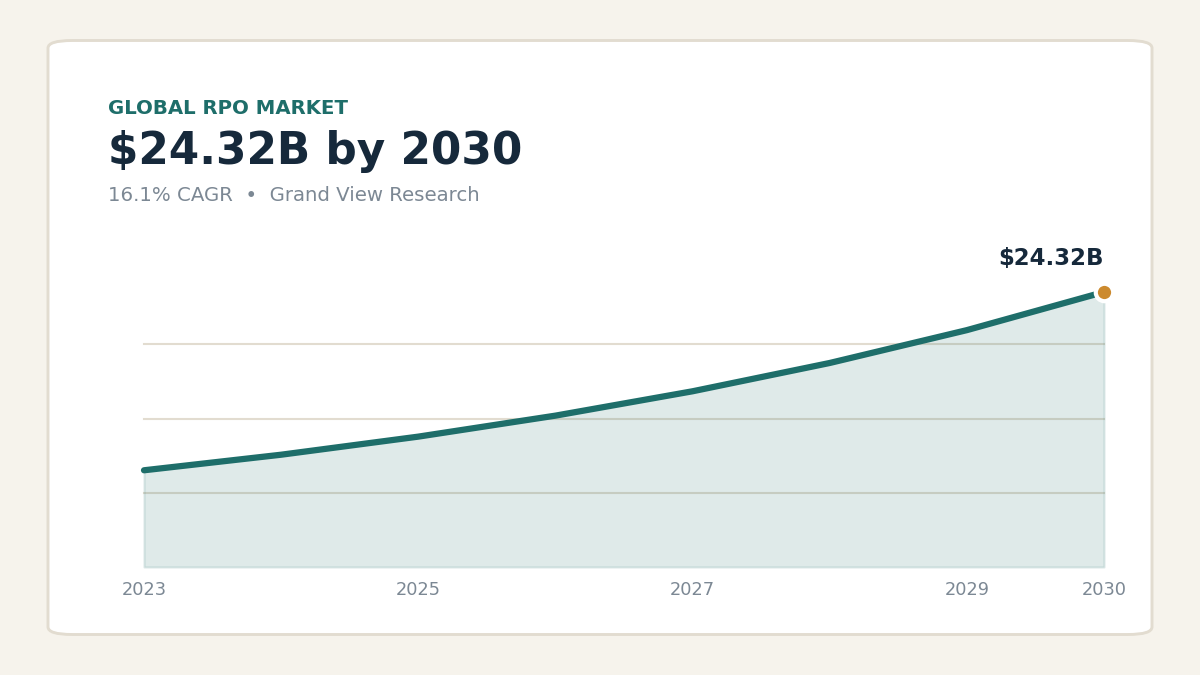
The global recruitment process outsourcing market is projected to reach $24.32 billion by 2030, growing at a 16.1% CAGR, a measure of how quickly companies are moving hiring functions to external partners.
What follows breaks down how the model works, where it saves time and money, what to verify before signing with a provider, and the mistakes that quietly erode its value. The goal is not to sell a service but to give you a framework precise enough to pressure-test any vendor pitch including the ones that promise more integration than they actually deliver.
What Is an RPO and EOR Combined Hiring Model?
An RPO and EOR combined hiring model is a single-partner arrangement in which one provider both sources and screens candidates (recruitment process outsourcing) and then legally employs them on your behalf (employer of record) running payroll, benefits administration, taxes, and statutory compliance without requiring you to open a local legal entity in the hire’s country.
The Real Problem: The Handoff Gap Between Hiring and Employing
The costliest failures in international hiring rarely happen during sourcing. They happen in the two-to-six-week window after a candidate says yes. A recruiter delivers a signed offer, and then the receiving company realizes it has no compliant way to actually put that person on payroll in Bengaluru, Warsaw, or São Paulo.
Setting up a legal entity to employ one or two people takes 3–6 months and often ₹15–25 lakhs in setup and annual maintenance in India alone before a single salary is paid. Multiply that across three or four countries and the math collapses.
So teams reach for a shortcut: classify the new hire as a contractor. That works until it doesn’t. Contractor misclassification penalties, back-taxes, and benefit claims routinely run into six figures, and enforcement has tightened across the EU, India, and the US in the past two years.
The deeper issue is ownership. When one vendor recruits and a second employs, accountability fractures at the handoff. Time-to-hire numbers look fine on the recruiter’s dashboard while the candidate sits unpaid and unonboarded for weeks, a gap that competitors’ faster offers exploit. Closing it is the entire premise of the RPO and EOR combined hiring model.
How the Combined Model Actually Works
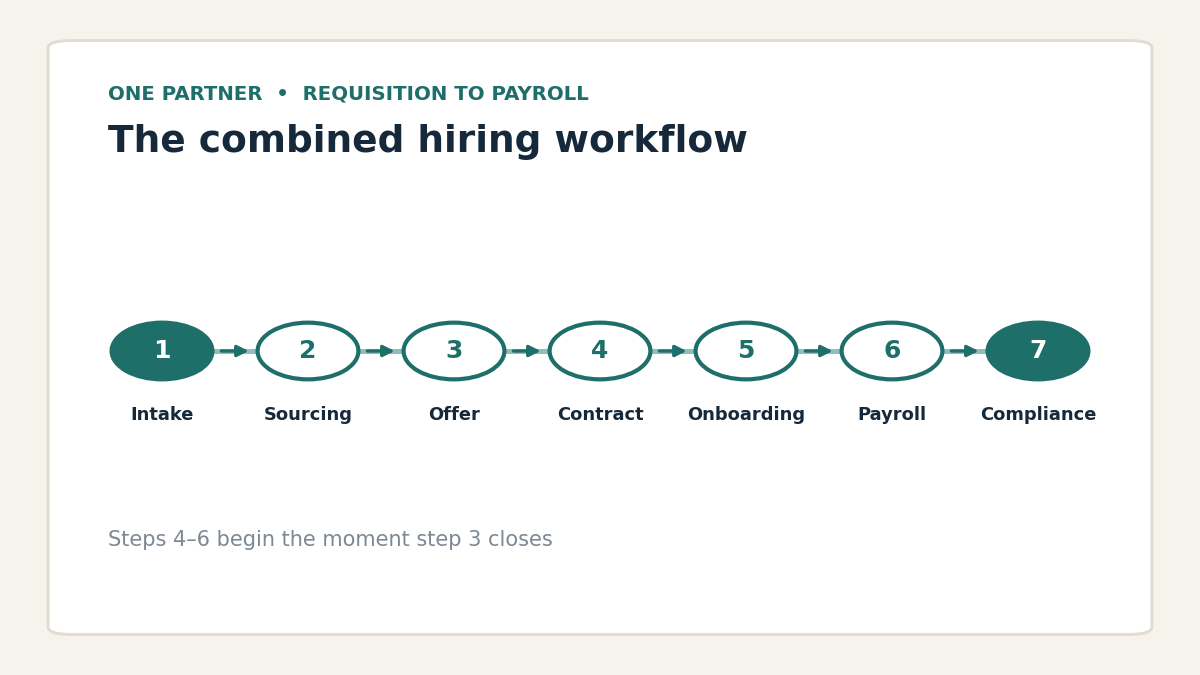
A combined hiring employment model works because a single operational team carries a candidate through every stage: intake, sourcing, screening, offer, contract, onboarding, payroll, and ongoing compliance.
There is no vendor-to-vendor translation layer, and one SLA governs the entire lifecycle. In practice, the RPO and EOR combined hiring model turns two procurement relationships into one.
How to Hire and Legally Employ Talent With One Partner: The Process
The end-to-end flow is more linear than most buyers expect. A well-run engagement moves through these steps:
- Role intake and workforce planning defining the requisition, target market, salary bands, and start date, with local-market pay data attached.
- Talent sourcing and screening the recruitment engine builds a shortlist against role and culture fit, drawing on active and passive candidates.
- Offer and negotiation the same team structures a compliant offer aligned to local labor norms.
- Employment contract generation locally compliant employment contracts are issued under the EOR’s registered entity.
- Onboarding and documentation background checks, right-to-work verification, and employee onboarding run in parallel, not sequence.
- Payroll, benefits, and statutory setup the worker is added to compliant payroll with tax withholding, social contributions, and benefits administration configured.
- Ongoing compliance and reporting the partner manages filings, renewals, and payroll compliance for as long as the employee stays.
This is where the ability to recruit and employ with RPO EOR under one roof compresses timelines: steps 4–6 begin the moment step 3 closes, rather than restarting with a new vendor.
Architecture Decision: Aggregator vs. Owned-Entity EOR
Not all employer-of-record providers are built the same, and the difference matters for risk. An owned-entity model means the partner holds its own registered legal entities in each country and directly employs your worker. An aggregator model means the partner subcontracts employment to third-party local firms it doesn’t control.
Owned-entity coverage gives cleaner liability lines and more consistent payroll compliance, but usually covers fewer countries. Aggregators reach more markets faster but add a layer between you and the actual employer. For cross-border hiring into a handful of core markets, owned entities are generally the safer default.
RPO Plus Payroll Outsourcing: The Cost Implications
The economics of bundling recruitment and payroll differ from buying each separately. RPO is typically priced per hire or as a monthly management fee (often ₹80,000–₹2,50,000 per month for an active pipeline, or 8–20% of first-year salary per placement). EOR is usually a flat per-employee-per-month fee, commonly $200–$600 or ₹18,000–₹50,000 depending on country and salary.
Bundling rarely produces a large discount on the line items. The savings show up elsewhere: no ₹15–25 lakh entity setup, no duplicated onboarding work, and a shorter revenue-delaying gap between offer and productivity. For a team hiring 5–15 people across two or three countries, that avoided entity and rework cost is usually the single largest number on the page.
Compliance and Integration Considerations
The integration point people underinvest in is data. A clean model passes candidates and offers data straight into the employment and payroll system, so nothing is re-keyed. Ask any prospective partner how a signed offer becomes a payroll record if the answer involves manual spreadsheets, the “combined” claim is thin.
On the compliance side, the ability to hire and pay talent one partner manages depends on the partner genuinely owning statutory compliance in each jurisdiction: tax registration, social security, mandatory benefits, and termination rules that vary sharply by country.
Case Study Applications
Two engagements show the RPO and EOR combined hiring model in practice.
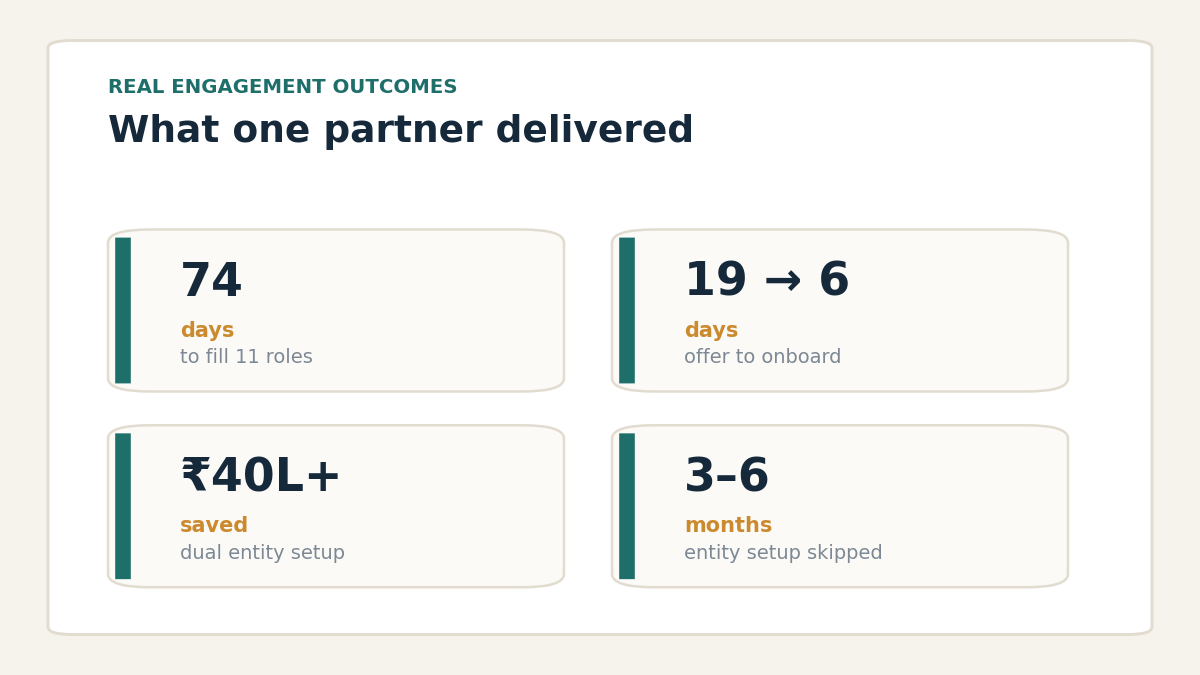
A Series-B SaaS firm needed 11 engineers across India and Poland in under 90 days but had no entity in either market. Using a single partner to source and then employ the hires, it filled all 11 roles in 74 days and avoided an estimated ₹40+ lakh in dual entity setup with every engineer on compliant local payroll from day one.
In a second engagement, a US healthtech company had been running offshore developers as contractors and faced a misclassification exposure flagged by counsel. Converting them to EOR-employed staff while keeping the same recruitment pipeline for new roles removed the liability and cut its average offer-to-onboard time from 19 days to 6.
Comparison: Which Approach Fits Your Situation
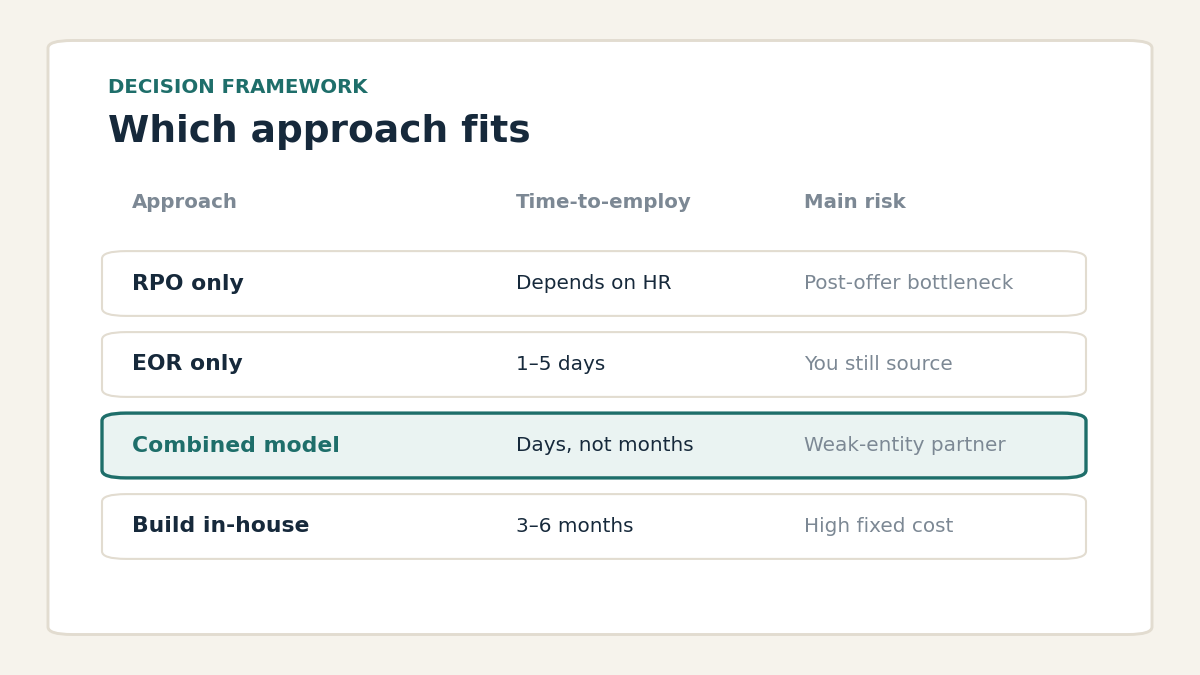
The decision usually comes down to how many markets you’re entering and whether you already have entities in place. The combined-model row below is where the RPO and EOR combined hiring model earns its place.
| Approach | Best when | Time-to-employ | Main risk |
| RPO only | You have local entities and payroll already | Depends on your HR | Post-offer bottleneck |
| EOR only | You have a candidate but no sourcing need | 1–5 days | You still own sourcing |
| Combined model | You need both talent and legal employment abroad | Days, not months | Choosing a weak-entity partner |
| Build in-house | 20+ hires in one stable market long-term | 3–6 months to set up | High fixed cost, slow start |
What Most Teams Get Wrong
The most common mistake is treating “combined” as a marketing label rather than an operational reality. Many providers sell recruitment and employer-of-record services from two internal teams that barely talk to each other. You get the same handoff gap, now hidden behind one invoice. The test is simple: ask who owns the SLA from requisition to first payroll, and whether it’s one accountable person or two teams pointing at each other.
The second error is optimizing for the lowest per-employee EOR fee while ignoring entity quality. A cheaper aggregator that subcontracts employment can leave you exposed to termination liability and benefit obligations you never see until something goes wrong. The fee difference of $100 per employee per month is irrelevant next to a single mishandled dismissal.
The third is scaling the model past its fit. Once you’re hiring 20-plus people in a single stable market for the long term, an owned entity often becomes cheaper than perpetual EOR fees. The combined model is a speed-and-flexibility instrument, not a permanent substitute for infrastructure you’ll eventually need.
Where to Go From Here
If you’re weighing an RPO and EOR combined hiring model and want to pressure-test whether “combined” means genuinely integrated or just co-invoiced, it helps to review a real workflow before committing to any vendor. Supersourcing has run sourcing-through-payroll engagements across multiple markets and can walk you through the entity structure, data flow, and compliance ownership behind a single-partner setup.
Bring your specific countries and hiring volume to the conversation. The answer changes considerably at 3 hires versus 30. Start at supersourcing.com/contact-us or email mayank@engineerbabu.com to map your requirement against the model before you sign anything.
Frequently Asked Questions
What is the difference between RPO and EOR?
RPO (recruitment process outsourcing) is about finding people sourcing, screening, and shortlisting candidates for your open roles. EOR (employer of record) is about employing them legally, hiring, paying, and keeping them compliant on your behalf. One fills the seat; the other makes the employment lawful. A combined model simply puts both under a single accountable partner.
Can one provider handle both recruitment and employment?
Yes, and that’s the core of the RPO and EOR combined hiring model. A single partner can source a candidate and then employ them through its own registered entity, running payroll and statutory compliance. The advantage is a continuous chain of ownership with no vendor handoff, which is where most delays and misclassification errors originate.
Is an EOR the same as payroll outsourcing?
No. Payroll outsourcing processes pay for people who are already your legal employees. An EOR is the legal employer, taking on tax, benefits, and termination liability so you don’t need a local entity. Payroll is one function inside what an EOR does, not the whole of it.
How much does an RPO and EOR combined model cost?
Expect two components: a recruitment fee (often 8–20% of first-year salary or a monthly pipeline fee) plus a per-employee EOR fee, commonly $200–$600 or ₹18,000–₹50,000 per person per month. The real economics come from avoiding ₹15–25 lakh in entity setup and eliminating duplicated onboarding work.
When should a company use RPO and EOR together?
The combined approach fits best when you’re hiring in one or more countries where you have no legal entity and you also need help sourcing the talent typically fast-scaling teams, market-entry projects, or firms converting risky contractors into compliant employees. If you already have entities and strong internal recruiting, you may only need one service.
Does using an EOR mean the workers are not my employees?
Legally, the EOR is the employer of record, but the worker reports to you, does your work, and functions as part of your team day to day. You retain full operational control; the partner carries the employment liability. If you want to bring them onto your own entity later, a well-run partner supports that transition.
