

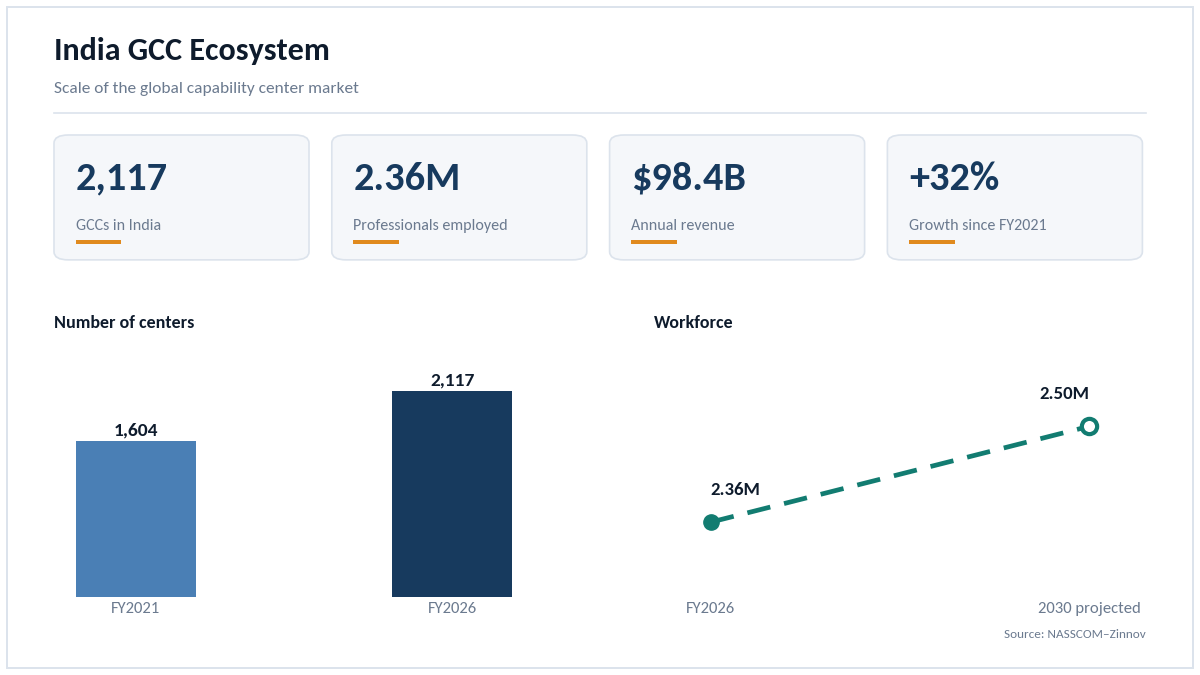
India crossed 2,117 global capability centers this year. Those centers employ 2.36 million people and generate $98.4 billion in annual revenue, a 32% increase in center count since FY2021. Which makes what is a GCC in business a question worth answering properly, because the model behind that number is now available to companies far smaller than the ones that pioneered it.
NASSCOM and Zinnov project India’s GCC market to reach approximately $100 billion in revenue with a workforce crossing 2.5 million by 2030.
The part that should interest a US executive more than the headline number: the fastest-growing segment is not the Fortune 500. It is mid-market companies that a decade ago would never have considered running their own offshore entity. The cost of standing one up has fallen, the legal path has been simplified, and the talent they need has stopped being available at a price they can pay in Austin, Denver, or Boston.
Strip away the acronym and it is a very old idea with a new name: instead of paying a vendor to do work for you, you hire the people yourself, in a country where the talent is deeper and the cost is lower, inside a company you own. You get the people, the code, the patents, and the institutional memory. The vendor model gives you an invoice and a statement of work.
That distinction of ownership versus procurement is the whole argument. Everything else in this guide is mechanics: how you actually do it, what it costs, how long it takes, and the specific ways it goes wrong.
Most content on this topic will tell you a GCC is “a strategic offshore hub driving digital transformation.” That sentence has never helped anyone make a decision. What follows is the version written for someone who has to defend the business case to a CFO who will ask, on slide three, when the savings actually show up.
TL;DR
This guide explains what is a GCC in business, who should build one, and exactly how the process runs from first decision to a functioning team. It is written for US founders, CTOs, COOs, and finance leaders who are weighing an offshore build against outsourcing or continued domestic hiring. No prior knowledge assumed.
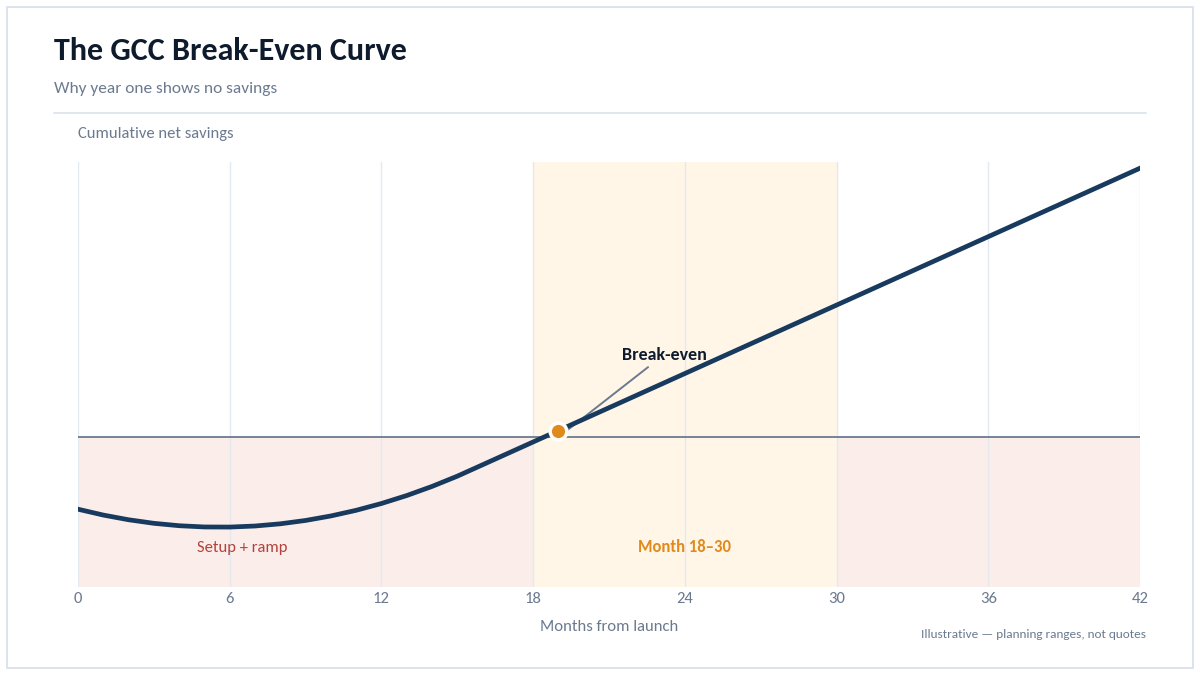
The single number to hold onto: a GCC typically delivers a 40–60% total cost advantage over equivalent US headcount, but it does not deliver it in year one. Legal entity formation alone runs 8–14 weeks, and most centers reach genuine run-rate economics somewhere between month 18 and month 30. Business cases that promise savings in quarter two are the ones that get cancelled in quarter three.
By the end you will be able to size your own build, choose between a wholly owned entity, an employer-of-record bridge, and a build-operate-transfer arrangement, budget the setup and per-head costs with real ranges, run a vetting process that filters for the right people, and recognise the five failure patterns that account for most struggling centers. You will also know when the honest answer is that you should not build one at all.
What Is a GCC? The Definition
A global capability center (GCC) is a wholly owned offshore or nearshore subsidiary that a company establishes to perform core business functions engineering, product, data, finance, or operations using its own directly employed staff. Unlike outsourcing, the parent retains full ownership of the workforce, the intellectual property, and the management structure.
That is the global capability center definition in 51 words, and it is deliberately precise on the two things that separate a GCC from everything adjacent to it: direct employment and retained IP.
Three things it is routinely confused with, and is not:
- A BPO or outsourcing vendor. In an outsourcing arrangement, a third party employs the staff, owns the delivery infrastructure, and holds the operational relationship. You buy an outcome. In a GCC, you employ the people. You own the outcome and the mess.
- An offshore development center (ODC) run by a services firm. An ODC branded as “your dedicated team” inside a vendor’s building is still the vendor’s payroll and the vendor’s attrition problem. The team is dedicated; the employment is not yours.
- A branch or liaison office. These are limited-purpose registrations that generally cannot carry out full commercial operations or hire at scale in India. A GCC is normally incorporated as a Private Limited company, a full operating subsidiary.
GCC Full Form in IT and What Does GCC Stand For?
The gcc full form in it is Global Capability Center. Simple enough except this acronym is genuinely overloaded, and search results mix all three meanings.
If you are asking what does gcc stand for, the answer depends entirely on which room you are standing in:
- Global Capability Center the business and operating-model sense. This guide.
- GNU Compiler Collection the open-source compiler toolchain. If a developer on your team says “compile it with GCC,” this is what they mean. Unrelated.
- Gulf Cooperation Council the six-nation political and economic bloc. Common in trade and logistics contexts. Also unrelated.
Within the business sense, you will also encounter global in-house centres (GIC) and captive centres. Treat these as synonyms. “Captive” is the older term and carries a slightly dated connotation of pure cost work; “GCC” is the current standard and implies a broader mandate. Pick one and use it consistently in your internal documents mixed terminology in a board deck creates the impression that the team has not settled its own thinking.
Why It Matters: The Business Case in Concrete Terms
The gcc meaning in business only becomes useful when you attach it to outcomes a CFO recognises. Four categories, with the numbers that actually move:
- Cost structure
- Total cost advantage of roughly 40–60% versus equivalent US headcount, once fully loaded (salary, statutory contributions, facilities, overhead).
- The advantage is not uniform. It is widest at junior and mid levels and compresses sharply at senior and leadership levels, where India’s market for experienced engineering leaders is genuinely competitive.
- Fixed overhead legal, compliance, HR infrastructure, site leadership plateaus at roughly 30 people. Cost per head at 50 FTEs is materially better than at 20. Below about 15, the overhead ratio is punishing.
- Talent access and depth
- India produces a very large annual volume of STEM graduates and holds the world’s deepest concentration of engineering talent outside the US. For specialised roles platform engineering, data infrastructure, applied ML the constraint in the US is availability, not budget.
- GCCs typically pay 20–25% above what domestic Indian IT services firms offer for the same role. That premium is not a failure of the model; it is the mechanism by which GCCs win the better candidate.
- Control, IP, and risk
- Direct employment means IP is assigned to your entity by employment contract, not negotiated into a vendor MSA and re-negotiated at renewal.
- No shared-bandwidth problem: your engineers are not being rotated onto another client’s escalation on Friday afternoon.
- Governance, security posture, and data handling follow your policies, which matters enormously for regulated sectors fintech, healthtech, anything touching PHI or card data.
- Strategic mandate
- Practically: a modern GCC owns products, not tickets. It runs its own on-call rotation, ships to production, and increasingly holds P&L-adjacent accountability.
The reframe that matters: if you build a GCC purely to reduce a line item, you will staff it like a cost center, hire for compliance rather than judgment, and get exactly what you paid for. The centers that outperform are the ones chartered with ownership of something specific from day one.
The Core Problem Most Buyers Face
The failure mode is almost never “the talent was bad.” It is that the plan compressed three separate timelines into one optimistic number.
The 3-4x rule: in most engagements, first-time builders underestimate time-to-first-productive-output by a factor of three to four. A leadership team that budgets “we’ll have a team running in two months” is describing the hiring timeline only and only if hiring goes perfectly.
Here is what actually gets missed:
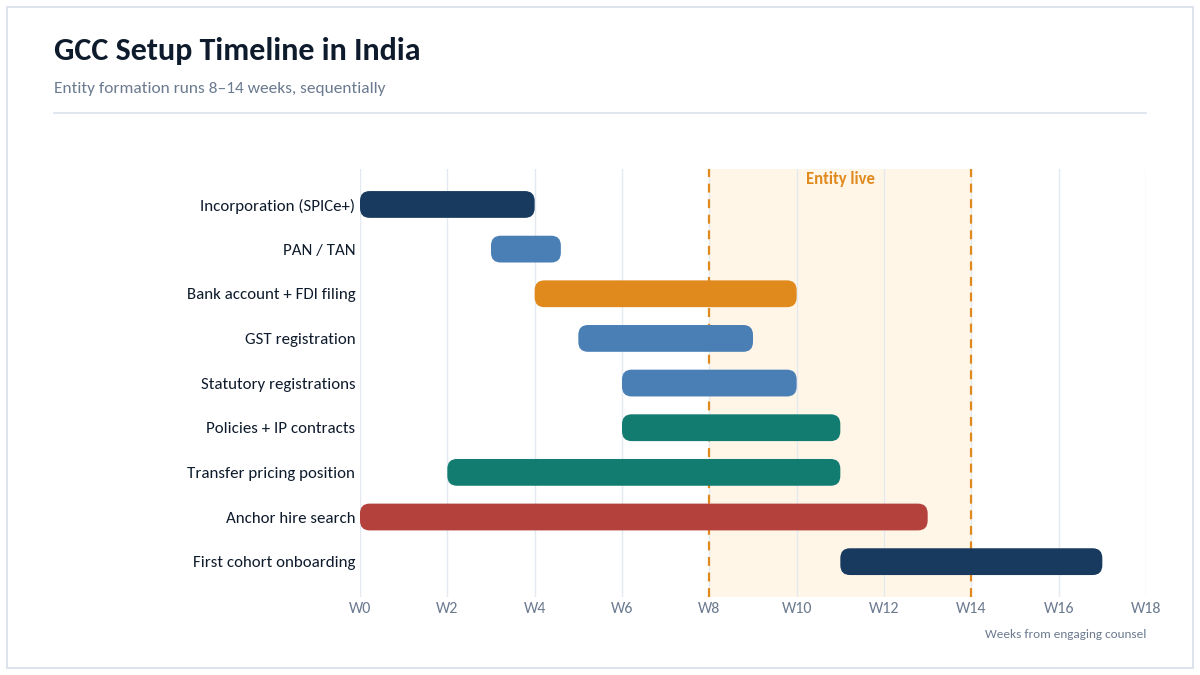
- Entity formation is sequential, not parallel. Incorporation, PAN/TAN, GST registration, bank account activation, and statutory registrations have dependencies. You cannot open a corporate bank account before incorporation completes, and you cannot run payroll before the bank account is live. The realistic band is 8–14 weeks from engaging counsel to a legally operable entity.
- The anchor hired gates and everything else. Your first senior hire, the site leader or founding engineering manager is the hardest role to fill and the one that determines the quality of the next twenty. Teams routinely budget 4 weeks for a search that credibly takes 8–14 weeks, then compromise on the candidate to stay on schedule. That compromise is the single most expensive decision in the entire build.
- Notice periods are a real calendar item. India’s standard notice period is 30–90 days, and 90 days is common at senior levels in established firms. An accepted offer in March may mean a start date in June. Every plan built on US-style two-week notice is wrong by roughly a quarter.
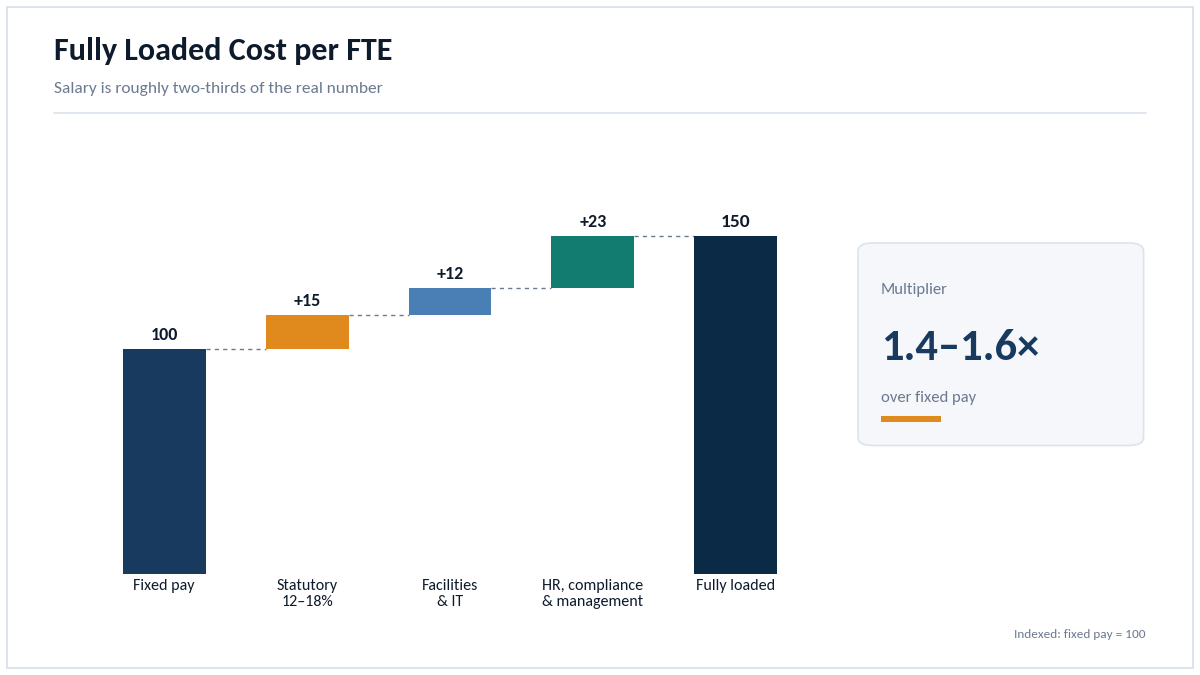
- Fully loaded cost is not salary. Statutory employer contributions provident fund, gratuity accrual, insurance commonly add 12–18% on fixed pay. Facilities, IT, tooling, HR, compliance, and management overhead push the fully loaded multiplier to roughly 1.4–1.6× fixed pay. Business cases built on salary alone overstate savings by a wide margin.
- Attrition arrives on schedule. The Indian tech market’s attrition dynamics are structural, not a reflection on your employer brand. Plan for it in the model rather than treating each departure as an anomaly.
Red flag: if your business case shows net savings in year one, it is wrong. The realistic pattern is modest or negative net savings in year one. You are absorbing setup costs, sub-scale overhead, and a learning curve with full run-rate economics arriving between month 18 and month 30. Boards briefed on that J-curve fund it calmly. Boards promised instant arbitrage to cancel the program at the dip, usually a quarter before the curve turns.
The Walkthrough: Building a GCC From Scratch
Seven phases. Read them in order the first time the sequencing errors are more expensive than the execution errors.
Phase 1 Defining the Mandate, Scope, and Budget Bands
Before any legal or hiring work begins, four decisions have to be written down and agreed by the people who control the budget. Ambiguity here surfaces later as scope disputes with your own offshore team.
The four decisions:
- Function and mandate. Not “engineering.” Specify: which products, which layers of the stack, which on-call responsibilities. “The India team owns the payments service end-to-end including production support” is a mandate. “The India team supports the payments team” is a recipe for a ticket queue.
- Headcount curve, not headcount. Model year 1, year 2, and year 3 separately. A 12-person year-one team scaling to 45 by year three is a different legal, real-estate, and leadership plan than a flat 12.
- Location. Bengaluru offers the deepest talent pool and commands roughly a 25–40% salary premium over tier-2 cities. Hyderabad typically runs 10–15% cheaper at comparable depth for engineering, analytics, and BFSI work. Pune, Chennai, and NCR each have distinct sector strengths. Tier-2 cities like Coimbatore, Ahmedabad, and Indore lower cost and attrition but narrow the senior talent pool considerably.
- Budget band. Set an all-in year-one number before you fall in love with the idea. Setup and first-year operating costs are covered in the Cost section below; bring that range into this conversation, not after it.
Scoping checklist answer all seven before proceeding:
- Which specific systems, products, or processes transfer to the GCC?
- What stays onshore permanently, and why?
- Who is the single accountable executive onshore? (Not a committee.)
- What is the target overlap window with the US team 2 hours, 4 hours, or full-shift?
- What does success look like at month 6, month 12, month 24, in measurable terms?
- What is the minimum viable team composition for the mandate to be real?
- What is the trigger condition to stop or reverse?
The 60% rule: if less than 60% of the work you are moving offshore can be owned end-to-end by the offshore team, you are not building a GCC. You are building a staffing arrangement with extra legal steps, and staff augmentation will serve you better and faster.
Be honest at this gate it is cheaper to conclude “not yet” here than in month nine. This is also the point at which a scoping conversation with a global capability center setup partner earns its keep, because the failure modes are highly patterned and an experienced team will recognise yours in an hour.
Phase 2 Legal Entity, Tax Structure, and Compliance
This is the phase that first-time builders most underestimate, and the one where the 2026 regulatory changes materially alter the math.
The standard structure: a wholly owned Private Limited company incorporated in India, with foreign investment through the automatic route (no prior government approval required for most IT and software services activity).
The Indian entity provides services to the US parent under an intercompany services agreement and is compensated on a cost-plus basis.
Sequential setup steps, with realistic durations:
- Name reservation and incorporation (SPICe+ filing with the Registrar of Companies) 2–4 weeks. Requires at least two directors, one of whom must be resident in India.
- PAN and TAN issuance issued alongside incorporation, typically within days of the certificate.
- Corporate bank account opening and FDI reporting 2–6 weeks. This is the most common stall point; foreign-parent KYC documentation frequently needs apostille or consular attestation, which people discover late.
- GST registration 2–4 weeks, state-specific.
- Statutory registrations Shops & Establishments (state), Provident Fund (EPFO), ESI where applicable, Professional Tax. 2–4 weeks, overlapping.
- Policy and governance setup employment contract templates with IP assignment, POSH (Prevention of Sexual Harassment) policy and Internal Committee constitution, which is a statutory requirement, not a nice-to-have.
- Intercompany services agreement and transfer pricing position draft alongside incorporation, not after.
Total realistic timeline to a legally operable entity: 8–14 weeks. Compressing below 8 weeks is possible only with clean documentation and an experienced local counsel already engaged.
The 2026 transfer pricing change you need to know about. India’s safe harbour regime governs the margin your Indian entity must book on services provided to the parent below it, you invite scrutiny. Per KPMG’s March 2026 analysis of the final Income-tax Rules, 2026, effective 1 April 2026 the CBDT consolidated software development, ITeS, KPO, and contract R&D into a single “IT services” category at a 15.5% cost-plus margin, and raised the eligibility threshold from ₹300 crore to ₹2,000 crore, with a five-year election window.
Why this matters in plain terms: the previous regime ran 17–24% depending on category, and category classification was itself a source of disputes. A lower, unified margin means less taxable income booked in India on the same cost base, and the higher threshold brings far larger centers inside the safe harbour. If your business case was modelled before April 2026, the tax assumptions are stale. Have it re-run.
Red flag: a setup advisor who cannot explain your transfer pricing position and permanent establishment exposure in one sitting is a company formation agent, not a GCC partner. Entity registration is the easy part; the intercompany structure is where real money is won and lost. If you do not have this expertise in-house, buy it either from a Big 4 tax practice or through IT consulting services that include entity and operating-model design.
The EOR bridge. You do not have to wait 14 weeks to start hiring. An employer-of-record arrangement lets you employ your first hires legally under a third party’s entity often within days while your own entity is being formed, then transfer them onto your payroll once it is live. This is the standard play and it removes the worst dependency in the entire plan. Budget for the EOR fee per employee per month and treat it as a bridge, not a destination.
Phase 3 Sourcing and Vetting the Team
The sequencing here is counterintuitive to most US leaders, who instinctively want to hire individual contributors first because that is where the visible work sits.
Hire in this order:
- Site leader or founding engineering manager. This person defines hiring standards, interviews everyone after them, and becomes your cultural translator. Over-invest here.
- Two to three senior individual contributors. They set the technical bar and become the interview panel. Hiring juniors before seniors means seniors later inherit code they would not have approved.
- The mid-level core. This is where the volume is and where the cost advantage is strongest.
- Junior hires and campus intake. Only once there are enough seniors to mentor them. A junior-heavy team without senior density produces velocity without judgment.
What a credible vetting funnel looks like:
- Structured screening against a written scorecard not a resume skim. Resume inflation is a real and well-documented problem in the Indian tech market, and the filter has to be capability-based.
- A live technical evaluation that mirrors real work: debugging an existing codebase, extending a service, reviewing a PR. Algorithmic puzzle rounds selected for interview preparation, not engineering judgment.
- A systems and design discussion is proportional to the level.
- Communication and ambiguity assessment. The offshore engineer who cannot say “I disagree, here is why” to a US director is a permanent throughput cap on the whole team.
- Reference and background verification, including employment and education verification. In India this is a standard, expected step.
Red flags in candidate screening patterns worth watching:
- Overlapping employment dates across two employers on the same resume.
- A candidate who can describe the architecture in detail but cannot explain a single trade-off they argued against.
- Compensation expectations wildly out of band for the level usually a signal of a competing offer being used as leverage, which frequently reappears as a counter-offer drop-out after acceptance.
- No questions about the mandate. Strong senior candidates interrogate the charter, because they have seen offshore teams chartered as ticket queues before.
The offer-to-joining gap is the metric nobody tracks and everybody should. In the Indian market, accepted offers do not equal joiners counter-offers from the current employer during a 60–90 day notice period are routine. Track joining rate explicitly and manage the notice period actively with structured engagement rather than going silent after the offer letter. Across the engagements Supersourcing runs, a 98% joining rate and sub-1% drop-off on contract roles come from that active management, not from luck.
For infrastructure-heavy mandates the first roles are usually platform and reliability, so if the plan is to stand up your own cloud footprint, the search for a site leader and the search to hire cloud engineers should run in parallel rather than in sequence.
Phase 4 Choosing an Operating Model and Getting the Contracts Right
Four models, and the choice is mostly a function of headcount, timeline, and how much operational load you can absorb.
| Model | You own the entity | Speed to first hire | Best fit |
| DIY build | Yes, from day one | 3–5 months | 50+ FTEs, existing India experience, in-house legal/tax capacity |
| Managed GCC / partner-led build | Yes, with operational support | 4–10 weeks | 20–100 FTEs, first-time builders |
| Build-Operate-Transfer (BOT) | Not initially; transfers later | 4–8 weeks | Want the outcome, want to defer the operational load, plan to own it eventually |
| EOR / staff augmentation | No | Days to 3 weeks | Under ~15 FTEs, or testing the thesis before committing |
Contract terms that actually matter check every one:
- IP assignment. Must flow to the parent, must be present in the employment contract, and must survive termination. Verify the local employment template does this; a US-drafted clause dropped into an Indian contract may not be enforceable as written.
- NDA and data handling, aligned to your compliance regime (SOC 2, HIPAA, PCI DSS as applicable) and reflected in the physical and network access design, not just on paper.
- BOT transfer mechanics. If you are using BOT, negotiate the transfer price formula, trigger conditions, and employee-transfer treatment at signing. A BOT contract that leaves the transfer price to future negotiation hands your partner enormous leverage at exactly the moment you have the least.
- Replacement and exit terms. For partner-led or augmented models, a defined replacement window matters; the standard worth insisting on is a replacement within 7–10 days if a hire is not a fit.
- Notice and wind-down. What happens to the team, the entity, the data, and the code if you stop.
- No shared bandwidth. If a partner supplies people, contract for dedicated allocation explicitly, with named individuals.
The negotiation point most teams miss: in BOT arrangements, the partner’s incentive during the “operate” phase is to keep operating. Tie the transfer trigger to an objective condition: a headcount threshold, a date, or a delivery milestone rather than mutual agreement. “Transfer upon mutual agreement” is not a transfer clause; it is an option the partner holds. If you are engaging a partner for hiring at volume, the same discipline applies to recruitment process outsourcing contracts: define the SLA, the replacement window, and the exit in writing before the first requisition opens.
Phase 5 Onboarding and Ramp-Up: The First Two Weeks
The first fortnight determines whether the offshore team behaves as an extension of your engineering organisation or as a vendor waiting for instructions. Most of the damage is done by accident, through logistics.
Day-one readiness checklist complete before the start date, not on it:
- Laptop and hardware delivered and configured (procurement in India can take 1–2 weeks; order early)
- SSO, email, VPN, and MFA provisioned and tested
- Repository, CI/CD, cloud console, and ticketing access at the correct permission level
- Named onshore buddy assigned per new hire
- First-week calendar populated with real meetings, not orientation filler
- A scoped, shippable first task identified small, real, and merged within week one
The two-week ramp structure that works:
- Days 1–3: environment setup, codebase orientation, architecture walkthrough with a senior engineer, first PR merged (even if trivial).
- Days 4–7: shadow a live on-call or support rotation. Nothing teaches system reality faster.
- Days 8–10: first independent task, scoped to complete within the window.
- Days 11–14: first retrospective with the manager, explicitly covering what is unclear about the mandate.
The onboarding friction almost nobody plans for: access approvals. In most enterprises, granting production or data access to a newly incorporated foreign subsidiary requires security review, and that review has its own queue.
Teams routinely have engineers sitting for two to three weeks with no meaningful access because the request was raised on day one instead of six weeks prior. Raise the access and security review before the first offer letter goes out. This one sequencing change reclaims more calendar time than any other adjustment in the ramp phase.
Communication cadence, established in week one and not renegotiated:
- A daily async standup in a shared channel is written, so the US team reads it in the morning.
- A twice-weekly live overlap window of 2–3 hours, protected on both calendars.
- A weekly manager 1:1, video on.
- A monthly all-hands where the offshore team presents to the US organisation, not the reverse. This single practice does more for perceived ownership than any engagement budget.
Phase 6 Managing Delivery
Once the team is running, the failure mode shifts from logistics to governance. The specific risk: the offshore center becomes invisible to leadership except when something breaks.
Metrics worth tracking monthly:
| Metric | Why it matters | Healthy signal |
| Cycle time (commit → production) | Measures autonomy, not effort | Converging toward onshore team parity by month 6 |
| Percentage of work self-initiated | Distinguishes ownership from a ticket queue | Rising quarter over quarter |
| Escalation rate to onshore | Measures dependency | Falling after month 3 |
| Voluntary attrition (rolling 12 months) | Leading indicator of manager quality | Compare against local market, not US market |
| Offer-to-join conversion | Health of employer brand locally | Track separately from acceptance rate |
| Fully loaded cost per productive FTE-year | The number that makes every trade-off legible | Reported quarterly beside headcount |
Governance structure:
- Weekly: delivery review at team level, run by the offshore manager.
- Monthly: business review with the onshore accountable executive outcomes and blockers, not activity reports.
- Quarterly: mandate review. Is the charter still right? What should I transfer next?
- Annually: compensation benchmarking against the local market. Indian tech compensation moves faster than US compensation; a band that was competitive 18 months ago may now be below market, and you will discover this through resignations rather than through data if you are not looking.
The management anti-pattern to avoid: routing all offshore work through a single onshore “coordinator.” It feels efficient and it caps the team’s ceiling permanently, because every decision has to pass through one person’s calendar. Push decision rights down to the offshore managers and hold them to outcomes.
Phase 7 Scaling, Replacing, or Exiting
Scaling signals add headcount when at least two are true:
- The offshore team is consistently completing its mandate and pulling additional scope voluntarily.
- Cycle time has stabilised at or near onshore parity.
- The existing senior engineers have bandwidth to mentor new hires (roughly 1 senior per 3–4 juniors).
- There is a defined mandate for the new headcount, not just budget.
Scaling anti-signals do not add headcount when:
- Escalation rates are flat or rising.
- The site leader role is vacant or interim.
- You are adding people to fix a velocity problem caused by unclear ownership. More engineers will not resolve a mandate problem; they will make it more expensive.
Replacement policy. Some hires do not work out; the question is how fast you find out and what happens next. Contract a defined replacement window 7–10 days is a reasonable standard for augmented or partner-sourced roles and separately establish an internal 90-day performance checkpoint for direct hires. Waiting two quarters to address a bad fit costs more than the salary; it costs the standard.
Expansion into adjacent functions follows the same phase sequence at a smaller scale. A center that started with application engineering commonly extends next into platform and reliability work, the point at which teams hire DevOps engineers and start owning their own deployment path rather than requesting deployments from an onshore team.
Exiting or transferring. Plan this before you need it:
- Documentation and knowledge transfer a live runbook, not a retrospective handover document written under duress.
- Statutory wind-down closing of an Indian entity is a regulated, multi-month process involving tax clearance and RoC filings. It is slower than incorporation.
- Employee obligations notice, severance, and gratuity obligations are statutory. Model them.
- IP and data repatriation verify assignment is complete and access is revoked in a documented sequence.
- The BOT alternative to exit a struggling wholly owned center can sometimes be transferred to a partner to operate rather than closed. Preserving the team is usually cheaper than rebuilding one.
Comparison: GCC vs Outsourcing vs Staff Augmentation vs In-House
The gcc vs outsourcing question is usually posed as binary. There are four viable structures and most companies use two of them simultaneously.
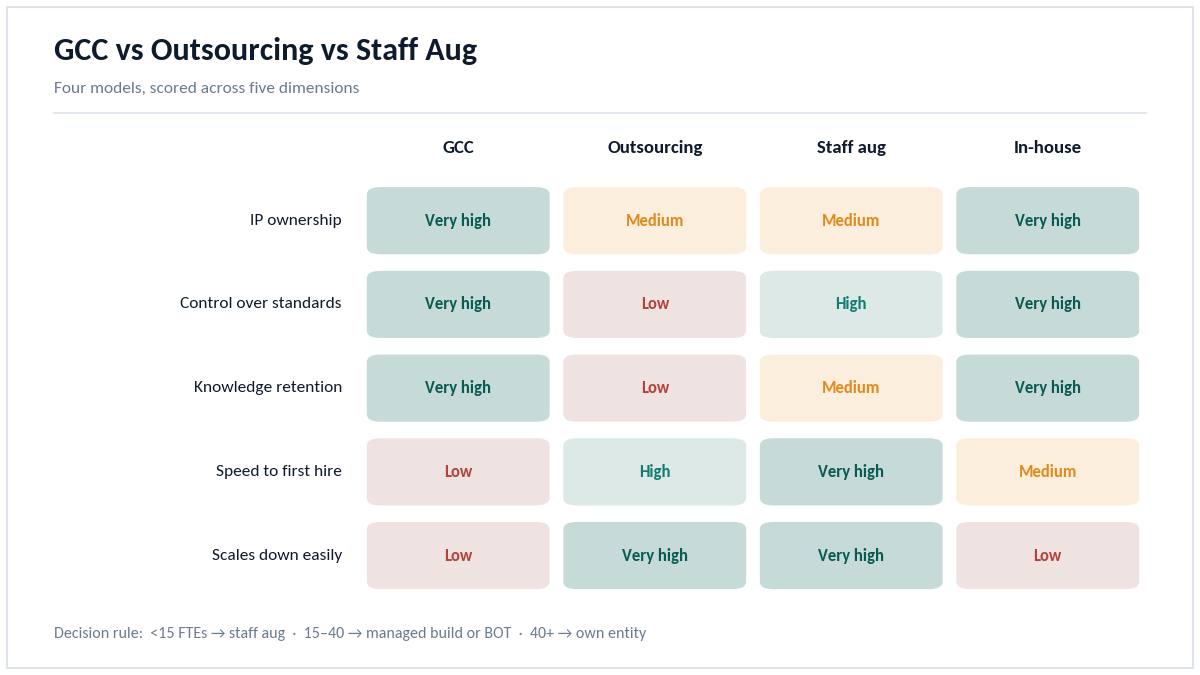
| Dimension | GCC (own entity) | Outsourcing / BPO | Staff augmentation | Onshore in-house |
| Who employs the people | You | The vendor | The staffing partner | You |
| IP ownership | Full, direct | Contractual, negotiated | Contractual | Full, direct |
| Relative cost per FTE | Low–medium | Medium (bundled) | Medium | Highest |
| Time to first productive person | 3–5 months (days with EOR bridge) | 4–8 weeks | 1–3 weeks | 6–12 weeks |
| Operational load on you | High | Low | Medium | High |
| Control over standards | Full | Limited | Medium–high | Full |
| Scales down easily | No | Yes | Yes | No |
| Institutional knowledge retention | High | Low | Medium | High |
| Break-even horizon | 18–30 months | Immediate | Immediate | N/A |
The decision rule, stated plainly:
- Under ~15 FTEs, or under 18 months of expected duration → staff augmentation or EOR. The fixed overhead of an entity cannot be amortised.
- 15–40 FTEs, first-time builder → partner-led managed build or BOT. You get entity ownership without absorbing the full operational load during ramp.
- 40+ FTEs, or IP-critical work, or a multi-year mandate → wholly owned GCC. This is where the economics and the control argument both hold.
- Work that is genuinely commoditised, non-differentiating, and stable → outsource it. Not everything deserves to be owned, and building a GCC to run a stable, well-specified process is an expensive way to buy something a vendor already does well.
The hybrid most mature companies actually run: a wholly owned GCC for product, platform, and data the differentiating work plus vendor relationships for commoditised or spiky capacity. Treating this as an either/or decision is the most common strategic error at this gate.
What Most Teams Get Wrong
Five patterns, in rough order of how much damage they cause.
- They charter the center as a cost center and then wonder why it behaves like one. A team told its purpose is to be cheaper and optimise for looking busy at low cost. A team given ownership of a product surface will optimise for that surface. The charter is self-fulfilling. This is why 92% of GCC leaders now report value beyond cost arbitrage; the ones still running pure cost mandates are, quietly, the ones underperforming.
- They hire the site leader last. Because the leader is expensive and the ICs are the “real work,” teams defer the senior hire and let an onshore manager run the team remotely for the first two quarters. Every hiring standard, every cultural norm, and every escalation pattern gets set during exactly that window by default rather than by design. The correction later costs more than the salary saved.
- They benchmark Indian compensation against Indian IT services firms. GCCs compete with other GCCs and with well-funded product companies, not with the domestic services market. Budgeting at services-firm rates produces either an empty pipeline or a team of people who could not get an offer elsewhere. The 20–25% premium over services-firm compensation is the price of the talent tier you actually need.
- They measure activity instead of autonomy. Tickets closed and story points are exactly the metrics an offshore team will optimise if you publish them. Track escalation rate, self-initiated work, and cycle time to production instead those three tell you whether you built a team or a queue.
- They treat the 18–30 month J-curve as a failure rather than the plan. Setup cost, sub-scale overhead, and ramp inefficiency mean year one shows thin or negative net savings. Every experienced operator knows this. Boards that were not told about it in advance interpret month 14 as evidence the model does not work and the programs that get cancelled at the dip are disproportionately the ones that were on track.
The uncomfortable one: a meaningful share of companies asking “should we build a GCC” should not. If your offshore scope is under 15 people, your requirements change quarterly, or nobody onshore has the bandwidth to own the relationship at an executive level, the entity will become an administrative burden attached to a team you are not managing well. Staff augmentation for eighteen months, then revisit, is a legitimate and frequently correct answer.
Cost and Timeline Reality Check
The section most competing articles skip. All figures are planning ranges based on market patterns, not quotes; they vary by city, sector, and role mix, and should be re-validated against live benchmarks before they enter a board deck.
One-time setup costs
| Line item | Typical range (USD) | Notes |
| Legal incorporation, registrations, filings | $4,000 – $12,000 | Higher with complex parent structures |
| Tax and transfer pricing advisory (initial) | $8,000 – $25,000 | Re-scope post-April 2026 rule change |
| Recruitment (first cohort) | 8–20% of first-year CTC per hire | Varies by model and seniority |
| Workspace fit-out or managed office deposits | $500 – $2,500 per seat | Managed/serviced office avoids most capex |
| IT hardware and tooling per head | $1,500 – $3,000 | Procurement lead time 1–2 weeks |
| Indicative total, 20-person center | $80,000 – $250,000 | Excludes salaries |
Recurring cost per employee
- Fully loaded multiplier: roughly 1.4–1.6× fixed compensation, covering statutory contributions (12–18%), facilities, IT, HR, compliance, and management overhead.
- Managed workspace: commonly $150–$400 per seat per month depending on city and grade.
- Cost efficiency versus US equivalent: widest at junior and mid levels, compressing substantially at senior and leadership levels where India’s market is genuinely competitive.
Typical timelines by scenario
| Scenario | Time to first productive person | Time to full initial team |
| EOR bridge, 5–10 people | 2–4 weeks | 6–10 weeks |
| Partner-led managed build, 20–30 people | 6–10 weeks | 4–7 months |
| Wholly owned DIY build, 20–30 people | 3–5 months | 6–9 months |
| BOT, 30+ people | 6–10 weeks | 5–8 months |
What drives costs up
- Bengaluru over tier-2 cities (25–40% salary premium)
- AI/ML, cybersecurity, and specialised platform roles (typically 15–25% above standard engineering bands)
- Senior-heavy team composition
- Multi-city footprint before reaching scale in the first city
- Compressed hiring timelines, which reliably increase buyout and premium costs
What drives costs down
- Reaching 30+ FTEs, where fixed overhead amortises meaningfully
- Tier-2 city location for roles that do not require the deepest senior pool
- Balanced seniority pyramid rather than an all-senior team
- Managed workspace instead of a leased and fitted-out facility
- Electing the safe harbour regime where eligible, reducing transfer pricing dispute exposure and the associated professional-fee drag
Break-even reality: modest or negative net savings in year one; full run-rate economics typically between month 18 and month 30. Report fully loaded cost per retained, productive FTE-year quarterly beside headcount is the one number that makes every trade-off in this guide legible in money.
Where to Go From Here
If you are mid-decision, the useful next step is not more reading. It is a scoping conversation that answers three questions specific to your situation: does your scope clear the ~60% end-to-end ownership threshold, does your headcount curve justify an entity or an employer-of-record bridge for the next eighteen months, and what does the fully loaded cost per FTE actually look like for your role mix and target city.
That is a one-hour conversation, and it is worth having before you commission a business case rather than after because the most expensive GCC decisions are the ones made on stale assumptions about timelines, transfer pricing, and hiring velocity.
Supersourcing has spent ten-plus years on the delivery side of this problem: 527+ IT projects, GCC setup, and technical hiring for companies including Swiggy, Paytm, Razorpay, Chargebee, Adani, and Apollo Hospitals. If you want a candid read on whether a GCC is right for your scope, or a build plan if it is:
Talk to our GCC team → Bring your target function, rough headcount curve, and timeline. We will tell you if the answer is staff augmentation instead.
Frequently Asked Questions
What does GCC stand for in business?
GCC stands for Global Capability Center, a wholly owned offshore or nearshore subsidiary performing core business functions with directly employed staff. It is also called a global in-house center (GIC) or captive center. In software contexts the same acronym means GNU Compiler Collection, and in trade contexts it means Gulf Cooperation Council, so confirm which sense is intended.
What is the difference between a GCC and outsourcing?
Employment and ownership. In outsourcing, a vendor employs the workforce, owns the delivery infrastructure, and you purchase a defined outcome. In a GCC, you employ the people directly through your own legal entity and retain full ownership of the intellectual property, the management structure, and the institutional knowledge. Outsourcing is faster to start and easier to exit; a GCC compounds value over time.
How many employees do you need to justify a GCC?
As a working threshold, roughly 30–40 FTEs. Fixed overhead legal entity, compliance, HR infrastructure, site leadership plateaus around 30 people, so cost per head improves sharply above that line. Below about 15 people the overhead ratio rarely justifies an entity, and an employer-of-record or staff augmentation arrangement will produce better economics with far less operational load.
How long does it take to set up a GCC in India?
Legal entity formation runs 8–14 weeks from engaging counsel to a fully operable entity, because incorporation, banking, and statutory registrations are sequential. Adding hiring, a realistic wholly owned build reaches the first productive headcount in 3–5 months and a full initial team of 20–30 in 6–9 months. An employer-of-record bridge can put your first hires to work within weeks while the entity forms in parallel.
How much does it cost to set up a GCC in India?
For a 20-person center, a one-time setup typically lands between $80,000 and $250,000 excluding salaries, covering incorporation, tax and transfer pricing advisory, recruitment, workspace, and hardware. Ongoing cost per employee runs roughly 1.4–1.6× fixed compensation once statutory contributions, facilities, and overhead are included. City choice and role mix move both figures significantly.
Do GCCs only exist in India?
No. Poland, Mexico, the Philippines, Costa Rica, Vietnam, and Egypt all host substantial capability centers, and nearshore locations often win on time-zone overlap. India dominates in scale and engineering depth; it hosts roughly half of all global GCCs, with 2,117 centers employing 2.36 million people. The right answer depends on your function mix, overlap requirement, and language needs.
Can we convert an existing outsourcing relationship into a GCC?
Yes, and it is a common path. A build-operate-transfer arrangement is designed for exactly this: a partner stands up and runs the center, then transfers the entity and team to you at a pre-agreed trigger. The critical requirement is negotiating the transfer price formula and trigger conditions at signing rather than deferring them, because leverage shifts decisively once the team exists.
What legal documents are required for a GCC in India?
At minimum: incorporation documents (SPICe+ filing, MOA/AOA), PAN and TAN, GST registration, Shops & Establishments registration, EPFO and ESI registrations, a POSH policy with a constituted Internal Committee, employment contracts carrying enforceable IP assignment, and an intercompany services agreement supported by a transfer pricing position. Requirements vary by state and sector to validate against current rules with local counsel or a partner who has filed them recently, ideally before the business case is finalised rather than after.
