

I was on a call three months ago with a US-based fintech CTO who’d just burned through $180,000 and 14 months trying to scale an engineering team through a staff augmentation vendor in India. He wasn’t sold as a bad engineer. The skills matched the JDs. The interviews went fine. The problem was simpler and more expensive: nobody told him that the 6 developers he was paying for were split across 4 different clients at any given time.
That’s not a horror story. That’s Tuesday in this industry.
Tech staff augmentation in India is a legitimate, powerful model when it’s structured correctly. Supersourcing — where I’ve spent the last 14 years building teams for clients from early-stage startups to Brillio-scale enterprise transformations — has placed thousands of engineers through this model. I know exactly where it works and where the money leaks.
In 2026, the demand for flexible engineering capacity is only accelerating — but so is the gap between demand and actual hiring outcomes. According to Adecco India, overall tech hiring across permanent, contractual, and augmentation roles is projected to grow 12–15%, adding nearly 1,25,000 new jobs this year, signaling a massive reliance on external talent models like staff augmentation.
This surge isn’t just about growth — it’s about necessity. Companies are increasingly turning to augmentation because traditional hiring simply can’t keep up with AI, cloud, and data talent demand. If you want to dive deeper into the numbers, check out this report: Tech hiring set to rise 12–15% in 2026: Adecco India.
This isn’t a vendor pitch. It’s what I’d tell a founder before they sign the contract.
 What Is Tech Staff Augmentation in India (The Actual Definition)?
 What Is Tech Staff Augmentation in India (The Actual Definition)?
Tech staff augmentation in India is the practice of embedding trained, pre-vetted technology professionals — software engineers, DevOps specialists, QA engineers, data scientists, architects — directly into a client’s team on a temporary or extended basis, without the overhead of local hiring.
You retain control of the work. The vendor handles sourcing, contracts, compliance, and payroll. You get the output of an employee without the fixed-cost structure of one.
The reason India specifically dominates this market: engineering talent density, English proficiency, timezone overlap with both US and European morning windows, and a cost structure that delivers senior full-stack engineers at 35–50% of US equivalent cost — not junior talent, but engineers with 5–10 years of production experience.
That said, the model fails predictably when buyers don’t understand how vendors actually operate.
The Talent Supply Chain Most Clients Never See
Before evaluating any vendor, you need to understand the supply chain you’re buying into.
India’s tech staffing ecosystem has three layers. Large IT services companies — Wipros, Infosyses, HCL — operate at scale but with deep bench-management structures. Mid-market vendors like Supersourcing (vendor partners with Wipro, Virtusa, and Impetus) operate with leaner structures and faster deployment cycles. And then there’s the long tail of smaller shops that often arbitrage talent from the first two categories.
When Supersourcing built the fintech banking and settlement platform for Open Money, we didn’t just source engineers — we structured dedicated pods with explicit single-client commitments. That decision added roughly 12% to the engagement cost. It also meant zero context-switching loss and a platform that processed its first ₹100 crore within the first operational month.
The question to ask every vendor: are these engineers single-client dedicated, or pool-assigned? Most won’t answer directly. That’s your answer.
Shared-pool augmentation is not inherently wrong. For short sprints, specific feature builds, or QA cycles, it can be cost-efficient. For anything requiring architectural continuity, domain knowledge accumulation, or security-sensitive work — banking, healthcare, government — it will cost you more in rework than you saved in rates.
What Tech Staff Augmentation in India Actually Costs in 2026
Most vendors quote a day rate or monthly rate. That number is real but incomplete. Here’s the full cost picture:
The visible rate for a senior full-stack engineer (5–8 years, React/Node or Java/Spring) typically runs ₹2.2–3.8 lakhs per month from a mid-tier vendor. That’s $2,600–$4,500 USD at the current exchange. For a specialized ML/AI engineer or cloud architect, add 25–40% to that range.
What’s not in the rate: onboarding friction costs, which average 3–6 weeks of reduced velocity; context transfer overhead, especially painful if the role changes hands; and what I call the “coordination tax” — the calendar cost of async communication across timezone gaps if your team isn’t structured for it.
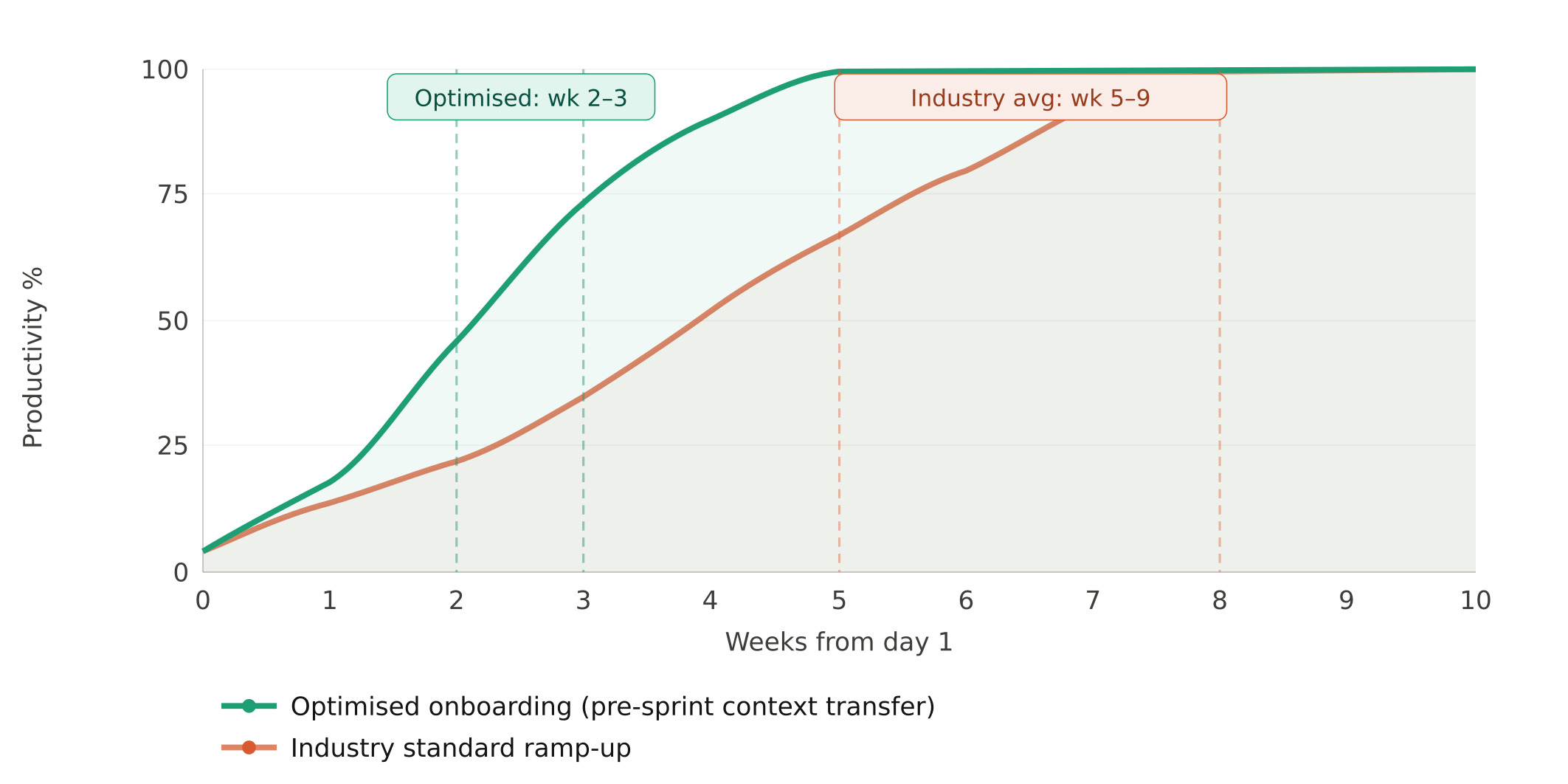
For the Kargo.tech product development and team scaling engagement, we ran a pre-onboarding knowledge transfer sprint — 2 weeks before the first billable day — that compressed actual time-to-productivity from the industry average of 6 weeks down to 11 days. That’s a structural decision, not magic. Most vendors don’t do it because it’s not billable.
 When evaluating total engagement cost, use this rough model:
| Engagement Type | Visible Rate (Monthly/Engineer) | True Cost Multiplier | Notes |
| Pool-assigned, short sprint | ₹1.8–2.5L | 1.0x | Fine for isolated, well-scoped tasks |
| Dedicated, time-and-materials | ₹2.5–3.8L | 1.15x | Context continuity, higher productivity |
| Dedicated pod with PM layer | ₹3.5–5.2L | 1.25x | Best for product development at scale |
| GCC-model (permanent team) | Setup ₹15–40L one-time | 0.9x long-term | Converts to owned capability after 12–18 months |
The GCC (Global Capability Centre) model is increasingly relevant for companies that have validated augmentation and are ready to build a permanent India-based engineering function. That’s a different conversation — but the path from augmentation to GCC is one we’ve helped several clients navigate, and the transition typically happens naturally around the 18–24 month mark when the engagement has grown to 12+ engineers.
How to Evaluate a Tech Staff Augmentation Vendor in India
Most vendor evaluation processes I’ve seen focus on the wrong things — company size, client logos, certifications. Here’s what actually predicts engagement quality:
- Sourcing transparency. Can they show you the sourcing pipeline? How many candidates does a typical JD generate? What’s the interview-to-placement ratio? Vendors who source from their own talent network (not just aggregating from Naukri and LinkedIn) have significantly better retention rates. Supersourcing’s AI-powered hiring platform runs structured technical assessments before a candidate ever reaches client interviews — the rejection rate at client interview stage drops from industry average 60–70% to under 20%.
- Replacement SLA. What’s the contractual commitment if an engineer leaves or underperforms? Industry standard is 30 days. You want 15. If they push back on 15, that tells you something about how confident they are in their talent quality.
- Domain match depth. A vendor who placed 50 engineers in fintech knows things about regulatory compliance, core banking API integration, and PCI-DSS requirements that a generalist vendor doesn’t. When we built the Pennywise digital transformation engagement, our fintech-specific experience meant we could flag 3 architectural decisions in week one that would have caused compliance issues in month six. That’s not engineering excellence — that’s domain pattern recognition.
- Reference specificity. Don’t ask for references. Ask for a reference who had a failure in their engagement and how it was resolved. Every mature vendor has had a bad placement. The ones worth working with can describe it clearly and explain the remediation.
The Hidden Ramp-Up Problem (And How to Cut It in Half)
Here’s something most articles on staff augmentation don’t touch: the productivity curve is non-linear and vendor-dependent.
A developer joining your team remotely from India doesn’t hit full productivity on day 1. Or week 1. Research from teams I’ve observed across 200+ engagements puts the realistic range at 5–9 weeks before genuine independent contribution. The variance comes down almost entirely to three variables: documentation quality on your side, structured onboarding on the vendor side, and communication tooling alignment.
The CTOs who cut this down to 2–3 weeks consistently do two things. First, they invest in a 3–5 day context immersion before the first sprint — not HR paperwork, but actual architecture walkthroughs, decision history docs, and a dedicated senior engineer as a short-term buddy. Second, they establish communication cadences in writing first, not call-first. Indian engineering teams, particularly senior engineers, often absorb written context faster than verbal — it’s partially a timezone artifact, partially a communication style pattern I’ve observed repeatedly.
If your vendor isn’t asking about your onboarding process during the sales conversation, they’ve never optimized it. It’s not a gotcha question — it’s table stakes.
What Most People Get Wrong About India Timezone Overlap
The standard narrative: Indian engineers work IST (UTC+5:30), which means a 9:30–11:30 AM overlap with Europe and a painful 30-minute-to-3-hour overlap with the US East Coast.
The practical reality from teams I’ve managed across both: timezone is a problem you design around, not a fixed constraint.
Senior engineers at established vendors in India routinely work a shifted schedule — often 12 PM IST to 9 PM IST — specifically to maintain US East Coast overlap of 2:30–5:00 PM. This is a negotiable term in most contracts. It’s almost never mentioned in the initial conversation because most vendors structure it as a premium, and buyers don’t know to ask.
For the Brillio enterprise digital transformation engagement via hiring SAP and DevOps, the entire India-side team operated a 12 PM–9 PM IST schedule. Every daily standup, every architectural review, every sprint planning call happened in live overlap. The “timezone tax” that was supposed to be a risk in the engagement plan simply didn’t materialize.
Ask specifically: “What is your standard operating window for US/EU clients, and what’s the cost delta for a shifted-schedule team?” If the answer is vague, that’s a process maturity signal.
IT Staffing vs. Staff Augmentation vs. RPO vs. GCC: Which Model Is Right?
These four terms get used interchangeably. They’re not the same.
- IT staffing is transactional hiring support — sourcing contract workers for defined periods. Best for: short-term capacity needs, specific project sprints, covering parental or medical leave gaps in engineering teams.
- Tech staff augmentation is embedded team extension — engineers work within your team structure, under your processes, using your tools. Best for: product development, scaling velocity, maintaining architectural continuity. This is the model this article addresses.
- RPO (Recruitment Process Outsourcing) is outsourcing your hiring function itself — the vendor becomes your recruiting department, sourcing, screening, and managing the pipeline for permanent hires. Best for: companies scaling headcount 50+ engineers over 12–18 months who can’t build internal TA capacity fast enough.
- GCC (Global Capability Centre) is building a wholly-owned, legally independent engineering entity in India — your own subsidiary, not a vendor relationship. Best for: companies with 12+ engineers in augmentation who’ve validated the talent market, want to eliminate vendor margins long-term, and can invest the 6–12 months of setup. The Supersourcing team has run GCC setup engagements where the full entity — legal structure, HR stack, office infrastructure, talent pipeline — was operational in 4.5 months. The market average is 9–14 months.
If you’re under 8 engineers in India, staff augmentation. If you’re at 15+ and expect to stay there for 3+ years, start the GCC conversation now, not when you’re at 30.
 The “What Most People Get Wrong” List (From 200+ Engagements)
 The “What Most People Get Wrong” List (From 200+ Engagements)
- Treating augmentation like outsourcing. Outsourcing is “here’s a problem, bring me back a solution.” Augmentation is “here’s my team, join it.” If you’re not willing to bring augmented engineers into your Slack, your sprint ceremonies, your code reviews — you’re buying the wrong model. The failure rate for augmentation-treated-as-outsourcing is, in my observation, around 60%.
- JD-matching instead of capability-mapping. A JD for “senior React engineer” generates candidates who can pass a React interview. A capability map of what you’re actually building — the component complexity, the state management requirements, the performance bottlenecks you’re trying to resolve — generates candidates who can actually accelerate your product. The difference in time-to-productivity is 2–3 weeks on average.
- Ignoring attrition clauses. The Indian tech market has significant attrition pressure. Senior engineers at Tier-1 product companies get 40–60% salary offers from competitors regularly. Your augmentation contract should have explicit replacement SLAs, notice periods, and knowledge transfer requirements. If these aren’t in the contract, you’re one resignation away from a 4-week productivity crater.
- Underestimating communication investment. The teams that get the most from India-based augmentation spend disproportionately on async communication infrastructure — detailed PRDs, architecture decision records, comprehensive Notion documentation. The teams that struggle most treat it as a communication overhead rather than a velocity multiplier.
- Confusing rate with cost. Covered above, but worth restating: a ₹2L/month engineer who needs 8 weeks to be productive costs more than a ₹3L/month engineer who’s contributing in week two.
Frequently Asked Questions
1. What is the minimum engagement size that makes tech staff augmentation in India cost-effective?
In most cases, a single dedicated engineer for a minimum of 3 months is the baseline for genuine ROI. Below that, the onboarding overhead and coordination investment consume a disproportionate share of the benefit. For very short-term needs — 4–8 weeks, specific technical tasks — IT staffing or a specialized freelance platform is often more appropriate.
2. How long does it take to deploy an augmented engineer from an India-based vendor?
From signed contract to first day: 10–21 days for most mid-tier vendors with active pipelines. For specialized skills — ML infrastructure, blockchain, specific ERP systems — expect 3–5 weeks. Rush deployments in 5–7 days are possible but almost always involve pre-screened bench candidates, which means less domain-specific fit.
3. Is India-based staff augmentation suitable for fintech or healthcare projects with regulatory requirements?
Yes, but vendor selection matters enormously. You need explicit documentation of security protocols (SOC 2, ISO 27001), contractual data residency commitments, and engineering team experience with compliance frameworks like PCI-DSS, HIPAA, or RBI guidelines. Ask for a security questionnaire response before the first commercial conversation.
4. What’s the difference between a dedicated team model and staff augmentation?
Staff augmentation places individual engineers within your existing team structure. A dedicated team model deploys a full pod — engineers, QA, PM, often a tech lead — as a unit. Dedicated teams carry more overhead but have internal cohesion, which typically means faster delivery on complex product development. For feature development or capacity augmentation, individual augmentation is usually sufficient. For net-new product development, dedicated teams consistently outperform.
5. How do I protect IP when working with Indian augmentation vendors?
A well-structured NDA, IP assignment agreement, and contractor agreement are non-negotiable. Equally important: ensure the contract specifies that IP generated during the engagement vests entirely in your company, not the vendor. This seems obvious but a surprising number of standard vendor contracts are ambiguous on derivative works. Get your legal team to review specifically for IP assignment language before signing.
6. What should I look for in a tech staff augmentation vendor’s AI-powered hiring platform?
Look for structured technical assessment data — not just recruiter notes, but actual code exercise results, system design evaluation scores, and domain knowledge tests. The difference between a vendor using AI to rank resumes and one using AI to evaluate actual engineering capability is significant. The former saves the vendor time. The latter saves you rework.
7. How does the GCC transition typically work for companies that started with augmentation?
The typical path: 6–18 months of augmentation to validate the talent market and build internal knowledge of India operations, followed by a 6–12 month GCC setup phase running in parallel with the existing augmentation structure. By month 24–30, most of the augmented team has been converted to direct employees of the GCC entity. The total setup cost for a GCC targeting 15–25 engineers is typically ₹25–60 lakhs, recovered within 18–24 months relative to continued vendor margins.
A Framework for Making the Decision
Before engaging any vendor, run through these questions:
- What’s the minimum duration I can commit to? (Under 3 months: consider IT staffing first)
- Do I need domain experience or generalist engineering capacity? (Domain-specific: filter hard on vendor client history)
- What’s my internal documentation and onboarding infrastructure like? (Low documentation maturity: budget 4 weeks of setup time before augmented engineers can contribute)
- Am I buying individual capacity or building a team? (15+ engineers: start the GCC conversation now)
- What’s my tolerance for attrition risk? (Low tolerance: contractual replacement SLA of 15 days or less is non-negotiable)
If you’re actively evaluating tech staff augmentation in India and want to talk through the architecture of the engagement — not the sales pitch, but the actual structural decisions — I’m usually the one on those calls.
No account manager. No BDR intro call. Just a direct conversation about whether the model and the timing make sense for what you’re building.
Mayank Pratap is the co-founder of Supersourcing, an AI-powered hiring and IT services company. He has spent 14 years building technology products and engineering teams, with vendor partnerships with Wipro, Virtusa, and Impetus, and has personally overseen 200+ tech staffing and augmentation engagements across fintech, enterprise, and product companies.
