

Every CTO I’ve spoken to in the last 18 months has the same problem. Their engineering team ships features fast. Deployments break things. On-call rotations are a mess. Incident response is reactive, not systematic. And somewhere in that chaos, they’ve decided the fix is hiring an SRE.
That instinct is right. The execution is usually wrong.
Most companies approach SRE hiring the same way they’d hire a senior backend engineer — post a JD, screen for Kubernetes and Linux, pick the person who sounds most confident in the interview. Then six months later they wonder why nothing has actually changed. The system is still fragile. MTTR hasn’t moved. The SRE they hired is essentially doing DevOps work with a fancier title.
And the gap is only widening. According to The SRE Report 2026, only 17% of teams regularly run resilience or chaos experiments in production, and nearly half still have low tolerance for controlled failure — meaning most organizations are still fundamentally reactive when it comes to reliability.
I’ve been building and scaling engineering teams for 14 years. Supersourcing is an AI-powered hiring platform and IT staffing company — vendor partners with Wipro, Virtusa, and Impetus. When the Supersourcing team helped Kargo.tech scale their engineering function from 4 to 31 engineers across 14 months, SRE capability was the foundational piece we got right before everything else. This blog is what I’d tell you if you were sitting across from me.
What Site Reliability Engineering Actually Means (And Why the Definition Matters for Hiring)
Site reliability engineering is the discipline of applying software engineering principles to infrastructure and operations problems. Google coined the term. Most companies misapply the concept.
Hiring for SRE in India without a clear definition of what your SRE should own is the fastest way to waste 4-6 months and ₹18-30 lakhs. I’ve seen it happen at scale-ups and at enterprises both.
An SRE’s core mandate covers four things: defining and tracking SLOs (service level objectives), managing error budgets, leading incident response, and reducing toil through automation. If your job description doesn’t reflect these four things, you’re not hiring an SRE — you’re hiring a DevOps engineer with an SRE label. Those are different skill sets. Different mindsets. Different outcomes.
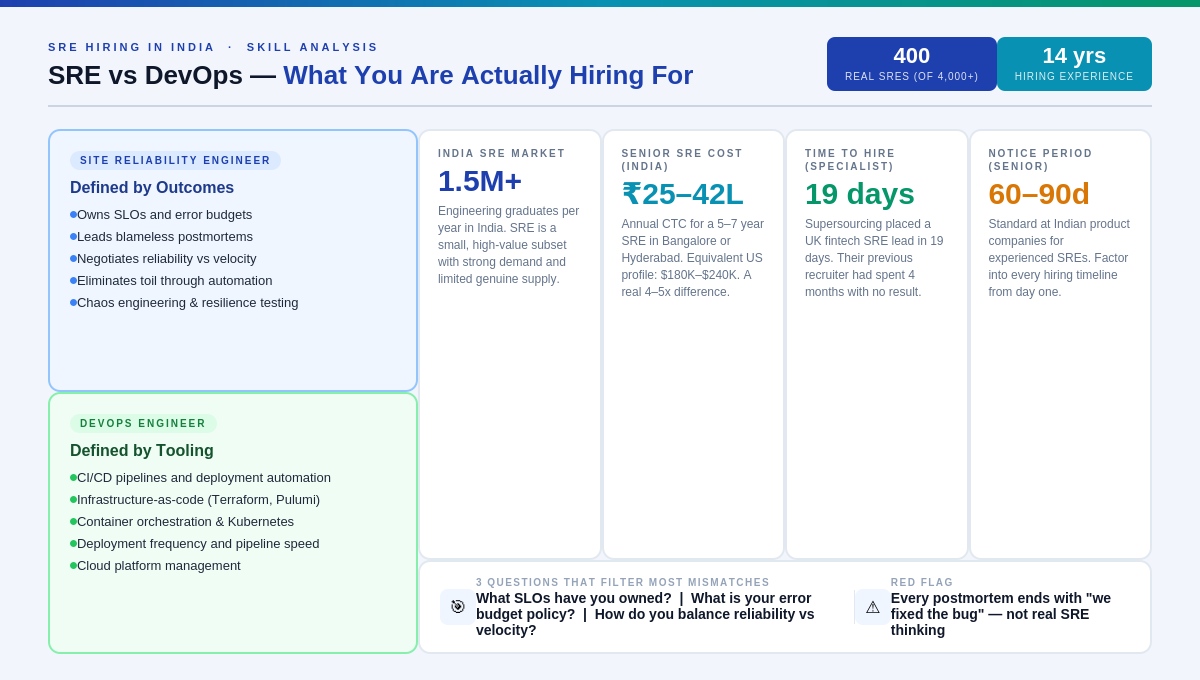
The reason this distinction matters for hiring in India specifically is that the talent pool is large but the genuine SRE practitioners — people who’ve actually owned SLOs, conducted proper blameless postmortems, built chaos engineering programs — are a smaller subset than the market suggests. LinkedIn will show you 4,000 profiles with “SRE” in the title. Maybe 400 of them have done real SRE work.
 Why India Is the Right Market to Hire SRE Talent (The Numbers Are Real)
 Why India Is the Right Market to Hire SRE Talent (The Numbers Are Real)
India produces roughly 1.5 million engineering graduates annually. The SRE discipline has matured significantly here over the last 5-6 years, driven by large-scale product companies — Flipkart, Swiggy, Razorpay, PhonePe — building reliability engineering functions that rival anything in the US or Europe.
The cost differential is meaningful but not the whole story. A senior SRE in Bangalore or Hyderabad with 5-7 years of experience and genuine SLO ownership costs ₹25-42 lakhs per year in total compensation. The equivalent profile in London or San Francisco costs $180,000-$240,000. That’s a 4-5x difference.
But cost arbitrage isn’t the reason I’d recommend India-first for SRE hiring. The reason is availability. The US market for experienced SREs is genuinely undersupplied right now. India has a growing pipeline of engineers who’ve operated at scale — specifically in fintech, e-commerce, and SaaS — where reliability engineering at the infrastructure level is non-negotiable.
The Supersourcing team placed an SRE lead for a UK-based fintech last year. The brief was specific: Prometheus/Grafana stack, experience with multi-region Kubernetes clusters, and someone who’d genuinely owned incident response, not just participated in it. We found 3 qualified candidates in 19 days. The client’s previous recruiter had been searching the UK market for 4 months with nothing to show.
Availability, combined with cost, combined with the timezone overlap (India’s working hours cover European mornings and US evenings) — that’s the real case for hiring SREs in India.
What Skills Actually Separate a Good SRE from a Great One
This is where most hiring processes fall apart. Companies screen for tool familiarity instead of engineering judgment.
Tool familiarity is table stakes. Kubernetes, Terraform, Prometheus, Grafana, PagerDuty, cloud platforms (AWS/GCP/Azure), CI/CD pipelines, Linux internals — a competent SRE candidate should have touched most of these. But the presence of these on a resume tells you very little about whether someone will actually improve your system’s reliability.
What separates good from great is three things.
First, error budget thinking.
Can this person articulate what an error budget is, why it matters, and how they’ve used it to make a real decision — specifically, a decision to slow down feature releases? If they’ve never had that conversation with a product team, they haven’t done real SRE work.
Second, toil reduction philosophy.
Ask candidates to walk you through a piece of operational toil they eliminated. What was the toil? How did they measure it? What did they automate? How much time did it recover? The answer tells you whether they’re reactive operators or proactive engineers.
Third, postmortem culture.
How they talk about past incidents reveals everything. Great SREs don’t blame people. They talk about systems, incentives, and contributing factors. They can describe a postmortem they ran where the finding made someone uncomfortable — including themselves. If every postmortem story ends with “we fixed the bug and it hasn’t happened since,” that’s a red flag.
How to Structure the Hiring Process for SRE Roles in India
 How to Structure the Hiring Process for SRE Roles in India
Step 1: Define scope before writing the JD
Decide whether you need an SRE who builds (greenfield reliability infrastructure), an SRE who operates (owns production, leads incidents), or an SRE who consults internally (embeds with product teams to improve reliability practices). These are three different roles. Writing one JD for all three produces the wrong candidates at every stage.
Step 2: Write a JD that filters, not just attracts
The JD should name your stack, your scale (requests per second, number of services, deployment frequency), your current SLO maturity, and what success looks like in 90 days. Vague JDs attract volume. Specific JDs attract signals. I’d rather have 12 qualified applicants than 200 unqualified ones.
Step 3: Screening for judgment, not credentials
Phone screens should cover: what SLOs have they owned, what’s their error budget policy, how do they handle the tension between reliability and velocity. These three questions eliminate most mismatched candidates in 20 minutes.
Step 4: Technical assessment grounded in your actual systems
Give them a real incident timeline — sanitize it from your production history — and ask them to walk through the contributing factors, the detection gap, and what they’d instrument differently. This is infinitely more useful than a LeetCode exercise. SREs aren’t solving algorithmic problems. They’re debugging distributed systems under pressure.
Step 5: Cultural fit for reliability culture specifically
Does this person believe reliability is a shared engineering responsibility or a dedicated team’s job? Neither answer is wrong — but the answer needs to match your engineering culture or you’ll have constant friction.
What Hiring SREs in India Actually Costs (Realistic Numbers, Not Vendor Estimates)
I’ve seen enough hiring proposals from staffing companies to know that most of them understate the true cost and overstate the speed. Here’s what the numbers actually look like.
Direct hire (full-time employment):
| Level | Experience | Annual CTC (Bangalore/Hyderabad) | Time to Hire |
| SRE Engineer | 2-4 years | ₹12-20 lakhs | 6-10 weeks |
| Senior SRE | 5-7 years | ₹25-42 lakhs | 8-14 weeks |
| SRE Lead | 8-12 years | ₹45-70 lakhs | 10-18 weeks |
| SRE Manager | 10+ years | ₹65-95 lakhs | 12-20 weeks |
Staff augmentation / dedicated team model:
For companies that want SRE capability without full-time headcount, dedicated team models through a vendor like Supersourcing run ₹8-18 lakhs per engineer per month depending on seniority. The advantage is speed — 2-3 weeks to onboarding versus 6-10 weeks for direct hire — and flexibility. You’re not locked into a full-time role if your SRE needs change.
The hidden costs most people don’t account for: interview time (3-5 engineering hours per candidate, multiplied by a funnel of 40-60 candidates for a senior role), notice periods (60-90 days is standard for experienced SREs at Indian product companies), and the productivity ramp time (a new SRE takes 6-8 weeks to be genuinely useful in a new environment, not 2 weeks as most hiring plans assume).
GCC Setup and SRE Hiring: What Changes When You’re Building a Capability Center
A number of companies I speak with aren’t just looking to hire one SRE — they’re building out a Global Capability Center in India and need to stand up an entire reliability engineering function.
This is a meaningfully different problem. You’re not filling a role. You’re building a practice.
The Supersourcing team has worked through GCC setup for engineering functions across multiple domains. For reliability engineering specifically, the sequence matters. You need to hire the SRE lead first — someone senior enough to define the practice, build the tooling philosophy, and make the first architectural decisions. Hiring junior SREs before you have a lead is one of the most common and expensive mistakes I see. Junior SREs without guidance will default to DevOps work. You’ll spend 12 months trying to reorient them.
For a GCC-context SRE build-out, a realistic timeline looks like this: SRE lead hired and onboarded by month 2-3, foundational observability stack (Prometheus, Grafana, distributed tracing) defined by month 3-4, first SLOs written and tracked by month 4-5, first senior SRE hired by month 4, team of 3-4 functional by month 6-7.
That’s 7 months to a functioning reliability engineering capability. Companies that try to compress it to 3 months end up with a team that’s technically present but culturally and practically not doing SRE work.
What Most Companies Get Wrong When They Hire SREs in India
 What Most Companies Get Wrong When They Hire SREs in India
I’ve reviewed enough hiring processes and post-hire retrospectives to see the patterns clearly.
Mistake 1: Hiring SRE as a reliability band-aid.
Companies with systemic reliability problems — poor deployment practices, no service ownership model, no incident culture — hire an SRE expecting them to fix it from the outside. One or two SREs cannot fix a broken engineering culture. They’ll either burn out trying or they’ll find a way to survive without actually changing anything. SRE hiring works when it amplifies an existing engineering discipline, not when it substitutes for one.
Mistake 2: Treating SRE as a senior DevOps role.
The overlap is real. The distinction matters. SRE is defined by SLOs, error budgets, and the explicit negotiation between reliability and velocity. DevOps is defined by tooling, pipeline automation, and deployment frequency. Both are valuable. Conflating them means you end up with someone good at CI/CD pipelines who’s never had the conversation about why you’d freeze feature releases to protect an error budget.
Mistake 3: Ignoring the vendor/staffing company’s SRE-specific track record.
Most IT staffing companies in India can fill backend engineering roles reliably. Far fewer have a genuine track record in SRE-specific placement. Ask for 3 SRE-specific case studies. Ask how many SRE profiles they’ve placed in the last 12 months and at what seniority. Ask what their SRE-specific technical screening looks like. If the answers are vague, that’s your answer.
Mistake 4: Optimizing for speed over fit at the senior level.
For a junior SRE, a 3-week hire is fine. For an SRE lead or SRE manager, rushing the process is how you end up with the wrong person in a role that defines your entire reliability culture for years. I’ve seen companies offer 12-week hiring processes for these roles and it’s genuinely worth it.
Frequently Asked Questions
1. What is the difference between an SRE and a DevOps engineer in the Indian talent market?
In the Indian market, the line between SRE and DevOps is blurry at the junior level — many engineers have done both without clear role separation. At the senior level (5+ years), genuine SRE practitioners will have owned SLOs, written error budget policies, led blameless postmortems, and built reliability automation. DevOps engineers at the same seniority will have deep CI/CD, infrastructure-as-code, and deployment pipeline expertise. Both profiles exist in India. The hiring process needs to distinguish between them clearly.
2. How long does it take to hire a senior SRE in India through a staffing partner?
Through a specialized staffing partner with an existing SRE talent network, 3-5 weeks is realistic for a senior SRE (5-7 years experience). Through a generalist recruiter, 10-16 weeks is more honest. Notice periods add 60-90 days on top of that for candidates currently employed. Plan your hiring timeline accordingly — if you need someone productive by Q3, start the process by Q1.
3. What tech stack should I expect from a qualified SRE candidate in India?
Kubernetes and container orchestration, Terraform or Pulumi for infrastructure-as-code, Prometheus and Grafana for observability, distributed tracing tools (Jaeger, Zipkin, or cloud-native equivalents), at least one major cloud platform deeply (AWS preferred, GCP second), Linux internals, and scripting (Python and Bash as baseline). For senior profiles, add experience with chaos engineering tools (Chaos Monkey, LitmusChaos) and incident management platforms (PagerDuty, OpsGenie).
4. Is remote hiring of SREs from India viable or do they need to be on-site?
Remote is entirely viable and is now the default for most India-based SRE engagements with international clients. The timezone consideration is real but manageable — India’s working hours (9 AM to 6 PM IST) overlap with European mornings and US evenings, which actually works well for on-call handoff structures. The critical factor is establishing clear incident response protocols and communication expectations upfront. SREs I’d be cautious about hiring remotely are those who’ve only ever worked in co-located teams — the async communication discipline is different.
5. What should I actually test in an SRE technical interview?
Give candidates a real or realistic incident timeline and ask them to walk through contributing factors, detection gaps, and what they’d instrument differently. Ask them to design an SLO framework for a service you describe — what metrics would they track, what would the availability target be, how would they set the error budget. Ask about a piece of toil they eliminated: what it was, how they measured it, what the automation looked like. These three exercises tell you more than any algorithm problem.
6. How do I evaluate whether a staffing company genuinely specializes in SRE hiring?
Ask for 3 specific SRE placements from the last 12 months — company name (or anonymized), seniority, time to fill, whether the placement is still in role. Ask what their SRE-specific screening looks like: who on their team evaluates SRE candidates technically, and what does that evaluation cover. Ask about their SRE network specifically — how many SRE practitioners are in their active talent pool. Vague answers to any of these questions are a red flag.
7. What’s a realistic budget to set up an SRE function in India from scratch?
For a 3-person SRE team (lead + 2 senior engineers) hired directly, budget ₹1.1-1.8 crore annually in total compensation. Add 20-25% for tooling, infrastructure, and operational overhead. For a GCC build-out where you’re establishing the full practice, year-one costs including setup, hiring, tooling, and management overhead typically run ₹2.2-3.5 crore for a functional 4-5 person team. These are real numbers from real engagements, not estimates padded for safety.
Before You Start Your SRE Search
If you’re seriously evaluating how to hire site reliability engineers in India — whether that’s a single senior hire, a dedicated team, or a full GCC reliability function — I’m usually the one on those early conversations.
Not a sales rep. Not an account manager. Me.
I’ve been through the SRE hiring process enough times across enough different company types and maturity stages to have an opinion on what works and what wastes your time. If you want to talk through your specific situation before you commit to a vendor or a hiring model, email me directly.
