

A SaaS CTO told me something last year that I haven’t stopped thinking about. His team had just fired their third React development vendor in 18 months. Not because the code was bad. The code was fine. They got fired because every vendor they hired optimized for building features — and nobody optimized for building a product that scales.
What makes this more concerning is that React isn’t some niche choice where mistakes are expected. It’s the default. In fact, React is used by 83.6% of JavaScript developers in 2026, making it the most dominant frontend ecosystem today. Which means most SaaS products aren’t failing because of the technology — they’re failing because of how that technology is being implemented.
By the time they reached 40,000 monthly active users, the frontend was a graveyard of unshared state, prop-drilling nightmares, and bundle sizes that made their enterprise prospects run their own performance audits.
He’d spent $340,000 on three vendors. The fourth engagement — the one that actually worked — cost $180,000 and solved the problem in 7 months.
The variable wasn’t the technology. It was how the hiring decision was made.
What “Hire ReactJS Developers for SaaS Product Company USA” Actually Means in 2026
Hiring ReactJS developers for SaaS product company USA means finding engineers who understand that a SaaS frontend is not a website. It’s a living system — multi-tenant, role-aware, performance-sensitive, and tied to subscription economics where a 200ms latency increase can directly impact churn.
The Supersourcing team has built or scaled the frontend for 90+ SaaS and digital products — from early-stage platforms processing their first 1,000 users to enterprise SaaS tools with concurrent load across 14 time zones. What separates the engagements that worked from the ones that didn’t almost always comes down to how the React developer understood state management at scale, not just component architecture.
That distinction matters more than most job descriptions acknowledge.
 The Actual Problem: Why Most SaaS Companies Hire React Developers Wrong
 The Actual Problem: Why Most SaaS Companies Hire React Developers Wrong
Most job descriptions for React developers at SaaS companies look like this: 3+ years React, Redux experience, REST API integration, bonus points for TypeScript. Generic. Interchangeable. Almost designed to attract developers who’ve built landing pages and called it SaaS.
The engineers who struggle in SaaS product environments aren’t bad developers. They’re developers who’ve never had to think about:
- Multi-tenancy at the component level — when your UI must render differently across 200 enterprise clients, each with custom permissions, themes, and feature flags
- Incremental rendering for large datasets — virtualization, pagination strategy, and when to push logic server-side vs. keep it in the React layer
- Frontend observability — error boundaries, session replay integration, performance budgets, and how a React developer’s decisions affect your P95 load time in production
- Design system governance — the difference between building a component library for 5 developers and maintaining one for 25 developers across 3 product squads
I’ve reviewed 40+ SaaS React codebases over the past 4 years. The fastest way to tell whether a React developer understood SaaS product development is to look at how they handled authentication state and role-based rendering. If it’s baked into every component ad-hoc, the developer builds for a demo. If it’s abstracted into a permission context layer with clean prop boundaries, the developer has shipped a real multi-user product.
What You Actually Need: A React Developer Specification for SaaS
Before you post a job description or contact a IT staffing partner, here’s the specification framework the Supersourcing team uses when scoping React hiring for SaaS clients:
Tier 1 — Non-negotiable technical requirements for SaaS React work:
- State management proficiency: Zustand, Redux Toolkit, or React Query depending on your data architecture (not “knows Redux” — knows when not to use Redux)
- TypeScript: not optional for any SaaS product with more than 2 developers; the type safety is the documentation
- Component architecture: compound components, render props, and custom hooks as first-class patterns — not afterthoughts
- Performance tooling: Lighthouse budgets, React DevTools Profiler, lazy loading strategy, and bundle analysis (Webpack Bundle Analyzer or Vite equivalents)
- API layer: understands React Query or SWR caching strategies, optimistic updates, and the difference between client state and server state
Tier 2 — SaaS-specific experience markers:
- Has built or maintained a multi-tenant frontend (even in one previous product)
- Has worked in a product with feature flags (LaunchDarkly, Unleash, or custom)
- Has participated in design system development, not just consumed one
- Understands A/B testing infrastructure at the component level
- Has dealt with real-time data (WebSockets, SSE) in a production product
Tier 3 — Team and process fit:
- Can scope frontend tasks into 2-3 day chunks (the inability to do this is the single biggest predictor of missed sprint goals)
- Has worked with design handoffs at Figma spec fidelity
- Has written frontend unit tests for business logic, not just snapshot tests
Most SaaS companies hire for Tier 1 and hope Tier 2 shows up. The Supersourcing team screens explicitly for all three tiers. That’s why the developers we place have a 94% 12-month retention rate on client teams — compared to the industry average closer to 60%.
How to Hire ReactJS Developers for SaaS in the USA: The Full Playbook
Option 1: Direct Hire (Full-Time Employee)
The economics: A senior React developer in a major US metro (San Francisco, New York, Seattle) runs $140,000–$190,000 base salary. Add 30–40% for benefits, equity dilution, recruiting overhead, and the 60–90 day ramp time before full productivity. Fully-loaded cost for year one: $200,000–$260,000.
When it makes sense: You’re past product-market fit, you have 2+ React engineers already (so the hire isn’t working alone), and you need someone embedded in daily product decision-making.
When it doesn’t: Pre-Series A, when headcount flexibility matters more than continuity. Or when you need 3 React developers and only have a budget for 1.5.
Option 2: Freelance React Developers
Toptal, Upwork, and direct LinkedIn sourcing. Rate range: $80–$180/hour for senior US-based React developers.
The hidden cost: freelance React developers optimized for delivery, not product thinking. They’ll build what you spec. SaaS products need developers who push back on the spec when it’ll create technical debt at scale.
The other hidden cost: coordination. Every hour you spend syncing a freelancer is an hour not building.
Option 3: Dedicated React Development Teams (Offshore / Nearshore)
This is where 60% of Supersourcing’s SaaS clients land, and where the economics change dramatically.
A dedicated team of senior React developers through Supersourcing’s staffing model costs $35,000–$55,000/year fully managed — that’s not a typo, and it’s not a race to the bottom on quality. It’s the output of Supersourcing’s AI-powered hiring platform that screens developers across 140+ technical and behavioral parameters before a single client interview.
The Brillio engagement is a useful reference point: the Supersourcing team placed 11 developers across their enterprise digital transformation initiative, including 4 senior React developers working on their SAP-integrated client portal. Time-to-productivity: 3 weeks average. Attrition in 18 months: zero.
Option 4: Augment Your Existing Team
You have 2 React developers. The product is growing faster than they can ship. You need 2 more — but you don’t need them permanently.
Team augmentation is the most underused model in US SaaS. The Supersourcing model for this: we source, screen, and onboard. You direct. No account manager in the middle. Mayank personally reviews team composition for every augmentation engagement above 3 developers.
 The Architecture Questions You Should Ask Before Hiring
 The Architecture Questions You Should Ask Before Hiring
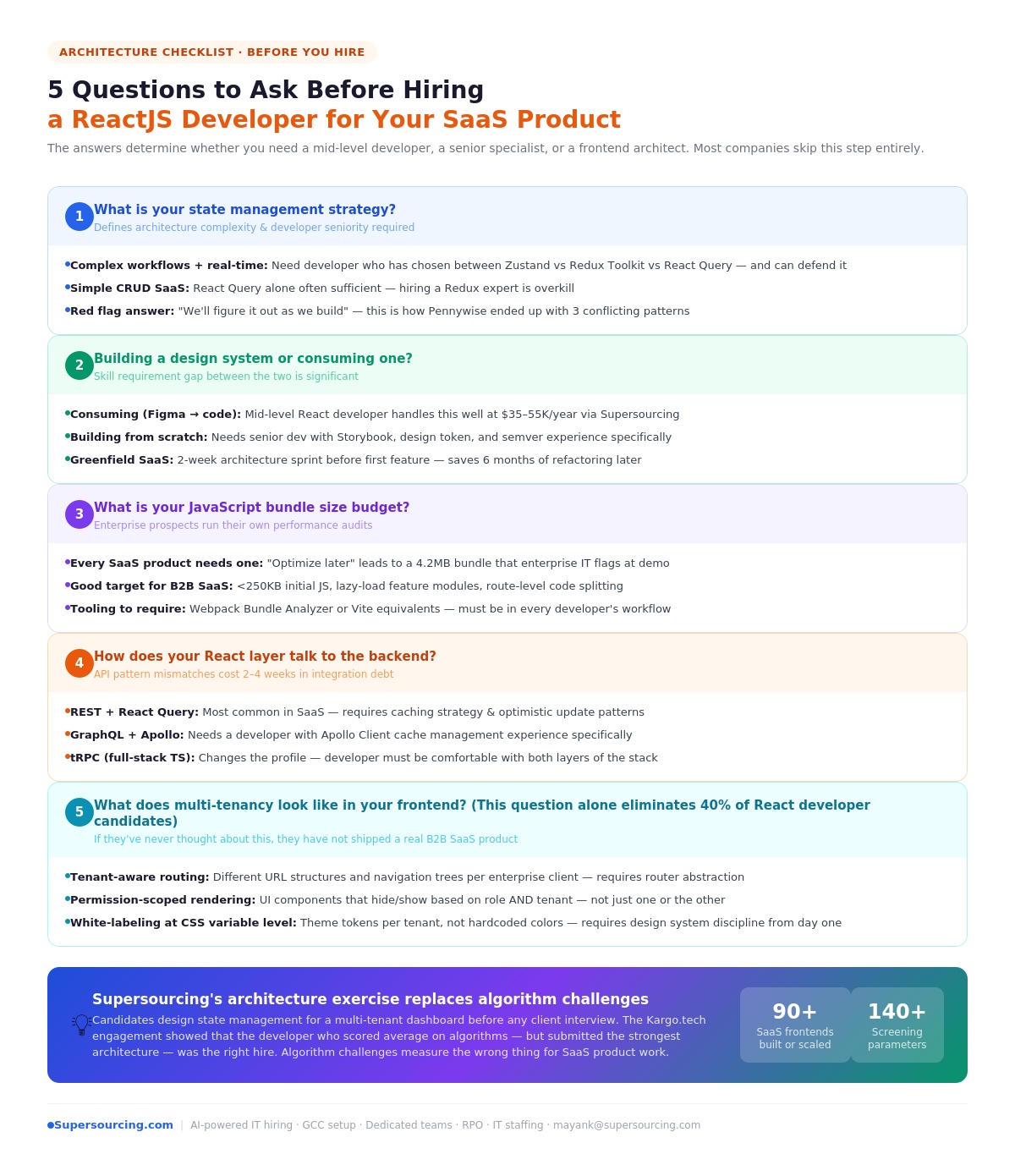
This is where most companies skip the hard work. Before you hire a React developer — or an entire React team — you need answers to these architecture questions. The answers determine who you need.
Question 1: What’s your state management strategy?
If your SaaS product has complex client-side state (multi-step workflows, collaborative features, real-time updates), you need a developer who’s made the Zustand vs. Redux Toolkit vs. React Query decision before — and can defend their choice.
Question 2: Are you building a design system or consuming one?
If you’re consuming Figma components and translating to code: mid-level React developer is fine. If you’re building the system itself — defining tokens, handling dark mode, writing Storybook documentation, managing semver for a component library — you need a senior developer with design system experience specifically.
Question 3: What’s your bundle size budget?
Every SaaS product should have one. “We’ll optimize later” is how you end up with a 4.2MB JavaScript bundle that your enterprise prospects’ IT departments flag before you even get to the demo.
Question 4: How does your React layer interact with your backend?
REST + React Query? GraphQL + Apollo? tRPC for full-stack TypeScript? The answer changes the hiring spec significantly. Don’t hire a React developer who’s never worked with your API pattern and expect a smooth integration.
Question 5: What does multi-tenancy look like in your frontend?
This question eliminates 40% of React developer candidates immediately. If they’ve never had to think about tenant-aware routing, permission-scoped component rendering, or white-labeling at the CSS variable level, they’re not the right developer for a B2B SaaS product.
 What the Pennywise Digital Transformation Taught Us About React at Scale
 What the Pennywise Digital Transformation Taught Us About React at Scale
Pennywise came to Supersourcing 18 months into a digital transformation initiative with a specific problem: their React frontend had been built by 3 different vendors, each with a different state management approach. Zustand in the dashboard. Context API in the transaction flow. A legacy Redux store nobody wanted to touch in the reporting module.
The fix wasn’t a rewrite. It was a 6-week refactoring engagement — 2 senior React developers from the Supersourcing team — that unified state management into React Query for server state and Zustand for UI state, reduced the number of re-renders on their dashboard by 67%, and cut their average page load from 3.8 seconds to 1.4 seconds.
The lesson: SaaS companies don’t fail because they hired bad React developers. They fail because they hired good React developers who made locally reasonable decisions that became globally incompatible as the team grew.
The hiring criterion that would have prevented it: prior experience working on a React codebase that outlasted its original development team.
Cost Breakdown: Hiring ReactJS Developers for SaaS in the USA
| Model | Annual Cost (Senior React Dev) | Time to Productivity | Flexibility |
| US Full-Time Hire | $200K–$260K (fully loaded) | 60–90 days | Low |
| US Freelance (40 hrs/wk) | $160K–$375K | 2–3 weeks | High |
| Nearshore (Mexico, Colombia) | $70K–$110K | 3–4 weeks | Medium |
| Offshore Dedicated (India) | $35K–$55K | 2–3 weeks | High |
| Offshore Team Augmentation | $30K–$50K/developer | 2–3 weeks | Very High |
These are 2026 numbers based on actual Supersourcing engagements. The offshore costs assume senior-level developers (5+ years), not entry-level. The Supersourcing AI-powered hiring platform matches developers based on SaaS-specific experience signals, not just keyword-matched resumes.
One clarification: “offshore” in 2026 is a dated frame for what’s actually happening. The Supersourcing team places React developers who work in your timezone, attend your standups, and collaborate in your Slack. The geography difference is in cost structure, not working model.
What Most Companies Get Wrong When Hiring React Developers for SaaS
I’ve watched this pattern enough times to call it a hiring trap.
- The trap: You interview React developers by showing them a coding challenge. They reverse a linked list, implement a debounce function, maybe build a small component from scratch. The ones who pass get hired.
- The problem: None of those tests predict whether a developer can architect a React application that survives 18 months of feature additions, team changes, and product pivots.
The Kargo.tech product development engagement is a clean illustration. Kargo needed 3 React developers to build a logistics SaaS platform from scratch. The Supersourcing team’s screening process included a take-home architecture exercise: design the state management layer for a multi-tenant dashboard with real-time shipment tracking and 3 user roles. Not code it. Design it.
Two candidates who’d aced the algorithm challenges submitted architectures that would have required a complete rewrite at 10,000 users. One candidate who’d scored average on algorithms submitted an architecture that accounted for eventual consistency in real-time data, lazy-loaded tenant configurations, and a permission layer that didn’t require re-rendering the entire tree on role changes.
The hire was obvious. The algorithm challenge had been noise.
- The other common mistake: Hiring a React developer when you actually need a frontend architect.
If you’re building a SaaS product from zero, the first React developer sets the architectural patterns that your next 5 developers inherit. A developer who’s great at building within an existing architecture isn’t the same as a developer who can establish the architecture others will build within.
For greenfield SaaS products, I always recommend a 2-week architecture sprint before any feature development begins — even if it delays the first feature delivery by two weeks. The Open Money fintech platform is one example: the Supersourcing team spent 13 days on frontend architecture decisions (routing strategy, state management, authentication flows, component library scaffolding) before writing a single feature component. The platform now processes banking and settlement transactions at scale without a single major frontend refactor.
 ReactJS vs. Other Frameworks: Why SaaS Companies Still Choose React
 ReactJS vs. Other Frameworks: Why SaaS Companies Still Choose React
This comes up in almost every scoping call. “Should we build in React or Next.js? Vue? Angular?”
For B2B SaaS specifically, here’s where I land after building on all of them:
React (with Vite or CRA successor) is the right choice when:
- Your product is primarily client-rendered (SPAs where SEO isn’t a primary concern)
- You have or plan to build a design system
- Your team will grow beyond 5 developers and you need hiring optionality
- You’re integrating with complex third-party APIs and need flexibility in your data layer
Next.js is the right choice when:
- Your SaaS product has public-facing pages that need SEO (pricing, landing, blog)
- You want to co-locate your API layer with your frontend for simpler deployments
- You’re building a hybrid product — part marketing site, part authenticated SaaS
Vue is a fine choice. It’s also a talent constraint. The React developer pool in India is 4x the size of the Vue pool. For the Supersourcing staffing model, this matters: faster placements, more competitive candidates.
Angular: only if your enterprise clients mandate it or you’re extending an existing Angular codebase. The framework has its place. For greenfield SaaS in 2026, it’s rarely the right starting point.
FAQ: Hiring ReactJS Developers for SaaS Products
1. How long does it take to hire a ReactJS developer for a SaaS product?
Through Supersourcing’s dedicated team model, the typical timeline is 7–14 days from brief to first interview, with developer onboarding completed within 3 weeks. Direct hiring in the US typically runs 60–90 days when accounting for sourcing, interviewing, offer negotiation, notice periods, and ramp time. If your product timeline can’t absorb 3 months of hiring overhead, the dedicated team model is worth a serious look.
2. What’s the difference between hiring a ReactJS developer and a full-stack developer for SaaS?
A React developer owns the frontend architecture, component design system, state management, and user experience performance. A full-stack developer handles both frontend and backend — useful in early-stage products where breadth matters more than depth, but a liability at scale when your React layer needs someone who’s thought deeply about frontend-specific concerns like bundle optimization, accessibility, and design system governance. Most SaaS products above $1M ARR benefit from a dedicated frontend/React specialist.
3. How do I evaluate a ReactJS developer’s SaaS experience specifically?
Ask them to describe the state management architecture of the last product they built, how they handled role-based rendering, and what they’d do differently. Ask about their approach to component library versioning. Ask how they’d debug a performance issue where a specific user action triggers unnecessary re-renders. The answers reveal whether they’ve shipped real SaaS products or just built demos.
4. Should I hire onshore or offshore ReactJS developers for my SaaS product?
The honest answer: it depends less on geography and more on working model discipline. Offshore developers working in your timezone, in your Slack, attending your standups, and being screened for SaaS-specific experience are meaningfully different from offshore developers handed a requirements doc and asked to deliver. Supersourcing’s model is the former. 94% of our placed React developers are still active on client teams 12 months after placement.
5. What does a ReactJS developer for SaaS cost in 2026?
Senior React developers in the US: $140K–$190K base salary, $200K–$260K fully loaded annually. Dedicated offshore senior React developers through Supersourcing: $35K–$55K/year. The cost difference isn’t a reflection of quality difference — it’s a reflection of labor market arbitrage combined with Supersourcing’s screening depth. The developers we place have built multi-tenant SaaS products, not just React components.
6. How many React developers does a SaaS product company typically need?
At pre-launch: 1–2 (one senior for architecture, one mid-level). At $1M–$5M ARR: 3–5 (split across product squads). At $5M+ ARR: 6–12, organized around feature teams with a shared design system owned by a dedicated frontend platform team. The Supersourcing team has staffed all three stages. The biggest mistake: waiting until you’re understaffed to hire. By that point, you’re hiring reactively into technical debt.
7. What should a ReactJS SaaS developer’s first 30 days look like?
Week 1: codebase orientation, existing architecture review, local environment setup, first small PR. Week 2: first feature ticket in their domain, pair programming with existing team. Week 3–4: independent delivery with code review. If a developer isn’t shipping independently by day 30, either the onboarding structure is broken or the hire was wrong. The Supersourcing team provides a 30-day onboarding framework with every developer placement to prevent this.
Supersourcing’s ReactJS Developer Placement Process
For US SaaS companies evaluating dedicated ReactJS development teams or staff augmentation, here’s exactly how the Supersourcing process works:
- Brief call (30 minutes) — Mayank or a senior team member reviews your product architecture, current stack, team size, and growth goals. No sales deck. No template questionnaire.
- Candidate sourcing (48–72 hours) — The Supersourcing AI-powered hiring platform identifies candidates from a pool of 50,000+ screened developers, filtered for SaaS-specific experience signals.
- Technical screening (3–5 days) — Candidates complete a SaaS-specific architecture exercise, not a generic algorithm challenge. Only the top 3% advance.
- Client interview (you run it) — You interview 2–3 shortlisted candidates. Average time from brief to first interview: 7–10 days.
- Onboarding — Developer joins your Slack, your standups, your sprint. Supersourcing handles HR, payroll, and compliance. You direct the work.
There are no account managers between you and the developer. No layers. You work with the person who built the screening process.
The Question Behind the Question
Most SaaS companies that reach out about hiring React developers aren’t really asking about hiring. They’re asking: “How do we ship faster without accumulating technical debt that kills us at Series B?”
The React developer is one answer. The hiring process is the other.
If you’re working through the architecture decisions for your SaaS product’s frontend — what to build in-house, what to offshore, how to structure a team that can scale from 5 to 50 — I’m usually the one on those calls.
No sales team. No templated response. Just a direct conversation about what’s actually going on in your product.
Mayank Pratap is co-founder of Supersourcing, an AI-powered IT hiring and staffing platform. He has 14 years of experience building and scaling technology products, with vendor partnerships including Wipro, Virtusa, and Impetus. Supersourcing has placed development teams for 300+ companies across IT services, GCC setup, RPO, and dedicated team engagements.
