

The Real Reason Your Last Node.js Hire Didn’t Work Out
Forty-three. That’s the number of conversations I had last year with UK startup founders who had already tried — and failed — to hire dedicated Node.js developers for UK startup before reaching out to Supersourcing.
UK startups are in a particularly sharp position right now. Post-Brexit visa complexity, London engineering salaries running £80,000–£110,000 for mid-senior Node.js talent, and VC funding cycles that demand you ship an MVP in 90 days — not 9 months.
The pressure to get this hire right on the first try is real. And the market data reflects that pressure: the median Node.js developer salary in the UK reached £70,000 in 2026, with top talent commanding significantly higher compensation, making hiring mistakes even more expensive for early-stage startups.
I’ve been building tech products for 14 years. Supersourcing is an AI-powered hiring and IT services company, and we’re vendor partners with Wipro, Virtusa, and Impetus. When the Supersourcing team built the Open Money fintech banking and settlement platform — processing real-time transactions across 12 integrated payment rails — the first architectural decision wasn’t which Node.js framework to use.
This article is what I wish someone had handed those 43 founders before they started.
Why UK Startups Are Choosing Node.js in 2026— and Why That Choice Creates a Specific Hiring Problem
Hiring dedicated Nodejs developers for a UK startup means building a backend engineering team around JavaScript’s server-side runtime — a technology purpose-built for I/O-heavy, real-time, and API-first architectures. At its core, Node.js uses a non-blocking, event-driven model that makes it exceptionally well-suited for microservices, serverless functions, WebSocket connections, and high-throughput REST APIs.
That definition sounds clean. The reality is messier.
Node.js is the right call for UK startups building SaaS platforms, fintech products, e-commerce backends, or anything requiring real-time data exchange. Its npm ecosystem — 2 million+ packages — means faster development cycles. Its JavaScript-everywhere story means a single developer can work across frontend and backend without context-switching. And for startups burning cash, that efficiency matters.
But this flexibility creates a specific hiring trap. Node.js developers range from developers who’ve added npm install express to a project all the way to engineers who’ve designed cloud-native, event-driven architectures processing 50,000 requests per second. Both call themselves “Node.js developers.” Knowing how to tell them apart is half the battle.
The other half is knowing where to find them, what to pay them, and how to structure the engagement so you’re not rebuilding the same codebase in 12 months.
 What UK Startup CTOs Actually Get Wrong When They Start This Search
 What UK Startup CTOs Actually Get Wrong When They Start This Search
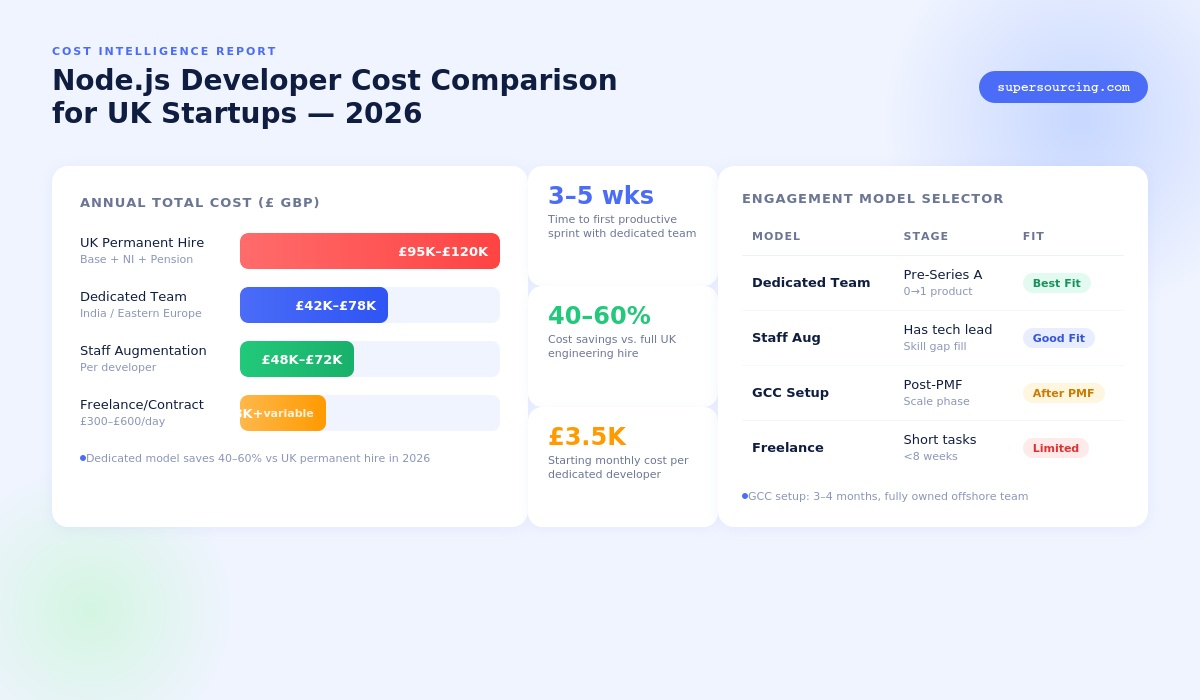
Most CTOs I talk to underestimate the total cost by 3-4x. Not because they’re bad at math — because the platforms they’re using show them the developer’s day rate and call it the total cost.
Here’s what that number doesn’t include: onboarding time (2-4 weeks minimum for a developer unfamiliar with your stack), infrastructure provisioning (someone needs to set up your CI/CD pipeline, staging environments, and monitoring dashboards), code review cycles (who reviews the Node.js developer’s work, especially early on?), and the compounding cost of technical debt when you hire fast and skip architecture reviews.
A senior Node.js developer at £500/day sounds cheaper than a £90,000/year permanent hire. But if you’re paying that rate for a developer who’s figuring out your system as they go, spending 3 weeks writing boilerplate templates, or making database schema decisions that will require a painful migration in six months — you’re not saving money. You’re borrowing against your future engineering budget.
The Kargo.tech team came to us after exactly this situation. They’d had two Node.js contractors in succession, each building on the previous developer’s decisions without any architectural coherence. By the time they engaged Supersourcing for dedicated team scaling, the codebase had three different authentication patterns, two ORM libraries, and zero integration tests. Rebuilding that cost more than starting clean would have.
I’m not saying this to pitch you. I’m saying this because it’s the most common mistake I see, and it’s entirely avoidable with the right hiring approach upfront.
How to Evaluate a Node.js Developer for a Startup Context (Not a Corporate One)
There’s a meaningful difference between a Node.js developer who’s spent five years in an enterprise IT environment and one who’s built three early-stage products from seed to Series A. Both are legitimate career paths. Only one of them is right for most UK startups.
What startup-context Node.js expertise looks like:
A developer who’s operated in startup environments understands scope trade-offs. They know when to use a managed service (AWS RDS, Firebase, Supabase) versus building their own solution. They don’t over-engineer an MVP. They write code that a future developer can extend without needing a guided tour.
They also understand that in a startup, “can you ship this in 3 days” is a real question with a real answer required. Not “let me refactor the base class first.”
When Supersourcing screens Node.js developers for UK startup clients, we run technical assessments that go beyond algorithm problems. We test for:
- Asynchronous programming depth — not just “do you know Promises,” but can you debug a race condition in a concurrent request handler? Can you explain when to use Promise.all versus Promise.allSettled and why it matters for your specific use case?
- API design judgment — given a product requirement, how do they structure REST endpoints? Do they think about versioning from day one? Do they understand rate limiting and throttling at the API gateway layer?
- Database decision-making — PostgreSQL or MongoDB for this schema? Why? What’s the indexing strategy? How does this decision interact with your eventual GDPR compliance requirements (relevant for every UK startup)?
- Error handling and observability — how do they approach logging? Have they integrated with Datadog, New Relic, or equivalent APM tools? Can they write code that makes production incidents diagnosable in under 10 minutes?
These questions have clear answers. Developers who can answer them confidently — with trade-offs, not just definitions — are the ones worth hiring.
The Engagement Models: Dedicated Team vs Freelancer vs Augmentation
When you decide to hire dedicated Node.js developers for UK startup, you’re actually choosing between three structurally different models. Most articles conflate them. They’re not the same thing.
| Engagement Model | Best For | Cost Range (Monthly) | Key Risk |
| Dedicated Remote Team | Startups building a full product, 3–18 month horizon | £8,000–£22,000 | Communication overhead if poorly managed |
| Staff Augmentation | Existing team with specific skill gaps | £4,000–£12,000 per developer | Knowledge silos if not integrated properly |
| Freelance/Contract | Short projects, <8 weeks, defined scope | £300–£600/day | No continuity, no ownership |
| Offshore GCC Model | Scaling post-product-market fit | £15,000–£40,000/month | Setup time (3–4 months) |
For most early-stage UK startups — pre-Series A, 0 to 1 product build — dedicated team is the right answer. You get continuity, team ownership, and the ability to scale up or down without the legal complexity of a UK employment contract.
Staff augmentation makes sense if you already have a Node.js-capable CTO or lead engineer who can provide architectural direction. You’re adding execution capacity, not leadership capacity.
The GCC (Global Capability Centre) model — which Supersourcing has helped several UK companies establish — is a different conversation entirely. It’s for companies past product-market fit who want to build a permanent offshore engineering function, not a vendor relationship. The setup takes 3–4 months and requires HR, legal, and tax infrastructure. The payoff is substantial: fully owned team at 40–60% of UK salary costs, zero vendor dependency.
Don’t go GCC until you know your product is going to market. Don’t go freelance if you need anyone thinking about system design.
Node.js Architecture Decisions That Determine Whether Your Startup Scales or Stalls
 Node.js Architecture Decisions That Determine Whether Your Startup Scales or Stalls
This is where most hiring articles stop. They tell you what to look for in a developer but not what the developer needs to actually build. Let me go deeper.
The architectural decisions made in the first 90 days of a Node.js project determine whether your system handles 10,000 users or 10 million. For UK startups, three decisions matter more than everything else combined.
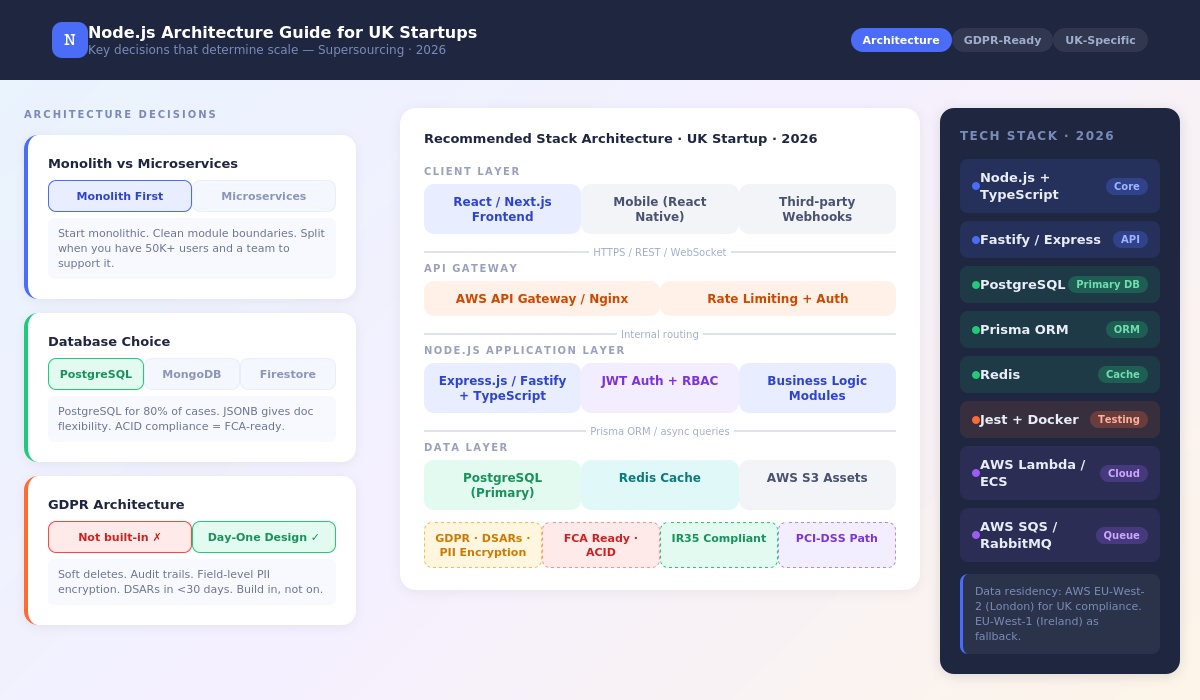
Monolith or Microservices — and Why the Answer Is Almost Always “Start Monolithic”
Every startup wants microservices because they’ve read that Netflix and Uber run microservices. What they don’t mention is that Netflix and Uber had hundreds of engineers and well-understood domain boundaries before they decomposed their monoliths.
A Node.js microservices architecture for a seed-stage startup is usually the wrong call. You end up with service discovery overhead, distributed tracing complexity, and inter-service latency problems — none of which you need when your primary challenge is proving product-market fit.
The right approach: build a well-structured monolith with clean module boundaries, designed to be split into IT services when you have the team and the scale that justifies it. Express.js or Fastify running on a single well-provisioned EC2 instance or AWS Lambda will handle your first 50,000 users without complaint.
Database Choice: When PostgreSQL Wins and When You Need Something Else
I’d pick PostgreSQL for 80% of UK startup use cases. Here’s why.
Node.js’s native async capabilities make it natural to write non-blocking queries, but the database itself becomes the bottleneck long before your Node.js application does. PostgreSQL’s support for JSONB columns gives you schema flexibility approaching MongoDB’s document model while preserving relational integrity and transaction support. For fintech and regulated industries — highly relevant for UK startups navigating FCA requirements — ACID compliance is non-negotiable.
The exception: if you’re building real-time collaborative features (document editing, live dashboards, multiplayer experiences), a document database or a purpose-built real-time database like Firebase Firestore makes more sense for specific collections. You don’t need to choose one database for everything.
The Supersourcing team built the Pennywise fintech stack on a PostgreSQL core with Redis caching for session management and rate limiting. The architecture handled a 40x traffic spike during their launch weekend without a single database incident.
Authentication and GDPR Architecture From Day One
UK startups have a legal obligation that US-based content about Node.js hiring consistently ignores: GDPR compliance is not a feature you add later. It’s an architectural constraint you build around from the beginning.
Your Node.js backend needs to handle data subject access requests (DSARs) — the right for any user to request all data you hold about them. If your user data is scattered across 12 tables with no clear ownership model, fulfilling that request in the 30-day legal window becomes an engineering sprint, not a database query.
Build your data model with GDPR in mind. Use soft deletes with audit trails. Log all data access events. Implement field-level encryption for PII. These aren’t nice-to-haves for UK startups — they’re table stakes, and the Node.js developer you hire needs to understand this before they write a single schema migration.
What the Hiring Process Should Actually Look Like
 What the Hiring Process Should Actually Look Like
Here’s the process the Supersourcing team runs when engaging dedicated Node.js developers for UK startup clients. It’s not fast. Fast hiring for technical roles is almost always expensive in the long run.
- Define the technical context document — Before screening anyone, write down: what the system does, current tech stack (or intended stack), expected traffic profile at launch and at 12 months, key third-party integrations, compliance requirements (GDPR, FCA, PCI-DSS if relevant), and team context (who will this developer work alongside?). This document takes 2–3 hours to write and saves 6–8 weeks of misaligned hiring.
- Screen for async communication skills — For a dedicated remote developer working with a UK startup, the ability to communicate clearly in writing is as important as technical skill. A developer who writes detailed, clear async updates is worth more to a distributed team than one who’s technically superior but requires synchronous check-ins to stay unblocked.
- Technical assessment on your actual codebase — Not an algorithm problem. Not HackerRank. Give candidates a real (simplified) version of a problem from your product. Ask them to design the API, explain the database schema, and identify the edge cases. This takes more effort to set up but produces dramatically better signals.
- Architecture interview, not a whiteboard session — Ask them to walk you through a system they’ve built. Where were the trade-offs? What would they do differently? What broke in production and how did they fix it? The answer to “what broke in production” tells you more than any coding test.
- 30-day structured onboarding — The first 30 days are not full productivity days. They’re discovery days. A developer who claims they can be fully productive in week one is either very familiar with your exact stack or overstating their confidence. Plan for 50–60% productivity in month one, 80% in month two, full contribution by month three.
What the Market Looks Like Right Now for UK Startups
Let me give you numbers, not ranges designed to avoid commitment.
A mid-senior Node.js developer hired through a dedicated team model from India or Eastern Europe costs £3,500–£6,500/month all-in (salary, overhead, management, hardware). The equivalent UK permanent hire costs £75,000–£95,000 in base salary alone — before employer NI contributions, pension, equipment, and management overhead, which brings the real annual cost to £95,000–£120,000.
That’s not a knock on UK developers. UK Node.js engineers are excellent, and if your product requires significant in-person collaboration or deep integration with UK enterprise customers, there’s a real case for local hiring. But for a startup where the primary engineering challenge is building fast and building right, the offshore dedicated model at 30–40% of UK cost is genuinely competitive on quality, not just price.
The caveat: quality at that price point requires either a strong technical leader on your side who can evaluate output, or a hiring partner with enough domain depth to screen properly. Platforms that show you developer profiles without assessing your specific technical context are not saving you time — they’re transferring the screening problem to you.
Supersourcing’s AI-powered hiring platform runs structured assessments calibrated to startup technical contexts, not generic developer benchmarks. That’s the difference between a platform that gives you a shortlist and one that gives you a shortlist of the right people.
What Most People Get Wrong About Dedicated Team Management
Here’s the pattern I see most often, and it kills more dedicated team engagements than any technical failure.
UK startup founders treat their dedicated Node.js developers like vendors. Deliverables in, output out. They don’t include them in product conversations. They don’t share context about why features are being built. They don’t give them visibility into the roadmap beyond the current sprint.
Then they’re surprised when the developer makes architectural decisions that don’t align with the product direction. Or when they lose the developer after 6 months because the developer felt like a code factory rather than a product builder.
The startups that get the most from dedicated teams run them exactly like their internal team. Same Slack channels. Same sprint planning. Same product demos. Same post-mortems. The timezone difference (typically 4–5.5 hours with India, 1–2 hours with Eastern Europe) is real but manageable with a 2-hour overlap window for synchronous work and rigorous async documentation for everything else.
The developers who stay for 2+ years are the ones who feel like they’re building something, not billing hours.
Brillio is a useful reference point here. The Supersourcing team supported Brillio’s enterprise digital transformation engagement, including SAP integration and DevOps pipeline work. The reason that engagement scaled from 3 developers to a 14-person team over 18 months wasn’t the technical quality alone — it was the integration model. Daily async standups, weekly architecture reviews with the client CTO, shared GitHub and Jira workspaces from day one.
That’s the model. Not a vendor relationship. A distributed team.
UK-Specific Considerations You Won’t Find in Generic Hiring Guides
 UK-Specific Considerations You Won’t Find in Generic Hiring Guides
A few things that matter specifically if you’re a UK startup and you’re reading US-written content about Node.js hiring:
- IR35 matters if you’re hiring UK-based contractors. Off-payroll working rules mean that if a UK-based Node.js developer operates through a personal service company but works essentially as an employee (set hours, single client, direction from your team), you may be responsible for their PAYE tax and NI contributions. Dedicated team models through an offshore partner avoid this entirely — the legal employer is the partner company, not you.
- Data residency requirements vary by sector. If you’re building in healthtech, fintech, or any sector handling sensitive personal data, check whether your Node.js backend infrastructure can legally process data outside the UK/EU. AWS EU-West-2 (London) and AWS EU-West-1 (Ireland) are the standard choices for UK-based data residency requirements.
- Time zone management with India (IST) is more manageable than most people think. A 10:30 AM – 12:30 PM UK overlap with IST gives you 2 hours of synchronous collaboration. That’s enough for daily standups, blocker resolution, and architecture discussions. The rest runs async. Most UK startups I’ve talked to were more worried about this than they needed to be.
Frequently Asked Questions
1. How much does it cost to hire a dedicated Node.js developer for a UK startup?
For a dedicated remote model (India or Eastern Europe), expect £3,500–£6,500/month per developer, all-in. This compares to £95,000–£120,000 annual total cost for a UK permanent hire when you include employer NI, pension, and overhead. For a 3-developer team, budget £10,000–£18,000/month. Pricing varies based on seniority, stack depth (e.g., Node.js + GraphQL + Kubernetes commands a premium), and whether you need a tech lead included in the team.
2. What’s the difference between staff augmentation and a dedicated development team?
Staff augmentation places individual developers inside your existing team structure — they work under your technical leadership. A dedicated team is a self-contained unit with its own lead, processes, and collective accountability for output. For UK startups without a strong internal tech lead, a dedicated team is usually better because you get built-in technical leadership. Staff aug works when you have a CTO or lead engineer who can provide that direction themselves.
3. How long does it take to hire and onboard a dedicated Node.js team?
From initial scoping to first productive sprint: 3–5 weeks. Week 1: requirements definition and sourcing. Week 2–3: technical screening and interviews. Week 4: contract and setup. Week 5: onboarding and first sprint. Expect 50–60% productivity in month one, full velocity by month three. Any vendor promising full productivity from day one is either oversimplifying or hasn’t thought through how knowledge transfer actually works.
4. Do offshore Node.js developers understand UK-specific requirements like GDPR?
Good ones do — and it should be a screening criterion, not an assumption. At Supersourcing, we specifically test for GDPR architectural awareness: data subject access requests, right to erasure, field-level PII encryption, and audit trail design. These aren’t UK-only concerns; they come up in EU-market products globally. Developers who’ve worked on products serving European users will have this context. Ask specifically during the interview process.
5. What Node.js frameworks and tools should the team be proficient in?
For most UK startup use cases: Express.js or Fastify (API framework), TypeScript (strongly recommended over plain JavaScript for team-built codebases), Prisma or TypeORM (database ORM), Jest (testing), and Docker for containerisation. For cloud-native deployments, AWS Lambda (serverless) or ECS (containerised services) are the UK startup standard. Bonus points for experience with message queues (RabbitMQ, AWS SQS) if you’re building event-driven architecture.
6. How do I avoid vendor lock-in when hiring a dedicated Node.js team through a partner?
Own the code repository from day one — GitHub or GitLab under your organisation, not the vendor’s. Require complete documentation of all architectural decisions (ADRs — Architecture Decision Records). Ensure the IP agreement explicitly assigns all work products to you. And structure the engagement so knowledge is distributed across your team, not siloed in one developer. A well-run dedicated team should be replaceable — that’s not a negative, it’s a sign of good engineering practices.
7. How do I evaluate the quality of Node.js developers before hiring them?
Skip algorithm tests. Give candidates a simplified version of a real problem from your product: design an API for feature X, explain your database schema choices, identify where this design could break under load. Then ask them to walk through a system they’ve built — specifically what broke in production and how they diagnosed it. Production debugging stories are the most reliable signal of senior engineering judgment.
8. If I want to evaluate Node.js architects specifically for UK fintech or healthtech products, who do I talk to?
If you’re building in a regulated sector and need Node.js developers who understand FCA requirements, PSD2 compliance, or NHS data standards — those are conversations I handle personally. The technical architecture decisions in regulated products are different enough that I’d want to talk through your specific context before recommending a team composition. mayank@supersourcing.com — I’m usually the one on those calls.
Who’s Right for a Dedicated Node.js Team Engagement — and Who Isn’t
A dedicated Node.js development team makes sense for you if:
- You have a defined product to build (MVP or v2 of an existing product)
- You have 3+ months of runway committed to engineering
- You have at least one person internally who can provide product direction (doesn’t need to be a technical co-founder)
- You’re willing to invest 2–4 hours/week in team communication and direction-setting
It’s not the right model if:
- You need a developer for a one-off feature with a 3-week timeline (go freelance)
- You have no product spec and need someone to figure out what to build (that’s a product consulting engagement first)
- You’re expecting the development partner to make business decisions — that’s your job
The startups that get the best outcomes from dedicated teams are the ones that treat developers as partners in building, not execution resources. That sounds obvious. It’s surprisingly rare.
Before You Commit to a Vendor, Do This First
If you’re evaluating where to hire dedicated Node.js developers for your UK startup and you want to talk through the architecture decisions before you commit to a team structure, I’m usually the one on those calls.
Not a sales person. Not an account manager. Me.
We can spend 30 minutes on your specific context — what you’re building, what your timeline looks like, what technical decisions need to be made before you can even write a job spec — and you’ll leave with a clearer picture of what you actually need, regardless of whether you work with Supersourcing or not.
Mayank Pratap is the Co-founder of Supersourcing, an AI-powered IT hiring and services company. He has been building technology products for 14 years, with deep experience in dedicated team models, GCC setup, and startup-to-scale engineering. Supersourcing is a vendor partner with Wipro, Virtusa, and Impetus, and has supported engineering teams across fintech, healthtech, and enterprise SaaS. All client engagements are led directly by Mayank — no sales team, no account managers.
