

The Number That Surprised Me
Last quarter, I reviewed the post-mortems of six cross-platform mobile projects that failed in Australia. Four of them had one thing in common: the companies hired Flutter developers with strong Dart portfolios, decent hourly rates, and solid references. The apps still shipped 4–5 months late. Two never launched.
What makes this even more counterintuitive is that Flutter itself is not the problem — it’s dominating the market. According to recent 2026 Flutter adoption statistics, around 46% of developers globally use Flutter, making it the most widely adopted cross-platform framework today. That means nearly half the developer ecosystem is building with the same tool — yet project failure rates still remain high when execution isn’t aligned with real-world deployment complexity.
Deep link handling on iOS 17 vs Android 14. Push notification compliance with Australian Privacy Act amendments. Payment gateway integrations that behave differently across Stripe, Afterpay, and Zip depending on which WebView renderer Flutter uses.
Cross-platform development isn’t hard. Cross-platform development done right for a specific market is a different problem entirely.
Supersourcing, an AI-powered hiring and IT services company with over 14 years of product delivery experience, has helped companies across the US, UK, and APAC build Flutter applications that actually reach production. This is what I’ve learned.
What “Hire Flutter Developers for Cross-Platform Mobile App Australia” Actually Means
Hiring Flutter developers for cross-platform mobile app development in Australia means sourcing engineers who can build a single Dart codebase that deploys natively to iOS, Android, and increasingly web and desktop — without the performance degradation or UX compromises that plagued earlier cross-platform frameworks like Cordova or early React Native.
The “Australia” part matters more than most job postings acknowledge. You’re looking for engineers who understand the timezone overlap constraints with Indian and Eastern European development hubs, the compliance requirements of the Australian Privacy Act 1988, and the performance expectations of a market where users have high smartphone literacy and low tolerance for janky UI.
 Why Australian Companies Are Moving to Flutter Right Now
 Why Australian Companies Are Moving to Flutter Right Now
Three things happened in the past 18 months that shifted the market:
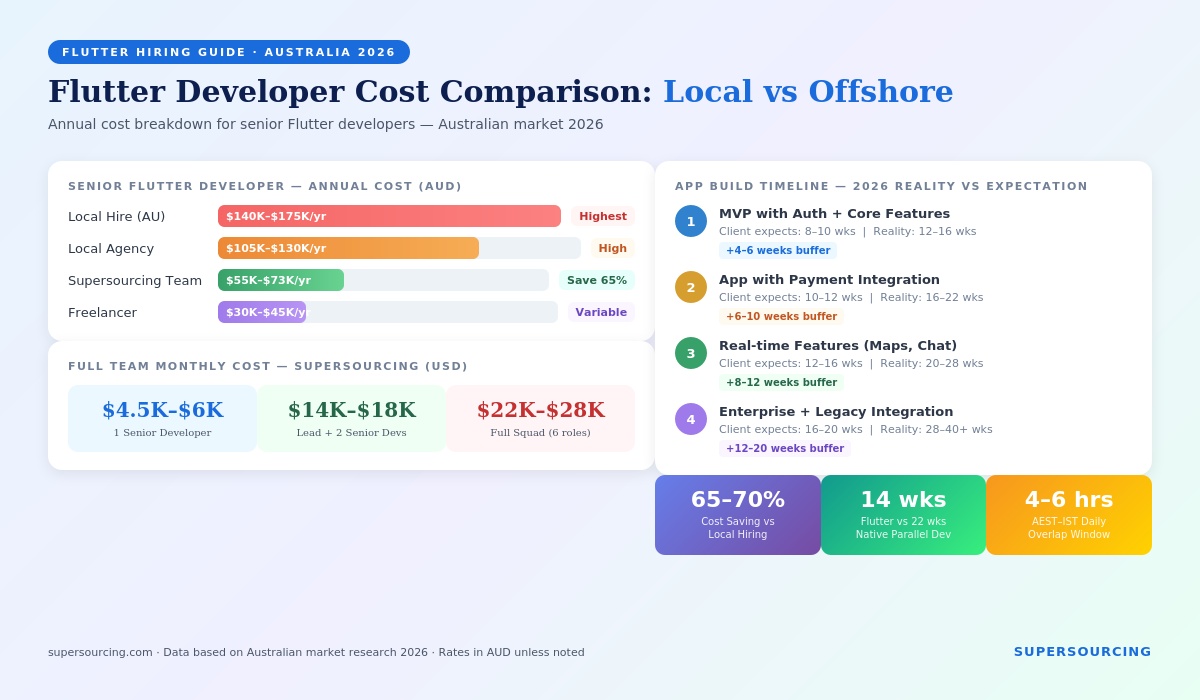
- Google doubled down. Flutter 3.x brought stable multi-platform support — iOS, Android, web, macOS, Windows, Linux from one codebase. The productivity gain is real. The Supersourcing team measured it directly on a recent fintech project: same feature set, Flutter build shipped in 14 weeks vs the 22-week estimate for native iOS + Android parallel development.
- The talent market fragmented. Australian-based Flutter developers with 3+ years of commercial experience typically charge AUD $120-$180/hour on the open market. That’s $240K-$360K annually for a single senior developer. Most scale-ups and mid-market companies can’t staff a full Flutter team domestically at those rates.
- AI-assisted development changed the productivity curve. Engineers using Copilot and Claude in their Flutter workflows are producing widget libraries, test suites, and state management boilerplate 40-60% faster than they were two years ago. This means the gap between a strong mid-level Flutter developer and a senior one has compressed — but only if the developer actually knows how to work with AI tooling. Most don’t.
The Actual Cost to Hire Flutter Developers for Cross-Platform Mobile App Development (Australia)
This is the section most blogs skip. They’ll give you a vague “it depends on your requirements” answer. I’ll give you the real numbers.
Hiring Locally in Australia
| Seniority | Daily Rate (Contract) | Annual Salary (Permanent) |
| Junior (1-2 years) | AUD $550-$750 | AUD $75K-$95K |
| Mid-level (2-4 years) | AUD $850-$1,100 | AUD $105K-$130K |
| Senior (4+ years) | AUD $1,200-$1,600 | AUD $140K-$175K |
| Flutter Lead / Architect | AUD $1,600-$2,200 | AUD $175K-$220K |
For a standard product team — one lead, two senior developers, one mid-level — you’re looking at AUD $700K-$900K annually in salaries alone. Add super, equipment, leave entitlements, and recruiter fees and you’re past $1M before you’ve written a line of code.
Hiring a Dedicated Flutter Team Through Supersourcing
The Supersourcing model for Australian clients: dedicated teams of Flutter developers based primarily in India, with timezone overlap windows of 4-6 hours daily and Australian-market-aware delivery practices.
| Team Configuration | Monthly Cost (USD) | Monthly Cost (AUD approx.) |
| 1 Flutter developer (senior) | $4,500-$6,000 | $6,800-$9,100 |
| 3-person team (lead + 2 senior) | $14,000-$18,000 | $21,000-$27,000 |
| Full squad (lead + 3 dev + QA + BA) | $22,000-$28,000 | $33,000-$42,000 |
The savings are real: 60-70% cost reduction vs local hiring for equivalent skill levels. The tradeoff is coordination overhead — roughly 2-3 hours per week of structured communication if done properly.
What a Cross-Platform Mobile App Actually Costs to Build
Ballpark development budgets for Australian market Flutter apps:
- MVP (core features, 2 platforms): AUD $65K-$120K, 12-18 weeks
- Mid-tier product (10-15 features, iOS + Android + web): AUD $150K-$280K, 20-32 weeks
- Enterprise app (complex integrations, compliance-heavy): AUD $300K-$600K+, 6-12 months
The variable that blows budgets most consistently: third-party integrations. Every Australian-specific integration — Afterpay, Zip, Australia Post API, Xero, MyGov identity services — adds 3-8 days of development time per integration, not counting QA cycles.
What to Look for When You Hire Flutter Developers
This is where the difference between a $150K successful project and a $300K failed one lives.
Flutter-Specific Technical Skills (Non-Negotiable)
- State management fluency. Ask specifically which state management approach they recommend for your use case and why. A developer who says “it depends” and can actually articulate what it depends on is worth more than one who’s memorised the Bloc documentation. The real answer for most commercial apps: Riverpod for smaller apps, Bloc for anything with complex async flows or team sizes above 3 developers.
- Platform channel expertise. Flutter’s Dart code communicates with native iOS and Android code through platform channels. Any meaningful Australian app will need them — for Afterpay’s native SDK, biometric authentication, or deep linking. If a developer has never written a platform channel, you’ll find out the hard way.
- Flutter Web maturity. Flutter Web is not Flutter Mobile. The rendering engine (CanvasKit vs HTML) makes decisions that affect SEO, performance, and accessibility differently. Most Flutter developers have minimal web experience. Ask for it specifically.
- Test coverage habits. Golden tests, widget tests, integration tests. What’s their coverage philosophy? A team that can’t answer this question will ship something that works in demo and breaks in production.
Experience Signals That Matter for Australia
- Has built or integrated Australian payment methods (Afterpay, Zip, PayID)
- Understands iOS App Store review requirements (Apple’s process is stricter for Australian financial apps)
- Has worked with APAC timezone clients and maintained communication without bottlenecks
- Familiar with Australian Privacy Act obligations for mobile apps that collect personal data
Red Flags I’ve Learned to Watch For
A portfolio full of demo apps and no production Play Store or App Store links. Flutter is a framework where polished demos are easy and production-ready apps are hard. If they can’t show you a live app, treat the portfolio accordingly.
Quoting flat timelines without seeing your API documentation. The Supersourcing team builds integration risk into every scoping session. Any developer who quotes you a timeline before auditing your backend architecture is guessing.
No mention of CI/CD setup. Flutter apps need fastlane or Codemagic for automated builds and deployments. If the developer doesn’t bring this up, you’ll be doing manual App Store submissions at midnight before your launch date.
The Flutter vs React Native Decision (For Australian Projects)
I get asked this on at least 3 calls per week. My honest answer:
Choose Flutter if:
- UI consistency across platforms is critical (fintech, healthtech, brand-sensitive apps)
- You’re targeting iOS + Android + Web from one codebase
- Your team doesn’t have existing JavaScript/React expertise
- Performance on lower-end Android devices matters (Flutter’s Skia renderer wins here)
Choose React Native if:
- Your team is already strong in React and TypeScript
- You’re building a content-heavy app with heavy web component reuse
- You need deep integration with a large JavaScript ecosystem library with no Flutter equivalent
For most Australian startups and scale-ups I work with, Flutter wins on performance and UI consistency. The Dart learning curve is steeper than people expect — typically 6-8 weeks before a strong JavaScript developer is productive in Flutter — but the output quality is higher.
| Factor | Flutter | React Native |
| UI consistency iOS/Android | ⭐⭐⭐⭐⭐ | ⭐⭐⭐ |
| Performance (GPU-rendered) | ⭐⭐⭐⭐⭐ | ⭐⭐⭐⭐ |
| Ecosystem maturity | ⭐⭐⭐⭐ | ⭐⭐⭐⭐⭐ |
| Web support | ⭐⭐⭐ | ⭐⭐⭐ |
| Talent availability (global) | ⭐⭐⭐⭐ | ⭐⭐⭐⭐⭐ |
| Hot reload / DX | ⭐⭐⭐⭐⭐ | ⭐⭐⭐⭐ |
| Australia-specific packages | ⭐⭐⭐ | ⭐⭐⭐⭐ |
How the Supersourcing Team Structures Flutter Engagements
When Kargo.tech came to us needing a cross-platform logistics mobile app with real-time tracking, driver interfaces, and customer-facing delivery updates, the first thing we did wasn’t write code. We spent 2 weeks mapping every API dependency — Google Maps, their internal dispatch system, three payment processors — before the first sprint.
That 2-week investment saved 6-8 weeks of integration rework later. The app launched on schedule.
The engagement model for cross-platform Flutter projects:
- Week 1-2: Discovery and architecture. API audit, third-party integration mapping, state management decision, CI/CD setup. This is where scope is locked and risk is identified. Skipping this is the most expensive mistake I see Australian companies make when they’re under pressure to ship.
- Week 3-6: Foundation sprint. Design system, navigation architecture, authentication flow, core API integration layer. The goal is a walking skeleton — not a polished app, but a complete end-to-end flow with real data.
- Week 7 onwards: Feature delivery. Two-week sprints, demo every sprint end, UAT involvement from week 10 onwards. Australian clients generally want weekly async updates and a live staging environment throughout.
- Pre-launch: Store submission and compliance. iOS App Store submission typically takes 5-7 days for first submission and 1-3 days for updates. Google Play is 24-72 hours. Build these windows into your launch plan — every first-time Flutter app has at least one rejection to work through.
What Most Companies Get Wrong When Hiring Flutter Developers
 What Most Companies Get Wrong When Hiring Flutter Developers
- They hire for Dart knowledge instead of mobile product judgment. Dart is not a hard language to learn. The hard parts of a Flutter project are product decisions: when to use native code vs Dart, how to handle offline states gracefully, where to put business logic so it’s testable. I’d rather have a developer with strong mobile product intuition and 12 months of Flutter experience than a Dart purist who’s never shipped to the App Store.
- They don’t account for the iOS-Android divergence tax. Flutter abstracts away a lot of platform differences. Not all of them. Push notifications, deep linking, background processing, and biometric authentication all behave materially differently on iOS vs Android. Budget 15-20% extra development time for platform-specific handling on these features. Every project that doesn’t budget this runs over on these features.
- They staff for the build phase, not the post-launch phase. A Flutter app isn’t done when it ships. OS updates — particularly major iOS releases in September each year — routinely break Flutter plugins. You need at least 0.5 of a developer’s time per quarter for maintenance on a production Flutter app. Companies that staff to zero after launch spend 3x as much on emergency fixes in the following 6 months.
- They treat the state management decision as optional. It isn’t. Choose setState and you’ll refactor when the app scales. Choose Bloc without understanding it and your junior developers will write unmaintainable code for 6 months before you notice. The state management architecture decision should happen in week 1, be documented, and be enforced in code review from day one.
Hiring Models Compared: Which Works for Australian Companies
| Model | Best for | Time to productivity | Risk |
| Local permanent hire | Long-term product, 2+ year horizon | 8-12 weeks (hire + onboard) | High (salary commitment) |
| Local contractor | Short-term surge, 3-6 months | 2-4 weeks | Medium (day rates) |
| Offshore dedicated team (Supersourcing) | Scaling fast, cost-sensitive | 2-3 weeks | Low (managed engagement) |
| Offshore freelancer (Upwork/Toptal) | Small, low-risk MVP | 1-2 weeks | High (quality variance) |
| Australian agency | Fixed-scope projects | Project start: 4-6 weeks | Medium (markup on dev costs) |
For most Australian scale-ups — Series A and beyond, or bootstrapped businesses with AUD $100K+ to spend — the dedicated offshore hiring model through a vendor like Supersourcing delivers the best risk-adjusted outcome. You get team continuity (same developers across sprints, not freelancer rotation), managed accountability, and cost structures that let you staff appropriately rather than cutting corners.
The Australian Compliance Layer You Can’t Skip
This doesn’t appear in most “hire Flutter developers” articles. It should.
- Australian Privacy Act 1988 (updated 2026). Any Flutter app that collects personal information from Australian users — including analytics data, location, or anything that could identify an individual — must have a compliant privacy policy, data retention controls, and the technical ability to respond to access/deletion requests. Firebase alone, configured out of the box, likely doesn’t meet these requirements.
- App Store age rating requirements. Australian Classification Board guidelines are stricter than US ones in some categories. Games with gambling mechanics and social apps targeting under-18s face different requirements in Australia vs other markets. Your Flutter developers need to know this before you submit.
- Accessibility requirements. Government procurement in Australia requires WCAG 2.1 AA compliance. If you’re building anything that touches government services or public-sector clients, your Flutter app needs accessibility testing — not just on iOS VoiceOver, but on Android TalkBack too. Flutter’s semantics layer is capable of good accessibility outcomes, but only if it’s designed in from the start.
- Payment Processing. If your app processes payments, you need PCI DSS compliance regardless of which gateway you use. Stripe and Afterpay handle the heavy lifting on this, but your Flutter implementation needs to be audited. Storing card data in SharedPreferences (which I’ve seen in production apps) is a critical vulnerability.
Real Timelines for Flutter App Delivery
Expectation vs reality for Australian market Flutter projects:
| Project Type | Typical Client Expectation | Realistic Timeline |
| Simple informational app (no backend) | 4-6 weeks | 6-8 weeks |
| MVP with user auth + basic CRUD | 8-10 weeks | 12-16 weeks |
| App with payment integration | 10-12 weeks | 16-22 weeks |
| App with real-time features (chat, maps, tracking) | 12-16 weeks | 20-28 weeks |
| Enterprise app with legacy system integration | 16-20 weeks | 28-40+ weeks |
The gap between expectation and reality isn’t developer laziness. It’s integration complexity that only becomes visible once you’re actually building. Every Australian financial app I’ve been involved with has had at least one integration surprise: an undocumented Afterpay SDK behaviour, an App Store review rejection for an Australian-specific requirement, or an insurance/compliance step that nobody factored into the timeline.
FAQ: Hiring Flutter Developers for Cross-Platform Mobile Apps in Australia
 FAQ: Hiring Flutter Developers for Cross-Platform Mobile Apps in Australia
1. How much does it cost to hire a Flutter developer in Australia?
Australian-based senior Flutter developers command AUD $1,200-$1,600 per day on contract, or AUD $140K-$175K annually as permanent employees. Dedicated offshore Flutter teams through a vendor like Supersourcing typically run USD $4,500-$6,000/month per senior developer — roughly 65-70% less than local market rates for equivalent skill levels.
2. How long does it take to build a cross-platform Flutter app?
A well-scoped MVP with user authentication, core features, and basic API integration realistically takes 12-16 weeks with a team of 2-3 Flutter developers. Apps with payment integrations, real-time features, or legacy system connections typically run 20-28 weeks. Factor in 1-2 weeks for App Store review cycles at launch.
3. Is Flutter better than React Native for Australian mobile apps?
For most Australian projects, Flutter delivers better UI consistency and performance. React Native has an advantage when your team already has strong React/JavaScript skills, or when you need deep integration with JavaScript ecosystem packages. The Dart learning curve is roughly 6-8 weeks for a strong JavaScript developer, but the resulting Flutter apps typically outperform React Native equivalents on mid-to-low-end Android hardware — relevant in a market where not all users have flagship devices.
4. Can one Flutter codebase really handle iOS, Android, and web?
Yes, with important caveats. Flutter’s web rendering uses a different engine (CanvasKit vs HTML renderer) and web-specific optimisations are often necessary for good performance. iOS and Android share approximately 90-95% of code, but platform channels for native features — biometrics, deep linking, push notifications — require separate implementations. Expect 15-20% of development time to go toward platform-specific handling even in a well-architected Flutter project.
5. What’s the best engagement model to hire Flutter developers from Australia?
For most Australian scale-ups, a dedicated offshore team model — where the same 2-4 Flutter developers work exclusively on your product across a 6-12 month engagement — delivers the best outcomes. It avoids the quality inconsistency of freelancer platforms, the markup of local agencies, and the overhead of building an internal team from scratch. The key is structured overlap hours (4-6 hours of shared working time daily) and documented communication rhythms, not physical co-location.
6. How do I evaluate a Flutter developer’s actual skill level?
Ask for links to apps they’ve shipped on the App Store or Play Store. Give them a 2-hour technical task involving a non-trivial state management scenario. Ask specifically about their approach to platform channels, their preferred testing strategy, and how they’ve handled offline states in previous apps. Dart syntax questions are the least useful filter — the hard skills are product judgment and native platform awareness, not language proficiency.
7. What Australian compliance requirements affect Flutter app development?
The main ones: Australian Privacy Act 1988 data handling requirements, App Store age rating and classification requirements stricter than US equivalents, WCAG 2.1 AA accessibility (required for government/public sector), and PCI DSS compliance for any payment processing. A Flutter developer without Australian market experience will often miss these until submission or audit — build compliance review into your development process, not your pre-launch checklist.
8. How do I manage a Flutter development team across Australian and Indian time zones?
The workable overlap between AEST and IST is roughly 4.5-6.5 hours depending on daylight saving. Structure your working rhythm around this: daily async standup at 8am IST (covering previous day’s progress, today’s plan, blockers), a live video call at 9am IST for any complex decisions, and a same-day async review of the day’s code by the Australian-side product owner by 6pm AEST. This model has worked across every Supersourcing engagement with Australian clients for the past three years.
Working with Supersourcing
If you’re evaluating how to hire Flutter developers for a cross-platform mobile app in Australia and want to talk through the architecture and team structure before you commit to a vendor, I take those calls personally.
Not a sales rep. Not an account manager. Me.
We’ve built cross-platform mobile applications for companies across fintech, logistics, and enterprise software. We’ve set up dedicated Flutter teams for Australian clients ranging from pre-seed startups to ASX-listed companies. Every client has come from a referral.
If that sounds like the conversation you need, reach out directly: mayank@supersourcing.com
