

There’s a deadline approaching that most companies are not ready for.
SAP ends mainstream support for ECC 6.0 and Business Suite 7 in 2027. Extended maintenance runs to 2030 — at a premium. Every company running legacy SAP needs to migrate to S/4HANA. Not eventually. Now.
That’s roughly 37,000 companies worldwide. Many of them Fortune 500. Most of them behind schedule. Almost all of them competing for the same small pool of SAP talent.
McKinsey estimated that the global S/4HANA migration market will exceed $50 billion.
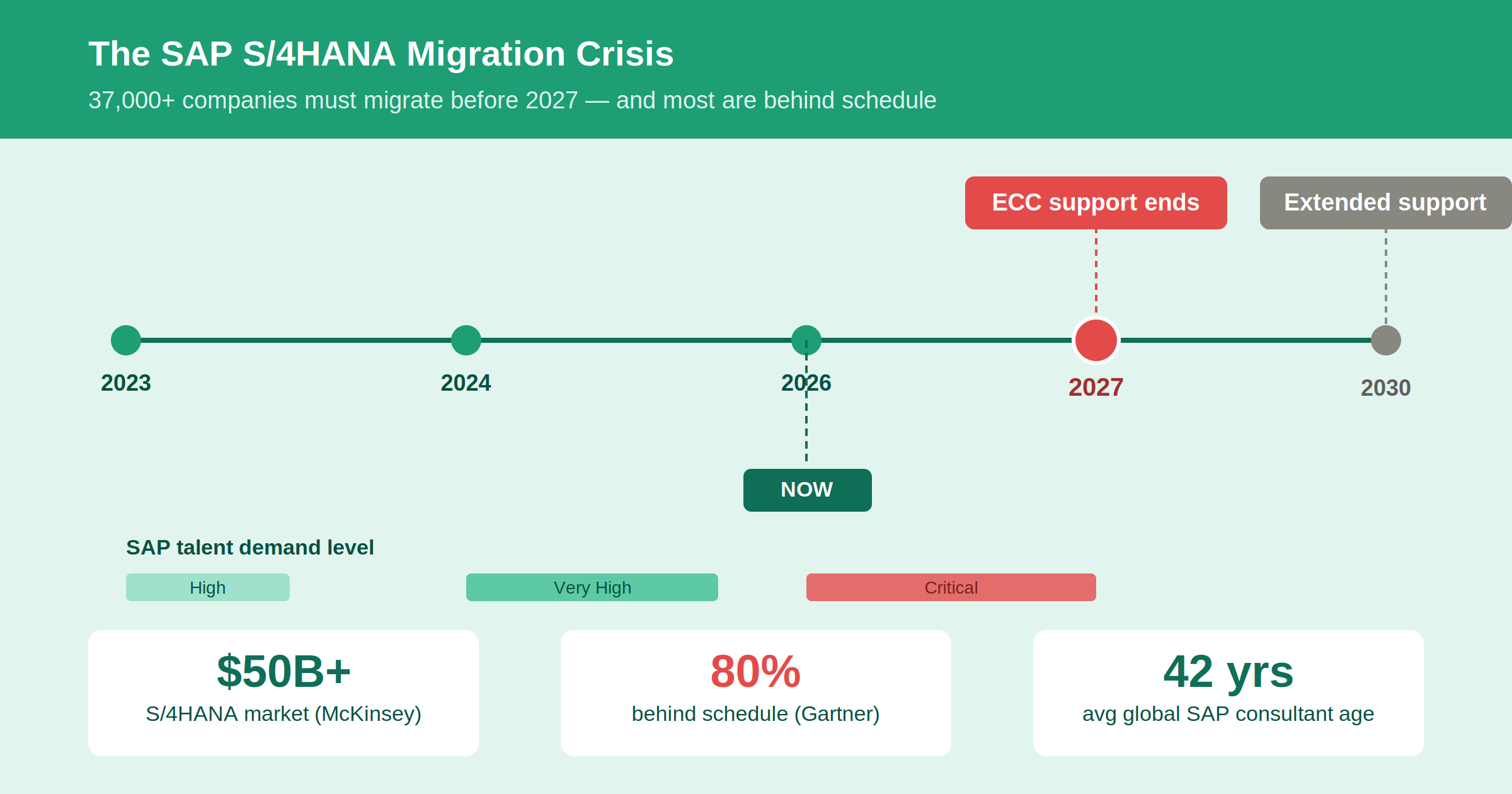
Gartner reported that 80% of SAP customers hadn’t completed their migration strategy by 2025. The demand for SAP developers — S/4HANA architects, ABAP specialists, Basis administrators, SuccessFactors consultants — has never been higher.
And the supply has never been tighter.
SAP talent is scarce for structural reasons. SAP certification is expensive and time-consuming. Enterprise SAP experience takes 5-10 years to develop meaningfully. The technology isn’t glamorous — young engineers gravitate toward Python, AI, and cloud-native stacks, not ABAP and FI/CO modules. The result: the average SAP consultant globally is 42 years old, commands premium rates, and has three competing offers at any given time.
This is why the world’s S/4HANA migration increasingly depends on Indian talent. India has the deepest SAP talent pool outside Germany — where SAP is headquartered. India’s IT services industry has been running SAP implementations for decades. Companies like Wipro, Infosys, TCS, and HCL have tens of thousands of SAP-certified professionals. The experience base is deep, the talent is available, and the cost is 50-65% lower than equivalent SAP consultants in the US, UK, or Europe.
But finding good SAP talent in India — assessed, verified, and ready to contribute from day one — is a different problem entirely.
That’s what Supersourcing solves. My name is Mayank Pratap. I co-founded Supersourcing — an IT staffing company that has placed engineers across 80+ technology specialisations for global enterprises. SAP is one of the deepest specialisations the team handles.
Our Talent Director, Vijay Kiran, built the engineering hiring operation at Flipkart — India’s largest e-commerce company, $35 billion valuation, 10,000+ engineers. Before Flipkart, he led engineering hiring at two other billion-dollar unicorns. Three unicorn hiring operations. Tens of thousands of engineers evaluated. That assessment expertise applies directly to SAP — because evaluating whether a SAP SuccessFactors consultant can actually configure a complex compensation module requires the same rigour as evaluating whether a backend engineer can build a payment system at scale.
Google selected us for the AI Accelerator 2024. CMMI certified us at Level 5. LinkedIn named us a Top Startup in India — twice. Wipro, Virtusa, and Impetus are our direct vendor partners. Vijay Shekhar Sharma backs us personally.
This blog is for the VP Engineering, SAP Program Director, IT Procurement Lead, or CTO at a global enterprise who needs SAP talent from India — and is frustrated with what they’ve received so far.
The SAP Hiring Problem — Why Your Internal TA Team Can’t Fill These Roles
Let me describe a pattern I’ve seen at every enterprise client who comes to us for SAP hiring.
Internal TA receives a requisition for a “Senior SAP ABAP Developer.” The TA team searches LinkedIn and their ATS. They find profiles that mention SAP ABAP. They send 10 profiles to the SAP Practice Lead.
The Practice Lead reviews them. Three candidates haven’t touched ABAP in 4 years — they transitioned to Fiori and JavaScript-based SAP UI5. Two candidates have ABAP experience but only in reports and forms — they’ve never built custom enhancements to standard SAP transactions. Two candidates have the right ABAP skills but zero S/4HANA exposure — they’ve only worked on ECC. One candidate looks perfect on paper but can’t explain the difference between a classical report and an ALV object during the screening call. One candidate is genuinely qualified but wants 40% more than the budget because they already have two offers.
Six weeks pass. The position is still open. The S/4HANA migration project is delayed. The
Program Director escalates to procurement. Procurement calls a staffing agency. The agency keyword-searches “SAP ABAP” and sends 20 resumes — with the same quality problems the internal TA team already encountered.
This cycle repeats because SAP hiring requires domain-specific assessment that generic recruiters — whether internal or agency — don’t have. “SAP ABAP” on a resume doesn’t mean the candidate can write production ABAP code for S/4HANA. “SAP SuccessFactors” doesn’t mean they can configure Employee Central. “SAP Basis” doesn’t mean they can manage a HANA database.
The gap between a keyword match and a qualified SAP professional is wider than in almost any other technology. And it’s this gap that costs enterprises months of delay and hundreds of thousands of dollars in migration overruns.
What Makes SAP Hiring Different From Standard Tech Hiring
SAP isn’t one technology. It’s an ecosystem of modules, platforms, tools, and integration layers — each with its own expertise requirements. Hiring for SAP is fundamentally different from hiring for Python or React or even cloud engineering.
Module Specificity Is Everything
An SAP SuccessFactors consultant who specialises in Employee Central is a completely different hire from one who specialises in Performance & Goals. Both are “SAP SuccessFactors” on a resume. In practice, they have different configuration knowledge, different integration experience, and different certification paths.
An ABAP developer who’s built custom BAPIs and idocs for ECC has different skills from one who’s built RAP-based applications for S/4HANA. Both are “ABAP developers.” The second is worth 30-40% more in the current market — and is 5x harder to find.
An SAP Basis administrator who manages on-premise ECC environments has different skills from one who manages HANA Cloud Platform (HCP) environments. The cloud Basis admin is rarer and commands higher rates.
The Supersourcing team assesses for specific module expertise. Not “do you know SAP?” but “can you configure SuccessFactors Compensation module for a 10,000-employee enterprise with 15 compensation plans across 6 countries?” That specificity is what separates our assessment from a keyword search.
Certification Matters — But It’s Not Enough
SAP certifications (C_TS4FI, C_HANATEC, C_HRHPC, etc.) are meaningful quality signals. They indicate that the candidate invested time and money in formal training and passed SAP’s own evaluation.
But certification alone doesn’t indicate production experience. A certified SAP HANA developer who’s never managed a production HANA instance at enterprise scale will struggle with performance tuning, data modelling at volume, and disaster recovery planning that comes only from operational experience.
The team’s assessment evaluates both — certification as a baseline, production experience as the differentiator. Vijay Kiran’s framework specifically separates “trained” from “experienced” — a distinction that matters enormously in SAP, where enterprise implementations are complex, multi-year engagements that demand battle-tested consultants, not recently certified ones.
The S/4HANA Premium
S/4HANA migration experience is the single most valuable specialisation in the SAP ecosystem right now. And it’s the scarcest.
Migrating from ECC to S/4HANA isn’t an upgrade. It’s a transformation. New data model
(Universal Journal). New UX layer (Fiori). New deployment options (on-premise, cloud, hybrid). New integration patterns. Legacy custom code that must be adapted or rewritten. Data migration that must be planned, executed, and validated without business disruption.
An SAP consultant with hands-on S/4HANA migration experience — who has actually led or participated in a brownfield or greenfield S/4HANA migration at an enterprise — commands 30-50% premium over standard SAP rates. And they’re available for weeks, not months — because everyone wants them.
The team has placed S/4HANA migration specialists for enterprises running against the 2027 deadline. Finding them requires active sourcing through SAP community networks, not passive job board posting. The AI-powered sourcing engine (Google AI Accelerator 2024) identifies candidates with specific S/4HANA migration keywords in their experience — not just “SAP” on the resume — before Vijay’s assessment team evaluates depth.
The SAP Talent Landscape in India — Why India Is Your Best Option
India’s SAP talent pool is the largest outside Germany. Here’s why.
India’s IT services industry has been running SAP implementations for 25+ years. Wipro — our direct vendor partner — has one of the largest SAP practices globally. Infosys, TCS, HCL, Tech Mahindra, and Cognizant each have thousands of SAP professionals. The SAP ecosystem in India is mature, deep, and continuously replenished.
SAP Labs India — SAP’s own R&D centre in Bangalore — is one of the largest SAP development centres in the world. This creates a talent flywheel: SAP’s own presence attracts SAP talent to India, which creates a deep market for SAP professionals, which attracts more SAP-dependent enterprises to hire from India.
The cost advantage is significant. A senior SAP ABAP developer in the US commands $120-$180/hour. The same seniority and expertise in India: $30-$60/hour. An SAP S/4HANA migration architect in the US: $180-$250/hour. In India: $50-$80/hour.
That’s not a quality compromise. It’s a structural cost difference driven by India’s lower cost of living. The SAP professionals in India are building the same solutions, working on the same platforms, using the same tools as their US or European counterparts. Many of them have worked at the same global companies — just from Indian offices.
But here’s the catch. India has the talent. Finding the right SAP professional — with the right module expertise, the right S/4HANA exposure, the right seniority, and the ability to communicate effectively with a global team — requires an assessment capability that most staffing agencies don’t have.
Generic agencies search “SAP” on LinkedIn. They find thousands of profiles. They can’t tell the difference between a SuccessFactors Employee Central expert and a SuccessFactors Learning Management expert. They can’t evaluate whether an ABAP developer’s code is production-grade or training-exercise quality. They can’t assess whether a Basis administrator can manage HANA at enterprise scale or only knows Basis for ECC.
Supersourcing’s assessment goes module-deep because Vijay Kiran’s framework demands it. The assessment is different for every SAP role type. And the EngineerBabu sister company — which builds production software daily — provides the engineering context to evaluate whether a candidate’s technical skills translate to production delivery.
How Supersourcing Hires SAP Talent — The Process
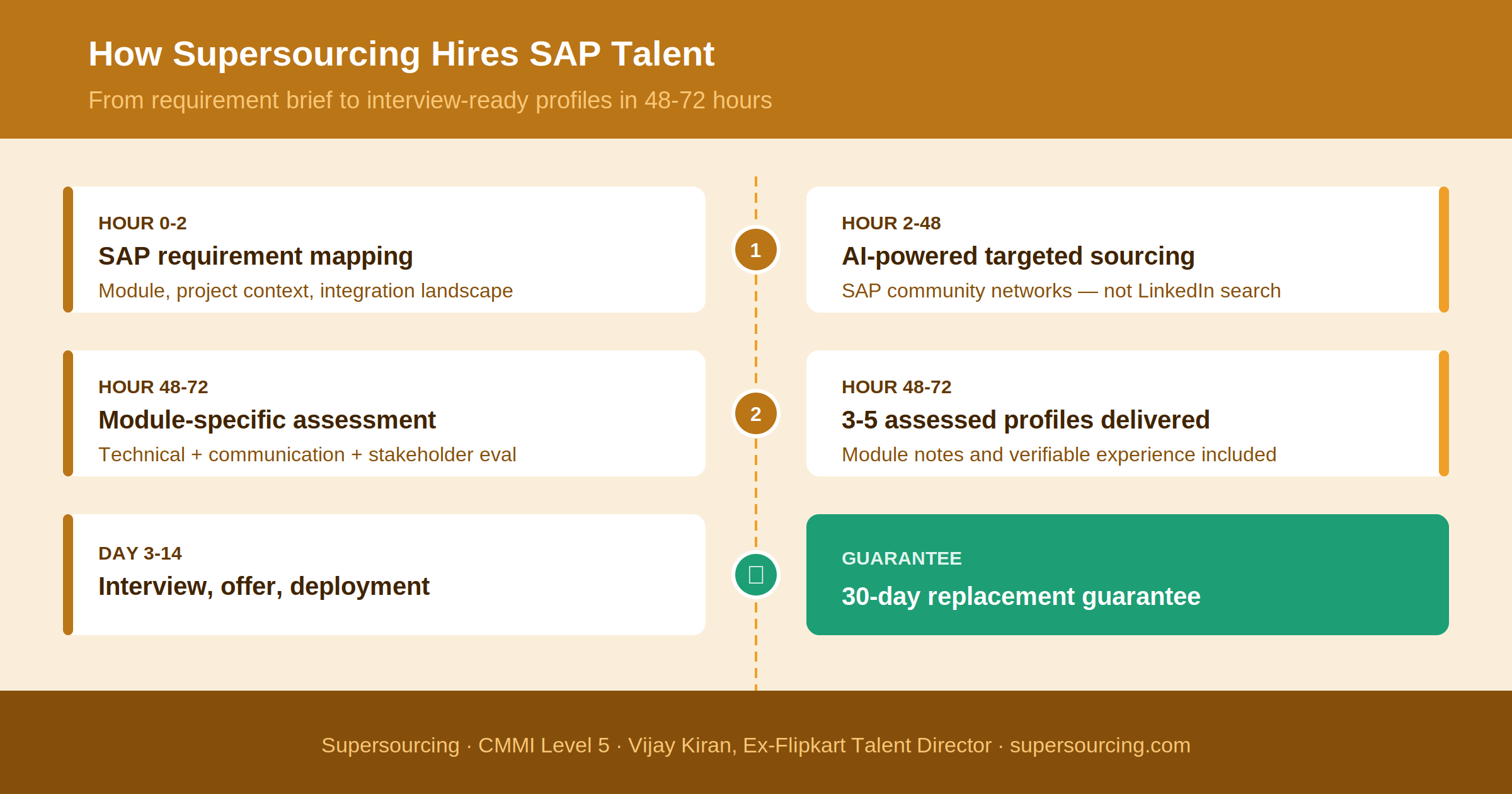
Hour 0-2: SAP-specific requirement mapping. Not a generic JD review. A detailed conversation about the specific SAP module, the project context (migration, new implementation, support, enhancement), the integration landscape (what other systems does SAP connect to), the timeline, and the candidate profile that the SAP Practice Lead would consider ideal. This conversation is led by someone who understands SAP — not a junior recruiter who’s never logged into an SAP GUI.
Hours 2-48: Sourcing from SAP-specific channels. The team sources through SAP community networks, SAP User Group connections, SAP-specific job channels, and AI-powered matching across active SAP professionals. Not a generic LinkedIn search for “SAP.” Targeted sourcing that reaches SAP professionals who aren’t actively job-hunting — because the best SAP talent rarely needs to apply for jobs.
Hours 48-72: Module-specific assessment. Each candidate is assessed against the specific module the client needs. An SAP SuccessFactors assessment covers module-specific configuration, integration patterns, and scenario-based questions drawn from real
SuccessFactors implementations. An ABAP assessment covers coding standards, performance optimisation, S/4HANA-specific syntax and APIs, and custom enhancement patterns. A Basis assessment covers HANA database management, transport management, security configuration, and disaster recovery planning.
Communication assessment happens in parallel. SAP consultants work with business stakeholders, not just IT teams. They need to explain technical decisions to finance directors, HR leaders, and operations managers. The team evaluates whether the candidate can do this clearly and confidently.
Hours 48-72: Delivery of 3-5 assessed profiles. Each profile includes module-specific assessment notes. Not “this person knows SAP.” Rather: “this person has configured SuccessFactors Employee Central for a 15,000-employee enterprise across 8 countries, integrated with ADP payroll, and can start in 2 weeks.” Specific. Verifiable. Interview-ready.
Days 3-14: Client interviews, offer, deployment. The team coordinates the entire process. For contract roles, Supersourcing handles payroll, compliance (PF, ESI, gratuity, professional tax), and employment documentation. CMMI Level 5 processes ensure compliance is systematic, not ad-hoc.
The SAP Roles the Team Fills
Let me be specific about what “SAP hiring” means at Supersourcing. Not a generic claim. Specific roles the team has assessed and placed.
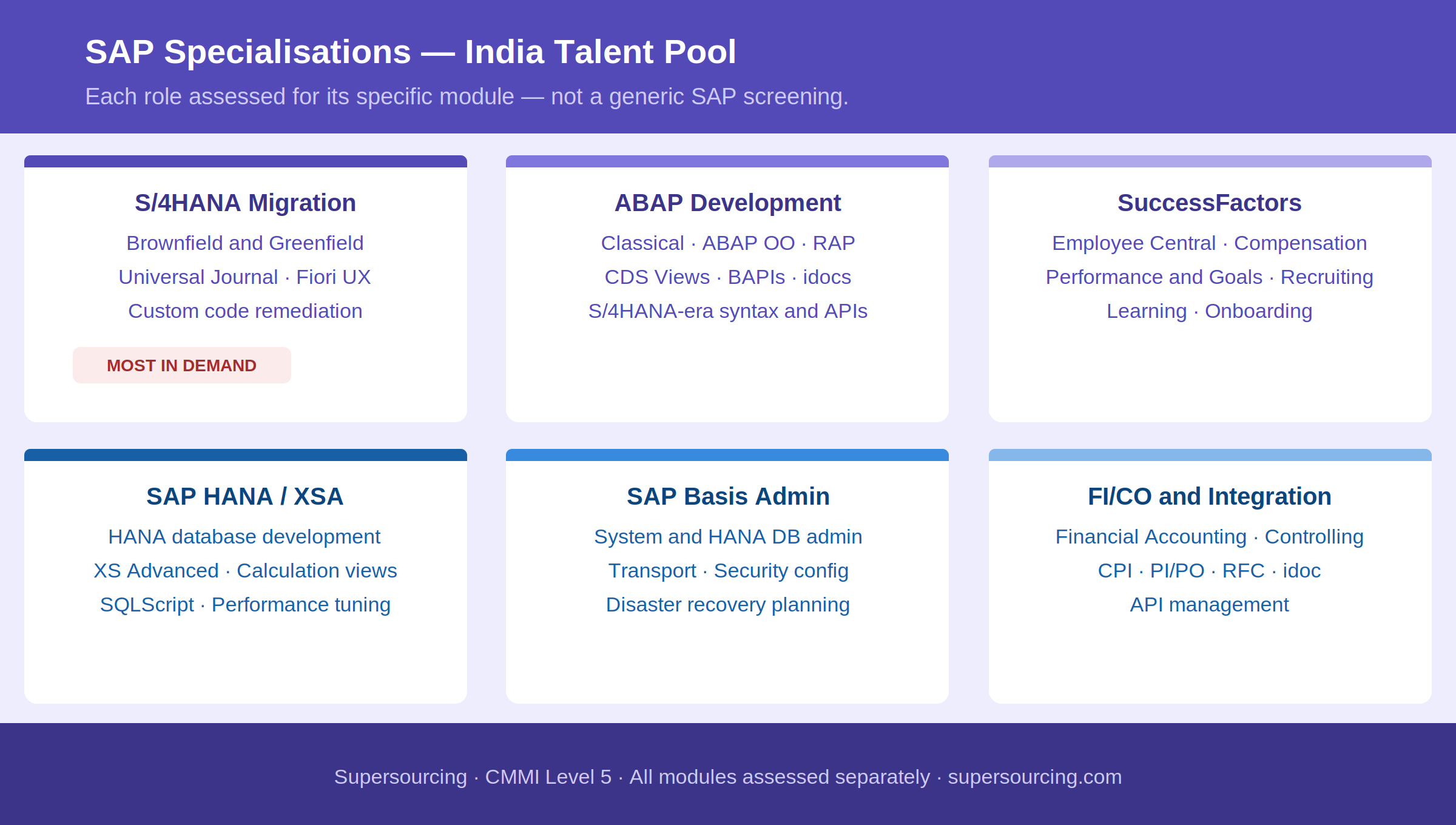 SAP S/4HANA Migration Specialists — Brownfield and greenfield migration. Data migration (Universal Journal). Custom code remediation. Fiori UX layer implementation.
S/4HANA-specific ABAP development (CDS views, RAP model). The most in-demand and hardest-to-find SAP specialisation globally.
SAP ABAP Developers — Classical ABAP, ABAP OO, CDS views, RAP-based applications, BAPIs, idocs, SAPscripts, Adobe Forms, ALV reports. Assessment distinguishes between ECC-era ABAP and S/4HANA-era ABAP — because the development paradigm has shifted significantly.
SAP SuccessFactors Consultants — Employee Central, Compensation, Performance & Goals, Recruiting, Learning Management, Onboarding. Each module assessed separately because a Compensation expert is not a Recruiting expert.
SAP HANA / e-HANA / XSA Developers — HANA database development, XS Advanced development, HANA modelling, calculation views, SQLScript. Assessment covers HANA-specific optimisation that’s fundamentally different from traditional RDBMS optimisation.
SAP Basis Administrators — System administration, transport management, HANA database administration, security configuration, performance monitoring, disaster recovery. Assessment distinguishes on-premise Basis from cloud Basis from HANA-specific Basis.
SAP FI/CO Consultants — Financial Accounting, Controlling, Asset Accounting. Configuration, integration, and customisation for enterprise finance operations.
SAP Integration Specialists — CPI (Cloud Platform Integration), PI/PO, RFC, idoc-based integration, API management. Assessed for real-world integration complexity, not textbook patterns.
For each role, the assessment is designed for that specific specialisation. A SuccessFactors Employee Central evaluation asks different questions than a SuccessFactors Compensation evaluation. An S/4HANA ABAP assessment evaluates CDS and RAP patterns. A Basis assessment for HANA covers different skills than Basis for ECC.
This module-specific assessment is why enterprises come to Supersourcing for SAP hiring after failing with generic agencies. Generic agencies can’t tell the difference between these roles. The Supersourcing team can — because the assessment framework was designed for this level of specificity.
The Engagement Models — SAP Is Different
SAP engagements don’t follow standard staffing patterns. Migration projects have defined timelines. Support operations are indefinite. Implementation phases require intensive staffing followed by steady-state support. The engagement model must flex with the project lifecycle.
Remote Contract — the SAP consultant works remotely, on Supersourcing’s payroll, for a defined project phase. Monthly billing. Common for: S/4HANA migration phases, implementation sprints, enhancement projects. Scale up for migration peak, scale down post-go-live. No long-term commitment.
Remote Full-Time — the SAP consultant joins the client’s payroll permanently, working remotely. Common for: SAP Centre of Excellence teams, ongoing support operations, strategic SAP roles where long-term ownership matters. One-time placement fee. 30-day replacement guarantee.
Onsite — the SAP consultant works from the client’s office. Common for: go-live support, hyper-care periods, roles requiring close collaboration with business stakeholders who aren’t remote-ready.
Hybrid — remote for configuration and development, onsite for workshops, testing, and go-live. The most common model for SAP implementations in 2026. The team assesses SAP candidates specifically for hybrid readiness.
Leadership Hiring — SAP Practice Head, SAP Program Director, SAP CoE Lead. These roles require a different evaluation — strategic thinking, vendor management capability, executive communication, team building. Vijay Kiran’s experience building leadership teams at Flipkart and two other unicorns applies directly to SAP leadership assessment.
Why Most SAP Staffing Fails — And How to Prevent It
Three patterns I’ve seen repeatedly.
Module mismatch. The client needs a SuccessFactors Employee Central consultant. The agency sends a SuccessFactors Performance & Goals consultant. Both say “SAP
SuccessFactors” on the resume. The agency couldn’t tell the difference. The client discovers the mismatch during the first week of work. A week wasted. The replacement cycle starts again.
Supersourcing’s module-specific assessment prevents this. The assessment is designed for the exact module the client needs. A SuccessFactors Employee Central evaluation asks Employee Central-specific questions. If the candidate’s real expertise is Performance & Goals, the assessment catches it before the client sees the profile.
Certification without experience. The candidate has a shiny C_TS4FI_2021 certification. They’ve never configured a production S/4HANA Finance system. They learned S/4HANA in a training sandbox. The difference between sandbox configuration and enterprise-scale production is enormous — data volumes, integration complexity, customisation requirements, performance demands.
Vijay Kiran’s assessment framework specifically separates certification from production experience. The assessment asks scenario-based questions drawn from real enterprise implementations. A candidate who’s only trained in a sandbox can’t answer them convincingly. The filter works.
Treating SAP like generic development. SAP implementations involve business stakeholders — finance teams, HR teams, supply chain teams — who don’t speak technology. An SAP consultant who can configure a module perfectly but can’t explain their decisions to a CFO creates friction that slows the entire project.
The communication assessment the team runs evaluates specifically for business stakeholder communication — not just English fluency, but the ability to translate technical SAP decisions into business language. This is a requirement that generic staffing agencies never assess for.
What Enterprises Get With Supersourcing for SAP Hiring
Mayank Pratap leads the company personally. The enterprise client talks to the founder, not a sales team.
Vijay Kiran — who built engineering hiring at Flipkart ($35B, 10,000+ engineers) and two other unicorn companies — runs the assessment. The quality bar for SAP candidates is set by someone who’s evaluated tens of thousands of engineers at India’s most demanding companies.
Module-specific assessment across every SAP specialisation: S/4HANA, ABAP, SuccessFactors, HANA, e-HANA, XSA, Basis, FI/CO, and integration. Not generic SAP screening. Evaluation designed for the exact module the client needs.
48-72 hours to assessed shortlist. 12-14 days to deployed SAP consultant. 30-day replacement guarantee on permanent placements.
CMMI Level 5 for compliance that satisfies enterprise procurement. Google AI Accelerator 2024 for AI-powered sourcing that finds SAP talent faster than manual search. LinkedIn Top Startup India — twice. Wipro, Virtusa, Impetus as direct vendor partners — companies with massive SAP practices that trust Supersourcing as a staffing partner.
Transparent pricing. Module-specific rates. No hidden margins.
Let’s Talk SAP
If you have SAP positions open — S/4HANA migration architects, ABAP developers,
SuccessFactors consultants, Basis administrators, or SAP leadership roles — and your current staffing partners are sending you generic “SAP” resumes that don’t match the specific module you need, email me.
mayank@supersourcing.com. The founder.
Tell me the SAP module, the seniority level, the project context (migration, implementation, support), and the timeline. The team will have 3-5 module-assessed, interview-ready profiles in your inbox within 48-72 hours.
No commitment. No contract to sign first. Just assessed profiles for the exact SAP specialisation you need.
If they’re strong, we talk next steps. If they’re not, you’ve lost nothing.
Mayank Pratap Co-founder, Supersourcing mayank@supersourcing.com | supersourcing.com
Google AI Accelerator 2024 · CMMI Level 5 · LinkedIn Top Startup India (Twice) · Talent Director: Ex-Flipkart, 3 Unicorn Hiring Ops · Wipro / Virtusa / Impetus Vendor Partner · Backed by Vijay Shekhar Sharma
Frequently Asked Questions
How much does it cost to hire SAP developers in India?
SAP developer rates in India range from $25-$70/hour depending on module specialisation and seniority. SAP S/4HANA migration architects command premium rates at $50-$80/hour. Standard SAP ABAP developers range $25-$45/hour. SuccessFactors consultants range $35-$60/hour. These represent 50-65% savings versus equivalent US or European SAP rates. Supersourcing provides exact rates after understanding the specific module and engagement model.
How fast can Supersourcing provide SAP developers?
3-5 assessed, interview-ready SAP profiles within 48-72 hours. Full deployment averages 12-14 days. Each candidate is assessed specifically for the SAP module required — not through a generic technical test. Speed is achieved through AI-powered sourcing (Google AI Accelerator 2024) combined with Vijay Kiran’s module-specific assessment framework.
What SAP modules can Supersourcing hire for?
All major modules: S/4HANA migration (brownfield and greenfield), ABAP development (classical and S/4HANA-era), SAP SuccessFactors (Employee Central, Compensation, Performance & Goals, Recruiting, Learning, Onboarding), SAP HANA / e-HANA / XSA, SAP Basis administration, FI/CO, integration (CPI, PI/PO), and SAP leadership roles (Practice Heads, Program Directors). Assessment is module-specific for every placement.
Why is it hard to hire SAP developers?
Four structural reasons: SAP certification is expensive and time-consuming, enterprise SAP experience takes 5-10 years to build, S/4HANA migration is creating unprecedented demand against the 2027 deadline, and younger engineers prefer modern tech stacks over SAP. India has the deepest SAP talent pool outside Germany — making it the most viable market for global enterprises facing SAP talent shortages.
Does Supersourcing offer contract and permanent SAP hiring?
Yes. Five models: Remote Contract (monthly billing, ideal for migration phases), Remote Full-Time (permanent hire, 30-day replacement guarantee), Onsite (for go-live and hyper-care), Hybrid (most common for SAP implementations), and Leadership Hiring (SAP Practice Heads, Program Directors). The team recommends the right model based on the project lifecycle stage and organisational context.
