

I’ve reviewed the scope documents for probably 200+ mobile app projects in the past three years. The number that launched on time and within budget? Closer to 40%. The number where the root cause of failure was the React Native developer hiring decision specifically? About 60% of those failures. Not the technology. Not the idea. The hiring model.
What makes this even more deceptive in 2026 is that React Native itself isn’t the weak link — far from it. In fact, React Native powers around 38–40% of new cross-platform mobile apps in 2026, which means the ecosystem, tooling, and talent pool are more mature than ever. Yet despite that maturity, UK startups continue to ship late — or not at all — because they confuse availability of developers with availability of the right developers for production-grade systems.
UK startups are particularly exposed to this because the talent market here creates a specific trap: day rates that signal quality but don’t guarantee it, freelance-to-permanent promises that rarely materialise, and a gap between “builds React Native apps” and “builds production-grade cross-platform products” that’s wide enough to sink six months of runway.
When the Supersourcing team built the mobile experience for Kargo.tech’s logistics platform, the first conversation wasn’t about features. It was about who would own the codebase when the engagement ended. That question alone filtered 70% of candidates out of contention before a single line of code was written.
This is what you should be thinking about before you post that job description.
What Does It Actually Mean to Hire React Native Developers for Startup App Project UK?
Hiring React Native developers for a startup app project in the UK means sourcing engineers with cross-platform mobile development expertise who can build iOS and Android applications from a single JavaScript codebase — while navigating UK employment structures (PAYE, IR35, limited company contractors), time zone alignment requirements, and the specific performance expectations of a startup where speed-to-market and technical debt management must coexist.
That definition sounds dry. Here’s what it means in practice: you’re not just hiring a developer. You’re choosing an architecture philosophy, a documentation standard, a QA process (or lack of one), and — most critically — a handover protocol.
Most startups discover this around week eight. That’s when the first feature request hits something the original dev “didn’t architect for.”
 The Real Cost of React Native Development for UK Startups
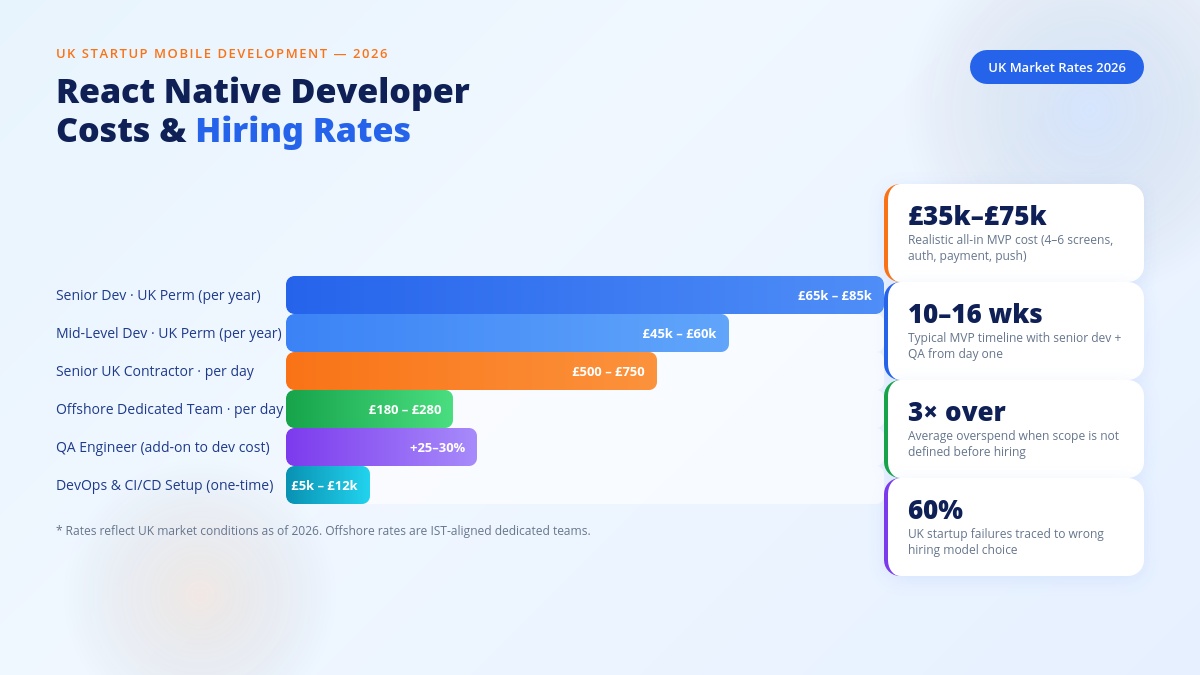 The Real Cost of React Native Development for UK Startups
I’ve seen the same startups budget £40,000 for an MVP and end up spending £110,000. Not because anyone lied to them — because the estimate was honest about development cost and silent about everything adjacent to it.
Here’s a more complete breakdown:
Development costs (realistic UK market rates, 2025-2026):
- Senior React Native developer (UK-based, permanent): £65,000–£85,000/year
- Mid-level React Native developer (UK-based): £45,000–£60,000/year
- Senior contractor (UK, outside IR35): £500–£750/day
- Senior developer via dedicated offshore team (India, IST-aligned): £180–£280/day equivalent
What the rate doesn’t include:
- QA engineer (budget an additional 25–30% of dev cost)
- DevOps and CI/CD setup: £5,000–£12,000 one-time
- Third-party API licensing (push notifications, payment gateways, mapping): £800–£3,000/year
- App Store and Google Play developer accounts, review cycles, rejection remediation
- Code review and architecture oversight if you’re hiring mid-level talent
For a typical UK startup MVP — 4-5 core screens, user authentication, one payment integration, basic push notifications — realistic all-in cost is £35,000–£75,000 over 3–5 months. Not the £15,000 figure floating around agency websites.
The Pennywise project taught me something specific about this: the clients who came in with the most unrealistic budgets had almost always been quoted by someone who assumed they’d use a free-tier backend forever. Twelve weeks into build, the cloud infrastructure costs alone surprised them. Build your cost model with production scale in mind from day one.
Five Hiring Models for React Native Development — and When Each One Actually Works
There’s no universally correct hiring model. There’s the right one for your stage, your risk tolerance, and your technical oversight capacity.
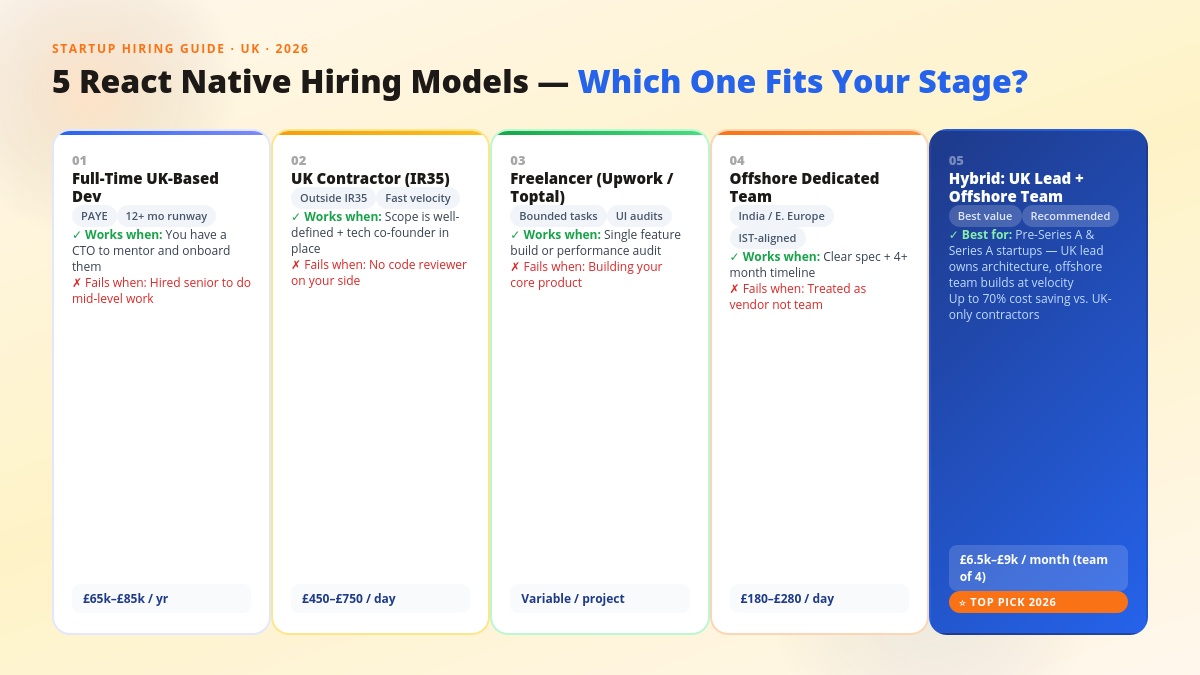
1. Full-Time UK-Based React Native Developer
- When it works: You have 12+ months of runway, you’re building proprietary technology that genuinely requires deep institutional knowledge, and you have a CTO or senior technical lead who can onboard and mentor them.
- When it fails: You hire a senior developer to do mid-level work because you were impressed by their CV. The role under-challenges them inside six months. They leave. You start over.
- Timeline to productive output: 6–10 weeks including hiring process, notice period, and onboarding.
2. UK Contractor (Inside or Outside IR35)
- When it works: You need velocity now, you have a well-defined scope, and you have either a technical co-founder or an experienced CTO managing the engagement.
- When it fails: The contractor optimises for billable days, not for your product. Without a technical owner on your side who reads code, you won’t know until the invoice is already large.
- Typical day rate: £450–£750 depending on seniority and specialism. React Native developers who also handle native modules command the upper end.
3. Freelance Developer (Upwork, Toptal, or Direct)
- When it works: Specific, bounded tasks — a particular feature build, a UI refresh, a performance audit.
- When it fails: You’re building the core product. Freelancers have context-switching costs that compound across engagements. What feels like cost saving on day one becomes re-explanation overhead by week four.
4. Offshore Dedicated Team (India, Eastern Europe, LATAM)
- When it works: You have a clear product specification or a technical co-founder to provide direction. You need 2–4 developers working as a coordinated team, not independent contributors. You want to scale resourcing without UK employment overhead.
- When it fails: You treat the team as a vendor rather than as your team. Communication is async-only. No one on your side reviews code or attends standups consistently.
- Supersourcing context: We’ve set up GCC-model dedicated teams for UK startups where the offshore team becomes a genuine product team — attending UK standups at IST+4:30 or earlier, using the same tools, operating within the same sprint structure. This model consistently outperforms UK contractor arrangements for projects with 4+ month timelines. The Brillio engagement demonstrated this: a 14-person team across two time zones delivered enterprise SAP and DevOps transformation with zero geo-caused delays.
5. Hybrid: UK Tech Lead + Offshore React Native Team
This is the model I’d recommend for most UK startups at Series A or pre-Series A stage. A UK-based senior tech lead (contractor or fractional CTO) owns architecture decisions, code review, and stakeholder communication. The build team is 2–4 offshore React Native developers who work at velocity.
Cost comparison: £6,500–£9,000/month for a 4-person team in this model vs. £25,000–£30,000/month for the equivalent capacity in UK-only contractors. Quality parity is achievable if the lead is genuinely strong and genuinely engaged.
The React Native Technical Assessment Most Startups Skip
 The React Native Technical Assessment Most Startups Skip
I’ve watched hiring managers test for the wrong things consistently. They ask about Redux architecture when they should be asking about native module bridging. They ask about component design when they should be asking about performance profiling.
For a startup app specifically, the five things that actually predict build quality:
- Navigation architecture experience
Ask specifically: “How would you structure navigation for an app that has unauthenticated onboarding, authenticated main flow, and a modal-based checkout?” A developer who can answer this cleanly has shipped real apps. A developer who says “I’d use React Navigation” and stops there hasn’t.
- Native module bridging
At some point your React Native app will need something that requires a native module — camera customisation, biometric authentication, deep hardware integration. Ask how they’ve handled this. Look for actual examples, not theoretical answers.
- Performance optimisation on low-end Android devices
UK startups often forget that their product will be used on a Samsung A12 by someone on a train in Manchester. Ask for specific techniques — FlatList optimisation, image caching strategies, JS thread blocking patterns they’ve resolved.
- Expo vs. bare React Native decision-making
This isn’t a trick question. Both are right in different contexts. A developer who reflexively picks one without asking about your use case hasn’t thought about it enough.
- App Store review process experience
This is often the week-or-more delay nobody plans for. Someone who’s been through rejection cycles, knows how to write review notes, and understands Apple’s guideline edge cases saves you significant time.
Where UK Startups Lose the Most Time (and Money) in React Native Projects
Three patterns repeat so consistently I can almost predict which projects will hit them in the discovery call.
Problem 1: The scope that wasn’t a scope
“An app like Deliveroo but for local IT services” is a vision, not a scope. React Native developers can’t estimate against a vision. The projects that go 3x over budget are almost always the ones where the initial scope document was a mood board and a paragraph.
Fix: Before you hire anyone, produce a user flow map. Screen by screen. What data does each screen show? What actions can the user take? What happens when those actions fail? This document is worth more than the developer’s portfolio.
Problem 2: The API dependency nobody owned
Your app integrates with a payment gateway, a logistics API, a mapping service, and your own backend. Each of these has its own documentation quality, sandbox behaviour, and edge-case behaviour in production. In 70% of projects I’ve reviewed, no one owned the third-party API integration work as a distinct workstream.
The React Native developer ends up doing four jobs simultaneously — building UI, writing integration code, debugging undocumented API behaviour, and trying to keep up with your feature requests. Something breaks.
Fix: Assign a technical lead who specifically owns the integration layer. Separate it from the UI build in your timeline and your sprint planning.
Problem 3: The QA that happened at the end
I understand why startups do this. QA feels like a second build phase. It’s easier to defer. But React Native apps have a specific surface area — cross-platform rendering differences, gesture handler conflicts, iOS/Android permission handling — that means bugs caught in week two are £500 problems. The same bugs caught in week twelve are £5,000 problems.
The Open Money fintech banking platform is a project worth referencing here. We built settlement flows, transaction histories, and multi-currency wallet views across iOS and Android. The team ran parallel QA from sprint one. Total post-launch defects: 4. Compare that to the typical UK startup MVP that launches with 40.
React Native vs. Flutter vs. Native: The Honest Comparison for UK Startups
 React Native vs. Flutter vs. Native: The Honest Comparison for UK Startups
I’ll keep this short because it’s genuinely simpler than the blog posts make it seem.
| Factor | React Native | Flutter | Native (Swift/Kotlin) |
| Development speed (MVP) | Fast | Fast | Slow |
| JavaScript/Web dev leverage | High | Low | Low |
| Performance ceiling | High (with care) | Higher | Highest |
| Community & packages | Very large | Growing fast | Mature but split |
| UI consistency across OS | Good | Excellent | N/A (per-platform) |
| Long-term maintenance cost | Medium | Medium | Higher |
| Talent availability in UK | Good | Growing | Good |
| Best for | Startups with JS talent, content/service apps | Startups prioritising UI fidelity | Apps needing deep hardware integration |
The only scenario where I’d push a UK startup away from React Native: you’re building something with real-time graphics rendering, heavy background processing, or deep hardware integration where the native module bridging overhead becomes a genuine constraint. That’s maybe 15% of startup apps.
For the other 85%? React Native’s ecosystem maturity, the leverage it gives you over web developers, and the active Meta-backed community make it the right default.
What Most Startups Get Wrong When Hiring React Native Developers
This is the pattern I’ve seen enough times that I can predict it on the discovery call.
The startup hires based on portfolio polish. The portfolio looks good. The screens are beautiful. The animations are smooth. The developer joins and within three weeks you notice the codebase is a series of bespoke solutions with no consistent architecture, the test coverage is zero, and the component structure makes it genuinely difficult to add new features without touching five files.
Beautiful apps and maintainable codebases are not the same thing. They are not even correlated.
What you should be evaluating instead:
- Code review discipline. Ask to see a pull request they’ve reviewed — not submitted, reviewed. How they critique someone else’s code tells you more about their standards than anything they’ve built.
- Documentation habits. Show me your README. If it’s three lines, that’s a signal.
- Conversation quality. Does the developer push back on requirements that don’t make sense? Do they ask clarifying questions? The developers who say yes to everything in the interview say yes to everything in the build. That sounds like a good thing until you realise that “yes” included a technically questionable decision that now requires three weeks of rework.
How to Evaluate a React Native Development Partner (Agency or Dedicated Team)
 How to Evaluate a React Native Development Partner (Agency or Dedicated Team)
If you’re going with an agency or a dedicated team provider rather than hiring directly, the evaluation criteria shift. You’re not just assessing individual developer quality anymore.
Questions that separate real operators from sales teams:
- “Walk me through your QA process for cross-platform issues.” A real answer names specific tools (Detox, Appium, manual regression checklists). A salesman’s answer says “we take quality very seriously.”
- “What’s your process when a developer on our dedicated team leaves?” The answer should include a knowledge transfer protocol, a notice period equivalent, and a replacement timeline. If they’re vague, ask again. If they’re still vague, that’s your answer.
- “Can I speak with a client who used you for a React Native project that’s now in production maintenance?” Not a reference during the sales phase — a current client who’ll take a 20-minute call. The agencies that can produce this within 48 hours are the ones worth talking to.
- “What’s your approach to IR35 compliance for UK-based engagements?” If they stumble on this question, they haven’t done proper UK work before.
- “Show me the last post-mortem you wrote for a project that went wrong.” This question alone filters enormously. Every project has something going wrong. Partners who’ve documented and learned from it are the ones who won’t repeat it on your project.
FAQ: Hiring React Native Developers for UK Startup App Projects
1. How much does it cost to hire a React Native developer for a UK startup app?
Full-time UK-based React Native developers cost £45,000–£85,000/year depending on seniority. Contractors charge £450–£750/day. Offshore dedicated teams via a partner like Supersourcing run £180–£280/day equivalent — typically the best cost-to-quality ratio for startups with 4+ month builds.
2. How long does it take to build a React Native MVP for a UK startup?
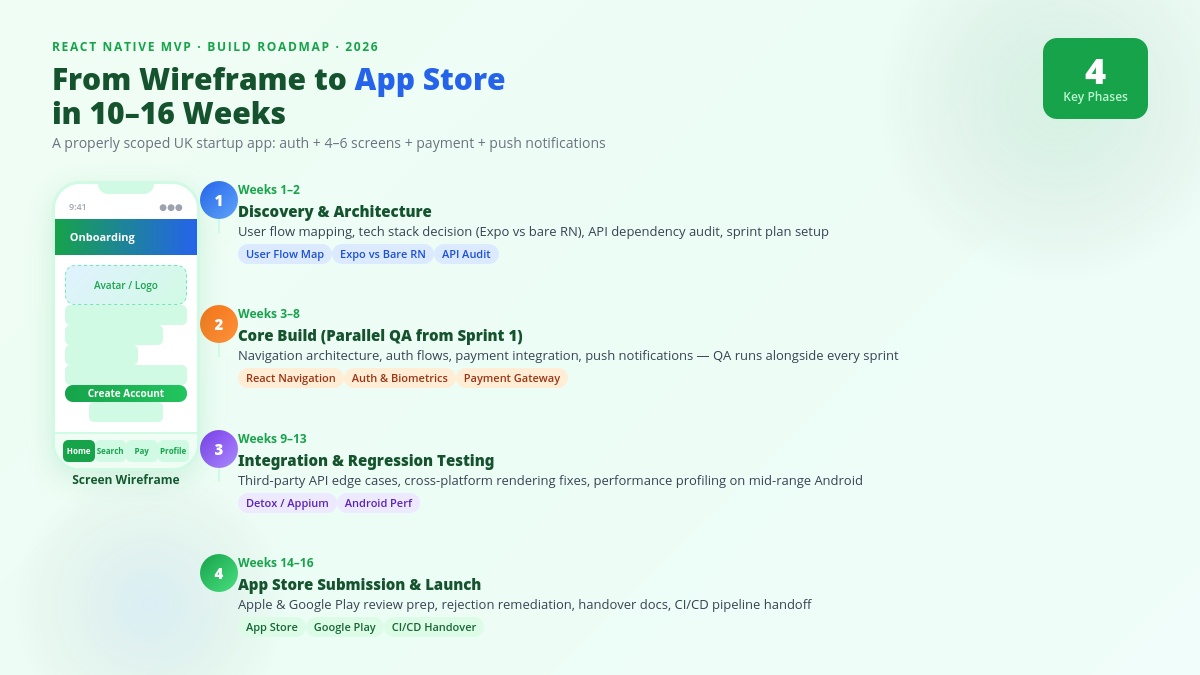
A properly scoped MVP — authentication, 4–6 core screens, one payment integration, basic push notifications — takes 10–16 weeks with a senior developer and QA resource. This assumes the scope document is complete before development starts. Scope creep is the single most predictable timeline extender.
3. Is React Native good enough for a production-grade UK startup app?
Yes, for the vast majority of use cases. Apps with complex real-time features, heavy background processing, or deep hardware integration may hit performance limits, but 80%+ of UK startup apps don’t touch those constraints. React Native apps are in production at Microsoft, Shopify, and Coinbase — the “it’s not production-ready” argument is about five years out of date.
4. What is IR35 and how does it affect hiring React Native contractors in the UK?
IR35 is UK tax legislation that determines whether a contractor should be taxed as an employee. Since the 2021 off-payroll working rules, medium and large private sector companies bear responsibility for IR35 determination. If your React Native contractor is inside IR35, you must deduct PAYE and National Insurance. Misclassification carries significant HMRC penalties. Always seek proper IR35 advice before engaging contractors.
5. Should I hire a React Native freelancer or a dedicated team for my startup?
Freelancers are appropriate for bounded, specific tasks — a particular feature, a UI audit, a performance investigation. For building a core product, a dedicated team (2–4 developers with consistent context and coordinated sprint delivery) produces substantially better output. Context continuity is undervalued until you experience the alternative.
6. What technical skills should I test for when hiring React Native developers?
Beyond React Native itself: navigation architecture design, native module bridging experience, performance profiling (especially on mid-range Android), state management (Redux, Zustand, or MobX — and the ability to choose between them with reasoning), and App Store submission experience. TypeScript proficiency has become a practical requirement for production-grade work.
7. Can I use React Native for a fintech app in the UK?
Yes. The Supersourcing team built fintech mobile experiences including banking and settlement platforms. The critical considerations for UK fintech are FCA compliance, PSD2/Open Banking API integration, biometric authentication (using native modules or Expo’s LocalAuthentication), and end-to-end encryption standards. React Native handles all of these — the complexity is in the compliance and backend architecture, not the mobile framework.
What to Do Before You Hire Anyone
Before the first interview, before the first scope call, build three documents:
- User flow map. Every screen. Every action. Every error state. If you can’t produce this, you’re not ready to hire — you’re ready to hire a product consultant.
- Non-negotiable feature list. Not “nice-to-have” features. The minimum that makes this app worth downloading. Most startups discover their MVP is 60% smaller than they thought when they’re forced to write this list.
- Handover requirements. What do you need to own when the engagement ends? Source code, documentation, deployment credentials, third-party account access. Write this before the contract, not after.
The startups that get this right spend less money, launch faster, and end up with codebases they can actually maintain. The startups that skip this documentation phase end up in the group that overspends by 3x.
If You Want to Talk Through the Architecture Before You Commit
I’m the one on these calls at Supersourcing. Not a sales team, not an account manager. If you’re evaluating how to hire or structure a React Native team for your UK startup project — the model, the cost, the technical risks in your specific build — I’m happy to spend 30 minutes on it.
No pitch deck. No proposals unless you want one. Just an honest conversation about what actually works for your stage.
Mayank Pratap is co-founder of Supersourcing, an AI-powered hiring and IT services company. He has 14 years of experience building technology products and leads client engagements personally. Supersourcing is a vendor partner with Wipro, Virtusa, and Impetus, and has built products for clients including Open Money, Brillio, Pennywise, and Kargo.tech.
