

Hiring SAP ABAP talent has quietly become one of the biggest bottlenecks in S/4HANA programs. While most enterprises focus on securing functional consultants, it’s the technical ABAP layer that ultimately determines whether migrations stay on track or spiral into delays.
Hire SAP ABAP Developers in India is no longer just a cost decision—it’s a timeline-critical strategy. As organizations transition from ECC to S/4HANA, thousands of custom ABAP objects must be analyzed, remediated, or rebuilt to align with HANA’s simplified data model and modern frameworks like RAP.
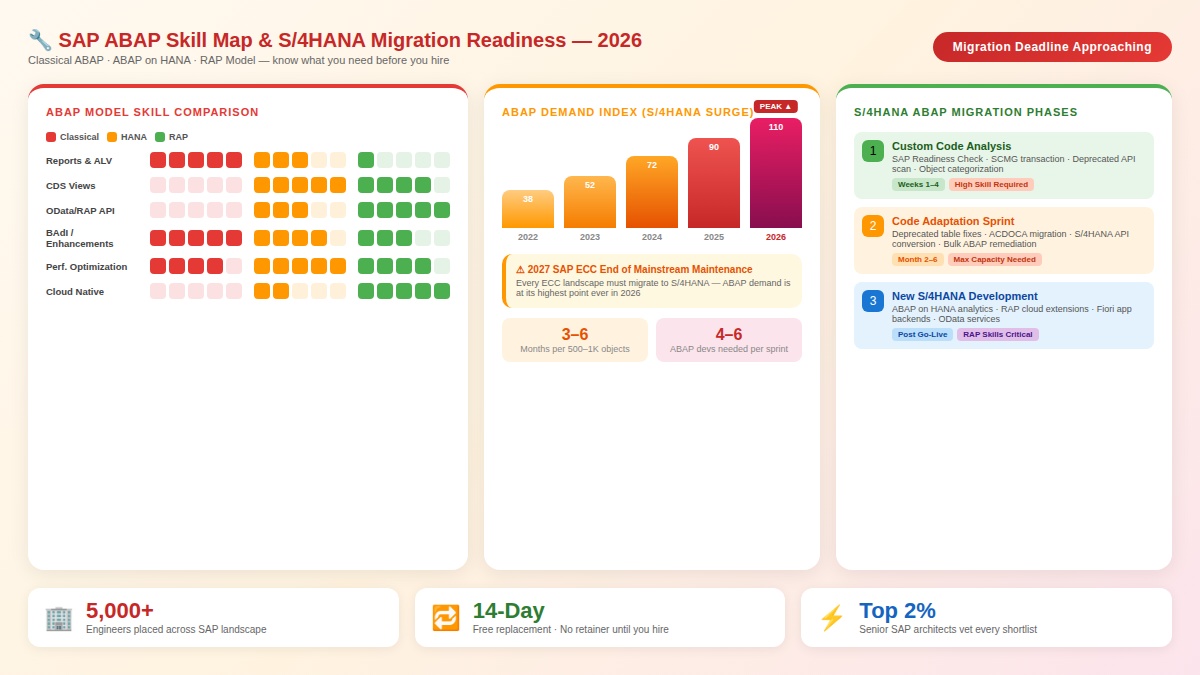
The urgency is real: according to SAP S/4HANA adoption trends report, a majority of SAP customers are actively moving toward S/4HANA ahead of the 2027 maintenance deadline, significantly increasing demand for skilled ABAP developers globally.
In large landscapes, custom code runs into thousands of objects—making ABAP one of the most under-resourced yet critical workstreams. This guide explains how to hire the right SAP ABAP developers in India, what skills matter today, and how to build a team that can actually deliver your migration on time.
ABAP in 2026: Classical, ABAP on HANA, and RAP Three Different Skill Sets
Classical ABAP is the traditional SAP development language Reports (ALV grid, classical report), Function Modules and BAPIs, BAdIs and User Exits for enhancement, ABAP Objects for object-oriented development, ALE/EDI for IDoc-based integration, and ABAP Workbench tools. Classical ABAP expertise is required for ECC maintenance, custom code migration assessment, and legacy code adaptation for S/4HANA compatibility. This is where the deepest experience pool in India exists.
ABAP on HANA extends classical ABAP for the S/4HANA HANA database environment. The key addition is Core Data Services (CDS views) , a development layer that defines data models and analytical views directly in the HANA database layer, enabling database-level computation for complex analytical queries. CDS views are used to build the Virtual Data Models (VDMs) that power S/4HANA’s embedded analytics and Fiori analytical applications.
ABAP on HANA also includes AMDP (ABAP Managed Database Procedures) for pushing computation into HANA’s in-memory engine using HANA SQLScript. An ABAP developer moving from classical ECC to S/4HANA who has not learned CDS view design and AMDP will not be effective on the analytics and reporting workstream.
ABAP RESTful Application Programming (RAP) is the modern ABAP programming model for S/4HANA Cloud and S/4HANA Cloud ABAP Environment. RAP uses CDS entities as the foundation, defines business object behavior using Behavior Definition Language (BDFL), exposes OData services automatically from behavior definitions, and deploys to S/4HANA’s ABAP Environment. RAP represents a fundamental architectural shift from classical ABAP; it is a cloud-native, API-first development model where the behavior of business objects is defined declaratively rather than implemented procedurally.
ABAP developers who have only done classical development need significant reskilling for RAP; the concepts, the tools, and the debugging approaches are all different.
The hiring implication is significant: specify which ABAP model you need. Classical ABAP for ECC maintenance and migration adaptation is a large pool. ABAP on HANA with CDS view design is a medium pool with meaningful experience. RAP for S/4HANA Cloud extensions is a small pool that commands the highest premium.
The ABAP Talent Market in India: What You Are Fighting For
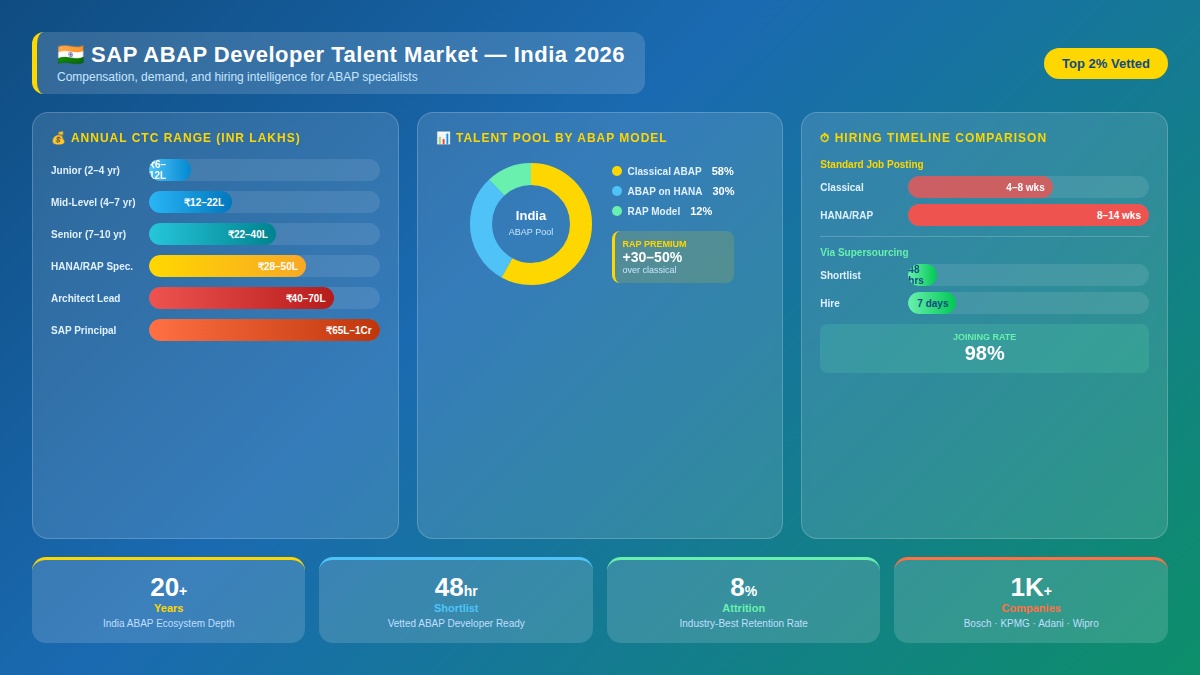
India’s SAP ecosystem has one of the deepest ABAP talent pools in the world built over 20+ years of SAP implementations, dedicated development team, and SI delivery from Bangalore, Hyderabad, and Pune. The challenge is the distribution of that experience across classical ABAP, ABAP on HANA, and RAP.
Classical ABAP with 8+ years of ECC experience: reasonably deep pool, competitive but findable within 4–8 weeks through proactive sourcing. This is the core migration adaptation resource and the profile most in demand for active S/4HANA programs.
ABAP on HANA with CDS view design and AMDP: meaningful pool but actively competed for by every SI running S/4HANA analytics and reporting workstreams. 6–10 weeks through standard job postings.
RAP model ABAP with S/4HANA Cloud ABAP Environment experience: small pool, high demand, 8–14 weeks through standard job postings. Commands 30–50% premium over equivalent classical ABAP profiles.
| Level | Experience | Annual CTC (INR) |
| Junior ABAP Developer | 2–4 years | ₹6L – ₹12L |
| Mid-Level ABAP Developer | 4–7 years | ₹12L – ₹22L |
| Senior ABAP Developer | 7–10 years | ₹22L – ₹40L |
| ABAP on HANA / RAP Specialist | 5–9 years S/4HANA specific | ₹28L – ₹50L |
| ABAP Architect / Technical Lead | 10–14 years | ₹40L – ₹70L |
| SAP Technical Architect / Principal | 14+ years | ₹65L – ₹1Cr |
What to Actually Assess in an SAP ABAP Developer Interview
Performance optimization thinking is the most revealing technical filter.
Ask the candidate to explain how they would optimize an existing ABAP report that is running slowly against a large table. How do they approach analysis, checking the execution plan, identifying missing indices, looking for full table scans, and assessing SELECT statement efficiency?
What specific ABAP SQL optimization techniques do they use SELECT with specific field lists rather than SELECT *, use of ABAP Open SQL aggregations rather than application-layer loops, use of parallel cursors for related table reads, avoiding SELECT inside loops?
Developers who give generic answers about “best practices” without specific optimization techniques have not debugged enough production ABAP performance issues.
ABAP on HANA and CDS view design depth for S/4HANA roles.
For S/4HANA roles, ask about CDS view design specifically. What annotation types do they use and why @AbapCatalog.sqlViewName, @Analytics.dataCategory, @UI.lineItem, @OData.publish? How do they design CDS associations versus joins for performance?
How do they build analytical CDS views with measures and dimensions for embedded analytics consumption? Developers who have only done basic CDS view configuration without understanding annotations and the difference between transactional and analytical CDS views are not ready for the S/4HANA analytics workstream.
Custom code migration experience for S/4HANA programs.
For developers being placed on S/4HANA migration programs, ask specifically about custom code adaptation experience: have they used SAP’s custom code migration tools (SCMG transaction, SAP Readiness Check)? Have they adapted code that used deprecated function modules or table names (MARA/MARC being replaced by I_Material in S/4HANA)?
Have they handled the Universal Journal impact on finance custom code reports that read BSEG and BKPF needing to be redesigned for ACDOCA? Real migration experience reveals whether the developer understands the data model changes, not just the ABAP syntax.
RAP model design for S/4HANA Cloud roles.
For RAP-specific roles, ask the candidate to explain the RAP programming model lifecycle CDS entity definition, behavior definition, behavior implementation class, and OData service exposure. Ask them to explain the difference between managed and unmanaged scenarios in RAP, and when they would use each.
Ask about action and function definition in BDFL and how they test RAP applications in the ABAP Development Tools (ADT) Eclipse environment.
Enhancement framework design BAdIs, User Exits, and implicit enhancements.
Every enterprise SAP system has custom enhancements layered on the standard functionality. Ask the candidate to explain the difference between classic User Exits, function module exits, BAdIs (Business Add-Ins), and implicit enhancements and which they would use for a specific customization scenario.
Developers who cannot articulate the enhancement framework hierarchy in detail will implement enhancements incorrectly and create upgrade complications.
The ABAP Workstream in S/4HANA Migrations: Why It Gets Underestimated
The S/4HANA migration ABAP workstream has three phases that all need to be staffed correctly.
Phase 1: Custom code analysis and remediation planning.
Using SAP’s Readiness Check and custom code analysis tools to identify affected objects, deprecated APIs, obsoleted table selects, code patterns incompatible with S/4HANA’s data model. Typically produces a list of hundreds to thousands of objects that need assessment, categorization (adapt, replace, retire), and effort estimation. Requires experienced ABAP developers who understand the S/4HANA data model changes well enough to make accurate remediation effort estimates.
Phase 2: Custom code adaptation.
The actual adaptation work modifying ABAP code to use S/4HANA-compatible APIs, replacing deprecated table reads with S/4HANA equivalents, adapting finance reports to use ACDOCA instead of BSEG/BKPF, adapting logistics code to use the simplified S/4HANA inventory tables. This is where volume ABAP developer capacity is needed; the ratio of adaptation work to other migration workstreams is consistently higher than most programs plan for.
Phase 3: New development in S/4HANA patterns.
Once the migration is complete, ongoing ABAP development shifts to S/4HANA patterns ABAP on HANA for analytics, RAP for new business object development in S/4HANA Cloud, Fiori app extensions using ABAP back-end IT services. The developers who are most productive in this phase are those who invested in learning the new programming models during the migration program.
The 3 Most Common SAP ABAP Hiring Mistakes
Equating years of experience with S/4HANA readiness.
A developer with 12 years of classical ABAP experience who has never worked on S/4HANA is not automatically ready for an S/4HANA program. The data model changes particularly the Universal Journal in Finance require explicit retraining and hands-on S/4HANA experience. Experience years are an indicator of classical ABAP depth. S/4HANA readiness requires specific assessment.
Understanding the ABAP workstream relative to functional.
Migration programs typically budget 1 ABAP developer per 2–3 functional consultants. Actual adaptation work on large custom code inventories often requires ratios closer to 1:1 or even more ABAP capacity than functional capacity during the code remediation sprint. Programs that discover this mismatch at sprint 3 have to make rushed hires that slow rather than accelerate the program.
Not assessing performance optimization for senior ABAP roles.
Performance bugs in ABAP SELECT inside loops, missing database indices, inefficient aggregations are among the most common causes of SAP system performance issues. Senior ABAP developers who cannot diagnose and optimize ABAP performance create production problems that functional teams cannot resolve. Performance optimization proficiency is non-negotiable for senior ABAP assessment.
How Supersourcing Vets SAP ABAP Developers
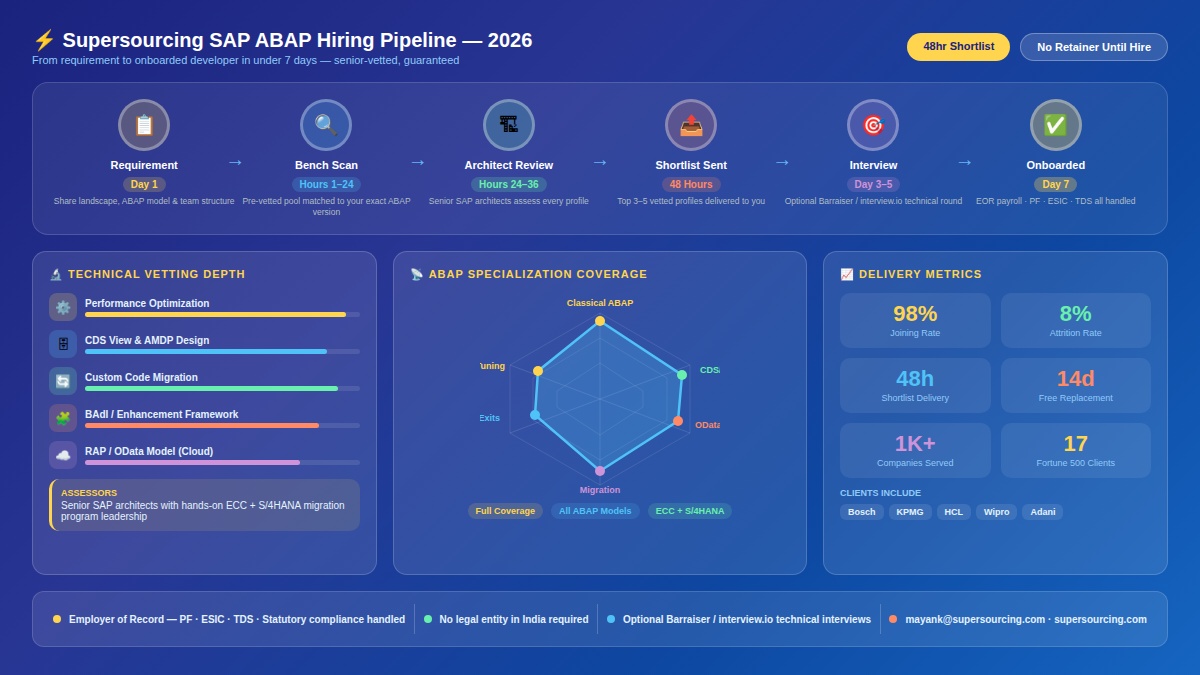
Our senior SAP architects people who have led ABAP workstreams on ECC and S/4HANA migration programs assess every ABAP developer shortlist. We assess ABAP version-specific depth (classical vs ABAP on HANA vs RAP), performance optimization thinking, custom code migration experience, enhancement framework design, and CDS view and OData service design for S/4HANA roles.
We maintain a continuously vetted bench across all ABAP specializations. Shortlist in 48 hours. We have delivered SAP specialists for Bosch (350+ engineers over two years), HCL, KPMG, Adani Group, Wipro, and 1,000+ other global companies.
Optional Barrister or interview.io technical interviews arranged by us. 8% attrition. 98% joining rate. 14-day free replacement.
FAQ
What is the difference between classical ABAP and ABAP on HANA for hiring?
Classical ABAP covers traditional development reports, function modules, BAdIs, ALE/EDI. ABAP on HANA adds CDS views for database-level computation and analytical models, AMDP for HANA SQLScript procedures, and ABAP SQL optimizations specific to the HANA in-memory engine. S/4HANA programs require ABAP on HANA skills, particularly CDS views for analytics and reporting. Classical ABAP alone is insufficient for S/4HANA development leadership.
What is the RAP programming model and why does it matter?
ABAP RESTful Application Programming (RAP) is the modern development model for S/4HANA Cloud using CDS entities, Behavior Definition Language, and OData automatic exposure to build cloud-native SAP applications. RAP is architecturally different from classical ABAP and requires specific reskilling. It is mandatory knowledge for developers building new applications in S/4HANA Cloud environments.
How long does a typical S/4HANA custom code migration workstream take?
Depends entirely on the custom code inventory size. A moderately customized ECC system with 500–1,000 affected custom code objects typically requires 3–6 months for adaptation with a team of 4–6 ABAP developers working in parallel. Large custom code inventories of 2,000–5,000 objects require 6–12 months and proportionally larger ABAP teams. Most programs that miss their go-live dates underestimate this workstream.
Can you place ABAP developers specifically for custom code migration programs?
Yes. Custom code migration experience SAP Readiness Check tool usage, deprecated API remediation, Universal Journal finance code adaptation, and S/4HANA logistics table adaptation is specifically assessed for migration program roles.
What is your replacement policy?
Free replacement within 14 days. No charge, no questions.
Do I need a legal entity in India?
No. We act as Employer of Record payroll, PF, ESIC, TDS, all statutory compliance handled by us.
What is the realistic hiring timeline for a senior ABAP on HANA developer in India without Supersourcing?
6–10 weeks through standard job postings. Through Supersourcing: 48-hour shortlist, hire within 7 days.
Talk to Us About Your SAP ABAP Requirement
If you are building an ABAP team for an S/4HANA migration, a custom code adaptation program, or an ongoing S/4HANA development center of excellence I am usually the one on those calls.
Email: mayank@supersourcing.com Or book a meeting directly at supersourcing.com
Tell us your SAP landscape (ECC version, custom code volume estimate), ABAP model required (classical, ABAP on HANA, RAP), migration phase, and team composition. Shortlist in 48 hours from there.
No retainer until you hire. Replacement clause on every engagement.
Mayank Pratap Singh · Co-founder, Supersourcing Google AI Accelerator · LinkedIn Top 20 Startups India · 5,000+ Engineers Placed · 1,000+ Companies · 17 Fortune 500s
