

Global demand for DevOps engineers grew 40% between 2022 and 2024, yet fewer than 1 in 5 mid-size enterprises has a fully staffed Azure-native delivery team in place. The gap is not a pipeline problem, it is a hiring strategy problem. Most companies approach this as a standard technical recruitment exercise. It is not. When you hire Azure DevOps engineer India, you are making a long-term decision about your release velocity, compliance posture, and infrastructure cost structure simultaneously.
DevOps has become a critical function for mid-size enterprises aiming to scale faster, release more reliably, and control cloud costs. Yet despite rising cloud adoption, many organizations still lack a fully optimized Azure-native delivery team.
This is where hiring Azure DevOps engineer India shifts from a hiring task to a strategic decision. Companies that approach this as generic recruitment often struggle with inconsistent pipelines, poor infrastructure automation, and rising operational overhead.
The urgency is tied directly to cloud growth. According to Statista, cloud computing generated over half a trillion U.S. dollars in revenue in 2023, highlighting how rapidly enterprises are moving toward cloud-first architectures that demand strong DevOps foundations.
For IT leaders, the challenge is no longer whether to adopt DevOpsbut how to hire the right Azure DevOps talent who can build scalable, secure, and cost-efficient systems from day one.
TL;DR
Hiring an Azure DevOps engineer in India is not a recruitment task, it is an infrastructure decision. Get it wrong and you lose 4–6 months to mis-scoped hires and stalled pipelines.
This guide gives you a complete Azure DevOps skills checklist, real salary benchmarks (₹6L to ₹65L), and a clear breakdown of build vs. contract vs. managed team models so you evaluate options before you post a single JD.
If you run a 200–2,000 person company and are building an Azure-native delivery team including GCC setups everything you need to make the right call is in here.
What Is an Azure DevOps Engineer?
An Azure DevOps engineer is a specialist who designs, implements, and maintains continuous integration and continuous delivery (CI/CD) pipelines, infrastructure automation, and release governance within the Microsoft Azure ecosystem typically spanning Azure Pipelines, Azure Repos, Azure Boards, Azure Artifacts, and Azure Test Plans.
Why Mid-Size Enterprises Get This Hiring Decision Wrong
The typical mid-size company underestimates the scope of this role by 3x. They post a JD for “a DevOps resource” expecting one person to own pipelines, boards governance, artifact management, test automation hooks, and security scanning simultaneously.
That is a team, not a hire.
Companies that try to solve a DevOps transformation need with a single generalist spend 4–6 months realizing the deliverables require either a 3–4 person structure or a more precisely scoped specialist hire. The cost of that delay, missed releases, manual deployments, compliance audit failures routinely exceeds ₹30–50 lakhs in engineering overhead before corrective action is taken.
The second failure pattern: hiring based on years of experience rather than stack-specific proof. An engineer with 6 years of Jenkins and GitLab experience is not automatically equipped to architect Azure-native CI/CD automation. Certifications matter here in a way they do not in most other technical roles.
Azure DevOps Skills Checklist: What to Actually Test For
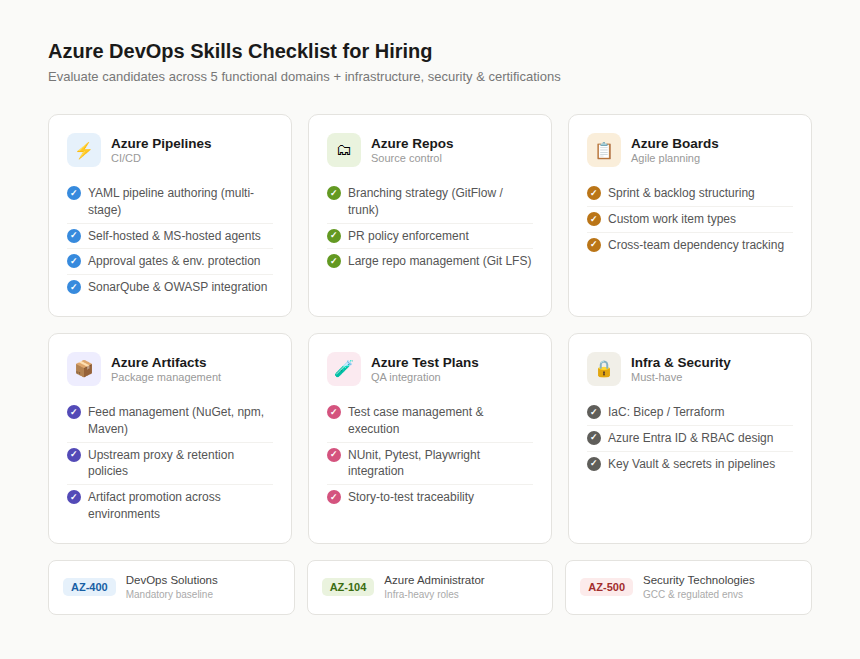
When you hire Azure DevOps engineer India, evaluate candidates across five functional domains not just pipeline knowledge.
Core Technical Competencies
- Azure Pipelines (CI/CD)
- YAML pipeline authoring (multi-stage)
- Self-hosted and Microsoft-hosted agent configuration
- Approval gates, environment protection rules
- Integration with SonarQube, OWASP, and container scanning tools
- Azure Repos
- Branching strategy design (GitFlow vs trunk-based)
- Pull request policy enforcement
- Large repository management (Git LFS, shallow clones)
- Azure Boards
- Sprint and backlog structuring
- Custom work item types, process templates
- Cross-team dependency tracking
- Azure Artifacts
- Package feed management (NuGet, npm, Maven, Python)
- Upstream proxy and retention policies
- Artifact promotion across environments
- Azure Test Plans
- Test case management and execution
- Integration with automated test frameworks (NUnit, Pytest, Playwright)
- Traceability from user story to test result
Infrastructure and Security Competencies
Beyond the five core modules, evaluate for:
- Infrastructure as code (Bicep, Terraform)
- Azure Active Directory / Entra ID integration
- Role-based access control (RBAC) design
- Key Vault and secrets management in pipelines
Certifications That Signal Real Competence
- AZ-400 (Designing and Implementing Microsoft DevOps Solutions) mandatory baseline
- AZ-104 (Azure Administrator) useful for engineers with infra responsibilities
- AZ-500 (Azure Security Technologies) relevant for GCC or regulated environments
Azure DevOps Salary India: Benchmarks by Seniority
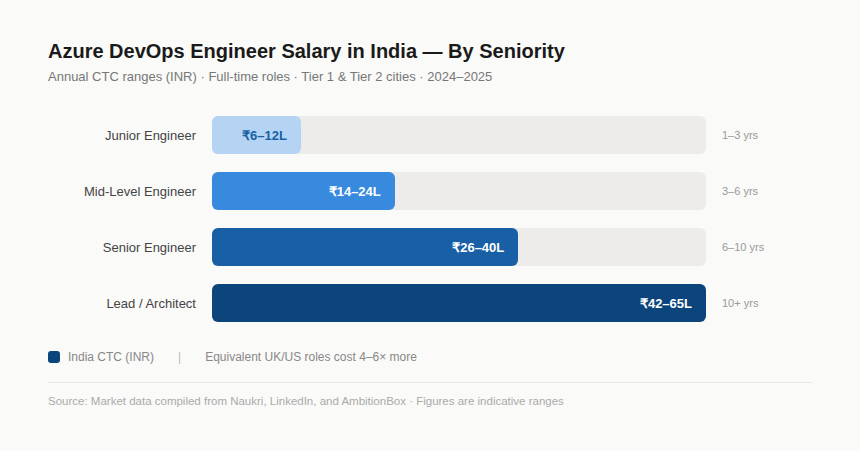
Azure DevOps salary India varies significantly by seniority, location, and specialization. The following ranges reflect 2024–2025 market data for full-time roles in Tier 1 and Tier 2 cities.
| Seniority Level | Experience | Annual CTC Range (INR) |
| Junior Engineer | 1–3 years | ₹6–12 lakhs |
| Mid-Level Engineer | 3–6 years | ₹14–24 lakhs |
| Senior Engineer | 6–10 years | ₹26–40 lakhs |
| Lead / Architect | 10+ years | ₹42–65 lakhs |
For comparison, equivalent roles in the UK or US cost 4–6x these figures when accounting for base salary, benefits, and overhead. This is the primary economic rationale to hire Azure specialists offshore, but salary arbitrage alone is a weak strategy. Companies that optimize purely on cost often underpay for the seniority tier they actually need and end up with a team that cannot execute at the required complexity level.
GCC Use Case: Why Azure-Native Teams Are Being Built Offshore
One of the clearest structural drivers for the decision to hire Azure DevOps engineer India is the rapid expansion of Global Capability Centers (GCCs). Over 1,600 GCCs currently operate in India, with a growing share explicitly structured around Microsoft Azure delivery stacks.
Why Azure specifically? MNC subsidiaries operating in India particularly in BFSI, healthcare, and manufacturing are standardized on Microsoft 365 and Azure by their global parent entities. Building a GCC team that runs non-Azure tooling creates integration friction, license conflicts, and compliance complexity. The result is that GCC leads are actively scoping dedicated cloud-native delivery teams with AZ-400-certified engineers, not generalist DevOps staff.
What an Azure-Native GCC Team Typically Looks Like
A functional GCC delivery team at a 500–1,000 person MNC usually requires:
- 1 Azure DevOps Lead / Architect
- 2–3 Pipeline Engineers (CI/CD specialists)
- 1 Infrastructure Engineer (Bicep/Terraform focus)
- 1 Security and Compliance Engineer (AZ-500 preferred)
This team can handle 6–10 active release pipeline environments simultaneously with appropriate sprint velocity across integrated backlogs.
Real-World Application: How Mid-Size Enterprises Have Structured This
Case 1 Regional BFSI Firm (1,200 employees): A mid-size financial services company operating across Southeast Asia needed to migrate 14 legacy applications to Azure and establish a CI/CD-first delivery model. They assembled a 4-person offshore Azure DevOps pipeline engineer team in India within 6 weeks. Within 90 days, mean time to deploy dropped from 11 days to under 4 hours. Compliance audit coverage improved from 60% to 94% through automated test plan integration.
Case 2 B2B SaaS Company (400 employees): A European SaaS company setting up a GCC in Pune needed Azure Boards governance aligned to SAFe methodology. A 3-person engagement one architect and two board specialists restructured their backlog management and pipeline governance in 8 weeks. Sprint velocity increased 28% in the first two quarters post-implementation.
Hire Azure Specialist Offshore: Build vs. Contract vs. Managed
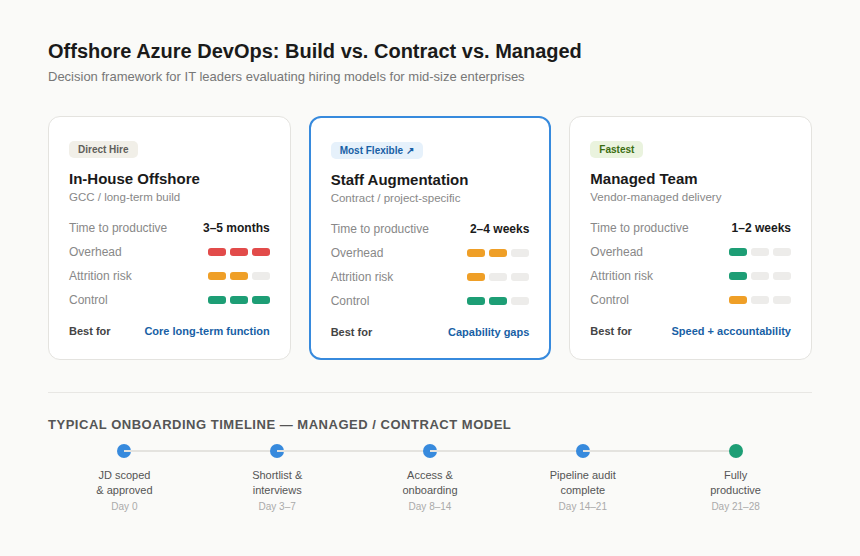
When evaluating how to hire Azure specialists offshore, IT leaders face three structural models. Each has different risk, cost, and control implications.
| Model | Time to Productive | Overhead | Best For |
| Direct hire (in-house offshore) | 3–5 months | High (HR, infra, attrition mgmt) | Long-term GCC strategy |
| Contract / Staff augmentation | 2–4 weeks | Medium | Project-specific gaps |
| Managed DevOps team | 1–2 weeks | Low (vendor-managed) | Speed + accountability |
The direct hire model carries the highest overhead recruiting timelines, bench periods, attrition risk but offers the deepest long-term institutional alignment. The managed team model optimizes for speed and accountability but requires clear SLA definitions and escalation paths from day one.
For most 200–800 person companies without an existing India office, the contract or managed model is the more rational entry point. The GCC / direct hire model makes sense when Azure DevOps is a core long-term delivery function, not a transitional need.
What Most Teams Get Wrong When They Hire Azure DevOps Engineer India
The most common mistake is treating this as a straightforward technical hire rather than an architecture decision with downstream process implications.
Teams spend 6–8 weeks interviewing candidates for pipeline skills, select someone strong on YAML and CI/CD, then discover 3 months in that their Azure Boards governance, artifact retention policies, and test traceability are completely unconfigured. The engineer they hired was excellent at what they were asked but no one scoped the full operational surface area.
The second pattern is underweighting soft skills in an offshore context. Remote DevOps delivery requires engineers who can document decisions clearly, communicate blockers proactively, and own SLA adherence without daily supervision. A technically brilliant engineer who waits for direction will cost you 20–30% productivity versus one who drives initiatives independently.
Vet for initiative as rigorously as you vet for technical depth.
FAQ
What does an Azure DevOps engineer do day-to-day?
Day-to-day responsibilities include maintaining CI/CD pipelines, managing release approvals, updating Azure Boards backlogs, monitoring build and deployment health, resolving pipeline failures, and collaborating with development and QA teams. Senior engineers also handle infrastructure changes, security scanning configurations, and architecture decisions.
How much does it cost to hire an Azure DevOps engineer in India?
Full-time Azure DevOps salary India ranges from ₹6–12 lakhs for juniors to ₹42–65 lakhs for architects. Managed or staff augmentation models typically cost $20–$55 USD per hour depending on seniority and engagement structure significantly lower than onshore equivalents in the UK, US, or Western Europe.
How to evaluate Azure DevOps engineer skills before hiring?
Use a structured technical assessment covering all five Azure DevOps modules (Pipelines, Repos, Boards, Artifacts, Test Plans), plus a live pipeline debugging exercise. Verify AZ-400 certification status independently. Ask for architecture samples from previous engagements and probe for decision rationale, not just outputs.
Is it better to hire offshore Azure DevOps engineers or build in-house?
For most mid-size enterprises, offshore models offer a 50–65% cost advantage with comparable technical depth when the hiring is done correctly. The tradeoff is coordination overhead and timezone alignment. Hybrid models with an onshore lead with an offshore execution team tend to work best for 500+ person companies with continuous delivery requirements.
How long does it take to onboard an offshore Azure DevOps team?
Contract or managed teams typically reach productive output within 2–4 weeks. The first two weeks cover codebase familiarization, pipeline audits, and access provisioning. Direct hires in a GCC structure take 3–5 months from JD to full productivity. Factor in a 30-day handover buffer when replacing an existing team.
What certifications should an Azure DevOps engineer have?
AZ-400 is the baseline and should be non-negotiable for mid-level and senior hires. AZ-104 adds value for engineers with infrastructure responsibilities. AZ-500 is relevant for GCC environments, regulated industries, or any setup involving GCC compliance frameworks. Do not substitute training certificates for Microsoft-issued certification credentials.
What is a realistic Azure DevOps team structure for a 500-person company?
A 500-person company with active cloud delivery needs typically requires 4–5 dedicated specialists: one lead or architect, two pipeline engineers, one infrastructure engineer, and one security/compliance engineer. Smaller teams of 2–3 work only when scope is narrow and the product release cadence is low-frequency.
Next Step
If you are actively scoping how to hire Azure DevOps engineer India whether building a GCC team, augmenting existing capacity, or standing up a managed delivery function the real work starts with defining operational scope before the first interview.
Supersourcing has structured Azure DevOps teams across GCC, enterprise, and product delivery contexts. If you want a pressure-tested evaluation framework before committing to a hiring model, reach out directly: https://supersourcing.com/
