

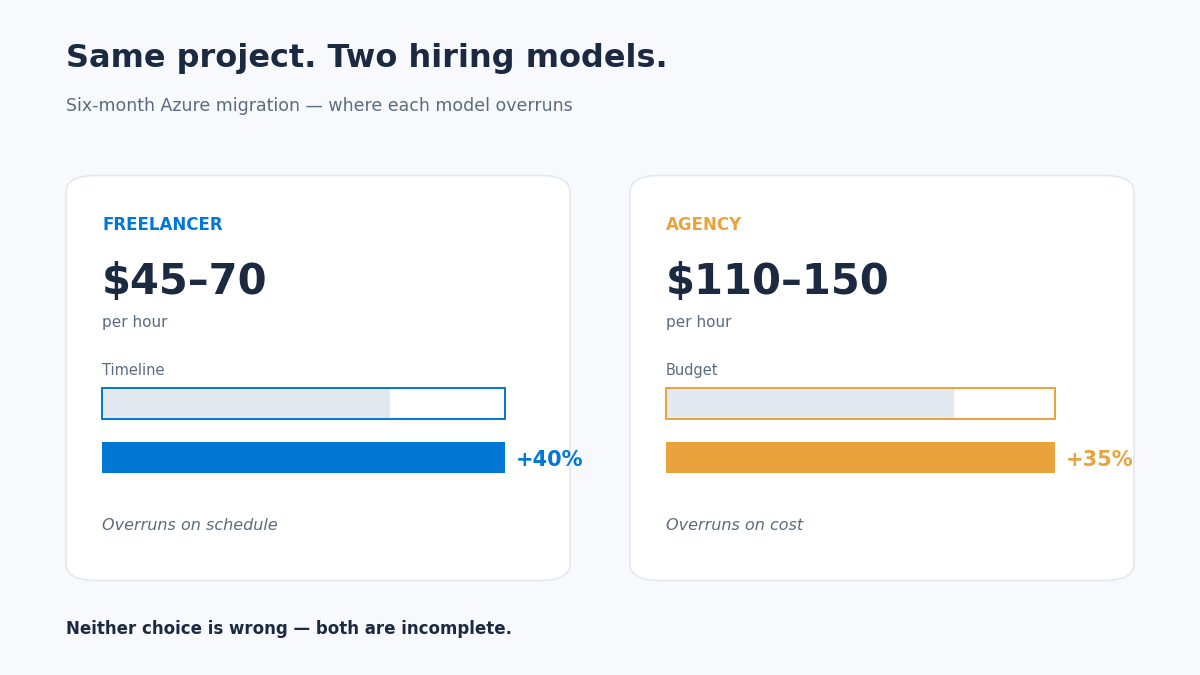
Two companies start identical Azure migration projects in the same quarter. One decides to hire freelance Azure developers at $45–$70 per hour. The other signs a $110–$150 per hour agency contract. Six months later, the freelancer-led project is 40% over its original timeline, and the agency-led project is 35% over its original budget. Neither team made a “wrong” choice, both made an incomplete one.
That pattern repeats across cloud projects because most hiring decisions are made on a single variable: the hourly rate. But an Azure engagement is rarely a single-variable problem. It spans Azure architecture decisions, security and compliance configuration, ongoing cloud infrastructure management, and handover documentation and each of those areas rewards a different hiring model.
The honest answer to the freelancer-versus-agency question is that both models work, both fail, and the failure modes are predictable. Freelancers fail on continuity and bandwidth. Agencies fail on cost efficiency and speed of decision-making. The teams that get this right are the ones that map their project’s risk profile to the model’s known weaknesses before signing anything.
This guide breaks down the real cost structures, the risks each side hides, a 7-step talent vetting process that works for both models, and a decision framework you can apply to your next Azure project whether that’s a greenfield build, an Azure cloud migration, or long-term platform support.
According to Upwork’s Future Workforce Index, 28% of U.S. skilled knowledge workers now operate as freelancers or independent professionals, collectively generating $1.5 trillion in earnings in 2024 and IT/development is one of the categories where full-time freelancers out-earn their employed counterparts.
The talent supply is no longer the constraint. Selection and structure are.
What Does It Mean to Hire Freelance Azure Developers?
To hire Azure developers is to contract independent, self-employed cloud professionals directly typically on hourly or project-based terms to design, build, migrate, or maintain applications and infrastructure on Microsoft Azure, without the management layer, overhead costs, or long-term commitments of a development agency or full-time employment.
That definition contains the entire trade-off. You remove the management layer, and with it the overhead but also the built-in project accountability, redundancy, and quality assurance that the layer provides. Everything that follows in this guide is about deciding when that trade is worth making.
The Real Challenge: This Decision Costs More Than the Rate Card Shows
Most teams treat this as a procurement decision when it is actually a risk-allocation decision. And they consistently underestimate the hidden costs on both sides by 3–4x.
Consider what the rate card leaves out. When you hire freelance Azure developers directly, you absorb the cost of sourcing (10–20 hours of screening per hire), the cost of a bad hire (industry data consistently puts a mis-hire at 30–50% of the role’s annual cost), and the cost of single-person dependency if your freelancer becomes unavailable mid-migration, replacement and ramp-up typically takes 4–8 weeks.
Agencies invert the problem. The rate covers vetting, replacement guarantees, and management but you pay that premium on every billed hour, whether the task needs a senior architect or a junior engineer running scripts. On a 12-month engagement, a 60–100% rate premium compounds into a six-figure difference for a two-to-three-person team.
Azure adds a domain-specific wrinkle: the skill surface is enormous. AKS, Azure Functions, Cosmos DB, Synapse, Entra ID, Azure DevOps pipelines, landing zones, FinOps no individual covers all of it deeply. A freelancer gives you depth in one or two areas. An agency gives you breadth on demand. Your project’s shape determines which gap is more expensive.
Freelance vs Agency Developer: The Deep Comparison
The freelance vs agency developer decision comes down to four dimensions: cost, risk, accountability, and scalability. Each deserves scrutiny beyond the sales pitch.
Cost Structures and Freelance Azure Developer Hourly Rates
Typical 2026 market ranges look like this. Freelance Azure developer hourly rates run $40–$75 for mid-level and $75–$130 for senior or architect-level independent professionals, depending on region and specialization. Agency rates for equivalent seniority run $90–$180 per hour in most Western markets, with offshore Azure development agency teams quoting $35–$70 per hour blended.
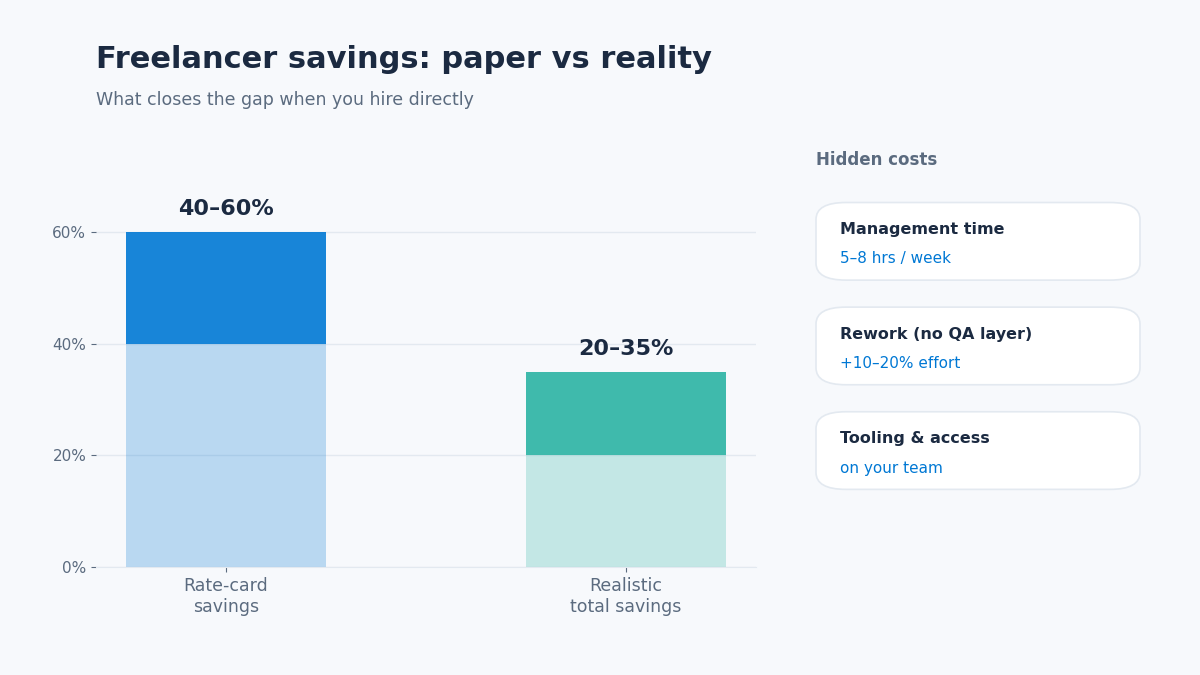
On paper, freelancers cost 40–60% less. In practice, three factors narrow the gap. First, you pay for your own management time budget 5–8 hours per week of a technical lead’s attention per freelancer. Second, rework: without an agency’s QA layer, defect-related rework on freelancer projects commonly adds 10–20% to total effort. Third, tooling and access overhead licenses, environments, and security reviews lands on your team.
The realistic total-cost gap is closer to 20–35%, not 50%. That is still significant. It is just smaller than the rate card implies.
Azure Freelancer Risks You Should Price In
The most common Azure freelancer risks are structural, not personal, and they show up regardless of how skilled the individual is:
- Single point of failure. One person holds the architecture knowledge, the credentials context, and the undocumented decisions. Illness, a better offer, or simple overcommitment stalls the project for weeks.
- Bandwidth ceilings. Independent professionals juggle 2–4 clients on average. Your P1 incident competes with someone else’s deadline.
- Security and compliance exposure. Enterprise Azure work touches Entra ID, key vaults, and production data. Verifying an individual’s security practices is harder than auditing an agency’s ISO 27001 or SOC 2 posture.
- Verification burden. Certifications like AZ-104 or AZ-305 confirm knowledge, not judgment. Resume inflation in cloud roles is well documented, and screening it out takes real engineering time.
None of these is disqualifying. All of them are priceable through documentation requirements, credential hygiene, overlap periods, and contractual response-time terms.
Agency Hiring Benefits and Their Honest Trade-Offs
The core agency hiring benefits are redundancy, accountability, and elasticity. If a developer leaves, the agency replaces them at its own cost. If the project needs a data engineer for six weeks, one appears without a new hiring cycle. Contracts carry SLAs, and there is an escalation path above the individual doing the work.
For regulated industries, fintech, healthcare, anything touching HIPAA or PCI workloads agencies also simplify compliance, since vendor security assessments replace individual background checks.
The trade-offs are equally real. You rarely choose the specific engineers, and quiet substitution of senior staff with junior staff mid-engagement is a known industry pattern. Communication runs through account managers, adding 1–3 days of latency to decisions. And minimum engagement sizes often $15,000–$25,000 per month price out smaller workloads entirely.
How to Verify a Freelance Azure Developer’s Skills: A 7-Step Vetting Process
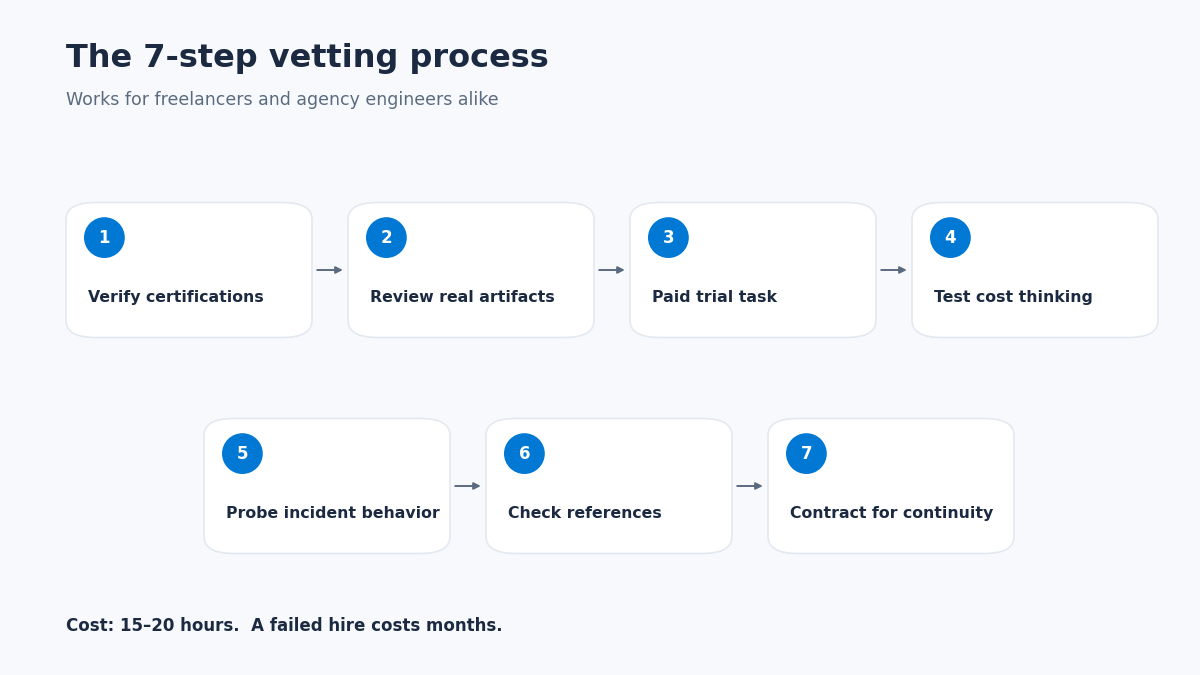
Whichever model you lean toward, the talent vetting process below is what separates teams that get burned from teams that don’t. It applies to individuals and to the engineers an agency proposes.
- Verify certifications at the source. Check AZ-104, AZ-204, AZ-305, or AZ-400 credentials through Microsoft’s verification portal, not screenshots. Microsoft-certified Azure professionals can share a transcript link in under two minutes.
- Review real Azure artifacts. Ask for a sanitized Bicep/Terraform module, an Azure DevOps or GitHub Actions pipeline definition, or an architecture diagram from a past project. Fluency shows in the details naming conventions, tagging strategy, network segmentation.
- Run a scoped paid trial (8–16 hours). A small, production-adjacent task reveals more than any interview: a cost-review of a resource group, a pipeline fix, a landing-zone assessment.
- Test cost thinking explicitly. Ask how they would cut a specific workload’s spend by 30%. Strong candidates immediately discuss reservations, right-sizing, autoscaling, and storage tiering the fundamentals of cloud cost optimization.
- Probe incident behavior. Walk through a real outage scenario. Listen for diagnostic sequence, communication cadence, and rollback discipline rather than tool name-dropping.
- Check references on reliability, not skill. Past clients already validated competence by paying invoices. Ask instead about missed deadlines, responsiveness, and handover quality.
- Contract for continuity. Require documentation-as-you-go, credential management through your tenant (never personal accounts), and a 2-week structured handover clause.
Teams that run all seven steps report dramatically fewer failed engagements than teams that hire on portfolio and rate alone. The process costs 15–20 hours. A failed hire costs months.
Real-World Outcomes: Two Short Case Studies
A Series-B logistics SaaS needed to move 14 services from a legacy VM setup to AKS. They engaged two vetted independent Azure specialists with Azure DevOps expertise instead of the $38,000/month agency quote they had received. Total cost came in at roughly $19,500/month, and the migration finished in 5 months one month late, but 46% under the agency budget. The deciding factor: a strong in-house tech lead who could absorb coordination overhead.
Contrast that with a mid-market healthcare firm that hired a solo freelancer for a HIPAA-scoped Azure environment. The engineer was competent, but a compliance audit stalled the project for 7 weeks because individual vendor assessments couldn’t satisfy the auditor. The firm switched to a compliance-certified partner mid-project, absorbing a $60,000 restart cost. The lesson was not “freelancers fail” it was that regulatory posture, not skill, dictated the right model.
Decision Framework: When to Choose an Agency Over a Freelancer
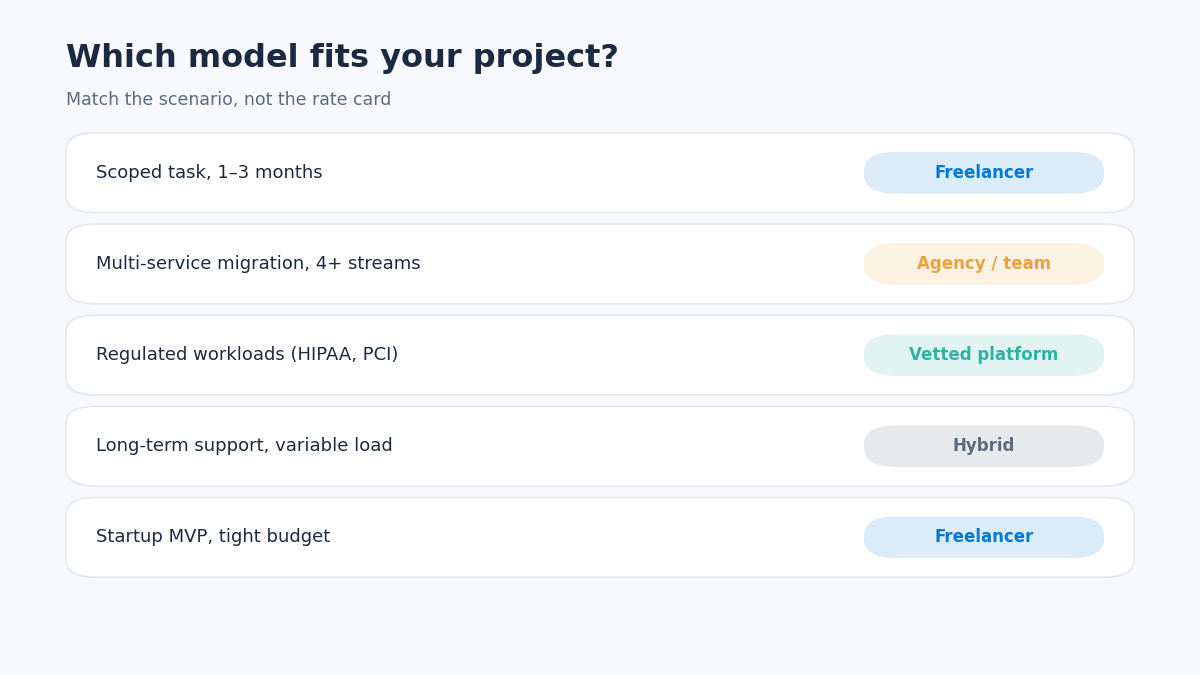
Use the project’s characteristics, not the rate card to choose. The table below covers the most common scenarios.
| Project Scenario | Better Fit | Why |
| Scoped task, 1–3 months (pipeline, single-app migration) | Freelancer | Low coordination need; agency overhead adds cost without value |
| Multi-service migration, 4+ workstreams | Agency or team | Needs breadth, parallel capacity, and built-in redundancy |
| Regulated workloads (HIPAA, PCI, SOC 2 scope) | Agency / vetted platform | Vendor-level compliance posture satisfies auditors faster |
| Long-term platform support with variable load | Hybrid | Retain 1–2 independents for continuity; burst via partner |
| Startup MVP on tight budget | Freelancer | Speed and cost dominate; risk tolerance is naturally higher |
Two heuristics resolve most edge cases. If the project fails when one person disappears, you need more than one person accountable. And if your team cannot technically evaluate the work being delivered, you need someone whose business depends on evaluating it for you.
There is also a third path that has matured considerably. Vetted talent platforms such as Supersourcing now sit between the two models: engineers are pre-screened with agency-grade rigor verified certifications, live technical assessments, background checks but engage with freelancer-style flexibility and pricing, with replacement guarantees built in. For teams that want vetted Azure developers without agency retainers or 20-hour screening cycles, this hybrid has become the default rather than the compromise. The same logic applies to broader IT staff augmentation, where a dedicated development team can scale up or down monthly instead of being locked into fixed contracts.
What Most Teams Get Wrong About Freelance Developer Reliability
Here is the contrarian part: freelance developer reliability is not primarily a function of the developer. It is a function of the engagement design. After enough projects, the pattern is unmistakable: the same engineer who ghosted one client delivers flawlessly for another, and the difference is almost always structural.
Three design choices predict reliability better than any reference check. First, payment cadence: weekly or milestone-based payments keep incentives aligned; net-60 terms push your project to the bottom of a freelancer’s queue. Second, meeting rhythm: engagements with a fixed 30-minute weekly sync have measurably fewer silent failures than “ping me when it’s done” arrangements. Third, scope hygiene: reliability collapses fastest when scope creeps without renegotiation the freelancer disengages emotionally long before they disengage contractually.
The uncomfortable corollary applies to agencies too. An agency’s accountability is only as strong as your contract’s specificity. “Senior Azure engineer” means nothing; “named engineer, AZ-305 certified, minimum 32 hours/week, substitution requires written approval” means everything. Teams that blame the model or model are usually looking away from their own engagement design. Fix the structure, and both models become dramatically more reliable. This is also why remote developer hiring keeps maturing as a discipline: the tooling and norms for structured engagement have improved faster than the talent pool itself.
Pressure-Test Your Hiring Decision Before You Commit
If you are weighing whether to hire freelance Azure developers or sign an agency contract, the worst outcome is deciding on rate alone and discovering the hidden costs in month four. Supersourcing has run this evaluation across 1,000+ engineering engagements matching pre-vetted, certification-verified Azure engineers to companies within 72 hours, with replacement guarantees that close the accountability gap freelance hiring usually leaves open.
Share your project scope and we’ll tell you honestly which model fits, including when the answer is “just hire an agency.”
Frequently Asked Questions
Is it cheaper to hire a freelance Azure developer or an agency?
Freelancers cost 40–60% less on rate, but after management overhead, rework, and tooling, the realistic total-cost advantage is 20–35%. For short, well-scoped projects the freelancer advantage holds clearly. For 6+ month, multi-workstream engagements, agency pricing narrows the gap through reduced coordination cost and lower rework rates.
How much do freelance Azure developers charge per hour in 2026?
Mid-level independents typically charge $40–$75 per hour, while senior engineers and cloud architects charge $75–$130. Rates vary by region; engineers in India and Eastern Europe often quote 30–50% below U.S. rates for equivalent certification levels and by specialization, with AKS, data engineering, and security skills commanding the top of each band.
What are the biggest risks of hiring freelance developers?
The four structural risks are single-person dependency, bandwidth competition with other clients, security verification gaps, and unverified skill claims. All four are manageable through contract design: documentation requirements, response-time SLAs, tenant-controlled credentials, and paid trial tasks. Skill is rarely the actual failure point engagement structure is.
Can freelancers handle enterprise-grade Azure projects?
Yes, with two conditions: the enterprise has internal technical leadership to coordinate them, and the workload is not under a compliance regime that requires vendor-level audits. Many enterprises now run hybrid models independent specialists for depth, partner teams for breadth rather than treating it as a binary choice.
When should a company use a development agency instead of a freelancer?
Choose an agency when the project spans 4+ parallel workstreams, sits inside HIPAA/PCI/SOC 2 scope, or lacks internal technical oversight. Choose a freelancer for scoped, well-defined tasks under 3 months where speed and cost matter most. If you fall between those cases, a vetted-talent platform usually delivers the best cost-to-accountability ratio.
How do I verify a freelance Azure developer’s skills before committing?
Verify certifications through Microsoft’s official portal, review real infrastructure-as-code artifacts, and run an 8–16 hour paid trial task before signing a long engagement. If you’d rather not spend 15–20 hours screening per hire, a pre-vetted platform compresses this into a 48–72 hour matching process, a reasonable point to book a short consultation and pressure-test your shortlist.
