

The $2.4M Workday Program That Delivered Half a System
A US-based professional services firm 9,000 employees across 22 countries approved a Workday HCM and Financials implementation. The brief: Workday HCM for core HR, recruiting, talent, and learning across all 22 countries, Workday Financials for accounting and procurement in the US and UK entities, and Workday Extend for three custom applications replacing legacy HR tools. Nineteen months. Thirteen India-based Workday consultants. $2.4M.
Most Workday programs don’t fail because of the platform—they fail because the wrong consultants are hired for the job. Enterprises approve multi-country rollouts expecting unified HR and finance systems, only to encounter delays, rework, and rising costs when execution begins.
This is where Hiring Workday Consultants from India becomes a strategic decision rather than a sourcing exercise. Workday HCM, Financials, and Extend demand deep, module-specific expertise that cannot be replaced with generalist experience.
The urgency is growing as enterprise cloud adoption accelerates. According to Gartner, worldwide enterprise application software spending is projected to grow steadily through 2026, driven by cloud ERP and HCM platforms like Workday, increasing the demand for experienced implementation talent.
In practice, the difference between a successful rollout and a costly mid-project recovery often comes down to one factor: whether your consultants have actually delivered the specific Workday modules in real production environments.
This guide is what that CHRO needed before she signed the SOW.
TL;DR 8 Answers Before You Read Further
| Question | Answer |
| What does a Senior Workday Consultant cost from India? | $42–68/hr fully loaded. A Workday Solution Architect runs $88–128/hr. Section 5 has the full rate stack. |
| What's the single most important verification? | Module-specific production experience. Workday HCM core, Recruiting, Talent, Learning, Payroll, Financials, and Extend are different skill sets. A consultant with HCM core experience is not automatically capable of Recruiting or Financials. |
| Is there a public Workday certification registry? | No. Workday does not maintain a publicly searchable certification database. Verification is through Workday's partner portal (accessible only to Workday partners) or direct confirmation via Workday. This makes Workday the hardest enterprise stack to verify in this guide series. |
| Which Indian city has the deepest Workday talent? | Hyderabad and Bangalore. Both cities have Workday implementation partner practices and product company GCCs. |
| What's the most commonly misrepresented experience? | HCM core experience presented as full HCM suite capability. And functional configuration experience presented as Workday Extend (technical development) capability. |
| How many Workday Extend developers are in India? | Approximately 800 Workday Extend-certified developers with production deployment experience in India. Most "Workday technical" experience in India is integration (EIB, Studio, Core Connectors) not Extend application development. |
| What's typical attrition for Workday specialists? | 16–21% annually. Workday is a growing platform with high demand. Top Workday consultants have strong lateral options across Workday's expanding customer base. |
| What's the biggest hiring mistake? | Treating Workday as a single skill. HCM, Financials, Payroll, Recruiting, Extend, and Prism Analytics are different product areas requiring different specialists. Budget for module-specific coverage, not generic Workday headcount. |
Are You Actually Ready for This?
Workday programs fail for buyer-readiness reasons at a high rate. Scope ambiguity, undefined module ownership, and integration complexity discovered late are consistent failure drivers. Score yourself.
Score each: 0 (not in place), 2 (partially), 4 (done).
| # | Criterion | Score |
| 1 | Named Workday program owner with HRIS or Finance system authority | 0/2/4 |
| 2 | Module scope defined which Workday products in scope, phased or simultaneous | 0/2/4 |
| 3 | Tenant strategy confirmed production, implementation, sandbox tenant structure | 0/2/4 |
| 4 | Integration scope documented which HR, payroll, benefits, and finance systems connect to Workday | 0/2/4 |
| 5 | Country scope defined which geographies in scope, which employment law variations | 0/2/4 |
| 6 | Workday Extend scope confirmed which custom applications if any | 0/2/4 |
| 7 | Interview panel with Workday domain experience available within 5 business days | 0/2/4 |
| 8 | Legal SLA under 15 days for MSA review | 0/2/4 |
| 9 | Workday implementation tenant provisioned for offshore team | 0/2/4 |
| 10 | Business process owners confirmed for each module HR, Finance, Recruiting | 0/2/4 |
| 11 | KPIs defined: configuration completion rate, integration test pass rate, parallel run accuracy | 0/2/4 |
| 12 | CISO signed off on offshore access to Workday tenant with employee and financial data | 0/2/4 |
| 13 | Escalation path: vendor PM → your Workday Program Lead → your CHRO/CFO | 0/2/4 |
| 14 | IP ownership for Workday Extend applications, integration programs, and configuration in MSA | 0/2/4 |
| 15 | Finance can process USD-denominated invoices within 30 days | 0/2/4 |
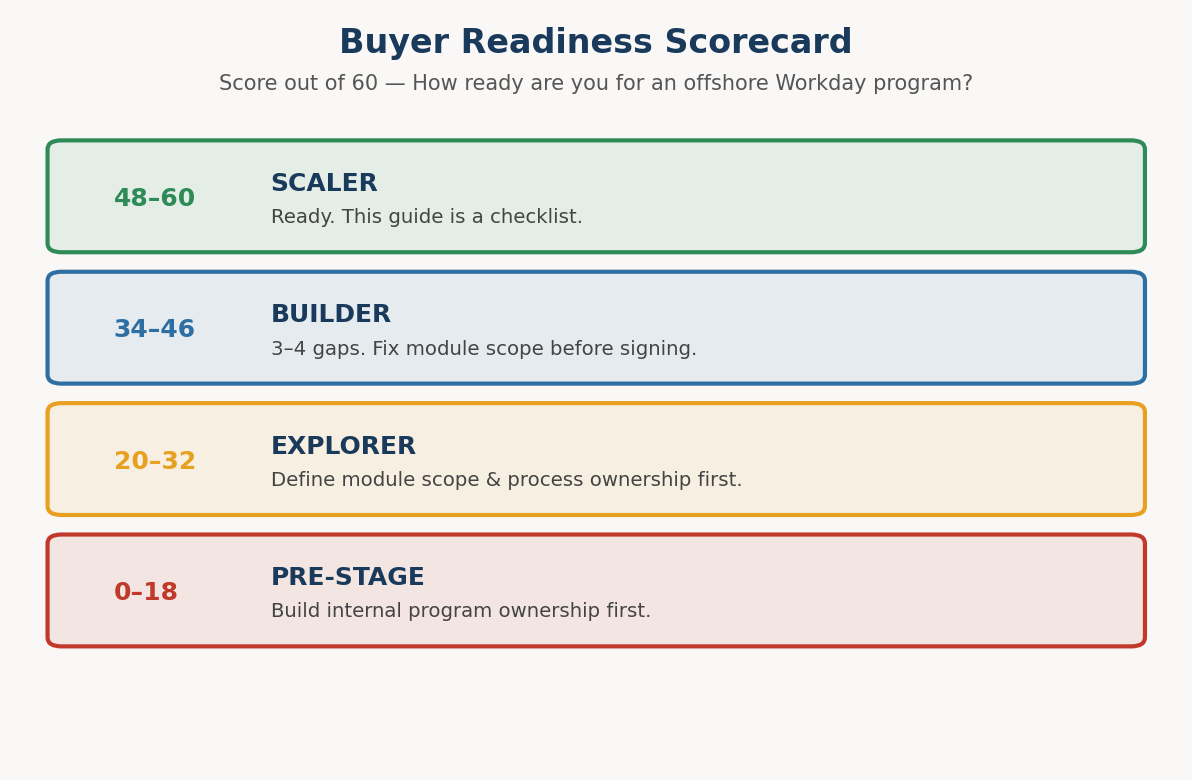
What your score means:
| Score | Tier | Reality Check |
| 48–60 | Scaler | Ready. This guide is a checklist. |
| 34–46 | Builder | 3–4 gaps. Module scope ambiguity is the most common Workday program killer. Fix before signing. |
| 20–32 | Explorer | Define module scope and business process ownership before engaging any vendor. |
| 0–18 | Pre-Stage | Workday programs require mature internal program ownership. Build it before signing an offshore SOW. |
From the deal floor: A UK retailer scored 14 on this checklist. The country scope (criterion 5) had not been defined; 12 countries were “potentially in scope.” The offshore team configured a UK-centric business process model for all 12 countries. Six countries required significant reconfiguration when their employment law variations were discovered in parallel. Eight weeks of rework. £195K. The country scope question was on the checklist.
The Workday Talent Market in India 2026
Workday is the dominant cloud HCM and Financials platform for mid-market and enterprise organisations globally. India’s Workday talent pool has grown significantly since 2018 as Workday’s customer base expanded in the US, UK, and Europe and as those customers built India-based support and implementation teams.
The critical verification problem:
Workday does not maintain a public certification registry. Unlike Salesforce (Trailhead), ServiceNow (nowlearning.servicenow.com), or Databricks (credentials.databricks.com) which have publicly searchable credential databases Workday certifications are managed through Workday’s partner portal, accessible only to Workday-authorized implementation partners.
This creates a verification gap unique to Workday in the enterprise staffing market:
- You cannot independently verify a Workday certification without Workday partner portal access
- Vendors can claim Workday certifications that you have no way to verify directly
- The only verification path is asking the vendor to confirm through their Workday partner portal access and accepting their confirmation
This makes Workday the stack where the interview-based verification in Section 8 matters most. Without a public registry, the module-specific interview questions are your primary verification mechanism.
The module pool breakdown:
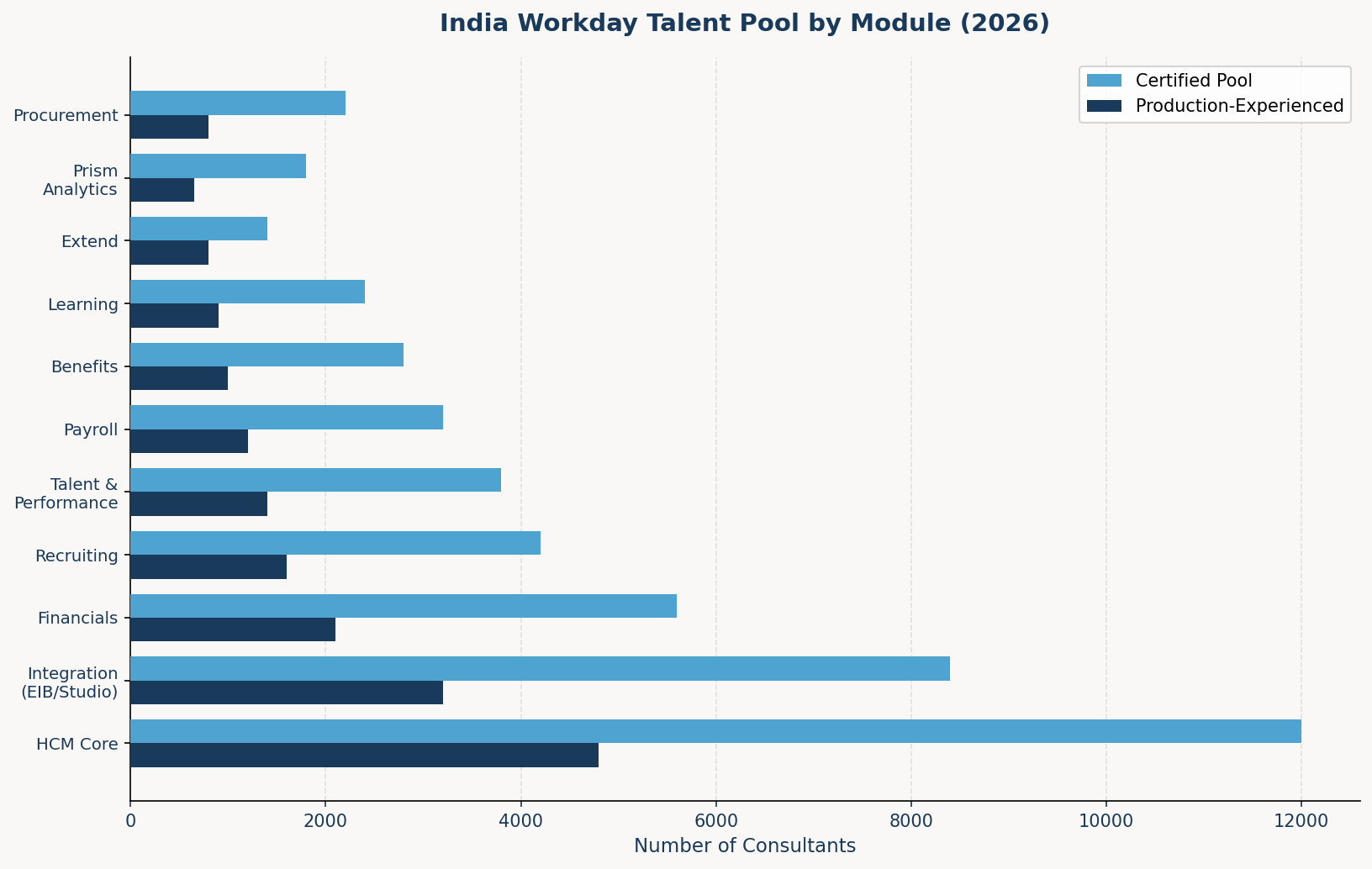
| Module | Estimated India Certified Pool | Production-Experienced |
| Workday HCM Core (Core HR, Org Management, Compensation) | ~12,000 | ~4,800 |
| Workday Recruiting | ~4,200 | ~1,600 |
| Workday Talent and Performance | ~3,800 | ~1,400 |
| Workday Learning | ~2,400 | ~900 |
| Workday Payroll (US/UK/Canada) | ~3,200 | ~1,200 |
| Workday Benefits (US) | ~2,800 | ~1,000 |
| Workday Financials (Accounting, AP/AR, Expenses) | ~5,600 | ~2,100 |
| Workday Procurement / Spend Management | ~2,200 | ~800 |
| Workday Prism Analytics / People Analytics | ~1,800 | ~650 |
| Workday Extend (custom application development) | ~1,400 | ~800 |
| Workday Integration (EIB, Studio, Core Connectors, PECI) | ~8,400 | ~3,200 |
The HCM core dominance problem:
The largest pool HCM Core is also the most commonly presented as covering the full HCM suite. A consultant with 6 years of Workday HCM Core experience has deep knowledge of worker records, compensation structures, org management, and HR business processes. They do not automatically have Workday Recruiting configuration depth, Workday Learning administration experience, or Workday Talent review cycle design experience.
Each Workday module has its own business process framework, configuration objects, and functional domain knowledge. Recruiting requires understanding of job requisition lifecycles, candidate stages, offer management, and ATS integration. Learning requires content management, curriculum design, and completion tracking configuration. These are different from HCM core, same platform, different configuration domain.
Vendors present “Workday HCM consultants” for programs that require HCM suite coverage. The suite has 8+ modules. Verify which modules specifically.
The Workday Extend gap:
Workday Extend is Workday’s application development framework allowing enterprises to build custom applications that run natively in the Workday tenant. It uses Workday’s proprietary development model, different from standard web development, and different from Workday’s integration tools (EIB, Studio).
Workday Extend production experience is genuinely rare. Approximately 800 developers in India have production Workday Extend experience. Most “Workday technical” candidates have integration experience (EIB, Studio, Core Connectors) not Extend application development. The two are completely different technical skills. Specify which you need.
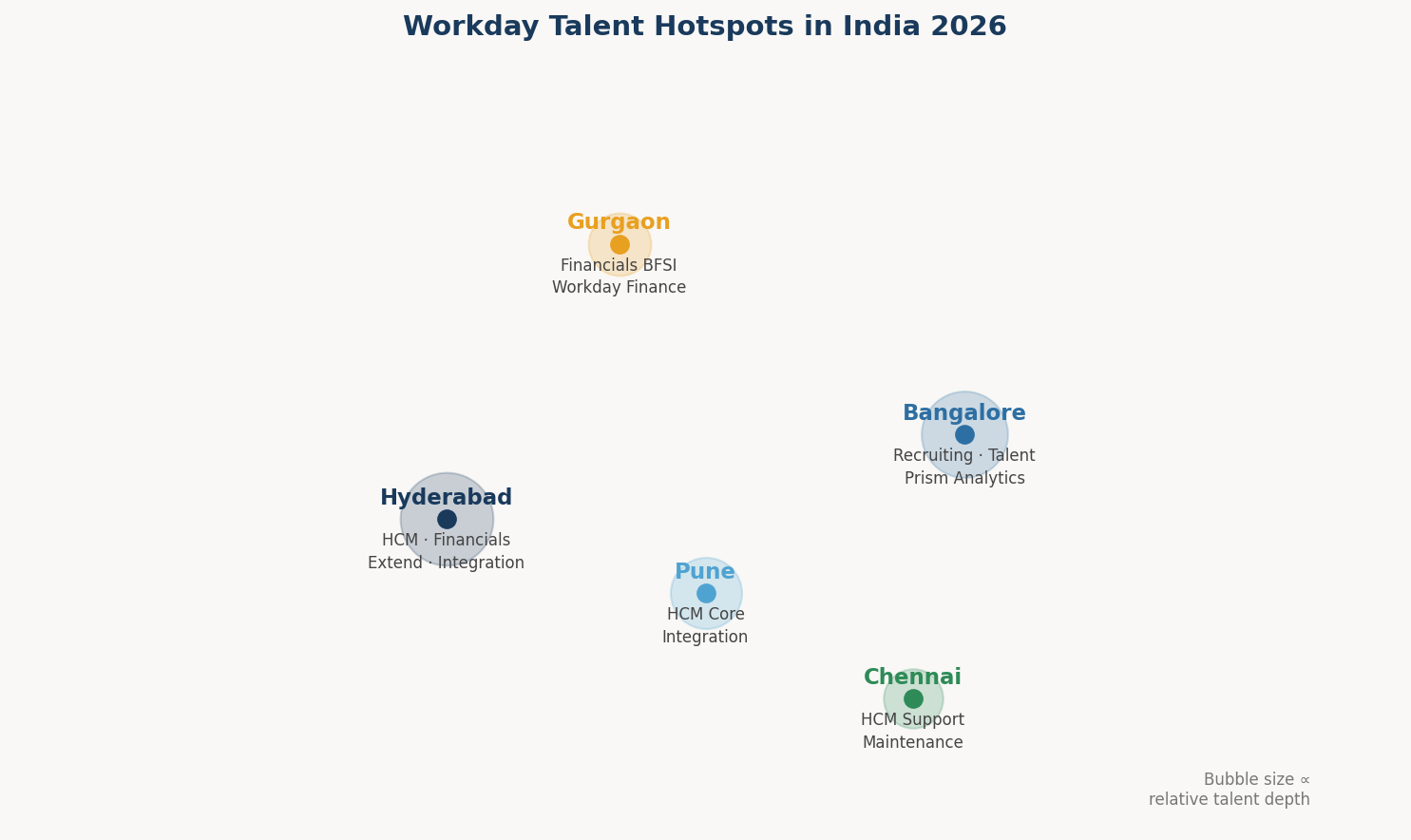
Where the talent lives:
| City | Dominant Workday Specialisations | Why |
| Hyderabad | Workday HCM, Financials, integration (EIB/Studio), Workday Extend | Microsoft India HQ effect. Large enterprise software delivery ecosystem. Workday’s India presence is concentrated here. |
| Bangalore | Workday HCM advanced modules (Recruiting, Talent, Learning), Prism Analytics, Workday Extend | Product company ecosystem. US tech GCCs with Workday deployments. |
| Pune | Workday HCM core, integration, functional configuration delivery | SI delivery centers. Cognizant, Wipro, Capgemini Workday practices. |
| Gurgaon | BFSI Workday programs, Workday Financials for financial services | BFSI GCC concentration. Financial IT services HR and Finance programs. |
| Chennai | Workday HCM support and maintenance, integration support | TCS/Cognizant legacy delivery. Support programs. |
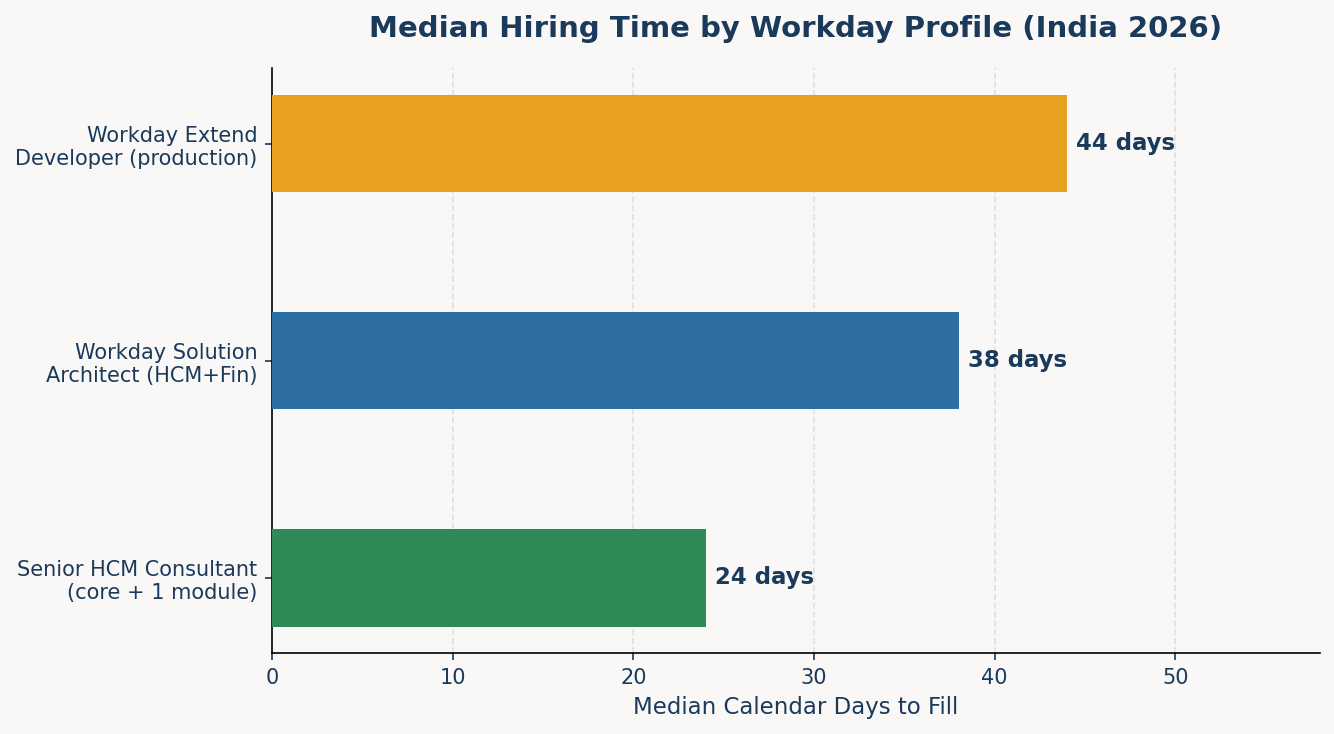
Supersourcing Index: Across 88 Workday placements in the Supersourcing GCC Benchmark 2026, median time-to-fill for a Senior Workday HCM Consultant (core HR + at least one advanced module) in Hyderabad was 24 calendar days. For a Workday Solution Architect with HCM and Financials depth: 38 days. For a Workday Extend developer with production application delivery: 44 days.
Red flag: Any vendor presenting a consultant as “full Workday suite” capable without specifying which modules they’ve configured in production. The Workday suite has 15+ modules across HCM and Financials. Nobody has deep production experience across all of them. Ask for the module list specifically.
What You’re Really Paying
Rate Table by Level
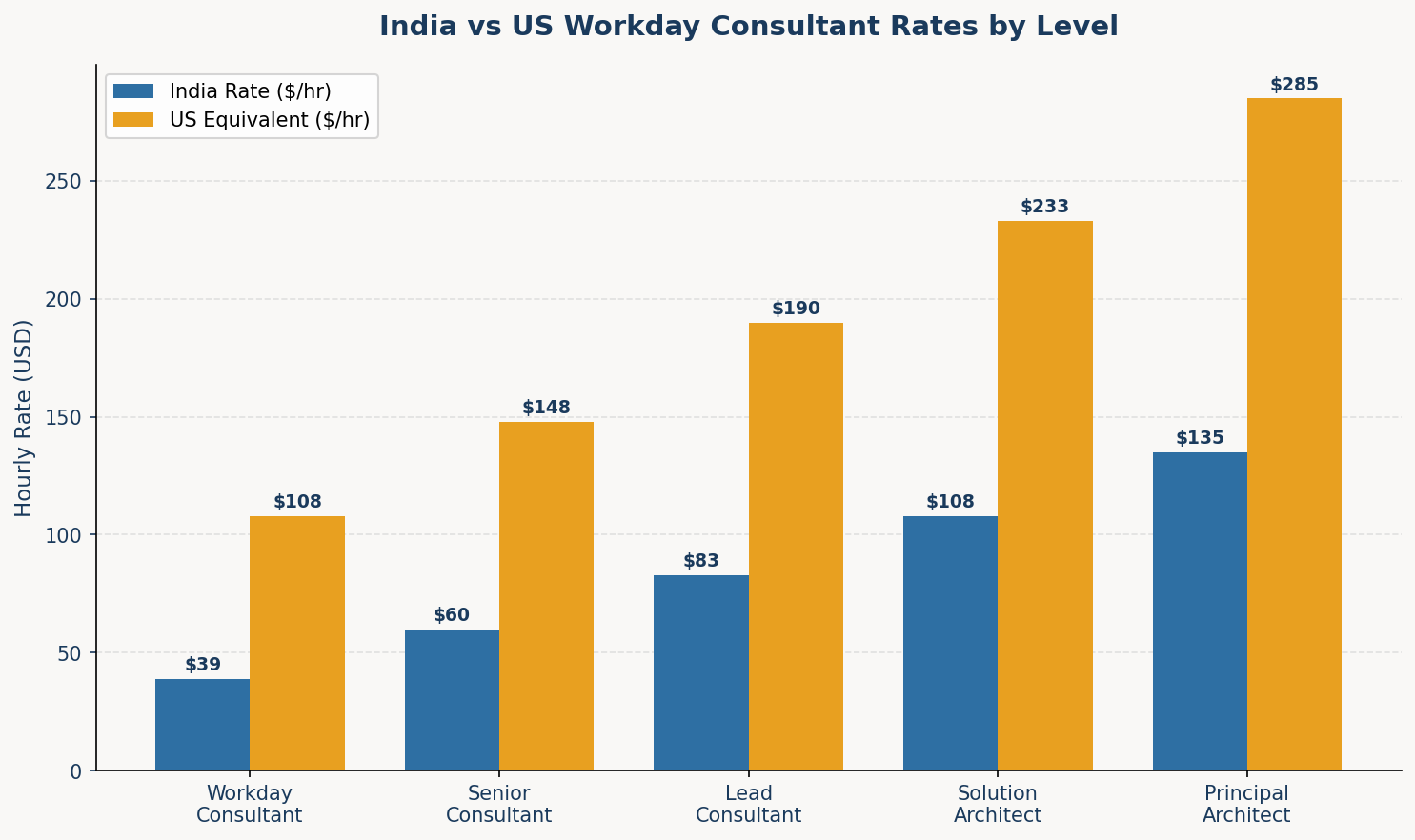
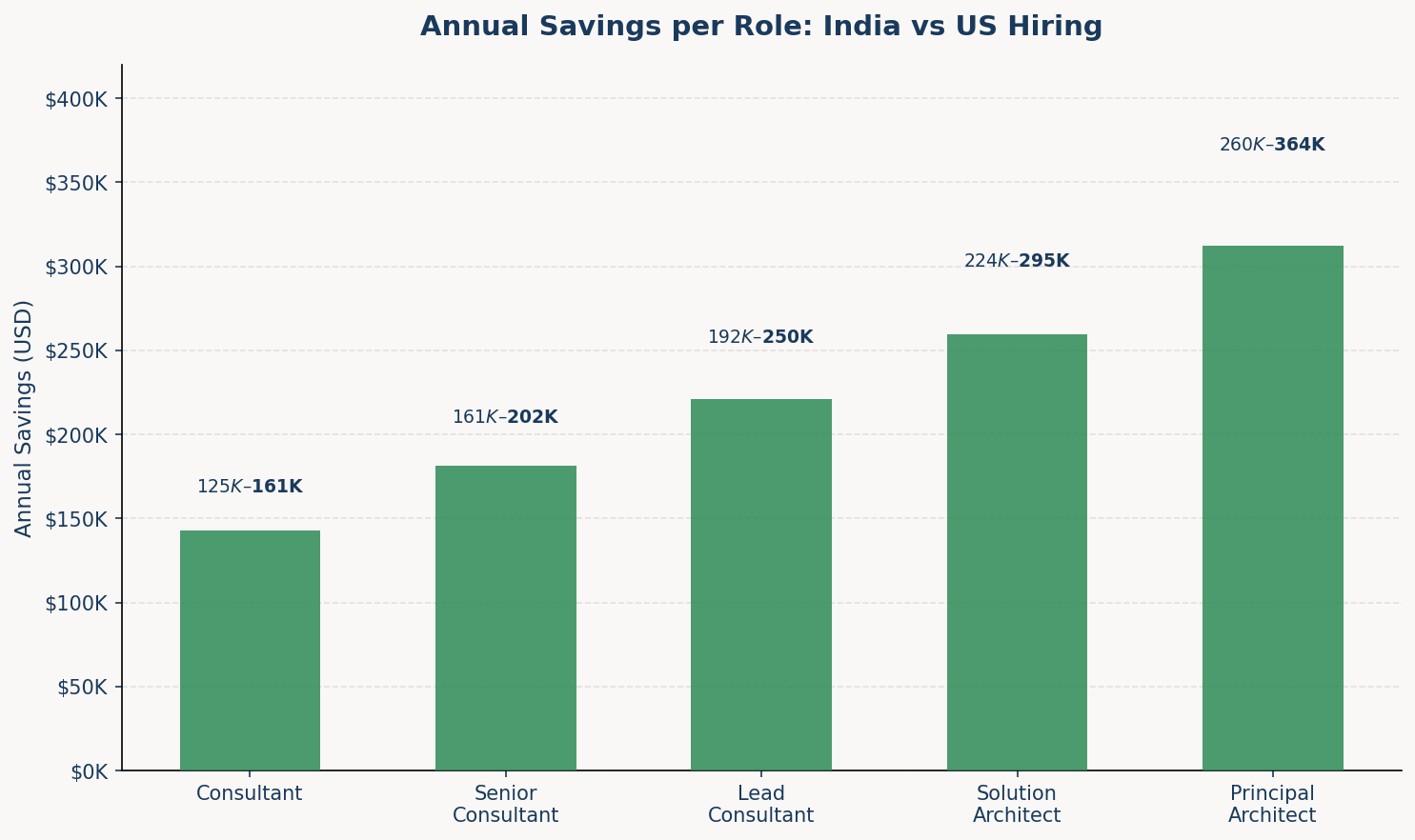
| Level | Experience | India Rate ($/hr) | US Equivalent ($/hr) | Annual Saving ($) |
| Workday Consultant | 3–6 yr | $30–48 | $90–125 | $125K–$161K |
| Senior Consultant | 6–9 yr | $48–72 | $125–170 | $161K–$202K |
| Lead Consultant / Module Lead | 8–12 yr | $68–98 | $160–220 | $192K–$250K |
| Workday Solution Architect | 10–14 yr | $88–128 | $195–270 | $224K–$295K |
| Principal Architect / Program Lead | 14+ yr | $115–155 | $240–330 | $260K–$364K |
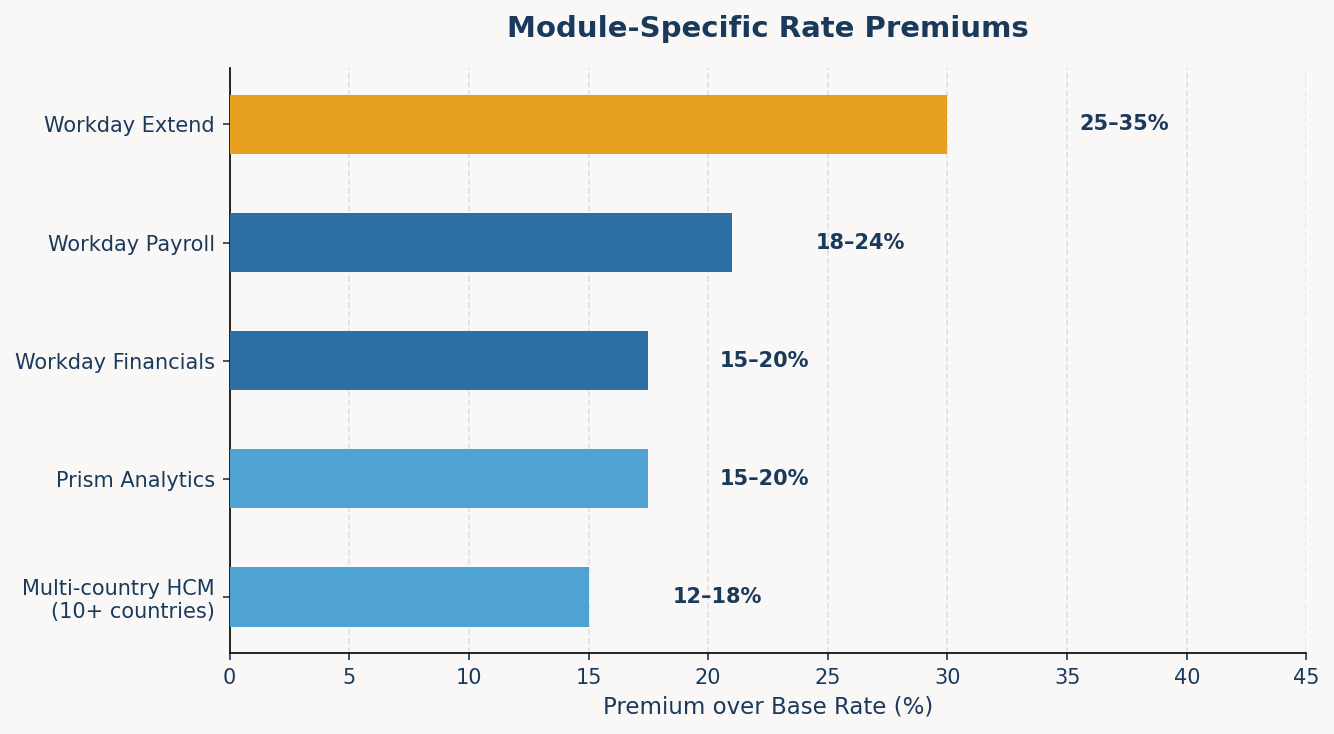
Module-specific premiums:
- Workday Payroll (US/UK/Canada): 18–24% premium. Payroll has regulatory complexity, parallel run requirements, and consequences of error that functional HCM doesn’t. The pool is thinner because payroll experience requires both Workday depth and payroll domain knowledge.
- Workday Financials: 15–20% premium over HCM-only at the same experience level. Financials requires accounting domain knowledge alongside Workday technical depth.
- Workday Extend: 25–35% premium over functional consultants. Application development in Workday’s proprietary framework is genuinely rare.
- Workday Prism Analytics: 15–20% premium. Data platform configuration for analytics on Workday data requires both Workday and analytics competencies.
- Multi-country HCM (10+ countries): 12–18% premium. Multi-country programs require employment law variation knowledge that adds complexity beyond standard HCM configuration.
The 4 Cost Layers
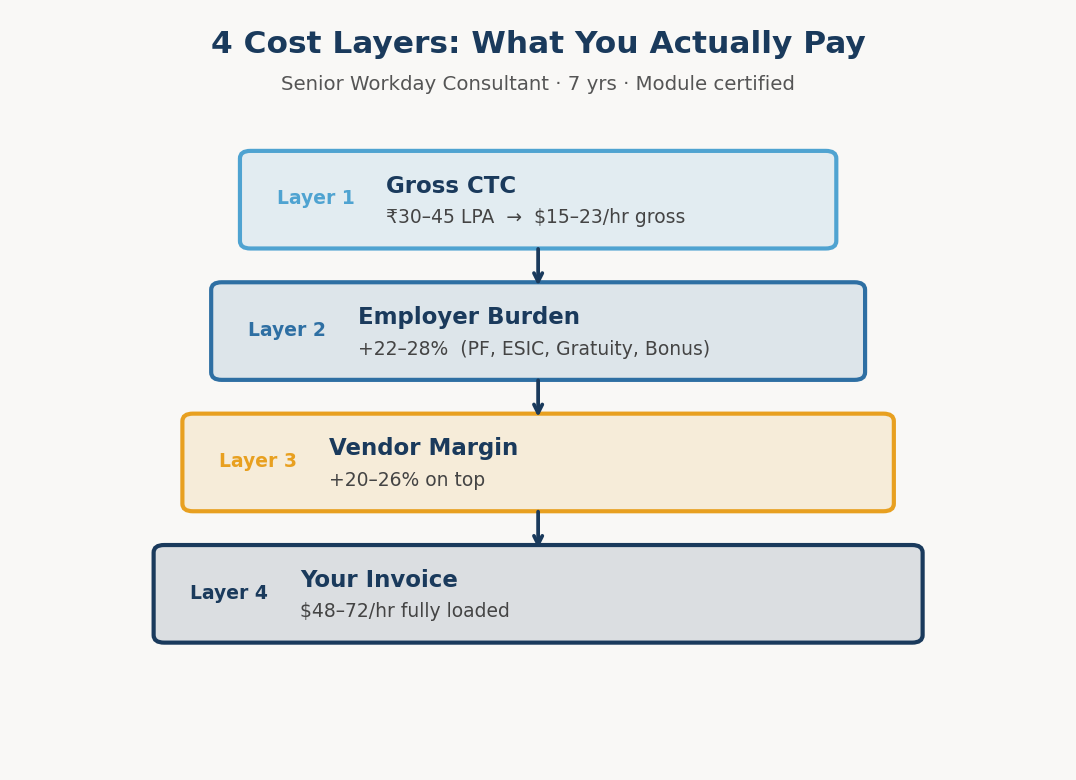
- Layer 1 Gross CTC Senior Workday Consultant with 7 years and module certifications: ₹30–45 LPA. At ₹96.4/$1: $31K–$47K annually $15–23/hr gross.
- Layer 2 Employer Burden PF, ESIC, Gratuity, bonus: 22–28% on top of gross CTC.
- Layer 3 Vendor Margin For Workday specialists: 20–26%.
- Layer 4 What Hits Your Invoice Senior Workday Consultant: $48–72/hr. A 10-consultant Workday team at blended $62/hr costs $1.24M annually. US equivalent: $2.9–3.4M. Annual saving: $1.7–2.2M.
The Certification Hierarchy What Actually Matters
The verification problem restated:
Workday certifications are managed through the Workday partner portal. Workday-authorized implementation partners can verify their consultants’ certifications through this portal. You, the buyer, cannot independently verify. This is unique among enterprise platforms and requires a different verification approach.
What to do instead:
Ask the vendor to provide: the consultant’s Workday Pro certification badge (Workday issues digital badges for certifications), the specific module certification name, and the year of certification. Then ask the vendor to confirm in writing through their Workday partner portal access. For any certification claim you cannot verify independently, the module-specific interview questions in Section 8 become your primary verification mechanism.
The Workday certification structure:
- Workday Pro Certifications (module-specific): Workday’s primary certification program. Each module has its own Pro certification Workday Pro HCM, Workday Pro Recruiting, Workday Pro Financials, Workday Pro Payroll (country-specific), etc. Pro certifications require passing Workday’s module-specific exam administered through Workday’s partner network. They are renewed with each major Workday release (twice per year).
- Workday badge programs: Workday issues digital badges for various certifications and competencies. These badges are the most visible certification signal they appear on LinkedIn and can be shared directly. Badge validity is time-limited and tied to release currency. An expired badge means the consultant has not maintained their certification currency through Workday’s biannual release updates.
- The release currency problem: Workday releases twice per year typically in March and September. Each release introduces new features, changed business process frameworks, and updated configuration approaches. Workday Pro certifications require maintenance through release-specific assessments. A consultant who has not maintained their certification through the current release cycle has outdated credentials.
Ask specifically: “Which Workday release is your certification currently through?” Current means within the last two releases. A consultant who cannot name the current Workday release is not maintaining their certification currency.
The integration vs Extend distinction:
This is critical and almost universally confused:
- Workday Integration Specialists use Workday’s integration tools EIB (Enterprise Interface Builder) for simple inbound/outbound file-based integrations, Workday Studio for complex transformations, Core Connectors for benefits and payroll connectors, and PECI (Payroll Effective Change Interface) for payroll integrations. Integration is functional-technical work configuring existing integration frameworks.
- Workday Extend Developers build custom applications within Workday’s tenant using Workday’s proprietary application development framework. This requires understanding Workday’s data model, business object framework, custom validation logic, and UI builder. It is application development, not integration configuration. The skill sets overlap minimally.
A consultant who lists “Workday technical experience” without specifying integration vs Extend is likely an integration specialist. For Extend development roles, require specific Extend experience and test it with the Extend scenario in Section 8.
The JD That Attracts the Right Candidates
JD 1: Senior Workday HCM Consultant HCM + Recruiting (5–8 years)
Senior Workday HCM Consultant HCM Core + Recruiting Remote from India Engagement: Staff Augmentation | Duration: 18 months Rate: ₹30–45 LPA CTC equivalent | Billing: $48–72/hr (vendor-facing)
What you’ll own: Workday HCM configuration across Core HR, Compensation, and Recruiting for a 12,000-employee global program. You’ll configure business process frameworks for hire, change job, and termination; compensation grade and plan structures; job requisition and candidate lifecycle in Recruiting; and offer management workflows. Measured on configuration quality, business process accuracy, and integration test pass rate.
What we require:
- Workday Pro HCM certification (current release ask vendor to confirm via partner portal)
- Workday Pro Recruiting certification preferred
- 5–8 years Workday experience, minimum 2 complete HCM implementations with Recruiting in scope
- Business process framework configuration can describe hire/change job/terminate BP steps, conditional routing, and approval chain design
- Compensation grade and plan configuration grade profiles, compensation plans, merit process setup
- Recruiting module depth job requisition design, candidate stage configuration, offer letter setup, background check integration
- Multi-country HCM experience preferred at least 5 countries in scope on a prior implementation
What disqualifies you:
- HCM core only experience with no Recruiting production configuration
- “Recruiting experience” limited to functional testing or support, not implementation configuration
- No business process framework design experience at senior level
- Workday experience limited to a single country deployment for a global program
Interview process: Module-specific technical screen (45 min) → Live Workday tenant configuration task (90 min) → Business process design discussion (45 min)
JD 2: Workday Solution Architect HCM + Financials (12+ years)
Workday Solution Architect HCM and Financials India GCC or BOT Engagement: GCC Build or BOT | Duration: 24+ months CTC: ₹80–115 LPA | Billing: $92–128/hr (vendor-facing)
What you’ll own: End-to-end Workday architecture across HCM and Financials for a 15,000-employee enterprise program. You will own the tenant configuration strategy, business process framework design across both pillars, integration architecture (EIB, Studio, PECI), security role model design, and the deployment strategy for 8 countries. Technical authority for a team of 10–18 Workday consultants.
What we require:
- Workday Pro certifications across HCM and Financials (confirmed via vendor partner portal)
- 12+ years enterprise HRIS and Finance system experience, minimum 4 complete Workday full-cycle implementations as architect
- Cross-pillar architecture can describe the data and process integration points between Workday HCM and Workday Financials (worker-to-vendor, org-to-cost-centre)
- Security architecture domain-based security, security groups, configurable security, and role assignment design at enterprise scale
- Integration architecture EIB, Workday Studio, Core Connectors, and third-party middleware integration patterns
- Multi-country deployment experience 8+ countries, employment law variation management, international payroll connectivity
Interview process: Architecture scenario (60 min) → Cross-pillar design discussion (45 min) → Security model design exercise (30 min) → Reference call with prior CHRO or CFO
What most enterprise JDs get wrong for Workday:
They say “Workday HCM experience required” which returns all 12,000 India HCM core consultants for programs that need Recruiting, Talent, and Financials. They don’t specify module depth which allows HCM core consultants to present as a full suite. They don’t mention Workday Extend separately which conflates integration configuration with application development. And they don’t specify the release currency requirement which allows outdated certifications to pass the baseline filter.
How to Verify Experience Not Just Credentials
The 3 verification steps before any Workday interview:
Step 1: Module list verification in writing
Before scheduling any technical interview, ask in writing: “List the specific Workday modules you have configured in production implementations not learned, not supported, not tested. Configured in a live go-live.” The response tells you immediately whether the candidate has the module coverage your program requires. A 6-year Workday consultant who lists “HCM Core, Compensation, and Benefits” for a program that needs Recruiting, Talent, and Financials is not your candidate. No interview needed.
Step 2: Release currency check
Ask: “What is the current Workday release and which release is your Pro certification currently through?” Workday’s biannual releases are named 2025R1, 2025R2, 2026R1, 2026R2. A consultant who cannot name the current release has not been maintaining release currency. A consultant whose certification is current through a release more than 2 cycles ago has outdated credentials for a current implementation.
Step 3: Implementation count and scope verification
Ask for the number of complete Workday go-lives, the approximate employee count, the country scope, and the modules configured on each. Real Workday consultants answer with specific numbers. “3 complete implementations: 8,000 employees/US+UK/HCM Core+Recruiting; 22,000 employees/US only/Full HCM Suite; 5,000 employees/Germany+Netherlands/HCM Core+Payroll” is a specific answer. “Multiple enterprise implementations across HCM and related modules” is not.
The 5 interview questions that expose fake seniority:
Q1: Business Process Framework Design “Walk me through how you’ve designed a Hire business process in Workday for a global enterprise with different approval requirements in the US (manager approval only), (HR approval required), and Germany (works council notification required) the BP steps, the conditional routing, and how you handled the works council requirement specifically.”
Real answer: describes the business process step configuration (Initiation, Action steps, Approval steps, To Do steps), the conditional routing using business process condition rules based on the supervisory org’s location or regulatory category, the works council notification as a To Do step (not an approval works councils are notified but don’t approve in standard Workday BP design), and how the Germany-specific routing is triggered. They describe specific BP objects, routing rules, approval chain configuration.
Consultant without deep BP framework experience describes the concept of approval workflows. Cannot describe conditional routing mechanics or the distinction between Approval and To Do steps.
Q2: Workday Security Model “Describe your approach to security role design for a 20,000-employee Workday HCM deployment, how you structure security groups, how you handle the manager self-service access scope, and how you prevent HR in one region from seeing employee data in another region.”
Real answer: describes Workday’s domain-based security (domains govern access to specific data and actions), security groups (role-based, job-based, user-based, intersection security groups), the manager access configuration (manager security group with the “subordinate in hierarchy” access scope), and regional data restriction using segment-based security creating security segments that restrict access to workers in specific supervisory org hierarchies or locations. They describe specific security group types and domain assignments.
Consultant without security architecture experience describes Workday security conceptually. Cannot describe domain-based security, intersection security groups, or segment-based security for regional restriction.
Q3: Workday Financials Integration with HCM “Explain the key integration points between Workday HCM and Workday Financials specifically how worker changes in HCM affect cost centre assignments in Financials, and how payroll accounting entries flow from Workday Payroll to the general ledger.”
Real answer: describes the worker-to-vendor relationship (Workday workers are also vendors in Financials for expense reimbursement), the cost centre hierarchy alignment between HCM supervisory orgs and Financials cost centres, the payroll accounting configuration how payroll journals are generated from payroll results and posted to the general ledger cost centres, and the position management to budget integration if position budgeting is in scope. They describe specific configuration objects, payroll accounting rules, journal source configuration, company assignment.
Consultant without cross-pillar experience describes the two products separately. Cannot describe the payroll-to-GL accounting flow or the worker-vendor relationship.
Q4: EIB Integration Design “Walk me through how you’ve designed an inbound EIB integration to load 50,000 employee records from a legacy HRMS into Workday, your file format design, the transformation approach, error handling, and how you handled records that failed validation.”
Real answer: describes the EIB (Enterprise Interface Builder) template design selecting the target business object (Worker), mapping the iLoad template fields to the legacy system fields, the transformation in Workday Studio if complex transformation is needed (or a pre-processing step in the middleware), the validation report review process (EIB generates a validation report before committing), error handling for failed records (partial commit vs all-or-nothing approach depending on the EIB configuration), and the reconciliation process post-load. They describe specific EIB configuration elements.
Consultant without integration experience describes data migration conceptually. Cannot describe the EIB template structure, validation report process, or partial commit configuration.
Q5: Workday Extend Application Design “Describe the architecture of a Workday Extend application you’ve built in production, the business object it extends, the custom validation logic, the UI components, and how you handled performance for high transaction volumes.”
Real answer: describes the Workday Extend application structure the business object extension (which Workday business object the app extends or works alongside), the custom fields and validation rules built in Extend, the UI builder components (Workday’s proprietary UI framework), and the performance considerations large dataset handling in Workday Extend requires specific approaches to avoid timeout issues (pagination, background processing for bulk operations). They describe a specific application with specific business logic.
A consultant with integration-only experience cannot answer. They describe Workday Studio or EIB instead. This single question perfectly separates Extend developers from integration developers.
8 CV red flags:
- “Workday HCM consultant” without specifying which HCM modules HCM is 8+ modules
- “Workday technical experience” without specifying EIB/Studio (integration) vs Extend (development)
- “Full suite Workday experience” claimed by a consultant with under 5 years total Workday experience the suite is too broad for deep experience across all modules in that time
- Workday certification listed without release year certifications without release currency indication may be outdated
- “Workday Financials experience” from a consultant whose LinkedIn shows only HRMS/HCM roles Finance module experience requires Finance domain knowledge
- Multiple “full cycle” implementations at the same company a company does one Workday implementation; multiple entries are likely phase 2 extensions, not separate go-lives
- “Global HCM experience” on a program with fewer than 3 countries single-region HCM is not global HCM
- “Workday Payroll experience” without being able to name the specific country payroll configuration Workday Payroll is country-specific (US Payroll, UK Payroll) and each has different configuration depth
How to Source What’s Working, What Isn’t
What’s working in 2026:
Workday partner network.
Workday maintains a tiered partner ecosystem Select, Premier, and Certified partners. India has approximately 25 Workday Premier and Certified partners. These partners have certified headcount requirements maintained through Workday’s partner program. An inquiry to 3–4 Workday Premier partners about available benches with module-specific requirements yields a verified shortlist.
Workday Community India.
Workday Community (community.workday.com) has active India participation. Workday Rising (annual conference) and Workday-organized regional events have India chapter presence. Senior consultants who contribute to Workday Community answering questions, writing guides are identifiable senior practitioners.
3 ready-to-use LinkedIn boolean search strings:
- String 1 (Senior HCM + Recruiting): “Workday” AND (“Recruiting” OR “Talent”) AND (“Senior” OR “Lead” OR “Architect”) AND (“Hyderabad” OR “Bangalore”)
- String 2 (Workday Financials): “Workday Financials” AND (“Accounting” OR “Financial Accounting” OR “AP”) AND (“India” OR “Hyderabad”)
- String 3 (Workday Extend): “Workday Extend” AND (“developer” OR “application”) AND “India”
Workday user group networks.
Workday has active user groups in Hyderabad, Bangalore, and Pune. User group members are customers and practitioners sourcing from user group contributors yields practitioners with production client-side experience, not just SI delivery experience.
Supersourcing pre-vetted bench. For Senior Workday HCM Consultants (module-specific, release-current), median fill time 24 calendar days. For Solution Architects, 38 days with module and release currency verification.
What isn’t working:
- “Workday consultant” job postings without module specification. Returns all 12,000 HCM core consultants. Without specifying Recruiting, Financials, or Extend specifically, you’re sourcing from the broadest possible pool. Module specificity in the posting is the single most important filter for Workday.
- Accepting certification claims without release currency verification. Workday’s biannual release cycle means certifications become outdated quickly. A consultant certified through 2023R1 in May 2026 has missed 5 release cycles. Their knowledge of current features and configuration approaches is potentially 2.5 years behind. Require current release certification.
- Conflating Workday integration and Workday Extend. The two skills are different. Hiring an EIB/Studio integration specialist for a Workday Extend application development role produces a consultant who cannot complete the work. Specify the technical requirement precisely integration configuration or application development.
The Contract Stack for Workday Engagements
Clause 1: Individual Resource Approval with Module and Release Specification
SOW schedule must list: name, Workday Pro certifications by module, release currency (current through which Workday release), and module scope of work. A consultant substituted from HCM Core to Financials without client approval is a material scope change. Module specification in the approval clause makes this contractually clear.
Clause 2: Certification Currency Maintenance
Require that all consultants on the engagement maintain their Workday Pro certification currency throughout the engagement. Workday releases twice per year consultants must complete release-specific maintenance assessments. A consultant whose certification lapses during a 12-month engagement is a compliance gap. Require vendor confirmation of certification currency at each release cycle.
Clause 3: IP Assignment Configuration, Workday Extend Applications, and Integration Programs
Must cover: Workday business process framework configurations (exported as XML), Workday Extend application definitions, EIB and Studio integration programs, security configuration documentation, and implementation decision log (record of all architectural decisions made during the program). Workday configuration is not obviously “code” it is a series of business object configurations. The IP Deed must name these specifically.
Clause 4: Tenant Access Revocation 24 Hours
All vendor consultant access to production, UAT, and implementation Workday tenants must be revoked within 24 hours of engagement end. Workday tenant access includes access to employee personal data and financial data; the access revocation is both an IP protection and a data privacy requirement.
Clause 5: Knowledge Transfer as a Delivery Milestone
Workday institutional knowledge why specific business processes were designed as they were, what employment law requirement drove a specific configuration decision concentrated in the consulting team. Require structured knowledge transfer throughout the engagement: configuration decision documentation after each major design decision, module-specific runbooks for system administration, and at least one internal team member trained per module for post-go-live support.
Running a Workday Team at Scale
Module ownership structure.
Assign clear module ownership for every module in scope, one named consultant owns each module’s configuration, one named internal business owner validates each module’s design. Matrix ownership (one consultant covering three modules) produces accountability gaps. For a 15+ module Workday program, plan for dedicated module consultants.
Workday release cycle planning.
Two releases per year mean your implementation timeline intersects with Workday releases. Plan for a release impact assessment sprint at each release reviewing new features that affect in-scope modules, validating that current configurations remain correct on the new release, and updating test scripts for changed functionality. Offshore teams that don’t plan for release cycles are surprised by release changes in UAT and production.
Tenant governance.
Implementation tenant for development and testing, UAT tenant for user acceptance, production tenant for go-live. All configuration changes move through this lifecycle. No configuration in production that hasn’t passed UAT. All configuration changes documented in the implementation workbook before being applied in the implementation tenant.
Parallel run management.
Workday Payroll and Financials programs require parallel run periods running the new system alongside the legacy system and reconciling outputs. Offshore consultants must understand parallel run requirements and be available for extended hours during parallel run weeks. Define parallel run ownership and escalation paths before the engagement starts.
Early warning signals:
- Configuration decisions not being documented in the implementation workbook
- Release impact assessment skipped at a release cycle
- Module-specific test cases failing in UAT for the same reason repeatedly
- Business process design decisions being made without business owner sign-off
- LinkedIn activity Workday module certifications updated, SI partner connections increasing
Retention levers: Module expansion Workday consultants who add a new module certification on your program (e.g., HCM core consultant who adds Recruiting certification) are building career value and engaged with their professional development. Release currency support funding the biannual release assessment completion signals investment in the consultant’s Workday career. Architecture ownership consultants who own the design of a complete module for an enterprise program have a career narrative that is difficult to walk away from.
When Things Go Wrong
Pattern 1: The Module Coverage Gap
Described in Section 1. HCM core consultants assigned to Recruiting and Financials without module-specific experience. The module list verification question (Step 1 in Section 8) and the module specification in the SOW resource approval clause prevent this entirely.
Pattern 2: The Release Currency Gap
A US technology company hired a Workday architect for an HCM Phase 2 program. The architect had excellent credentials and strong references. His Workday Pro certification was current through 2023R2 three releases behind the program’s implementation on 2025R1.
The gap mattered. Workday’s Skills Cloud (skills ontology for talent management) had been significantly redesigned between 2023R2 and 2025R1. The architect’s Skills Cloud configuration approach was based on the 2023 model; the new model in 2025R1 had different business objects, different configuration steps, and different integration patterns. The Skills Cloud workstream had to be redesigned.
Eight weeks of rework. $140K. The release currency question in the pre-screening step would have surfaced before the first interview was scheduled.
Pattern 3: The Extend vs Integration Confusion
A healthcare company required three custom Workday applications: a complex on-call scheduling app, a credential tracking app, and a custom performance review app all built in Workday Extend. The vendor provided a “Workday technical consultant” with 8 years of Workday integration experience.
Eight years of EIB and Studio experience does not produce Workday Extend capability. The consultant could not build Workday Extend applications. The first sprint produced nothing deployable. The engagement was restructured after 6 weeks. $95K written off. The Extend application design question (Q5 in Section 8) would have identified this in 10 minutes.
When India Is the Wrong Call
Scenario 1: Workday Payroll for countries with complex statutory requirements.
Workday Payroll for countries like Germany (Works Constitution Act, complex statutory deductions, collective bargaining agreements), France (complex social charge structures, employee representation requirements), or Brazil (intricate labor law complexity) requires both Workday Payroll configuration depth and deep country-specific payroll domain knowledge. India’s Workday pool has US, UK, and Canadian payroll depth. For complex European or LATAM country payroll specifically, the India pool thins significantly. Consider country-specific payroll specialists for the statutory complexity and India-based consultants for the Workday platform layer.
Scenario 2: Highly regulated HR data with restricted offshore access.
Some enterprise HR programs particularly in defence, government-adjacent industries, or programs with strict data residency requirements restrict employee personal data access to specific geographies. If your Workday tenant contains employee data that cannot be accessed from India under your regulatory framework, offshore configuration is not viable. Work with your compliance and legal team to assess data residency requirements before signing an offshore Workday SOW.
Scenario 3: Sub-6 consultant programs with niche module combinations.
A 4-consultant program requiring Workday Financials Procurement + Advanced Compensation + Workday Extend simultaneously is too niche and too small for standard IT staffing. The three required profiles are different specialists. For small programs with niche module combinations, a Workday partner boutique with multi-module certified consultants is a better fit than enterprise staff augmentation.
The Supersourcing Vendor Scorecard™ Workday Edition
Score your vendor before you sign. Maximum 100 points. Minimum threshold: 65.
Category 1: Bench Depth and Module Specificity (0–20 pts)
| Criterion | 0 | 10 | 20 |
| Can produce module-specific Pro certification list for all claimed bench within 24 hours | Cannot | Some | All bench, all modules listed |
| Release currency confirmed for all claimed bench | Not checked | Checked for some | Confirmed current for all |
| Extend vs integration distinction acknowledged proactively | Conflates them | Distinguishes when asked | Proactively separates with specific evidence |
Category 2: Vetting Process (0–20 pts)
| Criterion | 0 | 10 | 20 |
| Module-specific technical screen (not generic Workday questions) | Generic questions | Module-specific written | Live tenant task required |
| Business process framework questions in screen | Not asked | Conceptual questions | Specific BP design scenario |
| Release currency verified in technical screen | Not verified | Asked verbally | Workday release named and confirmed |
Category 3: Contract Readiness (0–20 pts)
| Criterion | 0 | 10 | 20 |
| IP Assignment covering Extend apps and configuration workbooks | Not available | Available on request | Standard, items named |
| Certification currency maintenance clause | Not present | Best effort | Biannual release maintenance contractual |
| Knowledge transfer as delivery milestone (not end-of-project) | Not present | End-of-project | Per-module throughout engagement |
Category 4: Workday Delivery Track Record (0–20 pts)
| Criterion | 0 | 10 | 20 |
| Named Workday go-live clients with module scope specified | None | Logo only | Named contact + modules + go-live date |
| Cross-pillar programs (HCM + Financials) verified | None | Claimed | Verified with reference |
| Attrition on Workday programs | Unknown / >25% | 18–25% | <18% |
Category 5: Commercial Structure (0–20 pts)
| Criterion | 0 | 10 | 20 |
| Rate card by module and pillar (HCM vs Financials vs Extend) | Single Workday rate | HCM/Financials distinction | Full module and pillar matrix |
| Substitution clause with module equivalence requirement | Not present | Available | Standard, module equivalence specified |
| SLA on replacement with module match | None | Best effort | Contractual 21-day SLA |
Score interpretation: 85–100 shortlist; 65–84 proceed with conditions; 45–64 significant risk; below 45 walk.
15 Questions Buyers Actually Ask
Q: Does Workday have a public certification registry I can verify against?
No. Workday does not maintain a publicly searchable certification database. Verification goes through Workday’s partner portal, accessible only to Workday-authorized implementation partners. Ask the vendor to confirm certifications through their partner portal access in writing. For additional verification, Workday issues digital badges asking candidates to share their Workday Pro badge directly, which shows the module and release currency. The module-specific interview questions in Section 8 remain your primary independent verification mechanism.
Q: What is the difference between Workday HCM and Workday Financials from a hiring perspective?
Workday HCM consultants configure HR processes employee records, org management, compensation, recruiting, talent, learning, and payroll. They come from HR technology backgrounds and understand HR business processes. Workday Financials consultants configure accounting, AP/AR, procurement, and expense management. They come from Finance technology backgrounds and require accounting domain knowledge alongside Workday technical depth. The platforms share Workday’s architecture but the domain knowledge requirements are completely different. Hire separately for each pillar and don’t assume HCM experience transfers to Financials or vice versa.
Q: What is Workday Extend and why is it different from Workday integration?
Workday Extend is Workday’s application development framework used to build custom applications that run natively within the Workday tenant. It uses Workday’s proprietary business object framework and UI builder. Workday integration uses Workday’s integration tools EIB for file-based integrations, Workday Studio for complex transformations, and Core Connectors for standard integrations. The two require completely different skills. Integration configuration is functional-technical work within defined Workday frameworks. Extend development is application development in a proprietary environment. Approximately 800 India-based consultants have production Workday Extend experience. Do not substitute integration experience for Extend development capability.
Q: How do Workday’s biannual releases affect offshore program planning?
Two major releases per year (approximately March and September) mean your program timeline intersects with release cycles. Each release introduces new features and may change configuration behaviour. Plan for: a release impact assessment sprint at each release cycle, regression testing of existing configurations on the new release, and consultant certification maintenance (Workday Pro certifications require release-specific maintenance). Programs that ignore release planning are surprised by release-driven configuration changes in UAT and production. Include release management as a named responsibility in the SOW.
Q: Can one consultant cover both Workday HCM and Workday Financials?
At the architect and solution design level, a Workday Solution Architect should have cross-pillar awareness to design the integration points between HCM and Financials. At the module configuration level no. Configuring Workday Financials requires accounting domain knowledge and deep Financials module experience that is separate from HCM configuration depth. Plan for dedicated Financials consultants for Financials module work and dedicated HCM consultants for HCM module work, with a solution architect who understands both.
Q: What is the realistic timeline to hire a 12-person Workday team in India?
For a mixed team 1 solution architect, 4 HCM senior consultants across different modules, 3 Financials consultants, 2 integration specialists, 1 Extend developer, 1 QA expect 45–60 days from JD sign-off to full team onboarded. The solution architect (38-day median fill) and Extend developer (44-day median fill) are the long poles. Starting all sourcing in parallel from day one minimises total assembly time.
Q: How do I verify Workday experience when there’s no public registry?
Three approaches: module-specific interview questions that only production experience can answer (Section 8 has five), implementation count and scope verification in writing before scheduling, and direct reference calls with the candidate’s prior Workday program director or CHRO. The reference call is particularly valuable for Workday because it can confirm both module scope and program context (go-live, employee count, country scope) that a CV cannot fabricate convincingly.
Q: What’s the most commonly misconfigured element in Workday HCM programs?
Security. Workday’s domain-based security model is powerful but complex. Misconfigured security, overly broad access, missing security group assignments, incorrect supervisory org scope either exposes sensitive employee data to users who shouldn’t see it or blocks legitimate access that disrupts business processes. Security design requires dedicated attention from an architect who understands Workday’s security model thoroughly. The security model design question (Q2 in Section 8) assesses this capability before any security configuration begins.
Q: Is Workday talent in India comparable to US talent quality?
For standard HCM module configuration (Core HR, Compensation, Recruiting) and Financials accounting: functionally equivalent for delivery roles. India’s Workday practices have delivered implementations for major US and European enterprises for 10+ years. For the most complex programs Workday Payroll for countries with intricate statutory requirements, or Workday Extend applications with complex business logic the deepest expertise is distributed between the US (where Workday was founded and where many of its largest implementations are managed) and India. For standard module implementation and integration: India-based talent delivers at global quality standards.
Q: What’s the hardest Workday profile to hire in India in 2026?
A Workday Solution Architect with current certifications across HCM (including Payroll and Advanced Compensation) and Financials, Workday Extend production experience, and multi-country deployment across 15+ countries including complex European jurisdictions. This combination narrows the India pool to under 100 active practitioners. Median fill time: 48+ days. Expect competition from global Workday partners for the same profiles.
Q: Is Supersourcing the right partner for a 5-consultant Workday program?
Not our ideal engagement. Our model is built for 10+ consultant programs. For a 5-consultant Workday program, a Workday Premier partner with a staff augmentation capability is a better fit. We’d rather tell you that than win a deal we’ll underserve.
Closing
Workday hiring from India works. The module-specific talent is real, the implementation track record is deep, and the savings versus US hiring are substantial $125K to $364K per consultant per year.
The unique challenge with Workday is the absence of a public certification registry. This shifts the verification burden entirely to interview-based assessment. The five questions in Section 8 particularly the business process framework question and the Extend vs integration question are the verification mechanism. They take 15 minutes to ask in writing before scheduling any interview. They eliminate the mismatched profiles before any interview time is spent.
Module specificity is everything. “Workday experience” is not a qualification. “Workday Pro Recruiting, release-current, 2 production go-lives” is a qualification.
Book a 30-minute Workday Talent Discovery Call → No deck. Just the numbers and the bench.
