

The $2.9M Dynamics 365 Program That Confused Three Products
A UK-based professional services company with 6,500 employees, legacy Sage finance system, Salesforce CRM, and a patchwork of HR tools decided to consolidate onto Microsoft Dynamics 365. The brief: Dynamics 365 Finance and Operations (F&O) for financial management and project accounting, Dynamics 365 Customer Engagement (CE/CRM) for sales and customer service, and Power Platform for workflow automation and custom apps. Seventeen months. Twelve India-based Dynamics 365 consultants. $2.9M.
The vendor positioned itself as a “Microsoft Dynamics partner with full D365 capability.” The CVs listed Dynamics 365 certifications and implementations. All consistent on the surface.
This is where hiring microsoft dynamics 365 consultants becomes a strategic decision rather than a routine hiring task. Dynamics 365 Finance & Operations, Customer Engagement, and Project Operations are not interchangeable and hiring generalists often leads to misaligned implementations and costly rework.
The urgency is growing as enterprise adoption accelerates. Microsoft highlights Dynamics 365 as a core part of its cloud business applications used globally for ERP and CRM transformation, reflecting how organizations are standardizing on integrated cloud platforms heading into 2026.
By month six: the F&O workstream was being configured for a product type the client didn’t need. The Project Operations requirement had been partially mapped into F&O, producing a configuration that was technically possible but functionally wrong. No project billing capability. No resource scheduling. No time and expense integration with the planned Power Platform mobile app.
Remediation: Project Operations was scoped in as an additional workstream with new specialist consultants, 5-month timeline extension, and $640K in additional spend. The F&O configuration that had already been built required significant redesign to accommodate the correct product architecture.
Nobody was dishonest. The vendor didn’t know the distinction well enough to catch the gap before signing. The buyer didn’t know the product landscape well enough to specify what they needed. This guide closes that gap.
TL;DR 8 Answers Before You Read Further
| Question | Answer |
| What does a Senior Dynamics 365 Consultant cost from India? | $38–65/hr fully loaded. A Dynamics 365 Solution Architect runs $85–125/hr. Section 5 has the full rate stack. |
| What's the single most important thing to clarify before hiring? | Which Dynamics 365 product. D365 Finance, D365 Operations, D365 CE (Sales, Customer Service, Field Service), D365 Project Operations, and Power Platform are different products requiring different specialists. |
| Which Indian city has the deepest D365 talent? | Hyderabad dominates Microsoft India HQ effect. Bangalore for Power Platform and D365 CE. Pune for D365 F&O manufacturing. |
| What certification actually matters? | MB-300 (Core Finance and Operations) + module-specific certifications (MB-310 for Finance, MB-330 for Supply Chain, MB-500 for D365 Developer). For CE: MB-210 (Sales), MB-230 (Customer Service). Microsoft Learn certifications are publicly verifiable. |
| How many D365 F&O architects are in India? | Approximately 1,600 D365 Finance and Operations architects with production implementation experience. The CE pool is larger (approximately 2,800 CE architects). Power Platform architects: approximately 3,200. |
| What's the most commonly misrepresented experience? | D365 CE (CRM) experience presented as D365 F&O (ERP) capability. They share the Microsoft brand but are completely different products with different data models, different implementation approaches, and different technical skills. |
| What's typical attrition for D365 specialists? | 16–21% for F&O specialists. Higher for Power Platform (20–25%) due to high demand and transferable skills across many platforms. |
| What's the biggest hiring mistake? | Hiring a "Dynamics 365 partner" without specifying which D365 product area. A CE-strong vendor cannot deliver F&O without genuinely experienced F&O consultants. |
Are You Actually Ready for This?
Dynamics 365 programs fail when the product landscape isn’t understood before the vendor is engaged. Score yourself.
Score each: 0 (not in place), 2 (partially), 4 (done).
| # | Criterion | Score |
| 1 | Named D365 program owner with Microsoft product knowledge | 0/2/4 |
| 2 | D365 product scope confirmed F&O, CE, Project Operations, Business Central, or combination | 0/2/4 |
| 3 | F&O vs Business Central decision made if financial management is in scope | 0/2/4 |
| 4 | Power Platform scope defined Power Apps, Power Automate, Power BI, or combination | 0/2/4 |
| 5 | Dual-write requirements confirmed if both F&O and CE are in scope | 0/2/4 |
| 6 | Azure integration scope documented which Azure services connect to D365 | 0/2/4 |
| 7 | Interview panel with product-specific D365 experience available within 5 business days | 0/2/4 |
| 8 | Legal SLA under 15 days for MSA review | 0/2/4 |
| 9 | D365 sandbox environment provisioned for offshore team | 0/2/4 |
| 10 | License type confirmed D365 Finance, D365 SCM, D365 CE, or mixed | 0/2/4 |
| 11 | KPIs defined: configuration completion, integration test pass rate, user acceptance | 0/2/4 |
| 12 | CISO signed off on offshore access to D365 tenant with business data | 0/2/4 |
| 13 | Escalation path: vendor PM → your D365 Program Lead → your CTO/CFO | 0/2/4 |
| 14 | IP ownership for Power Platform solutions, custom X++ code, and integrations in MSA | 0/2/4 |
| 15 | Finance can process USD-denominated invoices within 30 days | 0/2/4 |
What your score means:
| Score | Tier | Reality Check |
| 48–60 | Scaler | Ready. |
| 34–46 | Builder | Product scope ambiguity is the most common D365 program killer. Fix before signing. |
| 20–32 | Explorer | Define which D365 products are in scope before engaging any vendor. |
| 0–18 | Pre-Stage | Understand the D365 product landscape before signing an offshore SOW. |
From the deal floor: A US retailer scored 12 on this checklist. The F&O vs Business Central decision (criterion 3) had not been made; both were “under consideration.” The offshore team configured D365 F&O for the first 10 weeks while the client decided. When Business Central was selected as the right product for their scale, 10 weeks of F&O configuration was written off. £185K. The product decision question on the checklist.
The Dynamics 365 Talent Market in India 2026
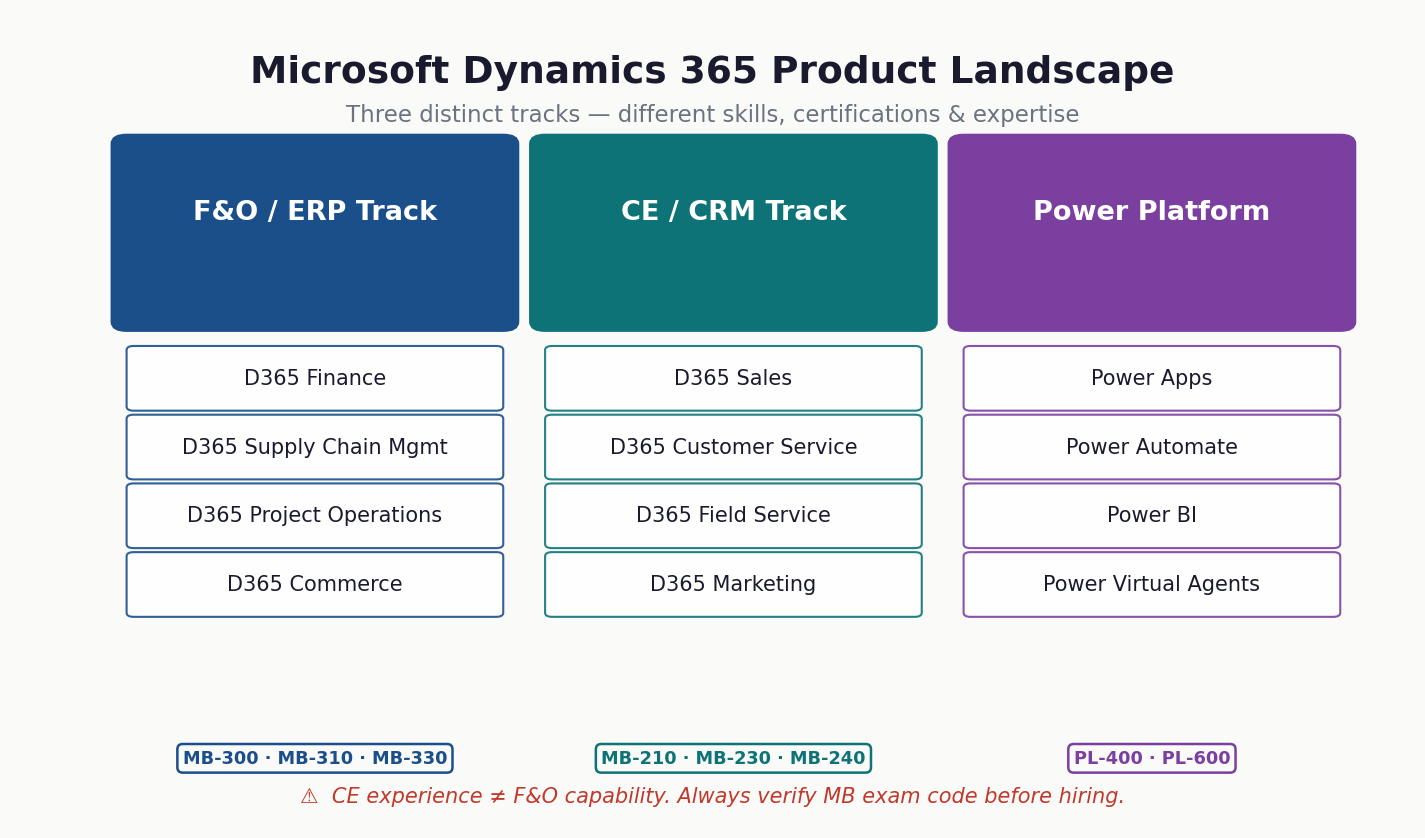
Microsoft Dynamics 365 is the enterprise application suite built on Microsoft Azure combining ERP (Finance, Operations, Supply Chain, Project Operations) and CRM (Sales, Customer Service, Field Service, Marketing) with Power Platform (Power Apps, Power Automate, Power BI, Power Virtual Agents) as the underlying extensibility and automation layer.
India has one of the largest Microsoft Dynamics talent pools globally, driven by Microsoft’s India engineering presence in Hyderabad (Microsoft India HQ), a large Microsoft partner ecosystem, and decades of Dynamics AX/NAV delivery from Indian SI firms.
The critical product separation:
The most important thing to understand about D365 talent is that “Dynamics 365 experience” covers fundamentally different products:
- Dynamics 365 Finance and Operations (F&O / ERP track): Dynamics 365 Finance, Dynamics 365 Supply Chain Management, Dynamics 365 Project Operations, Dynamics 365 Commerce. These are enterprise ERP applications successor to Dynamics AX. They require ERP implementation experience, accounting knowledge (for Finance), supply chain knowledge (for SCM), and X++ development skills for customisation.
- Dynamics 365 Customer Engagement (CE / CRM track): Dynamics 365 Sales, Dynamics 365 Customer Service, Dynamics 365 Field Service, Dynamics 365 Marketing. These are CRM applications successor to Dynamics CRM. They require CRM implementation experience, customer relationship process knowledge, and Power Platform skills for customisation.
- Power Platform: Power Apps, Power Automate, Power BI, Power Virtual Agents, Power Pages. These are Microsoft’s low-code/no-code development platform and analytics tools. Power Platform runs across both F&O and CE and is used for extensions, automation, and analytics on both product tracks.
A consultant with D365 CE (Sales and Customer Service) experience cannot implement D365 F&O (Finance and Operations) without specific ERP training. The products share a brand and a Microsoft Azure foundation. The application layer, data model, configuration approach, and required domain knowledge are completely different.
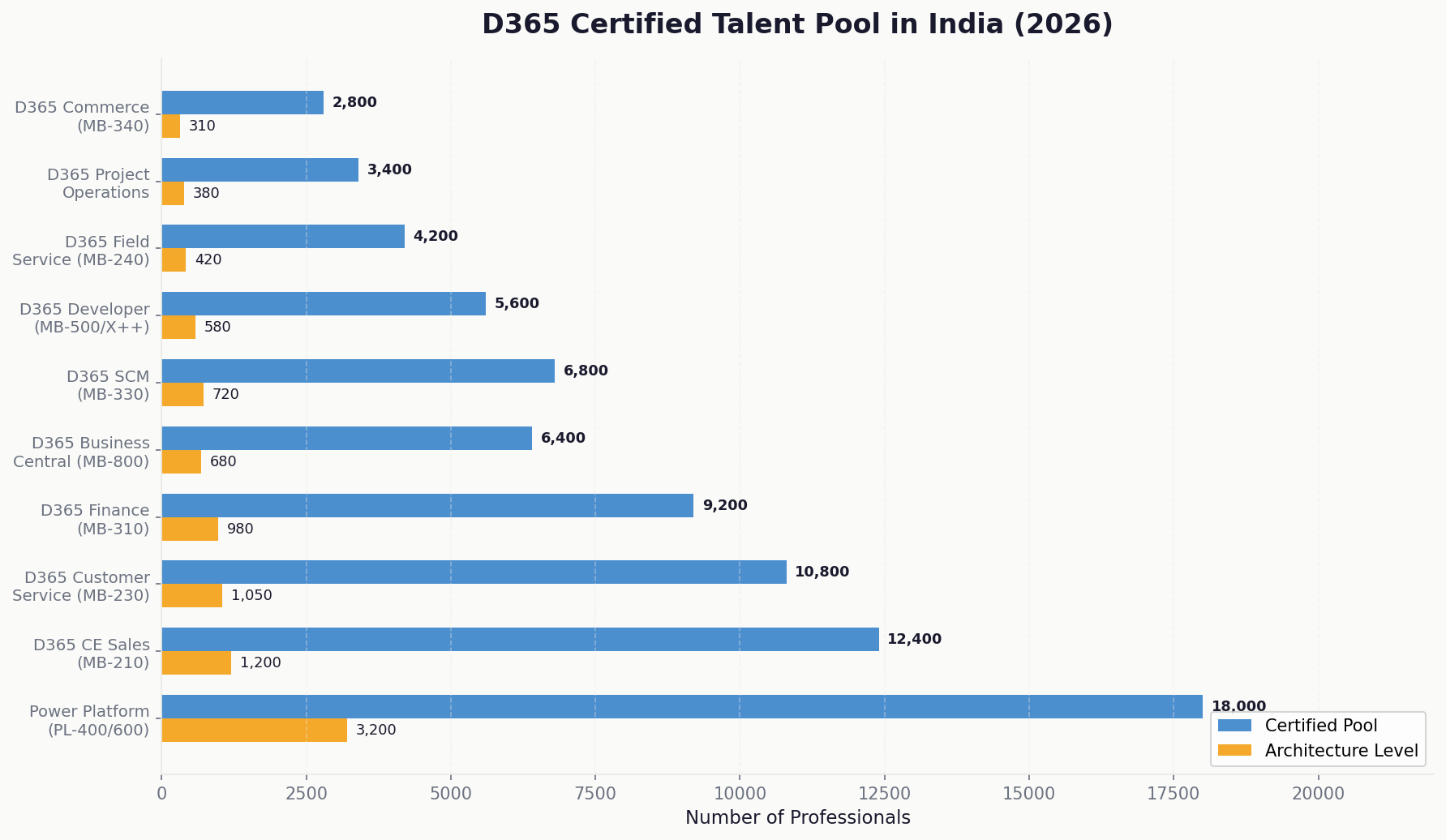
The India pool by product:
| Product | Estimated India Certified Pool | Architecture-Level |
| D365 Finance (MB-310) | ~9,200 | ~980 |
| D365 Supply Chain Management (MB-330) | ~6,800 | ~720 |
| D365 Project Operations | ~3,400 | ~380 |
| D365 Commerce (MB-340) | ~2,800 | ~310 |
| D365 CE Sales (MB-210) | ~12,400 | ~1,200 |
| D365 Customer Service (MB-230) | ~10,800 | ~1,050 |
| D365 Field Service (MB-240) | ~4,200 | ~420 |
| Power Platform (PL-400, PL-600) | ~18,000 | ~3,200 |
| D365 Developer (MB-500, X++) | ~5,600 | ~580 |
| D365 Business Central (MB-800) | ~6,400 | ~680 |
The legacy Dynamics AX advantage and risk:
India has a large pool of Dynamics AX (the predecessor to D365 F&O) consultants from years of AX 2009, AX 2012, and AX 2012 R3 delivery. This is an advantage Dynamics AX consultants have ERP domain knowledge and Microsoft ERP architecture understanding that maps well to D365 F&O.
The risk: AX 2012 and D365 F&O have significant architectural differences. AX 2012 runs on SQL Server with on-premise deployment. D365 F&O runs on Azure with a different development model, a different security framework, and a cloud-first deployment architecture. An AX 2012 consultant needs specific D365 F&O training before they are productive on a current D365 F&O program.
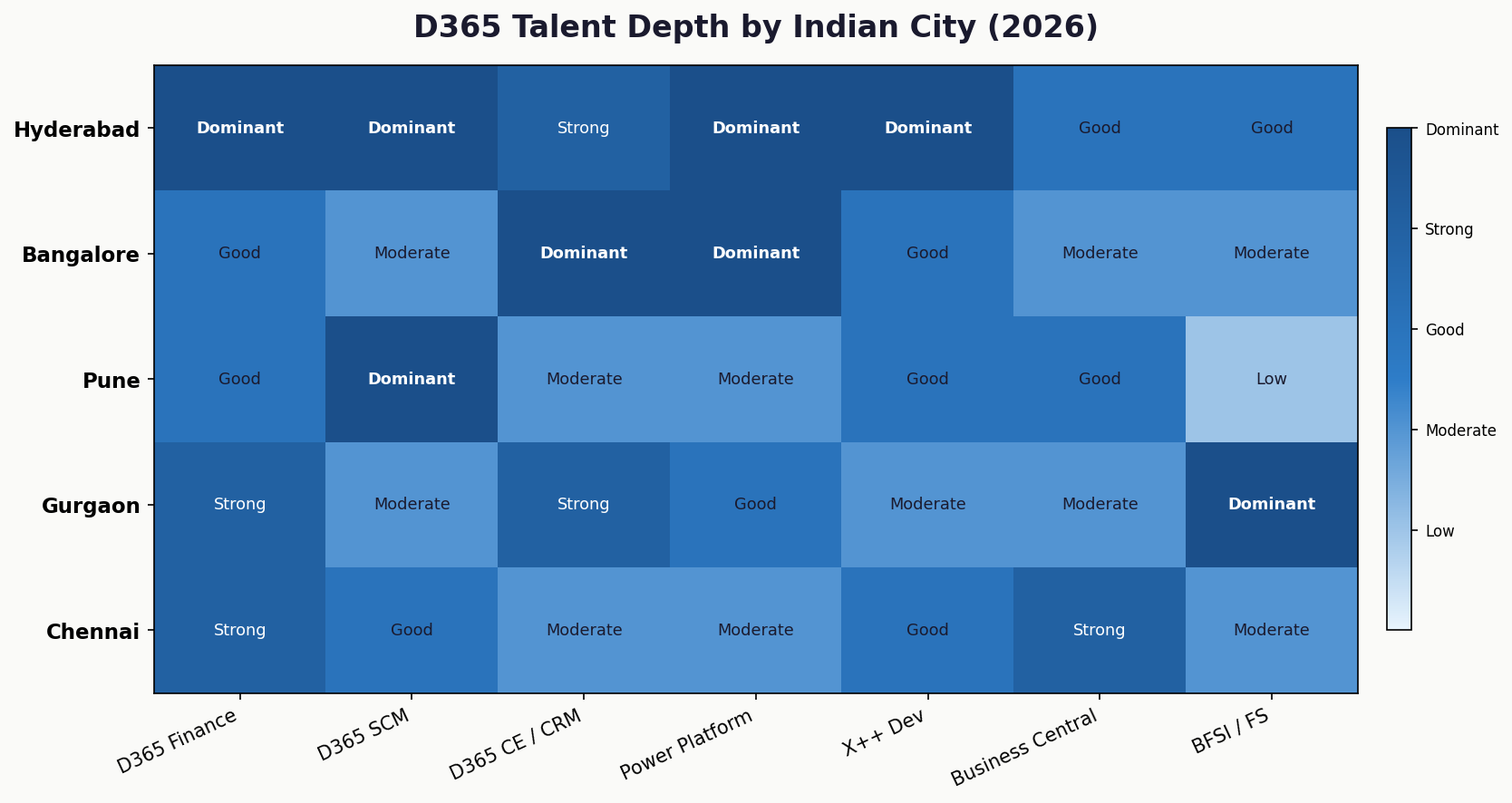
Where the talent lives:
| City | Dominant D365 Specialisations | Why |
| Hyderabad | D365 F&O Finance and SCM, D365 CE, Power Platform, D365 developer (X++) | Microsoft India HQ effect. Largest Microsoft ecosystem in India. Deep D365 talent across all products. |
| Bangalore | Power Platform, D365 CE, D365 F&O cloud-native, Azure integration | Cloud-native development talent. D365 CE and Power Platform focus. |
| Pune | D365 F&O manufacturing (SCM, Production), Dynamics AX migration | SI delivery centers. Manufacturing vertical depth from AX delivery. Transitioning to D365 F&O. |
| Gurgaon | D365 for BFSI, D365 CE for financial services, D365 Finance for banking | BFSI GCC concentration. Financial services D365 programs. |
| Chennai | Dynamics AX legacy support, D365 F&O Finance, D365 Business Central | Legacy AX delivery transitioning to D365. Strong Finance functional depth. |
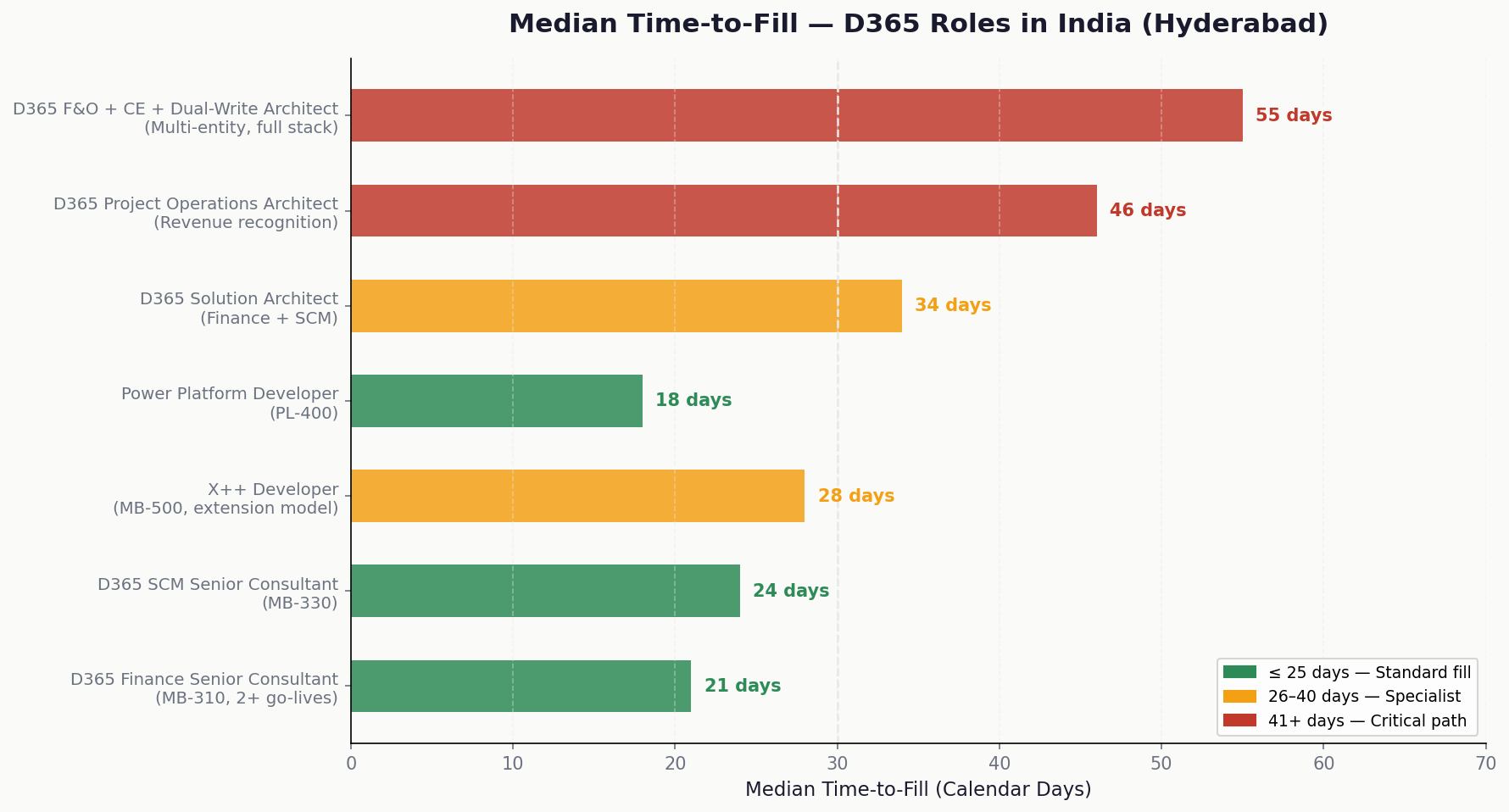
Supersourcing Index: Across 96 D365 placements in the Supersourcing GCC Benchmark 2026, median time-to-fill for a Senior D365 Finance Consultant (MB-310 certified, 2+ go-lives) in Hyderabad was 21 calendar days. For a D365 Solution Architect with Finance and SCM depth: 34 days. For a D365 Project Operations architect with revenue recognition and resource scheduling experience: 46 days.
Red flag: Any vendor presenting D365 CE credentials for a D365 F&O program or vice versa. The Microsoft Learn certification names are specific MB-310 is Finance, MB-210 is Sales (CE). The certification code tells you the product track. Verify before scheduling.
What You’re Really Paying
Rate Table by Level
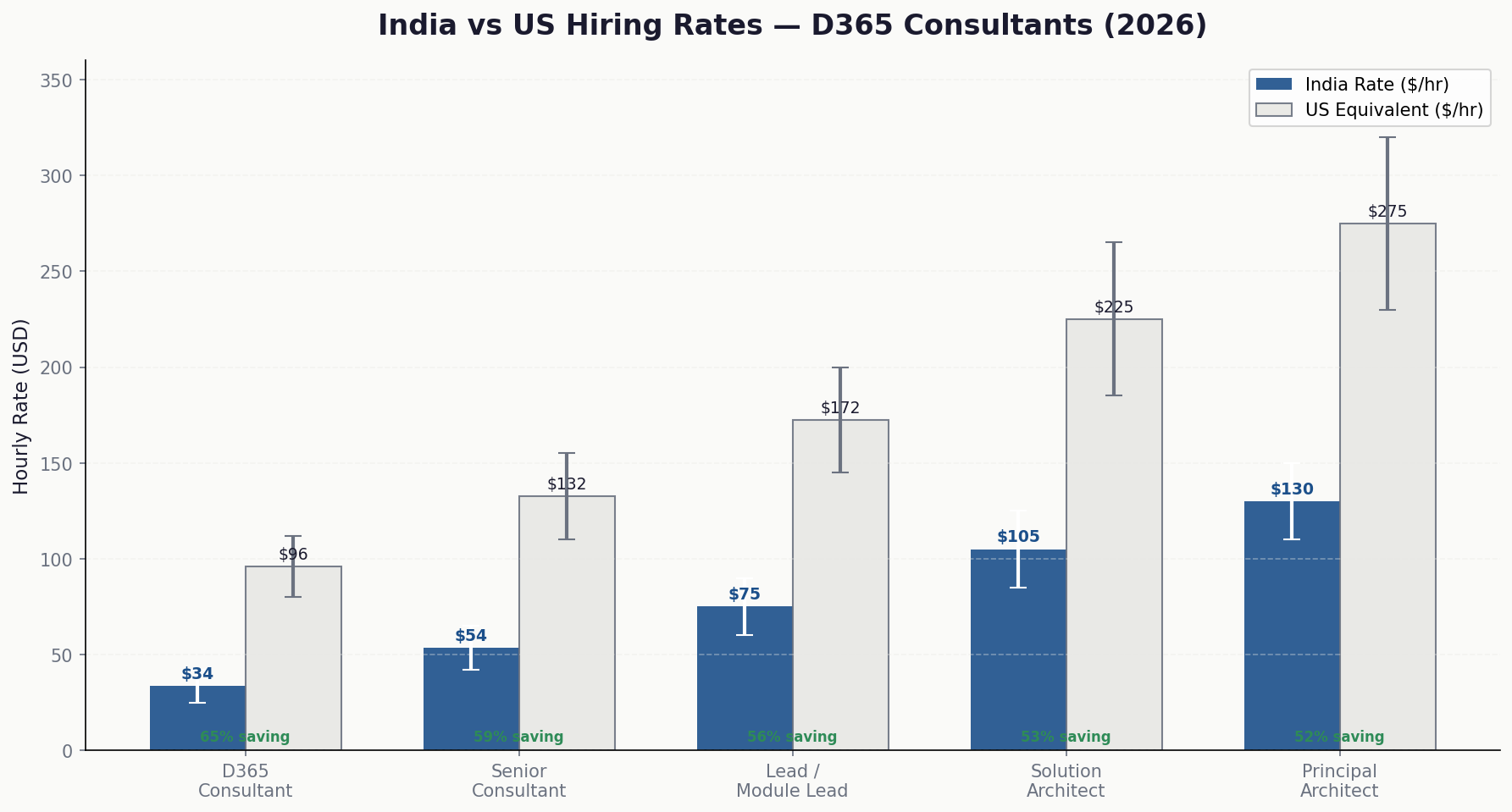
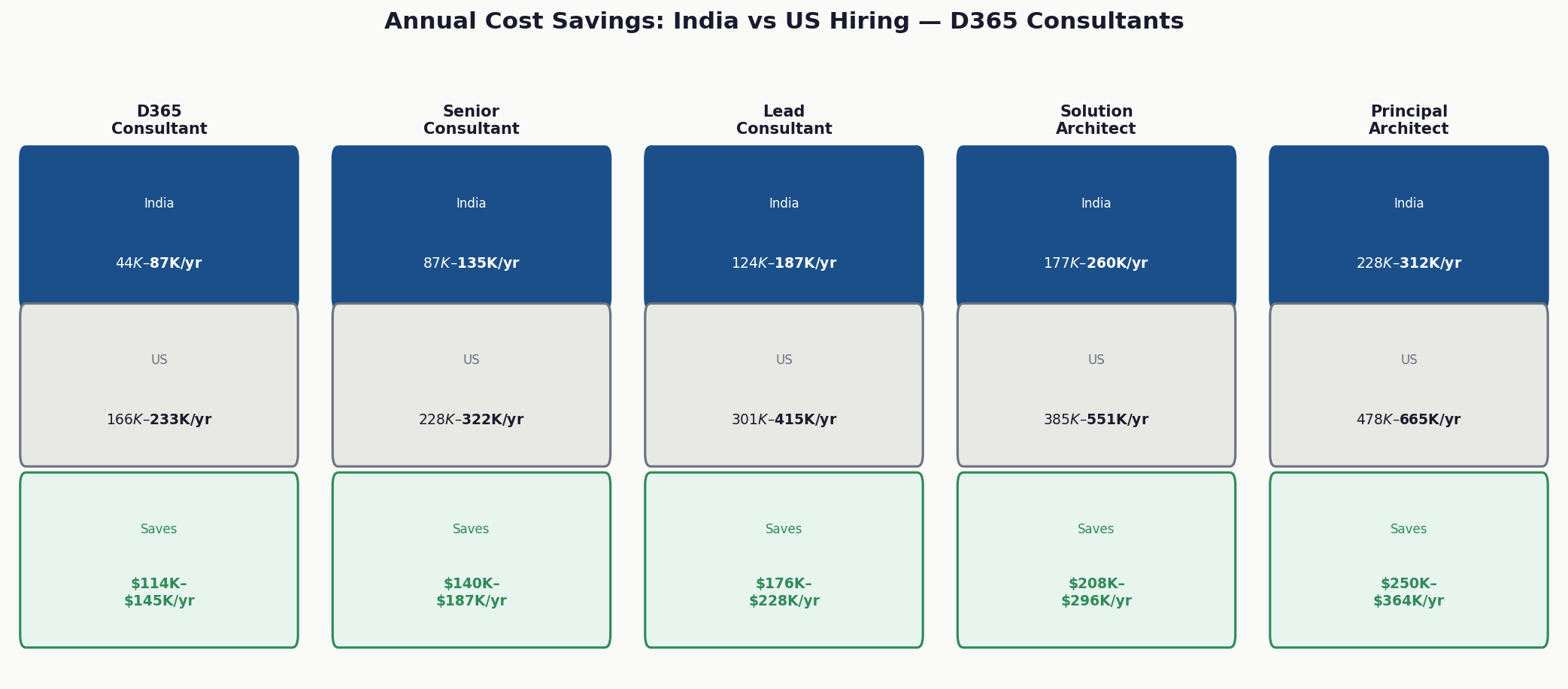
| Level | Experience | India Rate ($/hr) | US Equivalent ($/hr) | Annual Saving ($) |
| D365 Consultant | 2–4 yr | $25–42 | $80–112 | $114K–$145K |
| Senior Consultant | 4–7 yr | $42–65 | $110–155 | $140K–$187K |
| Lead Consultant / Module Lead | 6–10 yr | $60–90 | $145–200 | $176K–$228K |
| D365 Solution Architect | 8–12 yr | $85–125 | $185–265 | $208K–$296K |
| Principal Architect / Program Lead | 12+ yr | $110–150 | $230–320 | $250K–$364K |
Product premiums:
- D365 F&O over D365 CE: 15–22% premium. F&O requires ERP domain knowledge in addition to D365 technical skills. The pool is smaller.
- D365 Project Operations: 18–25% premium over standard F&O Finance. Project Operations requires both project management domain knowledge and D365 F&O technical depth.
- D365 Commerce: 15–20% premium. Retail and e-commerce integration complexity.
- X++ Developer (D365 F&O technical): 20–28% premium over functional consultants. X++ is D365 F&O’s development language, a specialist skill with a thin pool.
- Power Platform PL-600 (Power Platform Architect): 12–18% premium over PL-400 (developer level).
The 4 Cost Layers
- Layer 1 Gross CTC Senior D365 Finance Consultant: ₹26–40 LPA. At ₹96.4/$1: $27K–$41K annually.
- Layer 2 Employer Burden: 22–28% on top of gross CTC.
- Layer 3 Vendor Margin: 19–24%.
- Layer 4 What Hits Your Invoice Senior D365 Finance Consultant: $42–65/hr. A 10-consultant team at blended $56/hr costs $1.12M annually. US equivalent: $2.6–3.1M. Annual saving: $1.5–2.0M.
The Certification Hierarchy What Actually Matters
Microsoft Learn certifications are publicly verifiable at learn.microsoft.com/certifications. Every active Microsoft certification appears in the candidate’s public Microsoft Learn profile if they’ve made it public, or can be verified via the shared credential link the candidate provides.
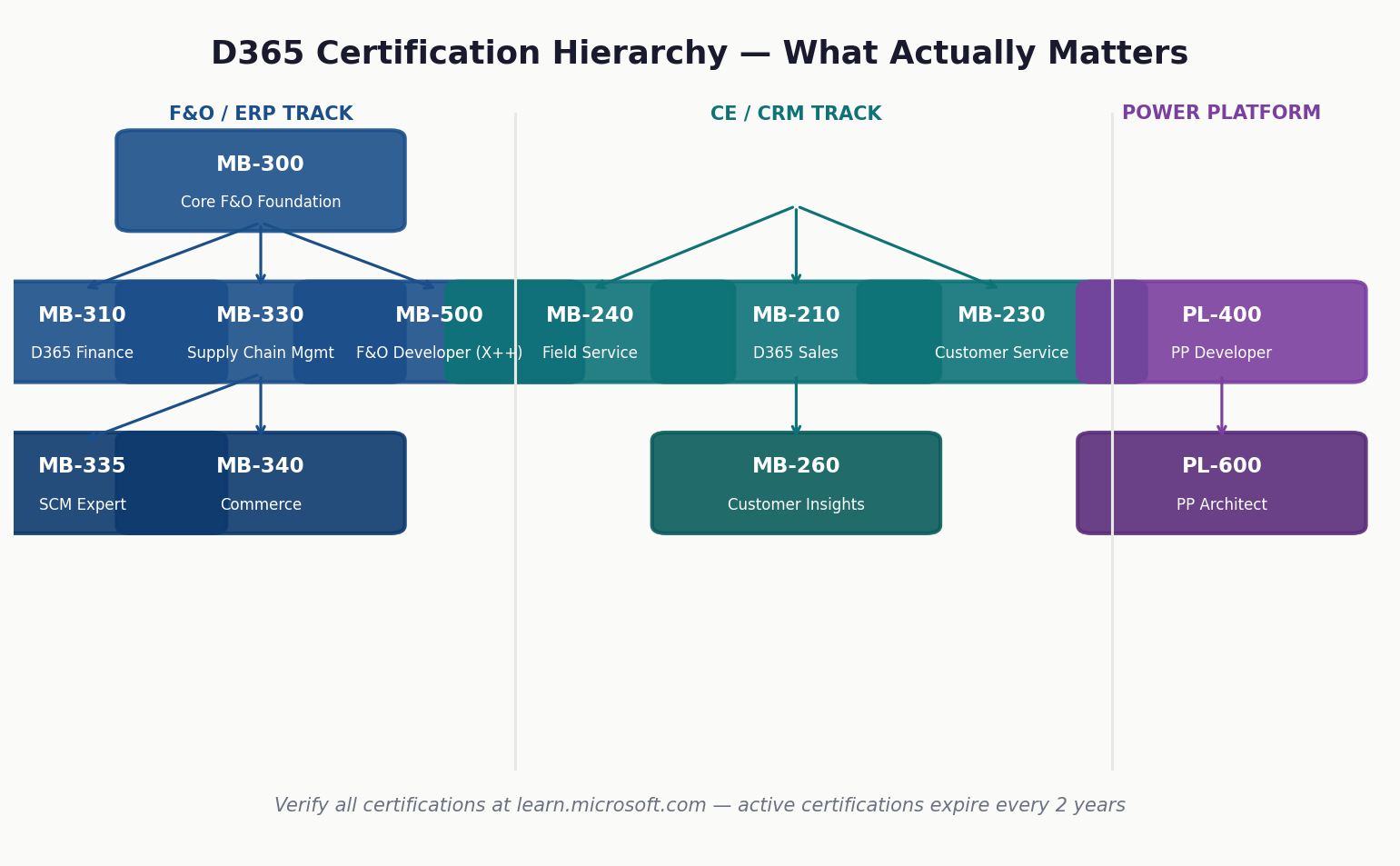
D365 Finance and Operations certification track:
- MB-300: Microsoft Dynamics 365: Core Finance and Operations the baseline for all F&O consultants. Tests core concepts, navigation, and fundamental configuration. Required foundation.
- MB-310: Microsoft Dynamics 365 Finance module certification for D365 Finance. Tests general ledger, accounts payable, accounts receivable, cash and bank management, budgeting, fixed assets. Required for Finance consultants.
- MB-330: Microsoft Dynamics 365 Supply Chain Management module certification for D365 SCM. Tests procurement, inventory, warehouse, transportation, production. Required for SCM consultants.
- MB-335: Microsoft Dynamics 365 Supply Chain Management, Expert advanced SCM certification covering complex manufacturing, advanced warehouse, and IoT integration.
- MB-340: Microsoft Dynamics 365 Commerce retail-specific module certification.
- MB-500: Microsoft Dynamics 365: Finance and Operations Apps Developer developer certification testing X++ development, extension framework, and technical architecture.
- PL-400: Microsoft Power Platform Developer Power Platform development certification.
- PL-600: Microsoft Power Platform Solution Architect architect-level Power Platform certification.
D365 Customer Engagement certification track:
- MB-200: Microsoft Power Platform + Dynamics 365 Core (now split into PL-900 and role-specific) foundational.
- MB-210: Microsoft Dynamics 365 Sales CE Sales module certification.
- MB-230: Microsoft Dynamics 365 Customer Service CE Customer Service module certification.
- MB-240: Microsoft Dynamics 365 Field Service Field Service module certification.
- MB-260: Microsoft Dynamics 365 Customer Insights Customer Data Platform certification.
How to verify: Ask the candidate to share their Microsoft Learn profile URL or the Credly badge link for each certification. Microsoft Learn profiles are publicly accessible at learn.microsoft.com/en-us/users/[username]/. Every active certification appears with the exam code, certification name, and expiry date. Verify the exam code matches the product track MB-310 is Finance, MB-210 is Sales (CE). They look different on the certification but a shared profile link makes verification unambiguous.
The AX 2012 vs D365 F&O distinction: Dynamics AX 2012 certifications (MB6-xxx series) are legacy credentials for the on-premise ERP product. D365 F&O certifications (MB-300/MB-310/MB-330 series) are current. An MB6-xxx certification is not a D365 F&O credential. For current D365 F&O programs, require MB-300 plus the relevant module certification (MB-310 for Finance, MB-330 for SCM).
The JD That Attracts the Right Candidates
JD 1: Senior D365 Finance Consultant (4–7 years)
Senior D365 Finance Consultant Remote from India Engagement: Staff Augmentation | Duration: 15 months Rate: ₹26–40 LPA CTC equivalent | Billing: $42–65/hr (vendor-facing)
What you’ll own: D365 Finance configuration for a professional services company general ledger setup, chart of accounts design, dimension configuration, AP and AR workflow design, fixed asset book configuration, and financial reporting. You’ll work in a D365 Finance environment on Azure, migrating from a legacy Sage system. Measured on configuration accuracy, integration test pass rate, and financial reporting output correctness.
What we require:
- MB-310: Microsoft Dynamics 365 Finance certification (verified at learn.microsoft.com before interview)
- MB-300 core foundation certification
- 4–7 years D365 or Dynamics AX experience, minimum 1 complete D365 Finance go-live (not AX 2012 only)
- Chart of accounts and dimension design financial dimension configuration, main account categories, account structure design
- AP and AR workflow configuration vendor invoice approval using D365 workflow engine, payment journal automation
- Financial reporting Financial Reporter (Management Reporter) or D365 financial reports
- Multi-entity/multi-currency experience preferred
What disqualifies you:
- D365 CE (CRM) experience only different product, different skills
- Dynamics AX 2012 only experience with no D365 F&O production exposure
- D365 Finance experience limited to training environments or Microsoft sandbox
Interview process: Technical screen (30 min) → Live D365 Finance configuration scenario (90 min, D365 sandbox access) → Financial dimension design discussion (45 min)
JD 2: D365 F&O Solution Architect Finance + SCM (10+ years)
D365 F&O Solution Architect India GCC or BOT Engagement: GCC Build or BOT | Duration: 24+ months CTC: ₹75–108 LPA | Billing: $88–125/hr (vendor-facing)
What you’ll own: End-to-end D365 F&O architecture across Finance and Supply Chain Management for an ERP migration from SAP ECC. You will own the solution design, data migration strategy, Azure integration architecture (using Azure Data Factory and D365 dual-write), security role model, extension strategy (X++ vs Power Platform), and deployment approach (Microsoft-managed vs customer-managed environments). Technical authority for 10–18 D365 consultants.
What we require:
- MB-300, MB-310, MB-330 all active (verified at learn.microsoft.com)
- MB-500 (Developer) preferred for extension architecture ownership
- 10+ years Microsoft ERP experience (AX + D365 F&O), minimum 3 D365 F&O go-lives as architect
- Azure integration architecture D365 Data Entities for integration, Azure Data Factory for ETL, Power Automate for lightweight automation
- Extension vs customisation decisions X++ extension model vs Power Platform vs standard D365 configuration approach
- Data migration architecture data entities, DIXF (Data Import Export Framework), migration approach from SAP or legacy ERP
- Security role design D365 privilege, duty, and role model design at enterprise scale
Interview process: Architecture scenario (60 min) → DIXF data migration design (45 min) → Extension strategy discussion (30 min) → Reference call with prior VP IT or CIO
What most enterprise JDs get wrong for D365:
They say “Microsoft Dynamics 365 experience required” returning CE consultants for F&O programs and vice versa. They don’t specify the product (Finance, SCM, CE, Project Operations) as the single most important filter. They treat AX 2012 and D365 F&O as equivalent; they are not.
They list “Power Platform experience” for F&O roles where X++ is the required extension to approach different technical skills. And they don’t specify go-live count and product version which allows training environment experience to present as production experience.
How to Verify Experience Not Just Credentials
The 3 verification steps before any D365 interview:
Step 1: learn.microsoft.com certification verification
Ask the candidate to share their Microsoft Learn profile URL or individual Credly badge link for each claimed certification. Go to the profile or badge every active Microsoft certification appears with the exam code and expiry date. Verify: MB-310 for Finance (not MB-210 which is Sales/CE), MB-330 for SCM, MB-500 for Developer. The exam code tells you the product track unambiguously.
Step 2: Product track separation in writing
Before scheduling, ask: “Is your primary D365 experience on the Finance and Operations track (MB-300/MB-310/MB-330) or the Customer Engagement track (MB-210/MB-230)? Have you delivered a D365 F&O go-live or a D365 CE go-live?” The answer tells you immediately whether the candidate is relevant for your program. CE experience for an F&O program requires stopping here.
Step 3: Implementation specificity
Ask: “On your most recent D365 Finance go-live, what was the approximate revenue of the client, which Finance modules were configured, and how did you handle the data migration from the legacy system?” Real D365 Finance consultants answer with specific numbers and data migration mechanics (DIXF framework, data entities, migration templates). AX 2012 consultants describe AX data migration (AIF, custom import tools). CE consultants describe CRM data migration (record import, customer record transformation). The answer tells you everything.
The 5 interview questions that expose fake seniority:
Q1: Financial Dimension Design “Walk me through your financial dimension structure design for a multi-entity D365 Finance deployment, how you chose which dimensions to configure, how you handled the intercompany dimension, and how your dimension structure supported management reporting.”
Real answer: describes D365 Finance’s dimension framework financial dimensions (cost centre, department, project, business unit), account structures (linking dimensions to main accounts), advanced rules (additional dimensions for specific account ranges), and how they designed the dimension structure for management reporting which dimensions are required, which are optional, which appear on which transaction types. They describe the intercompany dimension approach as either a dedicated intercompany dimension value or using the company as the intercompany identifier. They make specific design decisions.
Consultant without D365 Finance depth describes dimensions conceptually. Cannot describe account structures, advanced rules, or the intercompany dimension design approach.
Q2: DIXF Data Migration “Describe how you’ve used DIXF (Data Import Export Framework) to migrate vendor master data and open purchase orders from a legacy system into D365 F&O the data entity selection, the file format, the staging process, and error handling.”
Real answer: describes DIXF selecting the appropriate data entity (Vendors V2 entity for vendor master, Purchase Order Headers and Lines entities for open POs), the file format (Excel or CSV), the staging table approach (data loads to a staging table before committing to the target), the validation in staging (reviewing staging table errors before final push to target), and error handling correcting staging records and re-running the commit. They describe the DIXF job configuration and the import process in D365’s Data Management workspace.
AX 2012 consultant describes AX import tools (AIF, DIXF in AX different implementation). CE consultants cannot answer for F&O data entities.
Q3: X++ Extension Design “Explain the D365 F&O extension model: how do you extend a standard D365 table, form, or class without modifying the base code, and why is this important for upgrade safety?”
Real answer: describes D365 F&O’s extension-first development model table extensions (adding fields to existing tables via extension classes), form extensions (adding controls to existing forms via extension), class extensions (adding methods or augmenting existing methods via class augmentation / CoC Chain of Command pattern). Upgrade safety importance: extensions don’t modify base code, so Microsoft updates to base classes don’t break extensions. This contrasts with AX 2012’s overlayering approach which modified base code directly and created upgrade conflicts. They describe specific extension scenarios and the CoC pattern specifically.
AX 2012 consultant describes the AX 2012 overlayering approach (modifying MorphX directly). Cannot describe the D365 extension model or Chain of Command.
Q4: D365 Finance and Operations Security “Describe how you’ve designed a security model for a 3,000-user D365 F&O deployment, the privilege, duty, and role hierarchy, how you handled segregation of duties, and how you designed the security for a multi-company environment.”
Real answer: describes D365 F&O’s security framework privileges (access to individual objects menu items, tables, forms), duties (logical groupings of privileges for a business function), roles (collections of duties for a job function), and security groups (user assignment management). SOD configuration identifying conflicting duty assignments and configuring the SOD rule to alert or block. Multi-company security D365 F&O’s company accounts structure and how security policies apply across companies. They describe specific role and duty design decisions.
Consultant without D365 F&O security depth describes security generically. Cannot describe the privilege-duty-role hierarchy or D365’s SOD configuration approach.
Q5: Power Platform and D365 F&O Integration “Describe when you would use Power Automate vs X++ custom code vs Azure Logic Apps for a business process automation requirement in a D365 F&O program, and walk me through a specific implementation decision you’ve made.”
Real answer: describes the decision framework Power Automate for lightweight, user-triggered workflows that don’t require complex business logic or high-volume transaction processing (e.g., approval notifications, simple data lookups); X++ for complex business logic that needs to run inside the D365 F&O application layer with transaction integrity and performance (e.g., custom invoice validation that needs to run synchronously with the invoice posting); Azure Logic Apps for external system integrations that need reliable delivery, retry logic, and monitoring at enterprise scale. They describe a specific scenario where they made this decision and why.
Consultant without cross-platform experience describes Power Automate and X++ as alternatives without clear selection criteria. Cannot describe the performance and transaction integrity distinction between Power Automate and X++.
8 CV red flags:
- D365 CE certifications (MB-210, MB-230) listed for a D365 F&O program requirement
- Dynamics AX 2012 certifications (MB6-xxx) listed as D365 F&O credentials
- “Microsoft Dynamics 365 experience” without specifying CE or F&O product track
- “D365 Finance” experience that describes only chart of accounts setup without mentioning financial dimensions or subledger accounting
- “D365 technical developer” without specifying X++ vs Power Platform fundamentally different skills
- “Power Platform architect” presented as D365 F&O architect capability Power Platform and D365 F&O require different core skills
- D365 go-live count claimed for training sandboxes or Microsoft demo environments ask for client name and scale
- “D365 Project Operations” experience without being able to describe resource scheduling, time and expense integration, or project billing Project Operations has specific functionality that generic F&O consultants don’t know
How to Source What’s Working, What Isn’t
What’s working in 2026:
-
- Microsoft Partner Network India. Microsoft maintains a tiered partner ecosystem Microsoft Gold, Silver, and Solutions Partner designations. D365 implementations must be delivered by Microsoft-certified partners. An inquiry to 3–4 Microsoft Solutions Partner (Business Applications) firms in India about available benches with product track specificity yields verified candidates.
- Microsoft Tech Community India. Microsoft’s technical community has strong India participation Microsoft Most Valuable Professional (MVP) program has approximately 200+ active MVPs in India across Dynamics 365 and Power Platform. MVPs are identifiable, senior practitioners with verifiable public contributions.
- 3 ready-to-use LinkedIn boolean search strings:
- String 1 (D365 Finance Senior): “Dynamics 365 Finance” AND (“MB-310” OR “F&O” OR “Finance Operations”) AND (“Senior” OR “Lead” OR “Architect”) AND (“Hyderabad” OR “Bangalore”)
- String 2 (D365 Project Operations): “Dynamics 365 Project Operations” AND (“revenue recognition” OR “resource scheduling” OR “project billing”) AND “India”
- String 3 (X++ Developer): “X++” AND (“Dynamics 365” OR “D365”) AND (“developer” OR “technical”) AND “India”
- Microsoft Dynamics Community events. Microsoft Dynamics User Group (MDUG) and DynamicsCon have India chapter activity. Community speakers and contributors are identifiable senior practitioners. The D365 F&O community in India is smaller than the CE community F&O contributors are easier to identify and approach directly.
Supersourcing pre-vetted bench. For Senior D365 Finance Consultants (MB-310 certified, D365 go-live experience), median fill time 21 calendar days. For D365 Solution Architects (Finance + SCM), 34 days with certification verified before any CV submission.
What isn’t working:
- “Microsoft Dynamics 365” job postings without product track specification. Returns CE consultants, Power Platform developers, and F&O consultants indiscriminately. The product track F&O or CE is the mandatory filter. Without it, you’re reviewing the broadest possible pool with the lowest signal-to-noise ratio.
- Accepting legacy AX certifications for D365 F&O programs. The transition from Dynamics AX to D365 F&O is real and the ERP knowledge transfers but the technical architecture and certification are different. AX 2012 certifications do not verify D365 F&O capability. Require MB-300 + MB-310/MB-330 for D365 F&O programs.
- Power Platform depth as a substitute for F&O functional depth. Power Platform is used in almost every D365 program. Power Platform skill is not D365 F&O functional skill. A Power Platform architect who has never configured a D365 Finance general ledger cannot configure a general ledger. They can automate processes around it. The distinction matters for resource planning.
The Contract Stack for D365 Engagements
Clause 1: Individual Resource Approval with Product Track and Certification Code
SOW schedule must list: name, Microsoft Learn certification codes (MB-310 for Finance, MB-330 for SCM, MB-210 for CE the code specifies the product), go-live count, and product scope. A CE consultant substituted for an F&O requirement with different certification codes is a verifiable contractual breach.
Clause 2: IP Assignment Power Platform Solutions, X++ Extensions, and Integration Logic
Must cover: Power Apps solution packages (exported as managed solutions from D365), Power Automate cloud flows, X++ extension classes and models, Azure integration logic (Data Factory pipelines, Logic Apps), SSRS report designs, and configuration documentation. Power Platform solutions are packaged as managed or unmanaged solutions and specify that all solutions are exported and handed over as part of engagement closure.
Clause 3: Power Platform Solution Management
Require that all custom Power Platform development is packaged in named Solutions in the D365 tenant not deployed directly to the default solution. Named solutions with version control enable managed deployment and proper ALM (Application Lifecycle Management). Direct deployment to the default solution creates ungoverned customisations that are difficult to migrate and manage.
Clause 4: X++ Code in Approved Extension Model
All X++ development must use D365 F&O’s extension model (not overlayering). A code review gate before production deployment must verify that no base code has been modified, only extensions. Extensions that modify base code create upgrade conflicts that appear at every Microsoft update cycle.
Clause 5: Instance Access Revocation 24 Hours
All vendor consultant access to D365 production, UAT, and development environments must be revoked within 24 hours of engagement end. Azure AD user accounts, Power Platform maker access, and D365 administrator access must all be reviewed and revoked. D365 environments connected to Azure AD mean that a missed revocation leaves access active.
Running a D365 Team at Scale
- Environment strategy. D365 F&O uses a Microsoft Lifecycle Services (LCS)-managed environment hierarchy Development, Build, UAT, Production. All configuration changes are moved through this hierarchy via packages and deployable packages not through direct environment access. Offshore developers should work in Development environments. Production deployments are managed through LCS with formal release management.
- Power Platform ALM. Power Platform customisations must be managed in named Solutions with version control. The publisher prefix for all custom components should follow your organisation’s naming convention. Solution imports to UAT and production must go through a formal approval process with no direct production changes to Power Platform components. Unmanaged solutions in production are a governance anti-pattern that offshore teams default to when ALM is not enforced.
- ISV solution management. D365 programs frequently include ISV (Independent Software Vendor) solutions and third-party extensions installed from Microsoft AppSource. ISV solutions interact with custom development. Require that all ISV solution selections are approved by the solution architect before installation, and that the ISV upgrade path is evaluated before committing to any ISV solution in production.
- Quarterly update management. Microsoft releases quarterly updates to D365 F&O (and monthly updates to CE and Power Platform). Each update must be deployed to the development and UAT environments, tested, and then deployed to production. Offshore teams must maintain awareness of the update schedule and their impact on custom X++ extensions and Power Platform solutions.
Early warning signals:
- X++ code developed against base classes rather than using extension model
- Power Platform customisations deployed to default solution without named solution management
- Environment bypasses developers requesting direct production access for “quick fixes”
- ISV solutions installed without solution architect approval
- LinkedIn activity D365 certifications updated, Microsoft partner connections increasing
Retention levers: Product breadth D365 consultants who expand from Finance to SCM, or from CE to Power Platform on your program are building career value. Microsoft certifications are modular; each new module certification is achievable and valuable. Certification sponsorship MB-335 (Supply Chain Expert), PL-600 (Power Platform Architect) are meaningful career milestones. Azure integration exposure D365 consultants who extend into Azure Data Factory, Azure Service Bus, and Azure API Management are building skills that command premium market rates.
When Things Go Wrong
Pattern 1: The CE-for-F&O Substitution
Described in Section 1. D365 CE (Project Operations) experience substituted for D365 F&O (Finance and Operations). The product track certification verification (Step 1 in Section 8) and the product track separation question (Step 2) catch this before the first consultant is onboarded.
Pattern 2: The Overlayering Crisis
A US manufacturing company hired an offshore D365 F&O team that included two developers with strong Dynamics AX 2012 backgrounds. In AX 2012, customisation used overlayering modifying Microsoft base code directly. They applied the same approach in D365 F&O.
Microsoft’s quarterly update in month 8 deployed changes to two base classes that the team had overlayered. The update broke both custom modifications. The UAT environment was deployed with the broken code before the issue was discovered. Two weeks of emergency code remediation, migration to the extension model, and re-testing. $95K. The X++ extension model compliance clause in Section 10 and the extension design question (Q3 in Section 8) would have prevented this entirely.
Pattern 3: The Power Platform Default Solution
A UK professional services company’s D365 CE and Power Platform implementation had all custom Power Platform components deployed directly to the default solution standard practice when teams don’t enforce ALM. After 18 months, the default solution contained 340 custom components with no version history, no rollback capability, and no documentation of what each component did.
When a critical Power Automate flow started failing, diagnosing the issue required reviewing hundreds of ungoverned components to find dependencies. The fix took 3 days. The documentation and ALM remediation took 6 weeks. £95K. The Power Platform ALM requirement in the contract and the Solution management clause would have established governance from the first sprint.
When India Is the Wrong Call
Scenario 1: D365 programs with significant German or Nordic statutory requirements.
D365 Finance for Germany (GoBD compliance, tax reporting, DATEV integration), Norway, Sweden, or Denmark (Scandinavian payroll and statutory reporting) requires both D365 Finance technical depth and country-specific statutory knowledge. India’s D365 pool has US, UK, and ANZ statutory depth. For complex continental European statutory requirements, consider EMEA-based consultants for the statutory configuration and India-based consultants for the standard Finance functional configuration.
Scenario 2: D365 Field Service for complex IoT and connected assets programs.
D365 Field Service with deep IoT integration (Azure IoT Hub, Connected Field Service for equipment monitoring), predictive maintenance, and complex scheduling optimization for large field workforces is a specialist implementation. The India pool has D365 Field Service depth but production experience with Azure IoT Hub integration and complex scheduling optimisation at scale is concentrated in a small number of specialist firms. Verify this specific experience before assuming the general D365 pool covers it.
Scenario 3: Sub-5 consultant programs with cross-product scope.
A 4-consultant program needing D365 Finance + D365 CE + Power Platform simultaneously requires three different specialist profiles. For small programs with multi-product scope, a Microsoft Solutions Partner boutique with multi-product certified consultants is a better fit than enterprise staff augmentation.
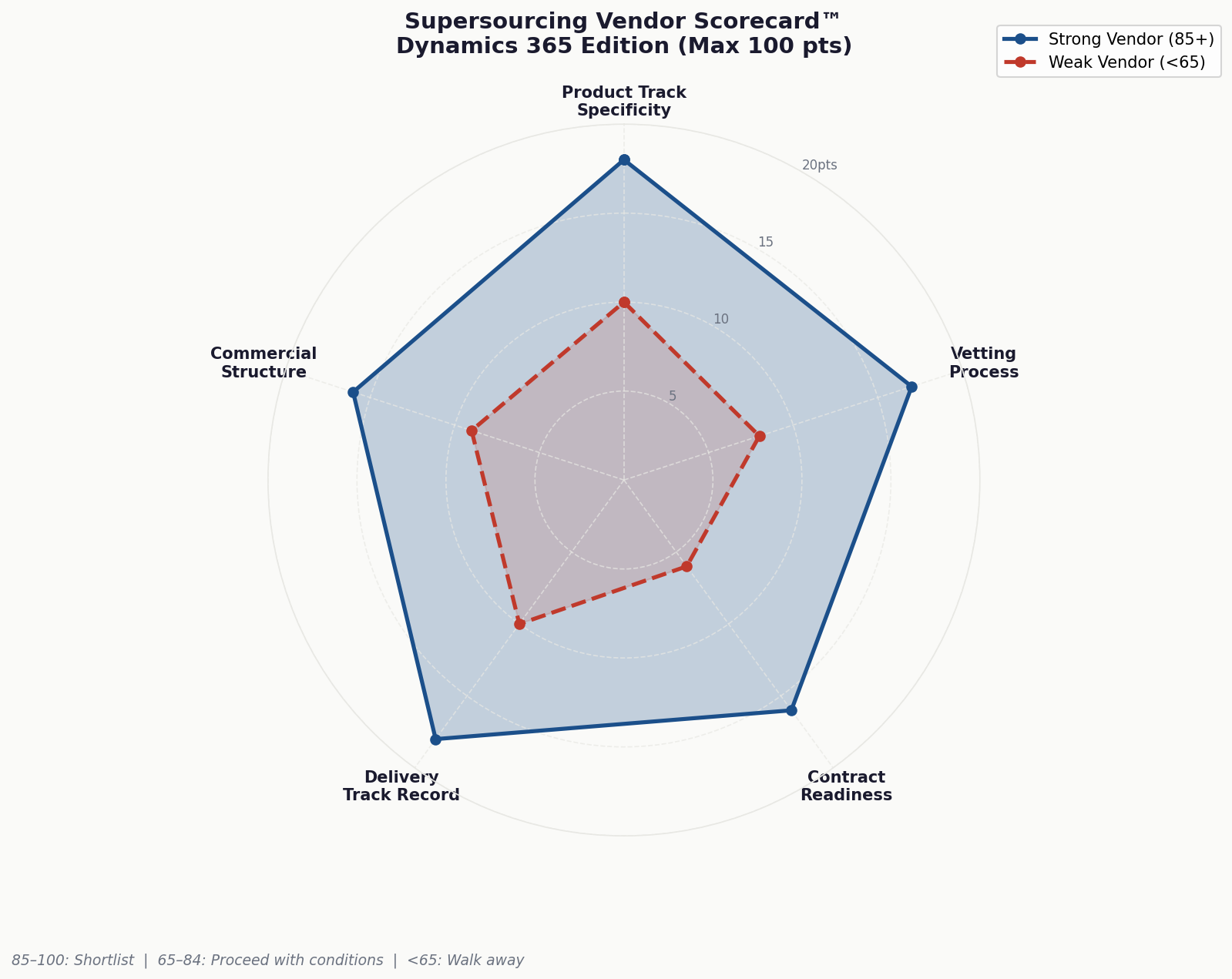
The Supersourcing Vendor Scorecard™ Dynamics 365 Edition
Score your vendor before you sign. Maximum 100 points. Minimum threshold: 65.
Category 1: Product Track Specificity (0–20 pts)
| Criterion | 0 | 10 | 20 |
| Can produce Microsoft Learn certification codes (MB-310 not MB-210) for all claimed bench within 24 hours | Cannot | Some | All bench, all codes confirmed |
| F&O vs CE distinction acknowledged proactively | Conflates them | Distinguishes when asked | Proactively verified with go-live list |
| AX 2012 vs D365 F&O distinction confirmed for claimed F&O bench | Conflates them | Distinguishes when asked | D365 go-live count confirmed separately |
Category 2: Vetting Process (0–20 pts)
| Criterion | 0 | 10 | 20 |
| Product track-specific technical assessment | Generic D365 | Product-specific written | Live D365 sandbox task |
| X++ extension model vs overlayering tested for developer roles | Not tested | Conceptual | Specific extension scenario required |
| DIXF data migration knowledge for F&O roles | Not tested | Conceptual | Specific entity and staging process |
Category 3: Contract Readiness (0–20 pts)
| Criterion | 0 | 10 | 20 |
| IP Assignment covering Power Platform solutions and X++ models | Not available | Available on request | Standard, items named |
| X++ extension model compliance clause (no overlayering) | Not present | Best effort | Contractual code review gate |
| Power Platform ALM requirement (named solutions) | Not present | Best effort | Contractual named solution requirement |
Category 4: D365 Delivery Track Record (0–20 pts)
| Criterion | 0 | 10 | 20 |
| Named D365 F&O go-live clients with product and module confirmed | None | Logo only | Named contact + product + go-live date |
| Cross-product programs (F&O + CE) verified | None | Claimed | Verified with reference |
| Attrition on D365 programs | Unknown / >22% | 16–22% | <16% |
Category 5: Commercial Structure (0–20 pts)
| Criterion | 0 | 10 | 20 |
| Rate card by product (F&O vs CE vs Power Platform) and certification | Single D365 rate | F&O/CE distinction | Full product and cert matrix |
| Substitution clause with product track and cert code equivalence | Not present | Available | Standard, MB code equivalence |
| SLA on replacement with product track match | None | Best effort | Contractual 14-day SLA |
Score interpretation: 85–100 shortlist; 65–84 proceed with conditions; 45–64 significant risk; below 45 walk.
15 Questions Buyers Actually Ask
Q: What is the difference between Dynamics 365 Finance and Operations and Dynamics 365 Customer Engagement?
Dynamics 365 Finance and Operations (F&O) is Microsoft’s enterprise ERP suite covering financial management, supply chain, manufacturing, and project management. It is the successor to Dynamics AX. Dynamics 365 Customer Engagement (CE) is Microsoft’s CRM suite covering sales, customer service, field service, and marketing. It is the successor to Dynamics CRM. They share the Microsoft brand and Azure infrastructure but have completely different application layers, data models, and required implementation expertise. An F&O consultant cannot implement CE without specific CRM training, and a CE consultant cannot implement F&O without specific ERP training.
Q: What is D365 Business Central and how is it different from D365 Finance?
Dynamics 365 Business Central is Microsoft’s mid-market ERP designed for small and medium enterprises with simpler financial management, inventory, and basic project requirements. Dynamics 365 Finance is Microsoft’s enterprise ERP designed for complex multi-entity, multi-currency financial management, advanced budgeting, and sophisticated accounting at enterprise scale. If your organisation has under 500 employees with straightforward financial management requirements, Business Central is likely the right fit. For large enterprises with complex multi-entity consolidation, advanced treasury management, or sophisticated project accounting: D365 Finance or D365 Project Operations.
Q: How do I verify a Microsoft Dynamics 365 certification?
Ask the candidate to share their Microsoft Learn profile URL (learn.microsoft.com/en-us/users/[username]/) or their Credly badge link for each claimed certification. Every active Microsoft certification appears in the Learn profile with the exam code and expiry date. The exam code is the key verification MB-310 is D365 Finance, MB-210 is D365 Sales (CE). They look similar on a CV but the codes are unambiguous. Certifications expire after two years and require renewal to check the expiry date.
Q: What is X++ and why does it matter for D365 F&O hiring?
X++ is Microsoft Dynamics 365 Finance and Operations’ proprietary development language, an object-oriented language built specifically for D365 F&O customisation and extension. All D365 F&O technical development uses X++ for business logic extensions (class augmentation, table extensions, form extensions). X++ skills are specific to D365 F & O; they don’t transfer to D365 CE, Power Platform, or other Microsoft products. A D365 F&O developer must have X++ skills. A Power Platform developer who has no X++ experience cannot deliver D365 F&O technical customisation. When hiring D365 F&O developers, require X++ experience and test it specifically in the technical interview.
Q: What is the D365 extension model and why does it matter?
D365 F&O’s extension model requires that all customisations are built as extensions of existing code rather than modifications to base code (overlayering). Extensions add new fields to existing tables, new methods to existing classes, or new controls to existing forms without modifying the original code. This means Microsoft’s quarterly updates don’t break customisations and extensions are separate from base code. Overlayering (the AX 2012 approach of modifying base code directly) creates upgrade conflicts every time Microsoft releases an update. For any D365 F&O developer role, require extension model compliance and verify it in the technical interview with Q3 in Section 8.
Q: What is Power Platform and how does it fit in a D365 program?
Power Platform is Microsoft’s suite of low-code/no-code tools Power Apps (custom apps), Power Automate (workflow automation), Power BI (analytics and reporting), and Power Virtual Agents (chatbots). Power Platform sits across both D365 F&O and D365 CE and is used for: lightweight automation that doesn’t require X++ code (Power Automate), custom canvas or model-driven apps (Power Apps), business intelligence and dashboards (Power BI), and process automation with D365 integration. Power Platform is not a replacement for X++ customisation in D365 F&O for complex business logic. It is a complement for user-facing automation and reporting, and uses X++ for transactional business logic that needs to run inside D365 F&O’s application layer.
Q: What is dual-write in D365 and when does it matter?
Dual-write is Microsoft’s real-time data synchronisation between D365 F&O (ERP) and D365 CE (CRM). If your program includes both D365 F&O and D365 CE, dual-write synchronises data between the two systems in real time customer records, product catalogue, inventory on-hand. Without dual-write, F&O and CE data is siloed. Dual-write requires specific configuration in both systems and has performance implications: write operations in one system immediately trigger write operations in the other. For programs including both F&O and CE, require dual-write configuration experience from your solution architect.
Q: Can AX 2012 consultants work on D365 F&O programs?
Yes with caveats. AX 2012 consultants have ERP domain knowledge and Microsoft ERP architecture understanding that maps well to D365 F&O. The transition requires: specific D365 F&O training on the extension model (not overlayering), familiarity with the D365 F&O cloud architecture (LCS, Azure-hosted environments), and the difference in development tools (Visual Studio for D365 F&O vs MorphX for AX 2012). For functional configuration roles, an AX 2012 consultant can transition in 4–8 weeks. For architect roles, require at least one D365 F&O go-live as primary qualification. AX 2012 experience is valuable context, not a substitute for D365 production experience.
Q: What’s the realistic timeline to build a 14-person D365 F&O team in India?
For a team covering Finance and SCM 1 solution architect, 3 Finance senior consultants, 3 SCM senior consultants, 2 X++ developers, 2 Power Platform developers, 2 integration specialists, 1 QA expect 40–55 days from JD sign-off to full team onboarded. The solution architect (34-day median fill) and X++ developers (specialist profile, 28-day median fill) are the critical paths. Parallel sourcing from day one minimises total assembly time.
Q: Is D365 F&O talent in India comparable to US talent?
For standard Finance and SCM module configuration at current certification level: functionally equivalent for delivery roles. India’s D365 practices particularly in Hyderabad have delivered D365 F&O implementations for major US and UK enterprises for 10+ years. For the most complex D365 F&O scenarios complex manufacturing with advanced planning (DDMRP, master planning optimisation), multi-entity consolidation with complex intercompany transactions, or D365 Project Operations for large professional services organisations the deepest expertise is distributed between the US, UK, and India. For standard ERP configuration and X++ development: India talent delivers at global quality standards.
Q: What’s the hardest D365 profile to hire in India?
A D365 F&O Solution Architect with Finance, SCM, and Project Operations certification (MB-310, MB-330, and Project Operations module), X++ extension model production experience, and dual-write architecture experience for a multi-entity program including both F&O and CE. This combination narrows the India pool to under 200 active practitioners. Median fill time: 46+ days. Competition from global Microsoft programs for the same profiles.
Q: Is Supersourcing the right partner for a 4-consultant D365 program?
Not our ideal engagement. For a 4-consultant D365 program, a Microsoft Solutions Partner boutique is a better fit. We’d rather tell you that than win a deal we’ll underserve.
Closing
Dynamics 365 hiring from India works. The certified talent is real Hyderabad has one of the largest Microsoft Dynamics talent pools in the world. The implementation track record is deep. The savings versus US and UK hiring are substantial $114K to $364K per consultant per year.
The failure mode is not India. It is “Dynamics 365 experience required” without the three words that matter: Finance and Operations. The MB exam code MB-310 vs MB-210 tells you the product track in 2 seconds. The go-live count and product specificity tell you whether the experience is production or training. These are 5-minute checks that eliminate the most expensive sourcing mistake in D365 hiring.
Book a 30-minute Dynamics 365 Talent Discovery Call → No deck. Just the numbers and the bench.
