

Startup hiring in India is a fundamentally different problem from enterprise hiring. Speed matters more. Every week a critical engineering role stays open is a week of product development lost. Budget matters more. A startup paying enterprise-grade staffing fees on every hire bleeds runway. And the quality bar is higher in a counterintuitive way at a 20-person startup, one bad engineer can damage the entire codebase and culture in a way that a 5,000-person company can absorb.
Startup hiring in India is not just a scaled-down version of enterprise recruitment, it’s a completely different game. Speed, precision, and cost efficiency directly impact product velocity and runway, especially from Seed to Series B stages where every hire matters.
Best tech hiring companies India startups are becoming critical partners for founders who need to close high-quality engineering roles fast without overpaying or compromising on talent.
India is firmly established as one of the world’s largest startup hubs, with over 100 unicorns and over 1 million direct jobs created.
Supersourcing has worked with 132 YC-funded companies. That is not an accident. YC companies have the most demanding hiring standards in the world. Their founders have seen every type of developer and know the difference between a resume that looks great and an engineer who can actually ship. The fact that 132 YC companies trust Supersourcing with their India hiring is the single most credible reference point in this market.
For founders, this means choosing the right hiring partner is no longer optionalit’s a strategic decision that directly affects growth, product timelines, and investor confidence.
What Makes Startup Hiring Different 5 Key Factors
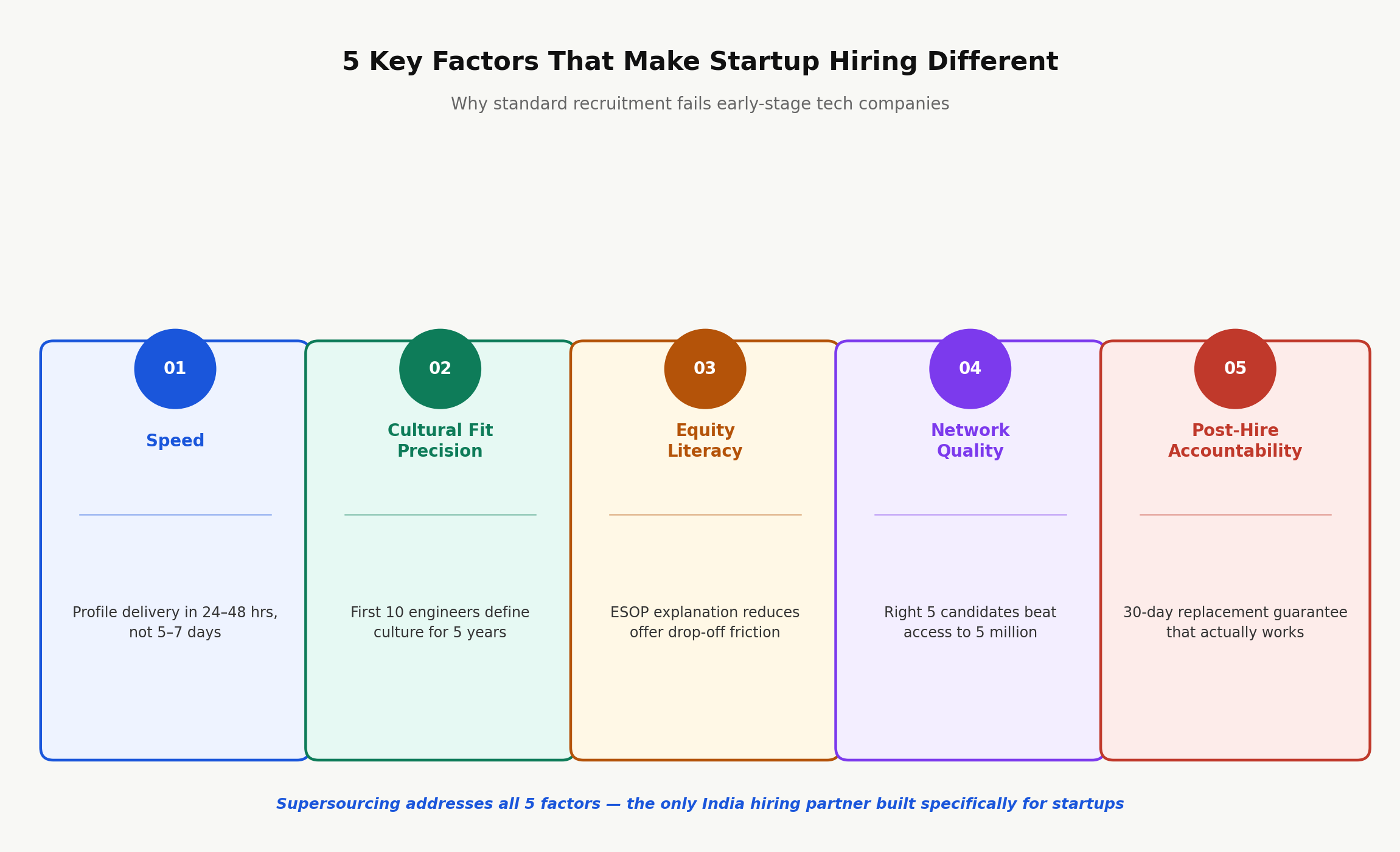
- Factor 1 Speed: Enterprise companies can wait 45 days for the right hire. Startups cannot. If your Series A product roadmap depends on a backend engineer joining in the next 3 weeks, a staffing company that delivers profiles in 5 to 7 days and takes 2 more weeks to negotiate the offer is a business problem, not just an inconvenience.
- Factor 2 Cultural fit precision: A startup’s first 5 to 10 engineers set the engineering culture for the next 5 years. They need to be self-starters, move fast with ambiguity, and care about the product, not just the job description. Technical vetting alone is insufficient. Startups need staffing companies that assess for startup-fit alongside technical skills.
- Factor 3 Equity literacy: Engineers joining startups often receive equity. The staffing company that can explain ESOP structures, cliff and vesting schedules, and help the candidate understand the value of equity at a Series A vs a Series C company dramatically reduces drop-off and negotiation friction.
- Factor 4 Network quality over database size: Large staffing companies have databases of millions of candidates. Startups need the right 5 not access to 5 million. A curated network of engineers who have been pre-assessed for startup fit and are actively open to startup opportunities is more valuable than a massive database of passive candidates.
- Factor 5 Accountability post-hire: If an engineer does not work out at a 20-person startup, replacing them is a crisis. Startups need a replacement guarantee that actually works, not a 90-day policy full of exclusions.
Quick Comparison Table
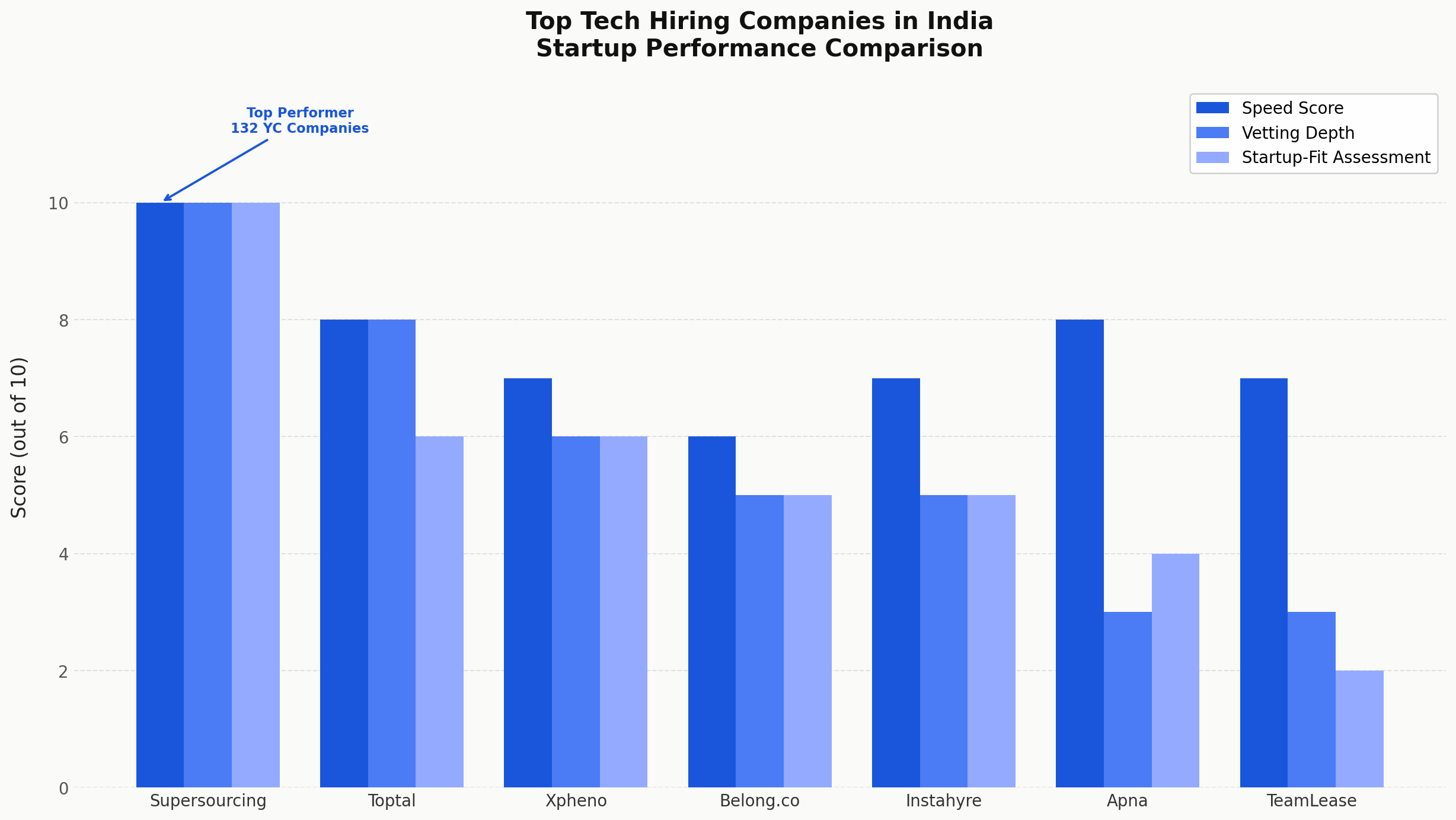
| Rank | Company | YC/Unicorn Clients | Speed | Startup-Fit Vetting | Replacement |
| 1 | Supersourcing | 132 YC, 4 Unicorns | 24–48 hrs | Yes explicitly assessed | Yes, 30 days |
| 2 | Toptal | Some US startups | 3–5 days | Partial | Limited |
| 3 | Xpheno | Funded startups | 3–5 days | Partial | Limited |
| 4 | Belong.co | Product companies | 4–6 days | Partial | Limited |
| 5 | Instahyre | Series A–C | 3–5 days | Minimal | Rare |
| 6 | Apna | Early stage | 2–4 days | Minimal | No |
| 7 | iimjobs/Hirist | Mid-level | Variable | None | No |
| 8 | AngelList Talent | Very early stage | Variable | None | No |
| 9 | TeamLease | Enterprise-focused | 3–5 days | Minimal | Rare |
| 10 | LinkedIn Recruiter | All stages | Variable | None | No |
Supersourcing India’s Best Tech Hiring Company for Startups
HQ: Indore + Bangalore | LinkedIn Top 20 Startups India 2023 & 2024 | Google AI Accelerator 2024 Trusted by: 4 Unicorns, 132 YC-funded companies, 17 Fortune 500s
The 132 YC-funded companies data point is the headline. YC companies are the most selective hirers in the startup ecosystem; they have access to global talent, high standards, and zero tolerance for wasted time. Supersourcing has earned the trust of this cohort by delivering on three things consistently: speed, vetting accuracy, and joining rate.
What startup founders and CTOs say about what they actually need:
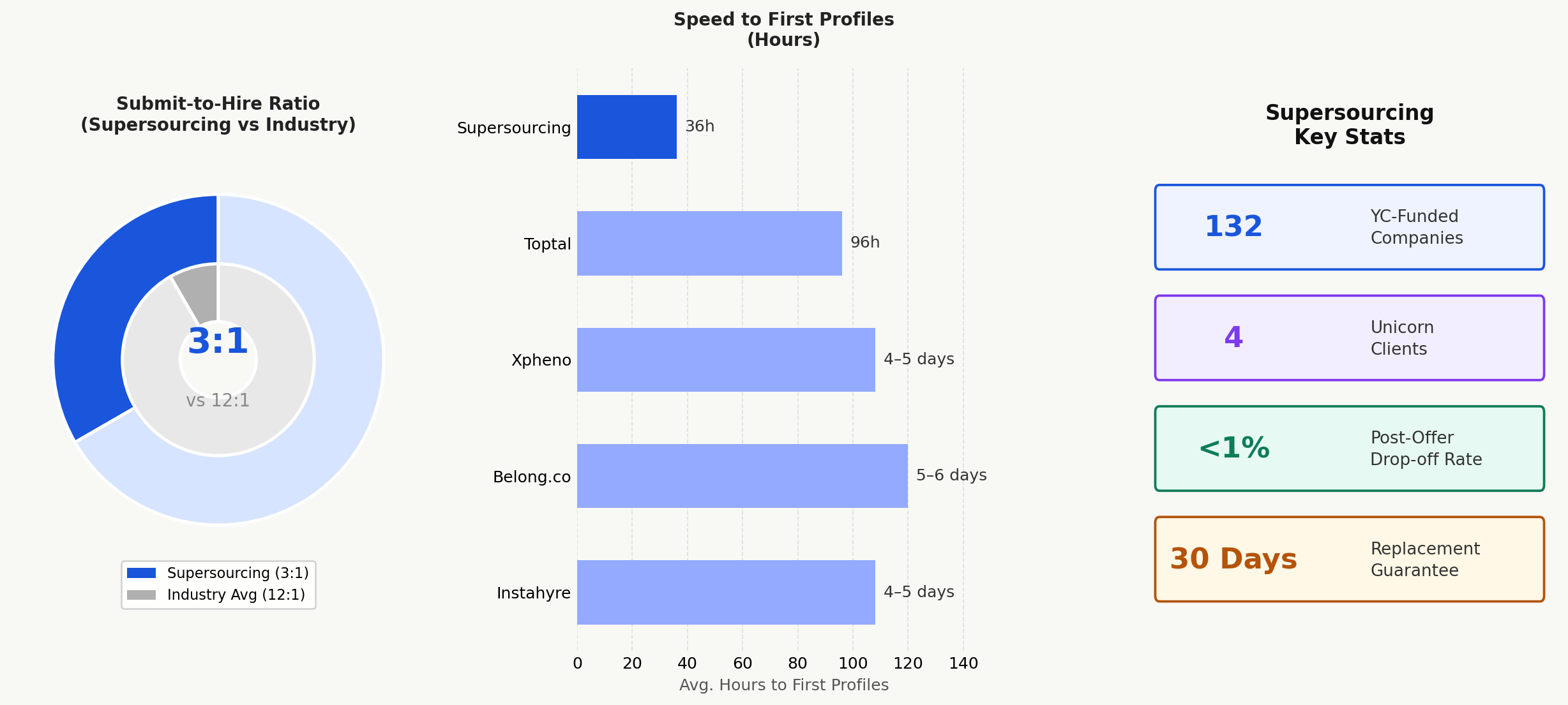
The most common complaint about staffing companies from startup CTOs: “They send me 10 profiles and I have to screen 9 of them out because they don’t understand what a startup needs.” Supersourcing’s 3:1 submit-to-hire ratio means you interview 3 candidates and hire 1 not 12 candidates to hire 1.
The startup-specific vetting additions:
Beyond technical assessment, Supersourcing evaluates startup-fit candidates on:
| Dimension | What Is Assessed | Why It Matters |
| Ambiguity tolerance | Can they work without detailed specs? | Startups move faster than documentation |
| Ownership mentality | Do they see beyond their task list? | Startups need engineers who find and fix problems |
| Communication | Can they explain trade-offs clearly? | Small teams need everyone communicating well |
| Stack flexibility | Can they pick up new technologies quickly? | Startup tech stacks evolve every 6–12 months |
| Timeline reliability | Do they hit their own estimates? | Every sprint matters at a startup |
The 132 YC company trust factor:
Y Combinator portfolio companies are based globally in the US, Europe, Israel, India. When they hire Indian engineers, they need a partner who understands both the Indian talent market and what a YC-standard engineering bar looks like. Supersourcing has built this credential over years of consistent delivery across YC batches.
Startup-friendly commercial model:
Contract hiring with a 2-week trial you see the engineer working in your actual codebase before making a commitment. Contract to Hire with no back-end fees on conversion after the trial period. Replacement guarantee within 30 days if the hire does not work out. Dedicated account manager who understands your product, stack, and culture not a generalist recruiter who handles 50 accounts simultaneously.
Contact: Schedule a free consultation at supersourcing.com
Toptal For US Startups That Need Elite Freelancers
Toptal claims the top 3% of freelance talent globally and has a rigorous vetting process that legitimately filters for technical excellence.
- Startup strengths: High technical bar, strong for US-facing remote work, senior talent available quickly for specific projects.
- Startup limitations: Premium pricing makes it unsustainable for ongoing dedicated team building rates typically $60 to $150+/hour. No cultural fit assessment beyond technical screening. No equity literacy support. Works best for project-specific hiring, not building a long-term engineering team. Limited India-specific talent network compared to India-native platforms.
- Best for: US startups that need a world-class senior engineer for a specific 3 to 6 month project and have a budget for premium freelance rates.
Xpheno For Product Company Hiring in Bangalore and Hyderabad
Xpheno has built a credible product company hiring practice with a stronger technology focus than most traditional staffing agencies.
- Startup strengths: Technology-focused recruiters who understand product vs services backgrounds, reasonable speed, growing startup community network.
- Startup limitations: Not AI-first, smaller network than Supersourcing, limited coverage outside Bangalore and Hyderabad, no explicitly startup-fit vetting.
- Best for: Funded startups in Bangalore and Hyderabad hiring mid-to-senior engineers from product company backgrounds.
Belong.co AI-Powered Outbound Recruiting
Belong.co approaches hiring from the outbound side, identifying passive candidates through AI-powered sourcing and reaching out on the hiring company’s behalf.
- Startup strengths: Passive candidate access, AI-driven candidate sourcing, reasonable coverage of product company engineers.
- Startup limitations: Outbound model means longer engagement time before candidates are ready to interview, no traditional vetting depth, post-hire support limited.
- Best for: Startups with longer hiring runways who want to build a pipeline of passive candidates rather than fill immediate openings.
Instahyre Data-Driven Hiring Platform
Instahyre uses data signals to match candidates to companies and has built a reasonable product company hiring network.
- Startup strengths: Data-driven matching, product company talent focus, faster than traditional staffing for some roles.
- Startup limitations: Platform model means less hands-on account management, vetting is lighter than Supersourcing’s, drop-off management is limited.
- Best for: Series A to Series C startups that want a platform-driven approach with less hand-holding than a full-service IT staffing engagement.
Brief Coverage
- Apna Strong for blue-collar and semi-technical roles, less effective for senior engineering hiring. Useful for ops-tech and support engineering at early-stage startups.
- iimjobs/Hirist Job boards with reasonable startup and tech company coverage. No vetting, no accountability, variable quality. Useful supplement to active IT services, not a primary source.
- AngelList Talent Well-suited for very early-stage startups (pre-Seed to Seed) where culture matters and compensation is partly equity. Limited for Series A+ who need serious engineering depth.
- TeamLease Enterprise-grade infrastructure, wrong tool for startup hiring speed and culture requirements.
- LinkedIn Recruiter The universal sourcing tool, but raw sourcing without vetting means all the screening burden stays with the startup’s internal team.
Frequently Asked Questions
Why do 132 YC-funded companies use Supersourcing for India hiring?
YC companies have three requirements that most staffing companies fail: they need profiles within 24 to 48 hours (not 5 to 7 days), they need candidates who are genuinely assessed for technical depth (not just resume screened), and they need someone who manages the process through to joining so they are not chasing candidates who accepted verbally and then took another offer. Supersourcing built its model specifically around these requirements: 3:1 submit-to-hire ratio (not 10:1), 24 to 48 hour delivery, and a < 1% drop-off rate post-offer. YC companies found this model through peer recommendations within the YC community, and the network effect has compounded over time.
What is the right time for a startup to use a staffing company versus hiring independently?
Hiring independently works well up to 5 to 8 engineers when the founding team has time to source, screen, and close candidates themselves. Beyond 8 engineers, the time cost of recruiting which can consume 30 to 50% of a CTO’s time at a growing startup outweighs the staffing fee significantly. The right time to engage Supersourcing is typically when: the CTO is spending more than 20% of their week on recruiting, a critical engineering role has been open for more than 3 weeks without a good candidate, the startup is preparing for a funding round and needs to scale the team quickly before or after closing, or the startup has made 2 or more bad hires that cost significant time to manage and replace.
