

If you are trying to figure out how to hire DevOps engineers India in 2026, the first thing to understand is that “DevOps engineer” is no longer one job. The role has split into two distinct disciplines: traditional DevOps, which centers on CI/CD pipelines, deployment automation, and operational tooling, and platform engineering, which centers on internal developer platforms, Kubernetes cluster management, and infrastructure as code.
Hiring the wrong profile for the wrong problem is the single most common and most expensive mistake companies make when they hire DevOps engineers in India.
Demand for DevOps engineers in India has outpaced supply for several years running. Every company running production systems needs at least one strong DevOps hire, and the quality range across candidates is enormous.
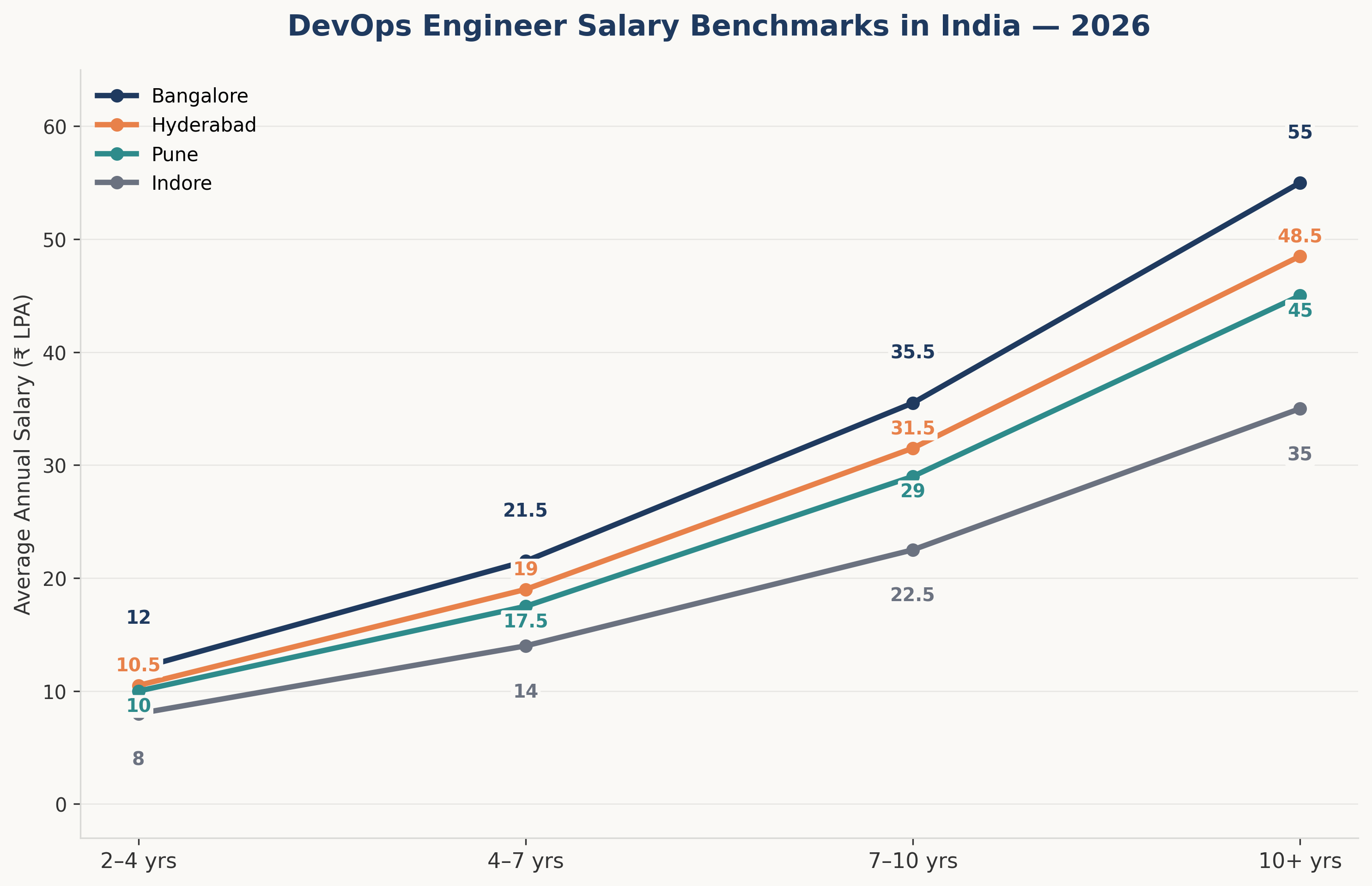
The importance of DevOps continues to grow as organizations prioritize faster and more reliable software delivery. According to DevOps Engineering in 2026 Trends & Growth, the global DevOps market is projected to expand from around $10.4 billion in 2023 to $25.5 billion by 2028, driven by cloud adoption, automation, and the need for continuous delivery at scale. This rapid growth is directly increasing demand for skilled DevOps engineers, making hiring more competitive in markets like India heading into 2026.
A DevOps engineer who has wired up a Jenkins pipeline is a fundamentally different hire from one who has designed and operated a multi-cluster Kubernetes platform serving 100,000 requests per second.
This guide walks through how to tell the two apart, how to structure your interview process, what to pay at each experience level and city, and the red flags that should end a candidate’s process immediately.
Why India Is a Strategic Hub for DevOps and Platform Engineering Talent in 2026
India has become one of the largest global pools of cloud-native engineering talent, driven by the scale of AWS, GCP, and Azure adoption across Indian SaaS, fintech, and e-commerce companies. Bangalore, Hyderabad, and Pune have deep enterprise infrastructure ecosystems, while emerging hubs like Indore and Pune are producing strong mid-level talent at a meaningfully lower cost base.
For companies hiring globally, this combination of technical depth and cost efficiency is why India remains a top destination to hire DevOps engineers in 2026 but it also means the sourcing and screening process has to be rigorous, because the same demand that makes India attractive also floods the market with under-qualified applicants claiming Kubernetes and Terraform experience they don’t actually have.
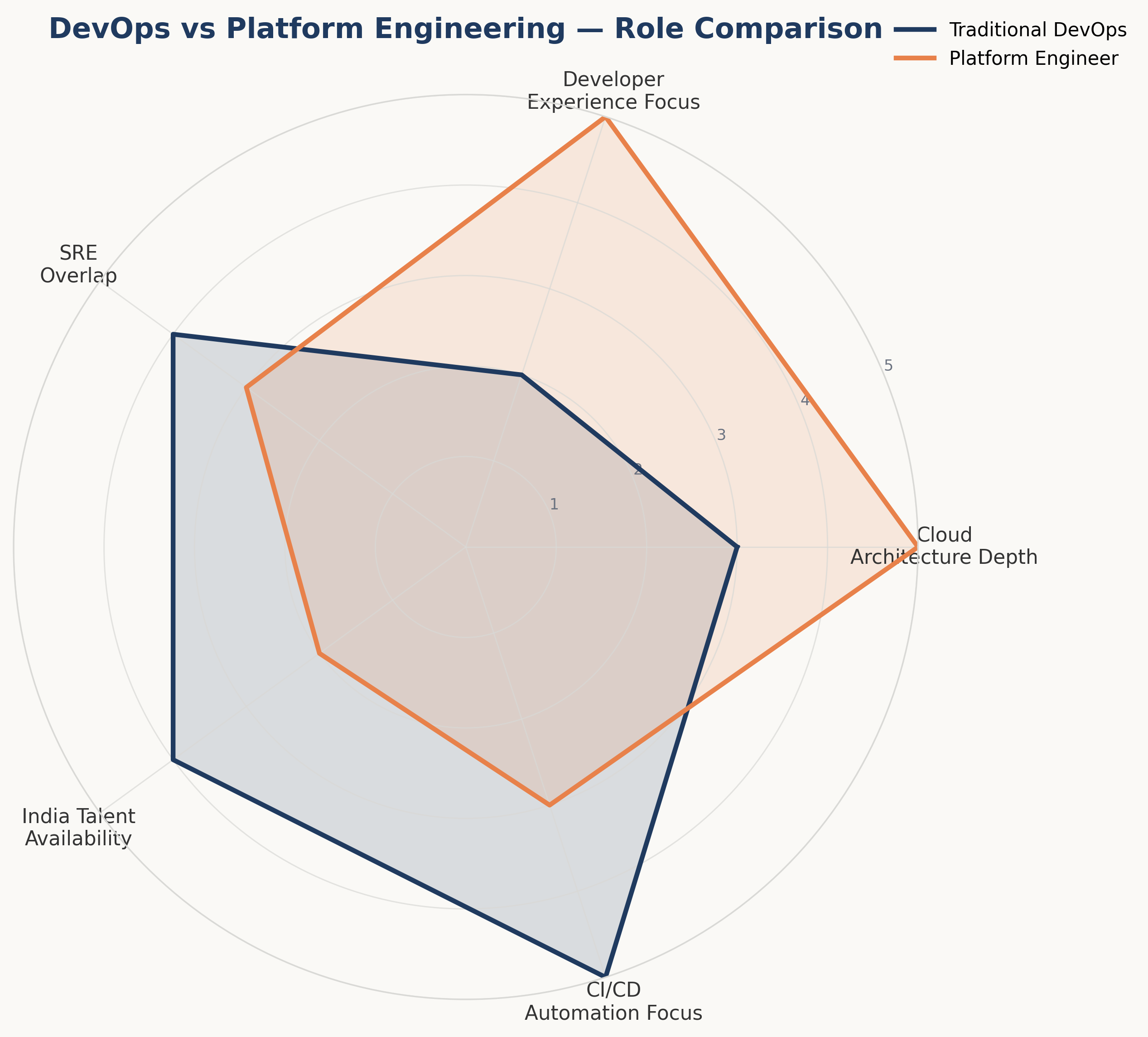
DevOps vs Platform Engineering Which Role Do You Actually Need?
Before writing a job description, decide which of these two profiles solves your actual problem. Most companies default to posting “DevOps Engineer” regardless of what they need, which attracts the wrong applicant pool and wastes weeks of interview time.
| Dimension | Traditional DevOps Engineer | Platform/Infrastructure Engineer |
| Primary focus | Deployment automation, monitoring, incident response | Internal developer platform, Kubernetes, IaC |
| Key tools | Jenkins, GitLab CI, Docker, Ansible | Kubernetes, Terraform, Helm, ArgoCD, Backstage |
| Cloud depth | Moderate deployment focused | Deep architecture focused |
| Developer experience | Moderate | High focus building tools for other engineers |
| SRE overlap | Significant | Moderate |
| India supply | Moderate | More constrained premium skills |
If your product is still early-stage and your main pain point is “deployments are manual and slow,” you need traditional DevOps. If you already run Kubernetes in production and your engineers are complaining about environment inconsistency, provisioning delays, or a lack of self-service tooling, you need a platform engineer and you should expect to pay a premium and wait longer to find one.
The Skill Assessment Framework
Once you know which role you’re hiring for, the next step is assessing candidates against concrete, demonstrable skills rather than resume keywords. Anyone can write “Kubernetes” and “Terraform” on a CV; very few candidates can actually design a production-grade deployment or debug a real incident under pressure.
Core DevOps Skills Assessment
| Skill | Assessment Approach | Green Flags | Red Flags |
| CI/CD design | Design a CI/CD pipeline for a microservices application | Environment separation, secret management, rollback strategy, testing stages | “We use Jenkins” without any architectural thinking |
| Docker/containerisation | Code review a Dockerfile | Multi-stage builds, non-root user, layer caching awareness | Massive single-layer Dockerfiles |
| Kubernetes | Design a Kubernetes deployment for a stateful application | Pod disruption budgets, resource requests/limits, persistent volume strategy | “I know kubectl commands” |
| IaC (Terraform) | Review a Terraform module | State management, remote backend, module structure | Terraform as copy-paste from StackOverflow |
| Monitoring/observability | Ask about their monitoring stack | Metrics + logs + traces, alerting philosophy, SLO/SLI understanding | Only monitors uptime |
| Incident response | Ask about a production incident | Clear RCA process, blameless postmortem culture, runbook mindset | “We fixed it and moved on” |
Cloud Platform Depth by Provider
Most Indian DevOps candidates will list all three major clouds, but real depth is usually concentrated in one. Probe accordingly rather than assuming breadth equals competence.
| Cloud | What to Assess |
| AWS | VPC networking, IAM least privilege, EKS, cost optimisation (Reserved Instances, Spot), CloudTrail |
| GCP | GKE, IAM, networking (VPC, Shared VPC), Cloud Armor, billing alerts |
| Azure | AKS, Azure AD integration, Azure Policy, Cost Management |
A candidate who can speak fluently about IAM least-privilege design or Kubernetes resource requests on one cloud, but goes vague the moment you switch providers, is being honest about where their real experience lies; that’s a good sign, not a bad one. Be wary of candidates who claim equally deep expertise across all three; it’s rare and usually means shallow exposure to each.
Salary Benchmarks for DevOps Engineers in India 2026
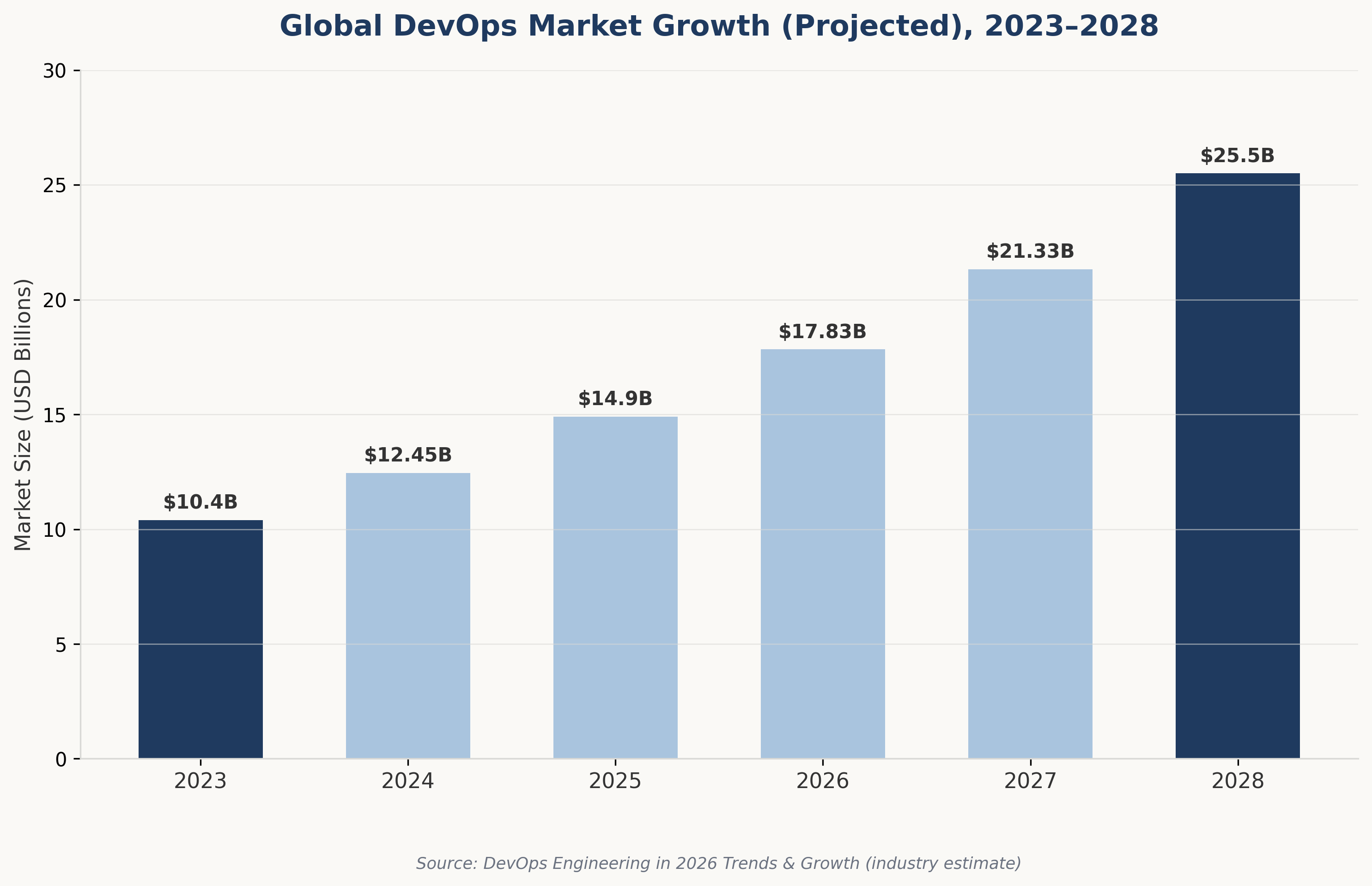
Compensation for DevOps and platform engineers varies significantly by city and experience band. Use these ranges as a starting point for budgeting, and expect platform engineers to command a premium over traditional DevOps at every level.
| Experience | Bangalore (₹ LPA) | Hyderabad (₹ LPA) | Pune (₹ LPA) | Indore (₹ LPA) |
| 2–4 years | ₹8–16 | ₹7–14 | ₹7–13 | ₹6–10 |
| 4–7 years | ₹15–28 | ₹13–25 | ₹12–23 | ₹10–18 |
| 7–10 years | ₹26–45 | ₹23–40 | ₹21–37 | ₹17–28 |
| 10+ years | ₹40–70 | ₹35–62 | ₹32–58 | ₹25–45 |
Platform engineers command a 20–25% premium over traditional DevOps engineers at equivalent experience, largely because Kubernetes and Terraform depth is harder to find and slower to develop than CI/CD automation skills. Companies hiring outside the top-tier metros Indore being a good example can access strong 4–7 year experienced engineers at 30–40% lower cost than Bangalore equivalents, without a meaningful drop in quality, provided the screening process is rigorous.
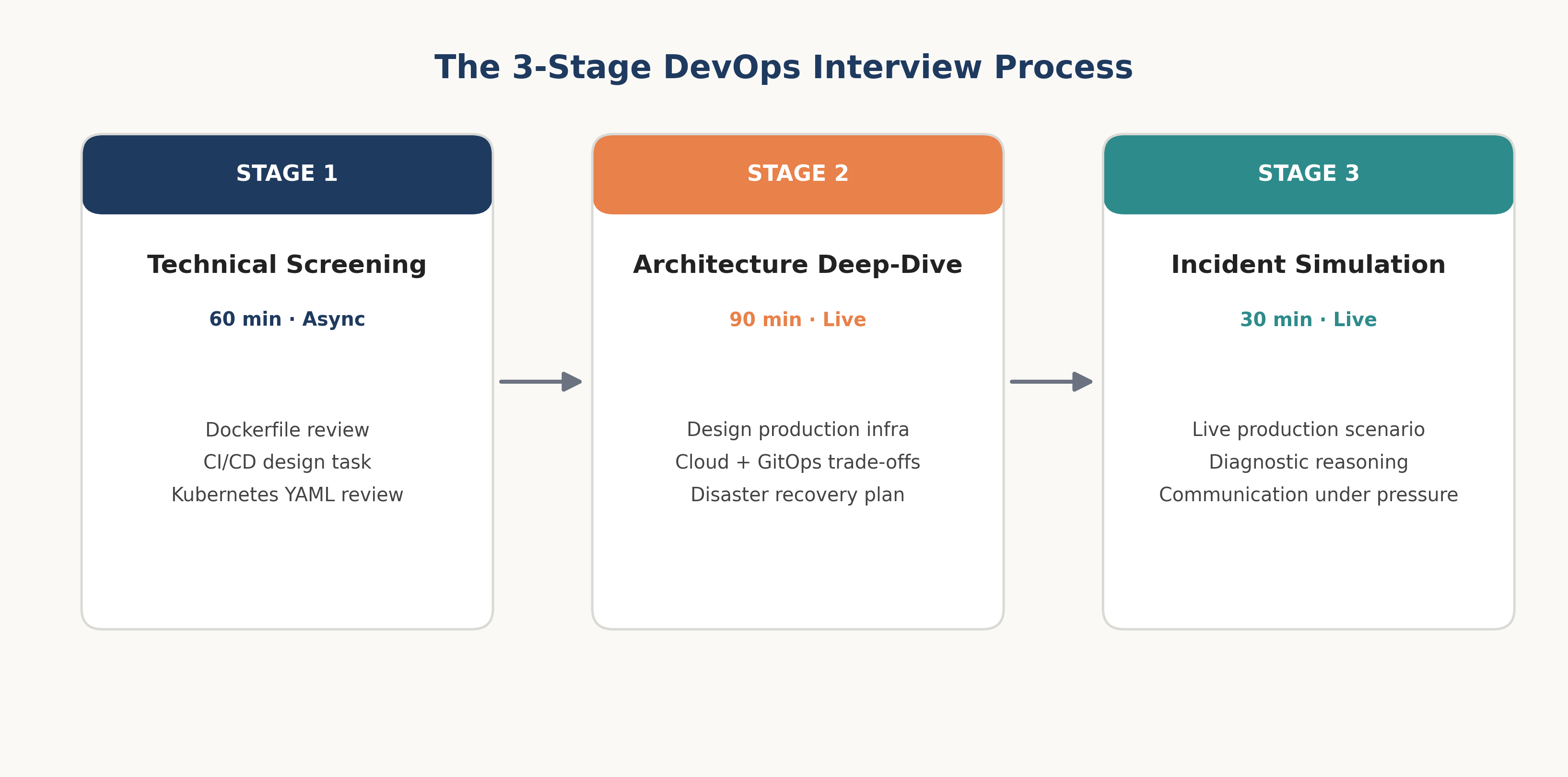
The 3-Stage Interview Process
A structured, multi-stage process is the single best defense against hiring a DevOps engineer who talks well but has never operated production infrastructure under real load.
Stage 1 Technical screening (60 minutes, async).
Give candidates a Dockerfile review task where they identify issues and rewrite it for production use. Follow with a CI/CD design question writing a GitHub Actions workflow for a scenario involving multiple environments and a Kubernetes YAML task where they must spot problems in a given deployment manifest. This stage filters out tutorial-level candidates before you invest any live interview time.
Stage 2 Architecture deep-dive (90 minutes, live).
Present a realistic production scenario: “We have a Python microservice that needs to run on AWS, handle 10,000 requests per minute at peak, store data in Postgres, use Redis for caching, and be deployed via GitOps. Design the infrastructure.” Walk through their reasoning on Kubernetes vs ECS, VPC design, RDS configuration, monitoring stack, secret management, CI/CD pipeline, and disaster recovery. The goal isn’t a “correct” answer, it’s watching how they reason through trade-offs.
Stage 3 Incident simulation (30 minutes).
Describe a live-fire scenario: “CPU on all pods in the payment service just spiked to 100%. Traffic is 3x normal. What do you do?” Pay attention to their diagnostic process, whether they prioritise traffic and user impact first, how clearly they communicate under pressure, and whether they think about post-incident follow-up rather than just the immediate fix.
Red Flags in DevOps Profiles
| Red Flag | Signal |
| “Experience with Kubernetes” but cannot explain pod scheduling | Followed tutorials, never operated a cluster |
| Terraform without understanding state locking | Has caused state corruption in the past or will |
| No monitoring setup on their systems | Deploying blind |
| “I follow security best practices” but cannot name a specific one | No security depth |
| Never participated in an on-call rotation | No real production operations experience |
| Cannot explain why they chose one cloud service over another | Copy-paste architecture |
Any one of these red flags on its own isn’t necessarily disqualifying, but two or more in a single interview is a strong signal to move on. Candidates who have genuinely operated production infrastructure even at a smaller scale will have specific, concrete stories about things that went wrong and what they learned. Vagueness at this stage almost always predicts vagueness on the job.
Common Mistakes Companies Make When Hiring DevOps Engineers in India
Even with a good framework, most hiring processes fail in a few predictable ways. The most common is skipping Stage 1 screening entirely and jumping straight to live interviews, which wastes senior engineering time on candidates who could have been filtered out asynchronously. The second is anchoring too heavily on resume-listed tools rather than demonstrated reasoning.
A candidate who has “used Terraform” for six months of copy-pasting existing modules is not the same as one who has designed and maintained a Terraform module structure from scratch. The third is underestimating time-to-hire: strong platform engineers with real Kubernetes depth are scarce, and a slow process means losing them to competing offers. Building a pre-vetted pipeline, rather than starting the search from zero for every open role, is the difference between a 48-hour hire and a two-month search.
Why Supersourcing for DevOps Hiring
Supersourcing placed DevOps engineers for Adani Group, setting up automated CI/CD pipelines that reduced deployment time by 50%. Those engineers were assessed not on claimed Kubernetes experience but on demonstrated ability to design and operate production infrastructure using the same bar outlined throughout this guide. That is the standard Supersourcing maintains for every DevOps and platform engineering placement, backed by a pre-vetted talent pool that can typically be shortlisted within 24–48 hours.
Contact: Schedule a free consultation at supersourcing.com
Frequently Asked Questions
What is the difference between DevOps and platform engineering in India’s job market?
DevOps engineers focus on the deployment and operations layer CI/CD pipelines, monitoring, incident response, deployment automation. Platform engineers focus on the infrastructure and developer experience layer Kubernetes cluster management, infrastructure as code, internal developer platforms, and the tooling that other engineers use to deploy and operate their services. The platform engineering role has emerged as Kubernetes has become the dominant deployment target; it requires deeper infrastructure and cloud architecture knowledge than traditional DevOps. In India’s job market, platform engineers with Kubernetes and Terraform depth command a 20 to 25% salary premium over traditional DevOps engineers with equivalent years of experience.
How do I distinguish a genuine Kubernetes expert from someone who has done Kubernetes tutorials?
Three questions reliably separate real Kubernetes expertise from tutorial-level knowledge: ask them to explain pod disruption budgets and when they would use one (real operators use these to manage upgrades safely; tutorial engineers have never needed them); ask them to describe a Kubernetes incident they debugged what tools they used, what the root cause was, and what the fix involved (real answers involve specific kubectl commands, log analysis, and a specific failure mode; fake answers are vague and generic); ask them to explain the trade-offs between DaemonSets and Deployments for a log collection agent (real understanding includes resource overhead, scheduling guarantees, and upgrade strategies; tutorial knowledge knows the definitions but not the trade-offs).
How long does it take to hire a DevOps engineer in India in 2026?
A rigorous 3-stage process, run internally, typically takes three to six weeks from job posting to offer, largely due to sourcing and screening time. Working with a pre-vetted talent partner like Supersourcing compresses this significantly, since candidates arrive already screened against the skill framework above, often enabling a shortlist within 24–48 hours.
Should I hire a generalist DevOps engineer or a specialist platform engineer first?
Early-stage companies with simple deployment needs are usually better served by a strong generalist DevOps engineer who can own CI/CD, monitoring, and basic cloud infrastructure. Once you’re running Kubernetes in production at meaningful scale, or your engineering team is large enough that developer experience and self-service infrastructure become a bottleneck, it’s time to bring in a dedicated platform engineer.
