

DevOps failures in high-stakes environments like capital markets are expensive misconfigured pipelines, unstable deployments, or poor infrastructure design can translate into operational risk within hours. Yet most enterprises still spend weeks shortlisting candidates before any real engineering work begins.
Hire a DevOps Engineer in India is no longer just a cost decision, it’s a strategic move to access scalable cloud, automation, and CI/CD expertise. However, the gap between resume-level DevOps skills and real-world production experience is where most hiring decisions fail.
The demand is accelerating alongside automation. According to Gartner, by 2026, 30% of enterprises will automate more than half of their network activities, a sharp rise from under 10% in 2023 driving strong demand for DevOps and infrastructure automation talent:
Gartner Automation Forecast 2026
Capital markets technology stacks are among the most unforgiving environments for DevOps failures; a misconfigured Murex deployment or an unstable CI/CD pipeline can translate into millions in settlement risk within hours. Yet most global banks and asset managers still spend 60–90 days just shortlisting candidates before a single line of infrastructure code is written.
TL;DR: What You Need to Know Before You Hire a DevOps Engineer in India
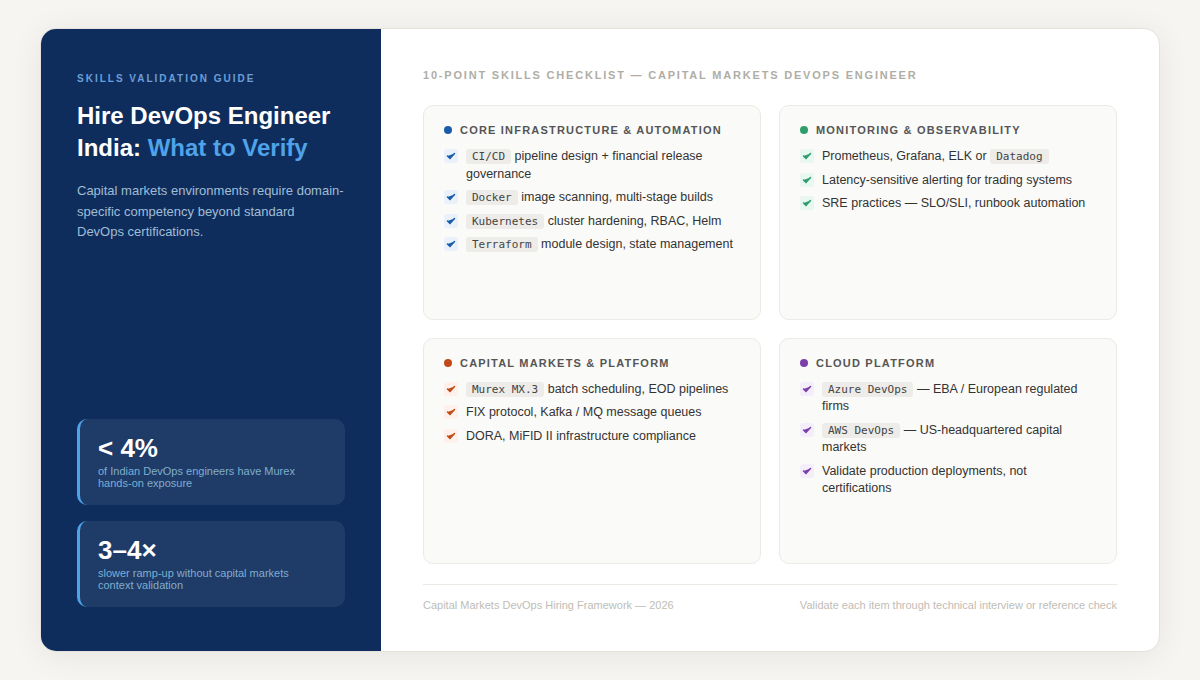
Finding a DevOps engineer in India is easy. Finding one who can operate inside a Murex MX.3 environment, manage EOD batch pipelines, and meet DORA compliance standards that's a different problem entirely. Less than 4% of Indian DevOps engineers have hands-on capital markets exposure. That gap is where most enterprise hiring decisions fail.
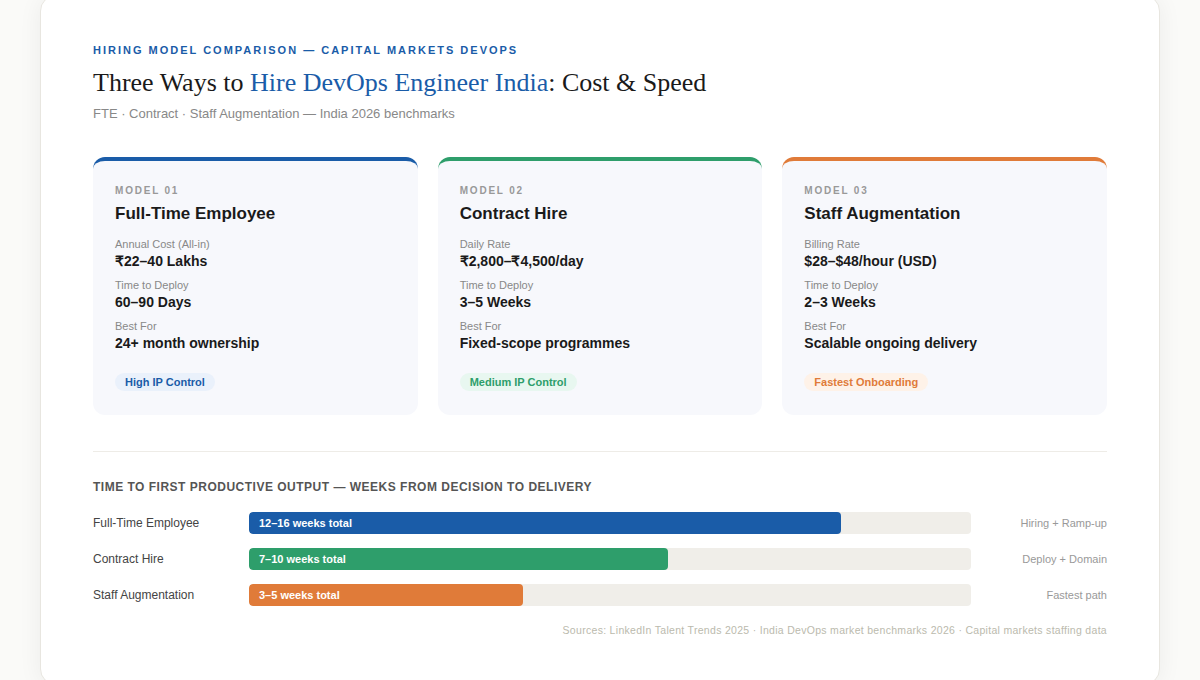
Three hiring models dominate this market: full-time employment (60–90 day cycle, ₹22–40L all-in), contract hire (3–5 weeks, ₹2,800–₹4,500/day), and staff augmentation (2–3 weeks, $28–$48/hour). Each suits a different engagement scope. Choosing the wrong model costs 3–4 months of ramp time and a project timeline slip.
This guide covers all three models with cost benchmarks, a 10-point skills checklist for capital markets DevOps interviews, an Azure vs AWS decision framework, and the most common mistakes enterprise buyers make. If you're evaluating vendors or building a shortlist, everything you need to pressure-test that decision is below.
What Does It Mean to Hire a DevOps Engineer for Capital Markets in India?
Hiring a DevOps engineer India for capital markets refers to sourcing cloud infrastructure, automation, and release engineering talent specifically experienced with financial platform environments like Murex, Calypso, or Finastra from India’s technology talent pool, either as full-time employees, independent contractors, or through a staff augmentation partner.
The Core Problem: Why Capital Markets DevOps Hiring Takes 3× Longer Than It Should
Standard DevOps hiring pipelines are not built for Murex platform engineer hiring. Most recruitment processes screen for general Kubernetes or Terraform skills without validating domain-specific requirements: end-of-day batch processing windows, trade lifecycle integration, regulatory reporting pipelines, or low-latency market data feeds.
The result: a candidate who passes five interview rounds fails in week two when they encounter a Murex MX.3 environment for the first time. Teams underestimate the ramp-up by 3–4 months, and the project timeline slips accordingly.
Three additional friction points make this worse:
- Salary expectations diverge sharply between general DevOps candidates and capital-markets-experienced engineers, often by ₹8–12 lakhs annually at the senior level
- Indian engineers with hands-on Murex DevOps exposure represent less than 4% of the available DevOps talent pool
- Most enterprise buyers do not have a validated skills framework before they begin interviewing, so they recognize the wrong profile only after hiring
Three Hiring Models: FTE, Contract, and DevOps Team Augmentation India
Full-Time Employee (FTE)
Hiring directly onto your payroll gives maximum control over delivery, IP ownership, and institutional knowledge retention. However, for hire a DevOps engineer in India engagements, direct FTE hiring from overseas carries significant overhead: employer-of-record costs, benefits, equipment provisioning, and a 60–90 day hiring cycle before productivity.
Typical cost range: ₹18–32 lakhs per annum for a mid-to-senior DevOps engineer with capital markets exposure. Add 20–25% for employer contributions, compliance, and overhead. This model works best when the engagement is 24+ months and requires deep system ownership.
Contract Hire
Contract-based hiring typically 6–18 month engagements via an Indian staffing firm offers faster time-to-deploy (usually 3–5 weeks) and lower administrative burden. The trade-off is higher day rates and weaker long-term retention incentives.
Typical cost range: ₹2,800–₹4,500 per day for a senior Murex or cloud-native DevOps specialist. This model suits defined-scope programmes: platform migrations, MX.3 upgrades, or infrastructure re-architecture initiatives.
DevOps Staff Augmentation India
DevOps team augmentation India via a managed services or engineering partner sits between the two. The vendor owns recruitment, compliance, and HR; the client directs the technical work. For capital markets buyers, this model reduces hiring risk significantly because reputable vendors pre-screen for domain fit rather than just tool proficiency.
Typical cost range: $28–$48 per hour (billing in USD is common for global engagements), inclusive of management overhead. Onboarding time drops to 2–3 weeks when the vendor maintains a pre-qualified bench.
| Model | Time to Deploy | Annual Cost (Senior) | IP Control | Best For |
| FTE | 60–90 days | ₹22–40L (all-in) | High | Long-term platform ownership |
| Contract | 3–5 weeks | ₹18–28L equivalent | Medium | Fixed-scope programmes |
| Staff Augmentation | 2–3 weeks | $58K–$100K USD equiv. | Medium-High | Scalable, ongoing delivery |
Skills Checklist: What to Verify Before You hire a DevOps engineer in India
Not all DevOps skill sets are equivalent in capital markets contexts. Use this checklist to structure technical interviews and vendor qualification.
Core Infrastructure & Automation
- CI/CD pipeline design and toolchain Jenkins, GitLab CI, or GitHub Actions; familiarity with financial release governance (four-eyes approval, audit trails)
- Docker containerization image security scanning, multi-stage builds, registry management
- Kubernetes orchestration cluster hardening, RBAC policies, Helm chart management for stateful financial workloads
- Terraform infrastructure-as-code module design, state management, multi-cloud deployments
Monitoring & Observability 5. DevOps toolchain observability stack Prometheus, Grafana, ELK, or Datadog; experience with latency-sensitive alerting for trading systems 6. SRE practices SLO/SLI definition, runbook automation, incident management frameworks
Capital Markets & Platform-Specific 7. Murex MX.3 infrastructure patterns (batch scheduling, EOD pipelines, market data feeds) 8. FIX protocol connectivity, message queue management (Kafka, MQ) 9. Regulatory environment awareness DORA, MiFID II infrastructure implications
Cloud Platform 10. Azure DevOps vs AWS DevOps candidates should have hands-on experience with at least one; Azure is predominant in European capital markets, AWS in US-headquartered firms
Azure DevOps vs AWS DevOps for Capital Markets Environments
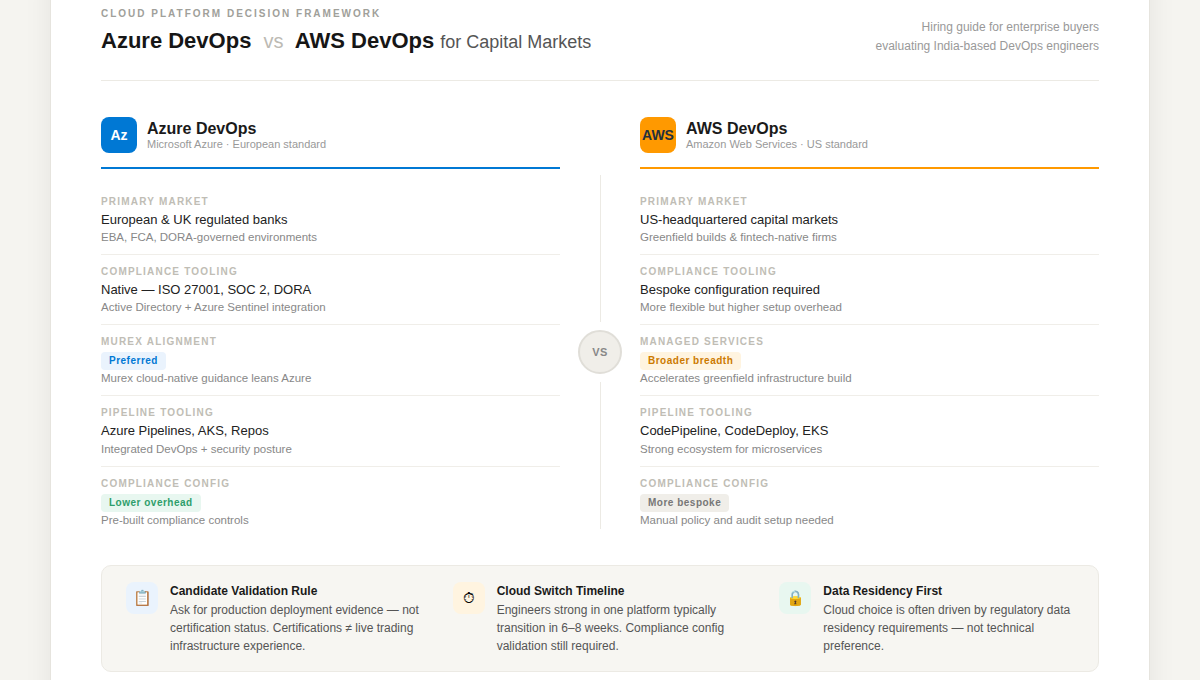
The Azure DevOps vs AWS DevOps choice for capital markets is rarely purely technical; it follows existing enterprise cloud commitments and regulatory data residency requirements.
Azure DevOps dominates in European and UK-regulated environments. Its integration with Active Directory, Azure Sentinel, and native compliance tooling (ISO 27001, SOC 2, DORA-aligned controls) makes it the default for banks operating under EBA guidelines. Murex’s own cloud-native deployment guidance learns Azure.
AWS DevOps using CodePipeline, CodeDeploy, and EKS is more prevalent in US-headquartered firms and greenfield capital markets technology builds. AWS’s breadth of managed services accelerates infrastructure build-out but requires more bespoke compliance configuration.
When evaluating candidates, ask for evidence of production deployments rather than certification status. A candidate with an AWS Solutions Architect certification but no production Kubernetes work in a regulated environment is less valuable than one without certifications who has managed live trading infrastructure.
Real-World Application: How Enterprise Teams Have Structured This
Case 1 European Investment Bank, Murex MX.3 Cloud Migration A tier-2 European investment bank needed to re-platform its Murex environment onto Azure within a 9-month regulatory deadline. Using a DevOps staff augmentation India model, they onboarded a 4-engineer team (2 Murex infrastructure specialists, 1 Kubernetes lead, 1 CI/CD architect) within 3 weeks. The migration completed in 8.5 months two weeks ahead of schedule at approximately 40% of the equivalent UK contractor cost.
Case 2 US Asset Manager, DevOps Team Build-Out A mid-size US asset manager chose to hire a DevOps engineer in India via direct FTE across a 6-month hiring window. Despite competitive salaries (₹28–32L range), time-to-productivity averaged 14 weeks per engineer due to capital markets domain gaps. The same firm subsequently shifted to an augmentation model for subsequent hires, reducing onboarding time to under 4 weeks.
What Most Teams Get Wrong When They hire a DevOps engineer in India
The most common failure mode is treating fintech talent India hiring as a pure cost arbitrage exercise. Teams build a job description based on tool lists Kubernetes, Terraform, Jenkins without specifying the operational context: batch-critical systems, real-time P&L feeds, regulatory audit requirements.
This produces a candidate pool that looks identical on paper but varies by 3–4× in actual delivery speed once inside a capital markets environment.
The second mistake is skipping domain validation during vendor qualification. When working with a staff augmentation India tech partner, buyers should require: a live technical case study specific to financial systems, reference checks from prior capital markets clients, and a defined knowledge transfer process not just an NDA and rate card.
Engineers who have operated trading infrastructure know what a failing end-of-day batch actually costs. That domain intuition does not appear on a CV.
FAQ: Hiring DevOps Engineers in India for Capital Markets
What is the average DevOps engineer salary India 2026 for capital markets roles?
For engineers with 4–8 years of experience and capital markets exposure, the DevOps engineer salary India 2026 range sits at ₹18–32 lakhs per annum for direct employment. Candidates with hands-on Murex MX.3 or Calypso infrastructure experience command a 25–35% premium over generalist DevOps profiles at equivalent seniority.
How long does it take to onboard a remote DevOps engineer from India?
Via staff augmentation, 2–3 weeks for initial productivity and 6–8 weeks for full integration into complex capital markets workflows. Direct FTE hiring runs 60–90 days to the offer stage, followed by a 3–4 month ramp period for domain-specific systems.
Should I hire a full-time or contract DevOps engineer in India for a Murex project?
Contract or staff augmentation is preferable for projects under 18 months or where the scope is well-defined (e.g., a specific MX.3 upgrade). Full-time makes sense when you are building a permanent platform ownership capability and have the HR infrastructure to manage Indian employment compliance.
What are the risks of DevOps team augmentation India for regulated financial firms?
Primary risks are IP leakage, knowledge concentration, and vendor dependency. Mitigate by requiring contractual IP assignment clauses, maintaining internal architectural ownership, structuring knowledge transfer milestones into the engagement, and avoiding single-vendor dependency for critical pipeline components.
How does Azure DevOps compare to AWS DevOps when evaluating candidates?
Validate cloud experience against your actual environment. Azure is standard for EBA-regulated European firms; AWS is more common in US capital markets. Candidates strong in one can typically transition to the other in 6–8 weeks, but domain-specific compliance configuration (network policies, secret management, audit logging) requires hands-on validation regardless of cloud label.
What is the minimum viable skills checklist before I hire a DevOps engineer in India for a trading platform?
At minimum: production Kubernetes on a regulated workload, CI/CD pipeline governance experience (not just tooling), Terraform state management at scale, and demonstrated familiarity with at least one capital markets platform. Monitoring experience with latency-sensitive alerting is critical and frequently overlooked.
Can a DevOps engineer in India work within UK or EU regulatory compliance frameworks?
Yes but explicitly verify it. DORA, MiFID II infrastructure requirements, and FCA operational resilience rules have specific implications for pipeline design, access control, and incident response. Engineers who have worked with European financial institutions or for Indian outsourcing firms serving those clients will have relevant exposure. Certification alone is insufficient validation.
Next Step: Pressure-Test Your Hiring Approach Before You Commit
If you are preparing to hire a DevOps engineer in India for a Murex, Calypso, or capital markets infrastructure engagement and want to validate your hiring model, skills framework, or vendor shortlist before committing budget our team has structured and delivered this process across more than 30 capital markets engineering engagements.
We can review your job specifications, benchmark your rate expectations against current market data, and identify domain gaps in your current candidate pipeline. Reach out at Supersourcing to schedule a no-obligation technical scoping call.
