

Two projects, identical scope, identical tech stack, identical team size. One closed at $62,000. The other crossed $140,000 and shipped four months late. The difference wasn’t the vendor’s skill, it was the contract structure signed on day one.
The contract structure is the most underestimated decision in the entire buying process. Software development outsourcing pricing models determine far more than the number on the invoice; they decide who absorbs the risk when requirements change, how fast the team can pivot, what gets reported to you every week, and whether a mid-project idea costs you a conversation or a 30-page change request. Yet most buyers spend weeks comparing vendor portfolios and under an hour comparing contract models and then wonder why the budget behaved the way it did.
The stakes are not small. Global spending on IT outsourcing is projected to exceed $591 billion in 2025 (Statista), and a large share of that money flows through one of three contract structures: fixed price, time & material (T&M), or dedicated team. Pick the right one for your scope certainty and the model becomes invisible; it just works. Pick the wrong one and you fight it every sprint.
McKinsey’s landmark study of 5,400+ IT projects found that large software projects run, on average, 45% over budget and 7% over schedule, while delivering 56% less value than predicted. Most of that overrun traces back to a mismatch between scope certainty and contract structure exactly what this guide teaches you to prevent.
This guide is the internal playbook Supersourcing’s delivery teams use after 527+ delivered IT projects, made public. It walks the full lifecycle from defining requirements to exiting a contract with real rate bands in ₹ and $, invoice mechanics, risk-allocation logic, red flags, and a decision flowchart you can apply in ten minutes. Read it once, bookmark it, and you’ll never sign a development contract blind again.
What Are Software Development Outsourcing Pricing Models?
Every outsourcing contract you will ever sign is built on one of a handful of software project pricing models, the contractual frameworks that define how a client pays a vendor for development work. A software development pricing model is the agreed structure that determines what you pay for (deliverables, hours, or people), when you pay, who bears the risk of change, and how progress is measured, the three dominant models being fixed price, time & material, and dedicated team.
To be precise about what a pricing model is not:
- It is not an engagement model. Engagement models (project outsourcing, staff augmentation, managed team) describe who does what. Pricing models describe how money moves. They pair up, but they’re separate decisions.
- It is not a rate card. A rate card lists hourly or monthly prices per role. The pricing model determines whether that rate card even matters to you (in fixed price, it mostly doesn’t).
- It is not a delivery methodology. Agile vs waterfall shapes how the team works; the pricing model shapes how you’re billed for it. T&M pairs naturally with agile, fixed price with waterfall but neither is mandatory.
Why the Pricing Model Decision Matters
Understanding how outsourcing pricing works changes four business outcomes directly and the deltas are larger than most buyers expect:
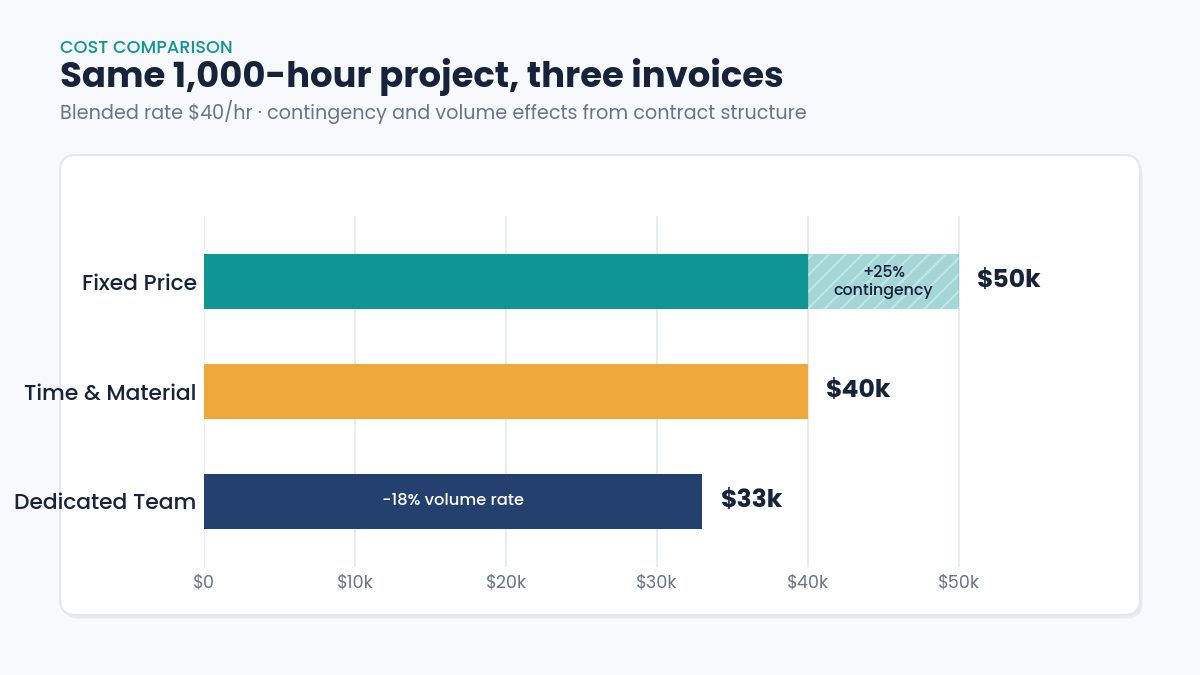
- Total cost of ownership. The same 1,000-hour project can land 20–40% apart depending on the model. Fixed price vendors bake in a 15–30% risk contingency; T&M strips it out but exposes you to overrun; dedicated teams drop the effective hourly rate 10–25% below T&M in exchange for a longer commitment.
- Speed to start and speed to change. A fixed price contract typically needs 2–4 weeks of specification work before code starts. T&M can start in 3–5 days. A mid-project pivot costs 1–3 weeks of change-request negotiation under fixed price versus a backlog re-prioritization conversation under T&M.
- Risk allocation. Under fixed price, the vendor carries delivery risk (and prices it in). Under T&M, you carry it. Under a dedicated team, risk is shared: the vendor guarantees capacity and replacement; you own output. Knowing where the risk sits tells you where to concentrate your governance effort.
- Quality incentives. Fixed price incentivizes the vendor to do the minimum that passes acceptance criteria. T&M incentivizes thoroughness (sometimes too much of it). Dedicated team incentivizes retention and long-term code health, because the same engineers live with their decisions for 12+ months.
- Cash-flow shape. Fixed price front-loads payments into milestones (often 20–30% advance). T&M bills monthly in arrears against timesheets. Dedicated team is a flat, predictable monthly invoice the easiest to budget, the hardest to shrink quickly.
The one-line version: the pricing model is a risk-transfer instrument disguised as a billing method. Buy the risk allocation first; the invoice format follows.
The Core Problem: Buyers Choose Models Backwards
Most teams pick a pricing model by asking “which one is cheapest?” the one question the model itself cannot answer. Here is what actually goes wrong, pattern by pattern:
- Scope certainty gets overestimated by 3–4x. Teams routinely claim “requirements are 90% final” when a structured discovery phase reveals 50–60% at best. That gap is invisible under T&M and catastrophic under fixed price, where every discovered requirement becomes a paid change request at premium rates ($90–150/hour for CR work that base scope priced at $40–60).
- The contingency buffer gets paid twice. Buyers who force a fixed price on fuzzy scope pay the vendor’s 25–30% risk premium and the change-request bills the classic double payment. On a $100k project, that’s $25–45k of avoidable spend.
- T&M gets treated as a blank check instead of a governed instrument. Without weekly burn-rate reviews, sprint-level acceptance, and a not-to-exceed cap, T&M projects drift 30–50% past estimates before anyone escalates. The model isn’t the problem; the missing governance cadence is.
- Dedicated team pricing gets compared to freelance hourly rates. A $5,500/month dedicated senior engineer looks expensive next to a $30/hour freelancer until you price in the freelancer’s 40–60% shared-bandwidth reality, zero replacement guarantee, and 2–6 week re-hiring gap when they vanish. Compared per productive hour, the dedicated model usually wins by 15–30% for engagements beyond 6 months.
- Exit terms get read at exit time. Notice periods (typically 30–60 days), IP-assignment triggers, and code-escrow clauses are negotiated cheapest at signing and most expensive at separation.
The rest of this guide fixes each of these failure modes in sequence starting with the phase where 70% of pricing pain is created: requirements definition.
The A-to-Z Walkthrough: From First Requirement to Final Invoice
This is the full lifecycle of an outsourced software project viewed through the pricing lens. Six phases, no skipped steps. Each phase notes how the three models behave differently, because the model you choose in Phase 3 changes what you must do in Phases 1, 4, 5, and 6.
Phase 1 Defining Requirements (and Scoring Your Scope Certainty)
Everything in choosing a pricing model for development flows from one honest measurement: how certain is your scope? Not how certain you feel how certain the documentation proves.
The scope certainty test. Score yourself before talking to any vendor:
- Can you write pass/fail acceptance criteria for 90%+ of features today? (Yes = +3, Partially = +1, No = 0)
- Do you have finalized UI/UX designs or detailed wireframes? (Yes = +2, Rough sketches = +1, No = 0)
- Have the integrations (payment gateways, ERPs, third-party APIs) been named and their docs reviewed? (Yes = +2, Named only = +1, No = 0)
- Has a comparable product been built before by anyone on your side? (Yes = +2, No = 0)
- Will the requirements survive contact with your first 100 users unchanged? (Honestly yes = +1, No = 0)
Scoring: 8–10 → fixed price is viable. 4–7 → time & material or milestone-based fixed price per module. 0–3 → T&M for a paid discovery phase first ($5,000–15,000 / ₹4–12 lakh, 2–4 weeks), then re-decide.
Budget bands to anchor before vendor conversations:
- MVP / prototype: $15,000–60,000 (₹12–50 lakh), 8–16 weeks
- Full production application: $60,000–250,000 (₹50 lakh–2 crore), 4–9 months
- Enterprise platform / multi-system integration: $250,000–1M+ (₹2–8+ crore), 9–24 months
- Ongoing product engineering (dedicated team): $12,000–45,000/month (₹10–37 lakh/month) for a 3–8 person pod
Red flag: any vendor who quotes a fixed price on a two-page requirements email without a discovery conversation is either padding 40%+ contingency or planning to make margin on change requests. Both cost you.
Deliverables to exit Phase 1 with:
- A prioritized feature list split into must-ship and nice-to-have
- Acceptance criteria for every must-ship feature (even one line each)
- Named tech stack and integration list
- A budget band and a hard ceiling (the number you will not cross)
- Your scope-certainty score, written down it becomes your model-selection input in Phase 3
Phase 2 Sourcing & Vetting Vendors (Reading Rate Cards Like an Insider)
Vendor evaluation and pricing evaluation are the same exercise. A rate card tells you more about a vendor’s operating model than their portfolio does.
How outsourcing companies calculate hourly rates. The blended rate you see is roughly: developer salary cost ÷ billable utilization (usually 70–80%) + overhead (office, benefits, bench, sales typically 35–55% of salary) + margin (15–30%). That’s why a developer earning ₹18 lakh/year ($21,600) bills out at $28–40/hour, not $10. A rate dramatically below regional norms means one of three things: shared bandwidth (your “full-time” developer serves 2–3 clients), junior talent presented as senior, or a bait rate that climbs after month two.
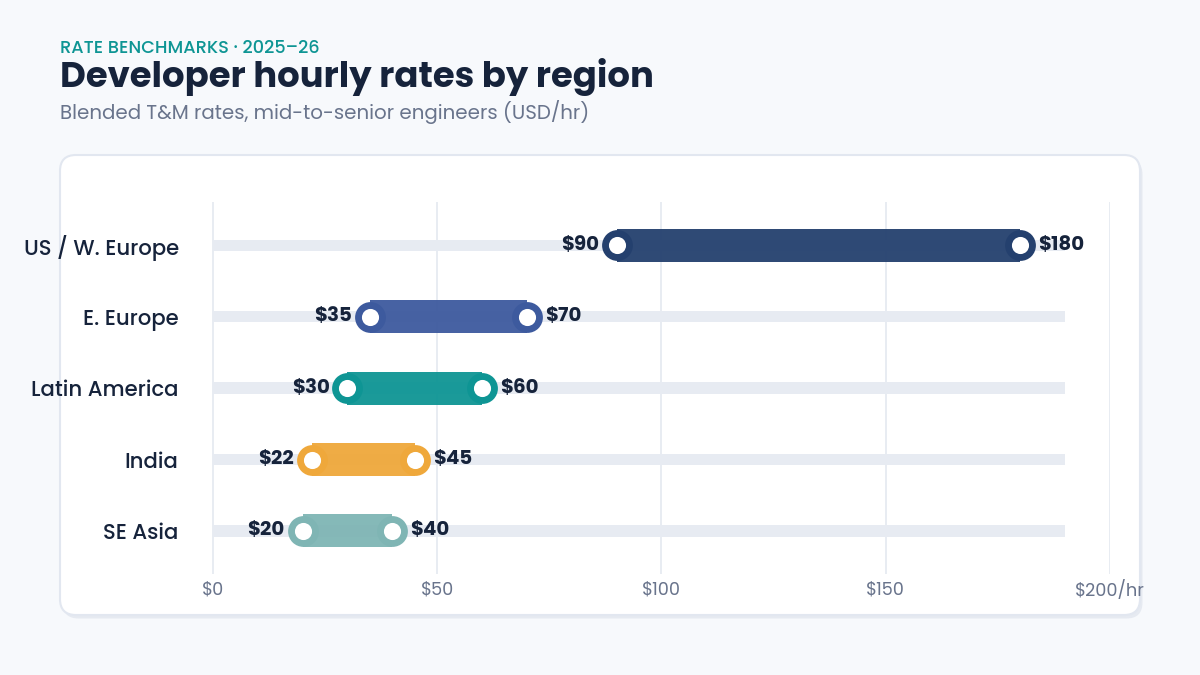
Regional blended-rate benchmarks (mid-to-senior engineers, 2025–26):
| Region | Hourly (T&M) | Monthly (dedicated) |
| India | $22–45 | $3,000–6,500 |
| Eastern Europe | $35–70 | $5,500–10,500 |
| Latin America | $30–60 | $4,800–9,500 |
| Southeast Asia | $20–40 | $2,800–5,800 |
| US / Western Europe | $90–180 | $14,000–28,000 |
Vetting checklist pricing-specific questions to ask every shortlisted vendor:
- “Show me a sample invoice and timesheet from a live T&M project.” (Redacted is fine. Refusal is a red flag.)
- “What’s your change-request rate versus your base rate?” (A CR premium above 25% signals a change-request-driven margin model.)
- “What’s your utilization assumption per billed FTE?” (Below 100% dedicated = shared bandwidth. Ask directly.)
- “What’s your replacement policy and its timeline?” (Best-in-class: a replacement candidate in 7–10 working days, at no re-onboarding fee.)
- “Who owns the IP, and when does ownership transfer on payment, or on delivery?” (Answer must be: on payment, per milestone, in writing.)
- “What are your payment terms and late-milestone remedies?” (Net-15/net-30 is standard; advance beyond 30% is not.)
Technical + cultural evaluation in parallel: insist on interviewing the actual engineers who’ll be staffed, not “representative profiles.” Vetted-marketplace models including Supersourcing’s AI-driven screening, which surfaces the top 2% of a talent pool and produces an interview-ready shortlist in 7–10 working days exist precisely because résumé-forwarding shops can’t make that guarantee. If you’d rather see how vetting works in practice, the hire pre-vetted software developers page breaks down the screening funnel stage by stage.
The 3-day rule: if a vendor takes more than 3 business days to answer a pricing-mechanics question during the sales cycle, expect the same latency on invoices and change requests after signing. Pre-sale responsiveness is the ceiling, not the floor.
Phase 3 Choosing the Model & Structuring the Contract
This is the core decision, so here are all three models at working depth: mechanics, invoicing, risk, and the contract clauses each one needs.
Model 1: Fixed Price
Mechanics. You and the vendor agree on a complete scope (the statement of work), a total price, and a milestone schedule. The vendor estimates internally, adds a 15–30% contingency buffer, and commits. Anything outside the SOW is a change request, separately estimated and billed.
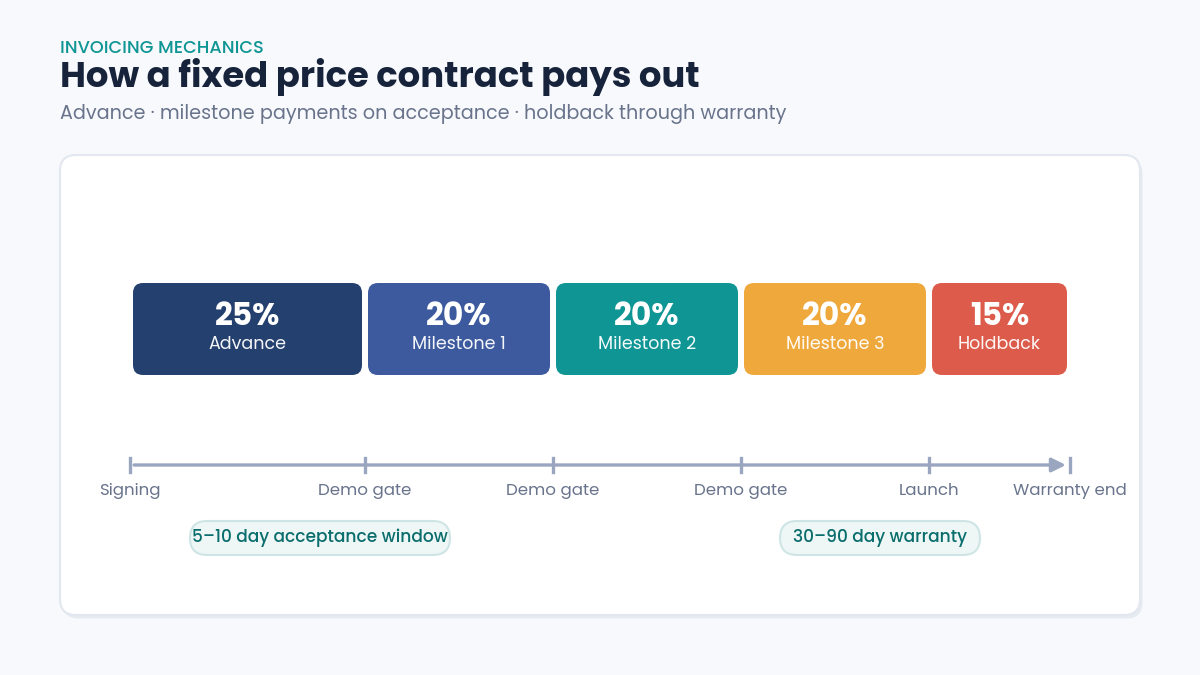
Invoicing & reporting. Typically 20–30% advance, then 3–6 milestone payments tied to accepted deliverables, with 10–20% held back for post-launch acceptance (a 2–4 week warranty window). Reporting is milestone-centric: you see demo builds at each gate, not daily burn.
Fixed price pros:
- Total budget known on day one; easiest model to get CFO approval for
- Delivery risk sits with the vendor overruns are their problem, not yours
- Minimal management overhead; you review at milestones, not sprints
- Clean procurement fit: one PO, defined deliverables, defined dates
Fixed price cons:
- Requires 2–4 weeks of upfront specification before any code is written
- Every change is a paid, negotiated change request pivots are slow and expensive
- Vendors optimize for “passes acceptance criteria,” not “best possible product”
- The 15–30% contingency is in your price whether the risk materializes or not
- Disputes concentrate at milestone acceptance (“that’s out of scope” arguments)
Contract must-haves: exhaustive SOW with acceptance criteria per deliverable; CR procedure with pre-agreed CR rate card; milestone acceptance window (5–10 business days, silence = acceptance is vendor-friendly negotiate explicit acceptance); IP assignment per paid milestone; delay remedies (0.5–1% of milestone value per week late is a common liquidated-damages band); warranty period of 30–90 days for defect fixes at no charge.
Model 2: Time & Material
Mechanics. You pay for actual hours worked at agreed role-based rates (or one blended rate). Scope lives in a living backlog; the team estimates in sprints; you re-prioritize continuously. Understanding fixed price vs time and material at the risk level: T&M moves delivery risk from vendor to client, and removes the contingency premium in exchange.
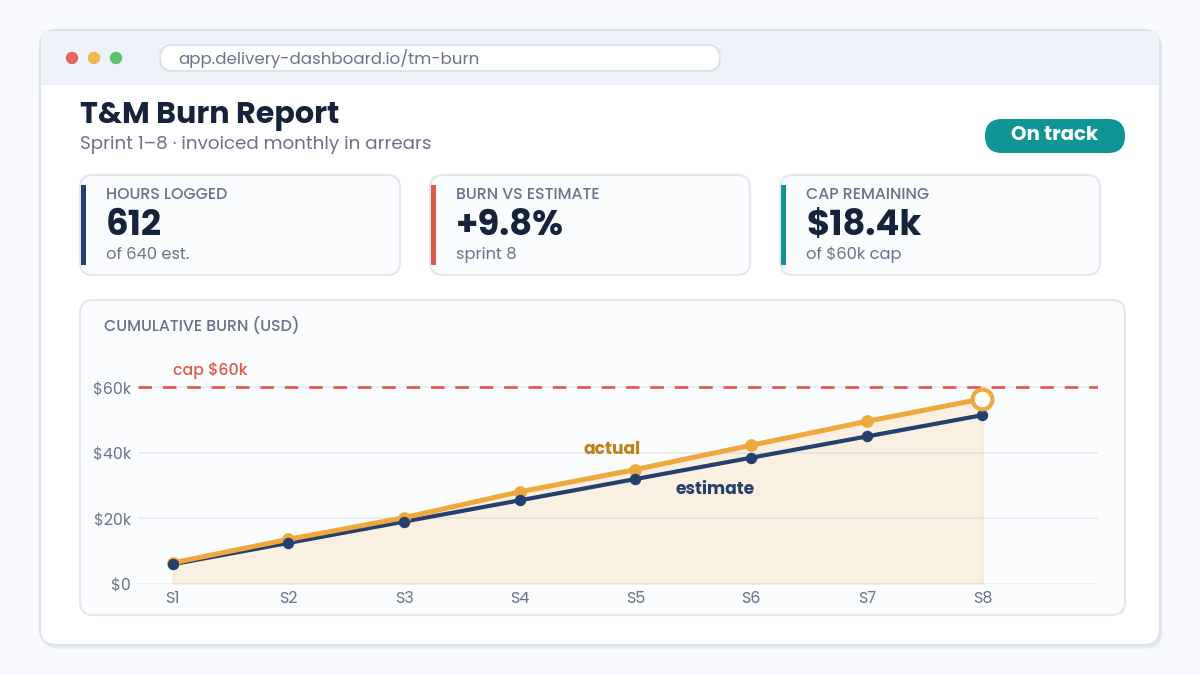
How does time and material billing work in practice? The vendor logs hours per person per task (Jira/Harvest/internal tools), sends a timesheet weekly or biweekly, and invoices monthly in arrears: hours × rate per role, plus pre-approved expenses. You should receive: per-person hour logs mapped to tickets, sprint velocity, burn versus estimate, and remaining-budget forecast. If the monthly invoice is one line “Development services: 640 hours” demand ticket-level mapping or walk.
T&M pros:
- Start in 3–5 days; no specification marathon required
- Change is free (structurally): re-prioritize the backlog, don’t renegotiate the contract
- No contingency premium you pay for work done, not risk insured
- Full transparency into who did what, if you enforce proper timesheets
- Naturally fits agile delivery and evolving products
T&M cons:
- Total cost is open-ended; the budget is a forecast, not a promise
- Delivery risk is yours; a slow team burns your money, not theirs
- Requires real governance: weekly burn reviews, sprint acceptance, an engaged product owner (plan 4–8 hours/week of your time)
- Perverse incentive risk if unmanaged: more hours = more revenue
Contract must-haves: rate card locked per role for 12 months; a not-to-exceed cap (T&M with cap) requiring written approval to breach this single clause removes 80% of T&M’s scariness; timesheet granularity defined in the contract (per-person, per-ticket); 30-day termination for convenience; monthly invoice dispute window of 10 business days; key-person clause naming engineers who can’t be swapped without your consent.
Model 3: Dedicated Team
Mechanics. You pay a flat monthly fee per team member (or per pod) for exclusive, full-time capacity and no shared bandwidth. The vendor handles recruiting, payroll, benefits, replacement, and infrastructure; you direct the work day-to-day like your own squad. Dedicated team pricing is effectively renting an engineering org, not buying a project.
Invoicing & reporting. One predictable monthly invoice: headcount × monthly rate, in advance or arrears per contract. Reporting shifts from hours to outcomes: sprint reports, velocity trends, release notes, plus a monthly account-management review. A dedicated account manager (not a salesperson) should own escalations. That’s the structural difference between a dedicated team provider and a body shop.
Dedicated team pros:
- Lowest effective rate for long engagements typically 10–25% below equivalent T&M hours
- Knowledge compounds: the same engineers own the codebase for 12+ months, cutting onboarding waste to near zero after quarter one
- Flat monthly cost the easiest model to budget and forecast
- Replacement guarantee shifts attrition risk to the vendor (benchmark: replacement in 7–10 days, sub-1% drop-off on well-run contract roles)
- Scales up or down with 30–60 days’ notice instead of a new contract
Dedicated team cons:
- Commitment floor: rarely worth it under 6 months or under 3 people
- You pay for capacity, not output a poorly directed team burns full price
- Management is on you: product direction, sprint planning, and code review standards are your job (or you add a paid tech lead at $5,500–9,000/month offshore)
- Ramp-down takes a notice period; you can’t shrink to zero overnight
Contract must-haves: named team members with CVs annexed; exclusivity clause (100% allocation, no moonlighting on other clients); replacement SLA with timeline; NDA plus IP assignment covering everything produced during the engagement; knowledge-transfer obligation on exit (documentation + 2–4 week handover); rate-lock for 12 months with capped annual increases (5–8% is market).
Hybrids worth knowing: milestone-based fixed price (fixed price per module, re-scoped between modules good for 4–7 scope-certainty scores); T&M with cap (described above); fixed price discovery → T&M build → dedicated team maintenance, which is the most common full-lifecycle sequence on products that succeed.
Phase 4 Onboarding & Ramp-Up (The First Two Weeks Decide the First Six Months)
Ramp-up is where pricing models quietly leak money. A team billing from day one but unblocked only on day nine costs you 30+ wasted person-hours per engineer.
The two-week onboarding checklist (works for all three models):
- Before day 1: repo access, VPN, cloud console roles, Jira/Linear board, Slack/Teams channels, staging environment credentials all provisioned. Every missed item costs half a billable day.
- Day 1–2: architecture walkthrough by your tech lead (recorded), product context session, definition-of-done agreed in writing.
- Day 3–5: first small ticket merged to production or staging a deliberate “tracer bullet” that proves the whole pipeline (access, CI/CD, review, deploy) works end to end.
- Week 2: communication cadence locked: daily async standup, one weekly sync call (kept under 30 minutes), sprint boundaries fixed, escalation path named (one person on each side).
- End of week 2: first sprint review with a working demo. Under T&M, this is also your first burn-versus-estimate checkpoint.
Model-specific onboarding notes:
- Fixed price: onboarding is mostly vendor-internal; your job is to answer clarification questions within 24 hours clarification latency is the #1 cause of “client-caused delay” claims later.
- T&M: insist on timesheet visibility from week one, not month one. The first invoice should surprise no one.
- Dedicated team: treat onboarding like hiring your own staff, company context, product vision, even the informal stuff. Teams that get a proper first-week induction hit full velocity 3–4 weeks sooner.
Phase 5 Managing Delivery (Governance Cadence by Model)
Ongoing management is where the models diverge most in your effort, so budget your own hours accordingly.
Governance cadence table:
| Activity | Fixed Price | T&M | Dedicated Team |
| Your weekly time investment | 1–2 hrs | 4–8 hrs | 5–10 hrs |
| Primary checkpoint | Milestone demo | Sprint review + burn report | Sprint review + monthly business review |
| Key metric to watch | Milestone slippage (days) | Burn rate vs estimate (%) | Velocity trend + attrition |
| Invoice verification | Deliverable acceptance | Timesheet-to-ticket audit | Headcount + allocation check |
| Escalation trigger | Any milestone >1 week late | Burn >15% over sprint estimate | Velocity down 2 sprints running |
KPIs that actually predict trouble (all models):
- Sprint predictability committed vs delivered story points; below 75% for two consecutive sprints means estimation or scope problems.
- Cycle time tickets start to production; a rising trend flags process debt before deadlines slip.
- Defect escape rate bugs found post-release per sprint; over 3–5 per sprint on a mid-size app means QA is being squeezed (common on fixed price near milestones).
- Invoice variance actual vs forecast spend; anything beyond ±10% monthly needs a written explanation, not a shrug.
Red flag: reporting that arrives only when you ask. Best-practice vendors push reports on a fixed cadence without prompting proactive reporting correlates strongly with proactive problem-solving. For teams that would rather delegate this entire governance layer, managed delivery through a structured custom IT services arrangement wraps account management, QA, and reporting into the engagement itself.
Phase 6 Scaling, Converting, or Exiting
Every engagement ends in one of three ways: it grows, it changes shape, or it winds down. All three should be priced and papered before you need them.
Scaling up:
- Adding headcount to a dedicated team should take 2–4 weeks (7–10 working days to shortlist, plus notice/onboarding) and require only an amendment, not a new MSA.
- Locking the incremental rate at contract time “additional engineers at then-current rates” is a blank check.
- For 15+ engineer scale on a multi-year horizon, compare the dedicated-team monthly run-rate against a Global Capability Center build-out: the GCC route typically wins on cost past 25–30 FTEs and 24+ months, at the price of setup effort.
Converting between models when to switch from fixed price to time and material (and other moves):
- Fixed price → T&M: the moment change requests exceed 15–20% of the original contract value. You’re already paying T&M prices with fixed price friction; formalize it.
- T&M → dedicated team: when the same engineers have been billing 140+ hours/month for 4+ consecutive months. Converting typically saves 10–25% and locks the team in.
- Dedicated team → fixed price: rare, but sensible for a discrete final module when the roadmap is ending and scope is fully known.
Exiting cleanly the offboarding checklist:
- Trigger the knowledge-transfer clause: architecture docs, runbooks, credential inventory, recorded handover sessions (2–4 weeks).
- Confirm IP assignment is complete for every paid deliverable to get a written IP confirmation letter, not just the contract clause.
- Rotate every credential the vendor ever touched. Everyone.
- Settle the final invoice against the notice period (30–60 days is standard; anything above 90 is vendor-protective).
- Hold the final 10–15% payment until the handover acceptance criteria defined at signing, not at exit are met.
Replacement policies during the engagement: the market-best standard is a replacement candidate presented within 7–10 days when a team member isn’t a fit, with no re-onboarding fees and no reset of the rate lock. If a vendor’s replacement clause is vague (“commercially reasonable efforts”), price that vagueness in it usually costs you 3–6 weeks of velocity when it triggers.
Case Studies: Pricing Models Under Real Load
Three engagements from Supersourcing’s delivery history, chosen because each one isolates a different pricing-model lesson. Metrics first, story second.
Case 1 100+ engineers on a dedicated capacity model (fintech). Paytm needed to add more than 100 engineers across payments and platform teams without diluting its hiring bar. Running the expansion on a dedicated, exclusively-allocated model with vetted shortlists delivered in 7–10 working days per role and a 98% joining rate meant the cost per productive engineer stayed flat even as headcount tripled, because no budget leaked to shared-bandwidth contractors or re-hiring cycles. The lesson: at 20+ FTE scale, per-seat monthly pricing beats hourly billing on both cost and predictability.
Case 2 Hyper-growth hiring where speed was the pricing variable (food delivery). During Swiggy’s engineering scale-up, the binding constraint wasn’t rate; it was the cost of an unfilled seat, which for a revenue-critical squad runs $15,000–40,000 per vacant month in delayed roadmap value. Compressing the JD-to-shortlist cycle to under two weeks made a marginally higher per-hire cost irrelevant against the recovered velocity. The lesson: when time-to-fill dominates, optimize the pricing conversation around speed guarantees, not rate-card decimals.
Case 3 Fixed price rescue converted to T&M with cap (anonymized healthtech). A patient-scheduling platform signed at $85,000 fixed price hit $31,000 in change requests by month four 36% of contract value as clinical workflows kept evolving. Converting the remaining scope to T&M with a $60,000 cap and biweekly burn reviews cut the effective change-cost premium from ~28% to zero and shipped the revised scope 7 weeks later at $54,200. The lesson: CR spend above 15–20% of contract value is the objective conversion trigger act on it, don’t ride it out.
More outcome-metric write-ups across fintech, healthtech, and SaaS are collected in the client case studies library.
The Decision Framework: Match the Model to Your Scope Certainty
Here is the full comparison, followed by the flowchart logic you can run in ten minutes.
| Dimension | Fixed Price | Time & Material | Dedicated Team |
| Best for | Well-specified projects, <6 months | Evolving scope, agile builds | Long-term product engineering, 6+ months |
| Scope certainty needed | High (8–10/10) | Low–medium (any) | Medium (roadmap-level) |
| Budget predictability | Highest (fixed) | Lowest (forecast only) | High (flat monthly) |
| Flexibility to change | Lowest (paid CRs) | Highest (re-prioritize backlog) | High (you direct the team) |
| Delivery risk sits with | Vendor | Client | Shared |
| Speed to start | Slow (2–4 wk spec) | Fast (3–5 days) | Medium (2–4 wk staffing) |
| Effective cost level | Base + 15–30% contingency | Base rate | Base − 10–25% (volume) |
| Your management load | Low (1–2 hrs/wk) | Medium–high (4–8 hrs/wk) | High (5–10 hrs/wk) |
| Invoice basis | Milestones accepted | Hours × rate (timesheets) | Headcount × monthly rate |
| Exit friction | At milestone boundaries | 30-day notice, clean | 30–60 day notice + handover |
The flowchart (infographic logic):
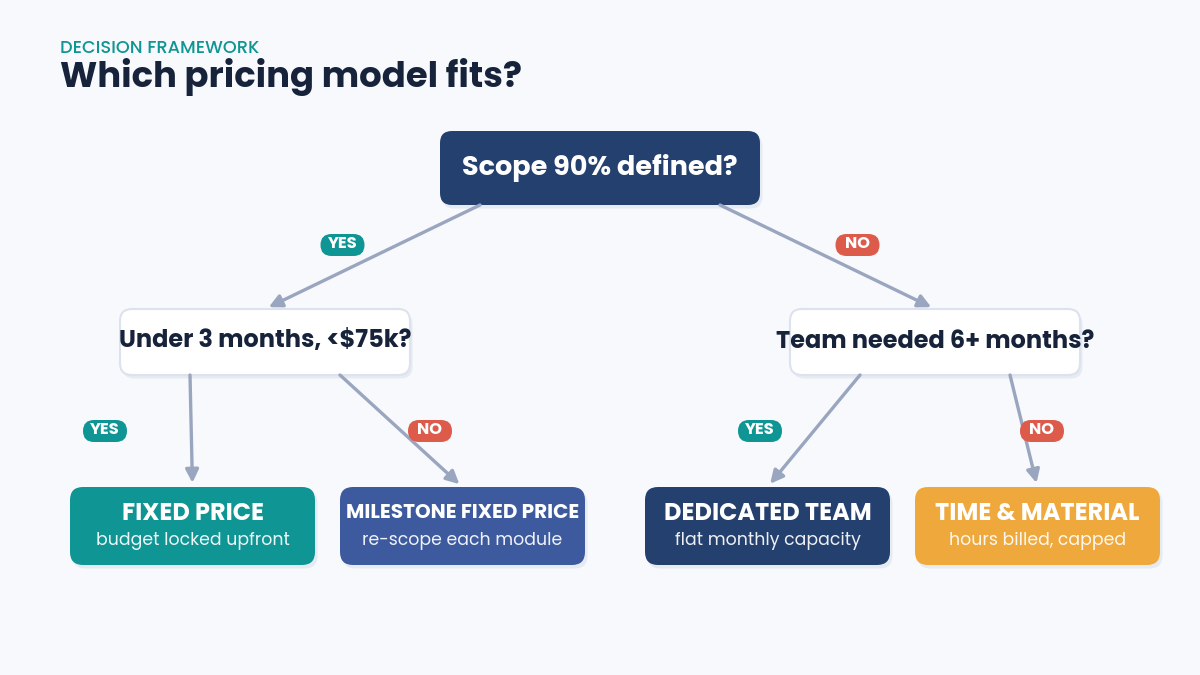
Can you write pass/fail acceptance criteria for 90%+ of features today?
- Yes → go to 2.
- No → go to 3.
Is the project under ~3 months and under ~$75k?
- Yes → Fixed price. Scope is provable and the blast radius of being wrong is small.
- No → Milestone-based fixed price. Fix price per module; re-scope at each gate so contingency doesn’t compound across a long timeline.
Do you need the team 6+ months with continuously evolving priorities?
- Yes → Dedicated team. You’re buying capacity and compounding knowledge, not a deliverable.
- No → Time & material and add a not-to-exceed cap if your budget approval process is rigid.
Three tie-breakers when you’re on a boundary:
- Cash-flow constraint → dedicated team (flat monthly) beats fixed price (lumpy milestones).
- First time outsourcing → T&M with cap; it’s the most forgiving model to learn governance on.
- Compliance-heavy procurement (public sector, regulated enterprise) → fixed price or milestone-based fixed price; open-ended T&M rarely survives procurement review.
What Most Teams Get Wrong
Patterns from 500+ engagements, stated plainly:
They negotiate the rate and ignore the utilization. A $35/hour engineer at 60% real allocation costs more per unit of output than a $48/hour engineer at 100%. Effective rate = invoice ÷ productive hours. Almost nobody computes it; everyone should. The no-shared-bandwidth clause is worth more than a $5/hour discount every single time.
They believe fixed price means fixed cost. Fixed price fixes the cost of the original scope. On projects with evolving requirements, 20–40% of final spend arrives via change requests priced at premium rates. Fixed price is the most expensive model for uncertain scope, the inversion of what its name implies.
They use T&M without a cap and then blame T&M. T&M isn’t risky; ungoverned T&M is. A not-to-exceed cap, per-ticket timesheets, and a 30-minute weekly burn review turn T&M into the most transparent instrument on this list. Teams that skip all three and then declare “T&M burned us” misdiagnose a governance failure as a model failure.
They evaluate dedicated teams on month-one cost instead of month-twelve output. Months 1–2 of a dedicated pod run at 50–70% velocity while context builds. Buyers who churn vendors at month three to chase a cheaper rate pay the ramp-up tax repeatedly, often 15–25% of annual spend lost to serial onboarding. Knowledge compounding is the entire economic case for the model; interrupting it destroys the discount.
They treat the contract as legal hygiene instead of an operating manual. The CR rate card, acceptance windows, replacement SLA, IP-transfer trigger, and exit handover terms are the levers you’ll actually pull. Teams that can’t locate their acceptance-window clause during a milestone dispute pay for that afternoon of not-reading for months.
They ask “which model is cheapest?” instead of “where should the risk sit?” All three models converge to similar totals when scope certainty is correctly matched. The spread of the 20–40% swings comes from mismatches. Price the risk allocation first; the cheapest model is the one that fits.
Cost & Timeline Reality Check
The section most competing content on software development outsourcing pricing models skips: actual numbers, stated as ranges you can plan against.
Typical engagement costs by scenario (offshore/India-anchored, 2025–26):
- Discovery phase (any model): $5,000–15,000 / ₹4–12 lakh · 2–4 weeks
- MVP, fixed price: $25,000–80,000 / ₹20–65 lakh · 10–16 weeks including spec
- MVP, T&M (3–4 person team): $18,000–30,000 per month of build / ₹15–25 lakh · code starts week one
- Dedicated pod (2 seniors, 2 mid, 1 QA): $18,000–26,000 / ₹15–21 lakh per month · 2–4 week staffing lead time
- Single dedicated senior engineer: $4,500–6,500 / ₹3.7–5.4 lakh per month
- Tech lead / architect add-on: $5,500–9,000 / ₹4.5–7.5 lakh per month
- Change requests on fixed price: base rate + 20–50% premium, each CR adding 1–3 weeks of negotiation-plus-build
What drives cost up:
- Scope uncertainty forced into a fixed price (contingency + CRs the double payment)
- Niche stacks (Rust, embedded, on-staff ML engineering) add 20–40% over mainstream web/mobile rates
- Compliance overhead (HIPAA, PCI-DSS, SOC 2 environments) add 10–25% for process, audit trails, and restricted-access tooling
- Time-zone overlap requirements above 4 hours/day with US teams narrows the talent pool, adds 10–15%
- Serial vendor switching each switch costs 15–25% of annual spend in ramp-up waste
What drives cost down:
- A written scope-certainty score and honest model match (the single biggest lever worth 20–40%)
- 12-month rate locks and volume commitments (dedicated teams price 10–25% under T&M equivalents)
- Reusable acceptance criteria and design assets entering Phase 1 cuts spec time 30–50%
- A named product owner on your side with decision authority cuts clarification latency, the hidden tax on every model
- Not-to-exceed caps that force scope discipline before, not after, the burn
Timeline reality: vendor selection done properly takes 2–4 weeks; contract negotiation 1–3 weeks (fixed price is the slowest to paper); staffing/spec 1–4 weeks depending on model. Plan 4–8 weeks from “we should outsource this” to the first sprint and treat any promise of “we start tomorrow” on a fixed price contract as the red flag it is.
Deciding This Week? Do These Three Things
If you’re mid-decision on an outsourcing contract right now, the path is short:
- Score your scope certainty using the Phase 1 test ten minutes, brutally honest.
- Run the flowchart in the decision framework above and write down the model it outputs before any vendor tells you their preference.
- Pressure-test the quote in front of you against the rate bands and contract must-haves in this guide. Every clause named here is negotiable before signing and expensive after.
If you’d rather run step three with people who’ve structured these contracts across 527+ projects including which model fits your specific scope score and what your quote should cost, book a working session at supersourcing.com/contact-us. Bring the quote; thirty minutes is usually enough to find the 20% hiding in it.
FAQ
What is the difference between fixed price and time and material?
Fixed price locks scope and cost upfront the vendor commits to deliverables at a set total and absorbs overrun risk, pricing in a 15–30% contingency. Time and material bills actual hours at agreed rates against a flexible backlog, so you carry delivery risk but skip the contingency premium and can change direction freely. The honest deciding variable is scope certainty, not preference.
How much does a dedicated development team cost per month?
A typical offshore pod of two senior engineers, two mid-level, one QA runs $18,000–26,000 (₹15–21 lakh) per month from India, roughly 40–60% more from Eastern Europe or Latin America. Single senior engineers run $4,500–6,500/month offshore. Expect a 6-month minimum commitment and rates locked for 12 months with 5–8% annual increase caps.
Which pricing model is best for startups building an MVP?
Usually time and material with a not-to-exceed cap, preceded by a 2–4 week paid discovery. Startup scope changes weekly by design, which makes fixed price a change-request trap. Once the MVP validates and a 6+ month roadmap exists, converting the same engineers to a dedicated team typically cuts effective cost 10–25%.
What is scope creep and which pricing model controls it best?
Scope creep is the gradual, unpriced expansion of requirements beyond the original agreement. Fixed price controls it contractually every addition becomes a paid change request but at the cost of friction. T&M absorbs creep financially rather than preventing it, which is why the cap and weekly burn review matter. Dedicated teams handle creep best culturally: scope trades against capacity in sprint planning rather than against money.
Can you switch pricing models in the middle of a project?
Yes, and mature vendors expect it. The common conversions: fixed price to T&M once change requests pass 15–20% of contract value, and T&M to dedicated team once the same engineers bill 140+ hours/month for 4+ months. Paper the conversion as a contract amendment with IP continuity confirmed never as a verbal arrangement.
What should a fixed price contract include to protect the client?
Five clauses do most of the work: acceptance criteria per milestone with an explicit acceptance window; a pre-agreed change-request rate card; IP assignment triggered by each milestone payment; delay remedies (liquidated damages of 0.5–1% of milestone value per week is a market band); and a 30–90 day post-launch warranty covering defect fixes at no charge.
Is time and material riskier for the client than fixed price?
It transfers different risks, not more risks. T&M exposes you to cost overrun but eliminates the fixed price failure modes: paying contingency you didn’t use, CR premiums, and minimum-viable-acceptance quality. With a cap, per-ticket timesheets, and weekly burn reviews, governed T&M is frequently the lower-risk instrument for any project scoring below 8/10 on scope certainty.
How do I know a vendor’s pricing is trustworthy before signing?
Ask for a redacted sample invoice and timesheet, the CR rate versus base rate, the utilization assumption per billed FTE, and the replacement SLA in writing. Trustworthy answers are specific numbers delivered within 3 business days. If you want a second opinion on a quote you’re currently evaluating, model choice, rate sanity, or contract clauses, that’s exactly the kind of 30-minute working session worth booking before you sign, not after.
