

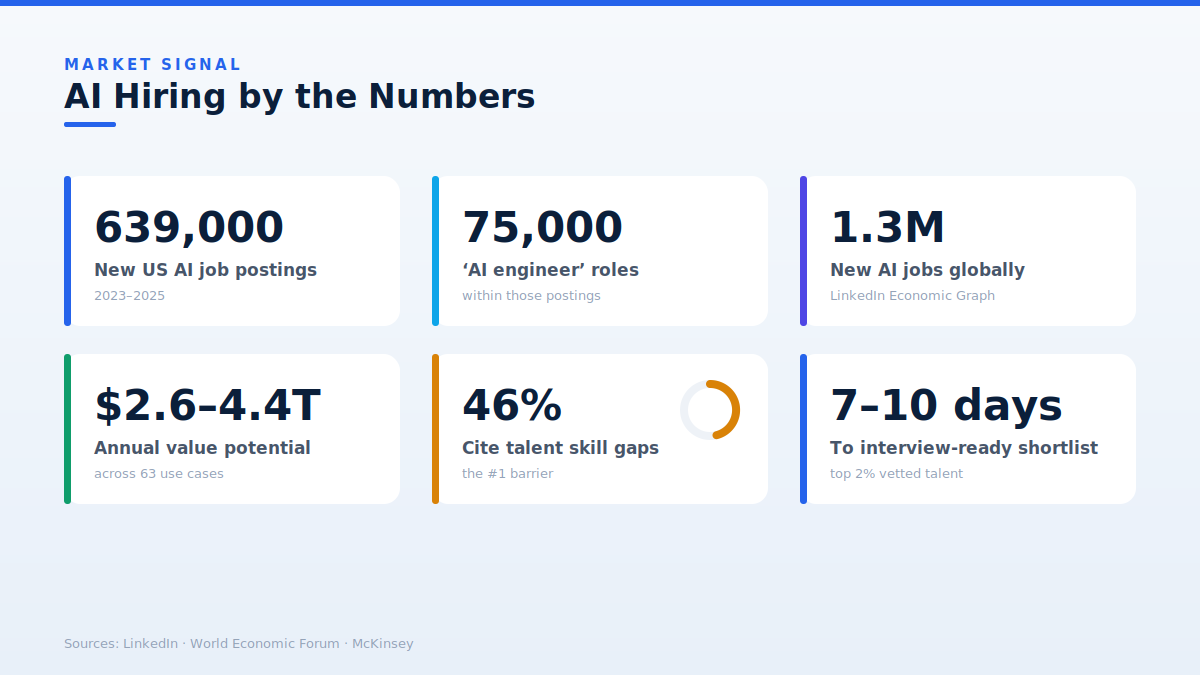
Between 2023 and 2025, employers added roughly 639,000 new AI-related job postings in the United States alone, and about 75,000 of them carried the literal title “AI engineer.” Demand has never been the bottleneck. The bottleneck is that most teams trying to hire generative AI engineers are screening for the wrong signals, budgeting for the wrong seniority, and quietly bundling three or four different jobs into one job description then wondering why the first two hires didn’t stick.
LinkedIn’s Economic Graph found AI Engineer among the fastest-growing roles of the past three years, part of an estimated 1.3 million new AI-centric jobs created globally from forward-deployed engineers to model researchers.
The generative AI market has moved faster than the vocabulary used to hire for it. “Prompt engineer,” “GenAI engineer,” “LLM engineer,” and “applied ML researcher” get used interchangeably in job posts that then interview for none of them well. The result is predictable: a candidate who can build a slick ChatGPT demo but has never shipped anything that survives real traffic, real data, and real cost constraints.
This guide is built to fix that end to end. It walks the entire lifecycle from deciding you need the role, to writing a requirement that filters correctly, to sourcing and vetting, to contracts and IP, to onboarding, to managing delivery quality, to scaling or exiting cleanly. If you have never made this hire before, you can read start to finish and run the process yourself. If you have made it before and it went sideways, the diagnosis is probably in here too.
A quick note on scope: this is not a “top 10 skills” listicle. It is closer to an internal playbook that happens to be public. Every section is meant to teach something the last article you read left out.
What Is a Generative AI Engineer?
A generative AI engineer is a software engineer who designs, builds, and operates production systems on top of foundation models large language models, diffusion models, and multimodal models using techniques like retrieval-augmented generation, fine-tuning, embeddings, evaluation harnesses, and guardrails to turn a probabilistic model into a reliable product feature.
That definition matters because of what the role is not:
- I am not a data scientist. A data scientist explores data and builds models from scratch; a generative AI engineer mostly composes, adapts, and productionizes existing foundation models.
- It is not a pure prompt engineer. Prompt design is one skill inside the role, not the whole job.
- It is not an ML research scientist. Researchers advance the underlying models; generative AI engineers apply them under latency, cost, and reliability constraints.
Getting this distinction right before you write the job post is the single highest-leverage thing you can do. Almost every failed hire in this category traces back to a title-to-work mismatch created on day one.
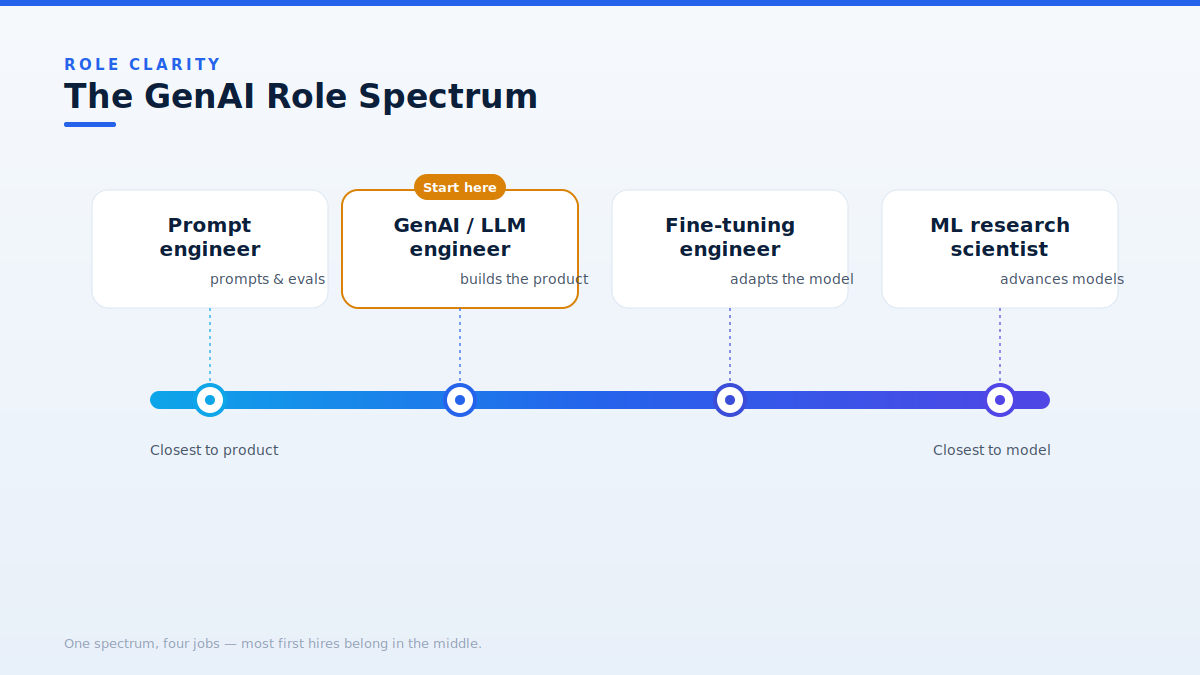
The Generative AI Role Spectrum: Prompt Engineer vs AI Engineer vs ML Researcher
The clearest way to resolve the prompt engineer vs AI engineer confusion is to stop treating these as job titles and start treating them as points on a spectrum. Each point sits at a different distance from the underlying model, and that distance predicts the skills, the salary band, and the kind of work you’ll actually get.
Here is the spectrum, from closest-to-the-product to closest-to-the-model effectively the “GenAI role spectrum” infographic in text form:
| Role | Core job | Works with | Typically needs |
| Prompt engineer | Craft, test, and version prompts and instructions; design system prompts and few-shot examples | APIs, prompt-management tools, evals | Strong reasoning + language skills; light coding |
| GenAI / LLM application engineer | Build the product around the model: RAG pipelines, tool-calling, agents, guardrails, latency and cost control | Python, vector DBs, orchestration frameworks | Full software engineering + LLM systems |
| ML / fine-tuning engineer | Adapt models: fine-tuning, LoRA/QLoRA, distillation, quantization, custom evals | PyTorch, GPUs, training pipelines | Deep ML + infra |
| Applied ML research scientist | Improve model architectures and training methods | Research stacks, large compute | PhD-level research + publications |
The practical takeaway: most companies buying their first hire in this space think they want a research scientist and actually need a GenAI application engineer. The application engineer sits in the sweet spot close enough to the model to control quality, close enough to the product to ship it. If you can only make one hire, make it here.
When you genuinely need a prompt engineer: you have a stable product, heavy reliance on a single model provider, and a need to squeeze quality out of prompts and evaluation rather than architecture. That is a real role, but it is rarely the first role.
Why Getting This Hire Right Actually Matters
The business case for taking this seriously is not abstract. The downstream outcomes are measurable, and they move in both directions depending on who you put in the seat.
- Cost of a mis-hire: a wrong senior hire in this band can burn $120,000–$250,000 (or ₹35–60 lakhs in India) in salary, ramp time, and opportunity cost before you even realize the fit is wrong typically 3–5 months in.
- Speed to a working feature: a strong GenAI application engineer ships a production-grade RAG feature in 4–8 weeks; a demo-builder produces something that looks done in one week and then stalls for months at the reliability stage.
- Inference cost control: experienced engineers routinely cut token and inference spend by 30–60% through caching, model routing, and prompt compression the difference between a feature that’s economical and one that quietly bleeds margin.
- Quality and risk: proper evaluation and guardrails reduce hallucination and compliance incidents that, in regulated sectors, carry real legal and reputational cost.
The macro backdrop reinforces the urgency. McKinsey estimates generative AI could add $2.6 trillion to $4.4 trillion in annual economic value across 63 use cases with software engineering, customer operations, marketing, and R&D capturing most of it. McKinsey. The value is real; the constraint is people who can build it well.
The Core Problem Most Buyers Face
Here is the pattern we see repeatedly. A company decides to add AI to its product, writes a job description that reads like a wish list scraped from four different roles, and then spends three months interviewing candidates against criteria that don’t match the actual work. The talent shortage is real. McKinsey found 46% of leaders name talent skill gaps as the single biggest barrier to capturing AI value McKinsey but the self-inflicted problems are just as costly.
Four failure modes account for most of the damage:
- The demo trap. Candidates who are fluent with a model playground but have never handled evaluation, cost, latency, or the messy 20% of inputs that break naive pipelines. Their work demos beautifully and fails in production.
- Seniority mismatch. Teams pay research-scientist salaries for work an application engineer should do, or hand a junior a problem that needs someone who has shipped LLM systems before.
- Vetting theater. Interviews that quiz trivia (“what’s the context window of model X?”) instead of testing whether the person can debug a hallucinating RAG pipeline.
- No definition of done. Nobody agreed on what “working” means: an accuracy threshold, a latency budget, a hallucination rate so delivery drifts and there’s no way to say whether the hire succeeded.
The 3-4x rule: most teams underestimate the time from “first interview” to “productive on our codebase” by 3–4x. They budget two weeks; the reality for a genuinely production-capable engineer, sourced and vetted properly, is closer to a disciplined 7–10 working day shortlist followed by a structured onboarding and much longer if you’re sourcing cold and screening yourself.
The rest of this guide is the antidote: a phase-by-phase process that removes each of these failure modes.
The A-to-Z Walkthrough: From Scratch to a Productive Hire
This is the core of the guide. LLM application development hiring has a predictable lifecycle, and skipping a phase is where projects break. Work through all six.
Phase 1 Defining Requirements (Scope, Skills, Timeline, Budget)
Before sourcing a single resume, get specific about the work. Vague requirements are the root cause of most bad hires in this space.
Step-by-step scoping checklist:
- Name the use case in one sentence. “A support assistant that answers from our docs” is a RAG problem. “A tool that generates marketing variants” is a generation-and-evaluation problem. “A model tuned to our domain language” is a fine-tuning problem. Each implies a different hire.
- Decide build vs. adapt vs. train. Most first projects are adapted (RAG + prompt engineering + guardrails), not training. This decision sets the seniority you need.
- Fix the constraints early: target accuracy or groundedness, acceptable hallucination rate, latency budget (e.g. sub-2-second responses), and monthly inference cost ceiling.
- Choose the engagement horizon: a 6–12 week project sprint, a 6-month build, or an ongoing embedded role.
- Set a budget band (concrete ranges in the Cost section below) so sourcing filters to the right seniority from day one.
The generative AI developer skills that actually matter for a production application engineer use this as your must-have checklist:
- Strong Python and general software engineering (testing, versioning, CI/CD) non-negotiable.
- RAG end to end: chunking strategy, embeddings, a vector database (Pinecone, Weaviate, pgvector, or FAISS), retrieval, and reranking.
- Prompt engineering as a disciplined practice, not vibes: system prompts, few-shot design, prompt versioning.
- Evaluation: building an evals harness, measuring groundedness and hallucination rate, regression-testing prompt changes.
- Orchestration frameworks: LangChain, LlamaIndex, or equivalent and knowing when not to use them.
- LLMOps / observability: logging, tracing, monitoring drift, and cost.
- Guardrails and safety: input/output validation, PII handling, red-teaming.
- Cost and latency engineering: caching, model routing, quantization awareness.
Fine-tuning, LoRA/QLoRA, and distillation are “nice to have” for most application roles and “must have” only if Phase 1 established that you’re genuinely training or adapting weights.
Phase 2 Sourcing & Vetting
This is where good hiring is won or lost. The market is thin and noisy, so your screen has to separate production engineers from demo-builders fast.
What good sourcing looks like:
- A pre-vetted pipeline beats cold posting. AI-driven sourcing that surfaces the top 2% of vetted talent compresses a months-long search into a 7–10 working day shortlist.
- Portfolio over pedigree: shipped LLM features, open-source contributions, and a working eval mindset beat a degree in this field.
The RAG developer skills you should probe directly because RAG is where most real projects live form a tight technical screen:
- Can they explain a chunking strategy and why they chose it for a given document type?
- Do they rerank retrieved results, and can they say when reranking is worth the latency?
- How do they measure whether retrieval is actually grounding the answer versus the model confabulating?
- How do they handle the queries where retrieval returns nothing useful?
Red flags to watch for:
- Talks only about model choice, never about evaluation or cost.
- Has never measured a hallucination rate or built an eval set.
- Every project is a notebook demo; nothing reached production traffic.
- Can’t explain a single tradeoff they made under latency or budget pressure.
- Name-drops frameworks but can’t say what problem the framework solved.
Generative AI hiring interview questions worth using a practical set that tests judgment, not trivia:
- “Walk me through the RAG system you shipped. Where did it break first, and how did you find out?”
- “Your assistant is confidently wrong 8% of the time. Walk me through diagnosing and fixing it.”
- “How would you cut this feature’s inference cost by half without gutting the quality?”
- “When would you fine-tune instead of doing RAG or prompt engineering?”
- “Show me how you’d build an eval set for this use case from scratch.”
Pair the interview with a paid, scoped work sample, a small RAG or evaluation task on realistic (sanitized) data. It predicts on-the-job performance far better than whiteboarding. Balance the technical screen with a cultural and communication check: this role sits between product, data, and engineering, so the ability to explain tradeoffs to non-technical stakeholders is part of the job, not a bonus.
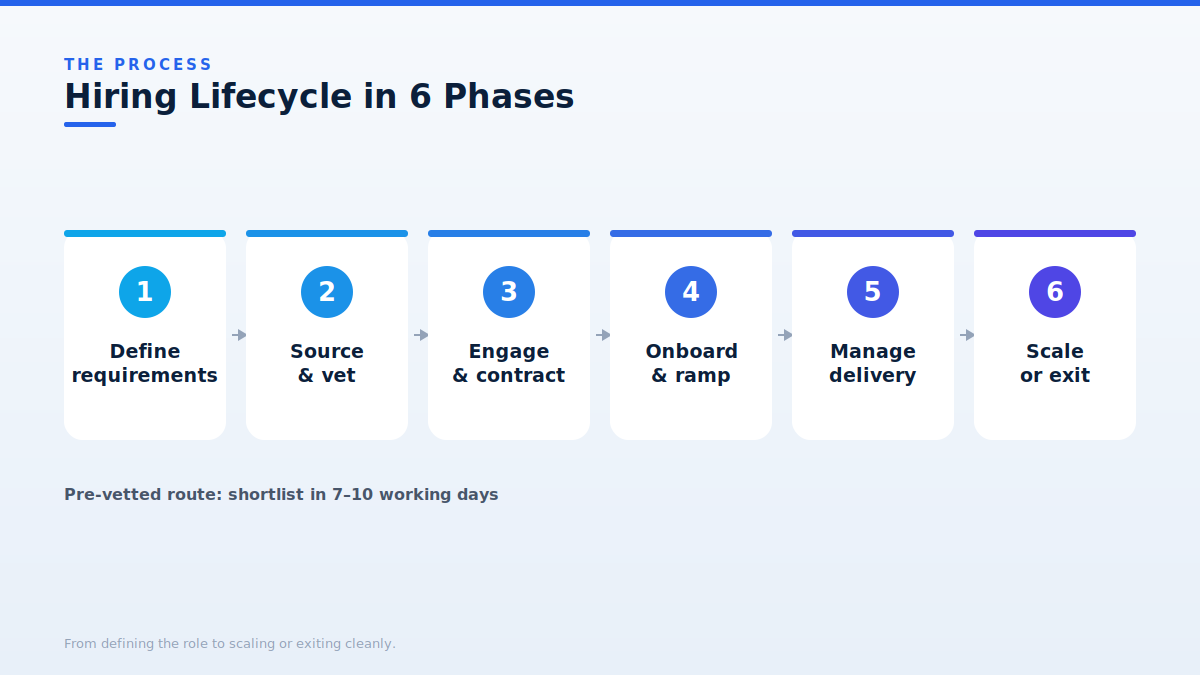
Phase 3 Engagement Models & Contracts
Once you’ve found the person or team, decide how you engage them. The model you choose changes cost, control, speed, and risk.
The three common models:
- Dedicated team / embedded engineer a full-time resource who works only on your product, with a dedicated account manager and no shared bandwidth. Best for ongoing product work and highest continuity.
- Staff augmentation you slot vetted engineers into your existing team under your management. Best when you have the leadership but not the headcount.
- Project-based / managed delivery an outcome is scoped and delivered by a team. Best for a defined, time-boxed build.
Contract terms that are non-negotiable for AI work:
- NDA-backed IP protection and clear IP assignment everything built, including prompts, eval sets, and fine-tuned artifacts, is yours.
- Data handling clauses: where your data lives, whether it can touch third-party model APIs, and deletion terms.
- A replacement guarantees a genuine practitioner-grade arrangement replaces a hire who isn’t a fit within 7–10 days, not “we’ll try.”
- Clear exit and knowledge-transfer terms so the engagement can end without stranding your codebase.
Phase 4 Onboarding & Ramp-Up
A great hire underperforms for a month if onboarding is sloppy. The first two weeks set the trajectory.
First-14-days onboarding checklist:
- Days 1–2: access to repos, model API keys, vector DB, data (sanitized where needed), and observability tooling. Nothing kills momentum like a week waiting for credentials.
- Days 3–5: a written brief of the use case, constraints, and the definition of done agreed in Phase 1. Pair them with one internal owner.
- Days 6–10: a small, real, shippable first task ideally a slice of the eval harness or a narrow RAG improvement so they touch production early.
- Days 11–14: first delivery review against the agreed metrics; calibrate communication cadence.
Set the communication cadence now: a short daily async update, a weekly demo, and a shared dashboard for cost and quality metrics. Remote and GCC-based engineers thrive on written clarity far more than on meetings.
Phase 5 Managing Delivery
Managing GenAI delivery is different from managing ordinary software delivery because “working” is a moving, probabilistic target. You manage metrics, not feelings.
KPIs to track from week one:
- Quality: groundedness / accuracy against your eval set, and hallucination rate over time.
- Reliability: error rate, fallback rate, and p95 latency.
- Cost: inference spend per request and per active user.
- Velocity: eval-passing changes shipped per sprint.
Reporting cadence that works: a weekly demo tied to the metrics above, a live dashboard for cost and quality, and a dedicated account manager or team lead as the single point of accountability. The structure matters more than the frequency one owner, one dashboard, one agreed definition of done.
Phase 6 Scaling or Exiting
Whatever you build, plan the end state before you need it.
To scale:
- Add a second engineer only once the first has stabilized evals and observability otherwise you’re adding people to an unmeasured system.
- Split roles as you grow: an application engineer for product, a fine-tuning or LLMOps specialist for depth.
- Consider a Global Capability Center (GCC) once you’re running a standing AI team of five or more it converts recurring vendor spend into an owned, long-term capability.
To exit cleanly:
- Enforce knowledge transfer: documented prompts, eval sets, architecture, and runbooks.
- Rotate or replace under the agreed guarantee window if fit is wrong with genuine partners, replacements land inside 7–10 days.
- Keep IP assignment airtight so nothing walks out the door.
Case Studies: What Outcome-Focused Hiring Looks Like
The following reflect real engagement patterns from work across fintech, healthtech, and consumer tech clients including names like Swiggy, Paytm, OkCredit, and Somnoware using verifiable delivery metrics rather than embellished figures.
- Fintech scale-up (Paytm-scale hiring). When a fintech needs to add 100+ engineers, the differentiator is a 98% candidate joining rate and under 1% drop-off on contract roles. That reliability not headline speed alone is what keeps a hiring plan from unraveling mid-quarter.
- Consumer tech (Swiggy-scale ramp). For high-growth consumer platforms, the constraint is surfacing quality fast. An AI-driven pipeline that presents the top 2% of vetted talent as an interview-ready shortlist in 7–10 working days turns a stalled search into a staffed team without lowering the technical bar.
- Recruitment automation (Somnoware / OkCredit pattern). For lean engineering orgs, dedicated account management and NDA-backed IP protection matter as much as the hire itself because a small team can’t absorb a bad fit or an IP dispute. A replacement guarantee inside 7–10 days removes the single-point-of-failure risk that keeps founders up at night.
The pattern across all three: lead with the metric that de-risks the decision, not the anecdote.
A Decision Framework You Can Apply Yourself
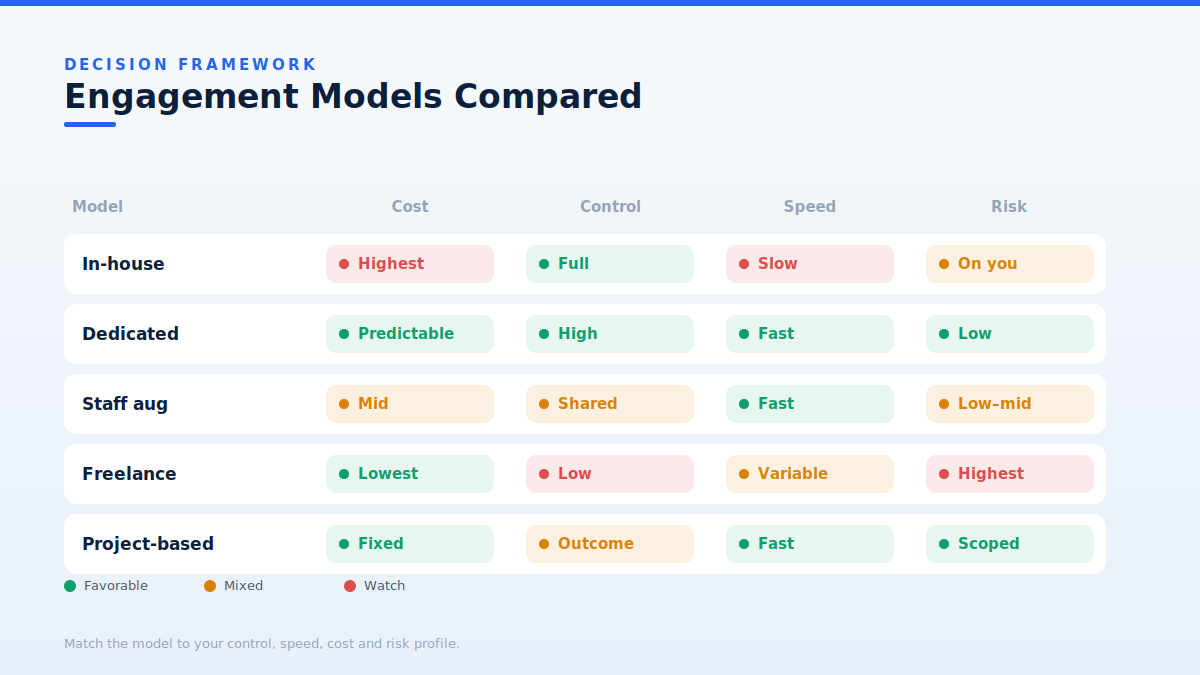
Before you commit, run your situation through this comparison. There is no universally “best” model, only the best fit for your control, speed, cost, and risk profile.
| Model | Cost | Control | Speed to start | Risk | Best when |
| In-house full-time | Highest total cost; slowest to fill | Full | Slow (2–4 months to hire) | Hiring risk on you | You have a long-term, core AI roadmap |
| Dedicated / embedded (via partner) | Predictable monthly | High | Fast (7–10 working days) | Low; replacement-backed | Ongoing product work without hiring overhead |
| Staff augmentation | Mid | You manage | Fast | Low–mid | You have leadership but need hands |
| Freelance / marketplace | Lowest upfront | Low | Variable | Highest (vetting, continuity, IP) | One-off, low-stakes experiments |
| Project-based managed delivery | Fixed scope | Outcome-level | Fast | Low if scoped well | A defined, time-boxed build |
How to read this table: the further right your risk tolerance and the more central AI is to your product, the more you should lean toward dedicated or in-house. The more experimental and time-boxed the work, the more freelance or project-based makes sense with eyes open about vetting and IP.
What Most Teams Get Wrong
This is the part worth arguing with, because the consensus advice is mostly wrong at the edges.
They hire for the model, not for the system. The model is a commodity that changes every few months. The durable skill is everything around the model retrieval, evaluation, guardrails, cost control. Hiring someone because they “know GPT-class models” is like hiring a chef because they own a specific brand of oven.
They over-index on prompt engineering as a standalone role. In 2023 it looked like the future. In practice, prompt skill is now table stakes folded into the application engineer’s job. Hiring a dedicated engineer before you have a stable product is usually premature.
They confuse a good demo with a good hire. A demo optimizes for the happy path. Production is the unhappy path: the 20% of inputs that are ambiguous, adversarial, or out of scope. The engineers worth paying for talk about that 20% unprompted.
They skip evaluation entirely. Teams ship LLM features with no eval set, then “improve” prompts by feel. Without an evals harness you cannot tell whether a change helped or hurt. An engineer who doesn’t build evals is an engineer who is guessing.
They treat this as a pure engineering hire. The best generative AI engineers sit at a three-way intersection of product judgment, engineering rigor, and a probabilistic mindset. Screening only for coding ability filters out exactly the judgment that makes the role valuable.
The contrarian bottom line: the scarcest skill in this market is not model knowledge. It’s the discipline to measure, control cost, and reason about failure and almost no job description screens for it.
Cost & Timeline Reality Check
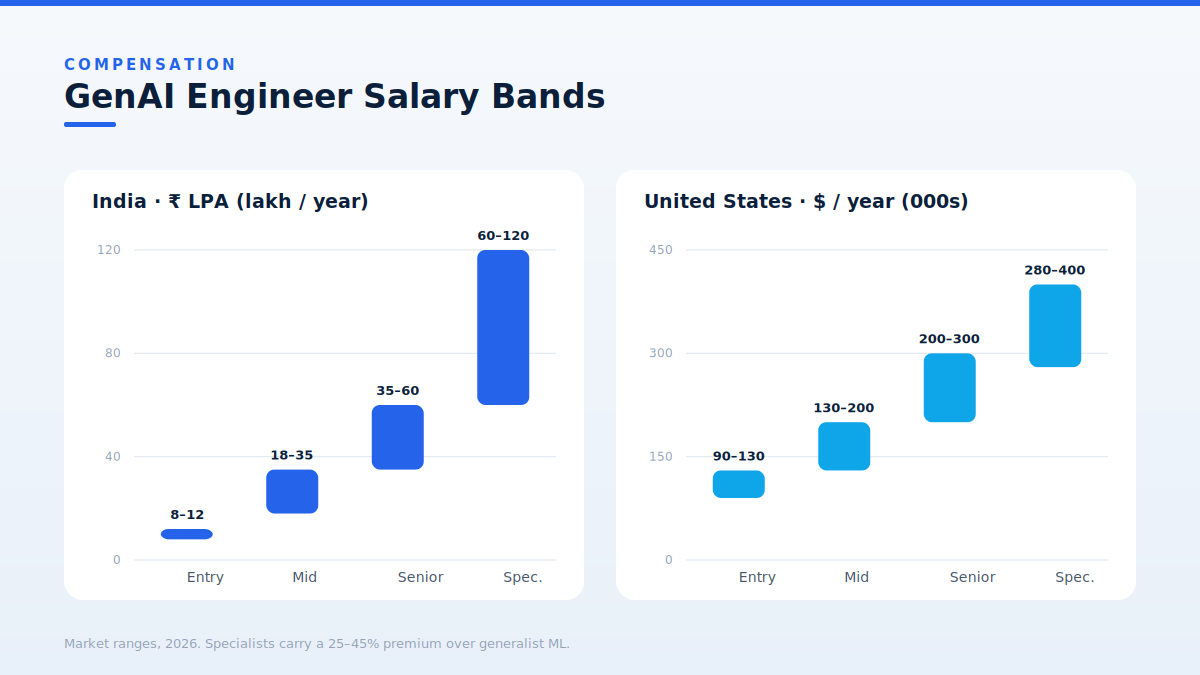
This is the section most competing content leaves out. Here are concrete ranges. Treat them as market bands as of 2026, not quotes actual numbers move with seniority, city, and specialization.
Salary bands (full-time equivalent):
| Seniority | India (₹ / year) | US ($ / year) |
| Entry (0–2 yrs) | ₹8–12 LPA | $90,000–130,000 |
| Mid (3–6 yrs) | ₹18–35 LPA | $130,000–200,000 |
| Senior GenAI/LLM engineer | ₹35–60 LPA | $200,000–300,000+ |
| Specialist / fine-tuning / research-adjacent | ₹60 LPA–₹1.2 Cr | $280,000–400,000+ |
Generative AI specialists typically command a 25–45% premium over generalist ML engineers, and product companies and GCCs pay materially more than IT-services firms for equivalent experience.
What drives the cost up: true fine-tuning / training work, deep MLOps, scarce domain expertise (healthcare, finance), tier-1 city location, and senior scarcity. What drives cost down: application-layer (RAG-first) work rather than training, remote and offshore/GCC delivery, and clearly scoped project engagements.
Timelines by scenario:
- Pre-vetted shortlist to interview: 7–10 working days.
- Cold, self-managed search: 6–12 weeks, often longer for senior roles.
- First production-grade feature shipped: 4–8 weeks after a strong hire ramps.
- Replacement of a poor fit (with a guarantee): 7–10 days versus months if you started over.
The honest headline: the sourcing step is where a partner compresses the timeline most; the ramp-and-ship step depends on the quality of the hire and the clarity of your Phase 1 definition.
Where to Go From Here
If you’re mid-decision, the next step isn’t “post a job and wait.” It’s to lock down Phase 1 the one-sentence use case, the build-vs-adapt call, and the definition of done because that single document determines whether the rest of the process filters for the right person or the wrong one.
If you’d rather compress the sourcing and vetting into a 7–10 working day shortlist of the top 2% of vetted talent backed by IP protection and a replacement guarantee, that’s exactly the process Supersourcing runs for teams building on foundation models. Bring your Phase 1 brief; we’ll tell you honestly whether you need an application engineer, a prompt specialist, or a fine-tuning hire before anyone gets on a call.
Frequently Asked Questions
What does a generative AI engineer do?
A generative AI engineer builds and operates production systems on top of foundation models. Day to day that means designing RAG pipelines, engineering and versioning prompts, building evaluation harnesses, adding guardrails, and controlling latency and inference cost turning a probabilistic model into a feature that behaves reliably under real traffic.
Is a prompt engineer the same as an AI engineer?
No. A prompt engineer focuses on crafting and testing prompts and instructions. A generative AI engineer does that as one part of a broader software role that includes retrieval, evaluation, orchestration, guardrails, and cost engineering. Prompt skill is now usually folded into the engineer’s job rather than being a standalone first hire.
What skills should a generative AI engineer have?
Strong Python and software engineering fundamentals first, then RAG (chunking, embeddings, a vector database, reranking), disciplined prompt engineering, an evaluation mindset, orchestration frameworks, LLMOps and observability, guardrails, and cost/latency control. Fine-tuning and LoRA/QLoRA matter only if you’re genuinely adapting model weights.
How much does it cost to hire a generative AI engineer?
In India, roughly ₹8–12 LPA at entry, ₹18–35 LPA mid-level, and ₹35–60 LPA for seniors, with specialists reaching ₹1 crore-plus. In the US, roughly $90k–130k entry, $130k–200k mid, and $200k–300k-plus senior. Specialists carry a 25–45% premium over generalist ML engineers.
How long does it take to hire an AI engineer?
With a pre-vetted pipeline, an interview-ready shortlist can land in 7–10 working days. A cold, self-managed search usually takes 6–12 weeks, and longer for senior roles. Getting a first production feature shipped adds another 4–8 weeks after the hire ramps.
What’s the difference between RAG and fine-tuning?
RAG (retrieval-augmented generation) feeds relevant external data into the model at query time, so knowledge stays current and auditable without retraining. Fine-tuning changes the model’s weights to bake in style, format, or domain behavior. Most first projects need RAG, not fine-tuning and hiring for the wrong one wastes the budget.
How do you vet a generative AI engineer?
Combine a systems-focused interview with a paid, scoped work sample on realistic data. Probe how they measure hallucination rate, how they debug a failing RAG pipeline, and what tradeoffs they made under cost and latency pressure. Portfolios of shipped features beat pedigree; watch for candidates who only discuss model choice and never evaluation.
Should I hire in-house or use staff augmentation for AI?
Hire in-house when AI is core to your product and roadmap for years and you can absorb a 2–4 month search. Use staff augmentation or a dedicated partner when you need production capability in 7–10 working days, want a replacement guarantee, or lack the headcount to run a long search. Many teams start augmented, then convert the capability into a Global Capability Center once the team stabilizes a natural moment to talk to a specialist partner.
