

Global Capability Centers that get GCC AI team hiring India right don’t do it by posting job descriptions and waiting. They do it by sequencing roles deliberately, benchmarking costs before committing, and structuring the team against delivery milestones not org chart aesthetics.
Most GCC AI builds take 9–14 months to reach production-grade output. Those that do it in 5–6 months share one trait: they are hired in the right order.
Global Capability Centers (GCCs) don’t fail at AI because of talent shortages; they fail because of how they build teams. The difference comes down to role sequencing, cost clarity, and aligning hiring with delivery milestones instead of org charts.
GCC AI team hiring India is where most enterprises either accelerate to production or get stuck in pilot cycles. The fastest-moving GCCs don’t hire in parallel, they start with data and architecture roles, then layer ML engineers and application teams in a defined sequence.
The urgency is growing. According to Statista AI market size forecast, the global AI market is expected to exceed $300 billion by 2026, driven by enterprise adoption and large-scale deployments.
The takeaway is simple: building a GCC AI team isn’t about hiring fasterit’s about hiring in the right order to reach production sooner and avoid expensive rework.
TL;DR: What This Blog Covers
Hiring sequence beats hiring speed. Most GCC AI builds stall not because India lacks talent but because teams hire the wrong roles first. Start with a Senior Data Engineer, not an AI Manager.
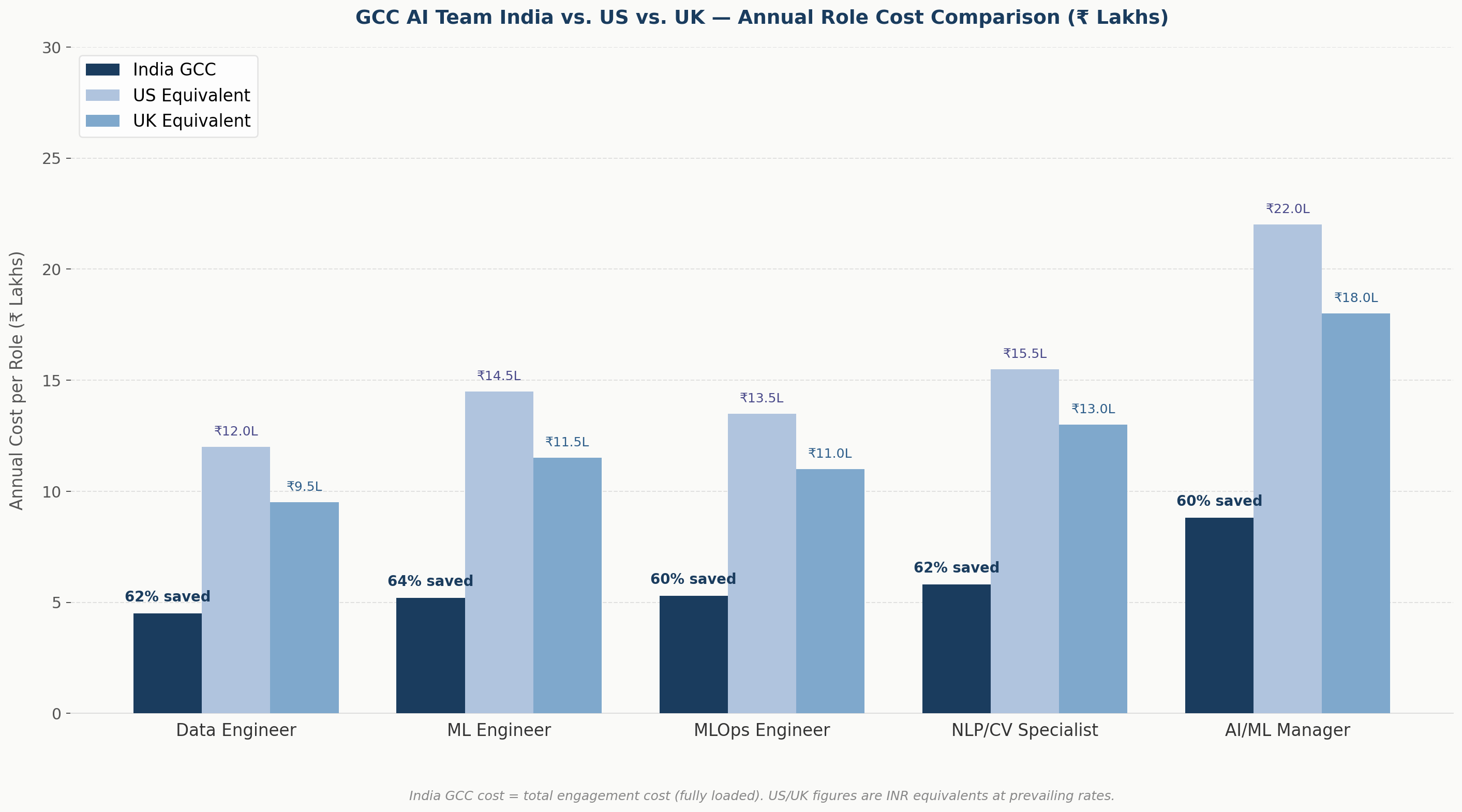
A production-ready AI team of 10–12 people takes 9–12 months and costs ₹5–8 crores annually, fully loaded. That's 40–60% less than an equivalent US or UK team. The cost advantage is real but only if the structure is right.
This blog breaks down the exact hiring sequence across three stages, role-by-role cost benchmarks, and the mistakes that add 4–6 months of delay to most GCC AI team hiring India builds. If you're planning a 2026 AI team in your GCC, this is the sequence to follow.
What Is GCC AI Team Hiring India?
GCC AI team hiring India is the structured process of recruiting, sequencing, and onboarding artificial intelligence, machine learning, and data engineering professionals within a Global Capability Center based in India aligned to headquarters’ product or R&D roadmap, not just headcount targets.
The Real Challenge: Why AI Team Builds in GCCs Stall
Most GCC leaders underestimate the AI team ramp-up timeline by 3–4x. The assumption is: “India has deep AI talent, we’ll hire fast.” The reality is more specific.
The India tech talent pool for senior AI roles principal ML engineers, MLOps architects, NLP leads is large in volume but narrow in availability. Candidates at the L5–L7 equivalent level typically carry 3–5 competing offers. Notice periods run 60–90 days. And most companies mistake activity (interviews scheduled) for progress (offers accepted and joined).
Three patterns cause the most damage:
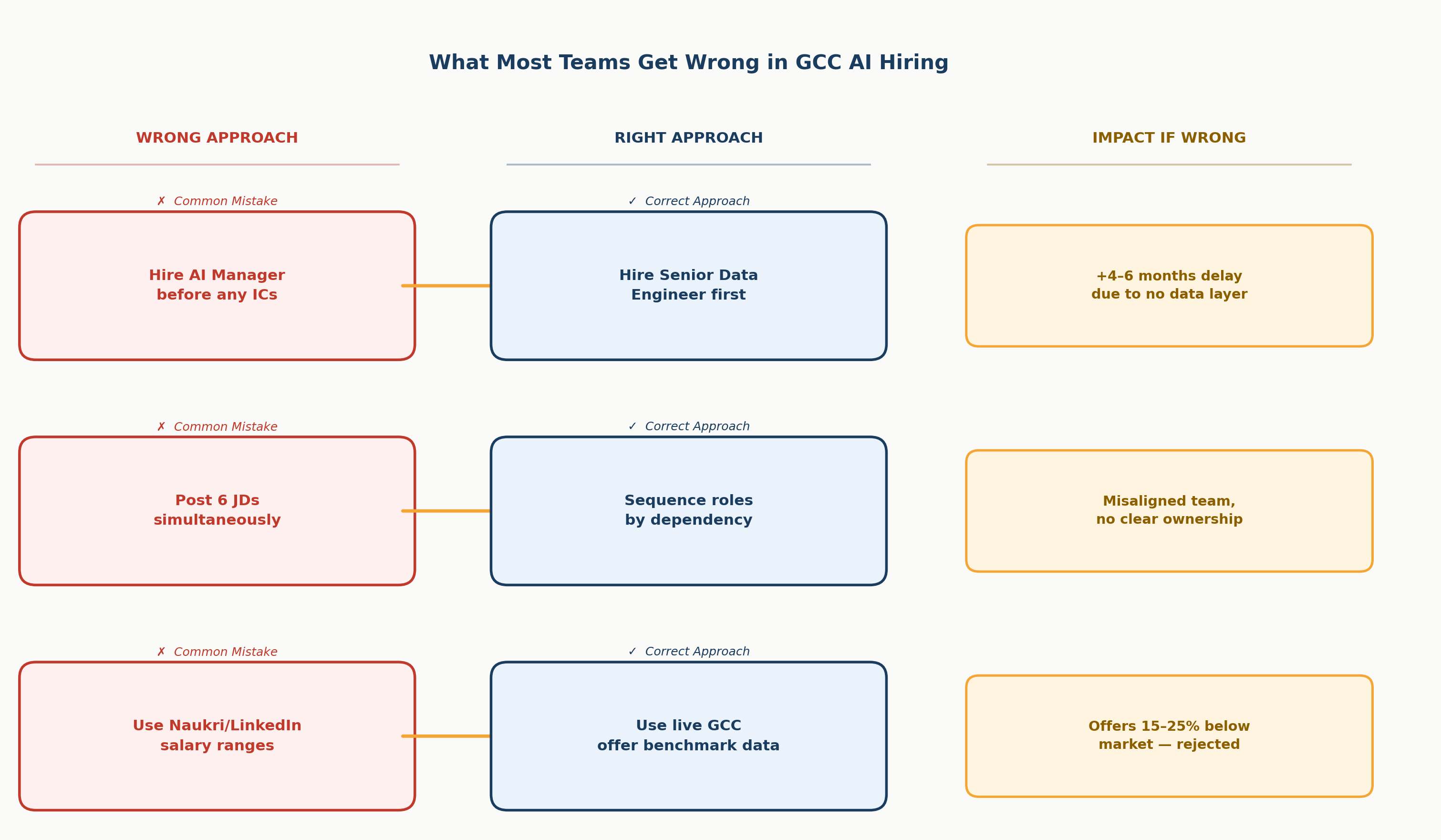
- Hiring an AI Manager before individual contributors are in place. A manager with no team defaults to planning, not building.
- Posting for generalist “AI Engineers” when the roadmap actually needs specialization across data engineering, model training, and deployment infrastructure.
- Benchmarking salaries against Indian startup norms rather than GCC compensation bands which run 20–35% higher and include equity, retention bonuses, and global exposure premiums.
These aren’t soft HR problems. They’re 6-month delays with a direct cost.
AI Team Structure GCC India: How to Build It by Stage
Stage 1: The Foundation Layer (Months 1–3)
When beginning the GCC AI team hiring India, the first hire is almost never who leadership expects. It should not be a VP of AI or a Chief Data Officer. It should be a Senior Data Engineer.
Without clean, accessible, well-structured data pipelines, every ML model built on top will perform poorly and fail in production. The data engineering layer is the foundation. Hire this first.
Stage 1 hiring sequence:
- Senior Data Engineer (₹28–42 lakhs/year)
- ML Engineer – Training & Experimentation (₹30–45 lakhs/year)
- Data Scientist / Applied Researcher (₹26–38 lakhs/year)
Stage 1 target: 3 people. Timeline: 10–14 weeks from mandate to joining, accounting for notice periods.
Stage 2: Specialization Layer (Months 3–6)
Once data infrastructure is operational and the first models are in development, the team scales into specialization. This is where machine learning team India GCC builds diverge based on use case NLP-heavy, computer vision, recommendation systems, or generative AI integration.
Stage 2 additions:
- MLOps Engineer (₹32–50 lakhs/year) critical for model deployment, monitoring, and CI/CD pipelines for ML
- NLP Specialist / CV Engineer based on product focus (₹35–55 lakhs/year)
- AI/ML Tech Lead or Engineering Manager (₹55–80 lakhs/year)
Stage 2 target: 6–8 people total. This is when the team becomes independently delivery-capable.
Stage 3: Scale Layer (Months 6–12)
The AI center of excellence structure typically emerges at this stage. The GCC is no longer just executing HQ projects, it’s originating AI roadmap items.
Stage 3 additions:
- Senior Data Scientist (specialized)
- AI Product Manager (India-side)
- Research Engineer (if applicable)
- 2–3 junior ML Engineers for scale
Total team for 12 months: 12–18 people. Full-stack AI hiring sequence GCC complete.
Team Structure Visual Notes for Designer
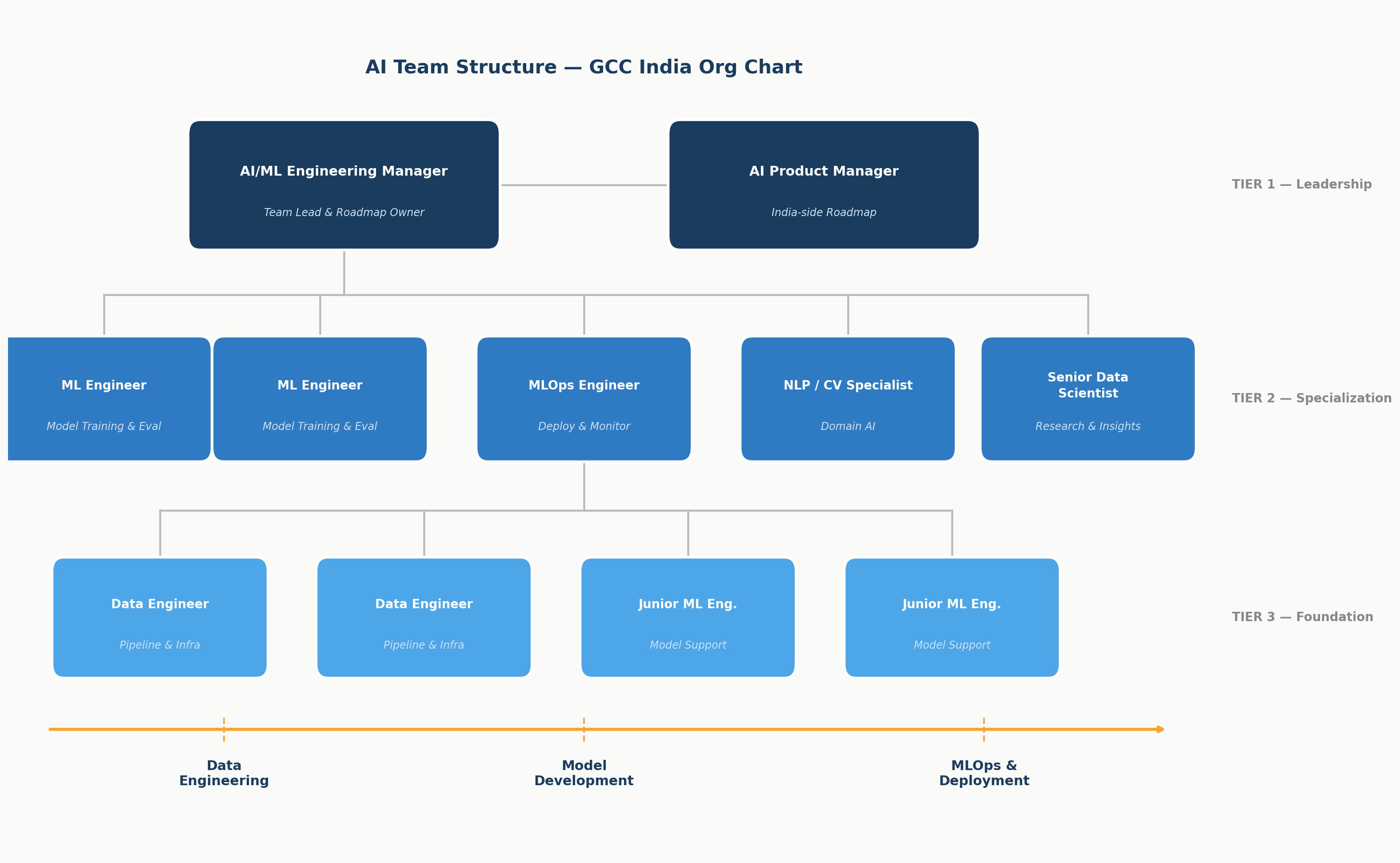
Org chart: Three-tier pyramid. Top tier: AI/ML Engineering Manager + AI Product Manager. Middle tier: ML Engineers (2–3), MLOps Engineer, NLP/CV Specialist, Senior Data Scientist. Bottom tier: Data Engineers (2), Junior ML Engineers (2–3). Arrows showing data flow left-to-right from Data Engineering → Model Development → MLOps/Deployment. Use GCC color palette.
Hire AI ML Team India: Cost Benchmarks by Role and Stage
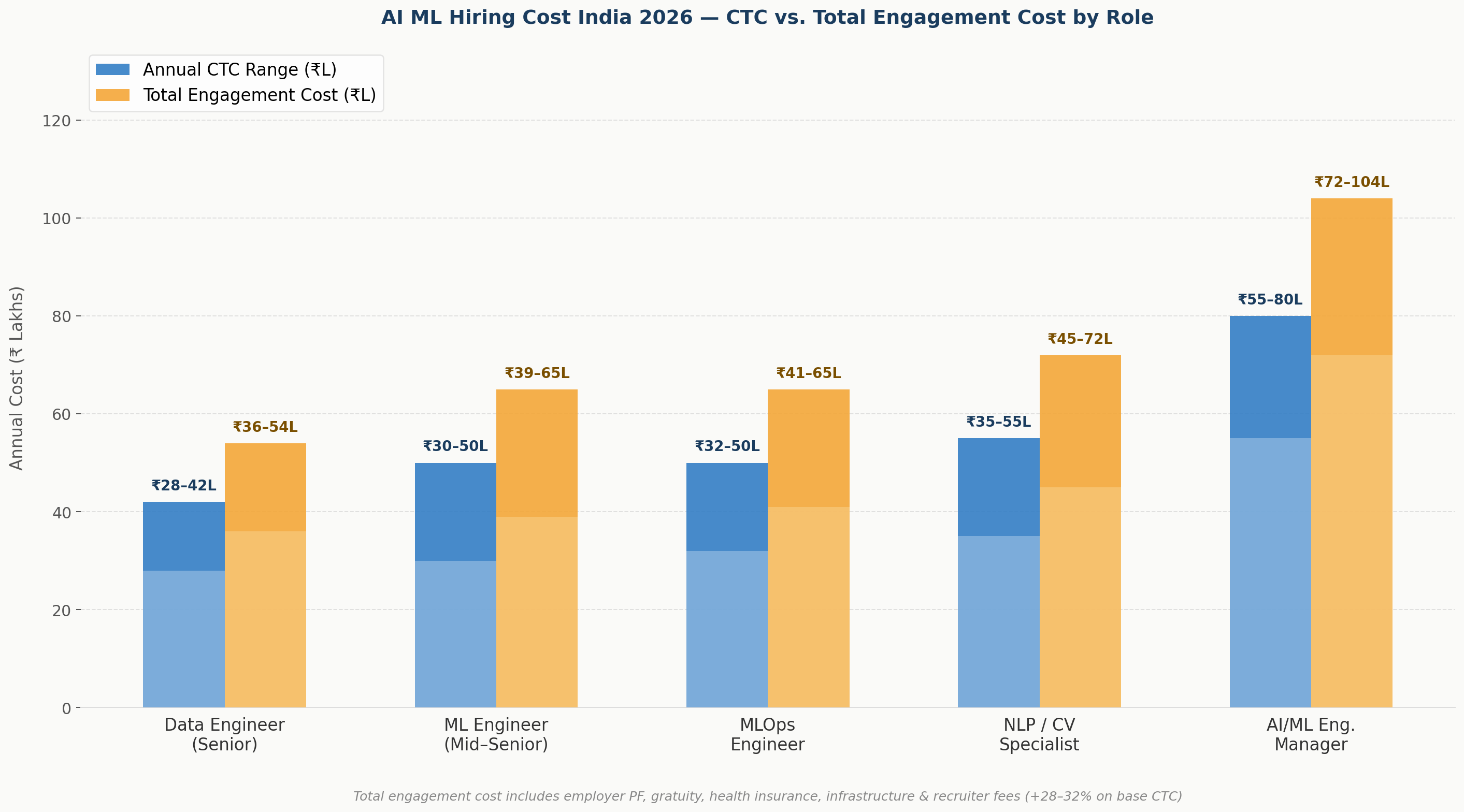
Understanding AI ML hiring cost India 2026 requires separating cash compensation from total engagement cost. A ₹40L salary becomes ₹52–58L when you factor in employer PF, gratuity accrual, health insurance, infrastructure, and recruiter fees.
| Role | Annual CTC (₹ Lakhs) | Total Engagement Cost (₹ Lakhs) |
| Data Engineer (Senior) | 28–42 | 36–54 |
| ML Engineer (Mid–Senior) | 30–50 | 39–65 |
| MLOps Engineer | 32–50 | 41–65 |
| NLP / CV Specialist | 35–55 | 45–72 |
| AI/ML Engineering Manager | 55–80 | 72–104 |
A 10-person offshore AI talent team in India, fully loaded, runs ₹5–8 crores annually roughly 40–60% of an equivalent team in the US or UK. That delta is the GCC value case.
GCC Technology Hiring 2026: What’s Changing
The GCC technology hiring 2026 landscape has shifted in three specific ways that affect machine learning team India GCC builds:
Generative AI specialization is now a discrete skill set, not a subset of ML engineering. Candidates who can work with LLM fine-tuning, RAG architectures, and prompt engineering pipelines command a 25–40% premium over general ML engineers.
Tier-2 cities are viable for data engineering and junior ML roles. Pune, Hyderabad, and Chennai now have sufficient depth for Stages 1–2 hiring and offer 15–20% cost savings vs. Bengaluru for equivalent talent.
Retention packages matter more than joining bonuses. The AI team ramp-up often unravels at month 8–10 when competitors counter-offer. GCCs that structure 18-month retention bonuses tied to milestone delivery see 60–70% better retention in the first 2 years.

Real-World Application: Two GCC AI Builds
Case 1 European FinTech GCC, Bengaluru: A 3-person founding AI team (data engineer, ML engineer, MLOps) was stood up in 11 weeks using a managed hiring model. Within 7 months, the team had deployed a fraud detection model reducing false positives by 34%, operating at 1/5th the cost of the equivalent Amsterdam team.
Case 2 US Healthcare SaaS GCC, Hyderabad: Leadership initially hired an AI Director before any ICs were in place. The team spent 4 months in planning mode with no production output. A restructure hiring 3 data engineers and 2 ML engineers first unlocked the first model deployment within 6 weeks of the correction.
What Most Teams Get Wrong in GCC AI Hiring
The most common failure is treating GCC AI team hiring India as a talent acquisition exercise rather than a team architecture exercise.
Posting 6 job descriptions simultaneously feels like momentum. It isn’t. It creates competing interview pipelines, misaligned onboarding, and a team where no one has dependencies figured out because everyone joined at the same time.
The technical hiring roadmap should be sequenced like code deployment dependent modules first, features second, optimizations third. Data infrastructure before model development. Model development before MLOps. MLOps before research specializations.
The second mistake: conflating AI cost benchmarking with market data from aggregator sites. Naukri and LinkedIn salary insights reflect posted ranges, not accepted offers. Real offer data from active GCC placements in 2025–2026 runs 15–25% higher for senior roles in AI/ML.
FAQ: GCC AI Team Hiring India
What does a typical AI team structure look like in a GCC?
A mature AI team structure GCC India runs 10–18 people across three layers: data engineering, model development (ML engineers, data scientists, NLP/CV specialists), and MLOps/deployment. An Engineering Manager and AI Product Manager sit above these layers. Most GCCs reach this structure 10–14 months after the first hire.
Which role should you hire first when building a GCC AI team?
Hire a Senior Data Engineer first. Clean, pipeline-ready data is the prerequisite for every ML model. Teams that skip this step and hire ML Engineers or Data Scientists first consistently report 3–5 months of delay while backfilling data infrastructure.
How much does it cost to hire an AI team in India for a GCC?
A 10-person team costs ₹5–8 crores annually on a fully loaded basis. Individual roles range from ₹28L for a mid-level data engineer to ₹80L+ for a senior ML Engineering Manager. Total engagement cost (including employer contributions and overhead) adds 28–32% to base CTC.
How long does it take to build a functional AI team in a GCC?
Realistically, 9–12 months to a fully operational team of 10–12. The first 3 months cover the foundation layer (3 hires). Months 3–6 bring the specialization layer. Months 6–12 add scale and leadership. Teams attempting to compress this to under 6 months typically face retention failures or skills gaps.
What is the difference between an AI team in a GCC vs. a startup?
GCC AI teams operate within enterprise constraints compliance, data governance, integration with global systems, alignment to HQ roadmaps. This requires different profiles than startup AI hiring. GCC hires need enterprise architecture experience, comfort with longer decision cycles, and the ability to work across time zones and stakeholder layers.
How do GCCs retain AI and ML talent in India?
The most effective retention tools are: milestone-linked bonuses at 12 and 18 months, access to global AI projects (not just execution work), clear technical growth tracks, and competitive RSU or phantom equity structures. Salary alone is insufficient; the top 15% of offshore AI talent receives competing offers every 4–6 months.
How do I evaluate a hiring partner for GCC AI team builds?
Prioritize partners with active placement data not just candidate databases. Ask for time-to-offer, offer-to-joining ratios, and 12-month retention rates by role type. A partner who has run GCC build-operate-transfer engagements will give you structured answers. A vendor without that experience will give you generic talent acquisition metrics.
Build Your GCC AI Team With a Structured Approach
Building a GCC AI team in India is not a hiring sprint it is a sequenced architecture decision. The companies that reach production-grade AI output in 5–6 months do one thing consistently: they treat role order as a technical dependency, not an HR preference.
If you’re mapping out your GCC AI team hiring India plan for 2026 and want to pressure-test your role sequence, cost assumptions, or hiring timeline before going to market, Supersourcing has run this process across 60+ GCC engagements in AI, data, and ML.
We work with GCC leaders at the planning stage before mandates go live, before compensation bands are locked, and before the first JD gets posted. That upstream involvement is what separates a 5-month build from a 12-month one.
Here is what we can do for your team:
- Benchmark your compensation structure against live offer data from active 2025–2026 GCC placements not aggregator estimates
- Review your hiring sequence against your product roadmap and flag dependency gaps before they become delays
- Identify the roles where you are most likely to face supply constraints, and build contingency into your timeline before you need it
Every week spent hiring in the wrong order is a week of delayed production output. The cost of that delay compounds faster than most GCC leaders anticipate.
If you are ready to build with structure, reach out to our GCC hiring team or write to us directly at mayank@engineerbabu.com. We will walk you through the sequencing framework in a single working session with no commitment required.
