

The number you should be scared of isn’t the funding round it’s 65%
When considering hiring a technical co-founder, it’s essential to weigh the benefits and challenges involved.
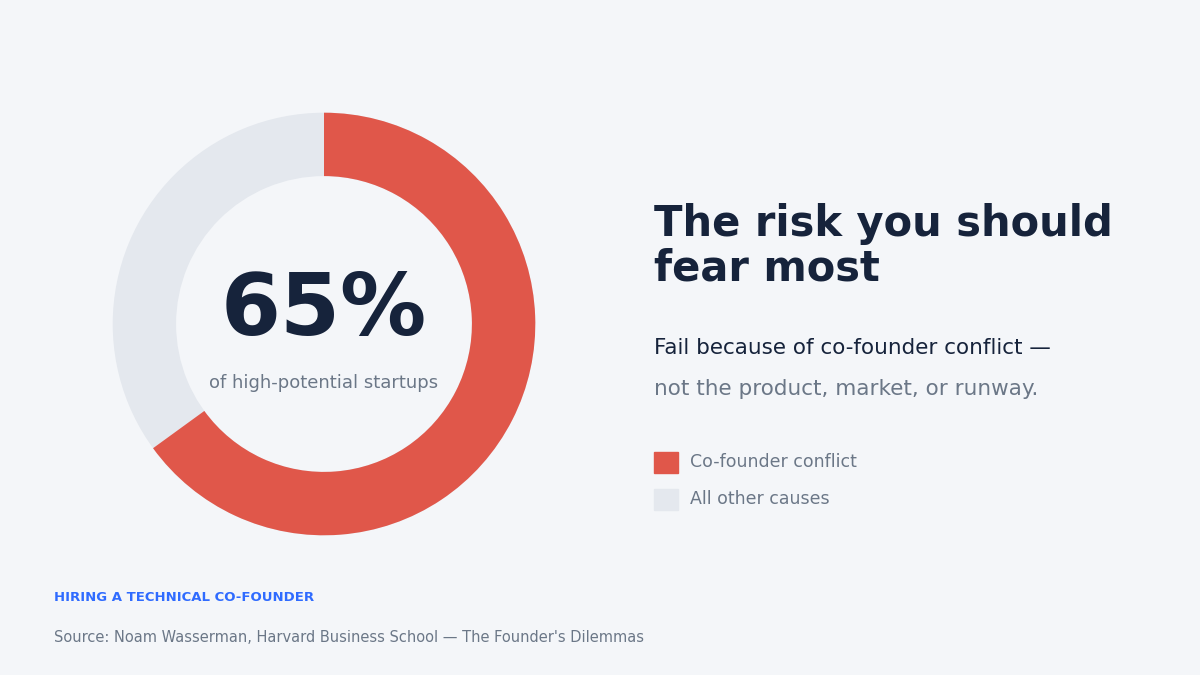
A commerce-ready idea, a waiting market, and a founder who can sell it none of that is what kills most startups. The people at the top do. Harvard Business School’s Noam Wasserman, after studying roughly 10,000 founders, found that 65% of high-potential startups fail because of conflict between co-founders, not the product, not the market, not the runway.
Hiring a technical co-founder can significantly impact your startup’s trajectory.
65% of high-potential startups fail due to co-founder conflict. Noam Wasserman, Harvard Business School, The Founder’s Dilemmas
That statistic reframes the entire problem. For a non-technical founder, the search for an engineering partner feels like a hunt for a rare skill. It is really a partner-selection decision with a 65% failure rate attached, and the person you pick will hold both half your equity and the entire codebase your company depends on.
Understanding the nuances of hiring a technical co-founder is crucial for non-technical founders.
This guide treats the decision with that weight. It walks the full path from deciding whether you even need a co-founder, to finding candidates, to running a technical evaluation without writing a line of code yourself, to structuring equity and vesting, to the contracts that protect you, and to the alternatives that get a product built when the right person never shows up. Every section is built to be executed, not just read. Where a number matters, the number is here: equity bands, vesting timelines, cost ranges in ₹ and $, and realistic calendars.
This guide focuses heavily on the process of hiring a technical co-founder and the implications of that choice.
What is a technical co-founder?
Having clarity on what you need before hiring a technical co-founder will save time and resources.
A technical co-founder is an early, equity-holding partner who owns the entire technology function of a startup architecture, the first product build, key hiring, and technical direction sharing founder-level risk and reward rather than working for a salary. They join before product-market fit and are accountable for turning the vision into a shippable, scalable system.
It is vital to define the expectations when hiring a technical co-founder.
It is easy to confuse the role with three adjacent ones. It is not:
Recognizing the difference between hiring a technical co-founder and a CTO can guide your decision-making process.
- A first engineer or contractor. They take a market salary and defined tasks; they don’t carry founder risk or founder-level equity.
- A CTO hire. A CTO is an executive who joins a functioning company with a paycheck and a smaller equity grant. (More on CTO vs technical co-founder below the distinction changes how you negotiate.)
- A development agency. An agency builds to your spec for a fee. It has no stake in whether the business succeeds and no obligation beyond the contract.
Many non-technical founders ask themselves about the necessity of hiring a technical co-founder.
Why the decision matters the business case in concrete terms
Getting this right, or wrong, moves four levers that decide whether the company lives: cost, speed, quality, and risk. The differences aren’t rounding errors.
The impact of hiring a technical co-founder can be profound, affecting everything from product development to market fit.
- Cost / equity. A co-founder typically costs 10–50% of the company in equity but little or no cash. A senior engineering hire in India costs roughly ₹16–35 lakh/year ($45k–75k) in salary; a fractional CTO runs ₹2.5–6 lakh/month. The equity you give a co-founder is the single most expensive “payment” you will ever make and the hardest to claw back.
- Speed. With the right partner, an MVP can move from the whiteboard to build in weeks. Founders who stall searching for “the one” routinely lose 6–12 months, often the difference between catching a market window and missing it.
- Quality. A co-founder who owns architecture makes decisions about that compound. Poor early stack and data-model choices create technical debt that can cost 20–40% of engineering time to service later.
- Risk. The wrong partner doesn’t just underperform; they can hold your IP, your credentials, and half your cap table hostage. This is where the 65% failure rate lives.
The core problem most non-technical founders face
Evaluating your need for hiring a technical co-founder can reshape your entire approach to building your startup.
The trap is predictable, and it has three parts. First, evaluation asymmetry: you are being asked to judge a skill you don’t have. Most non-technical founders default to proxies: a confident demo, a big-brand resume, a fast-talking whiteboard session that correlates weakly with the ability to build and scale a real product.
The decision-making process for hiring a technical co-founder is often complex.
Second, timeline denial. Founders assume a good co-founder is a few coffee chats away. In practice, a genuine co-founder search meeting enough people, building trust, working together on something real before committing runs 3 to 9 months. Teams underestimate this by 3–4x, then panic-hire the first available engineer.
Third, the commitment mismatch. Y Combinator partners have estimated that co-founder conflict accounts for over 20% of early-stage failures, and the most common trigger is unequal commitment: one founder all-in, the other keeping a job “until things are more certain.” That imbalance is invisible at the handshake and fatal by month six.
Assessing the commitment levels is crucial when hiring a technical co-founder.
The rest of this guide is organized to defuse all three: a repeatable way to evaluate technical judgment, a realistic calendar, and contract and vesting structures that surface commitment before it’s too late to matter.
The A-to-Z walkthrough: from “I think I need one” to a shipping product
A clear framework for hiring a technical co-founder can streamline your search.
This is the operational core. Six phases, in order, each with a checklist or numbered process you can run. Do not skip a phase because it looks obvious the skipped phases are exactly where first-time founders lose months and equity.
Each phase of hiring a technical co-founder is critical to ensure you find the right fit.
Phase 1 Define what you actually need (scope, skills, timeline, budget)
Before finding a technical co-founder, decide whether the role you’re hiring for is a co-founder at all. Many founders need a builder for 6–9 months, not a lifelong partner holding 30% of the company. Run this scoping pass first.
Before hiring a technical co-founder, clarity on your project scope is essential.
The 4-question scoping test:
- Duration of dependence Do you need deep technical ownership for the life of the company, or to get through a defined build (MVP, first paying customers)? Lifelong ownership → co-founder. Defined build → a paid team or fractional lead may fit better.
The right questions regarding hiring a technical co-founder can guide your decision-making.
- Decision authority Will this person set technical strategy and hire other engineers, or execute a roadmap you and advisors set? Strategy-setting justifies founder equity; execution usually doesn’t.
- Risk appetite match Can you both survive 12–24 months on little or no salary? If only one of you can, the commitment mismatch is already present.
- Founder-market fit: Does the product need continuous technical innovation as the moat (deep-tech, ML, infra), or is technology the enabler of a business/distribution edge? The former needs a co-founder; the latter often doesn’t.
Then write a one-page technical role brief covering:
- The core problem and who has it (not the solution the problem)
Being prepared with a clear brief before hiring a technical co-founder can set the tone for your partnership.
- The v1 scope: the 3–5 features that constitute a usable MVP, and nothing else
- The likely stack and why (web, mobile, data-heavy, real-time, on-device AI)
- Non-negotiables: security/compliance needs (HIPAA, PCI-DSS, GDPR, India’s DPDP Act)
- The first 12-month milestones tied to business outcomes, not feature counts
Budget bands to plan against (India-centric, USD in brackets):
| Path | Typical cost | Cash vs equity |
|---|---|---|
| Technical co-founder | 10–50% equity | Mostly equity, little/no cash |
| Fractional / part-time CTO | ₹2.5–6 lakh/month ($3k–7k) | Cash |
| Senior engineer (full-time hire) | ₹16–35 lakh/year ($45k–75k) | Cash + small ESOP |
| Dedicated development team | ₹6–15 lakh/month ($7k–18k) | Cash |
| MVP via project-based build | ₹8–40 lakh ($10k–50k) fixed | Cash |
Phase 2 Sourcing and vetting: where to look and how to judge without coding
Finding the right place to source candidates for hiring a technical co-founder is paramount.
This phase answers the two questions non-technical founders ask most: where to find a technical co-founder, and how to evaluate one when you can’t read the code yourself.
Where candidates actually come from (ranked by hit rate, not volume):
- People you’ve worked with before. YC’s own data has pointed to how long co-founders knew each other beforehand as a top predictor of success. Former colleagues and classmates outperform strangers every time.
- Open-source and technical communities. GitHub contributors, strong answerers on technical forums, and speakers at local meetups reveal skill publicly; you can inspect their work before you ever talk.
- Co-founder matching platforms. YC Co-Founder Matching, Antler, and startup-weekend events create structured introductions. Treat them as top-of-funnel, not a shortcut past vetting.
Engaging platforms for hiring a technical co-founder can accelerate your search.
- Angel and operator networks. Investors and experienced founders can vouch for engineers they’ve watched deliver a warm, pre-vetted signal.
- Curated talent partners. When the network runs dry, specialist firms surface pre-vetted senior engineers the top ~2% by their screening in days rather than months. This is also the bridge to the alternatives in Phase 3.
Vetting a technical co-founder the non-technical founder’s checklist:
You don’t need to read code. You need to test judgment, and you need a technical ally to co-sign the verdict. Run this before any equity conversation.
- Bring a technical assessor. A trusted senior engineer or fractional CTO sits in on one session and reviews their code. Non-negotiable if you can’t evaluate code yourself.
Testing candidates thoroughly before hiring a technical co-founder is essential.
- Review real work, not slides. Ask for a live walk-through of something they’ve shipped. Can they explain why they made each architectural trade-off?
- The “explain it to me” test. A strong engineer can explain a complex system to a non-technical person clearly. Inability to translate is a leadership red flag, not just a communication quirk.
- Run a paid trial project (1–2 weeks). Watch how they scope, communicate, hit deadlines, and handle ambiguity. This predicts the partnership better than any interview.
- Check they can hire. Your co-founder will build the team. Ask how they’d evaluate the first three engineers.
Gathering references during the process of hiring a technical co-founder can reveal insights.
- Reference the commitment. Talk to people who’ve worked with them under pressure. Did they finish? Did they own failures?
Red flags (any one warrants a hard pause):
- The perpetual “almost done.” Deadlines slip with elaborate explanations and no working software.
- Solo-hero syndrome. Can’t explain decisions, resists code review, treats the codebase as personal property.
- Salary-first framing. Wants founder equity and a full market salary from day one with no risk-sharing a commitment-mismatch signal.
- Won’t sign standard protections. Balks at mutual NDA or IP-assignment terms (covered in Phase 3).
Green flags (what a strong candidate looks like):
Identifying green flags during the interview process can ensure success when hiring a technical co-founder.
- Ships and finishes a visible track record of completed, working software development, not a graveyard of started projects.
- Explaining trade-offs plainly can tell you why they chose one approach over another in the language you follow.
- Asks about the business cares about users, unit economics, and distribution, not only the tech stack.
- Welcome review treats code review and an outside technical assessor as normal, not as an insult.
How to pitch yourself as a non-technical founder
Recruiting is a two-way sale, and strong engineers are evaluating you as hard as you’re evaluating them. With Korn Ferry projecting a 4.3-million-worker shortfall in technology roles alone, the best builders choose founders who de-risk the bet. Make yourself the obvious choice:
When pitching yourself to potential candidates for hiring a technical co-founder, clarity is key.
- Bring proof, not just a pitch. Customer interviews, a waitlist, letters of intent, or a no-code prototype with real usage move the conversation from “your idea” to “our opportunity.”
- Own the half they can’t. Show you’ll carry distribution, sales, fundraising, and operations so they can build. Founders who clearly own the go-to-market side are far easier to commit to.
- Be specific about equity and vesting up front. Vagueness reads as either naïveté or a future fight; a clear, fair offer signals you’ve done this seriously.
- Reduce their downside. A small salary runway, a validated pipeline, or committed angel interest all lower the risk you’re asking them to take.
Reducing risk when hiring a technical co-founder can make the partnership more attractive.
Should a non-technical founder pay a technical co-founder a salary?
If you can, yes at least a modest one. A true co-founder trades salary for equity, but “zero cash forever” filters out excellent engineers who have families and obligations, not just the risk-averse ones.
Common structures: no salary until first funding, a below-market stipend during the build, or a deferred-salary agreement that converts at the next raise. The governing principle is symmetry if you take no salary, parity is fair; if you do, so should they.
Phase 3 Engagement models, equity, and contracts
This is the phase that most guides gloss over and most founders get wrong. Three things must be settled before serious work begins: the engagement model, the technical co-founder equity split, and the legal protections.
Engagement models pick before you negotiate:
- True co-founder founder equity, vesting, minimal cash, shared control. Highest upside, highest risk.
Understanding the engagement models before hiring a technical co-founder can shape your strategy.
- Staff augmentation: a vetted engineer or two embedded in your team, on cash, no equity. Fast, flexible, reversible.
- Dedicated development team a managed pod that owns delivery end-to-end, on a monthly retainer, with a single accountable manager.
- Project-based build a fixed-scope MVP delivered for a fixed fee. Cleanest for a first version when you’re still testing the market.
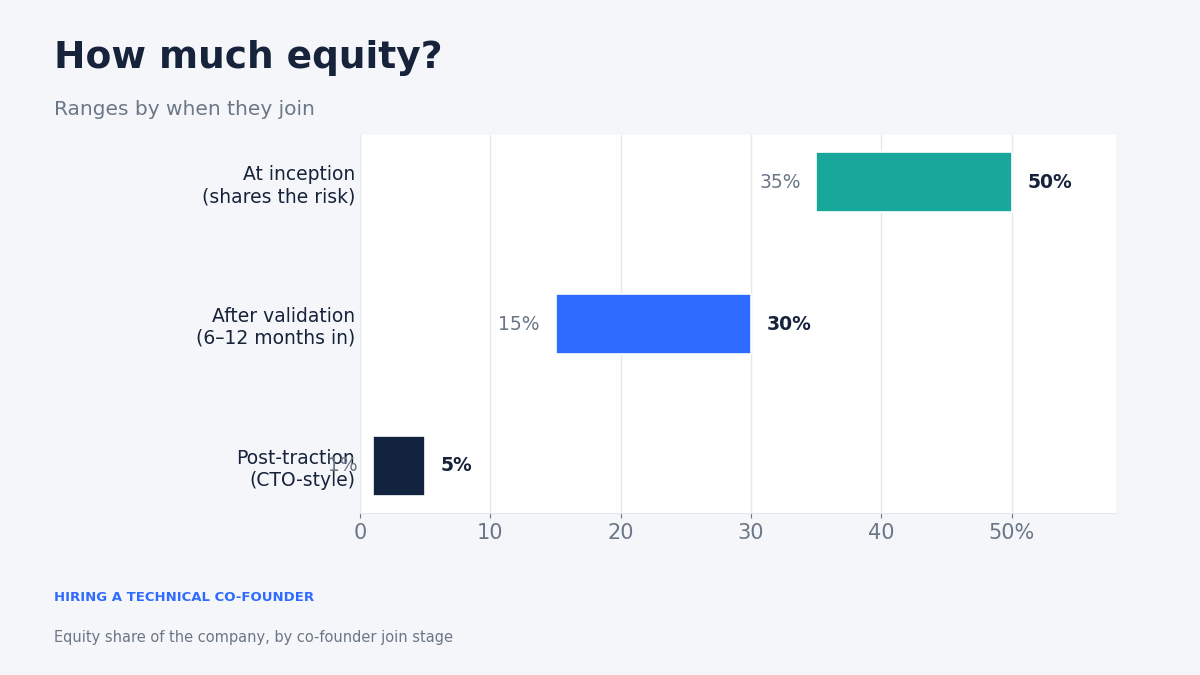
Equity the numbers, not the platitudes. Carta’s Founder Ownership Report 2026 found that only 41% of two-founder teams split equity equally; the majority split unequally, and there is almost always a “lead” founder with the larger share. Median founding teams retain about 56% of fully diluted equity by their seed round, dropping to ~36% by Series A. Translate that into ranges you can negotiate against:
Hiring a technical co-founder requires careful consideration of equity agreements.
- Joins at inception, full-time, shares the risk: 35–50%.
- Joins 6–12 months in, product already validated: 15–30%.
- Joins post-traction / post-funding as a leader (closer to a CTO hire): 1–5% plus salary.
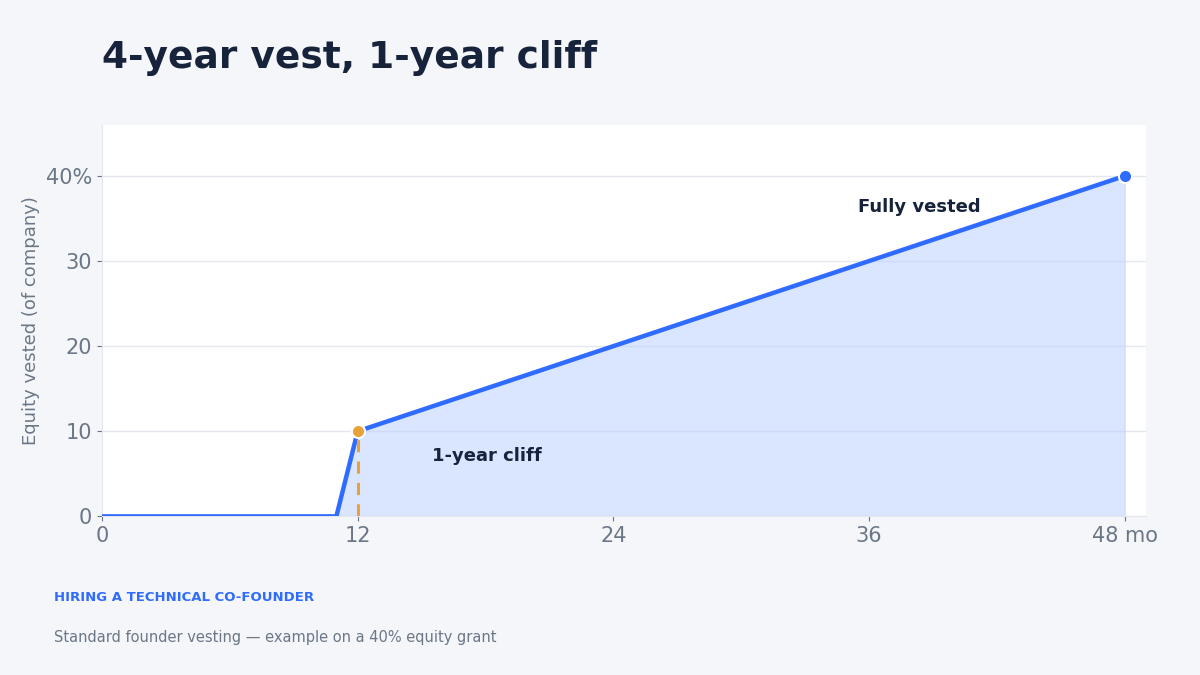
The vesting timeline treats this as your equity insurance. Never grant founder equity outright. Use a 4-year vesting schedule with a 1-year cliff, standard across the industry, so that a co-founder who leaves in month five walks away with nothing and the equity returns to the company.
Infographic 4-Year Vesting with a 1-Year Cliff (example: 40% grant):
| Milestone | Time elapsed | Equity vested | Notes |
|---|---|---|---|
| Signing | Day 0 | 0% | File the 83(b)-equivalent election where applicable |
| Before cliff | Months 1–11 | 0% | Leaves now → keeps nothing |
| 1-year cliff | Month 12 | 25% of grant (10% of company) | First tranche unlocks in one lump |
| Steady vest | Months 13–48 | +1/48 of grant each month | ~0.83% of company per month |
| Fully vested | Month 48 | 100% of grant (40% of company) | Full ownership earned |
Contracts and IP before any real work starts:
- Mutual NDA covering the idea, data, and any customer information.
- IP assignment agreement every line of code, design, and asset is assigned to the company, not the individual. This is the clause that prevents a departing co-founder from holding your product hostage.
- Founders’ agreement roles, decision rights, vesting, and an explicit exit/buy-back clause for what happens if someone leaves.
- Written milestones for the first 90 days so commitment is measurable, not assumed.
Having contracts defined early on is critical when hiring a technical co-founder.
Phase 4 Onboarding and ramp-up (the first two weeks)
The first fortnight sets the operating rhythm for years. Whether your partner is a co-founder or a dedicated software team, running a deliberate ramp ambiguity here reads as disorganization and erodes the trust you spent months building.
The 14-day onboarding checklist:
- Access, day one repositories, cloud accounts, design files, analytics, and any customer data (with the right permissions and least-privilege access).
- Context, not just tasks share the vision, the customer research, the competitive landscape, and the business model. Engineers build better when they understand the “why.”
- Toolchain agreements decide on project management (Linear, Jira), communication (Slack), documentation (Notion), and version control conventions in the first three days.
- Communication cadence set the standing rhythm: a short daily async update, one weekly synchronous review, and a monthly milestone check.
- First shippable target agrees on one small, real deliverable in weeks one to two. Early momentum beats a perfect long-term plan.
The 3-day rule: if by day three there is no agreed toolchain, no access, and no first target, the engagement is already drifting. Reset it immediately.
A smooth onboarding process is vital after hiring a technical co-founder.
Phase 5 Managing delivery (cadence, KPIs, accountability)
Non-technical founders often swing between two failure modes: micromanaging code they can’t read, or disappearing and hoping. Neither works. Manage outcomes and cadence, not keystrokes.
Reporting cadence that works:
Managing delivery expectations after hiring a technical co-founder is essential for success.
- Daily: one-line async status shipped, blocked, next.
- Weekly: a working demo of what changed, plus blockers that need your decision.
- Bi-weekly: sprint review against milestones; re-prioritize the backlog together.
- Monthly: progress against the 12-month business milestones from Phase 1.
KPIs a non-technical founder can actually track:
- Milestone hit rate percentage of committed sprint goals delivered on time.
Setting KPIs can help track progress after hiring a technical co-founder.
- Cycle time: how long a feature takes from “agreed” to “in production.”
- Escaped defects bugs found by users rather than caught before release.
- Roadmap confidence: does the delivery pace still support the fundraising or revenue timeline?
When you engage a managed team rather than a lone co-founder, insist on a single accountable manager and no shared bandwidth the engineers assigned to you should not be quietly time-sliced across three other clients.
A dedicated account manager and a replacement path (a strong provider replaces a poor-fit team member within 7–10 days) turn delivery from a hope into a contract term.
This is the model that firms like Supersourcing build engagements around, and it is worth demanding from anyone you pay.
Establishing a strong working relationship is critical when hiring a technical co-founder.
Phase 6 Scaling or exiting
Whatever you build has to survive success or absorb a parting. Plan both before you need them.
Scaling the technical function:
- Add engineers only against a validated bottleneck, not a funding high. Premature scaling is a documented top killer of “almost working” startups.
- Convert your co-founder or lead into a hiring manager: their first job at scale is building the team, using the same vetting checklist from Phase 2.
Scaling your team effectively is another consideration when hiring a technical co-founder.
- Use a Global Capability Center model when headcount justifies a permanent, wholly owned offshore engineering team rather than a series of individual hires.
Exiting cleanly (co-founder or vendor):
- Vesting does the heavy lifting. Unvested equity returns to the company; the cliff already protects you against early departures.
- Revoke access immediately credentials, repositories, cloud, and data on the day of departure.
- Confirm IP is assigned the Phase 3 agreement means the code stays with the company by default.
- Transition knowledge documentation, architecture diagrams, and a handover window prevent a single departure from stalling delivery.
- For vendor engagements, a replacement guarantee and NDA-backed IP protection make offboarding a formality rather than a crisis.
Case studies: outcomes first
Drawn from patterns Supersourcing has seen across high-growth Indian technology companies, these examples show what “done well” looks like. Metrics lead; the story follows.
100+ engineers hired for a fintech scale-up (Paytm-scale context). When a fintech platform needed to expand its engineering org fast without diluting quality, the winning approach wasn’t a single heroic co-founder it was a structured pipeline of pre-vetted senior engineers delivered against a 7–10 working-day shortlist cycle, with a candidate joining rate near 98%. The lesson for founders: once the product direction is set, disciplined sourcing beats waiting for a mythical perfect partner.
Hyper-growth e-commerce hiring (Swiggy/Dunzo context). Rapid-delivery businesses live or die on engineering velocity during demand spikes. Teams that plugged in dedicated, NDA-backed engineering pods rather than betting everything on one founder-engineer sustained release cadence through growth surges, with sub-1% contract drop-off keeping delivery predictable. The takeaway: the model that scales is dedicated capacity with a single accountable owner, not shared freelancers.
Recruitment automation for a health-tech firm (Somnoware context). A healthtech company facing compliance-heavy hiring compressed its time-to-shortlist dramatically by pairing AI-driven sourcing with human vetting, surfacing roughly the top 2% of relevant talent. The result was a shorter, cleaner engineering ramp evidence that for regulated products, vetting rigor matters more than raw candidate volume.
CTO vs technical co-founder: why the label changes the deal
Understanding the difference between a CTO and hiring a technical co-founder is crucial for founders.
Founders use the two titles interchangeably and then negotiate the wrong deal. The distinction isn’t seniority, it’s timing, risk, and what you’re actually buying, and it should drive every term you put on the table.
- When they join. A co-founder joins pre-product and pre-revenue, when the risk of total failure is highest. A CTO typically joins once there’s a product, customers, or funding a company already exists to be led.
- What they’re paid. Co-founders trade cash for ownership: little or no salary, 10–50% equity, vested over four years. A CTO takes a market executive salary with a far smaller grant, commonly 1–5%.
- What they own. A co-founder often defines the technology strategy and the first team from a blank page. A CTO usually inherits a codebase, a team, and constraints, and is measured on scaling them.
- How you negotiate. With a co-founder you’re aligning two people’s risk tolerance and long-term vision. The founders’ agreement is the core document. With a CTO you’re structuring an executive package the offer letter and ESOP terms are.
The practical rule: if you’re pre-product and sharing the risk, you’re recruiting a co-founder, talk equity and vesting first. If the company already runs and you need someone to scale it, you’re hiring a CTO talk salary and a defined grant. Using the wrong frame is how founders either overpay in equity or lose a leader they could have afforded.
Your decision framework should include the option of hiring a technical co-founder versus other roles.
Decision framework: co-founder, hire, agency, or dedicated team?
Use this to match the path to your actual situation rather than to startup folklore. Score each axis for your context.
| Model | Cost | Control | Speed to start | Risk | Best when |
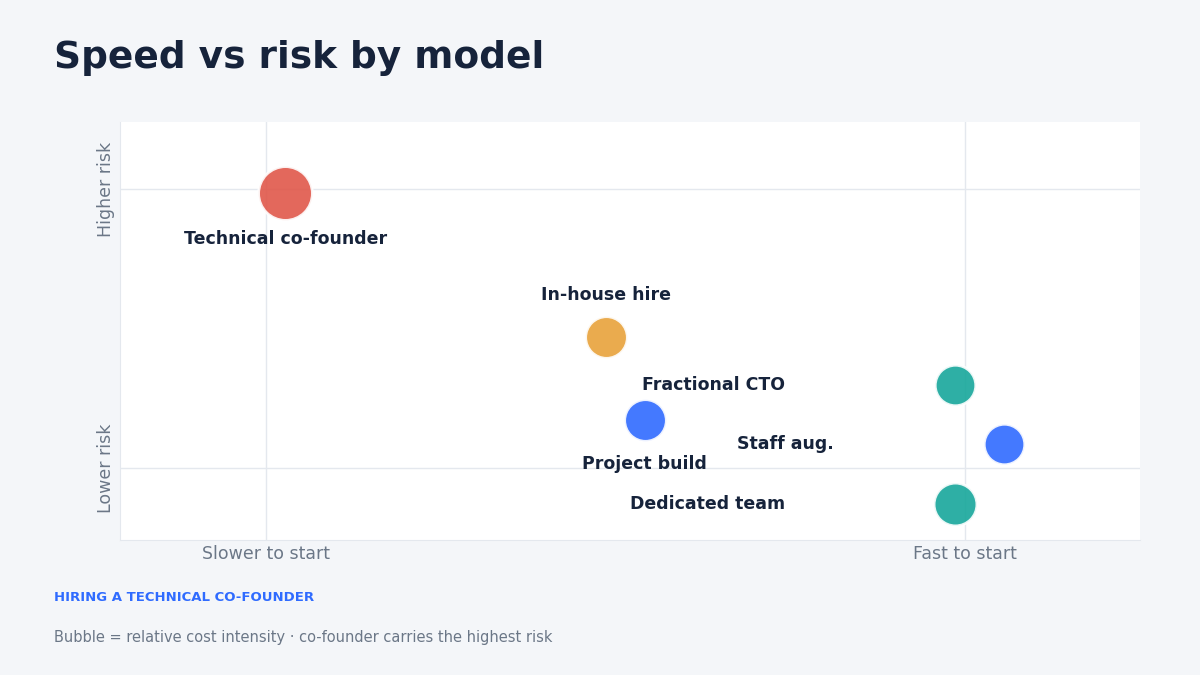
| Technical co-founder | Equity (10–50%) | Shared | Slow (3–9 mo search) | High (65% conflict rate) | Tech is the moat; you’ll build together for years |
| Fractional CTO | ₹2.5–6 L/mo | You retain | Fast (days) | Low | You need senior direction, not a full-time partner |
| In-house senior hire | ₹16–35 L/yr + ESOP | You retain | Medium (weeks) | Medium | You have cash and a clear roadmap to execute |
| Staff augmentation | ₹6–15 L/mo | You retain | Fast (days–2 wks) | Low | You need to flex capacity without long-term commitment |
| Dedicated dev team | ₹6–15 L/mo | You set direction | Fast (7–10 days) | Low | You want a managed pod to own delivery end-to-end |
| Project-based build | ₹8–40 L fixed | You set spec | Medium | Low–Medium | You’re validating a first version and want a fixed cost |
How to read it: if technology is your defensible advantage and you’ll be making architectural bets for years, the equity cost of a co-founder is justified. If technology is the enabler of a business or distribution edge, one of the cash-based, reversible models will get you to market faster and cheaper and you can add a co-founder later from a position of traction and leverage.
What most teams get wrong
This is the part worth arguing about, because the conventional advice is mostly wrong for first-time non-technical founders.
Mistake 1 Treating “get a technical co-founder” as step one. The strongest position from which to recruit an engineer is traction, not a pitch deck. Founders who build a rough first version through a paid team, a no-code prototype, or a fractional lead and get early users then attract better co-founders on better terms. Waiting for a co-founder before building anything inverts the leverage.
Mistake 2 Over-indexing on résumé, under-indexing on the trial. A two-week paid project reveals more about a future partner than a decade of brand-name experience. Founders skip it to “move fast” and then spend a year unwinding the wrong hire.
Mistake 3 Confusing equity generosity with commitment. Handing over 50% doesn’t buy loyalty; vesting and a cliff do. The founders who split casually and skip the founders’ agreement are the ones feeding the 65% failure statistic.
Mistake 4 Believing the binary. The framing of CTO vs technical co-founder, or “co-founder or nothing,” is false. There is a spectrum of fractional leadership, dedicated teams, staff augmentation and the right answer often changes as the company matures. Rigid thinking here is what costs founders their market window.
Mistake 5 Ignoring IP until it’s contested. The time to assign IP and sign an NDA is before the first commit, not during a dispute. This is boring, and it is the single cheapest insurance policy a founder can buy. In our experience across hundreds of technical engagements at Supersourcing, unprotected IP is the failure mode founders regret most.
Cost and timeline reality check
Budgeting for the costs associated with hiring a technical co-founder is essential.
This is the section competing content skips. Here are the ranges to plan a real budget and calendar against.
Cost tiers (India-centric; USD in brackets):
- MVP, project-based: ₹8–40 lakh ($10k–50k), one-time, fixed scope.
- Dedicated team (2–4 engineers + manager): ₹6–15 lakh/month ($7k–18k).
- Senior in-house engineer: ₹16–35 lakh/year ($45k–75k) plus a small ESOP grant.
- Fractional CTO: ₹2.5–6 lakh/month ($3k–7k) for part-time senior direction.
The financial implications of hiring a technical co-founder vary significantly.
- Technical co-founder: little or no cash, but 10–50% of the company over a successful exit, the most expensive line item by orders of magnitude.
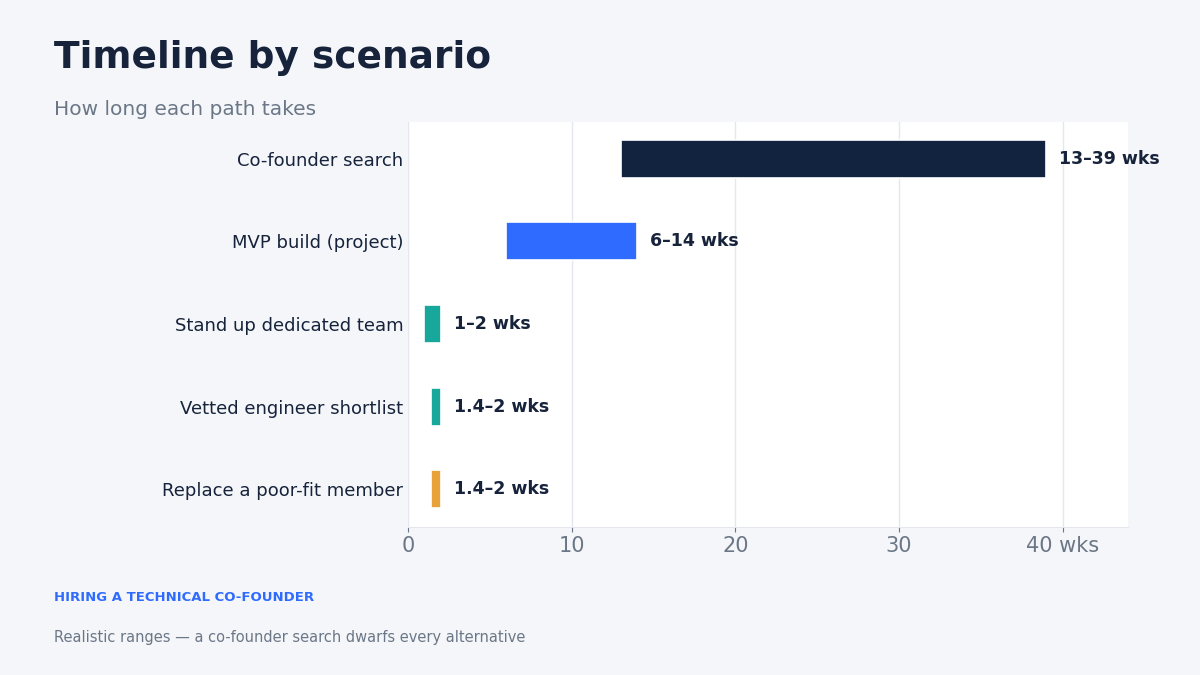
Realistic timelines by scenario:
| Scenario | Realistic timeline |
| Finding and committing to a genuine co-founder | 3–9 months |
| Vetted senior engineer via a specialist partner | 7–10 working days to shortlist |
| Standing up a dedicated team | 1–2 weeks |
| MVP build (project-based) | 6–14 weeks |
| Replacing a poor-fit team member (with a guarantee) | 7–10 days |
What drives cost up: regulatory/compliance scope (fintech, healthtech), real-time or ML-heavy systems, senior scarcity in a specific stack, and rework caused by skipping the vetting trial. What drives cost down: a tight, well-scoped v1; a dedicated (not shared) team; strong documentation; and picking a cash-based model over equity when technology isn’t the core moat.
What to do next if you’re mid-decision
If you’re weighing this right now, you’re at one of two points. Either you’ve found a promising candidate and need to vet, structure equity, and protect your IP in which case run Phase 2 and Phase 3 of this guide before you grant a single share.
Or the search has stalled, your market window is closing, and you need the product moving regardless, in which case the honest answer is to build in parallel through a dedicated team while you keep looking.
The one thing not to do is wait. A rough, shipping product built now beats a perfect co-founder found in a year, because traction is what earns you a better co-founder, better investors, and better terms later.
If you want a shortcut on the second path, a pre-vetted senior engineer or a dedicated, NDA-backed team shortlisted in about 7–10 working days, with a replacement guarantee if the fit is wrong, that’s a single conversation away. Start it here: https://supersourcing.com/contact-us/
Before proceeding with hiring a technical co-founder, consider your market position.
Frequently asked questions
Do I need a technical co-founder to raise funding?
No. Carta’s data shows two-person teams are common among funded startups, but solo and non-technical-led teams raise regularly, especially with early traction. Investors fund evidence users, revenue, retention more than team composition. A rough product built through a paid team can raise as effectively as a co-founder’s promise.
How much equity should a technical co-founder get?
It depends on timing and risk. A co-founder joining at inception and sharing the risk typically takes 35–50%; one joining after validation takes 15–30%; a post-traction technical leader is closer to a 1–5% CTO grant plus salary. Whatever the figure, vest it over four years with a one-year cliff non-negotiable.
How do I vet a technical co-founder if I can’t code?
Test judgment, not syntax. Bring a trusted senior engineer to one session, ask the candidate to walk through something they’ve shipped and justify the trade-offs, and run a one-to-two-week paid trial project. How they scope, communicate, and hit deadlines under real conditions predicts the partnership far better than any interview.
What are the alternatives to a technical co-founder?
Several, and they’re often better early on: a fractional CTO for senior direction, staff augmentation for flexible capacity, a dedicated development team to own delivery, or a fixed-scope project built for a first version. These are the practical alternatives to a technical co-founder when the right partner hasn’t appeared and they let you build now instead of waiting.
What’s the difference between a CTO and a technical co-founder?
Every startup needs to evaluate whether hiring a technical co-founder is the right decision for them.
A technical co-founder joins pre-product, carries founder-level risk and equity (10–50%), and takes little to no salary. A CTO is an executive hire who joins a functioning company with a market salary and a smaller equity grant (typically 1–5%). Same technical leadership; very different risk, timing, and compensation.
How long should the search realistically take?
Understanding the timeframe for hiring a technical co-founder is vital to planning your launch.
Plan for three to nine months to find, trial, and commit to the right person. Most founders underestimate this by three to four times. If your market window is shorter than your search, build the product through a paid team in parallel so momentum never depends on the search finishing.
The process of hiring a technical co-founder should be approached systematically.
How do I protect my idea before I have a co-founder?
Use a mutual NDA and an IP-assignment agreement before any real work begins, so all code and assets belong to the company by default. Ideas are rarely stolen; execution and code are what matter, and assigned IP plus a founders’ agreement with a buy-back clause protects both.
Is it cheaper to hire an agency than to give up equity?
Almost always, in absolute terms. A full MVP build runs ₹8–40 lakh once; 30% of a company that later exits for crores is a vastly larger payment. Equity makes sense only when you need permanent, founder-level ownership of technology as your moat, otherwise a cash-based build preserves both ownership and speed.
