

A GCC that’s earned real ownership over a product line can’t afford a staffing vendor missing SLAs, an IT vendor with no documented offboarding process, or a compliance partner nobody has risk-assessed since onboarding.
Here’s the pattern nobody names directly: almost every GCC past its first 18 months is running four to six vendors at once a staffing or RPO partner, an IT infrastructure or managed services vendor, a payroll and statutory-compliance vendor, a facilities/EHS vendor, sometimes a legal process outsourcing partner, occasionally a dedicated cybersecurity vendor. Each was onboarded separately, at a different time, by a different stakeholder, with a different contract template. None of them talk to each other, and often, nobody inside the GCC owns the full picture.
Gartner’s own numbers back up why this drifts out of control fast: the average organization manages more than 1,500 third-party relationships and still lacks visibility into a large share of that ecosystem, and separately, roughly three in four organizations are now actively pursuing vendor consolidation specifically to cut operational complexity and improve how tools and teams share information. A GCC is a smaller version of the same problem, just compressed into a single site with a single P&L owner who actually has to answer for it.
This challenge is only growing. According to Deloitte Global Outsourcing Survey, organizations continue to expand their third-party ecosystems, with a majority increasing outsourcing adoption to drive efficiency and scalability
This guide is the operating framework for that problem: how to tier your vendors, what a real third-party risk assessment covers for a staffing or payroll partner (not just an IT vendor), how to structure SLAs and quarterly reviews that actually get read, and what a workable exit clause looks like before you need one.
TL;DR
This guide is for GCC heads, India-site leaders, and global HR/IT/procurement stakeholders who are past the "what is a GCC" stage and are now responsible for running multiple external partners without losing visibility or control. It walks through the entire lifecycle from mapping which vendors you actually need, to vetting and contracting them, to running a governance cadence that catches problems before they become incidents, to exiting a vendor cleanly.
The single biggest number to hold onto: most GCCs are running 4-6 concurrent vendors by month 18, and the vast majority have never mapped those vendors against a shared risk tier, a shared SLA template, or a shared review calendar. That gap, not the vendor selection itself, is where cost overruns, compliance exposure, and delivery failures actually originate.
By the end, you'll be able to build a vendor tiering model, run a defensible third-party risk assessment, structure a quarterly business review that vendors take seriously, and write an exit clause that protects your data and your timeline the full GCC vendor management operating system, not just a vendor selection checklist.
What Is GCC Vendor Governance?
GCC vendor governance is the structured set of policies, review cadences, and risk controls a Global Capability Center uses to manage every external partner staffing, IT, payroll, facilities, legal, or compliance under one consistent framework rather than as separate, disconnected contracts.
It is often confused with:
- Vendor selection choosing the right partner is a one-time decision; governance is the ongoing system that manages that partner for the life of the contract.
- Procurement/contracting signing an MSA and SOW is necessary but insufficient; governance includes the risk tiering, SLA tracking, and review cadence that happens after signature.
- IT vendor management alone most guides on this topic only cover software/IT vendors; a mature GCC governance framework has to cover staffing, payroll, facilities, and legal vendors under the same structure, because they carry the same categories of operational and compliance risk.
Why It Matters: The Business Case
Ungoverned vendor relationships cost a GCC in ways that rarely show up on the invoice line:
- Compliance exposure to a payroll vendor without a current statutory filing record, or a staffing vendor without a valid labor license, can expose the parent entity to penalties that dwarf the vendor’s annual contract value.
- Delivery risk from redundant tooling the average enterprise runs dozens of overlapping vendor tools and contracts, each added as a rational one-off purchase, which quietly becomes expensive to license and exhausting to operate; GCCs replicate this at a smaller scale across staffing, IT services, and compliance categories.
- Talent quality inconsistency: an unvetted staffing vendor with no defined screening SLA produces higher first-90-day attrition, which directly inflates the GCC’s effective cost-per-hire.
- Slower incident response without a shared escalation matrix across vendors, a security or compliance incident that touches two vendors (say, IT infrastructure and payroll data) takes days longer to contain because no one owns the cross-vendor response.
- Negotiating leverage loss a GCC that reviews vendor performance quarterly, with data, renegotiates rates and SLAs from a position of evidence. A GCC that doesn’t, renews on inertia.
- Consolidation savings left on the table enterprises that formally review their vendor stack typically find 20-30% of vendors are either redundant or under-utilized relative to their contract value, freeing the budget for the vendors actually driving outcomes.
None of these costs show up as a single line item labeled “poor vendor governance” ; they show up scattered across attrition reports, compliance audits, and renewal negotiations, which is exactly why the problem persists past the point where it should have been obvious.
The Core Problem Most Buyers Face
Most GCC leaders underestimate the vendor governance problem by three to four times, because they scope it at setup “who do we hire to help us launch” instead of at steady state “who do we have relationships with 18 months from now, and how do we manage all of them together.”
What actually happens without a framework:
- Vendor sprawl by accident, not design. A staffing partner gets added in month 2. An IT managed services vendor in month 4. A second, more specialized staffing vendor for a niche skill in month 9 (nobody formally decommissions the first one’s scope). A facilities vendor inherited from the real estate team. By month 18, the GCC has 5-6 active vendor relationships, no shared onboarding template, and no single register of who’s active, who’s contracted for what, and who’s overdue for review.
- Risk assessments happen once, at onboarding, and never again. A vendor’s security posture, labor compliance status, or financial stability at month 1 is not their status at month 24. Most GCCs have no re-assessment cadence.
- SLAs exist in contracts but not in practice. Contracts specify a 7-10 day staffing turnaround or a 4-hour IT ticket response but no one is tracking actual performance against those numbers month over month, so underperformance becomes normal before anyone notices.
- Exit and transition planning is an afterthought. Contracts get signed with vague “reasonable transition assistance” language instead of a defined transition-out plan, data handover format, and timeline which turns every vendor exit into a fire drill.
THE WALKTHROUGH: Building GCC Vendor Governance From Scratch
Phase 1 Mapping and Defining Requirements
Before evaluating a single vendor, map what you actually need to govern. Most GCCs need to plan for some combination of these vendor categories:
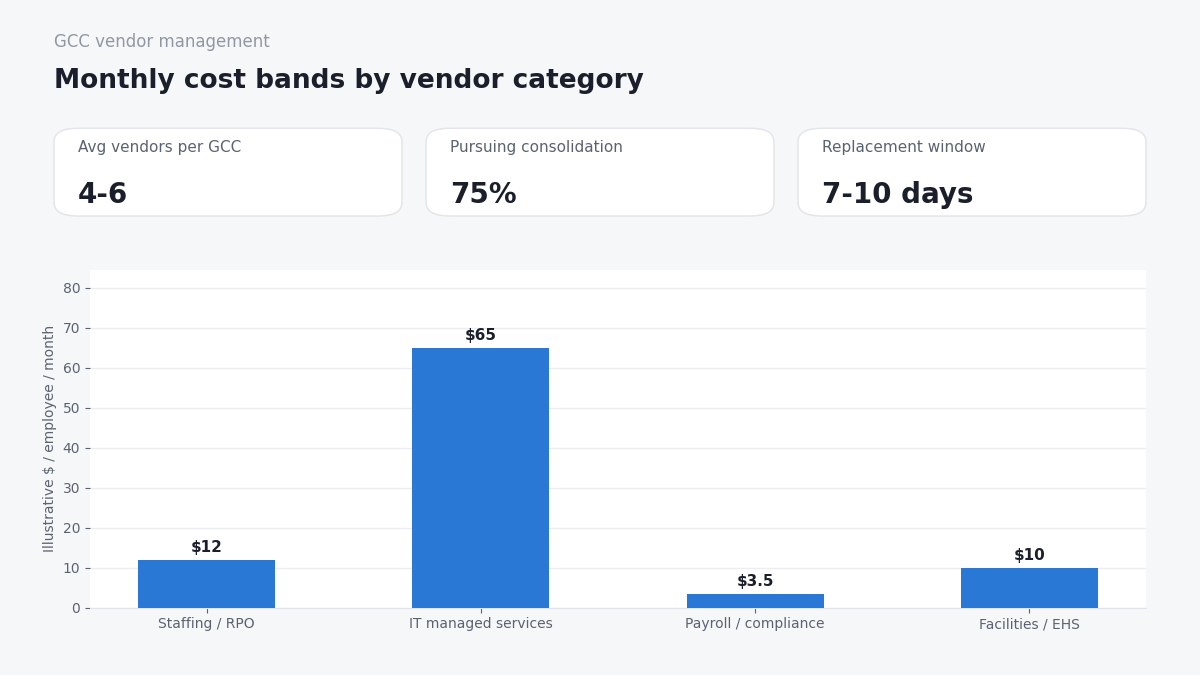
- Staffing / RPO sourcing, screening, and contract-to-hire pipelines. Budget band: for a mid-size India GCC, staffing/RPO fees typically run 8-15% of first-year CTC per hire, or a flat monthly retainer of $3,000-8,000 for dedicated recruiter bandwidth.
- IT infrastructure & managed services network, endpoint management, helpdesk. Budget band: $40-90 per employee per month for managed IT support at GCC scale (100-500 seats).
- Payroll & statutory compliance PF, ESI, professional tax, gratuity, labor law filings. Budget band: ₹150-400 per employee per month, or $2-5, depending on state and complexity.
- Facilities & EHS (environment, health, safety) office operations, compliance certifications, vendor-managed cafeteria/transport if applicable.
- Legal / LPO (legal process outsourcing) contract review, incorporation filings, ongoing regulatory tracking.
- Cybersecurity / compliance audit periodic penetration testing, ISO 27001 or SOC 2 audit support, DPDP Act (India’s data protection law) compliance review.
Requirements checklist for each vendor category:
- Defined scope (what’s in, what’s explicitly out)
- Volume/scale assumptions (e.g., “up to 50 hires/quarter” for staffing)
- Budget band with currency and payment terms
- Required certifications (ISO 27001, SOC 2, labor license, PF/ESI registration)
- Data access level (none, limited PII, full HRIS/payroll access)
- Named internal owner (not a department a person)
A useful discipline at this stage: write the requirement as if you were handing it to a vendor manager who’s never met you, not as a mental note. “We need a staffing partner” is not a requirement. “We need a staffing partner who can deliver a 7-10 working day shortlist for mid-to-senior backend and data engineering roles, at a volume of 15-20 hires per quarter, with a dedicated (not shared) recruiter, and a documented replacement policy” is a requirement it’s specific enough that two different vendors can be compared against it on the same criteria, and specific enough that you’ll notice in month six if the vendor has quietly drifted from what was agreed.
This is also the point to decide build-versus-buy for each function. A GCC with an internal HR team of three people generally shouldn’t be running payroll compliance in-house once headcount crosses 100-150 the statutory filing complexity (PF, ESI, professional tax, gratuity, shops and establishment registrations, and state-specific labor law variations) outpaces what a lean internal team can track reliably. Conversely, a GCC with a strong internal engineering leadership bench may only need staff augmentation for specific skill gaps rather than a full RPO relationship.
Phase 2 Sourcing & Vetting
Good screening for a vendor looks structurally similar to good candidate screening: you’re checking capability, track record, and fit, not just price.
What good vendor vetting includes:
- Reference checks with 2-3 existing clients of comparable size and industry ask specifically about SLA adherence, not just “were you happy.”
- Financial stability check (for staffing/payroll vendors especially a vendor’s insolvency mid-contract is a real operational risk, not a theoretical one).
- Security posture review for any vendor touching employee or company data requests their most recent penetration test summary or ISO 27001 certificate, not just a claim of compliance.
- A trial engagement or paid pilot before a full-scale contract, where feasible this is especially standard for staffing and RPO engagements, where a 90-day pilot on one job family reveals more than any RFP response.
Red flags in vendor evaluation:
- Vendors can’t name a single named point of contact who’ll own your account (a rotating “team” answer is a warning sign for accountability).
- No willingness to share a sample SLA-tracking report from an existing client.
- Pricing that’s meaningfully below market with no clear explanation (usually means either under-qualified screening for staffing, or under-resourced support for IT/compliance).
- Reluctance to include a right-to-audit clause or basic security documentation in the contract discussion.
For technical roles specifically, this is also the stage where GCCs decide whether to route certain hiring through a specialized partner for instance, a GCC standing up a data platform team will often want a partner experienced enough to help hire cloud engineers or backend specialists directly rather than running that search generically through a broad-scope staffing vendor.
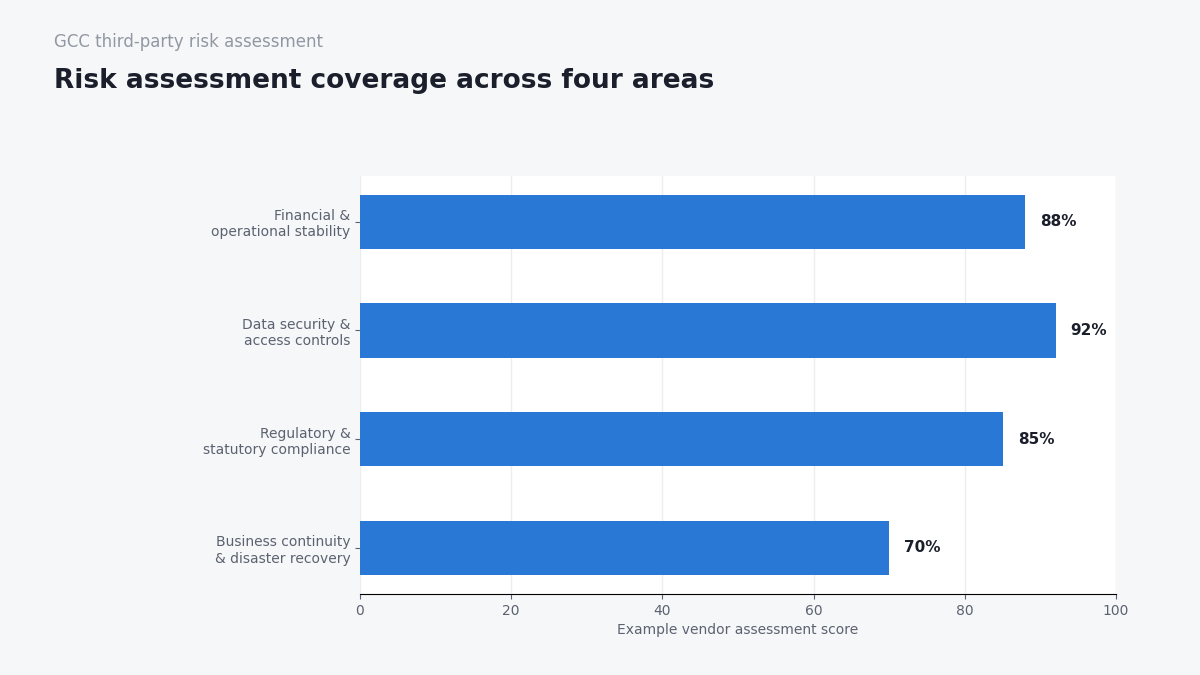
A practical GCC third-party risk assessment covers four areas, and it’s worth running this as a standing checklist rather than a one-time form:
- Financial and operational stability: how long has the vendor operated at this scale, and can they show continuity plans if a key account manager or delivery lead leaves? For staffing and payroll vendors specifically, ask about their own employee attrition rate. A vendor with high internal turnover on your account team will struggle to give you continuity.
- Data security and access controls what certifications do they hold (ISO 27001, SOC 2 Type II), how is data encrypted at rest and in transit, and critically, do they disclose any sub-processors who’ll also touch your data? A vendor that can’t name its own sub-processors is a red flag regardless of category.
- Regulatory and statutory compliance for staffing vendors, a valid labor license under the relevant state’s Contract Labour Act; for payroll vendors, current PF/ESI registration and a clean filing history; for any vendor processing employee data, alignment with India’s DPDP Act (Digital Personal Data Protection Act) obligations around consent, purpose limitation, and breach notification.
- Business continuity and disaster recovery: does the vendor have a documented BCP, and have they actually tested it (a written plan that’s never been tested is a paper exercise, not a control)?
Score each vendor against these four areas at onboarding, and repeat the assessment annually for Tier 1 vendors. A vendor’s risk profile at signature is a snapshot, not a guarantee, and the assessment is the mechanism that catches drift before it becomes an incident.
Phase 3 Engagement Models & Contracts
Choosing the engagement model:
| Model | Best for | Control level | Typical contract length |
| Dedicated / staff augmentation | Ongoing, embedded roles (engineering, ops) | High vendor talent works inside your team | 6-12 months, renewable |
| Project-based / SOW | Defined-scope work (a migration, an audit, a build) | Medium deliverable-based | Duration of project |
| Managed service | Non-core functions (IT helpdesk, payroll processing) | Lower day-to-day, higher outcome accountability | 12-24 months |
| RPO / recruitment outsourcing | High-volume, recurring hiring | Medium vendor owns pipeline, you own final decision | 12 months+ |
Contract terms that matter more than people think:
- NDA and IP assignment clauses for any vendor whose staff will touch code, product design, or proprietary data, the contract needs explicit IP assignment language, not just a generic mutual NDA.
- Data processing agreement (DPA) required wherever a vendor touches employee PII (payroll, staffing, HRIS-adjacent tools), specifying what data, retention period, and sub-processor disclosure.
- SLA definitions with numbers, not adjectives “prompt response” is not an SLA; “4-hour first response, 24-hour resolution for P2 tickets” is.
- Replacement/remediation clause what happens if a placed hire isn’t working out, or a vendor’s assigned resource underperforms. A 7-10 working day replacement window is a reasonable, common standard for staffing engagements.
- Exit and transition-out clause covered in depth in Phase 6, but it needs to exist in the original contract, not get negotiated during an actual exit.
Phase 4 Onboarding & Ramp-Up
The first two weeks of any vendor relationship set the tone for the following two years.
First 2-week onboarding checklist:
- Kickoff call with named SPOCs from both sides, documented in writing (not just verbally agreed).
- Access provisioning matched to the least-privilege principle: a staffing vendor doesn’t need payroll system access; a payroll vendor doesn’t need code repo access.
- Shared escalation matrix who to contact, in what order, for what severity of issue, on both sides.
- Baseline SLA dashboard set up before the first ticket/hire/filing happens, not after.
- Communication cadence agreed (weekly check-in for staffing, monthly for managed IT, quarterly for compliance-only vendors is a common starting split).
- Data analyst walkthrough confirms the vendor’s actual practice matches what was represented during vetting.
Phase 5 Managing Delivery
This is where most GCCs fall short not at onboarding, but in the ongoing cadence.
Reporting cadence by vendor type:
- Staffing/RPO: weekly pipeline report (roles open, candidates in stage, time-to-fill against the 7-10 day target)
- IT managed services: monthly SLA report (ticket volume, resolution time, uptime %)
- Payroll/compliance: monthly filing confirmation + quarterly compliance certificate refresh
- Facilities: monthly operational report + annual safety audit
- All vendors: quarterly business review (QBR), regardless of category
What a real QBR covers (not a status update):
- Performance against contracted SLAs, with actual numbers
- Any incidents or near-misses in the quarter, and root cause
- Renewed compliance documentation (labor license renewal, security cert renewal)
- Cost trend versus budget
- Relationship health is the named SPOC still the actual point of contact, or has it quietly rotated three times without notice?
- Forward-looking needs: does scope need to expand, shrink, or stay flat next quarter?
Vendor tiering model not every vendor needs the same oversight intensity:
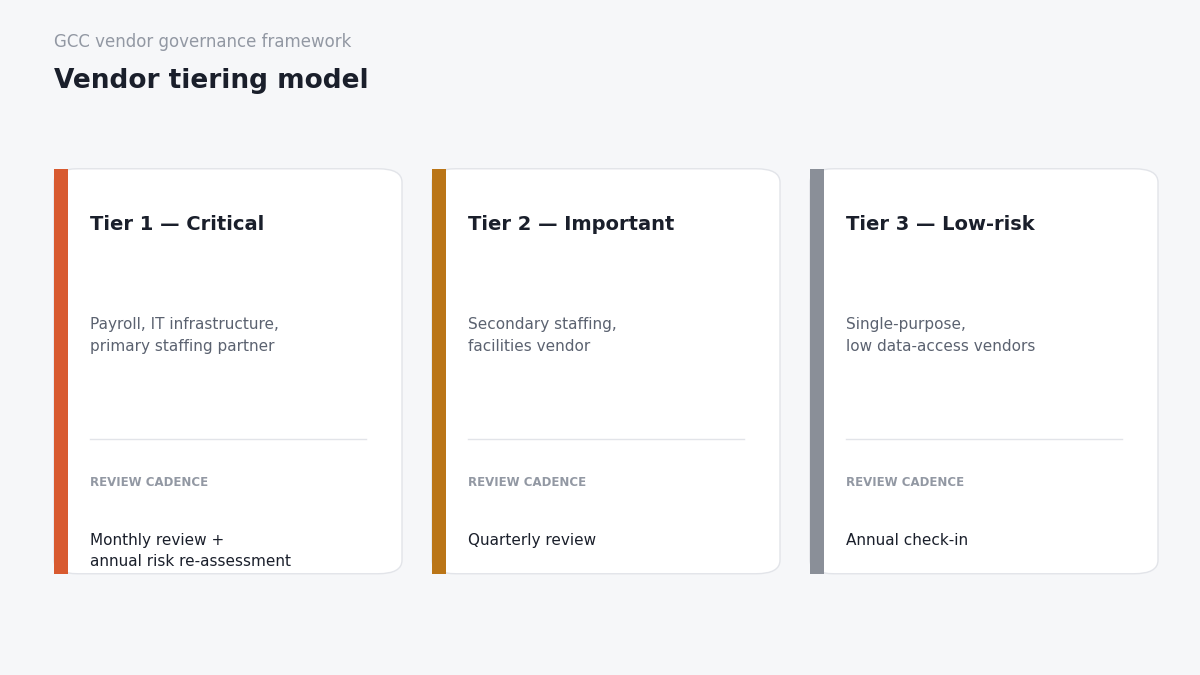
- Tier 1 (critical) vendors with access to sensitive data or core operations (payroll, IT infrastructure, primary staffing partner). Monthly formal review minimum, annual third-party risk re-assessment.
- Tier 2 (important) vendors supporting but not core to operations (secondary staffing for niche roles, facilities). Quarterly review.
- Tier 3 (low-risk) single-purpose, low-data-access vendors (e.g., a one-off legal filing service). Annual check-in, lighter documentation.
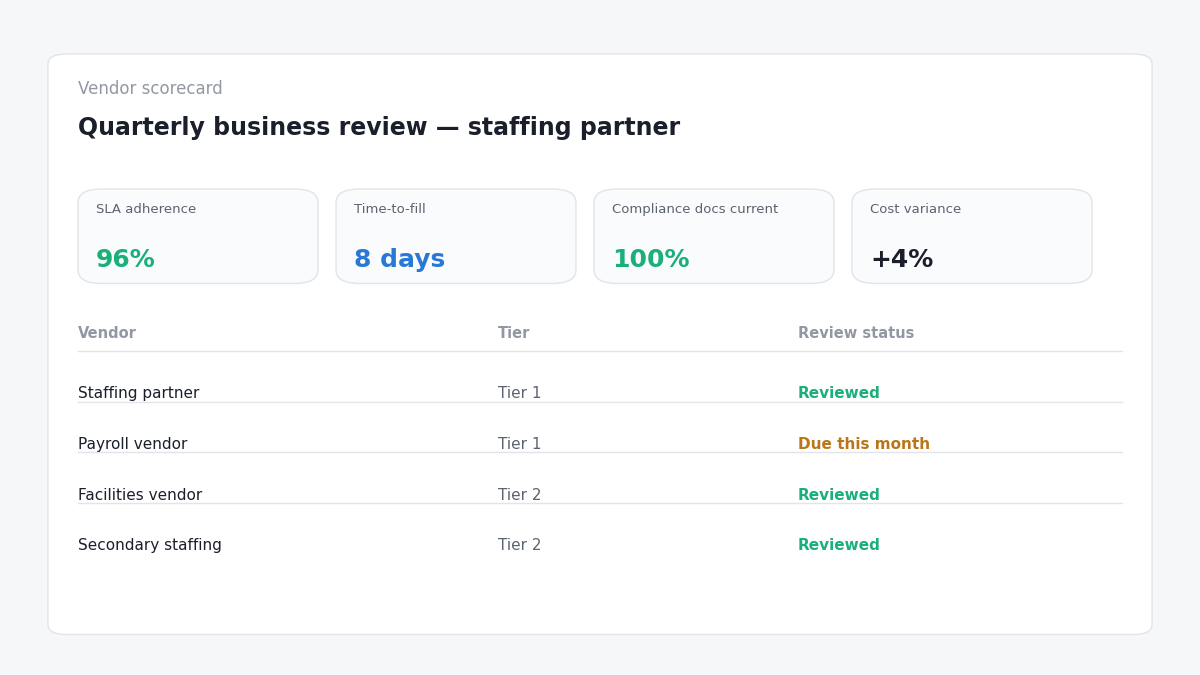
A simple vendor scorecard, tracked monthly for Tier 1 vendors and reviewed at each QBR, typically covers:
| Metric | What it measures | Example target |
| SLA adherence % | Contracted response/delivery time met | 95%+ tickets within SLA |
| Time-to-fill / time-to-resolution | Actual delivery speed vs. contracted target | 7-10 working days (staffing) |
| Compliance document currency | Are certifications and licenses current | 100% current, zero lapses |
| Escalation count and resolution time | How often issues need escalation, and how fast they close | Declining trend quarter over quarter |
| Cost variance vs. budget | Actual spend vs. contracted/forecasted spend | Within 5-10% of budget |
A scorecard like this turns a QBR from a status update into an actual negotiating and decision-making tool. It’s the difference between “the vendor says things are going well” and “here’s four quarters of data showing things are going well, or not.”
Phase 6 Scaling or Exiting
Adding headcount/scope with an existing vendor: Formalize scope changes through a contract amendment or new SOW, not a verbal understanding this is the single most common source of billing disputes six months later.
Replacement policies: A defined 7-10 working day replacement guarantee for IT staffing engagements protects both the pipeline and the budget; verify this is in writing before signing, not assumed as industry standard.
Offboarding / vendor exit what a workable exit clause includes:
- Notice period (30-90 days depending on vendor criticality tier)
- Data return/destruction format and timeline, with written confirmation
- Transition-out support obligation (defined hours or weeks of knowledge transfer, not “reasonable assistance”)
- Handover documentation requirements (process docs, open-issue logs, active candidate pipelines for staffing vendors)
- Final compliance sign-off (confirming all statutory filings up to the exit date are complete and documented)
Skipping this clause is the single most common regret GCC leaders report after a vendor relationship ends badly not because the vendor was malicious, but because nobody defined what “done” looked like on the way out.
Case Studies
Scale-up hiring under time pressure: When Swiggy needed to rapidly expand its engineering and product bench during a high-growth phase, the constraint wasn’t candidate availability it was screening throughput without compromising technical bar. A structured, AI-assisted sourcing and vetting pipeline compressed the shortlist-to-interview cycle meaningfully versus a traditional generalist search, while keeping joining rates high because candidates were pre-qualified against the actual role, not a generic job description.
Engineering hiring for a fast-moving fintech: OkCredit’s engineering hiring needed to move at startup speed without startup-style attrition. A dedicated account management structure rather than shared bandwidth across a recruiter pool meant the same team stayed accountable for pipeline quality across multiple hiring rounds, which is the same principle a GCC should demand from any staffing vendor it retains past a single hiring cycle.
Recruitment automation for a specialized healthtech player: Somnoware’s hiring needs centered on niche technical skill sets where generic sourcing underperforms. The lesson for GCC vendor governance is specific: a vendor evaluated only on generalist metrics (time-to-fill, volume) will look fine on a dashboard while missing the specialized-skill mandate a GCC actually needs which is why requirements definition (Phase 1) has to name the specific skill bands, not just headcount targets.
Across all three patterns, the common thread isn’t the vendor’s tooling or the company’s brand; it’s that governance discipline (a named account owner, a defined SLA, a scorecard that gets reviewed) is what separated a vendor relationship that scaled cleanly from one that needed constant firefighting.
None of these outcomes came from a better contract template alone; they came from someone inside the organization actually running the cadence described in Phase 5.
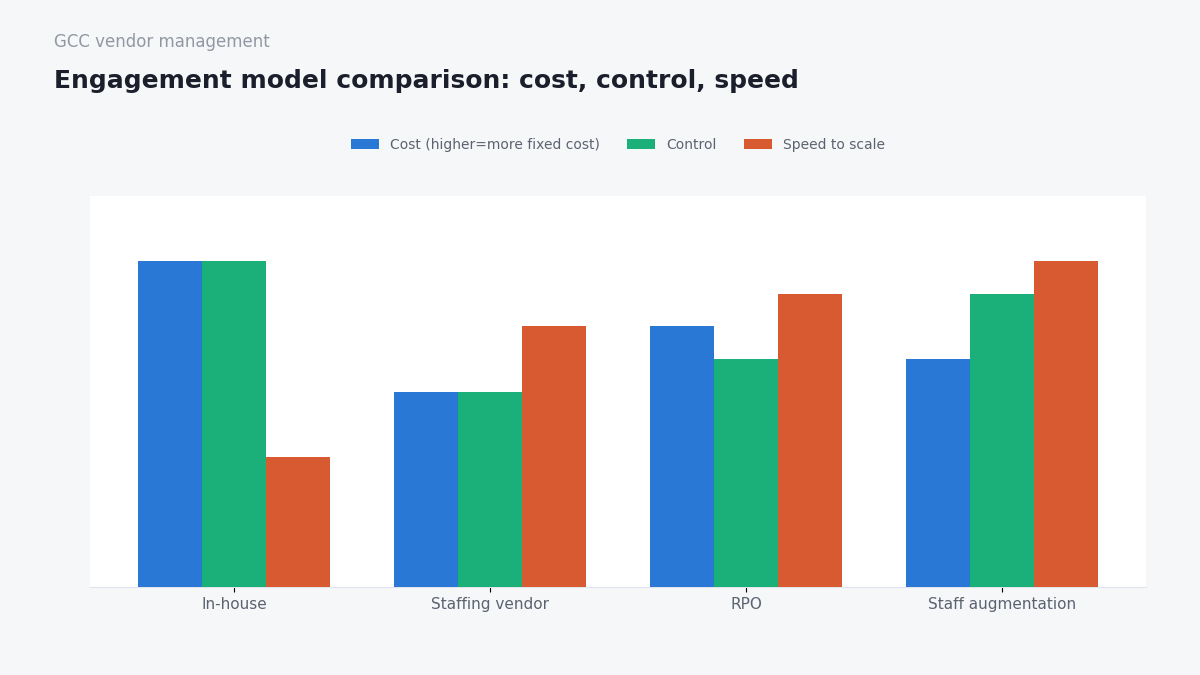
Comparison / Decision Framework: Staffing Vendor vs. RPO vs. In-House vs. Staff Augmentation
| Model | Cost | Control | Speed | Best fit |
| In-house recruiting team | Highest fixed cost, lowest variable cost at scale | Full control | Slower to scale up/down | GCCs past 300+ employees with steady, predictable hiring volume |
| Traditional staffing vendor | Per-hire fee (8-15% of CTC) | Medium vendor sources, you decide | Fast for standard roles | Steady-state hiring for common skill profiles |
| RPO (recruitment process outsourcing) | Retainer or per-hire, often blended | Medium-high vendor embeds in process | Fast, built for volume | High-volume, recurring hiring (50+ roles/quarter) |
| Dedicated staff augmentation | Monthly rate per resource | High resource works inside your team daily | Fastest for filling a specific skill gap | Filling a defined technical gap (e.g., needing to hire dedicated React developers or backend engineers for a live sprint) |
How to apply this framework: Score each option 1-5 against your top three constraints (usually cost, speed, and control) and weight by what actually matters for the specific role or function a GCC hiring its 400th generalist support engineer has different weighting than one filling a single senior architect role under deadline pressure.
What Most Teams Get Wrong
The single most common mistake isn’t vendor selection; it’s treating vendor governance as a procurement function instead of an operating discipline owned by someone inside the GCC with day-to-day accountability.
Procurement signs the contract and moves on to the next one; nobody in procurement is checking whether the payroll vendor’s PF filings are current in month 14.
A close second: GCCs consolidate vendors for cost reasons and lose specialization, or resist consolidation entirely and end up with six vendors doing overlapping work with no one owning the seams between them.
The right answer is rarely “consolidate everything” or “keep everything specialized” ; it’s mapping which functions genuinely benefit from a single point of accountability (staffing, IT helpdesk) versus which genuinely need domain specialists (a niche legal filing, a specific compliance audit) and consolidating only the former.
A third pattern: exit clauses get treated as boilerplate at signing and become a genuine operational crisis at termination usually because the vendor holding the data or the pipeline has no contractual obligation to hand it over in a usable format on a defined timeline.
A fourth, quieter pattern: GCCs confuse a vendor being responsive with a vendor being compliant. A staffing vendor that answers emails within an hour but hasn’t refreshed its labor license documentation in eighteen months looks like a good relationship right up until an audit or a labor inspection surfaces the gap at which point it becomes the GCC’s exposure, not the vendor’s, because the parent entity is ultimately accountable for who’s working under its roof and whose payroll data it’s trusting a third party with.
Cost & Timeline Reality Check
Typical vendor onboarding timelines:
- Staffing/RPO vendor: 2-3 weeks from contract signature to first candidate submission, assuming role specs are ready.
- IT managed services: 4-6 weeks for full transition if replacing an incumbent vendor (longer if migrating infrastructure, not just support).
- Payroll/compliance vendor: 4-8 weeks, largely gated by statutory registration transfers, not vendor readiness.
What drives costs up:
- Late or vague requirements definition (Phase 1 skipped or rushed) typically adds 15-25% to first-year vendor spend through scope creep and rework.
- No consolidated vendor register duplicate tooling or overlapping scope across vendors is common and usually invisible until a formal audit.
- Reactive risk assessment (only after an incident) versus proactive tiering post-incident remediation costs materially more than a scheduled annual review.
What drives costs down:
- Multi-year contracts with built-in rate protection, negotiated from a position of documented performance history (this is only possible if you’ve actually been tracking SLA data).
- Consolidating Tier 3 (low-risk, low-complexity) vendors where a single provider can reasonably cover 2-3 adjacent functions.
- A defined, enforced replacement/remediation clause that avoids the sunk-cost trap of tolerating an underperforming vendor because switching feels expensive.
A rough cost-tier reference for a mid-size India GCC (150-400 employees) running the standard vendor set:
- Staffing/RPO: typically 8-15% of first-year CTC per hire, or $3,000-8,000/month for a dedicated retainer model.
- IT managed services: $40-90 per employee per month, scaling down per-seat as headcount grows past 300.
- Payroll/statutory compliance: $2-5 (₹150-400) per employee per month, varying by state and filing complexity.
- Facilities/EHS: highly location-dependent, but budgeting 8-12% of total occupancy cost for a managed facilities vendor (versus in-house facilities staff) is a reasonable planning range.
- Legal/LPO support: retainer-based, commonly $1,500-4,000/month for ongoing contract review and regulatory tracking at GCC scale, separate from one-off incorporation or litigation costs.
These are planning bands, not quotes; actual pricing depends on the city (Bengaluru and Hyderabad typically price 10-20% higher than Tier-2 cities for the same scope), vendor tier, and contract length. Treat any vendor pricing significantly below these bands as a prompt to re-verify screening depth or support quality, not as a win.
Where to Start This Week
If you’re mid-decision on this right now, the highest-leverage first step isn’t picking a new vendor, it’s building the register. List every vendor you currently have, tier them (critical / important / low-risk), and check which ones are overdue for a compliance document refresh or a real SLA review.
That single exercise usually surfaces the problem before any new contract does.
For GCCs building or restructuring this governance layer whether that’s setting up a global capability center from scratch, restructuring IT staffing services, or bringing in recruitment process outsourcing support for a high-volume hiring push a partner with dedicated account management (not shared bandwidth) and a documented replacement guarantee removes a meaningful share of this operational risk before it starts.
If you’re at that stage, get in touch and walk through your current vendor map with a team that’s built this exact structure for centers like Razorpay’s and Chargebee’s before.
Frequently Asked Questions
What is vendor governance in a GCC?
It’s the ongoing system policies, review cadences, risk tiers, and escalation paths a GCC uses to manage every external vendor consistently, rather than letting each contract run independently with its own informal rules. It covers staffing, IT, payroll, facilities, and legal vendors under one shared framework.
How many vendors should a GCC realistically run?
Most mature GCCs run four to six concurrent vendors typically staffing/RPO, IT infrastructure, payroll/compliance, and facilities, sometimes adding legal or dedicated cybersecurity partners. The number itself isn’t the problem; running that many without a shared governance structure is.
What’s the difference between a staffing vendor and an RPO partner for a GCC?
A traditional staffing vendor sources and screens candidates per role, usually on a per-hire fee. An RPO partner embeds in your hiring process end-to-end, typically on a retainer or blended model, and is built for sustained, high-volume hiring rather than one-off role fills.
How do you assess third-party risk for a GCC vendor?
Check financial stability, data access level and security posture (certifications like ISO 27001), labor and statutory compliance status for staffing/payroll vendors, and reference checks focused specifically on SLA adherence not just general satisfaction. Repeat this annually, not just at onboarding.
What goes wrong when GCCs don’t govern vendors properly?
Compliance exposure from lapsed filings, delivery risk from untracked SLA breaches, higher effective cost-per-hire from unvetted staffing quality, and slow incident response because no shared escalation matrix exists across vendors.
Should a GCC consolidate to fewer vendors or keep specialists?
Consolidate functions that benefit from single-point accountability (staffing, IT helpdesk); keep specialists for niche, high-stakes functions (specific compliance audits, specialized legal filings). Blanket consolidation or blanket specialization both create problems; the decision should be function-by-function.
What compliance documents does a GCC need from every vendor?
At minimum: current business registration, relevant labor/staffing licenses (for staffing vendors), PF/ESI registration (for payroll vendors), a security certification or recent audit summary for any vendor touching data, and a signed NDA/IP assignment clause where applicable.
How often should vendor performance be reviewed?
Tier 1 (critical) vendors: monthly informal check-ins plus a quarterly business review. Tier 2: quarterly. Tier 3 (low-risk, single-purpose): an annual check-in is usually sufficient. All vendors should have compliance documentation re-verified at least annually.
What does a good vendor exit clause look like?
A defined notice period, a data return/destruction format and timeline in writing, a specific transition-out support obligation (hours or weeks, not “reasonable assistance”), required handover documentation, and a final compliance sign-off confirming all statutory obligations are current through the exit date.
Who should own vendor governance inside a GCC, the GCC head, procurement, or a dedicated vendor manager?
Procurement should own contracting; a named individual inside the GCC, a dedicated vendor manager for larger centers, or the GCC head directly for smaller ones should own the ongoing governance cadence, because procurement typically isn’t positioned to catch operational SLA drift or compliance lapses months after signature. If you’re building out this function and want a partner who’s run this model across staffing, IT, and RPO simultaneously for enterprise GCCs, that’s a conversation worth having early, not after the first vendor incident.
