

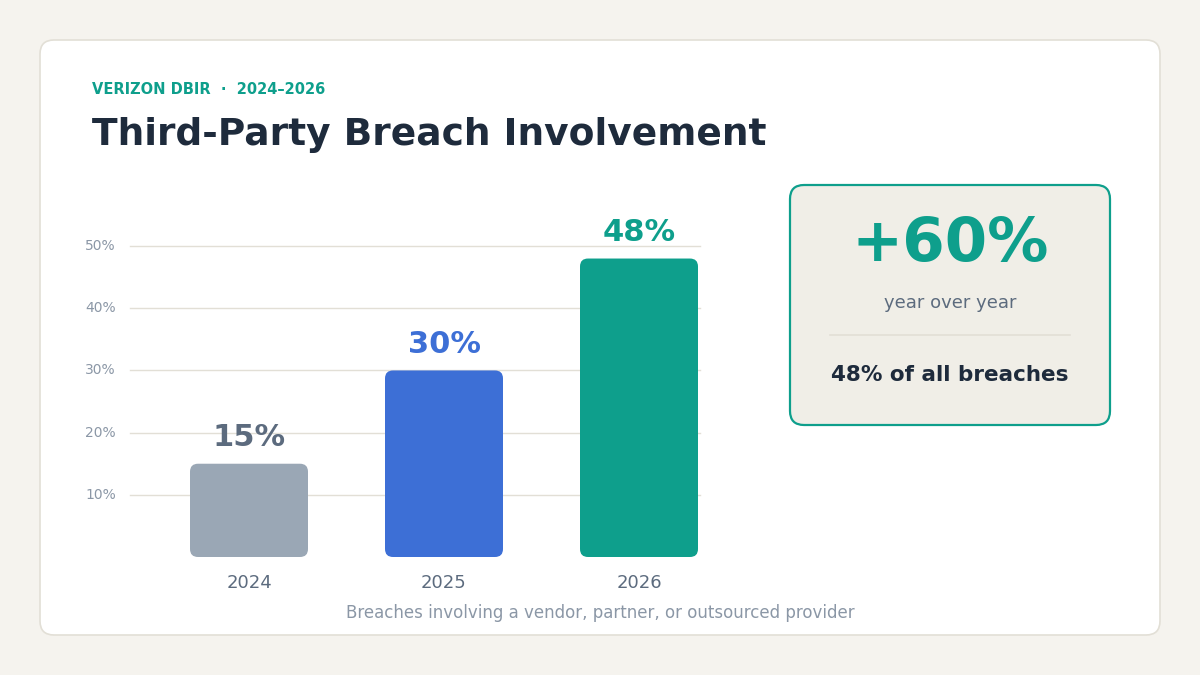
Third-party involvement in data breaches doubled in a single year from 15% to 30% of all breaches, according to Verizon’s 2025 Data Breach Investigations Report. Read that again: nearly one in three breaches now traces back to a vendor, partner, or outsourced provider, not the company’s own perimeter.
That statistic should reframe how you think about data security outsourcing software development. The question is no longer “is our network secure?” It’s “is every laptop, repository, and Slack channel touched by our external development team secure?” Because attackers have figured out what many buyers haven’t: the outsourced developer with production database access and no endpoint monitoring is a far softer target than your hardened corporate VPN.
The number that matters: Third-party involvement now accounts for 48% of all breaches, a 60% year-over-year jump, on top of the doubling recorded the year before per the Verizon 2026 DBIR. The same report found unapproved “shadow AI” use by employees tripled to 45%, opening a new data-leakage channel most vendor programs don’t yet cover. IBM’s latest Cost of a Data Breach Report pegs the global average breach cost at USD 4.44 million.
Here’s the contrarian part: outsourcing done properly is often more secure than an average in-house setup. A disciplined vendor with a SOC 2 Type II report, hardened endpoints, and audited access controls beats a startup where every engineer has admin rights and secrets live in a shared Google Doc. The security outcome isn’t determined by where your developers sit. It’s determined by the controls you design before the first line of code is written and enforce until the last credential is revoked.
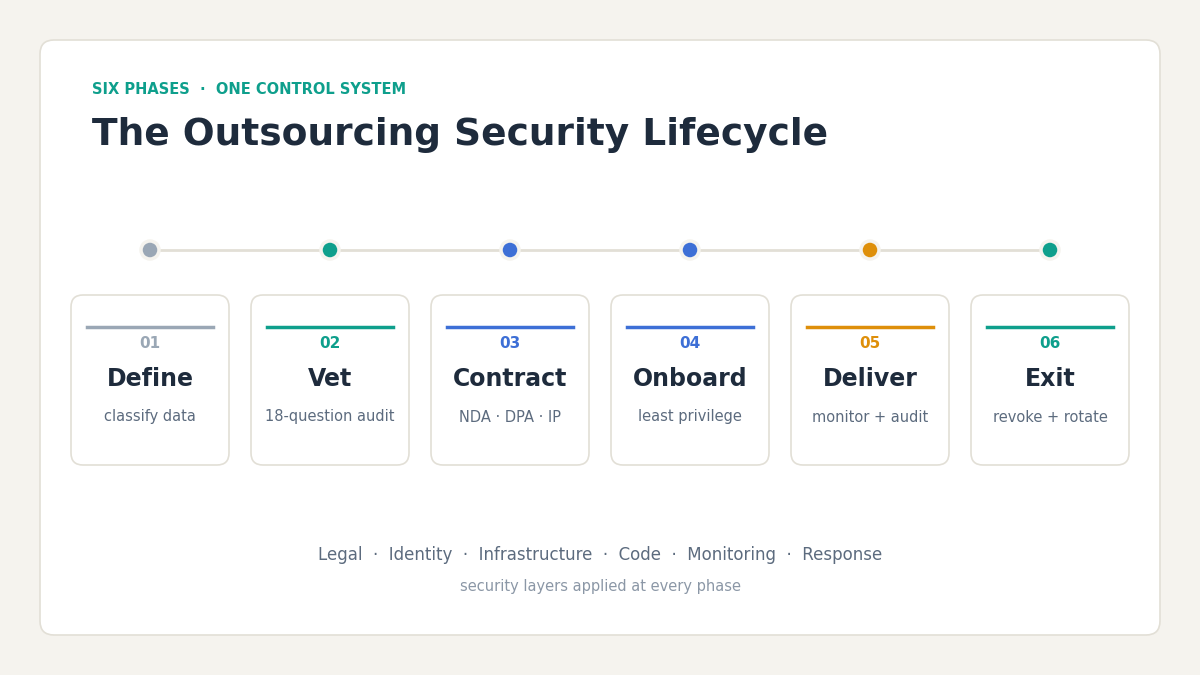
This guide is that control system, end to end. It covers the full lifecycle: classifying your data before you ever talk to a vendor, running security due diligence, negotiating the contract clauses that actually hold up, provisioning access week by week, monitoring delivery, and the phase where almost everyone botches offboarding cleanly. It includes the checklists, cost bands, and timelines that most published advice conveniently skips.
If you’re evaluating vendors right now, or you’ve already signed and have a nagging feeling you skipped steps, start here.
What Is Data Security Outsourcing Software Development?
Data security when outsourcing software development is the set of legal, technical, and operational controls contracts, access management, infrastructure hardening, monitoring, and offboarding procedures that protect a company’s source code, credentials, customer data, and intellectual property while external developers build, maintain, or test its software.
To be precise about what this is not:
- It is not just an NDA. An NDA creates a legal remedy after a leak; it prevents nothing on its own.
- It is not the vendor’s sole responsibility. Regulators and customers hold the data owner (you) accountable, regardless of whose engineer caused the breach.
- It is not a one-time certification check. A SOC 2 logo on a vendor’s website describes a point-in-time audit, not the security of your specific engagement.
Why It Matters: The Business Case
The business case for getting this right isn’t abstract “risk reduction” ; it shows up in specific line items and specific failure costs. The financial exposure from outsourcing data security risks breaks down like this:
- Regulatory exposure: up to 4% of global turnover. GDPR Article 83 allows fines up to €20 million or 4% of global annual revenue, whichever is higher and using an offshore vendor does not transfer that liability away from you. India’s DPDP Act and sector rules like HIPAA and PCI DSS add parallel exposure.
- Deal velocity: enterprise sales stall without it. Enterprise procurement teams now send 200+ question security assessments. If your answer to “do any third parties access production data?” is “yes, and we don’t monitor it,” deals slip by quarters or die.
- Valuation and diligence: acquirers reprice for sloppy IP chains. In M&A due diligence, missing IP assignment agreements from outsourced contributors is a classic reason for escrow holdbacks and price chips often 5–15% of deal value in earn-out restructuring.
- Insurance: cyber premiums track vendor governance. Underwriters increasingly ask for vendor management evidence; weak answers translate into 20–40% higher premiums or coverage exclusions for third-party incidents.
- Speed, counterintuitively. Teams with pre-built access playbooks onboard external developers in 3–5 days. Teams that improvise take 2–3 weeks and still end up with over-provisioned access nobody remembers granting.
The upside case matters too: buyers who solve security confidently can tap global talent pools 30–60% below onshore cost without adding unmanaged risk. Security maturity is what converts outsourcing from a gamble into an arbitrage.
The Core Problem: Why Most Buyers Get Burned
The failure pattern is remarkably consistent across engagements, and it isn’t malicious vendors. It’s structural under-investment at three specific moments.
Problem 1 Due diligence theater. Most buyers spend 15–20 hours evaluating a vendor’s portfolio and rates, and less than 2 hours on security. They ask “are you ISO 27001 certified?”, accept a yes, and move on. They don’t check the certificate’s scope (it may cover one office, not the delivery team), its expiry, or whether the controls apply to their project. Teams routinely underestimate real due diligence effort by 3–4x.
Problem 2 Access sprawls from day one. Under deadline pressure, the fastest onboarding path is “add them to everything.” Within 30 days, external developers typically hold 2–3x the access they need: production database credentials “for debugging,” admin rights on CI/CD “to fix the pipeline,” full org-wide repo visibility because per-repo permissions felt tedious. Verizon’s research found the median time to remediate leaked secrets discovered in a GitHub repository was 94 days three months of open exposure.
Problem 3 The offboarding void. Engagements end; access doesn’t. In access reviews following outsourced engagements, it’s common to find 20–40% of external accounts still active 60+ days after contract end SSH keys on servers, personal-device repo clones, API tokens hardcoded in scripts, Slack guest accounts with years of pinned credentials. Nobody owns the revocation checklist, so nobody runs it.
The common thread: security is treated as a gate at the start (“sign the NDA”) instead of a process across the lifecycle. The next section is that process, phase by phase.
The A-to-Z Security Walkthrough: From First Decision to Final Handover
This is the complete lifecycle. Each phase includes the controls to implement, the artifacts to produce, and the mistakes that surface later if you skip it. The phases map directly onto the six layers in the infographic above: legal, identity, infrastructure, code, monitoring, and response applied at the right moment.
Phase 1 Classify Your Data and Define the Security Scope (Week 0, before vendor conversations)
Everything downstream depends on one question most buyers never formally answer: what data will external developers actually touch? Answer it with a data classification exercise before you write a single vendor email.
The 4-tier classification that works for 90% of projects:
- Public marketing content, published docs. No special controls.
- Internal source code without secrets, architecture docs, Jira tickets. Requires NDA + access control.
- Confidential customer PII, business logic that constitutes trade secrets, API keys. Requires encryption, DLP, restricted access, audit logging.
- Restricted production databases, payment data, health records, credentials. Default answer: external developers get zero direct access. Use masked or synthetic data instead.
Then produce a one-page security scope document covering:
- Which classification tiers the project touches, and the specific datasets in each
- Applicable regulations (GDPR if EU data subjects, HIPAA for US health data, PCI DSS for cardholder data, DPDP Act for Indian personal data)
- Whether developers need production access at all (in ~80% of projects, they don’t synthetic data, anonymized snapshots, or staging environments suffice)
- Your non-negotiables: data residency requirements, device policies, background check requirements
Budget reality: if your project touches Tier 3–4 data, add 10–15% to your project budget for security controls (tooling, audits, environment separation) and 1–2 weeks to the timeline. Buyers who discover this mid-project pay more and ship later.
Red flag on your own side: if nobody in your company can name which regulation applies to your data, resolve that before outsourcing. A vendor cannot be more compliant than the requirements you hand them.
Phase 2 Security Due Diligence and Vendor Vetting (Weeks 1–2)
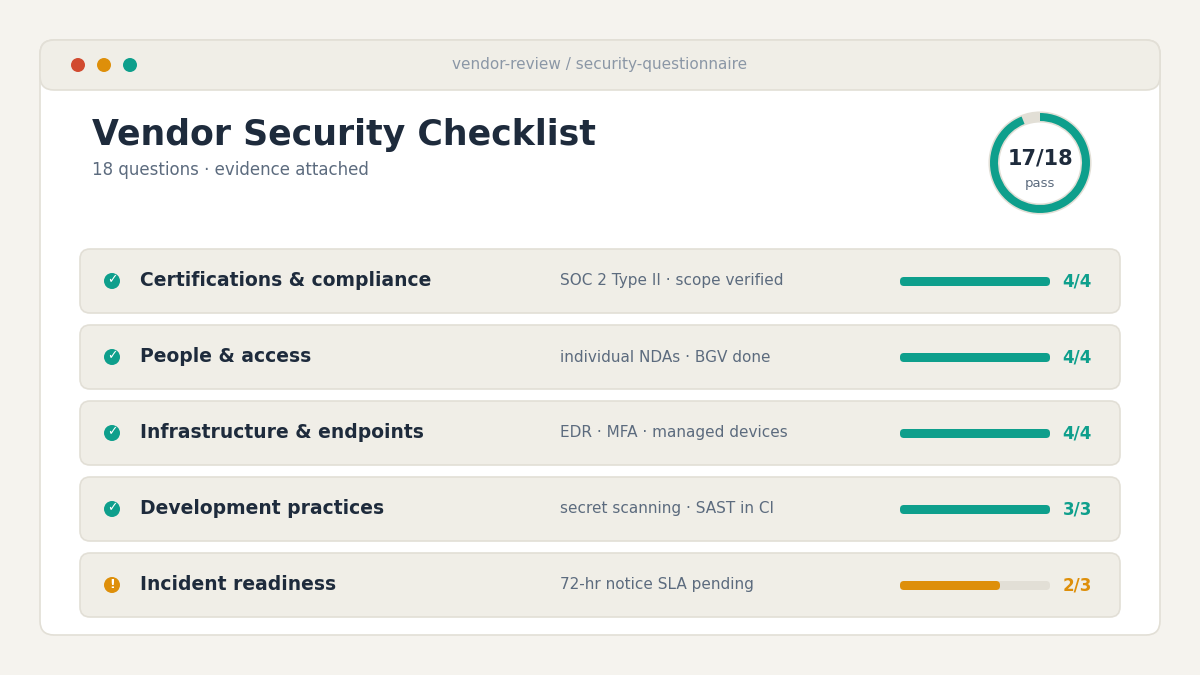
Rate cards and portfolios tell you whether a vendor can build. Security vetting tells you whether they can be trusted with Tier 3 data. Run both in parallel; a structured vendor security checklist turns this from a vibes exercise into an evidence exercise.
The vendor security questionnaire the 18 questions that matter:
Certifications & compliance
- Do you hold a current SOC 2 Type II report or ISO 27001 certificate? Share the report/certificate, its scope, and expiry date.
- Does the certification scope cover the specific office and dedicated team that will serve our account?
- Have you completed GDPR/DPDP compliance mapping? Can you sign a data processing agreement (DPA)?
- When was your last third-party penetration test, and can you share the executive summary?
People & access
- Do you run background verification on all engineers? What does it cover (identity, employment history, criminal record where lawful)?
- Do engineers sign individual confidentiality and IP assignment agreements with you (not just company-to-company)?
- Is access provisioned per-project on least-privilege principles? Describe your joiner/mover/leaver process and revocation SLA.
- What is your policy on personal devices (BYOD) for client work?
Infrastructure & endpoints
- Are client-work endpoints company-managed with full-disk encryption, EDR, and automatic patching?
- Do you support or provide VDI/secure remote desktop for restricted-data projects?
- Is MFA enforced on all systems? Is SSO available for client-provisioned accounts?
- How are secrets managed (vault tooling vs. shared documents)?
Development practices
- Describe your code repository security defaults: branch protection, mandatory code review, signed commits, secret scanning.
- Do you run SAST/dependency scanning (software composition analysis) in CI?
- How do you prevent code exfiltration (repo cloning to personal accounts, USB, personal cloud storage)?
Incident readiness
- Do you have a documented incident response plan? What is your client notification SLA (should be 24–72 hours)?
- Have you had a security incident in the last 36 months? How was it handled and disclosed?
- Will you accept a right-to-audit clause and an annual client security review?
Scoring guidance: treat evasive answers as “no.” A vendor who says “we can discuss that after signing” on any incident-readiness question is telling you the answer. Genuine security-mature vendors answer this questionnaire in 3–5 business days with documents attached; 2+ weeks of delay is itself a data point.
Red flags that should end the conversation:
- No willingness to sign individual-level NDAs or a DPA
- Certification scope that excludes the delivery location
- “All our engineers use their own laptops” for Tier 3+ data
- Refusal of a right-to-audit clause
- Shared logins or a single admin account for the whole team
This is also where the sourcing model matters. Marketplaces of anonymous freelancers make most of these questions unanswerable. Working with an established partner that runs verification, NDAs, and dedicated (non-shared) engineers as standard, the model platforms like Supersourcing used to hire pre-vetted software developers collapses this phase from weeks of vendor archaeology into a document review.
Phase 3 Contracts, Engagement Models, and the Clauses That Hold Up (Weeks 2–3)
Contracts don’t stop breaches, but they determine who pays for one, and well-drafted terms change vendor behavior long before an incident. Get four documents right.
- The Master Services Agreement (MSA) security clauses to insist on:
- Right-to-audit annually or for-cause, with 10–15 business days’ notice, covering security controls relevant to your engagement.
- Breach notification SLA written notice within 24–72 hours of discovery, including scope, affected data, and remediation steps. Push back on anything beyond 72 hours; GDPR gives you only 72 hours to notify regulators.
- Liability that matches the risk standard caps of “fees paid in the last 12 months” are fine for delivery disputes but inadequate for data breaches. Negotiate a super-cap (commonly 2–5x annual fees) or an uncapped carve-out for breaches of confidentiality and data protection obligations.
- Sub-processor control no subcontracting or fourth-party access without written approval. This is how “our vendor’s vendor” breaches happen.
- Security exhibits attach your concrete requirements (managed devices, MFA, no production data on endpoints) as a schedule, so they’re contractual, not aspirational.
- NDAs at two levels. Company-to-company NDAs are table stakes; the enforceable protection comes from each individual engineer signing confidentiality terms. Confirm the vendor’s employment agreements include this, and for Tier 4 projects, have key engineers sign your NDA directly.
- IP assignment the clause M&A lawyers check first. The contract must state that all work product is work made for hire (or fully assigned where that doctrine doesn’t apply locally), assigned upon creation not upon final payment with moral-rights waivers where the jurisdiction allows. Protecting source code offshore starts here: if assignment triggers only on full payment, a billing dispute puts your codebase ownership in limbo.
- The DPA. If personal data is processed, a data processing agreement is legally required under GDPR (Article 28) and best practice everywhere else. It must specify processing purposes, data categories, security measures, sub-processor rules, and cross-border transfer mechanisms (SCCs for EU data going to India or elsewhere).
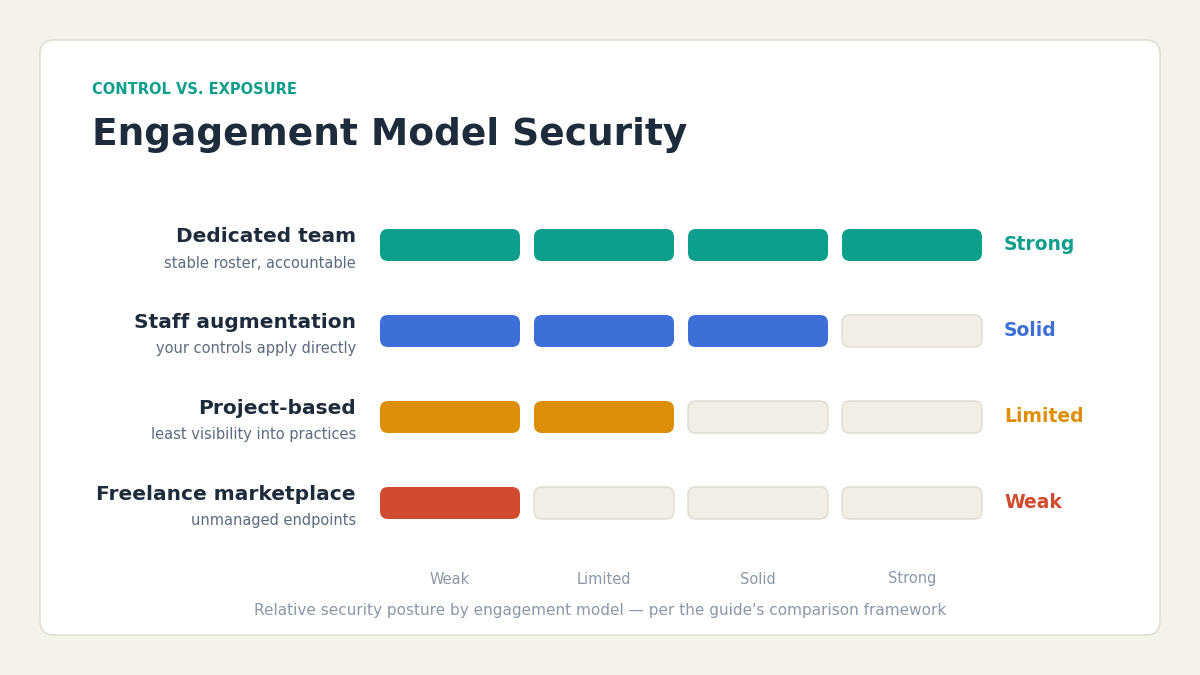
Engagement model security comparison:
| Model | Access pattern | Security pros | Security risks |
| Dedicated team | Long-lived, project-scoped | Stable roster, deep accountability, worth investing in hardened setup | Access accumulates over time schedule quarterly reviews |
| Staff augmentation | Individual, inside your systems | Your controls apply directly; easiest to monitor | Your IAM hygiene becomes the ceiling; weakest if your own controls are weak |
| Project-based / fixed bid | Vendor-side environment | Minimal access to your systems | Least visibility into practices; code and data live on infrastructure you don’t control |
| Freelance marketplace | Ad hoc, personal devices | Cheap, fast | Weakest of all: unverifiable identity, unmanaged endpoints, near-zero enforceability |
Phase 4 Secure Onboarding and Access Provisioning (Weeks 3–5, first 2 weeks of delivery)
Onboarding is where security architecture becomes daily reality. The goal: developers are productive by day 3–5, with exactly the access their current sprint requires nothing more. These secure offshore development practices are what separates a controlled engagement from access sprawl.
The week-by-week access schedule:
- Before day 1: Provision named accounts through your SSO/IAM with MFA enforced. No shared logins, ever. Create a per-project access group so revocation later is one action, not forty.
- Days 1–3: Grant Tier 2 access only assigned repositories (not org-wide), Jira/Linear project, docs space, communication channels as guests. Deliver security orientation: data handling rules, incident reporting path, prohibited actions (personal-device clones, secret sharing in chat, unauthorized tooling including pasting proprietary code into unapproved AI or generative tools).
- Days 4–10: Staging and development environment access with synthetic/masked data. CI/CD pipeline access at contributor (not admin) level.
- Week 3+ (only if genuinely required): Time-boxed, logged, read-only production access via a privileged access management (PAM) tool or jump host approved per-request, auto-expiring in 8–24 hours.
Code repository security defaults to enforce from day 1:
- Branch protection on main/release branches; merges only via reviewed pull requests (minimum one internal reviewer for external contributions in the first 60 days)
- Secret scanning enabled (GitHub Advanced Security, GitGuardian, or TruffleHog) remember the 94-day median exposure window for leaked repo secrets
- Secrets in a vault (HashiCorp Vault, AWS Secrets Manager, Doppler), never in code, config files, or chat
- Disable forking to personal accounts; restrict repo visibility to per-project teams
- Audit logging on all repo events, retained 12+ months
Endpoint decision the 3-tier rule: Tier 2 data → vendor-managed laptops with EDR and disk encryption, verified in writing. Tier 3 → your MDM enrollment or vendor attestation plus DLP. Tier 4 → VDI only (Azure Virtual Desktop, AWS WorkSpaces), where code and data never leave your cloud; budget $30–80 per user per month.
Phase 5 Managing Delivery: Monitoring, Audits, and Cadence (Ongoing)
Security in a steady state is a rhythm, not a project. Three cadences keep the engagement honest.
Weekly (automated, ~0 hours of human time):
- SIEM/audit-log alerts on anomalies: off-hours bulk repo cloning, mass file downloads, failed MFA bursts, access from unexpected geographies
- Secret-scanning and dependency-vulnerability reports routed to a shared channel with the vendor lead
Monthly (30–60 minutes):
- Access review: every external account against current sprint needs; strip anything unused for 30 days
- Review of new joiners/leavers on the vendor roster headcount changes you weren’t told about are a governance failure worth escalating
- Security KPI check: % of PRs reviewed, open critical vulnerabilities and their age, mean time to patch, incidents reported
Quarterly / annually:
- Quarterly: tabletop exercise or at minimum a walkthrough of the incident response plan with the vendor’s named security contact who calls whom, within what SLA, with what information
- Annually: exercise your right-to-audit. A focused vendor security audit (recheck questionnaire evidence, sample access logs, verify endpoint compliance, confirm certification renewal) takes 2–4 weeks and costs $5,000–15,000 with a third-party firm, or 20–30 internal hours. Renew the pen test on your product: $10,000–40,000 depending on scope.
Incident response planning decide these five things now, not during a breach:
- Detection ownership: who monitors what (your SIEM vs. vendor’s), and how alerts cross the boundary
- Notification chain: vendor’s named contact → your security lead → legal → (if thresholds met) regulators within 72 hours and affected customers per contract/law
- Containment authority: you can unilaterally suspend all vendor access during an investigation put this in the MSA
- Evidence preservation: logs, images, and communications retained; no vendor-side cleanup before joint review
- Post-incident review: blameless root-cause analysis within 10 business days, with remediation owners and dates
IBM’s data puts the average breach identification-and-containment cycle at 241 days. Engagements with a rehearsed joint IR plan compress detection from months to days; that delta is most of the cost difference between a contained incident and a headline.
Phase 6 Scaling, Replacing, and Exiting Cleanly
The engagement’s end (or growth) is a security event. Treat it like one.
When scaling up: every added engineer goes through the same Phase 4 pipeline no “just share Priya’s credentials for now.” If you’re scaling past 15–20 external engineers, that’s typically the point to consider a GCC setup, which converts third-party risk into first-party control: your entity, your policies, your infrastructure, with the talent-cost advantage intact.
When replacing an engineer: revoke the departing engineer’s access the same day, before or simultaneous with the announcement. Rotate any shared-context secrets (API keys, service credentials they touched). A vendor with a genuine replacement guarantee should complete a swap in 7–10 days including secure onboarding of the replacement.
The offboarding checklist (run within 24 hours of engagement end):
- Disable all named accounts via the per-project IAM group created in Phase 4
- Revoke API tokens, SSH keys, OAuth grants, and personal access tokens issued to the team
- Rotate every secret the team could have seen assume exposure, don’t audit for it
- Remove guest access from Slack/Teams, docs, dashboards, and cloud consoles
- Obtain written certification of data destruction: repos deleted from vendor machines, local copies wiped, backups purged per the DPA retention terms
- Reclaim or remotely wipe any hardware you issued
- Run a final access scan 7 and 30 days later orphaned accounts have a way of resurrecting
- Archive the engagement’s audit logs and security documentation for your compliance retention period (typically 3–7 years)
Exit clause to negotiate up front: a 30–60 day transition assistance period with knowledge transfer and handover documentation as a contractual deliverable, priced in advance. Vendors are cooperative before signing and busy after termination notice.
Case Studies: Security Controls Under Real Delivery Pressure
Scenarios below are drawn from real engagement patterns; client-identifying details are anonymized where the security specifics are not public.
Fintech scale-up, 40+ external engineers, zero production-data exposure. A payments company needed to double its engineering capacity in a quarter without widening its PCI DSS scope. The controls: all external engineers worked against tokenized synthetic data, production access was VDI-only with per-session approval, and access mapped to a single revocable IAM group per squad. Result: the team shipped through two release cycles and a PCI audit with zero findings attributable to external contributors and onboarding still averaged under 5 working days per engineer because the access playbook was templated, not improvised.
Healthtech platform, HIPAA-bound recruitment automation. A US sleep-diagnostics company (comparable to engagements like Somnoware’s recruitment automation work) needed offshore engineers on a product touching protected health information. De-identified datasets were generated for all development work, individual BAAs-adjacent confidentiality terms were signed by every named engineer, and quarterly access reviews were contractual. The measurable outcome: 100% of the eventual compliance questionnaire’s third-party-access questions could be answered with documented evidence, cutting a hospital-system procurement review from an expected 12 weeks to 6.
Enterprise SaaS, mid-engagement engineer replacement. When a senior external engineer resigned mid-sprint, the playbook mattered more than the person: same-day access revocation, rotation of the 14 secrets his role could have touched, and a vetted replacement productive within the 7–10 day window Supersourcing contracts as a replacement guarantee. Total security exposure window: under 6 hours. The client’s post-incident review found nothing to remediate which is the entire point of designing offboarding before you need it.
The Decision Framework: How Much Security Does Your Project Actually Need?
Not every project needs VDI and quarterly audits. Right-size using two axes: data sensitivity (the classification tier from Phase 1) and engagement depth (how embedded the external team is in your systems).
| Your situation | Minimum viable controls | Add for maturity |
| Tier 1–2 data, project-based build | NDA + IP assignment, private repos, named accounts with MFA | Secret scanning, monthly access review |
| Tier 2–3 data, staff augmentation | All of the above + DPA, managed endpoints, branch protection, SSO provisioning | SIEM alerts on repo events, quarterly reviews, annual vendor audit |
| Tier 3–4 data, dedicated team | All of the above + SOC 2/ISO 27001 vendor, masked data everywhere, PAM for any production access, joint IR plan | VDI, DLP, tabletop exercises, right-to-audit exercised annually |
| Tier 4 data, 15+ engineers, multi-year | Everything above | Consider a GCC: convert third-party risk to first-party control |
Three questions that resolve most edge cases:
- Could a screenshot of this data harm a customer or the company? If yes, treat it as Tier 3 minimum.
- Would we survive this vendor being breached tomorrow? If the honest answer is no, your controls, not your vendor choice, are the problem.
- Can we revoke everything in one hour? If not, fix provisioning architecture before adding headcount.
What Most Teams Get Wrong
Pattern-matching across hundreds of engagements surfaces the same contrarian truths. These are the ones worth disagreeing with conventional wisdom about.
They over-index on geography and under-index on controls. “Is it safe to outsource to India?” is the wrong question Verizon’s data shows third-party breaches doubling globally, across every delivery geography. The breach vector is almost never the country; it’s the unmanaged laptop, the shared login, the never-revoked token. A controls-mature team in Indore is safer than a controls-free team in Austin.
They negotiate liability caps like it’s a delivery dispute. Legal teams reflexively accept “liability capped at fees paid” because that’s normal for missed deadlines. It’s absurd for data: a $150K engagement capping liability on a $4.44M-average breach means you self-insured 97% of the risk without deciding to.
They confuse certification with coverage. SOC 2 compliance outsourcing questions usually stop at “do you have the report?” The report’s scope is what matters: which trust criteria, which locations, which systems, and whether the audit period is recent. A 2022 Type I covering a different office protects you not at all.
They protect the perimeter and ignore the exit. Budgets go to onboarding-phase controls; almost nothing goes to offboarding. Yet stale credentials post-engagement are among the most common real-world exposure paths. If you can only afford one process document, make it the revocation checklist.
They treat the vendor as the threat, when the shared surface is the threat. The realistic risk model isn’t a malicious vendor stealing code, it’s a phished vendor engineer, a leaked secret in a public repo, an infostealer on a personal device. That reframe changes your spend: less on surveillance of people, more on architecture that makes any single compromised account low-impact.
They ban AI tools instead of governing them. Blanket prohibitions push usage underground the definition of shadow IT. Mature buyers specify approved AI coding tools with enterprise data controls in the security exhibit, and prohibit pasting Tier 3+ code into anything else.
Cost and Timeline Reality Check
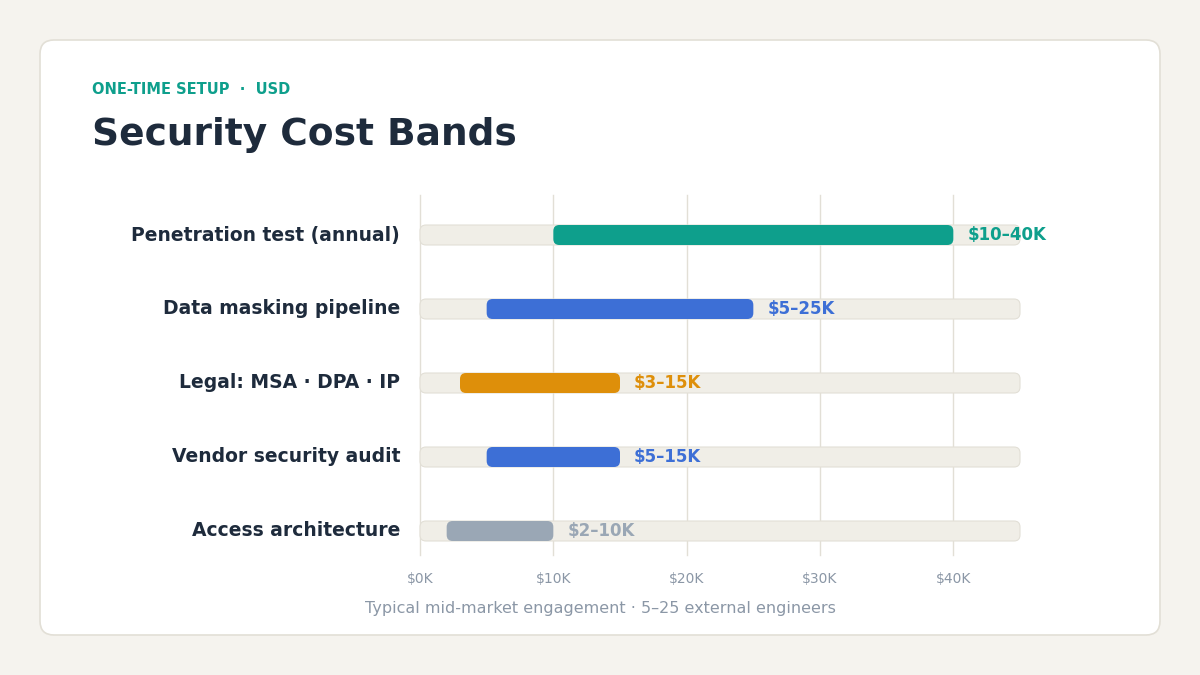
The section competing guides skip: what this actually costs, and how long it takes. Ranges reflect typical mid-market engagements (5–25 external engineers).
One-time / setup costs:
| Item | Range | Notes |
| Legal (MSA security exhibit, DPA, IP terms) | $3,000–15,000 | Lower if you template once and reuse |
| Vendor due diligence | 20–40 internal hours | 3–4x what most teams budget |
| Access architecture (IAM groups, SSO, repo hardening) | $2,000–10,000 + 1–2 weeks | Mostly engineering time |
| Data masking / synthetic data pipeline | $5,000–25,000 | Highest-ROI single control for Tier 3+ |
Recurring costs:
| Item | Range |
| VDI seats (Tier 4 projects) | $30–80 /user/month |
| EDR + DLP tooling | $8–25 /user/month |
| Secret scanning / repo security | $0–21 /user/month |
| Annual vendor security audit | $5,000–15,000 (third party) or 20–30 internal hours |
| Annual penetration test | $10,000–40,000 by scope |
Timelines by scenario:
- Tier 2 project, security-mature vendor: 1–2 weeks from vendor selection to secure first commit
- Tier 3 project, first time building controls: 4–6 weeks (contracts 2–3 weeks in parallel with access architecture)
- Tier 4 / regulated data: 6–10 weeks including DPA negotiation, masking pipeline, and IR planning
- Vendor security due diligence alone: 3–5 business days for a mature vendor to return evidence; 2–3 weeks for full evaluation of 2–3 finalists
What drives cost up: production access requirements, regulated data categories, multi-vendor arrangements (each sub-processor multiplies review effort), and retrofitting controls mid-engagement (typically 2–3x the cost of building them up front).
What drives cost down: eliminating production access entirely (kills the VDI and PAM line items for most teams), templated legal documents, choosing vendors whose certifications let you inherit evidence instead of generating it, and consolidating with one accountable partner instead of five micro-vendors.
For context on total engagement economics: dedicated offshore engineers typically run $40K–70K/year (₹15–30 lakhs/year onshore-equivalent roles vary) versus $130K–200K+ fully loaded onshore which is why a 10–15% security overhead still leaves the arbitrage decisively intact.
Your Next Step: Turn This Guide Into Your Playbook
If you’re mid-decision, do three things this week: run the Phase 1 data classification (one afternoon), send the 18-question vendor security checklist to every shortlisted provider, and flag the three contract clauses breach notification SLA, liability carve-out, right-to-audit for your legal review. Those steps alone put you ahead of most buyers who discover data security when outsourcing software development only after something leaks.
And if you’d rather inherit a secured model than assemble one dedicated engineers (no shared bandwidth), NDA-backed IP protection, verified talent shortlisted in 7–10 working days, and a 98% joining rate across 527+ delivered projects talk to the Supersourcing team about your specific data sensitivity and compliance requirements. One conversation, scoped to your project: https://supersourcing.com/contact-us/
You can also review client case studies or explore custom software development services and recruitment process outsourcing to see how these controls operate inside live engagements.
FAQ
What are the biggest security risks of outsourcing software development?
The top risks, in observed frequency order: leaked credentials and secrets (often via repos or chat), excessive access that’s never revoked, unmanaged personal devices carrying source code, IP ownership gaps from missing assignment clauses, and sub-processors you never approved. Malicious vendor theft the risk buyers fear most is far rarer than the mundane failures above.
How do I protect source code when outsourcing development?
Layer four controls: legal (IP assignment on creation, individual NDAs), repository (private repos, branch protection, no personal forks, secret scanning), endpoint (managed devices or VDI so code never rests on personal machines), and monitoring (audit logs with alerts on bulk cloning). No single layer suffices; the combination makes exfiltration both difficult and attributable.
What security certifications should an outsourcing vendor have?
SOC 2 Type II or ISO 27001 are the credible baseline but verify scope, audit period, and covered locations, not just existence. For regulated data, add domain evidence: GDPR/DPA readiness for EU data, HIPAA experience for health data, PCI DSS familiarity for payments. Certifications prove process maturity; your security exhibit makes the controls contractual.
Who is liable if my outsourcing vendor causes a data breach?
Legally, you remain accountable to regulators and customers as the data controller GDPR fines land on you regardless of whose engineer erred. Contractually, you can shift financial responsibility to the vendor via indemnities and breach carve-outs from liability caps, which is exactly why negotiating those clauses in Phase 3 matters more than any other legal term.
How long does vendor security due diligence take?
A mature vendor returns a completed security questionnaire with evidence (certificates, pen-test summaries, policy documents) in 3–5 business days. Full evaluation of 2–3 finalists, including reference checks and scope verification, takes 2–3 weeks. If a vendor needs more than two weeks just to answer the questionnaire, that delay is your answer.
Can offshore developers safely access production data?
Usually they shouldn’t need to roughly 80% of projects run entirely on masked, synthetic, or staging data. Where production access is genuinely unavoidable (specific debugging, data migrations), make it read-only, time-boxed to 8–24 hours, individually approved, routed through a PAM tool or jump host, and fully logged. “Standing production access for convenience” is the single control failure most likely to turn an incident into a breach.
What’s the fastest way to set this up correctly if I’m choosing a vendor right now?
Run Phases 1–3 in parallel: classify your data this week, send the 18-question checklist to shortlisted vendors, and template your MSA security exhibit while answers come back. If you’d rather start from a model where vetting, NDAs, dedicated engineers, and replacement guarantees are already built in, a scoped consultation can compress those three phases into days, see the closing section below.
