

Introduction
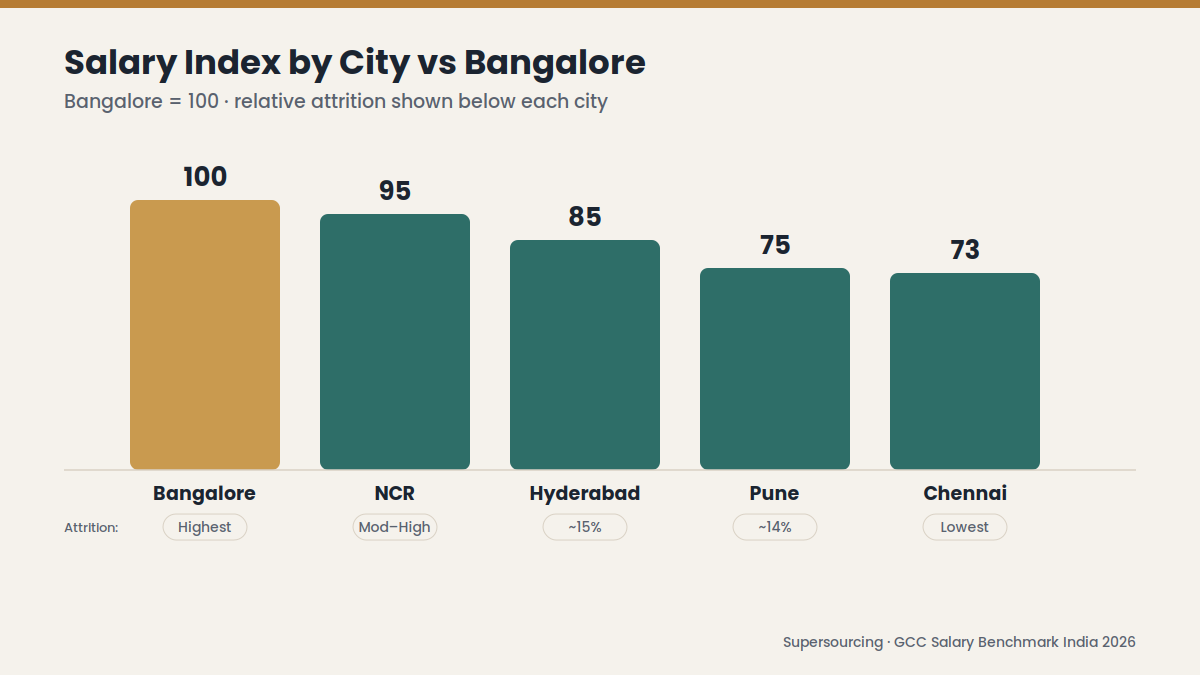
A senior backend engineer at a global capability center in Hyderabad earns roughly ₹35–50 lakh a year. The same title, at a mid-size IT services firm one metro station away, pays ₹18–24 lakh. Both are “senior.” Both are in the same city. The compensation gap between them is wider than the gap between some US and India salaries at the junior level and it is the single fact that breaks most first-time GCC budgets. Any useful GCC salary benchmark India 2026 has to start there: with the gap, the role, and the city, not with a national average.
That gap exists because a GCC is not buying execution capacity; it is buying ownership. Global roadmaps, long-term product mandates, and the expectation that an India team leads rather than follows all push pay higher, especially at senior levels. Using a vendor rate card to price GCC roles is the most common and most expensive mistake enterprises make when they land in India.
The stakes have never been higher, because the market has never been bigger. India now hosts 2,117 GCCs across 3,728 units, employing 2.36 million professionals and generating $98.4 billion in revenue, a 32% jump in GCC count since FY2021, per the NASSCOM–Zinnov GCC Value Orbit report, FY2026. More employers are competing for the same senior talent, which means a benchmark that was accurate 18 months ago will lose you candidates today.
Forward-looking callout: India’s salary increases are projected at 9.1% in 2026 the fastest in Asia Pacific with GCCs specifically at ~8.8%, according to the Deloitte India Talent Outlook 2026 (Business Standard). But the headline hides the real story: niche AI, cloud, and security roles are pulling 15–25% increases while commodity roles settle for 6–8%.
This guide is the role-by-role, city-by-city pay matrix that turns those trends into a hiring budget you can defend. Not an average. A working benchmark.
TL;DR
This is a data-first GCC salary benchmark for India in 2026 pay bands for the 20+ tech roles that GCCs actually hire, mapped across Bangalore, Hyderabad, Pune, Chennai, and NCR, plus the variable-pay and city-arbitrage math that most compensation content skips. It is written for GCC leaders, CHROs, and India expansion teams pricing roles before they commit a budget.
The single number to internalize: GCCs pay a 25–40% premium over IT services firms for equivalent roles, and that premium widens at senior and niche-skill levels where AI/ML specialists command 25–60% over general engineers. Get GCC compensation India wrong by 15% at the senior end and you don't get an underpaid hire; you get an empty seat, because senior engineers have enough competing offers to simply decline.
By the end, you'll be able to read the matrix at the right percentile for each role's scarcity, build fully loaded budget bands (not just base salary), pick the city that fits your cost-versus-stability trade-off, and structure offers that close instead of stall.
What Is a GCC Salary Benchmark?
A GCC salary benchmark is a structured pay reference that maps compensation for specific roles and seniority levels inside global capability centers, adjusted for city and skill scarcity, so an enterprise can price offers competitively without over- or under-paying. It captures fixed pay, variable pay, and market percentile not a single average.
It is often confused with things it is not:
- Not an IT-services rate card. Vendor pricing reflects billable delivery margins, not the ownership premium GCCs pay. Applying it undershoots by 25–40%.
- Not a national “average salary” figure. A single India-wide number hides 30–50% variance across cities for the same role, which makes it useless for budgeting a specific team.
- Not a job-board median. Aggregator medians blend startups, agencies, and captives, and lag the market by one to two quarters dangerous in a segment moving this fast.
Why It Matters: The Business Case
Compensation mispricing is the most expensive quiet mistake a GCC makes. The price is too low and you lose candidates before the interview loop closes. Price too high or structure the pay-mix wrong and you erode the cost rationale that justified the India operation in the first place. Accurate India GCC comp data touches four business outcomes directly:
- Offer acceptance and speed. At the senior end, being 15% below market doesn’t trigger a renegotiation, it triggers a decline. Empty roles cost more than expensive ones: a vacant senior engineering seat delays a roadmap far more than a ₹5 lakh overspend.
- Total cost base. Getting the pay-mix wrong (too much fixed, no retention lever) inflates your run-rate permanently. Fixed pay compounds every increment cycle; a well-placed one-time retention bonus does not.
- Attrition and backfill. India tech attrition has cooled to roughly 17% in 2026, but a mispriced band drives regretted attrition, and each backfill costs 30–50% of annual salary in recruiting, ramp, and lost delivery.
- Quality of leadership. Underpaying engineering leadership means hiring weaker leaders than the team needs which then drives attrition among the strong individual contributors below them. The cost cascades.
The upside is equally concrete. GCCs pay 25–40% more than IT services firms per role, yet still deliver 50–60% cost savings against onshore equivalents the arbitrage holds even after the premium.
A senior engineer who costs the equivalent of $180k–$220k in a US metro lands, fully loaded, in the ₹48–55 lakh range in India roughly a third of the onshore number for comparable ownership.
That is the entire economic thesis for an India GCC. Getting the benchmark right is how you capture that arbitrage without buying attrition; getting it wrong over-paying to compensate for a badly structured pay-mix is how you quietly hand the savings back.
The Core Problem Most Buyers Face
First-time GCC builders consistently underestimate real people’s cost by 30–50%, and they do it in the same three ways every time.
They benchmark base, not total. Indian offers combine fixed and variable pay, and increasingly RSUs or retention bonuses at senior levels. Benchmark base alone and you understate the true cost by 15–25% and you lose candidates who compare the full number against a competing offer.
They use one national number for a five-city market. India is not a single labour market. The same role varies 30–50% between Bangalore and a Tier-2 city. A budget built on a blended national average is simultaneously too high for Chennai and too low for Bangalore wrong everywhere.
The result is a budget that looks fine in the board deck and collapses in the first hiring quarter, offers declined, timelines slipped, and a scramble to re-band mid-cycle.
The through-line across all three errors is the same: each one imports a mental model built for a different market: a vendor rate card, a single-country average, a title-based grade into a market that prices ownership and scarcity instead.
The fix is rarely a bigger budget. It’s a benchmark structured the way the India GCC market actually clears offers.
The Walkthrough: From Zero to a Staffed, Priced GCC Team
This is the full lifecycle from deciding you need an India team to managing and scaling it organized as six phases. Follow it from start to finish and you can execute the whole process yourself.
Phase 1 Define requirements and set budget bands (the pay matrix)
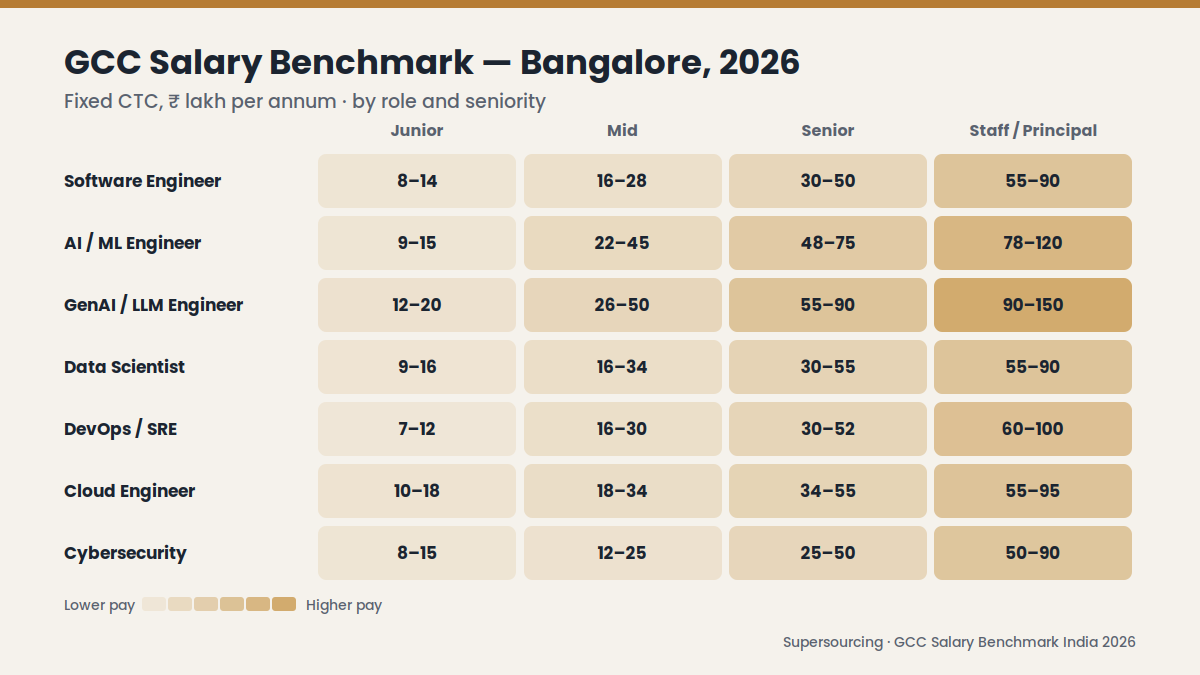
Before sourcing a single resume, translate your headcount plan into GCC pay scale by role bands. This is where the benchmark lives. The table below is the core role × seniority matrix for a Bangalore GCC, expressed as fixed CTC in ₹ LPA (lakhs per annum).
These are working market ranges for 2026, synthesised from multiple current market sources and validated against live offers, pressure-test them against your own city and role context before finalising.
Core engineering & data roles Bangalore GCC, fixed CTC (₹ LPA), 2026
| Role | Junior (0–2 yr) | Mid (3–5 yr) | Senior (6–9 yr) | Staff / Principal (10+ yr) |
| Software Engineer (backend/frontend) | 8–14 | 16–28 | 30–50 | 55–90 |
| Full-Stack Engineer | 9–16 | 18–32 | 32–52 | 55–85 |
| AI / ML Engineer | 9–15 | 22–45 | 48–75 | 78–120+ |
| GenAI / LLM Engineer | 12–20 | 26–50 | 55–90 | 90–150+ |
| Data Scientist | 9–16 | 16–34 | 30–55 | 55–90 |
| Data Engineer | 9–18 | 18–36 | 34–55 | 55–85 |
| DevOps / SRE | 7–12 | 16–30 | 30–52 | 60–100 |
| Cloud Engineer / Architect | 10–18 | 18–34 | 34–55 | 55–95 |
| QA / Test Automation Engineer | 5–12 | 12–24 | 22–36 | 36–55 |
| Cybersecurity Engineer / Architect | 8–15 | 12–25 | 25–50 | 50–90 |
Product, design & leadership roles Bangalore GCC, fixed CTC (₹ LPA), 2026
| Role | Mid | Senior | Lead / Director+ |
| Product Manager (global ownership) | 22–38 | 35–58 | 60–110 |
| Product Designer / UX | 14–26 | 26–45 | 45–75 |
| Engineering Manager | – | 50–90 | – |
| Director / VP Engineering | – | – | 100–200+ |
| GCC Head / CTO | – | – | 200+ |
Three rules for reading the matrix:
- Pick a percentile deliberately. Median (P50) is fine for abundant roles like mid-level full-stack. For scarce roles GenAI, staff-level platform, security architects target P75 or P90, or you won’t close them. For frontier skills, pay becomes a negotiation, not a band.
- Add variables and equity on top. These are fixed-CTC ranges. Layer variables pay separately (see below).
- Apply the city multiplier next (Phase 1 continues below).
Variable pay and the pay-mix. GCC variable pay typically runs 15–25% of fixed CTC, split between an annual performance bonus (10–15%) and retention components (5–10%). Two levers matter most:
- Retention bonuses increasingly standard since 2024 add a one-time ₹3–5 lakh payment for engineers who complete a 2–3 year commitment. They cool attrition without permanently inflating fixed pay.
- Top-performer multipliers. The Deloitte–NASSCOM survey shows top performers earning 1.5 — 1.8x the payout of average performers build that differentiation from day one.
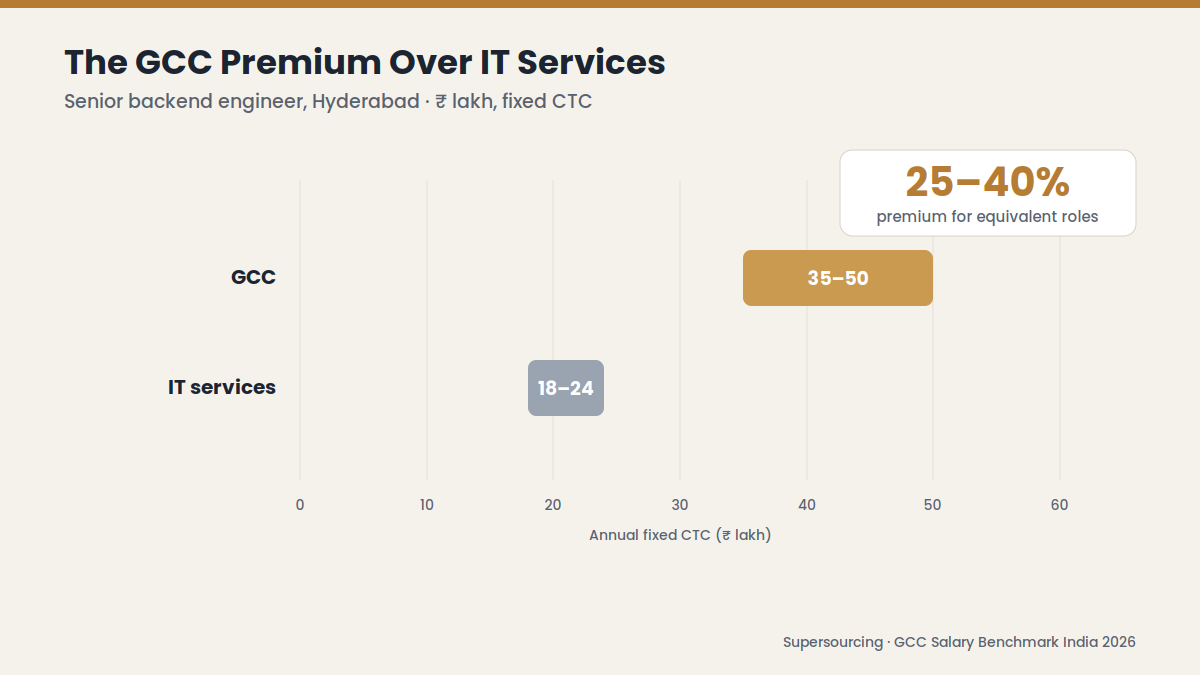
City multipliers (relative to Bangalore = 100). Bangalore sets the ceiling; every other hub trades some pay ceiling for stability or cost.
| City | Salary index vs. Bangalore | Typical attrition | Best-fit roles |
| Bangalore | 100 (baseline) | Highest | AI/ML, platform, deep-tech, product |
| Hyderabad | 80–90 (−10 to −20%) | ~15% | Cloud, data, BFSI-digital, backend |
| Pune | 70–80 (−20 to −30%) | ~14% | QA, DevOps, backend, data engineering |
| Chennai | 68–78 (similar to Pune, sometimes lower) | Lowest | Data platform, analytics, enterprise security |
| NCR (Gurugram/Noida) | Variable; premium for product, analytics, consulting | Moderate–high | Product management, analytics, finance functions |
Mumbai carries a slight premium over Bangalore for BFSI and fintech GCC roles given the concentration of global financial firms. Tier-2 cities (Coimbatore, Kochi, Ahmedabad, Indore) run 25–30% below Bangalore, offset by 30–40% lower cost of living. Per the Randstad salary trends work, average Tier-2 senior CTC has climbed to ~₹28.4 lakh, closing on the Tier-1 senior average of ~₹32.4 lakh. The arbitrage is narrowing, but it’s still real.
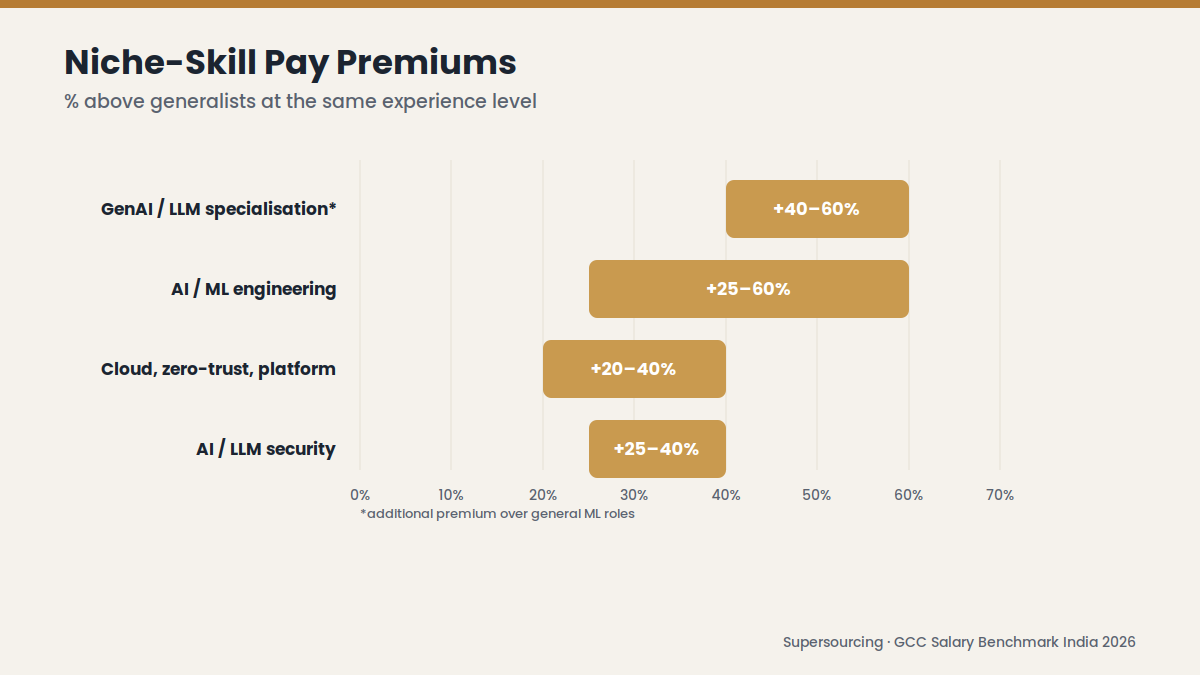
The niche-skill premium. Not all skills are priced equally. Layer these premiums on top of the general engineering band for the same experience level:
- AI / ML engineering: +25–60% over equivalent backend engineers.
- GenAI / LLM specialisation: an additional +40–60% over general ML.
- Cloud-native, zero-trust security, platform engineering: +20–40% over generalists.
- AI/LLM security skills: +25–40% over peer security engineers.
When you’re staffing an infrastructure-heavy centre, this is where budgets slip: plan to hire cloud engineers and platform specialists at P75+, not median.
Reading the matrix for the roles that actually break budgets. A few roles behave differently from the general band and deserve their own note:
- AI/ML and GenAI engineers are the steepest curve in the market. Mid-level ML engineers (3–7 years) already clear ₹22–45 LPA in Bangalore, and lead or principal ML talent runs from ₹78 LPA to well past ₹1 crore. Treat these as negotiations, not bands, and expect the number to move the moment a candidate has a competing GCC in play.
- Data scientists and data engineers get conflated in budgets but price differently. A senior data scientist with global product exposure commands ₹30–55 LPA, while data-platform engineers track closer to the backend curve. If you’re staffing an analytics-heavy centre, plan to hire data scientists and data engineers on separate bands, not one blended line.
- Engineering managers carry the highest absolute premium of any single line. GCCs routinely under-budget experienced India engineering leadership, then hire under-levelled managers whose ceiling quietly caps the whole team.
A worked budget example. Say you’re standing up a 12-person product-engineering pod in Hyderabad: one engineering manager, two senior engineers, four mid-level engineers, two mid-level ML engineers, one senior data scientist, one DevOps/SRE, and one product manager. Take the Bangalore fixed-CTC midpoints from the matrix above, apply the ~0.85 Hyderabad multiplier, then layer roughly 20% variable and ~11% statutory contributions.
The fixed-CTC line lands near ₹4.0–4.5 crore; fully loaded, budget closer to ₹5.2–5.6 crore before facilities. The single most common error here is pricing the two ML seats and the data scientist on the general engineering band under-fund those three and the pod ships six months late waiting on empty seats while the rest of the team sits idle.
Phase 2 Source and vet (what good screening looks like)
With bands set, sourcing begins. The bar for a GCC is higher than for a staff-augmentation seat: you’re hiring owners, not hands. What good screening looks like:
- Structured intake. Convert the role into a scorecard must-have skills, nice-to-haves, ownership scope before any résumé lands. Vague JDs produce vague shortlists.
- Technical depth check. For engineering, a real code/system-design exercise, not a trivia screen. For data/ML, a problem grounded in production reality, not a Kaggle puzzle.
- Cultural and communication fit. GCC roles work across time zones with global stakeholders. Screen for written communication and async ownership explicitly.
- Reference and stability check. Job-hopping patterns and counter-offer history predict early attrition.
Red flags to screen out early:
- Candidates whose CTC expectation jumps more than ~40% over current are often a sign they’ll leave for the next 40%.
- Résumés heavy on tools, thin on outcomes (“worked on” vs. “owned/shipped”).
- Reluctance to do a live technical exercise at senior levels.
- A vendor shortlist where the same profiles appear across multiple agencies is a signal of shared, non-exclusive bandwidth rather than dedicated sourcing.
What separates real vetting from résumé forwarding: a real screen tests the specific thing the role needs production ML experience for an ML role, incident-response judgement for an SRE, system-design trade-offs for a senior engineer rather than a generic aptitude test that any competent generalist passes.
The cost of weak vetting is invisible until the third month, when the hire can’t own the thing you hired them to own and the backfill clock starts. A serious partner surfaces a pre-vetted shortlist of the top few percent of qualified talent within a 7–10 working day cycle from JD to interview-ready candidates, not a stream of loosely matched CVs.
Phase 3 Choose an engagement model and lock contracts
How you engage talent shapes cost, control, and risk. The three models GCC builders weigh:
- Dedicated / captive hiring full-time employees on your entity or a build partner’s. Highest control and IP ownership, best for long-term product teams, highest fixed commitment.
- Staff augmentation vetted engineers embedded in your team, contracted through a partner. Fast to scale up or down, lighter commitment, ideal for filling specific skill gaps quickly.
- Project / managed delivery an outcome-based scope owned by the partner. Lowest management overhead, least direct control, best for well-defined bounded work.
Contract terms that protect you:
- NDA-backed IP protection, with IP assignment clauses that survive termination.
- A replacement guarantees a strong partner replaces a mishire within 7–10 days at no extra cost.
- Clear notice periods and no-poach terms.
- Data-security and access clauses aligned to your compliance regime.
If you’re standing up captive rather than augmenting, this is the stage to decide between setting up your own entity and a build-operate-transfer route; the choice drives your timeline and compliance load. A build partner can help you set up a global capability center without the 6–9 month entity-formation lag.
Phase 4 Onboard and ramp (the first two weeks)
Onboarding friction is where good hires quietly disengage. The first two weeks decide retention more than the offer did. A working checklist:
- Day 0 access ready. Laptop, VPN, repo access, SSO, and tool licenses provisioned before the start date. Nothing signals disorganisation like a first-day engineer with no repo access.
- Week 1 context, not tickets. Architecture overview, product context, and who-owns-what. Assign a buddy and a manager 1:1 on day one.
- Week 1 a small, shippable first task. An early, real merge builds belonging faster than any orientation deck.
- Week 2 feedback loop. A structured check-in to catch mismatches while they’re cheap to fix.
- Week 2 level and scope confirmation. Confirm the level you are hired at matches the work you’re actually handing over. A senior hire fed junior tickets disengages fast; a mid-level hire handed staff-level ambiguity flails. Re-level or re-scope early if the fit is off; it’s far cheaper in week two than in month six.
Onboarding friction point most teams miss: time-zone overlap expectations set during hiring but never formalised. Agree the overlap window in writing before day one, or you’ll relitigate it every sprint.
Phase 5 Manage delivery (cadence, KPIs, account structure)
A staffed team is not a delivering team. Managing delivery well means:
- Reporting cadence: weekly delivery update, bi-weekly stakeholder review, monthly business review. More frequent for the first quarter, then settle.
- KPIs that matter: cycle time, escaped-defect rate, and delivery predictability not lines of code or hours logged.
- A dedicated account manager, not shared bandwidth, so escalations have a single owner.
- Ongoing benchmark hygiene: re-check bands against the market each cycle. With increments at ~8.8% and niche roles rising faster, a band drifts out of market within a year.
The dedicated teams that retain best treat the account manager as an early-warning system, not a status-reporter. A rising counter-offer rate, a cluster of resignations in one skill area, or a pod consistently missing its time-zone overlap window are all band-drift or management signals that surface in delivery reviews months before they appear in an attrition report.
Catch them there and a mid-cycle correction costs a retention bonus. Miss them and it costs a full re-hire plus the ramp.
Phase 6 Scale or exit
Whether you’re adding headcount or winding down, plan the mechanics before you need them:
- Scaling up: hire leadership before you hire the layer beneath an under-levelled manager caps the team’s ceiling. Consider a multi-city model: sourcing 30%+ of engineers from Hyderabad, Pune, or Chennai while keeping leadership in Bangalore can cut aggregate compensation cost 15–20% without sacrificing quality.
- Replacement policy: a 7–10 day replacement guarantee should be contractual, not a favour.
- Offboarding: revoke access same-day, run structured exit interviews, and capture knowledge before the notice period ends attrition data is your best early-warning signal for band drift.
Case Studies
Outcome-focused, drawn from real engagements delivered across the client roster.
High-volume engineering scale-up (consumer tech). For a fast-scaling consumer platform, the mandate was volume without quality dilution dozens of engineers, fast. Leaning on AI-driven sourcing that surfaces the top ~2% of vetted talent and a 7–10 working-day shortlist cycle, the engagement delivered at a 98% candidate joining rate and under 1% drop-off on contract roles, the difference between a plan on paper and a team actually at desks.
Engineering hiring for a high-growth fintech. A fintech scaling its core engineering team needed backend and platform talent that could own systems, not just close tickets. Structured technical vetting plus dedicated (non-shared) sourcing compressed time-to-shortlist and held quality at the senior end, where a single mishire cascades into IC attrition below.
Recruitment automation for a healthtech firm. A healthtech company drowning in manual screening needed throughput without lowering the bar. AI-assisted sourcing and structured vetting cut screening load while keeping the joining and retention metrics above the same operating model that underpins a 8.5 NPS across engagements.
Across 527+ delivered IT projects, the pattern holds: the metric that separates a benchmark from a hire is joining rate and early retention, not shortlist volume.
Comparison / Decision Framework
Which engagement model fits depends on how you weigh cost, control, speed, and risk. Use this framework rather than defaulting to what a vendor pitches.
| Dimension | Dedicated / Captive GCC | Staff Augmentation | Project / Managed | Freelance |
| Cost (run-rate) | Highest fixed; best arbitrage at scale | Medium; flexes with need | Fixed to scope | Lowest headline, highest variance |
| Control & IP | Full ownership | High (your process) | Partner-led | Low |
| Speed to start | Slowest (entity/build) | Fast (7–10 days) | Medium | Fastest |
| Scale flexibility | Low (commitment) | High | Medium | High |
| Risk | Attrition & fixed cost | Partner dependency | Scope creep | Reliability & continuity |
| Best for | Long-term product ownership | Filling skill gaps fast | Bounded, defined work | Short spikes, low-criticality |
Decision rule of thumb: if the work is core, long-term, and IP-sensitive, build dedicated. If it’s core but you need speed and flex, augment. If it’s bounded and non-core, run it as managed delivery. Freelance only for short, low-criticality spikes.
A note on product companies and startups. GCCs aren’t only competing with IT services firms for talent, they’re competing with funded startups and product companies, which often show higher ceiling compensation through ESOPs.
For an engineer willing to accept liquidity risk, a startup’s total expected comp can run 30–50% above a GCC’s cash offer. GCCs counter with structured growth, global exposure, and cash certainty.
When you lose a candidate to a startup, it’s usually the equity story, not the base salary which is why a credible career path and a real retention bonus close more senior offers than chasing the startup’s paper number ever will.
What Most Teams Get Wrong
The single most expensive error is treating the benchmark as a cost-minimisation exercise instead of a market-positioning one. Teams anchor on the lowest defensible number, extend offers at P25, and then quietly lose every strong senior candidate to a GCC paying P75 while blaming “the market” for slow hiring.
The pattern beneath it: paying by title instead of by scarcity. A generalist backend role and a GenAI infrastructure role sit in the same “senior engineer” line item in the budget, so both get the same band. One over-pays a commodity role; the other under-pays a scarce one and leaves the seat empty for months. Scarcity, not title, sets the clearing price in 2026.
Two more traps that cost real money:
- Under-levelling leadership to save cost. A cheap engineering manager caps the whole team’s ceiling and drives out the best ICs. Leadership is the one line you should not economise.
- Setting bands once and forgetting them. With GCC increments near 8.8% and niche roles climbing 15–25%, a band set 12 months ago is already below market for your scarcest roles. Benchmark drift is silent until your offer-decline rate spikes.
- Benchmarking the number, ignoring the pay-mix. Two offers at the same ₹40 lakh CTC are not equal. One that’s 90% fixed reads as safe but locks in a permanent, compounding run-rate; one with a retention component and a genuine performance multiplier costs the same on paper but cools attrition and rewards your best people. Teams that benchmark only the headline number miss that structure is a lever, not a footnote.
The uncomfortable summary: the market doesn’t pay for your budget’s convenience. It pays for scarcity, ownership, and speed and it will leave your best-designed org chart half-staffed until your offers admit that.
Cost & Timeline Reality Check
Most competing content stops at base salary. Here’s what a role actually costs and how long teams actually take the numbers that decide your budget.
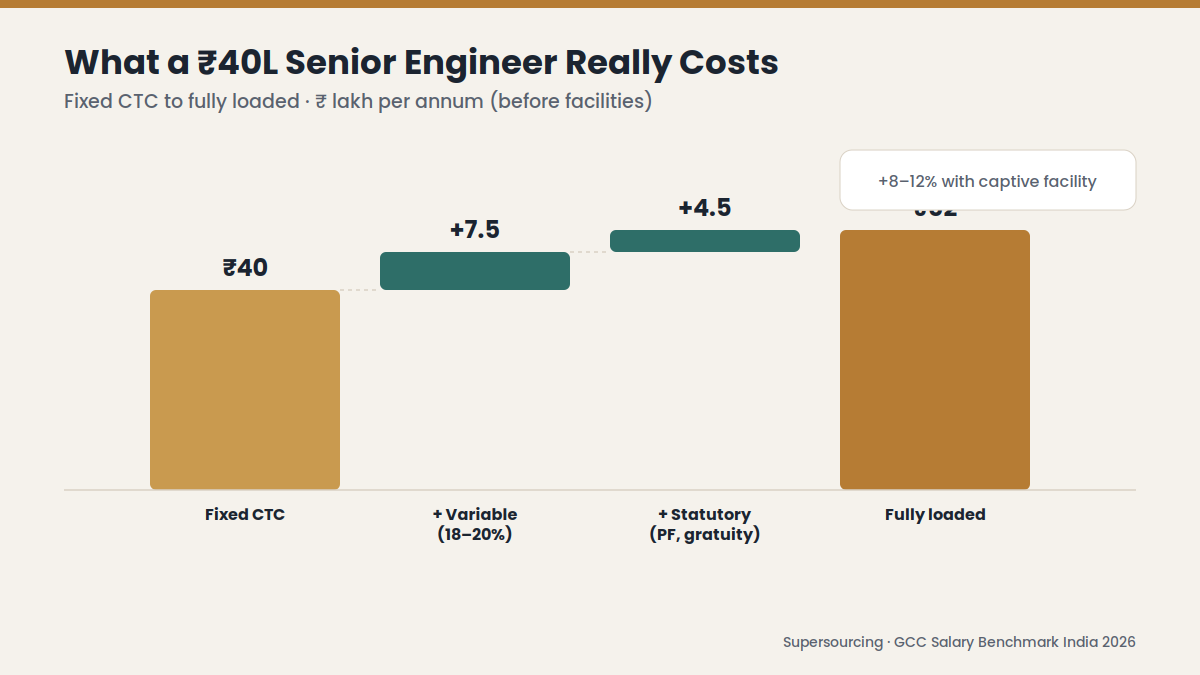
Fully loaded cost. Take fixed CTC, then layer:
- Variable pay: +15–25% of fixed.
- Employer statutory contributions (PF, gratuity, insurance): roughly +10–12%.
- Retention bonuses for scarce roles: +₹3–5 lakh one-time.
- Infrastructure/seat cost (if captive): additional per-head overhead.
A senior engineer with a ₹40 lakh fixed CTC realistically lands near ₹48–52 lakh fully loaded before facilities. Walked through: ₹40L fixed + ~₹7–8L variable (18–20%) + ~₹4–5L statutory (PF, gratuity, insurance) ≈ ₹51–53L, before any one-time retention bonus.
Add a captive facility and per-head infrastructure and the true number climbs a further 8–12%. This is exactly why a budget built on the ₹40 lakh headline runs 25–30% short by the second quarter and why the shortfall always surfaces mid-hire, when it’s hardest to fix.
Illustrative team-build cost (100 engineers, mixed seniority, annual people cost):
| City | Indicative annual people cost | Trade-off |
| Bangalore | Highest (baseline) | Deepest talent, highest attrition |
| Hyderabad | ~10–15% below Bangalore | Stable, strong cloud/data supply |
| Pune | ~20–30% below Bangalore | Lowest attrition tier, fastest-growing hub |
| Chennai | Comparable to Pune, sometimes lower | Most stable teams, enterprise-engineering bias |
Typical timelines:
| Scenario | Timeline |
| JD to interview-ready shortlist (via partner) | 7–10 working days |
| First hires onboarded (staff aug) | 2–4 weeks |
| Own-entity GCC formation (legal setup) | 6–9 months |
| Build-operate-transfer GCC to operational | 3–5 months |
| Replacement for a mishire (guarantee) | 7–10 days |
What drives cost up: Bangalore location, niche skills (AI/cloud/security), P75+ percentile targeting, high-fixed pay-mix, and senior leadership. What drives it down: multi-city sourcing, Tier-2 locations, staff-aug flexibility over fixed headcount, and a well-designed variable/retention mix. Structuring a compliant, cost-efficient centre is exactly where experienced IT staffing services and build partners earn their fee.
Where to Go From Here
If you’re mid-decision sizing a first India team, re-banding after a spate of declined offers, or choosing between your own entity and a build partner the next step isn’t another survey. It’s a benchmark pressure-tested against live offers for your specific roles and cities.
Send us the roles you’re hiring and the cities you’re considering, and the Supersourcing team will map them against current market bands, flag where you’re likely to lose candidates, and lay out the fastest compliant path to a staffed team including the 7–10 day replacement guarantee if a hire isn’t a fit.
Start here: https://supersourcing.com/contact-us/
Frequently Asked Questions
How much more do GCCs pay than IT services firms in India?
GCCs pay a 25–40% premium over IT services firms for equivalent roles, and the gap widens at senior and niche-skill levels; some senior specialist roles run close to 2x the vendor rate. The premium reflects global ownership rather than billable delivery, so applying a vendor rate card to price GCC roles systematically undershoots the market.
Should I benchmark base salary or total compensation?
Total compensation, always. Indian offers combine fixed and variable pay, plus RSUs or retention bonuses at senior levels. Benchmarking base alone understates real cost by 15–25% and loses you candidates who compare the full number against competing offers. Build your bands at a fully loaded cost.
Which Indian city is cheapest for building a GCC team?
Among the major hubs, Pune and Chennai run 20–30% below Bangalore, with the lowest attrition strong for QA, DevOps, backend, and data engineering. Hyderabad sits 10–20% below Bangalore with excellent cloud and data supply. Tier-2 cities go further (25–30% below) but with thinner senior pools.
What is the salary premium for AI/ML and cloud roles?
AI/ML engineers command 25–60% over equivalent-experience backend engineers, GenAI/LLM specialists add a further 40–60% over general ML, and cloud-native, security, and platform roles carry 20–40% premiums. These are the roles where you must target P75+ or leave seats empty for months.
How much variable pay do GCCs offer?
Typically 15–25% of fixed CTC is roughly a 10–15% annual performance bonus plus 5–10% in retention components, with top performers earning 1.5 — 1.8x the average payout. Retention bonuses (₹3–5 lakh one-time, tied to a 2–3 year commitment) are now common to counter competing offers without inflating fixed pay.
How often should I refresh my compensation bands?
At least annually, and more often for scarce roles. With GCC increments near 8.8% and niche AI/cloud/security roles climbing 15–25% a year, a band set 12 months ago is likely already below market where it matters most. Silent benchmark drift shows up first as a rising offer-decline rate.
When should I set up my own entity versus using a build partner?
Own-entity formation takes 6–9 months and carries a permanent compliance load worth it for a large, long-horizon captive. A build-operate-transfer or staffing partner gets you operational in 3–5 months (or 7–10 days for first hires via staff aug), which is usually the right call for teams under ~50 or those testing the model. If you’re weighing this, a short benchmarking and model-fit consultation will save months.
How do I stop losing strong candidates to competing offers?
Price by scarcity, not title; benchmark total comp, not base; and move fast a 7–10 day shortlist-to-offer cycle beats a slower process even at equal pay. The teams that lose candidates are usually anchored at P25 on roles the market clears at P75.
