

Global Capability Centers were built on a simple equation: large teams of junior talent, layered supervision, and labor arbitrage. Agentic AI breaks that equation not by making GCCs cheaper, but by making the pyramid itself obsolete. The AI impact on GCC operating models is now the single biggest structural question facing the 2,117 centers operating in India, and most leadership teams are still answering it with a tooling budget instead of an org redesign.
The data says the window for incremental thinking has closed. Nearly half of all GCCs established in India since FY2021 were built with AI as a core focus from inception, according to the FY2026 Zinnov–NASSCOM landscape report. New centers are not adding AI to an old model, they are skipping the old model entirely. That puts every legacy-shaped center in direct internal competition with AI-first peers for the same parent-company charters.
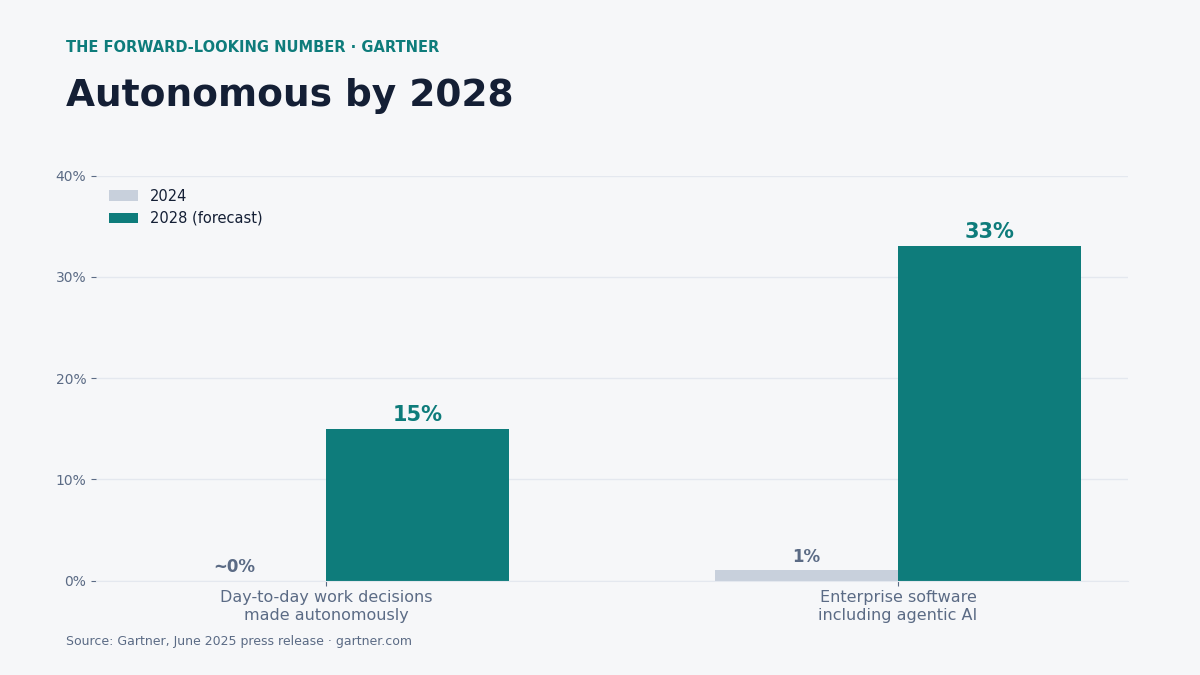
Call out the forward-looking number that matters: Gartner predicts that by 2028, at least 15% of day-to-day work decisions will be made autonomously through agentic AI, up from effectively 0% in 2024 and 33% of enterprise software applications will include agentic AI by the same year.
Fifteen percent of decisions is not a tooling story. Decisions are what L1 analysts, junior engineers, and first-line supervisors are hired to make. When agents absorb that layer, the shape of a GCC team, its seniority mix, its span of control, and its hiring pipeline has to change with it.
This guide is the operational playbook for that change. It covers what actually shifts (ratios, roles, charters), the six-phase process for redesigning an operating model without breaking delivery, what the transition costs in realistic ₹/$ bands, and the specific mistakes that cause more than 40% of agentic AI projects to get canceled. It is written from patterns observed across hundreds of enterprise hiring and GCC engagements not from vendor slideware.
TL;DR
This guide explains the AI impact on GCC operating models for leaders who run, build, or staff Global Capability Centers. It is written for GCC site heads, engineering leaders, and transformation owners who need to redesign teams, not just buy AI tools.
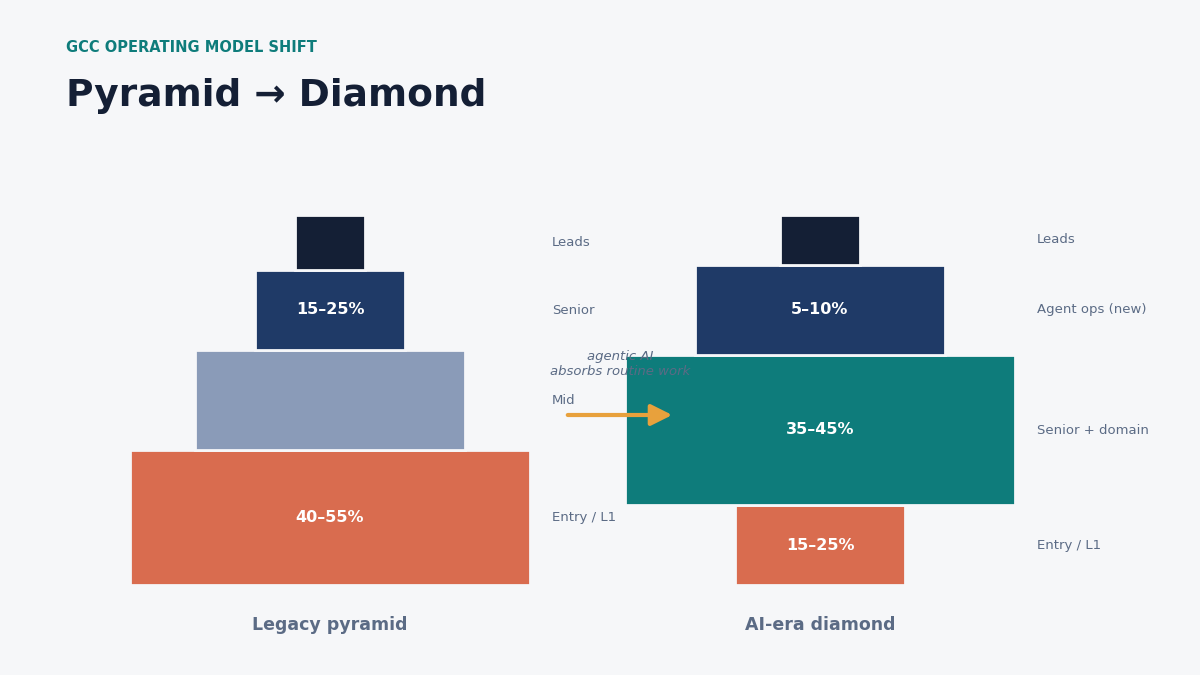
The headline shift is structural. Gartner expects 15% of day-to-day work decisions to be made autonomously by agentic AI by 2028, which collapses the L1-heavy pyramid most centers still run. The centers responding well are moving to a diamond-shaped model: roughly 30–50% fewer entry-level seats, a heavier band of senior engineers and domain experts, and new roles that manage agents instead of tickets. The same shift is redefining AI in GCC operations from a productivity add-on into the operating model itself.
By the end, you will be able to baseline your current model, pick the right first automation targets, plan new team ratios and hiring, budget the transition in realistic cost bands, and avoid the failure patterns that kill 4 in 10 agentic AI programs.
What Is the AI Impact on GCCs?
The AI impact on GCCs is the structural shift in how Global Capability Centers organize work as agentic AI absorbs routine execution: fewer entry-level (L1) roles, higher senior-talent density, new agent-management functions, smaller pod-based teams, and expanded charters moving centers from labor-arbitrage delivery engines to AI-augmented ownership hubs.
What it is not:
- Not just GenAI tool adoption. Giving 500 engineers a coding copilot changes productivity per seat; it does not change the operating model. The impact discussed here is the redesign of team shapes, ratios, and charters.
- Not headcount elimination as a strategy. The FY2026 data shows GCC hiring remains resilient; organizations are prioritizing redeployment and AI-led productivity over linear headcount growth, not mass reduction.
- Not RPA rebranded. RPA automated fixed, rule-based steps. Agentic AI plans, decides, and executes multi-step work with judgment which is why it reaches roles RPA never touched.
Why AI in GCC Operations Matters: The Business Case
The case for treating AI in GCC operations as an operating-model question not an IT project rests on numbers the parent company’s CFO already knows. India’s GCC ecosystem now generates $98.4 billion in market revenue across 2,117 centers employing 2.36 million professionals, and the centers winning bigger charters are the ones converting AI capability into measurably better unit economics.
The concrete outcomes at stake:
- Cost per outcome, not cost per seat. McKinsey’s research on AI-enabled software engineering shows leading adopters achieving 16–30% improvements in delivery time and team productivity, and 31–45% improvements in software quality. A center that delivers 25% more output per engineer changes its cost story without cutting a single seat.
- Speed of delivery. Agent-assisted L1 triage typically cuts first-response and routine-resolution times from hours to minutes, and AI-accelerated engineering compresses release cycles the difference between a GCC that gets product ownership and one that stays a ticket factory.
- Quality and consistency. Agents don’t skip runbook steps at 3 a.m. Exception rates drop when routine execution is standardized, and human review concentrates on genuinely ambiguous cases.
- Risk and resilience. Attrition in L1-heavy teams (historically the highest-churn band in Indian GCCs) stops being an operational risk when the routine layer is agentic and the human layer is senior, better paid, and more stable.
- Charter expansion. Parent companies hand bigger mandates product ownership, AI platform development, global process ownership to centers that demonstrate AI-led leverage. That is the real prize: revenue-side relevance, not cost-side savings.
The defensive case is equally real. With nearly half of post-FY2021 GCCs built AI-first from day one, a legacy-shaped center is now benchmarked against internal peers running leaner, more senior structures. Charters migrate to whoever delivers the better unit economics.
The charter shift, concretely: the AI impact on GCC charters shows up in three renegotiation patterns we see repeatedly. Execution mandates (“run these processes”) get repriced downward as agents commoditize them.
Ownership mandates (“own this product line, this platform, this global process”) get awarded to centers that prove AI-led leverage with instrumented evidence. And entirely new mandates building the parent company’s agent platform itself go to centers that moved early enough to have the talent in seats.
A center’s position on that ladder in 2026 largely determines its budget conversation in 2028.
The Core Problem: Why Most GCC Leaders Are Getting This Transition Wrong
Ambition isn’t the bottleneck sequencing is. The dominant failure pattern in gcc automation 2026 planning is buying the technology before redesigning the organization that has to absorb it, and the cancellation data shows how expensive that is: Gartner projects that over 40% of agentic AI projects will be scrapped by end-2027 due to escalating costs, unclear business value, or inadequate risk controls.
The specific ways it goes wrong, based on recurring patterns across enterprise engagements:
- Pilots that never touch the org chart. A GenAI pilot runs in a corner, shows a demo, wins applause and eighteen months later the team shape, seat ratios, and job descriptions are identical. Productivity gains that don’t change structure get absorbed as slack, not captured as value.
- Underestimating the redesign effort by 3–4x. Teams budget for licenses and integration, then discover the real work: SOP digitization, knowledge base curation, evaluation harnesses, exception-handling design, and role redefinition. In most engagements we’ve seen, the org and process work consumes 60–70% of total transition effort; the model/tooling layer is the minority.
- Hiring for the old pyramid while automating its base. Centers keep recruiting 40–60% of intake at entry level out of habit, then automate exactly that work creating a redeployment problem they built themselves.
- No agent-era metrics. Legacy GCC KPIs (utilization, tickets per FTE, seats billed) actively punish automation. If your dashboard rewards busy humans, your agents will be quietly turned off.
- Talent-market lag. Senior AI-adjacent roles LLMOps engineers, agent-workflow designers, evaluation leads take 2–3x longer to fill through traditional channels than the L1 roles they replace. Leaders discover this after the transformation deadline is set, not before.
The compounding risk: every quarter a center delays the structural shift, its AI-first internal competitors set the benchmark the parent company uses at charter-renewal time. This is a relative game, and the clock is shared.
The Walkthrough: Redesigning a Future GCC Operating Model in Six Phases
A credible future gcc operating model is built in sequence baseline, redesign, automate, re-staff, govern, scale. Each phase below includes the concrete outputs, timelines, and checklists to execute it. Treat this as the HowTo backbone of the guide (and mark it up with HowTo schema on publication).
Phase 1 Baseline the Current Operating Model (Weeks 1–4)
Before any automation decision, quantify what the center actually does and what it costs per unit of work. Most centers have never produced this view; it is the single highest-leverage artifact of the whole program. If you are setting up a new center rather than retrofitting one, run this same exercise on the target-state design; it is standard practice in mature GCC setup services engagements to baseline before a single hire.
Build the baseline in four steps:
- Work inventory. Catalog work at the task level, not the role level: ticket categories, request types, engineering activities, report cycles. Tag each with volume/month, average handling time, and error/rework rate.
- Automatability scoring. Score every task 1–5 on two axes: rule-clarity (is there a documented, stable procedure?) and judgment-intensity (how often does it need genuine human discretion?). High rule-clarity + low judgment = agent candidates. Typically 30–50% of L1 task volume lands in this quadrant.
- Ratio snapshot. Document today’s shape: % of headcount at L1/entry, mid, senior, and leadership; span of control per manager; cost per band. Legacy centers commonly run 40–55% entry-level; that number is your “before” photo.
- Charter map. List what the parent company has actually delegated (execution vs. ownership) and what it has explicitly withheld. The redesign has to target charter expansion, not just cost.
Red flag: if the work inventory can’t be completed because SOPs are tribal knowledge, that’s your first project. Agents cannot execute undocumented processes and neither, reliably, can new hires.
Phase 2 Redesign Team Shapes and Ratios (Weeks 3–8, overlapping Phase 1)
This is the heart of the shift: from pyramid to diamond. The pyramid put mass at the bottom because routine volume needed human hands. When agents absorb 30–50% of routine execution, the bottom narrows, the middle-senior band widens, and a new “agent management” function appears alongside delivery.
Target-state ratios that recur across AI-forward centers (use as planning bands, not gospel):
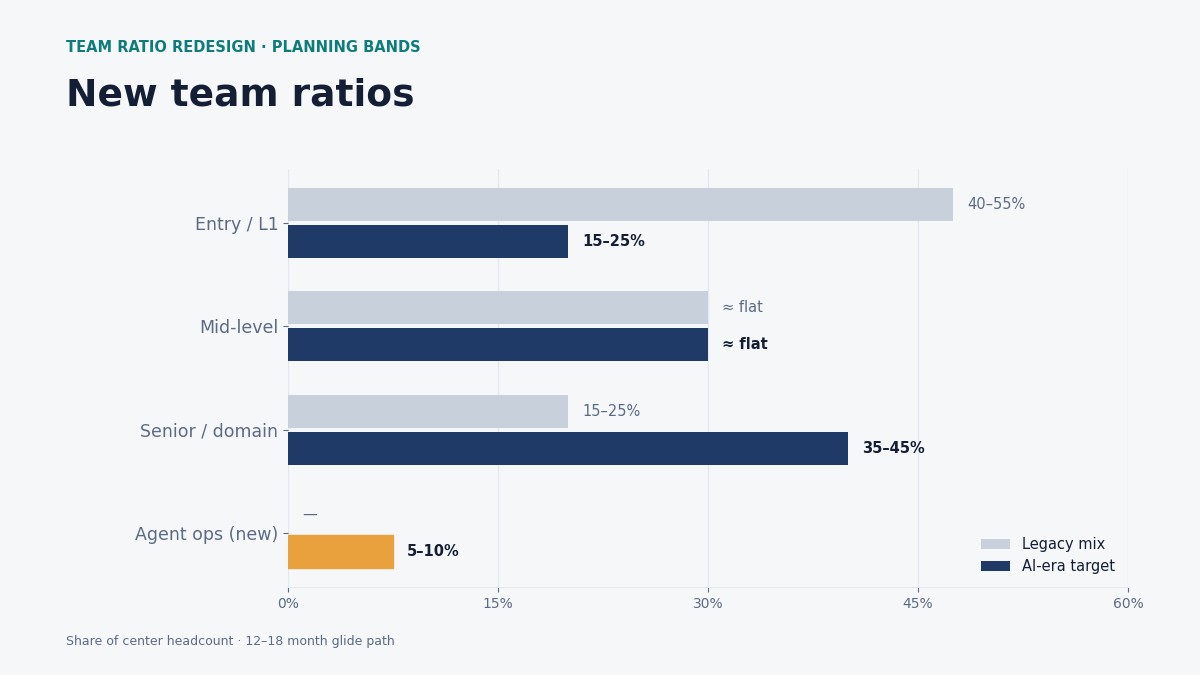
- Entry/L1 band: from 40–55% of headcount toward 15–25%. Remaining L1 roles shift from execution to exception handling and agent escalation review.
- Senior engineer / domain-expert band: from 15–25% toward 35–45%. Talent density replaces headcount volume as the capacity lever.
- Agent operations layer (new): typically 5–10% of technical headcount software developer engineers, agent-workflow designers, evaluation and guardrail owners, knowledge-base curators.
- Span of control: first-line supervision as agents handle routine coordination; spans of 8–12 humans plus an agent fleet become normal where 5–7 was standard.
- Pod structure: monolithic 30–50 person functional teams give way to 6–10 person cross-functional pods, each pairing senior humans with a defined set of agents and owning an outcome end-to-end.
The ratio math worth running: a 300-person center at 50% L1 (₹4–8 LPA band) restructured to 20% L1 with a 40% senior band (₹25–60 LPA) often lands within ±10% of the original people-cost while delivering 20–40% more output. The AI impact on GCC economics is a mix shift, not a simple cut.
Checklist for the redesign document:
- Target ratio per band with a 12–18 month glide path (no big-bang reorgs)
- Role-by-role disposition: automate / augment / redeploy / hire
- Named owner for the agent ops function
- Redeployment and reskilling plan for affected L1 staff (see Phase 4)
- Revised span-of-control and pod definitions
Phase 3 Pick First Use Cases and Build the Agentic Layer (Months 2–6)
Sequencing use cases is where agentic ai in gcc programs live or die. The winning pattern is boring: start where rule-clarity is high, blast radius is low, and volume is measurable.
Proven first-wave targets (in typical order of deployment):
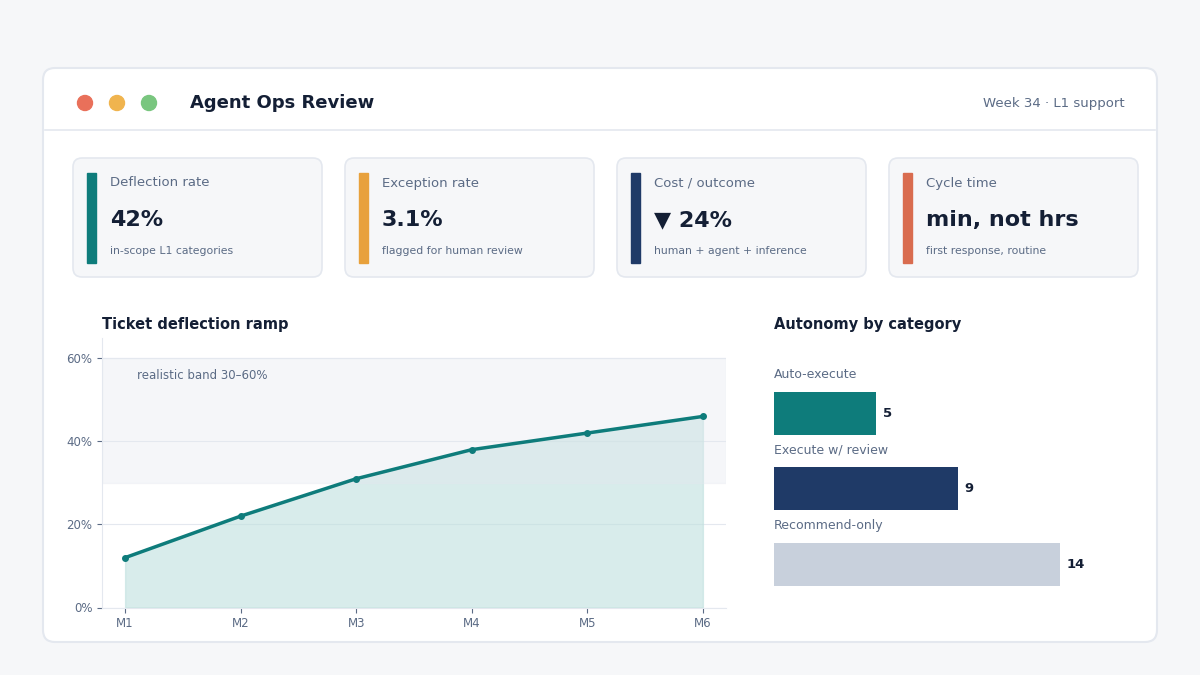
- L1 ticket triage and deflection classification, enrichment, routing, and resolution of documented request types. Ticket-deflection rates of 30–60% on in-scope categories are realistic within 1–2 quarters; treat vendor claims above 80% with suspicion.
- Knowledge retrieval (RAG) for support and engineering grounding agents and humans in curated internal documentation before granting any write-access autonomy.
- Engineering augmentation code generation, test authoring, documentation, and code review assistance across the SDLC. This is where gcc productivity gains show up fastest and most measurably, because engineering already has instrumented pipelines to prove them.
- Back-office workflows invoice matching, report assembly, reconciliation prep, compliance evidence gathering.
- Recruitment and HR ops screening, scheduling, and candidate communication (see the Somnoware case study below).
Build the platform layer once, not per use case:
- A shared orchestration layer (agent framework, tool/API access, identity) rather than per-team point solutions
- An evaluation harness: golden datasets, regression suites, and shadow deployments before any agent acts unsupervised
- Guardrails and audit logging as first-class requirements inadequate risk controls is one of Gartner’s three named cancellation causes
- Human-in-the-loop (HITL) checkpoints defined per action type: auto-execute, execute-with-review, or recommend-only
The 90-day rule: every use case gets 90 days from kickoff to measurable production impact on one metric (deflection rate, cycle time, cost per transaction). No measurable impact by day 90 → kill or re-scope. Zombie pilots are how budgets die.
Phase 4 Rebuild the Talent Model: New Roles, New Hiring, New Vetting (Months 2–9)
The hiring plan is where the redesigned org chart becomes real or stays a slide. Three workstreams run in parallel: hiring the new senior/AI band, reskilling the existing base, and changing how candidates are vetted.
The roles that define the ai-first gcc team structure:
- Agent-workflow / automation designers people who decompose business processes into agent-executable steps with HITL checkpoints. Part business analyst, part prompt/workflow engineer.
- LLMOps and MLOps engineers deployment, monitoring, cost control (FinOps for AI), and model lifecycle management for the agent fleet.
- Evaluation and guardrail leads owners of the test harnesses, red-teaming, and quality gates that keep autonomous actions safe.
- Senior full-stack and platform engineers widened the middle of the diamond; engineers senior enough to review agent output critically rather than accept it.
- Domain experts with AI fluency the people who encode judgment into agent policies for finance, healthcare, or supply-chain workflows.
- Knowledge-base curators have an unglamorous role that determines RAG quality more than model choice does.
Hiring reality check. These profiles sit in the most contested talent band in India the FY2026 landscape data ranks India the #1 AI hiring market globally, which means every GCC is fishing in the same pool. Traditional 6–10 week recruitment cycles for senior AI-adjacent roles are a transformation killer when your Phase 3 deadlines assume staffed pods.
This is exactly where specialized pipelines earn their keep: Supersourcing’s AI-driven sourcing model, for example, surfaces the top 2% of pre-vetted candidates and runs a 7–10 working day cycle from job description to interview-ready shortlist the difference between an agent ops team staffed this quarter and next year. Whether you hire Generative AI developers for the platform layer or hire machine learning engineers for evaluation and fine-tuning work, insist on the same cycle-time discipline you demand from your agents.
What vetting must now test (and mostly doesn’t):
- AI-assisted working style, openly. Let candidates use copilots in technical rounds and evaluate how they direct, verify, and correct the tool. A senior engineer who blindly accepts generated code is a higher risk than one who codes slower without assistance.
- Judgment over recall. Exception-handling scenarios (“the agent did X, the customer says Y, logs show Z what now?”) predict performance in a diamond-shaped org better than algorithm puzzles.
- Documentation ability. In an agentic center, undocumented knowledge is unautomatable knowledge. Test for it explicitly.
Reskilling the existing base the 60/25/15 pattern. Across restructurings we’ve observed, roughly 60% of affected L1 staff can be redeployed into exception-handling, QA-of-agents, or knowledge-curation roles with 8–12 weeks of structured reskilling; about 25% can step up into specialist tracks with longer investment; and around 15% will exit through natural attrition absorbed over the glide path.
Plan the training budget (typically ₹40,000–₹1,00,000 per reskilled employee for structured programs) before the automation, not after the morale damage.
Phase 5 Governance, Metrics, and Managing Delivery (Ongoing from Month 3)
An agentic center needs a management system designed for mixed human-agent delivery; this is where the AI impact on GCC governance becomes visible in the weekly operating rhythm.
The old cadence utilization reports and ticket counts measures exactly the wrong things.
The metric swap:
| Retire | Replace with |
| Tickets closed per FTE | Cost per resolved outcome (human + agent + inference cost) |
| Utilization % | Deflection rate and exception rate by category |
| Headcount growth vs. plan | Output per pod; charter scope delivered |
| Average handling time (human) | End-to-end cycle time (mixed pipeline) |
| Seat-based billing/chargeback | Outcome- or transaction-based chargeback to the parent |
Governance structure that works in practice:
- A weekly agent ops review (30 minutes): deflection, exception, and error trends per agent; cost per 1,000 actions; incidents. Same discipline as an SRE review.
- A monthly model/guardrail board: approves autonomy-level changes (recommend-only → execute-with-review → auto-execute) with evidence from the evaluation harness. No agent gets more autonomy on a hunch.
- A quarterly charter review with the parent company: convert demonstrated gains into expanded mandate. Centers that skip this step capture productivity but never capture strategic relevance.
- Clear accountability: every agent has a named human owner. “The AI did it” is not an acceptable root cause in an incident review.
Account-management note for staffed/augmented teams: if part of your capacity comes through staffing or project partners, hold them to the same telemetry.
Dedicated account managers, weekly delivery reporting, and NDA-backed IP protection on anything touching your agent workflows and prompts should be contractual defaults, not favors.
Phase 6 Scale, Redeploy, or Exit Legacy Structures (Months 9–24)
Scaling an AI-era center is a different motion from scaling a pyramid. You are no longer adding rows of seats; you are cloning pods, widening agent coverage, and negotiating bigger charters.
The scaling sequence:
- Clone what’s proven. Replicate the pod pattern (senior humans + agent fleet + owned outcome) into adjacent functions only after the first pods hold their metrics for two consecutive quarters.
- Wide agent scope deliberately. Move categories from execute-with-review to auto-execute based on evaluation data typically 1–2 categories per month, never wholesale.
- Redeploy before you hire. Each newly automated category frees exception-trained staff; route them to the next pod before opening external requisitions.
- Renegotiate the charter annually. Take cycle-time and quality evidence to the parent and bid for ownership-level work: product lines, global process ownership, AI platform mandates.
- Sunset with dignity. Legacy L1 structures wind down through attrition and redeployment over 12–18 months. Centers that do sudden cuts poison the local talent market they still depend on for senior hiring.
Exit and replacement hygiene: for any externally staffed roles, contract for replacement guarantees (7–10 days is a reasonable market standard for a strong partner) and for clean IP/knowledge handover prompts, workflows, and evaluation datasets are assets, and they walk out the door if contracts don’t say otherwise.
Case Studies: What the Shift Looks Like in Real Engagements
Abstract ratios are easy to nod at; the AI impact on GCC hiring becomes concrete when you look at how real scale-ups were staffed. Three short examples, metric first.
Paytm senior engineering at scale, fast. 100+ engineers hired for one of India’s largest fintech platforms, with the mix weighted toward the senior and specialist band rather than entry-level volume the exact diamond-shaped intake an AI-era operating model requires. The vetting pipeline’s 98% joining rate meant the ramp plan survived contact with the talent market.
Swiggy hiring scale-up without pipeline drag. During aggressive growth, Swiggy’s engineering scale-up ran on a 7–10 working day JD-to-shortlist cycle across product and platform roles. The lesson for GCC leaders: transformation timelines are gated by senior-hire velocity, and cycle time is a designable variable, not weather.
Somnoware recruitment automation as the use case itself. A healthtech firm’s recruitment process was automated end-to-end AI-driven sourcing and screening surfacing the top 2% of candidates, with humans concentrated on final evaluation and closing. The same pattern (agents handle volume, senior humans handle judgment) is the template for automating any GCC back-office function, and it holds candidate drop-off on contract roles under 1%.
Decision Framework: Which Operating Model Fits Your Center?
Use this to place your center honestly and pick the transition route. The AI impact on GCC structure is not uniform, and forcing every center to the same target state is its own failure mode. Most legacy centers should target the Diamond model within 18 months; AI-Native is realistic mainly for new builds.
| Dimension | Legacy Pyramid | Augmented Pyramid | Diamond (AI-Managed) | AI-Native Pod Model |
| Entry-level share | 40–55% | 35–45% | 15–25% | <15% |
| Senior/domain share | 15–25% | 20–30% | 35–45% | 50%+ |
| Agent role | None / RPA only | Copilots assist humans | Agents execute routine work under HITL | Agents are the default executor; humans own exceptions & design |
| Cost profile | Low cost/seat, high seats | Same seats, better output | Similar total cost, 20–40% more output | Highest cost/seat, lowest cost/outcome |
| Speed of change | Baseline | +10–20% cycle-time gain | +25–40% | Step-change on covered workflows |
| Key risk | Charter erosion to AI-first peers | Gains absorbed as slack | Transition execution risk | Governance/guardrail failure |
| Best fit | (No longer defensible as a target state) | 6–12 month stepping stone | Most existing centers | New builds, AI-first charters |
Three-question shortcut:
- Is >35% of your headcount doing documented, repeatable work? → You have Diamond-model headroom and are paying a pyramid tax today.
- Can you hire or access senior AI-adjacent talent in weeks, not quarters? → If not, fix the pipeline before announcing the transformation.
- Will the parent fund a 12–18 month glide path? → If only quarterly cost cuts get funded, start with engineering augmentation (fastest provable ROI) and use the evidence to buy the longer runway.
What Most Teams Get Wrong About the AI Shift in GCCs
The pattern across failed and stalled programs is remarkably consistent, and most of it contradicts the standard advice. Misreading the AI impact on GCC operating models as a technology project rather than an organizational redesign is the root error behind nearly everything below.
This section is deliberately opinionated; every point below comes from watching the same mistakes repeat across enterprise engagements.
They automate before they document. The single most common sequencing error. Agents amplify process quality: a well-documented workflow gets faster, an undocumented one gets erratically wrong at machine speed. Centers that spend the first 90 days on SOP digitization and knowledge-base curation ship agents that work; centers that skip it ship demos.
They protect the pyramid emotionally. Site leaders grew up managing headcount, and headcount is still how many GCC leaders’ importance is measured internally. The result: AI programs scoped to add capability without ever touching the ratio structure which is precisely how gains get absorbed as slack instead of showing up in unit economics. If the org chart looks identical 18 months after “transformation,” the transformation didn’t happen.
They cut juniors instead of redesigning junior work. The lazy reading of “fewer L1 roles” is a hiring freeze at the bottom. But a center with zero junior intake has no leadership pipeline in five years. The right move is smaller junior cohorts doing different work exception handling, agent QA, curation on an accelerated path to the senior band, not the elimination of the band.
They measure the humans and not the system. Deflection rate without exception-quality tracking is a vanity metric; an agent that “resolves” 60% of tickets while quietly mis-resolving 8% is destroying value. Mature centers track the mixed human-agent pipeline end to end: cost per correct outcome, including inference spend and rework.
They treat the 40% cancellation rate as someone else’s statistic. Gartner’s cancellation forecast names three causes: cost escalation, unclear value, weak risk controls and all three are governance failures, not model failures. The programs that survive have a kill rule (our 90-day rule above), an evaluation harness before autonomy, and a named human owner per agent. The programs that die have executive sponsorship and nothing else.
They assume the talent market will wait. Ratios on a slide are easy; a staffed agent-ops team is not. Senior AI-adjacent hiring is the long pole in almost every transition plan we’ve seen, and it is the one workstream leaders consistently start last.
Cost & Timeline Reality Check: GCC Automation in 2026
Honest numbers for gcc automation 2026 planning are the section most competing content omits, so here are usable bands. Figures are typical market ranges for India-based centers; your vertical, city, and compliance load will move them.
Talent cost bands (annual, India, typical 2026 market ranges):
- L1 / entry operations & support: ₹4–8 LPA ($5k–10k)
- Mid-level engineers / analysts: ₹12–25 LPA ($14k–30k)
- Senior engineers / domain experts: ₹25–60 LPA ($30k–72k)
- LLMOps / ML engineers, agent-workflow designers: ₹30–70 LPA ($36k–84k), with genuine scarcity at the top of the band
- Reskilling investment: ₹40,000–₹1,00,000 per redeployed employee for structured 8–12 week programs
Platform and run costs (order-of-magnitude, mid-sized center of 200–500 people):
- Agentic platform build (orchestration, evaluation harness, guardrails, integration): $150k–500k in year one, depending on how much is buy vs. build
- Inference and tooling run-rate: commonly $20–80 per covered employee per month at current pricing; budget FinOps discipline, because ungoverned agent loops are the new cloud-bill shock
- External advisory/implementation, if used: highly variable scope it per use case, not as a monolith
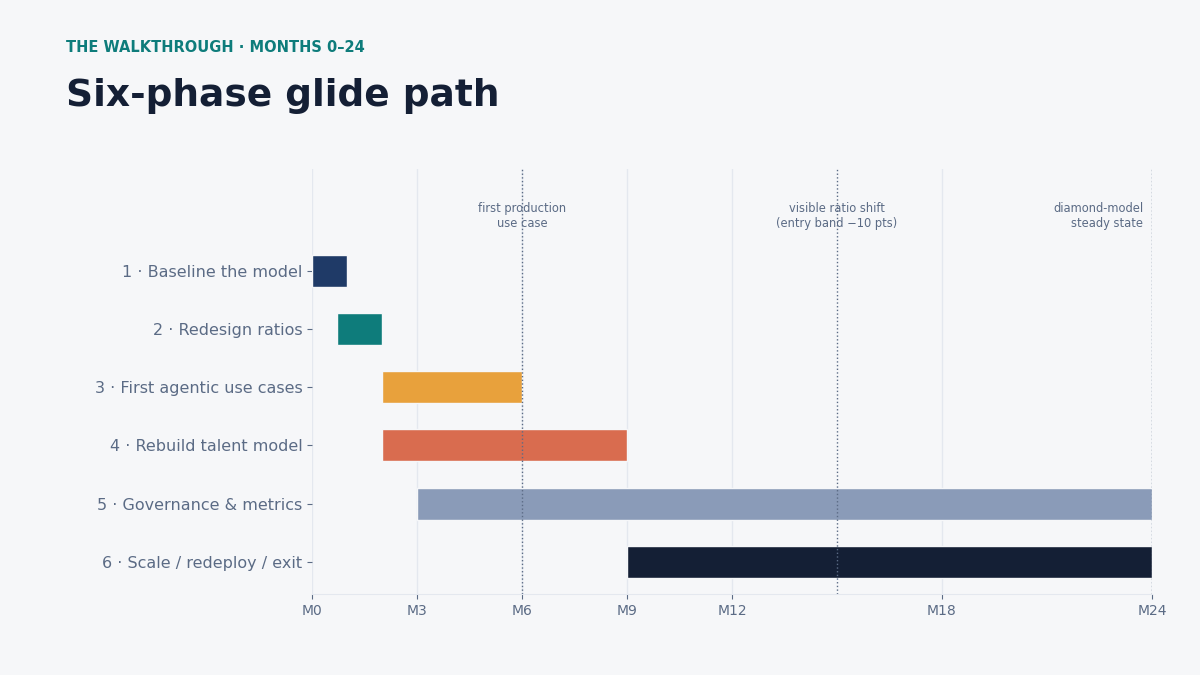
Timeline by scenario:
| Scenario | Realistic timeline | What gates it |
| First production use case (L1 deflection or engineering augmentation) | 3–6 months | SOP quality, evaluation harness |
| Visible ratio shift (entry band down 10+ points) | 12–18 months | Senior hiring velocity, redeployment program |
| Full Diamond-model operating state | 18–30 months | Charter renegotiation, governance maturity |
| New AI-first center build (greenfield) | 6–12 months to steady state | Setup route (BOT vs. self-build), leadership hiring |
Budget owners should read these bands as a system: the AI impact on GCC budgets is a reallocation (from L1 salary mass toward senior talent, platform, and inference) more than a net increase.
What moves cost up: undocumented processes (adds 3–6 months of curation work), regulated-data workflows (healthcare, BFSI compliance and audit design), fragmented point-solution tooling, and senior-hiring delays that idle the rest of the plan.
What moves cost down: a shared platform layer instead of per-team tools, redeployment before external hiring, outcome-based vendor contracts, and for the hiring workstream itself running intake through a recruitment process outsourcing model so internal TA capacity isn’t the bottleneck during the 12–18 month transition spike.
Where to Go From Here
If you’re mid-decision on restructuring a center or building a new one on AI-first ratios from day one the highest-value next step is small: pressure-test your Phase 1 baseline and target ratios against real market data on talent availability, cost bands, and hiring velocity before you commit the transformation budget.
That’s a working session, not a sales call. Supersourcing’s GCC and AI-talent team has run this exercise across 527+ delivered projects and can tell you within a conversation which parts of your plan the 2026 talent market will actually support and which ratios need a rethink. Bring your org chart and your automation shortlist: book a consultation.
FAQ: AI Impact on GCC Operations
What is the impact of AI on GCCs in India?
Agentic AI is shifting Indian GCCs from labor-arbitrage pyramids to senior-heavy, agent-augmented centers. The FY2026 Zinnov–NASSCOM data shows the ecosystem at 2,117 centers and $98.4 Bn in revenue, with hiring resilient but tilted toward AI skills and redeployment rather than linear headcount growth the structural pattern this guide details.
Will agentic AI reduce GCC headcount?
It reduces entry-level share far more than total headcount. Typical transitions cut L1 seats 30–50% while expanding senior, domain-expert, and agent-operations roles, often landing near cost-neutral with 20–40% more output. Centers using attrition and redeployment over a 12–18 month glide path rarely need large involuntary cuts.
How are GCC team structures changing because of AI?
The pyramid is becoming a diamond: 15–25% entry-level (down from 40–55%), 35–45% senior and domain talent, a new 5–10% agent-operations layer, wider spans of control, and 6–10 person cross-functional pods that pair senior humans with agent fleets and own outcomes end to end.
Which GCC functions get automated first?
The reliable first wave: L1 ticket triage and deflection, knowledge retrieval (RAG), software-engineering augmentation, back-office workflows like reconciliation prep and report assembly, and recruitment screening. All share high rule-clarity, measurable volume, and low blast radius, the three criteria that should gate any first use case.
What roles should a GCC hire in the AI era?
Agent-workflow designers, LLMOps/MLOps engineers, evaluation and guardrail leads, senior platform engineers, AI-fluent domain experts, and knowledge-base curators. These sit in India’s most contested talent band, so hiring velocity matters: a 7–10 working day sourcing-to-shortlist cycle is achievable with specialized pipelines and is often the difference between plan and slippage.
How do you measure GenAI productivity gains in a GCC?
Measure the mixed human-agent system, not the humans: cost per correct outcome (including inference spend), deflection and exception rates by category, end-to-end cycle time, and output per pod. McKinsey’s benchmarks for AI-enabled engineering 16–30% delivery and productivity gains, 31–45% quality gains among leading adopters are a fair external yardstick.
How much does it cost to add agentic AI capability to an existing GCC?
For a 200–500 person center: typically $150k–500k in year-one platform build, $20–80 per covered employee per month in inference/tooling run-rate, ₹40,000–₹1,00,000 per reskilled employee, plus the senior-hiring premium (₹30–70 LPA for agent-ops roles). Undocumented processes and regulated data are the two biggest cost multipliers.
How do we know if we’re ready to start or where to start?
Run the Phase 1 baseline: work inventory, automatability scoring, ratio snapshot, charter map. If more than 35% of headcount is doing documented, repeatable work, you have immediate headroom. If the baseline exposes gaps you can’t resource internally, especially the senior hiring and ratio redesign, a structured consultation with a team that has run GCC builds and AI-era scale-ups will compress months of trial and error into weeks.
