

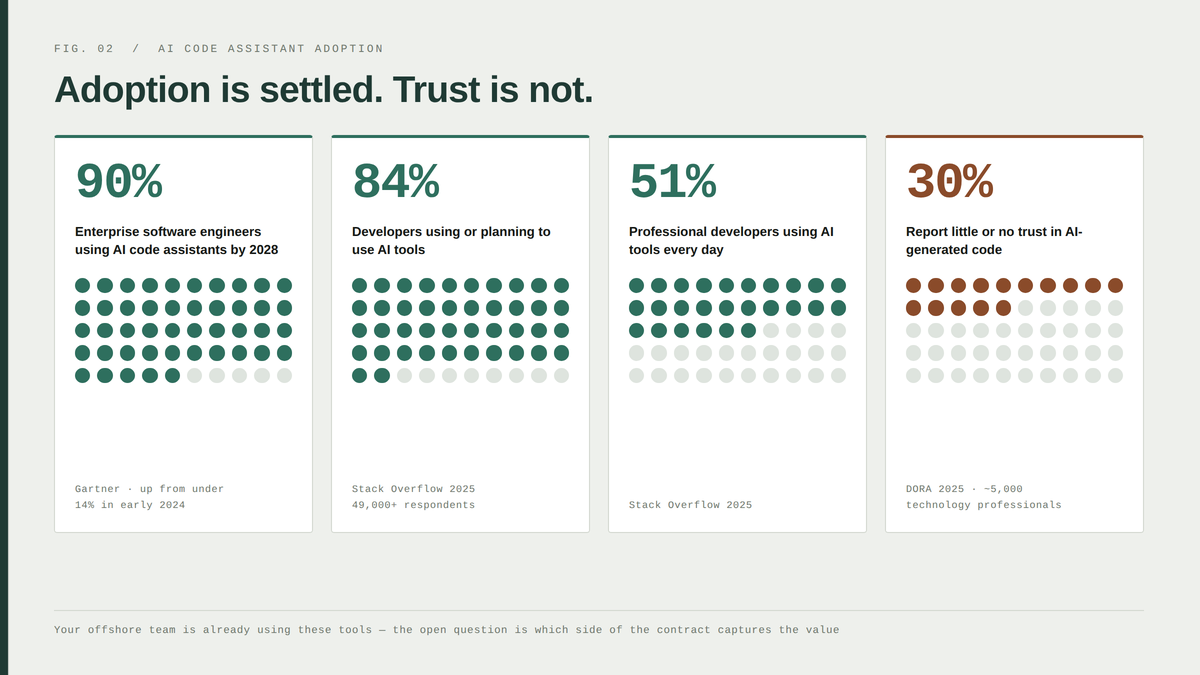
Gartner expects 90% of enterprise software engineers to be using AI code assistants by 2028 up from under 14% in early 2024. That single forecast quietly invalidates most offshore business cases written in the last three years, because nearly all of them priced engineering capacity in headcount rather than in output. Recalculating AI coding assistants offshore ROI starts by throwing that assumption out.
Gartner projects 90% of enterprise software engineers will use AI code assistants by 2028 (up from <14% in early 2024), and expects roughly a 30% aggregate productivity gain across the software development life cycle through 2028.
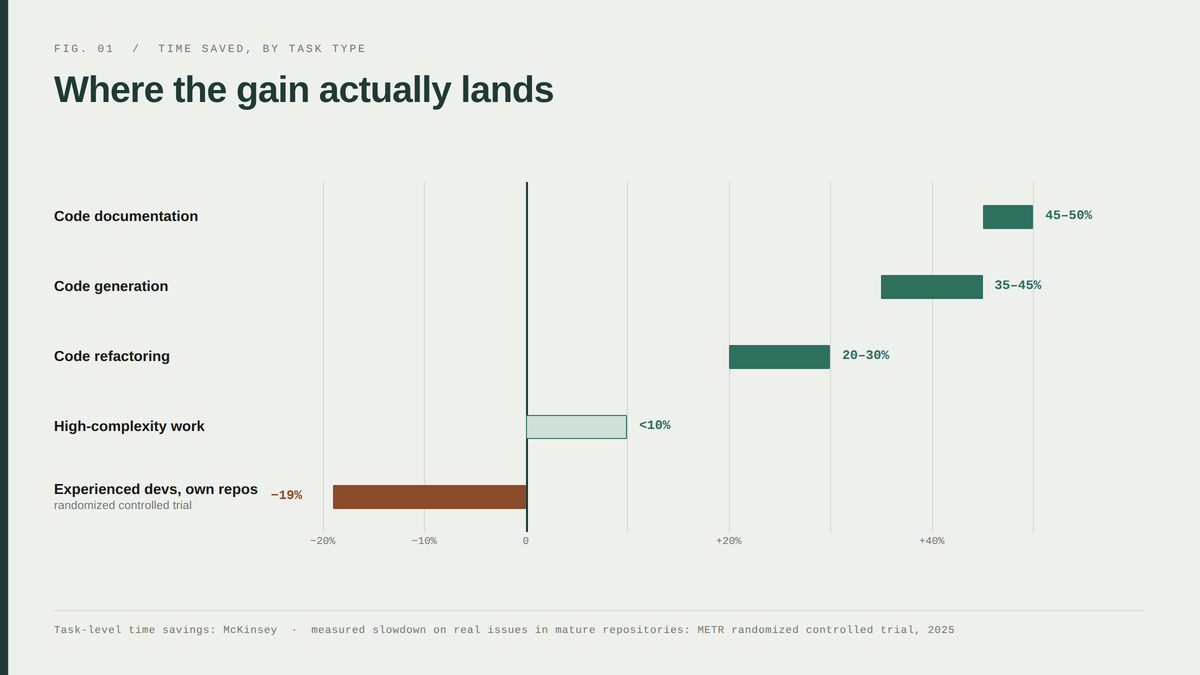
Here is the uncomfortable part. The published evidence on how much faster developers actually get is not just mixed, it is directly contradictory. McKinsey measured 35–50% time savings on documentation and code generation. A randomized controlled trial by METR found experienced developers took 19% longer on real issues in repositories they knew well. Both studies are competently run. Both are true. They measured different work.
That contradiction is the whole story for anyone buying offshore engineering capacity. The return on AI-assisted offshore delivery is not a number you can look up, because the gain lands unevenly across task types, seniority levels, and codebase maturity and the costs it creates land somewhere else entirely, usually on your senior reviewers and your architecture.
Most teams respond to this by doing one of two things. They cut offshore headcount on the assumption that AI absorbs the difference, and watch cycle time get worse. Or they keep the same team, add tool licences, and cannot prove any return at renewal because nobody captured a baseline.
This guide takes the third path: treat AI-assisted delivery as a change to your team’s composition and control system, not to its size. That framing is what makes the return measurable and defensible in front of a CFO.
TL;DR
This guide is for engineering leaders, founders, and procurement owners who run or are about to build an offshore or GCC engineering team and need to work out what AI coding assistants actually do to the economics. It covers the measurement problem, team composition, contracts, onboarding, cost bands, and the KPIs that still mean something.
The single number to hold onto: McKinsey found time savings of 45–50% on code documentation and 35–45% on code generation, but under 10% on high-complexity work. The gain is real and it is concentrated in exactly the tasks a junior offshore developer used to be hired for. That is why offshore team AI ROI now depends far more on your senior-to-junior ratio than on your hourly rate.
By the end you will be able to set a baseline you can defend, rewrite your team pyramid, negotiate the two contract clauses that decide who captures the savings, and run a 90-day measurement cycle that tells you whether the money came back.
What Are AI Coding Assistants, and What Do They Do to Offshore ROI?
AI coding assistants are large language model tools such as GitHub Copilot, Cursor, Claude Code, Codex and similar that generate, complete, explain, test, or refactor code inside a developer’s editor or terminal. In an offshore engagement they change unit economics by compressing routine implementation work while increasing review, verification, and architectural oversight load.
Three things this is commonly confused with:
- Not offshore automation or RPA. RPA replaces a business process. AI coding assistants sit inside the software development workflow and change how fast a human produces reviewable code.
- Not a replacement for a vetting process. A candidate who can prompt well is not the same as an engineer who can debug a production incident at 2 a.m. AI raises the floor of visible output while leaving the ceiling of judgement untouched.
- Not the same as agentic AI delivery. Autocomplete and chat are mature and widely adopted. Autonomous multi-step agents are still emergent Stack Overflow’s survey found roughly half of developers not using agents at all, and heavy resistance to AI in deployment and monitoring.
Why Offshore Team AI ROI Is a Board-Level Number Now
Adoption stopped being an interesting question about eighteen months ago. Google Cloud’s DORA research found 90% of nearly 5,000 technology professionals use AI at work, with over 80% reporting productivity gains and 30% reporting little or no trust in the code it produces. Stack Overflow’s survey of more than 49,000 developers put usage at 84% and daily use among professional developers at 51%.
Your offshore team is already using these tools. The only open question is whether the value shows up on your side of the contract or theirs.
The concrete business outcomes this decision moves:
- Cost per shipped feature, not cost per hour. A mid-level developer in India billing $25–45/hour who ships 30% more reviewable code is worth more than a $20/hour developer who does not but only if you have review capacity to absorb the output.
- Review capacity becomes the binding constraint. In most engagements the bottleneck migrates from “can we write it” to “can we verify it” within the first two months. Senior time, not junior time, becomes the scarce resource.
- Maintenance cost curve. GitClear’s analysis of 211 million changed lines found that moved (refactored) code fell from about 24.8% of changed lines in 2021 to 9.5%, while duplicated code blocks rose roughly eightfold. Duplication is a deferred bill, not a saving.
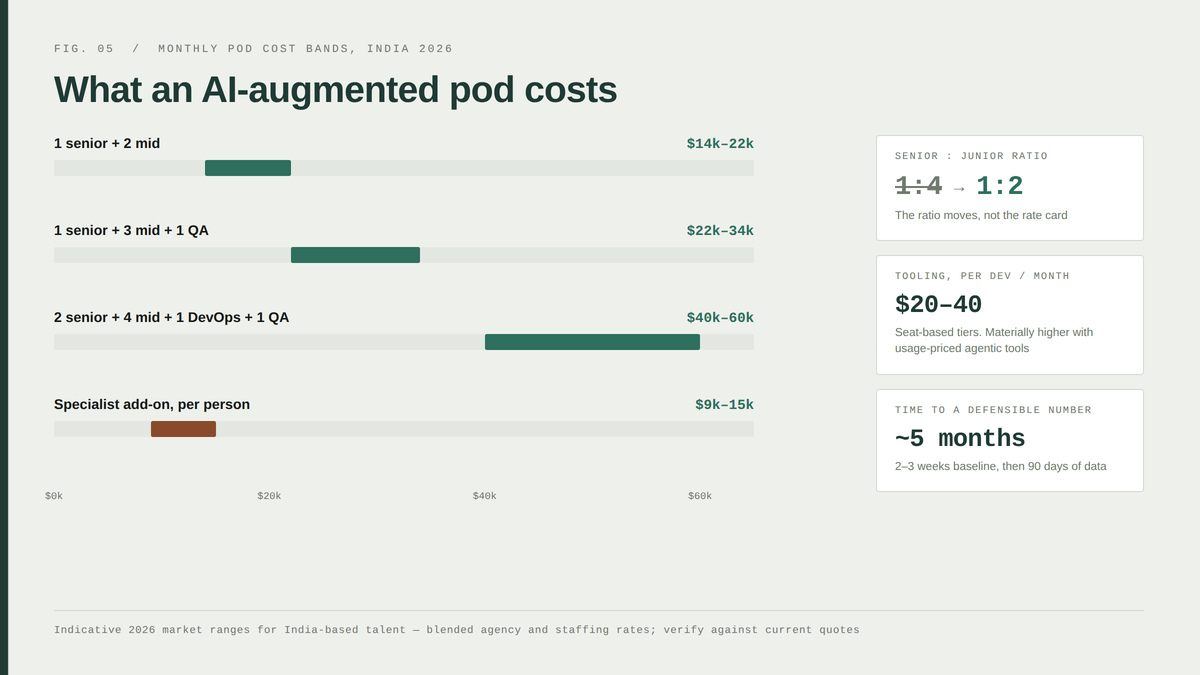
- Team shape. Work that justified a 1:4 senior-to-junior pyramid frequently now justifies 1:2. Fewer people, more expensive people, similar total spend, materially better output.
- Hiring speed as a competitive variable. When a specialist can be shortlisted in 7–10 working days rather than 8–12 weeks, you can restructure a team mid-quarter in response to what the data shows, instead of waiting for the next planning cycle.
- Compliance surface. Where AI tools are permitted to see your code and whether that is contractually specified is now a due-diligence question under DPDP Act 2023 and GDPR, not an IT preference.
India’s position sharpens the stakes. NASSCOM–Zinnov data puts India at 1,700+ global capability centres, roughly USD 64.6 billion in revenue and over 1.9 million professionals, tracking toward about USD 100 billion by 2030. The talent pool absorbing this tooling shift is the same pool most enterprises are buying from.
The Core Problem: Almost Nobody Has a Baseline
Here is what goes wrong, in order, in most engagements.
A team adopts AI tooling with no measurement of the prior state. Three months later leadership asks for the ROI. Someone pulled story points completed, which went up, and lines of code, which went up a lot. Both numbers are contaminated: story points are a human estimate that inflates when work feels easier, and code volume is now an anti-signal.
Then the second-order effects arrive:
- Review queues lengthen while commit volume rises. The team looks more productive and ships slower. Cycle time from first commit to merge is where this shows up first, usually in weeks 3–8.
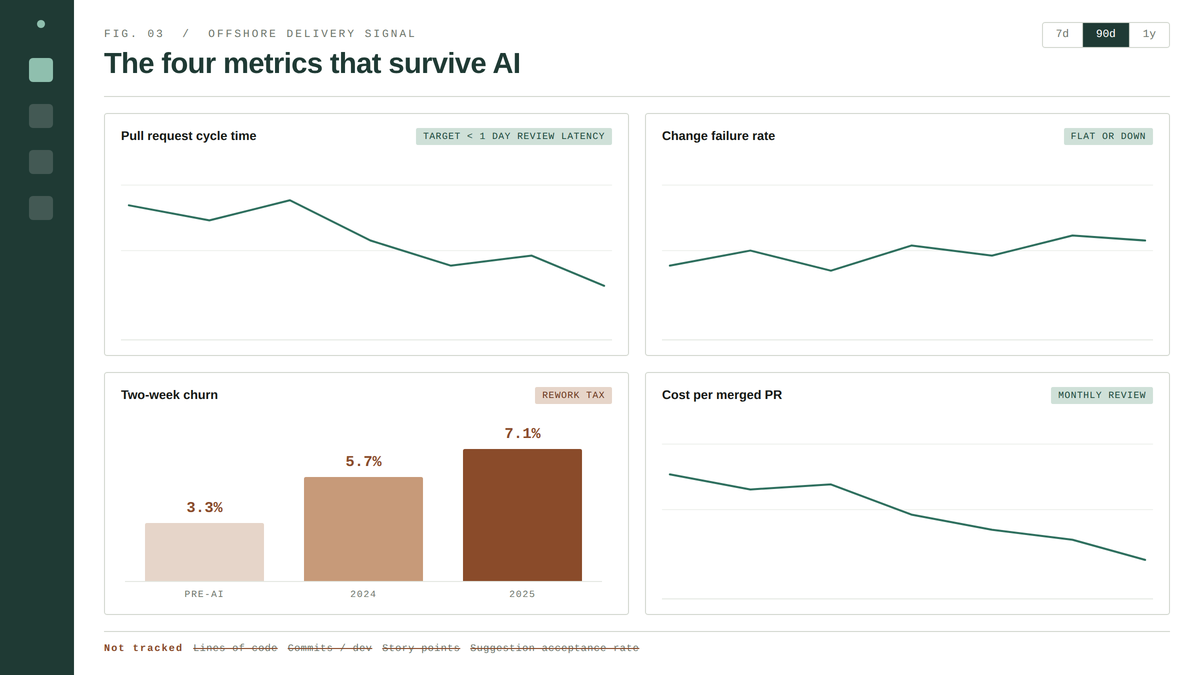
- Churn climbs quietly. GitClear’s data tracked code churn work rewritten shortly after it was committed, rising from roughly 3.3% pre-AI to 5.7% in 2024 and 7.1%. Output that gets rewritten inside two weeks was never output.
- Perception detaches from measurement. METR’s randomized trial is the sharpest example on record: developers predicted a 24% speedup, reported a 20% speedup afterwards, and were measured at 19% slower. A roughly 39-point gap between what people felt and what happened. METR’s February 2026 update indicates developers are likely faster now than in early 2025 as agentic tooling matured but the perception gap is the durable finding, not the sign of the number.
- Junior economics invert. McKinsey found that in some cases, tasks took junior developers 7–10% longer with AI tools than without. If your offshore pyramid is junior-heavy, AI can make it slower and more expensive at the same time.
The 3-week rule: if you have not instructed pull request cycle time, change failure rate, and two-week churn before rolling out tooling, you will spend the next renewal arguing from anecdote. Three weeks of clean baseline data is the cheapest insurance in this entire process.
Most dedicated teams underestimate the review and verification load by a factor of two to three. They budget for the writing and forget that someone senior now reads more code, from more sources, with less context about why it was written that way.
The Walkthrough: Building an AI-Augmented Offshore Team From Scratch
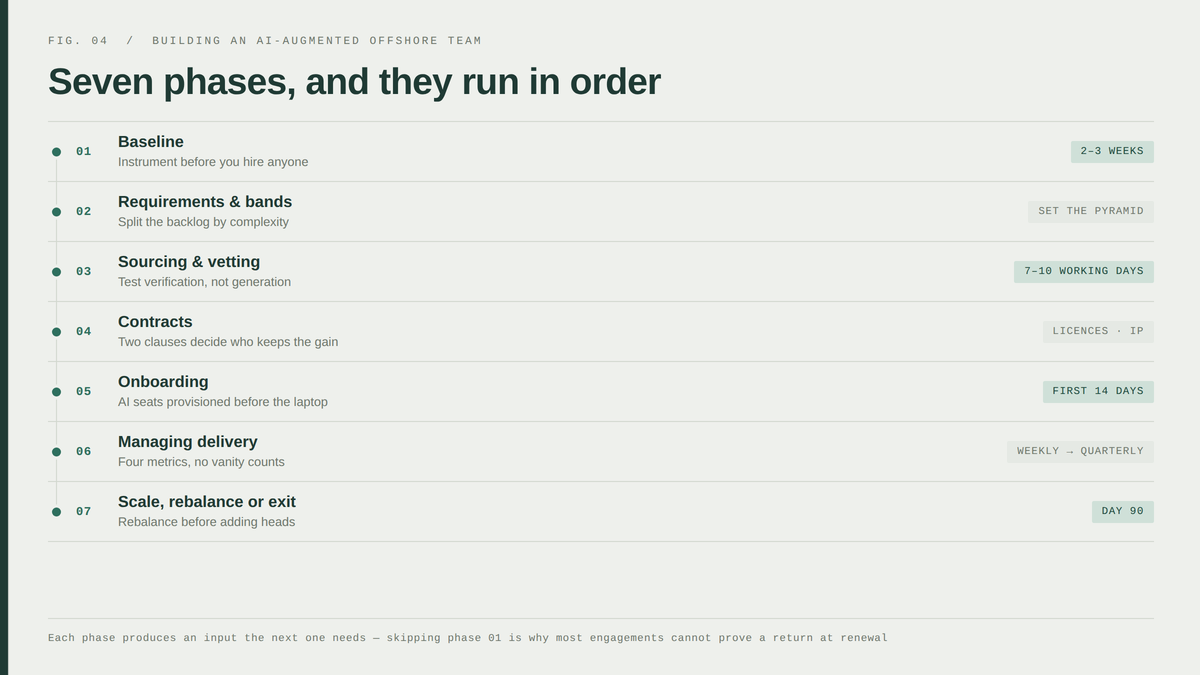
This is the full lifecycle from first suspicion that you need offshore capacity, through vetting, contracting, onboarding, measurement, and eventual scaling or exit. Follow it in order; the phases are sequenced because each one produces an input the next one needs.
Phase 1 Establish the baseline before you change anything
You cannot compute a return against an unknown starting point. Two to three weeks of data is enough.
Capture these six metrics for your existing team, whatever its size:
- Pull request cycle time median hours from first commit to merge, split by PR size.
- Review latency median hours a PR waits for first substantive review.
- Change failure rate percentage of deployments requiring a hotfix or rollback.
- Two-week churn percentage of newly added lines rewritten or deleted within 14 days.
- Escaped defects bugs found in production per release, normalised by release size.
- Cost per merged PR total loaded team cost divided by merged PRs, as a blunt but honest denominator.
Red flag: if nobody can produce these from your existing tooling within a week, your delivery process is not observable enough to measure any AI gain. Fix observability first is a two-week job and it pays for itself regardless of what you decide about offshore.
Do not use lines of code, commits per developer, or story points as your baseline. All three inflate under AI assistance without any corresponding increase in delivered value.
Phase 2 Define requirements, team shape, and budget bands
This is where AI tools developer output assumptions get encoded into a hiring plan and where most plans go wrong by simply subtracting headcount.
Work through this in sequence:
- Split the backlog by complexity, not by feature. Tag each item as routine (CRUD, integrations, documentation, test scaffolding, straightforward refactors), moderate (new service inside an existing pattern), or high-complexity (novel architecture, performance work, unfamiliar framework, anything touching money or PII).
- Apply differentiated assumptions. Using McKinsey’s measured bands as a planning input: assume meaningful compression on routine work, moderate compression on mid-tier work, and effectively none on high-complexity work.
- Count your review capacity. For every 1.0 FTE of new implementation capacity, budget 0.25–0.4 FTE of senior review and architectural oversight. This ratio is the single most commonly omitted line in an offshore business case.
- Set the pyramid. For AI-assisted delivery on a production codebase, 1:2 or 1:3 senior-to-junior tends to hold up. 1:5 and beyond, which worked when juniors were doing volume implementation, now produces review debt faster than it produces features.
- Price the tooling explicitly. Seats and usage are a real line item now, not a rounding error.
Indicative 2026 market bands for India-based engineering talent (blended agency and staffing rates; verify against current quotes):
| Level | Typical bill rate | Typical annual CTC equivalent | What AI changes |
| Junior (0–2 yrs) | $15–25/hr | ₹6–12 lakh | Weakest ROI case; needs supervision to convert AI output into safe code |
| Mid-level (3–5 yrs) | $25–45/hr | ₹15–30 lakh | Strongest absolute gain; the volume tier of an AI-augmented pod |
| Senior / lead (6–10 yrs) | $45–65/hr | ₹35–60 lakh | Value rises becomes the review and architecture constraint |
| Specialist (AI/ML, platform, security) | $60–85/hr+ | ₹45–90 lakh | Scarcest tier; rate has moved up, not down |
Tooling budget, per developer per month: roughly $20–40 for mainstream seat-based assistants at published business tiers, and materially more commonly in the low hundreds, occasionally higher where teams run agentic tools with usage-based pricing. Treat this as a directional range and get a written pass-through arrangement rather than an estimate.
If the work is concentrated in one stack, hire for that stack specifically rather than for a generic “full stack” profile. A team building event-driven services should hire Node.js developers with production experience in that runtime; a team whose bottleneck is deployment throughput should hire DevOps engineers before adding more application developers, because AI-assisted teams generate more deployable increments and hit CI/CD limits sooner.
Phase 3 Sourcing and vetting AI-augmented developers
Vetting is the phase AI has broken most thoroughly. Take-home tests and standard screening questions are now close to worthless as discriminators, because a mediocre engineer with a good tool produces the same artefact as a strong one.
What good screening looks like in 2026:
- Assume AI uses an instrument for it. Allow the tools. Ban the pretence that they were not used. You are hiring people who will use them daily; test the workflow you are buying.
- Run a live, observed session with the tools on. 60–90 minutes, a real bug in a codebase they have not seen, screen shared. Watch the sequence: do they read before they prompt, or prompt before they read?
- Ask for the failed attempts. The strongest single question we have found: “Walk me through something the assistant suggested that you rejected, and why.” Engineers who genuinely work this way have a long list. People who accept whatever appears have nothing to say and change the subject to a general point about AI.
- Test verification, not generation. Hand them AI-generated code containing a subtle defect, an off-by-one in pagination, a race condition, a missing index that only matters at scale and time the diagnosis.
- Probe architectural reasoning without tools. Ten minutes, whiteboard, no laptop. “This service is at 3,000 requests per second and p99 latency is degrading. Where do you look?” This is the tier AI does not backfill.
- Check code review skills directly. Give them a 300-line PR and ask for a review. Reviewing is now a larger share of the job than it was, and it is rarely assessed.
Red flag patterns to screen out:
- Fluent explanations of what code does with no account of why alternatives were rejected.
- Candidates who cannot reproduce a result when the tool is briefly taken away not because tool use is bad, but because it indicates no mental model underneath.
- A GitHub history of large single commits with generic messages and no review conversation.
- Anyone who describes AI tools as making review unnecessary. This correlates strongly with downstream defects.
At scale, screening depth is a throughput problem. AI-powered sourcing that surfaces a shortlist from the top few percent of vetted talent is what makes a 7–10 working day cycle from job description to interview-ready candidates possible without loosening the bar but the human evaluation above still has to happen. Tooling narrows the funnel; it does not replace the judgement at the end of it. This is the part of an IT staffing services engagement worth auditing in detail before you sign.
Phase 4 Engagement models, contracts, and the two clauses that decide ROI
Model selection matters less than two specific clauses that almost no standard MSA contains.
Clause 1 AI tooling, licensing, and cost pass-through. Rate cards written before agentic tooling existed are silent on who pays for seats and token consumption. Vendors resolve this silence in one of three ways: absorbed into the blended rate, passed through at cost with a cap, or quietly billed as a separate line at renewal. Specify which, in writing, including a monthly ceiling and a review trigger if usage exceeds it.
Clause 2 AI usage permissions and IP provenance. You need explicit language covering:
- Which tools are approved, and whether code may be sent to a third-party model endpoint at all.
- Whether prompts and completions may be retained or used for training by the tool vendor (enterprise tiers usually exclude this; consumer tiers often do not).
- Warranty that delivered code does not knowingly incorporate output flagged as matching public repositories under an incompatible licence.
- Assignment of IP in AI-assisted output to you, worded so that “generated” code is unambiguously covered.
- A prohibition on personal or unmanaged AI accounts. This is the real leak. In practice, the most common way proprietary code reaches an unapproved model is not a vendor decision, it is a blocked developer working around a security policy on day four.
Engagement model comparison:
| Model | Best fit | Cost profile | Control | Main AI-era risk |
| Staff augmentation | Known scope, existing team and process to absorb people | Hourly/monthly per person | High your process, your reviews | Your senior reviewers become the bottleneck |
| Dedicated pod | Ongoing product work, needs continuity on the codebase | Monthly per pod | Medium-high | Pod ships faster than you can make decisions |
| Project / fixed-bid | Well-defined deliverable, stable requirements | Fixed | Low | Vendor captures 100% of the efficiency gain |
| Captive GCC | 50+ engineers, long horizon, strategic IP | Fixed cost base + setup | Highest | Slowest to rebalance when tooling shifts again |
Fixed-bid deserves a specific warning. If a vendor’s cost to deliver drops 30% and the price was fixed before that, the entire gain accrues to them. Either move to a time-and-materials or pod model where efficiency shows up as scope throughput, or renegotiate fixed-bid pricing annually with an explicit productivity assumption written into the schedule.
Non-negotiables regardless of model: NDA in place before any repository access, named individuals rather than fungible “resources,” documented replacement terms with a stated turnaround (a 7–10 day replacement commitment is achievable and worth insisting on), and no shared bandwidth a developer split across three clients cannot hold enough context to review AI output competently in any of them.
Phase 5 Onboarding and the first 14 days
Ramp-up is where AI-augmented teams either compound or stall. The failure mode is specific and almost universal: access provisioning treats AI tooling as an afterthought, so a developer spends their first week productive in a way you did not authorise.
Sequence access in this order, before day one:
- AI tool provisioning and allowlisting first. Enterprise-tier seat, SSO, org policy applied, security sign-off obtained. Do this before the laptop, not after. A developer who is coding but cannot use the approved assistant will use an unapproved one.
- Repository read access with a scoped starter task identified.
- CI/CD and staging environment access.
- Observability and logging tools they need to see what production actually does.
- Production access: not in the first two weeks, on principle.
The first 14 days, day by day in blocks:
- Days 1–2: Environment running locally, approved AI tooling configured, first PR merged. The first PR should be trivial by designing a doc fix, a test, and a log line. You are testing the pipeline, not the person.
- Days 3–5: Codebase orientation with a written architecture walkthrough from your side, plus a shadowed code review. Have them review someone else’s PR on day 4; it surfaces gaps faster than making them write.
- Days 6–10: First real feature, scoped to two or three days of work, paired with a named reviewer who has committed bandwidth.
- Days 11–14: Second feature, unpaired but reviewed. First one-to-one with the actual manager, not the account manager.
Communication cadence that works across a 4.5–12 hour time gap:
- Daily async written standup with three lines: shipped, blocked, next.
- Two live overlap hours minimum, non-negotiable, scheduled the same time daily.
- Weekly 45-minute technical sync with the tech lead, not a status meeting, a design conversation.
- A documented escalation path with a named human and a stated response window for blockers.
Onboarding friction nobody warns you about: context, not capability, is what limits an AI-assisted newcomer. The assistant will confidently generate code that matches general patterns but violates your specific conventions, your error handling, your logging schema, your auth middleware.
Give every new joiner a written conventions document and, better, a repository-level configuration or rules file that encodes those conventions for the tooling itself. Teams that do this see the second-week PR quality gap close by roughly half compared with teams that rely on review comments to teach the same lessons. It takes an afternoon to write.
Target time-to-first-meaningful-commit: 3–5 working days for a mid-level developer joining a documented codebase, 7–10 days for one that is not documented. If it is past two weeks, the problem is on your side of the engagement.
Phase 6 Managing delivery: the KPIs that survive AI
Most delivery dashboards measure activity. Under AI assistance, activity metrics become actively misleading, volume rises whether or not value does.
The four metrics that still work:
- Pull request cycle time (first commit → merge). The honest speed number. It captures review latency, which is where AI-era bottlenecks live.
- Change failure rate. The quality guardrail. If throughput rises and this rises with it, you are shipping faster into a wall.
- Two-week churn. Percentage of new lines rewritten within 14 days. This is your rework tax, and it is the metric that catches AI output that looks finished.
- Escaped defects per release, normalised by release size. The lagging indicator that tells you whether the first three are lying.
Metrics to actively remove from reporting: lines of code, commits per developer, story points completed, AI suggestion acceptance rate. Acceptance rate in particular gets adopted because tool vendors surface it; a high acceptance rate is as consistent with uncritical acceptance as with good prompting, so it discriminates nothing.
Reporting cadence:
- Weekly: cycle time and review latency, reviewed by the tech lead. Fast enough to catch a queue forming.
- Bi-weekly: churn and change failure rate, reviewed jointly by your lead and the vendor’s account manager.
- Monthly: cost per merged PR and cost per shipped feature, reviewed by whoever owns the budget.
- Quarterly: team composition review is the senior-to-junior ratio still right for the work in the backlog?
Two structural requirements make this work. First, a dedicated account manager on the vendor side with authority to move people, not just to relay messages; escalating a delivery problem through a shared inbox costs you two weeks every time.
Second, a code owner is on your side for every significant module, because AI-generated code needs a human who is accountable for whether it belongs in the system. Across the 500+ delivery engagements Supersourcing has supported, the single best predictor of whether an offshore pod compounds or plateaus is whether that ownership was assigned on paper in month one.
Red flag: a rising ratio of PRs merged with zero review comments. It reads as maturity. It usually means reviewers have given up and are rubber-stamping a queue they cannot clear.
Phase 7 Scaling, rebalancing, or exiting
The decision point arrives at roughly 90 days, when you have enough post-baseline data to act on.
Scale when all four hold:
- Cycle time has improved or held while throughput rose.
- Change failure rate is flat or down.
- Review latency is under one working day at the current team size.
- The backlog contains at least two quarters of work at current velocity.
Rebalance instead of scaling when: throughput is up but review latency is climbing. Adding implementation capacity here makes things worse. Add senior review capacity, or convert two junior seats into one senior seat, a swap that is frequently cost-neutral and immediately unblocks the queue.
Exit or replace when: churn is above roughly 10% and not falling after two months of intervention, or when the same category of defect recurs across three sprints despite explicit feedback. Both signal a capability gap that AI tooling is masking rather than solving.
Offboarding checklist run it in this order:
- Revoke AI tool seats and audit for any personal-account usage during tenure.
- Revoke repository, CI/CD, and cloud access; rotate any credentials the individual could have seen.
- Confirm written IP assignment covering all delivered work, including AI-assisted output.
- Knowledge transfer: recorded walkthrough of owned modules, plus updated documentation, before the last working day not scheduled for it.
- Two-week overlap with the replacement wherever the notice period allows.
A stated replacement guarantee with a 7–10 day turnaround is worth negotiating for specifically, because the alternative of a 6–10 week re-hire cycle is where offshore ROI models actually die. Not in the rate card, in the gap.
Case Studies
Three engagements from Supersourcing’s delivery history, chosen because each isolates a constraint that AI tooling makes sharper rather than softer. Metric first, story second.
100+ engineers hired for Paytm. A fintech scale-up hiring at this volume cannot rely on generic profiles; each role was matched to a specific stack and product line, with vetting depth held constant across the whole cohort. The operative lesson for AI-era hiring is throughput without dilution: the constraint on scaling an engineering org is rarely candidate supply, it is maintaining evaluation depth at volume which is exactly the constraint that gets abandoned first when a team is trying to close 100 seats in a quarter.
Swiggy’s engineering scale-up under compressed timelines. High-growth consumer platforms hire in bursts tied to product launches, which means the shortlist has to arrive in days rather than months. Sustaining a 7–10 working day cycle from job description to interview-ready shortlist is what makes it possible to re-shape a team mid-quarter the capability that matters most now, because AI tooling keeps changing what the right team shape is.
OkCredit and Somnoware: specialist depth over headcount. Both engagements centred on hiring for specific technical depth rather than volume, with recruitment workflows automated so human evaluation time went to the candidates who warranted it. Across the portfolio, a 98% candidate joining rate and under 1% drop-off on contract roles are the metrics that matter here: in a market where a strong AI-augmented senior engineer is doing work that used to need three people, a candidate who accepts and then does not join is not an inconvenience it is a quarter of your delivery plan.
Decision Framework: Choose the Model Before You Choose the Vendor
Score your situation against these four dimensions, then read the recommended model. Be honest about the second row, it is the one that disqualifies most plans.
| Dimension | Question to answer honestly | If low | If high |
| Review capacity | Do you have senior engineers with real bandwidth to review incoming code? | Buy a pod that includes its own senior review | Staff augmentation works; buy implementation capacity |
| Codebase maturity | Is the codebase documented, tested, conventionally structured? | Expect AI gains near zero; fix this first | Expect gains at the upper end of published ranges |
| Scope stability | Will requirements hold for a quarter? | Time-and-materials or pod | Fixed-bid is defensible, with an annual productivity reset |
| Strategic horizon | Is this capability core for 3+ years? | Staff augmentation or pod | Consider a global capability center |
Cost, control, speed, and risk across the four options:
Freelance is where AI-era delivery breaks down most predictably. AI-assisted code needs a consistent reviewer who holds context on the codebase over months. A rotating cast of contractors produces individually plausible code that collectively does not cohere and the duplication data suggests that is precisely the failure mode AI tooling amplifies.
What Most Teams Get Wrong
The dominant error is treating AI coding assistants as a headcount reduction lever. They are a team composition lever. The teams capturing real returns did not shrink; they changed shape: fewer juniors, more seniors, more review capacity, tighter ownership.
Cutting headcount and expecting the tooling to absorb the difference moves the bottleneck from writing code to verifying it, and verification is the more expensive constraint.
Five specific patterns worth naming:
- Buying seats instead of buying a workflow. Licences are the cheap part. The expensive part is conventions files, review standards, and CI gates that make AI output safe by default. Teams that skip this get the output volume and none of the quality.
- Applying a single productivity multiplier across all work. A blanket “assume 30% faster” assumption is wrong twice: it undershoots on documentation and boilerplate, and it wildly overshoots on the complex work that determines whether you ship. Model routine and complex work separately or your plan will be wrong in both directions at once.
- Believing self-reported gains. METR’s trial found a roughly 39-point gap between perceived and measured productivity. Developer sentiment is a real signal about tool quality and retention. It is not a measurement of throughput, and it should never appear in an ROI calculation.
- Cutting juniors to zero. Tempting, given the evidence that juniors gain least. But juniors are your senior pipeline, and a team with no juniors in 2026 has no seniors in 2030 while your review load only grows. Reduce the ratio; do not zero the tier.
- Leaving the efficiency gain on the vendor’s side of the table. If your commercial model is fixed-price and your vendor’s cost to deliver has fallen, you are funding their margin expansion. This is the most expensive mistake on the list and the least discussed, because it never appears as a problem in any delivery metric.
Cost & Timeline Reality Check
Cost bands for an AI-augmented offshore pod (India, 2026 market ranges):
| Team shape | Monthly cost band | Realistic output | Notes |
| 1 senior + 2 mid | $14,000–22,000 | 1 substantial feature stream | Best starting configuration for most teams |
| 1 senior + 3 mid + 1 QA | $22,000–34,000 | 2 parallel streams | Add QA before adding a fourth developer |
| 2 senior + 4 mid + 1 DevOps + 1 QA | $40,000–60,000 | Full product squad, own release train | Needs a dedicated engineering manager on your side |
| Specialist add-on (AI/ML, security, platform) | $9,000–15,000 per person | Depends entirely on the problem | Rate has risen, not fallen scarce tier |
Add tooling: roughly $20–40 per developer per month for seat-based assistants at business tiers, rising into the low hundreds where agentic tools with usage-based pricing are in daily use. Budget it explicitly and get pass-through terms in writing.
What drives cost up:
- Undocumented legacy codebases expect a 20–40% effective productivity discount for the first quarter, and no meaningful AI gain until documentation exists.
- Compliance scope: healthcare, payments, or anything touching PII adds review overhead and narrows the approved tool set.
- Real-time overlap requirements beyond 4 hours, which is a rate premium in every offshore market.
- Specialist scarcity. Generative AI and platform engineering skills price at a premium; if the work genuinely needs it, hire Generative AI developers with production deployment experience rather than trying to upskill a generalist mid-project.
What drives cost down:
- A documented, tested codebase, the single largest lever, and one you control.
- Longer commitments: 12-month engagements typically price 10–15% below three-month ones.
- Async-first working, which removes the overlap premium.
- A stable senior-to-junior ratio, because rebalancing mid-engagement carries ramp-up costs every time.
Timeline by scenario:
| Scenario | Realistic timeline |
| Baseline instrumentation before any hiring | 2–3 weeks |
| Job description → interview-ready shortlist | 7–10 working days |
| Offer → onboarded (accounting for notice periods) | 2–6 weeks |
| Onboarded → first meaningful commit | 3–5 days documented codebase; 7–10 days if not |
| Onboarded → full productivity | 4–8 weeks |
| Enough post-baseline data to compute ROI | 90 days |
| Replacement if a hire is not a fit | 7–10 days with a contractual guarantee; 6–10 weeks without |
Total honest answer to “when will I know if this worked”: about five months from decision to defensible number. Anyone promising an ROI figure at 30 days is showing you activity metrics.
Where to Take This Next
If you are mid-decision, the sequence matters more than the vendor. Instrument your baseline for three weeks. Split your backlog by complexity. Work out your review capacity honestly. Only then decide how many people you need and at what seniority because that ratio, not the hourly rate, is what determines whether ai coding assistants offshore roi shows up as a real number or as a slide nobody can defend.
If that maps to something you are working through now a team shape you are unsure about, a renewal where the AI tooling terms are unclear, or a hiring plan that assumed a productivity multiplier nobody has tested a single conversation with people who have run the pattern before is usually enough to avoid the expensive version of the mistake.
Talk to the Supersourcing team about the team composition, not the headcount. Bring your backlog mix and your current review capacity; those two inputs are enough to model the rest.
FAQ
Do AI coding assistants make offshore teams cheaper or just faster?
Neither, directly. They change what a given team can produce, which lets you reshape the team usually toward fewer, more senior people. Cost per hour tends to rise; cost per shipped feature is what falls. If you measure only rate cards, an AI-augmented team looks more expensive while being better value.
Does AI reduce the number of offshore developers I need?
It reduces the number of junior implementers you need and increases demand for senior reviewers and architects. Net headcount often falls 20–30% for the same throughput, but the remaining team is more expensive per person. Plan the ratio change first, then let the headcount number fall out of it.
How much productivity gain should I budget for?
Model it by task type rather than as one number. McKinsey measured 45–50% time savings on documentation, 35–45% on code generation, 20–30% on refactoring, and under 10% on high-complexity work. Weight those against your own backlog mix. A blended 15–25% is a defensible planning assumption for most product teams; anything above 40% needs evidence from your own baseline.
Who pays for AI tool licences in a staff augmentation contract?
Whoever negotiated it into the contract. Most pre-2025 MSAs are silent, which means it gets resolved at renewal in the vendor’s favour. Specify the approved tool set, who buys the seats, whether usage-based costs pass through at cost, and a monthly ceiling that triggers a review.
How do I tell whether my offshore vendor’s developers use AI well or badly?
Look at two-week churn and review comment density, not output volume. Developers using AI will produce code that survives contact with review; developers using it badly produce a lot of code that gets rewritten within a fortnight. Asking to see churn data as part of monthly reporting of a vendor who cannot produce it is not measuring delivery quality at all.
Should I stop hiring junior developers?
No, but change the ratio. The evidence that juniors gain least from AI tooling is real. McKinsey found some tasks took junior developers 7–10% longer with the tools. Move from 1:4 or 1:5 senior-to-junior toward 1:2 or 1:3 and make sure each junior has a named mentor with actual review bandwidth.
Does AI-generated code create IP or compliance risk in an offshore engagement?
Yes, in two places: code leaving your environment to reach a model endpoint, and licence provenance of generated output. Both are contractually manageable enterprise tool tiers that exclude training on your data, an explicit approved-tool list, IP assignment worded to cover generated code, and a hard prohibition on personal AI accounts. The unmanaged-account route is the most common real-world exposure.
How long before I can prove ROI to my CFO?
Realistically 90 days of post-baseline data on top of 2–3 weeks of baseline, so roughly four to five months from decision. Bring four numbers: pull request cycle time, change failure rate, two-week churn, and cost per merged PR. If you would like help constructing that baseline before you commit to a team shape, that conversation is worth having before the hiring starts, not after.
