

Somewhere in your pipeline right now is a strong engineer who did not submit your take-home test. They read the brief, estimated six hours, checked the two other offers already on the table, and closed the tab. You will never see them in a report, because funnel dashboards count who failed, not who declined.
That silent loss is the real cost of a badly designed assessment, and it has become more expensive in the last eighteen months. Coding challenges for developer hiring used to fail in one direction: too hard, too long, too abstract. Now they fail in two. The same test that repels your best candidates is also trivially solvable by anyone with a frontier model in a second window so the signal degrades from both ends at once.
Gartner predicts that by 2028, one in four candidate profiles worldwide will be fake and contain material identity misrepresentation. In a Gartner survey of 3,000 job candidates, 6% already admitted to interview fraud either impersonating someone or having someone impersonate them. Source: Gartner, “Gartner Survey Shows Just 26% of Job Applicants Trust AI Will Fairly Evaluate Them,” 31 July 2025 hyperlink to the press release.
Most hiring teams responded to this by adding proctoring and hoping. That is the wrong lever. Proctoring polices the container; it does nothing about what is inside it. If a question can be answered correctly without understanding, tightening the webcam rules does not make the answer mean more.
The alternative is not more surveillance. It is a different class of question, scored against a rubric that was written before the first candidate saw it, delivered at a stage where its cost to the candidate is proportional to their probability of an offer. That is a design problem, and design problems have documented solutions.
This guide is the working version of that solution, the internal playbook, published.
TL;DR
This is a build guide for anyone who owns technical screening: engineering leads, heads of talent, founders doing their first ten hires, and GCC leaders standardising assessment across a new India centre. It covers what to measure, which format to use at which stage, how to time-box, how to score, what it costs, and how to audit the whole thing for fairness.
The number that reframes everything: keep an asynchronous screen at or under 60 minutes and your completion rate holds; push a take-home past roughly four hours and you begin filtering for candidate availability rather than candidate ability. Senior engineers with competing offers are the first to disappear, which means a long test systematically removes the exact people you built it to find.
By the end you will have a stage-by-stage architecture for coding challenges for developer hiring, a copy-paste rubric template with anchored scoring, defensible cost and timeline bands, and a short list of checks that surface bias before your legal team does. Applying take-home coding assignment best practices is the easy part; knowing which stage deserves a take-home at all is the decision this guide is built to make for you.
What Are Coding Challenges for Developer Hiring?
Coding challenges for developer hiring are structured work-sample tests that ask a candidate to produce or reason about real code under defined constraints, scored against a rubric fixed in advance. Their purpose is to replace impressions of competence with observable evidence of it measuring how someone actually works, rather than how well they interview.
Three things it is routinely confused with:
- Not an aptitude or logic test. Aptitude tests measure a general trait. A work-sample test measures performance on a task that resembles the job. The second predicts better and defends better.
- Not a certification exam. Certifications verify knowledge against a fixed syllabus. A coding challenge verifies judgment on an open problem where several answers are acceptable and the reasoning is the artefact.
- Not a productivity trial. If the output has commercial value to you, it has stopped being an assessment and become work. That distinction is the line the unpaid-labour objection sits on, and it is drawn by usability, not by hours.
Why Assessment Design Decides Your Hiring Outcome
Screening design is usually treated as a process detail owned by whoever has capacity. It is closer to a capital allocation decision, because four expensive numbers move when you change it.
- Engineer time is the largest hidden line item. A four-round loop consumes roughly 8–12 engineer-hours per candidate across interviewing, review, and debrief. At ten candidates per hire, that is 80–120 hours of senior capacity per role a full engineer-month redirected away from delivery.
- Completion rate sets the ceiling on pipeline quality. If 50% of invited candidates finish your screen, you did not evaluate half the people you sourced. Nothing further down the funnel recovers them.
- False negatives are invisible and compounding. A test that rejects competent engineers produces no error signal at all. The role stays open, the vacancy cost accrues, and the process looks rigorous while quietly failing.
- Offer acceptance is downstream of assessment experience. Candidates read process quality as a proxy for engineering culture. A vague brief and a three-week silence tell them exactly what your sprint reviews are like.
- Bad-hire cost is asymmetric. A mis-hire at senior level typically costs a multiple of salary once ramp time, team drag, backfill, and delivery slippage are counted which is why the screening stage carries more leverage per hour than any other part of the funnel.
The pattern worth internalising: assessment quality is a throughput lever, not a compliance step. Teams that treat coding challenges for developer hiring as paperwork pay for it in engineer-hours and vacancy weeks.
The Assessment Trap: Where Technical Hiring Loses Its Best Candidates
What goes wrong is rarely one bad decision. Most broken coding challenges for developer hiring are the product of a sequence of individually reasonable choices that compound into a process nobody would have designed on purpose.
The scope estimate is wrong by 2–3x. An engineer designs a task, solves it themselves in 90 minutes, and labels it a two-hour exercise. They already knew the domain, the schema, and the intended approach. A candidate starting cold reading the brief, setting up the environment, guessing at ambiguities routinely takes two to three times the author’s time. Assignments briefed as two hours regularly land at five.
The rubric is written after the submissions arrive. Reviewers open the code and form an impression, then reverse-engineer criteria that justify it. This is where inter-rater reliability collapses: the same submission passes with one reviewer and fails with another, and neither can articulate the difference beyond “it felt senior.”
The test measures the wrong construct. Timed algorithm puzzles measure recall and practice volume under stress. Most production work is comprehension, integration, and debugging inside code someone else wrote. A candidate can be excellent at the second and mediocre at the first, and your test will call that a failure.
The stage cost is inverted. Heavy assignments get placed early, where the candidate’s probability of an offer is at its lowest. Asking for six unpaid hours in exchange for roughly a one-in-ten chance of proceeding is a bargain nobody senior accepts.
Red flag: if your take-home pass-through rate is high but your on-site rejection rate is also high, the take-home is not screening, it is scheduling. It is admitting people the next round would have admitted anyway, at a cost of several unpaid hours each.
The integrity assumption is stale. Any process designed assumed the artefact reflected the author. A Gartner survey of 3,290 candidates found 39% already used AI during the application process, and the trajectory has only steepened since. Treating the submission as unassisted work is now the exception case, not the default.
Each of these is fixable. The rest of this guide fixes them in order.
The Technical Assessment Process for Hiring Developers: A Six-Phase Walkthrough
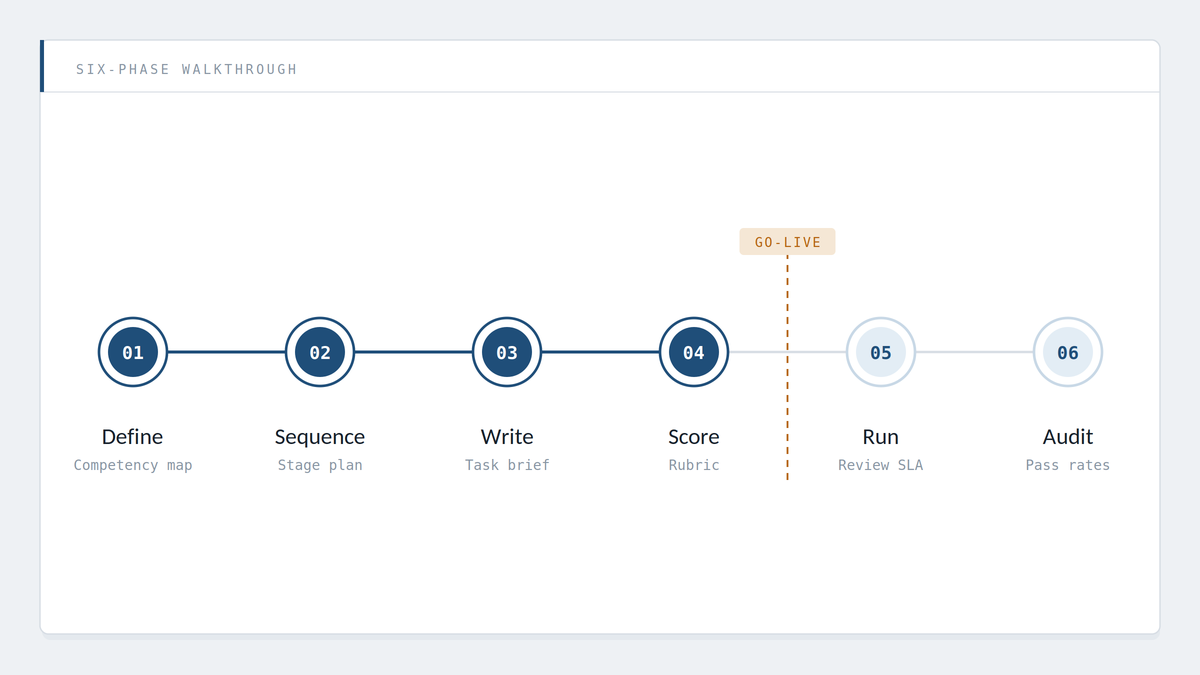
Everything below assumes you are starting from nothing: no rubric, no platform, no agreed stages. Work through the phases in order. Skipping Phase 1 is the single most common cause of an expensive Phase 5.
Phase 1 Decide what you are actually measuring
Most assessments are designed by choosing a question. That is backwards. Start by naming the competencies the role fails without, then find or build a task that exposes them.
Run a 45-minute job analysis with the hiring manager and one engineer who currently does the job well. Ask what the last three hard weeks in this role actually required. You are looking for verbs, not technologies.
The competency map five slots, ranked:
- Core implementation: can they write correct, readable code in the stack? (Table stakes; rarely the differentiator.)
- Comprehension: can they read unfamiliar code and form an accurate mental model? (Predicts week-one productivity better than anything else.)
- Debugging and diagnosis given failing behaviour, can they isolate cause from symptom?
- Design judgment: do they choose proportionate solutions, and can they name what they traded away?
- Communication of technical reasoning: can they make a decision legible to someone who was not in their head?
Rank these for the specific role and cut to the top three. A test that tries to measure five things measures none of them reliably.
Work example front-end mid-level. For a role where you would typically hire ReactJS developers, the top three are usually comprehension, design judgment, and communication. Implementation is assumed.
So the highest-signal exercise is not “build a component from scratch” it is “here is a component with a state-management problem and a failing test; diagnose it and explain the fix.” That takes 40 minutes and tells you more than a three-hour greenfield build.
Checklist before leaving Phase 1:
- Top three competencies written down and agreed by the hiring manager in writing
- One sentence per competency describing what “good” looks like at this level
- An explicit list of what you are choosing not to test
- Confirmation that every competency is genuinely required not aspirational
- Seniority band fixed, because the same task cannot assess a junior and a staff engineer
Phase 2 Design the stage architecture
Format is a stage-level decision, not a global one. One rule governs how coding challenges for developer hiring should be sequenced: the candidate’s time investment at any stage must be proportionate to their probability of advancing from it.
Early stages have low pass-through, so they must be cheap for the candidate. Later stages have high pass-through, so they can be expensive.
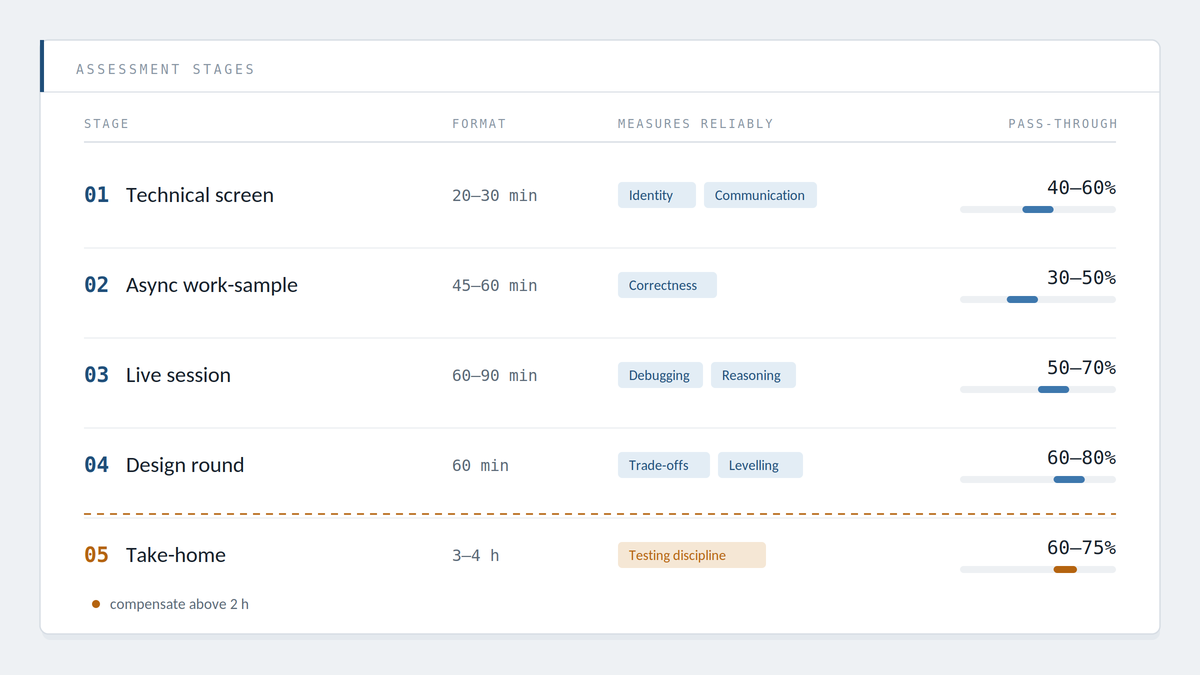
The four-stage architecture that works for most engineering roles:
- Stage 1 Recruiter/technical screen (20–30 min, synchronous). Verify the résumé is describing this person. Two or three specific questions about a project they claim. Purpose: identity and baseline plausibility.
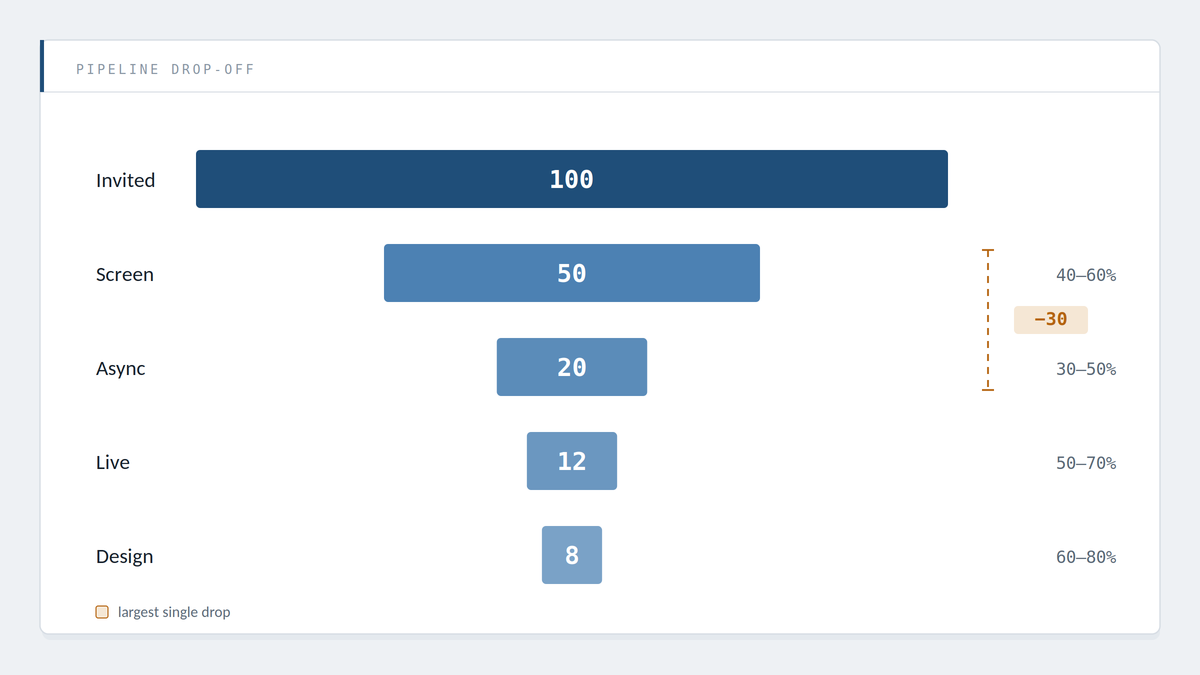
- Stage 2 Asynchronous work-sample (45–60 min, hard cap). One focused task. Auto-scored where possible. Purpose: eliminate the clearly unqualified without spending engineer time.
- Stage 3 Live technical session (60–90 min, synchronous, with an engineer). Pair debugging, code review, or extension of the Stage 2 artefact. Purpose: this is where real signal lives.
- Stage 4 Design and collaboration round (60 min). Open-ended system design plus team fit. Purpose: seniority calibration and levelling.
Infographic block assessment stage mapped to what it actually measures:
| Stage | Format | Measures reliably | Does not measure | Candidate cost | Typical pass-through |
| 1. Technical screen | Call, 20–30 min | Identity, claim accuracy, communication | Coding ability | 30 min | 40–60% |
| 2. Async work-sample | Timed, 45–60 min | Core implementation, basic correctness | Judgment, collaboration, design | 60 min | 30–50% |
| 3. Live session | Pair, 60–90 min | Comprehension, debugging, reasoning under ambiguity | Long-horizon design, thoroughness | 90 min | 50–70% |
| 4. Design round | Discussion, 60 min | Design judgment, trade-off articulation, levelling | Implementation quality | 60 min | 60–80% |
| Optional: extended take-home | Async, 3–4 h max | Code organisation, testing discipline, thoroughness | Speed, collaboration, verbal reasoning | 3–4 h (compensate) | 60–75% |
The 3-day rule: a candidate should be able to complete every stage within three working days of elapsed calendar time if they choose to. Not three days of work, three days of latency. Every additional week of scheduling drift is a week your competitor’s offer is landing.
Phase 3 Write the assignment (take home coding assignment best practices)
This is where most of the damage happens, and where the largest gains are available. The design principles below are specifically calibrated for a market where you should assume AI assistance is present.
Time-boxing rules that hold up:
- Cap the async screen at 60 minutes. Beyond that, completion rate falls and the marginal signal does not justify the loss.
- Cap any take-home at 4 hours, and pay for anything above 2. If the scope needs more, your scope is wrong.
- Halve your own estimate, then test it. Have an engineer who did not write the task attempt it cold and time themselves. That number is the real number.
- State the time box in the brief and mean it. Tell candidates explicitly: “we expect this to take 90 minutes; we will only review the first 90 minutes of work; do not polish.”
- Ship a working environment. A repo that runs with one command, or a browser IDE. Environment setup is not a competency you are hiring for, and it is where a third of the clock disappears.
Designing for a market where AI is assumed present. The strongest available finding here is uncomfortable: developers are adopting AI faster than they trust it.
Read that as a job description. The scarce skill in 2026 is not producing code, it is evaluating code that looks plausible and is subtly wrong. So build the test around that:
- Ask for a code review, not a code submission. Give the candidate 150 lines containing three defects: one syntactic, one logical, one architectural. Ask them to rank the defects by severity and justify the ranking. Generative tools find the first easily, the second sometimes, and the third almost never and the ranking rationale is where human judgment shows.
- Require a decision log. Three bullets: what you tried, what you rejected, why. Cheap to write if you did the work, near-impossible to fake convincingly under follow-up.
- Anchor the live round to the async artefact. “Walk me through line 40. Now change this requirement. What breaks?” Authorship becomes verifiable in four minutes, without a single proctoring tool.
- Allow AI explicitly, and score the usage. Ask candidates to state where they used assistance and what they changed about the output. You get honest data instead of an unenforceable ban, and how they answer is itself a signal.
- Use novel domain context. A task built on your own (anonymised) domain quirks resists pattern-matching far better than any variation of a public problem.
Red flag in the brief itself: if the assignment output could be shipped, you have crossed from assessment into unpaid labour. Two tests could you use this artefact commercially, and does the brief resemble a ticket in your backlog? If either is yes, redesign or pay market rate.
Work example backend. For a role where you would hire Nodejs developers, a defensible 90-minute async task: a small service with a failing integration test, an N+1 query, and an unhandled error path. The candidate fixes the failing test, identifies the performance issue, and writes three bullets on what they would change with a full day. That covers comprehension, diagnosis, and design judgment in 90 minutes.
The brief template seven required elements:
- Context: what the system is and why the task matters
- The task, stated as an outcome, not a spec
- Explicit time box and the instruction not to exceed it
- Exactly what will be evaluated, in the candidate’s own language
- What is explicitly out of scope (deployment, auth, styling, tests name it)
- AI policy, stated plainly
- Submission mechanics, deadline, and who reviews it
Phase 4 Build the rubric (fair coding test design starts here)
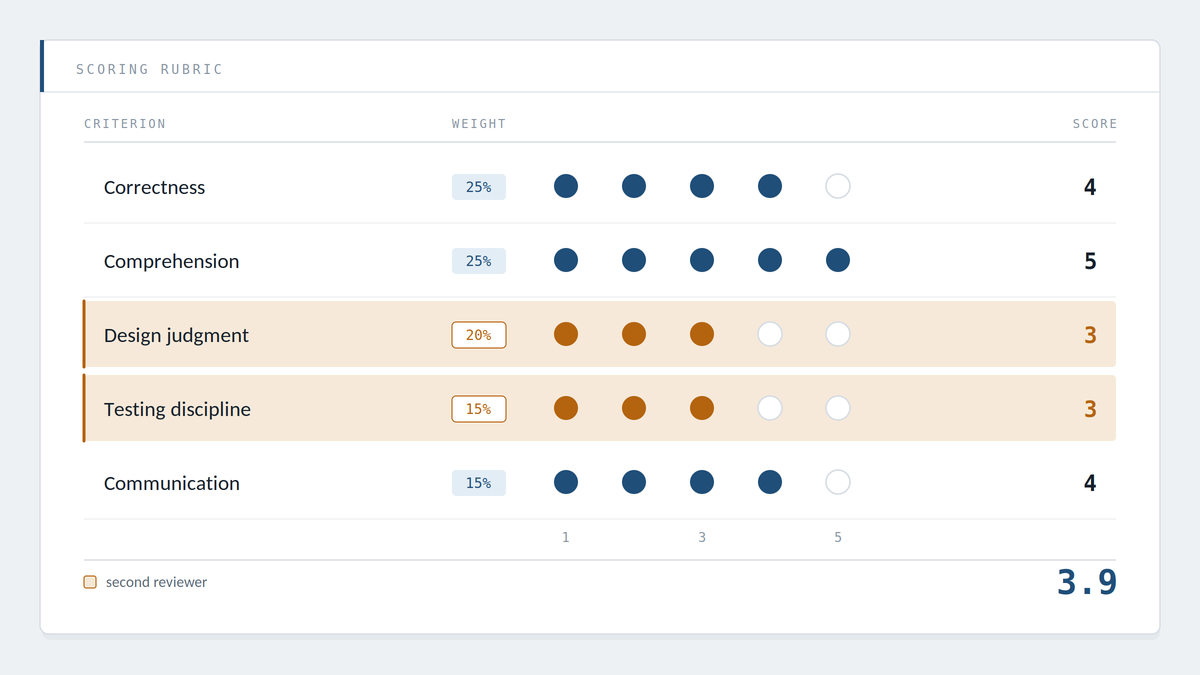
A rubric written before submissions arrive is the difference between assessment and taste. Fair coding test design depends on one property above all others: two reviewers scoring the same submission independently should land within one point of each other.
Rubric template copy this structure:
- Correctness (weight 25%)
- 1 Does not run, or fails the stated requirement
- 3 Meets the core requirement; edge cases unhandled
- 5 Meets requirement; handles the obvious failure modes deliberately
- Code comprehension / diagnosis (weight 25%)
- 1 Misidentifies cause; treats symptom
- 3 Finds the defect; explanation is partial
- 5 Isolates cause, names the mechanism, notes what else it could affect
- Design judgment (weight 20%)
- 1 No structure, or over-engineered beyond the brief
- 3 Reasonable structure; trade-offs unstated
- 5 Proportionate structure; names at least one thing deliberately traded away
- Testing and verification discipline (weight 15%)
- 1 No verification of any kind
- 3 Tests the happy path
- 5 Tests the boundary that would actually break in production
- Communication (weight 15%)
- 1 No reasoning offered
- 3 Describes what was done
- 5 Describes what was decided and why, at the right altitude for the reader
Four rules that make the rubric work:
- Anchor every score. A 3 must have a written definition. “Good/average/poor” is not a rubric; it is a mood.
- Score blind where feasible. Strip name, university, employer, and photo before review. This is the cheapest bias reduction available and it costs one step in your platform config.
- Two independent reviewers on the boundary cases. Not on everything , scoring 2.5 — 3.5 overall.
- Run a calibration session before go-live. Three reviewers, two anonymised historical submissions, score independently, then compare and argue. You will find the rubric ambiguity in twenty minutes rather than after fifteen candidates.
For roles where you hire QA engineers, invert the weights verification discipline becomes the 25% line and correctness drops to 15%, because the competency you are buying is the ability to find what others missed.
Phase 5 Run it without leaking candidates
Execution failures are unglamorous and account for most of the drop-off.
The operational checklist:
- Invite with a named human and a stated time box. Not a no-reply automation. Response rates differ materially.
- Give a 5-working-day window, not 48 hours. Employed candidates need a weekend. A short window filters for the unemployed.
- Commit to a review SLA in the invite 3 working days is a reasonable public commitment and hold to it.
- Instrument the funnel. Track invited, started, completed, and abandoned separately. “Never started” and “started then quit” are different diseases with different cures.
- Give every candidate one specific sentence of feedback. Not a form rejection. This is the cheapest employer-brand investment available to an engineering org.
- Log the reason for every rejection against a rubric line. If a rejection cannot be traced to a rubric criterion, it was a preference.
Phase 6 Measure, audit, and retire
An assessment is a measuring instrument, and instruments drift. Review yours quarterly against four numbers.
The four metrics that matter:
- Completion rate (completed ÷ invited). Under 70% on a short screen means your design is the problem, not your pipeline. This number responds to design changes within weeks.
- Stage pass-through rate. A stage passing 90% is not screening; a stage passing 10% is either mis-scoped or your sourcing is off. Both are actionable.
- Score-to-performance correlation. After two quarters, compare assessment scores against manager ratings at 90 days. If there is no relationship, your test is measuring something that does not matter.
- Pass rate by demographic group is the core of reducing bias in coding tests.
How to run the fairness check in one afternoon:
- Pull pass rates by group for every stage where you have sufficient samples.
- Apply the four-fifths screen: if any group’s pass rate is below 80% of the highest group’s rate, flag that stage for review. This is a diagnostic threshold, not a legal verdict, treat it as a prompt to inspect, and involve counsel before drawing conclusions.
- Inspect the flagged stage’s rubric for criteria that proxy for background rather than capability: familiarity with a specific toolchain, availability of uninterrupted evening hours, idiomatic English fluency where the role does not require it.
- Check for the design-side effect too. Published PNAS research spanning twelve studies and 13,342 participants documented an “AI assessment effect”: candidates who believe an AI is evaluating them systematically emphasise analytical traits and suppress intuitive and emotional ones. If you disclose AI scoring and increasingly you must expect the behaviour you are measuring to shift in response to the disclosure itself.
Retire questions on a schedule. Any question in use for more than two quarters at volume should be assumed partially leaked. Maintain three variants per role and rotate. Watch for the tell: a sudden cluster of unusually similar high-scoring submissions means the question is public.
What This Looks Like at Scale: Three Engagement Patterns
The following are patterns from Supersourcing engineering hiring engagements. Metrics quoted are programme-level figures we measure across engagements; client-specific numbers are described qualitatively where they are not ours to publish.
High-velocity consumer engineering (marketplace and fintech scale-ups). Across engagements with clients including Swiggy, Paytm, and Razorpay, the constraint was never candidate volume; it was reviewer throughput. Redesigning the front of the funnel around a 45-minute auto-scored screen, with engineer time reserved exclusively for a live pair-debugging round, is what makes a 7–10 working-day cycle from job description to interview-ready shortlist achievable. The measurable outcome across engagements: a 98% candidate joining rate, meaning the assessment stage stopped producing candidates who accepted and then evaporated.
Early-stage engineering teams (sub-30 engineers). With OkCredit and Dunzo-stage teams, the pattern is the opposite failure: no standardised assessment at all, so every hire is judged by whichever founder was in the room. Introducing a single anchored rubric and one calibration session per quarter is usually enough. The effect shows up in retention rather than speed on contract roles across our engagements, candidate drop-off runs under 1%, which is a rubric outcome as much as a sourcing one.
Regulated and long-cycle product organisations. For healthtech and enterprise SaaS clients such as Somnoware, Apollo Hospitals, and Chargebee, the binding constraint is defensibility: assessment decisions must be documentable months later. The change that matters is procedural, not technical: every rejection logged against a named rubric line, blind first-pass review, and quarterly pass-rate audits by group. Sustained satisfaction across these programmes sits at an 8.5 NPS, and the AI-driven sourcing layer that narrows to roughly the top 2% of vetted talent only works because the rubric downstream of it is stable enough to trust.
Live Coding Interview vs Take Home: A Decision Framework
Format choice is usually argued as a philosophy. It is a constraint problem. The comparison of live coding interview vs take home resolves differently depending on volume, seniority, and how much engineer time you can actually spend.
How to choose in one pass:
- More than 50 candidates per role? Async screen first, live session second. There is no version of this where engineers review 50 take-homes well.
- Fewer than 15 candidates and senior roles? Skip the async screen entirely. Go straight to a live pair session. The screen adds friction and removes nobody you wanted.
- Role is autonomous and remote-first? A take-home earns its place; it is the only format that observes independent work. Pay for it and cap it at four hours.
- Hiring through a partner? The vetting layer should already have absorbed Stages 1 and 2. A serious IT staffing agency vetting process delivers candidates who have cleared a standardised technical screen, which means your engineers’ first contact is the live round. If that is not what you are getting, you are paying for sourcing and calling it vetting.
- Hiring into a new GCC or offshore centre? Standardise the rubric before the first requisition, not after the tenth. Retrofitting consistency across two locations is materially harder than starting with it.
The default that works for most teams: async screen (60 min) → live pair session (90 min) → design round (60 min). Three stages, roughly four hours of candidate time, roughly three hours of engineer time per finalist. If your process is heavier than that, you should be able to name the specific risk each extra stage retires.
What Most Teams Get Wrong About Coding Tests
The consistent pattern across engineering organisations is this: teams optimise coding challenges for developer hiring to avoid false positives and never measure false negatives. Every additional hurdle feels like rigour because its cost is invisible. The candidates a bad test rejects do not appear in any dashboard; they appear in your competitor’s onboarding queue. A process tuned only against bad hires will converge on rejecting good ones.
Five specific errors, in descending order of how much they cost:
- Testing for the absence of weakness instead of the presence of strength. Multi-stage gauntlets reward candidates who are uniformly adequate and eliminate specialists who are exceptional at the one thing you need. Ask what this role must be excellent at, and let the rest be merely sufficient.
- Treating interview performance as a proxy for engineering performance. Live coding under observation activates a well-documented stress response. Some strong engineers perform materially worse when watched. If you cannot separate nerves from incapacity, your live round is measuring composure which is a real skill, just not usually the one on the job description.
- Banning AI instead of designing around it. An unenforceable rule produces two outcomes: honest candidates comply and are disadvantaged, dishonest ones do not and are rewarded. You have built a filter for willingness to break rules. Permit assistance, require disclosure, and ask the follow-up questions that only the author can answer.
- Letting the assignment drift into product work. The unpaid-labour objection is not primarily ethical; it is a signal problem. Candidates who suspect they are doing free work disengage or submit the minimum, and the ones with options simply leave. The moment a brief starts resembling a backlog ticket, the signal is already gone.
- Never retiring a question. A question in continuous use for a year is a question with a published solution. Teams keep using it because the pass rate looks healthy which is precisely the symptom of leakage, not the refutation of it.
The uncomfortable one: most teams cannot say what their assessment measures, because nobody ever wrote it down. Ask three interviewers on the same panel what a passing submission looks like and you will get three answers. That gap, not the choice of platform, not the question of difficulty , is where hiring quality is actually lost.
Cost and Timeline Reality Check
This is the section competing content skips. There are four real cost components, set out below, each labelled as either published pricing or a modelled estimate.
What developer assessment platforms actually cost
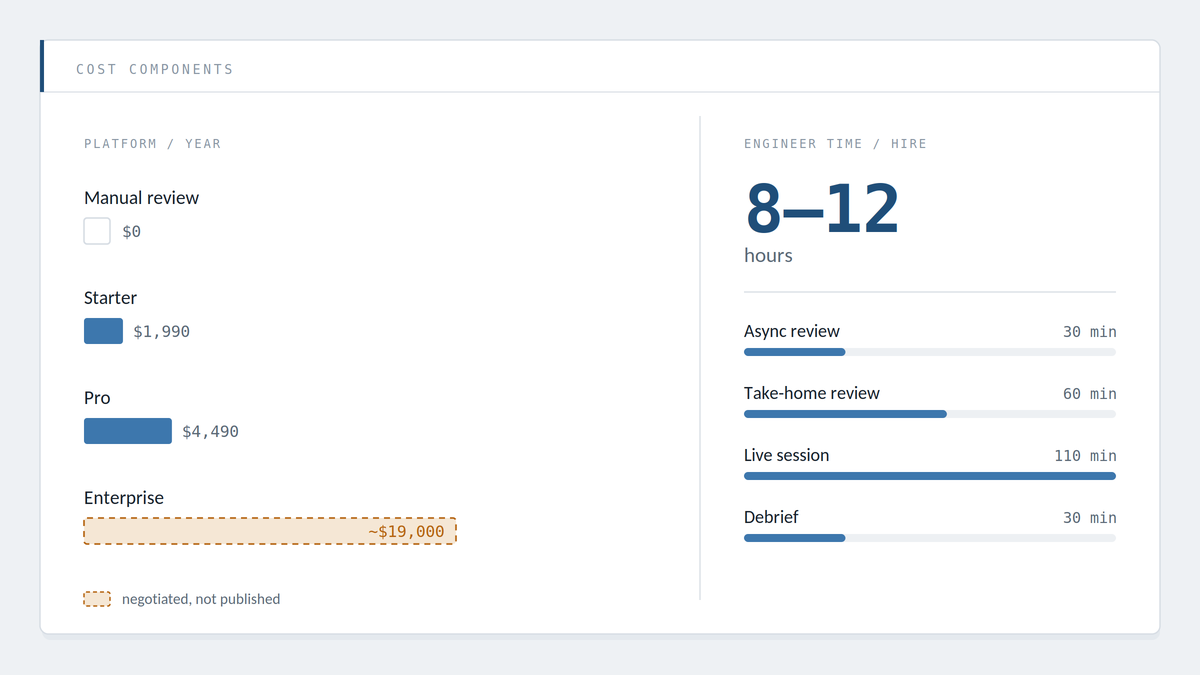
Published self-service pricing is the only honest starting point; enterprise tiers across the category are negotiated and quote-based. Among developer assessment platforms, the current published picture:
| Tier | Typical published range | What it fits |
| Free / open-source (Git repo + manual review) | ₹0 / $0 | Under 20 hires a year, one reviewer |
| Entry self-service (e.g. HackerRank Starter) | ~$165/month or ~$1,990/year (list) | 1 recruiter seat, low assessment volume |
| Mid self-service (e.g. HackerRank Pro) | ~$450/month or ~$4,490/year (list) | Multiple users, moderate volume |
| Enterprise (HackerRank, CodeSignal, Codility) | Quote-only; third-party procurement trackers cite entry points around $19,000/year and enterprise spend in the tens of thousands | ATS integration, SSO, proctoring, high volume |
Procurement notes that reliably saves money: multi-year commitments in this category typically move prices 15–30% below list, and negotiating a capped annual escalator (3–5%) matters more over three years than the first-year discount does.
Verify current list pricing on the vendor pricing pages before quoting these figures this category re-prices frequently.
The cost nobody budgets: reviewer time
Platform licence is rarely the largest number. The following is a model, not a benchmark substitute your own loaded hourly cost:
- Async screen review: 15–30 min per submission
- Take-home review: 45–60 min per submission
- Live session: 90 min, plus 20 min of write-up
- Debrief: 30 min × number of panellists
At ten screened candidates and three finalists per hire, that is roughly 8–12 engineer-hours per hire in a lean process, and 20+ in a heavy one. Multiply by your own fully loaded engineering cost to get the real cost-per-hire contribution. For teams running 20+ technical hires a year, that arithmetic is usually what justifies recruitment process outsourcing for the front of the funnel: the engineer-hours saved exceed the fee well before the tenth requisition.
Candidate compensation
If you require more than two hours of work, pay for it. Market practice is an honorarium pegged to a plausible hourly rate for the role and region, paid on submission regardless of outcome. Two operational points that matter more than the amount: state it in the invite (it materially improves completion), and process payment within 5 working days.
Timelines by scenario
| Scenario | Design & build | First candidate assessed | Steady state |
| First assessment from scratch, one role | 5–8 working days | Week 2 | Week 4 |
| Redesigning an existing process | 3–5 working days | Week 1 | Week 3 |
| Standardising across 5+ roles | 3–4 weeks | Week 2 | Week 6–8 |
| New GCC / offshore centre, multi-role | 4–6 weeks | Week 3 | Quarter 1 close |
| Sourced shortlist to interview-ready (partner-run) | 7–10 working days | Ongoing |
What drives cost and time up: more than three stages; more than three reviewers per candidate; bespoke questions per role rather than three variants per family; no environment scaffolding; unclear ownership of the rubric.
What drives them down: one rubric per role family; blind first-pass review; scheduling automation; a review SLA the team actually holds; retiring stages that have never once changed an outcome.
Where to Take This Next
If you are mid-decision, the most useful thing you can do this week is not choose a platform. Better coding challenges for developer hiring start with writing down the top three competencies for your open role and the anchored rubric that defines a pass. That single artefact resolves most of what feels like a tooling question.
If assessment volume is now consuming engineer capacity you need for shipping or you are standardising technical screening across a new GCC or a multi-role hiring push that is a different problem, and it is one we solve routinely: sourcing and vetting that hands your engineers an interview-ready shortlist in 7–10 working days, with a replacement guarantee inside the same window if a hire is not a fit.
Bring your open role and your current process. We will tell you which stages are earning their keep and which are costing you candidates.→ Talk to our team about your technical hiring process
FAQ
How long should a take-home coding assignment be?
Cap it at four hours of candidate effort, and compensate for anything above two. For an early-stage screen, 45–60 minutes is the practical ceiling before completion rates fall. Validate the estimate by having an engineer who did not write the task attempt it cold and time themselves author estimates run 2–3x optimistic almost universally.
Should you pay candidates for take-home assignments?
Yes, once the task exceeds roughly two hours. Pay a flat honorarium on submission, regardless of outcome, and say so in the invite. It improves completion rates, removes the unpaid-labour objection cleanly, and it costs less than the senior candidates you currently lose at that stage.
How do you prevent AI cheating in coding assessments?
You do not prevent it; you design so that it does not decide the outcome. Permit AI explicitly, require candidates to disclose where they used it, and anchor a live 20-minute conversation to their submission asking them to modify their own code under a changed requirement verifies authorship faster and more reliably than any proctoring tool.
What should a coding challenge rubric include?
Four to six weighted criteria, each with written anchors for at least scores 1, 3, and 5, plus a rule for which submissions get a second independent reviewer. If a reviewer cannot point to the criterion behind a rejection, the criterion does not exist. Calibrate with three reviewers on two historical submissions before go-live.
How many technical interview rounds should a developer role have?
Three is right for most roles: an async screen, a live technical session, and a design or collaboration round. Add a fourth only if you can name the specific risk it retires that the first three do not. Every extra stage costs both engineer hours and senior candidates with competing offers.
Is LeetCode-style interviewing still effective in 2026?
As a high-volume filter for early-career roles it still functions. As a signal about senior engineering capability, algorithm-puzzle coding challenges for developer hiring have weakened considerably: the problems are well-indexed, widely practised, and readily solved by generative tools. Comprehension, debugging, and code review exercises now carry more signal per candidate-minute for anything above junior level.
How do you reduce bias in coding tests?
Score blind, use anchored rubrics, use two reviewers on boundary cases, and audit pass rates by group each quarter using the four-fifths screen as a diagnostic. Also audit the task itself for criteria that proxy for circumstance rather than capability, uninterrupted evening hours and access to a specific toolchain are the two most common offenders.
Should we design this ourselves or bring in a hiring partner?
Design it yourself if you are hiring fewer than roughly ten engineers a year and have an engineer who will own the rubric. Bring in a partner when assessment volume is consuming engineer capacity you need for delivery, or when you are standardising across multiple roles or geographies that is the point where the engineer-hours saved exceed the cost of the engagement. A short scoping conversation will usually tell you which side of that line you are on.
