

Introduction
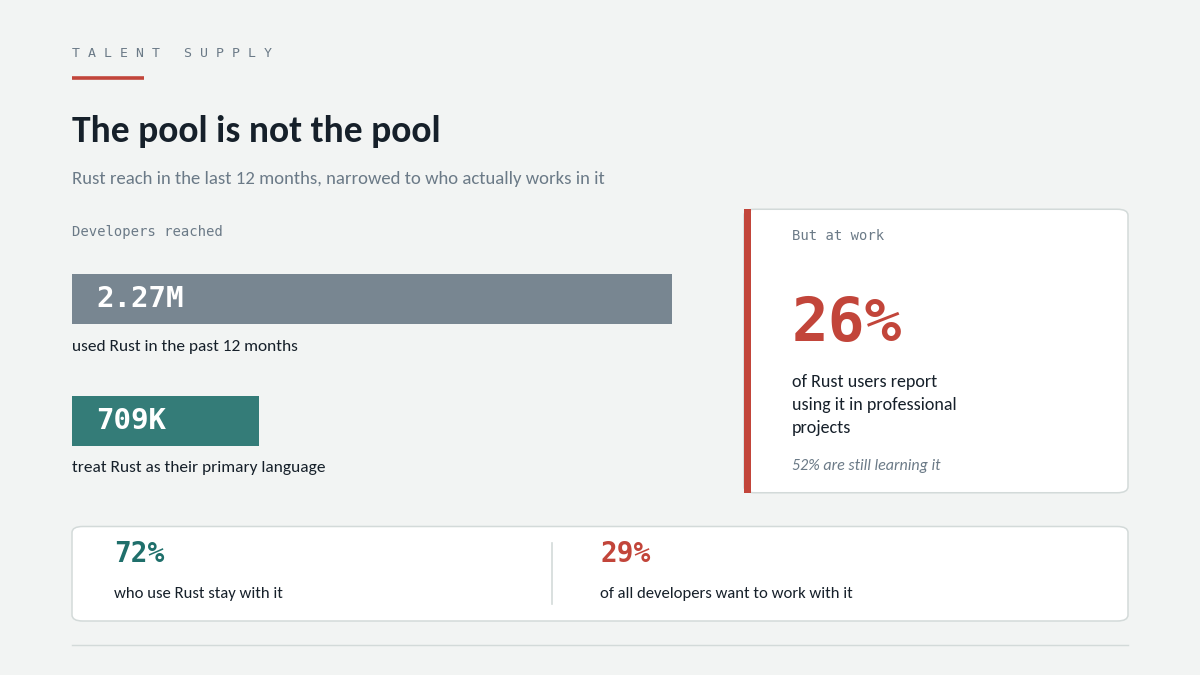
Two numbers explain why this role is so hard to fill. Around 2.27 million developers wrote some Rust in the past year but only about a quarter of them use it in professional projects. The rest are learning it, or using it on weekends. When a recruiter tells you the Rust talent pool is two million people, they are quoting the top of a funnel whose bottom is roughly one-fifth as wide and any plan to hire Rust developers this quarter needs to be budgeted against the smaller number.
That mismatch is now colliding with a compliance calendar. On 11 September 2026, the EU Cyber Resilience Act’s vulnerability reporting obligations took effect for manufacturers of products with digital elements, with the full requirements landing 11 December 2027 and penalties reaching €15 million or 2.5% of worldwide turnover.
From 11 September 2026, CRA-covered manufacturers must issue an early warning within 24 hours of learning that a vulnerability in their product is being actively exploited, including for products already on the market before the regulation applies in full.
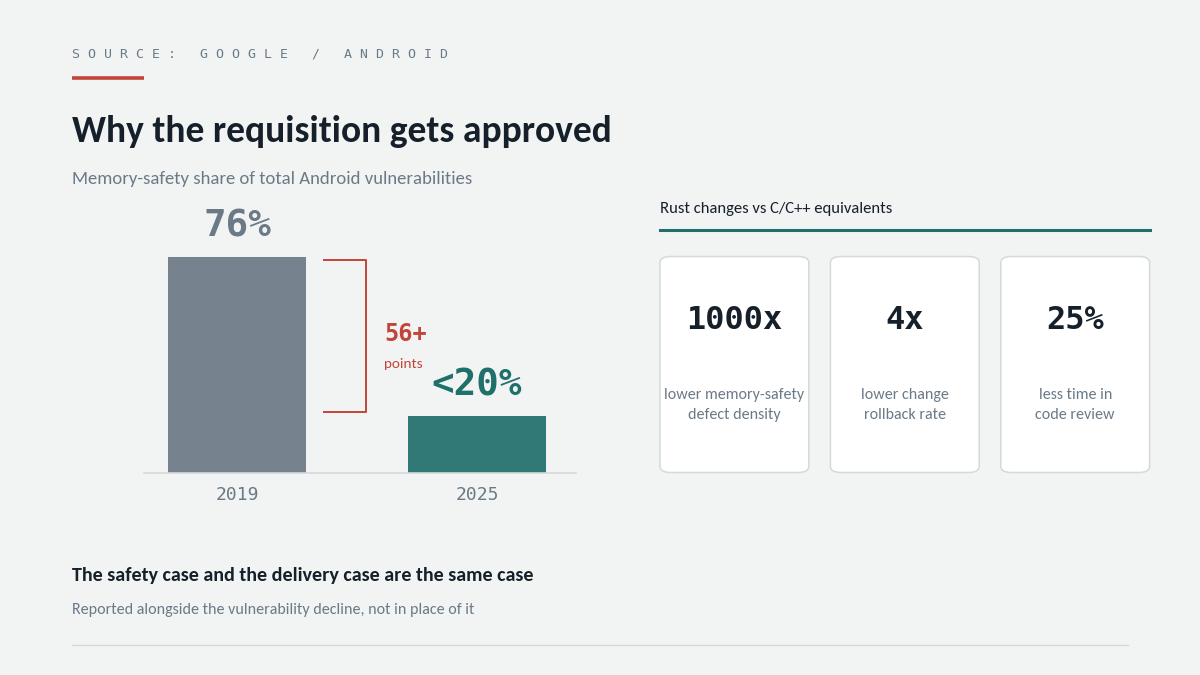
Regulation is not a hiring trigger by itself. What makes it one is that the cheapest way to reduce the vulnerability class you’ll be reporting on is to stop writing it. Google’s Android team reported that memory-safety vulnerabilities had dropped below 20% of total Android vulnerabilities for the first time down from 76% with roughly a thousandfold lower memory-safety defect density in Rust code than in the equivalent C and C++.
So the demand is real, the supply is thinner than the headline number suggests, and most companies still run the same requisition process they use for a React role. That is where the 90-day search comes from not from scarcity alone, but from scarcity met with a generic process. This guide is the process we’d use instead.
TL;DR
This is a practitioner's guide to hiring Rust developers: how to define the role, where the talent actually sits, how to screen for real competence, what it costs, and how to keep the hire productive after week two. It is written for CTOs, VPs of Engineering, and technical founders who have already decided Rust is the right call and now have to staff it.
The number that should reset your expectations: only around a quarter of people who used Rust in the last year use it professionally. Everything downstream your job description, your sourcing channels, your Rust developer salary band, your interview loop has to be built for a pool that small. Teams that get this right go from requirement to interview-ready shortlist in about 7–10 working days. Teams that don't average two to three months and often settle.
By the end, you'll be able to write a Rust job description that filters correctly, run a technical screen that separates borrow-checker fluency from tutorial completion, choose between full-time, contract, and dedicated-team models with a cost model attached, and set the ramp-up milestones that tell you in three weeks whether the hire will work.
What Does It Mean to Hire Rust Developers?
Hiring Rust developers is the process of sourcing, technically vetting, and engaging engineers who can build production systems in Rust meaning they are fluent in ownership, borrowing, and lifetimes, can reason about unsafe boundaries, and can ship within an existing toolchain rather than only writing standalone programs.
Three things it is routinely confused with:
- It is not “hiring a systems programmer.” Plenty of excellent C and C++ engineers cannot pass a Rust review cycle in their first quarter. The reverse is also true: strong Rust engineers may have never touched a linker script.
- It is not “hiring a blockchain developer.” Solana and Polkadot work is a Rust market, not the Rust market and its interview loop, comp expectations, and risk profile differ sharply from backend or embedded work.
- It is not “hiring a Go or Node developer with extra steps.” Rust roles carry a longer ramp, a smaller pool, and a compensation premium. Budgeting them as backend-equivalent is the single most common planning error we see.
Why the Business Case for Rust Is Now a Hiring Case
The argument for Rust used to be made by engineers to executives. It is now increasingly made by auditors, insurers, and procurement teams to both. That shift changes who owns the requisition and how fast it gets approved.
Concrete outcomes companies are buying when they staff Rust:
- Defect-class elimination, not defect reduction. Google’s Android data shows memory-safety vulnerabilities falling from 76% of total vulnerabilities in 2019 to under 20%, with a roughly 1000x lower memory-safety vulnerability density in Rust than in comparable C/C++ code.
- Faster delivery, counterintuitively. The same Google reporting found Rust changes had a 4x lower rollback rate and spent about 25% less time in code review than their C++ equivalents. The safety tax showed up as a delivery dividend.
- Procurement readiness. CISA and the NSA published joint guidance on reducing memory-related vulnerabilities through memory-safe languages, following CISA’s earlier framing of memory-unsafe languages as a product-security bad practice for critical infrastructure. In practice this now shows up as a question in enterprise vendor security questionnaires, where a missing answer is a commercial problem before it is a regulatory one.
- Infrastructure cost per request. Teams replacing garbage-collected services on hot paths typically report meaningful reductions in p99 latency and instance count. Treat any specific percentage as workload-dependent measure your own before building a business case on someone else’s benchmark.
The honest counterweight: none of this argues for rewriting a working C++ codebase. The economics favor Rust at boundaries, new services, parsers, network-facing components, cryptography, and anything that handles untrusted input. Scope the requisition to one of those boundaries and you hire Rust developers against a job that finishes; scope it to a migration and you’re staffing an open-ended program.
Rust Use Cases: Where the Language Actually Ships
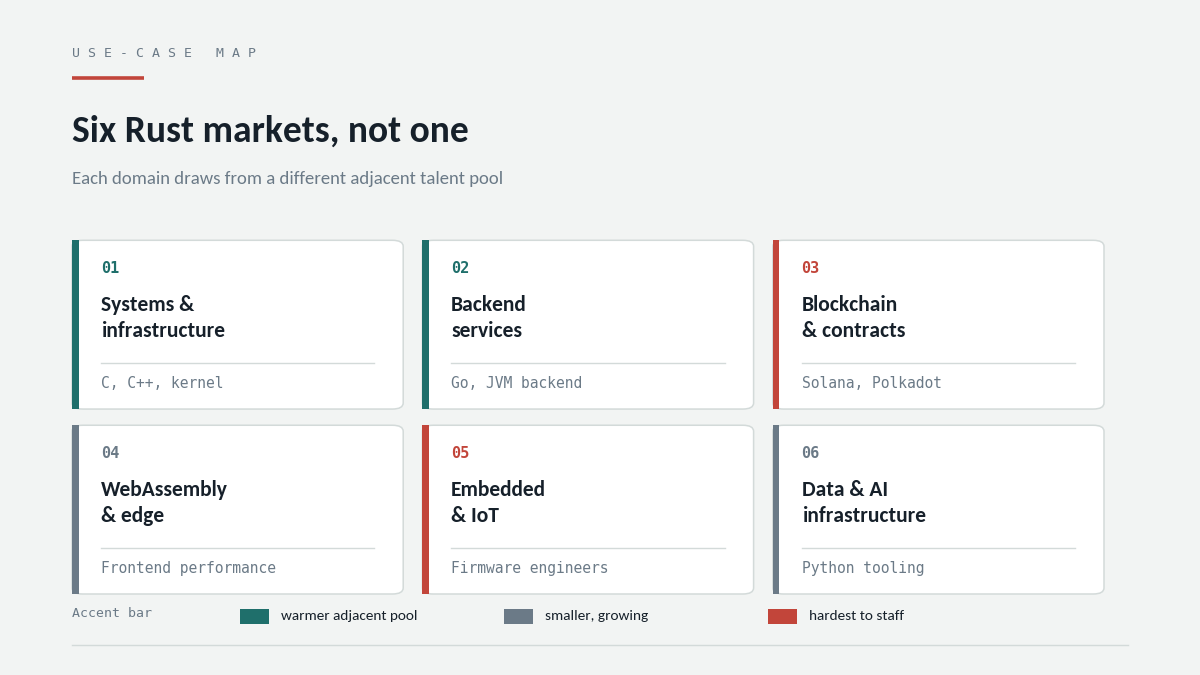
Rust use cases cluster into six recognizable domains, and knowing which one you’re hiring for changes almost everything downstream the sourcing channel, the interview, and the salary band. A Solana engineer and an embedded firmware engineer both write Rust and are not interchangeable.
- Systems and infrastructure software Operating system components, drivers, databases, storage engines, proxies, and CLI tooling. This is Rust’s original home and where the deepest expertise lives. Adjacent pool: C, C++, and kernel developers.
- Backend services and APIs Increasingly common, and the fastest-growing entry point for teams new to Rust. Typical stack: Tokio, Axum or Actix, SQLx, Serde. Adjacent pool: Go and JVM backend engineers which is why teams that also hire Golang engineers usually have a warmer talent funnel to work with than they realize.
- Blockchain and smart contract platforms Solana, Polkadot, NEAR, and most L1/L2 tooling. The most liquid Rust market and the most volatile on compensation. If your requirement is contract-level work rather than protocol engineering, the practical route is often to hire blockchain developers with Rust proficiency rather than to search for generalist Rust engineers who happen to know Solana.
- WebAssembly and edge compute Compiling Rust to WASM for browser-side compute, plugin sandboxes, and edge functions. Growing, small, and heavily overlapping with the frontend-performance community.
- Embedded and IoT no_std environments, real-time constraints, firmware. This is the domain most directly exposed to the CRA timeline, and the hardest to staff the intersection of “writes Rust” and “has shipped firmware” is genuinely narrow.
- Data and AI infrastructure Vector databases, inference runtimes, data-processing engines, and the Rust-based tooling now embedded under Python ecosystems. Notably, most Rust work sits alongside another language JavaScript/TypeScript, Python, and SQL are the most common companions, per JetBrains’ Rust ecosystem survey.
Scoping rule: write your job description for one of these six, not for “Rust.” Teams that hire Rust developers against a generic JD attract the widest possible funnel of the least relevant candidates, and their screening cost rises accordingly.
The Core Problem: Why Standard Recruiting Fails Here
Most hiring plans for this role are built on a number that is off by roughly 4x. Teams that set out to hire Rust developers see an enormous pool in aggregate, and then watch it convert like a niche specialty because it is one.
The scarcity math, using the most recent published data:
- ~2.27 million developers used Rust in the past 12 months (JetBrains).
- ~709,000 treat it as a primary language.
- 26% of surveyed Rust users report using it in professional projects; 52% describe themselves as currently learning it; 30% started using Rust within the past month.
- 72% of developers who use Rust want to keep using it, the highest admiration score of any language, while only about 29% of all developers say they want to work with it.
That last pair is the whole problem in two numbers. Rust has extraordinary retention and modest inflow. People who have it don’t leave it, and the people who don’t have it mostly aren’t coming. Standard recruiting assumes a liquid market where enough outreach volume produces enough replies. This market is illiquid.
What that produces in practice:
- Requisitions age out. A generic Rust JD posted to generic boards typically produces single-digit qualified applicants per month.
- Teams underestimate timelines by 3–4x. A plan built on “four to six weeks” routinely lands at three to five months once screening rejections are counted.
- The screen rejects the wrong people. Interview loops copied from C++ or Go roles over-index on algorithmic puzzles and miss the thing that actually predicts Rust productivity: how a candidate reasons about ownership under compiler pressure.
- Comp bands get set from the wrong comparable. Benchmarking Rust against general backend salaries produces offers that get declined in week six, after the pipeline has already cost you two months.
- Bus factor of one. The first Rust hire becomes the only person who can review Rust, which quietly caps merge velocity for the entire team.
Red flag: if your last three Rust candidates all withdrew at the offer stage, the problem is almost never the recruiter. It is a comp band set against the wrong market and a process that took long enough for a competing offer to land.
The Walkthrough: Hiring Rust Developers, Phase by Phase
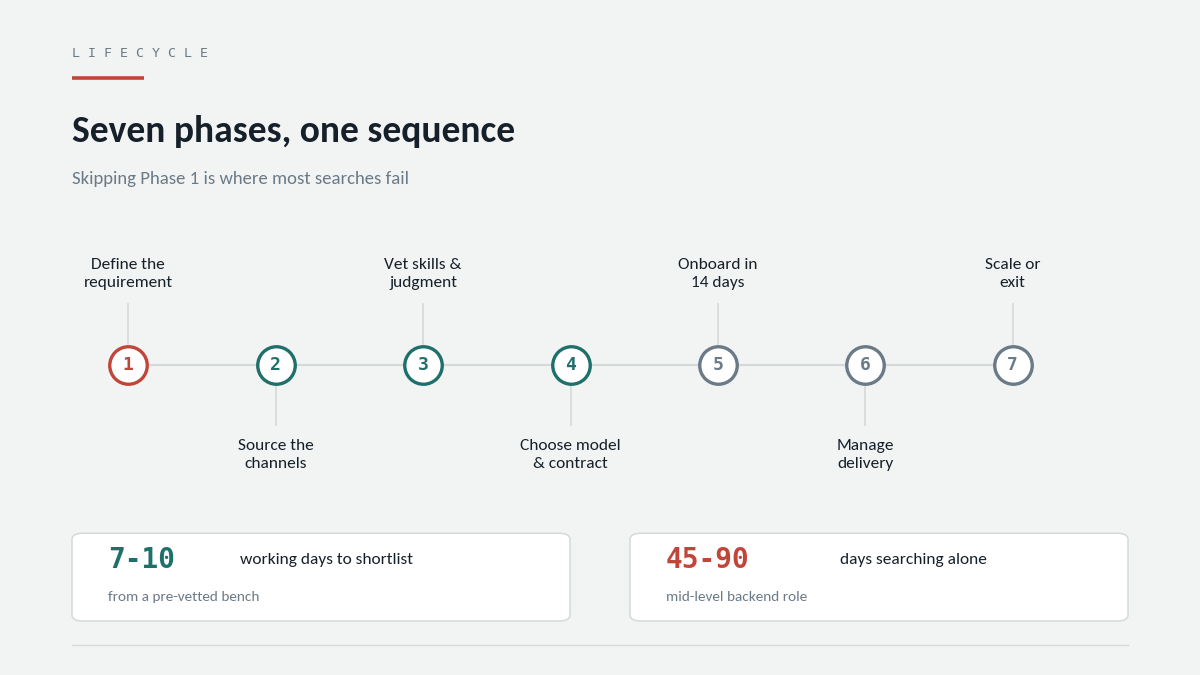
This is the full lifecycle from the moment someone says “we need Rust” to the moment you’re scaling or exiting the engagement. Do not skip Phase 1. Roughly half the failed Rust searches we see are requirement failures wearing a sourcing costume.
Phase 1 Define the requirement before writing the job description
The requirement document should be finishable in a single 60-minute session with the engineering lead. If it isn’t, you are not ready to open a requisition and most failed attempts to hire Rust developers trace back to a requisition opened before this session happened.
The 6-question scoping checklist:
- Which of the six use-case domains is this? (Systems, backend, blockchain, WASM, embedded, data infra.) One answer only.
- Greenfield or brownfield? A new service in Rust and an incremental migration across an FFI boundary from an existing C++ codebase are different jobs. Brownfield needs someone comfortable with unsafe and bindings; greenfield often doesn’t.
- Who reviews this code? If the answer is “nobody yet,” your first hire needs to be senior enough to set conventions which raises the band by roughly one seniority tier.
- What is the async requirement? Tokio-based service work and synchronous systems work draw from different sub-pools.
- What is the true seniority floor? Be specific: “has shipped Rust to production for 18+ months,” not “3–5 years experience.”
- What is the timeline consequence of being late? If it’s a compliance date, that changes the model you should choose in Phase 4.
Seniority bands worth writing down explicitly:
| Band | What they can actually do | Typical experience |
| Rust-capable | Productive in an existing Rust codebase with review support; strong in another language | 0–12 months Rust |
| Rust-proficient | Ships features independently; designs module boundaries; reads compiler errors fluently | 1–3 years Rust |
| Rust-senior | Owns architecture, manages unsafe boundaries, sets lint and error-handling conventions, reviews others | 3+ years Rust |
| Rust-specialist | Domain-deep async runtime internals, embedded no_std, protocol or consensus work | 3+ years plus domain |
The single most valuable line in the JD: state which crates and which domain, not just “Rust.” “Axum, SQLx, Postgres, deployed on Kubernetes” gets you a smaller, sharply better funnel than “Rust developer, 5 years.”
Phase 2 Sourcing: where scarce Rust talent actually sits
Rust does not respond to volume outreach, so channel selection matters more than message count. Rank the channels you use to hire Rust developers by the density of professional Rust users in each, not by audience size.
Sourcing channels, ranked by yield in our experience:
- Open-source contribution graphs. Contributors to widely used crates, and to the projects your stack depends on. Highest signal available, and almost nobody does it systematically.
- Adjacent-language pools with demonstrated Rust intent. C++, Go, and Scala engineers with public Rust side projects. This is the largest under-exploited pool in the market.
- Domain communities. Embedded working groups, Solana or Polkadot ecosystems, the async ecosystem’s discussion forums.
- Conference and meetup speaker lists. RustConf, RustNation, Rustikon, regional Rust meetups. Speakers are usually employed; their audiences frequently are not.
- Specialist IT staffing partners with pre-vetted benches. The only channel that compresses a 90-day search into days rather than weeks, because the vetting has already happened.
- General job boards. Lowest yield per hour spent. Post there, but do not build the plan around it.
Red flags we see constantly: a candidate whose entire Rust footprint is tutorial-shaped, a CLI tool, a toy web server, a ray tracer with no evidence of working inside someone else’s Rust codebase. Tutorial projects prove interest. They do not predict productivity, because the hard part of Rust in production is not writing it; it’s changing code someone else wrote without fighting the borrow checker for two days.
Realistic funnel expectation: for a mid-to-senior backend Rust role, plan on roughly 5–8 genuinely qualified profiles to produce one accepted offer. If a partner shows you thirty resumes, that is a filtering failure, not abundance.
Phase 3 Vetting: Rust developer skills and interview questions that predict output
Rust developer skills worth screening for split into three layers, and most failed interview loops test only the first.
Layer 1 Language mechanics (necessary, not sufficient):
- Ownership, borrowing, and lifetime annotations
- Result/Option handling and error-type design (this error, anyhow, or custom)
- Traits, generics, and trait objects; when to use each
- Send/Sync and what they actually guarantee
Layer 2 Production judgment (the real predictor):
- When to reach for unsafe, and how they document and contain it
- Dependency hygiene how they evaluate a crate before adding it
- Compile-time management on a large workspace
- Async runtime behavior: blocking calls inside async contexts, cancellation, backpressure
- Testing strategy, including property tests and Miri for unsafe code
Layer 3 Collaboration signals:
- Can they review someone else’s Rust without rewriting it?
- Can they explain a lifetime error to a colleague who doesn’t know Rust?
- How do they handle a design where the borrow checker says no and the deadline says yes?
Rust developer interview questions that separate real experience from study:
- “Walk me through a time the borrow checker forced you to change your design. What did you change, and was the final design better or worse?” (The best answers include one of each.)
- “You need to share mutable state across threads. Give me three options and the cost of each.” (Looking for Arc<Mutex<_>>, channels, and lock-free or actor patterns plus honest trade-offs.)
- “Show me unsafe code you’ve written or reviewed. What invariant were you upholding, and how did you verify it?” (Candidates who have never written unsafe should say so plainly that’s a fine answer for greenfield service work.)
- “Your service’s p99 got worse after adding an async database call. Where do you look?” (Blocking in async context is the expected first hypothesis.)
- “How do you decide whether to add a crate or write the 200 lines yourself?” (Supply-chain reasoning, maintenance burden, audit surface.)
- “What’s a Rust pattern you used to like and stopped using?” (Almost impossible to fake without real mileage.)
Portfolio evaluation checklist score each 0–2:
- Merged pull requests in a codebase they did not create
- Code review comments they wrote on others’ Rust
- At least one non-trivial unsafe block or FFI boundary, with documented invariants
- Evidence of error-handling design, not just .unwrap() everywhere
- Tests that go beyond happy path
- Any published crate, RFC participation, or issue triage
Score 8+ and proceed to a paid work-sample. Below 5, the ramp cost will land on your existing team.
Process note: cap the live technical exercise at 90 minutes and let them use the compiler and docs. An interview that bans documentation is testing memory, and Rust is a language where nobody including the people who wrote it works without the reference open.
Phase 4 Engagement models and contract terms
Model choice should follow the requirement’s duration and reversibility, not its budget line. Most companies hire Rust developers on the assumption that permanent employment is the default and everything else is a compromise, when a six-month compliance-driven migration and a permanent platform team are simply not the same purchase.
The four models, and when each is correct:
- Full-time employee. Correct when Rust is becoming a permanent part of your stack and you need someone to own conventions. Slowest to fill; highest retention if the work stays interesting.
- Staff augmentation / dedicated contractor. Correct when you have in-house engineering leadership and need capacity, not direction. Fastest to fill. This is where most first Rust hires should start, and it’s the standard model when you work through an IT staffing company in India or any comparable offshore partner.
- Dedicated team (pod). Correct for a bounded workstream, a migration, a new service, a protocol implementation where you want a lead, two engineers, and a QA function moving together.
- Project-based / fixed scope. Correct only when the specification is genuinely stable. Rust migrations rarely are.
Contract terms that matter specifically for Rust engagements:
- IP assignment covering crate contributions. Rust engineers often upstream fixes to open-source dependencies during the engagement. Saying explicitly what is assigned and what may be contributed publicly, silence here creates disputes later.
- NDA plus a defined unsafe review clause. If contract engineers can merge unsafe code without a named internal reviewer, you’ve outsourced your memory-safety guarantee to a stranger.
- Replacement window. A 7–10 day replacement guarantee is meaningful; a 30-day one is not, because 30 days is a full sprint of lost velocity.
- Notice period and buyout clarity. In the Indian market, 30–90 day notice periods are standard; the buyout question determines your actual start date and should be settled before the offer, not after.
- Knowledge-transfer deliverable as a contractual milestone. Not “documentation” in the abstract a named architecture decision record and a recorded walkthrough, due at a defined date.
Negotiation point worth knowing: senior Rust candidates in the current market negotiate scope more aggressively than compensation. An offer that specifies “you will own the async layer and set review standards” closes candidates that a higher offer with vague scope loses. We have seen this decide the outcome more often than money has.
Phase 5 Onboarding and the first two weeks
The first fourteen days determine whether the hire ships in month one or month three. Rust ramp-up is dominated by codebase context, not language learning assuming Phase 3 was done properly.
Day 0 checklist (complete before they log in):
- Repository access, CI access, and a working cargo build on a clean machine
- Cloud and infrastructure credentials provisioned the most common week-one blocker, and the reason infra staffing usually needs to be solved in parallel when you hire cloud engineers alongside the Rust role
- A named onboarding buddy with calendar time actually blocked
- One pre-selected first ticket: small, real, merges to main
- Written toolchain policy Rust version, MSRV, lint configuration, formatting
The 14-day ramp milestones:
| Day | Milestone | What it tells you |
| 2 | Local build green, first commit pushed | Environment and access are clean |
| 5 | First PR opened | They can navigate the codebase |
| 8 | First PR merged | Conventions understood, review loop working |
| 14 | Second feature scoped independently | They’re moving from guided to autonomous |
Friction pattern to plan for: in nearly every Rust onboarding we’ve run, the delay is not the language. It is compiled in an unfamiliar workspace plus a review queue where the new engineer’s PRs wait three days because only one person can review Rust. Fix the review bottleneck in week one pairs the new hire with the reviewer on their first two PRs and the rest of the ramp compresses.
Communication cadence for distributed teams: a 20-minute daily standup with 3–4 hours of timezone overlap covers most engagements. Below two hours of overlap, add a written end-of-day handoff or accept a one-day latency on every blocking question.
Phase 6 Managing delivery
Rust teams need different leading indicators than the ones most engineering dashboards default to, because Rust deliberately front-loads work into compile time and review.
KPIs worth tracking:
- Time to first merged PR (target: under 8 working days)
- PR cycle time, split into author time and review-wait time the second number is where Rust teams silently lose weeks
- Number of engineers who can approve Rust PRs (target: at least 2 within 60 days; this is your bus factor)
- unsafe block count and delta not zero, but known and reviewed
- CI build duration when it crosses ~15 minutes, developer throughput starts falling measurably
- Rollback rate expect this to fall as Rust coverage grows
KPIs to ignore: lines of code (Rust is verbose in setup and terse in logic, so the metric is noise) and story-point velocity in the first six weeks (the ramp curve makes it meaningless).
Governance cadence that works: weekly delivery review with the engineering lead, monthly with the account owner, quarterly on scope and headcount. Escalation should have a named human and a stated response window “24 hours to a substantive reply” not a shared inbox.
Phase 7 Scaling or exiting
Every engagement ends one of three ways: it grows, it converts, or it winds down. Decide which you’re planning for before month three.
If you’re scaling:
- Add the second Rust engineer before you feel you need them; the review bottleneck bites at one, not at three.
- Ratio to hold: roughly one Rust-senior per 3–4 Rust-proficient engineers.
- Beyond about 8–10 engineers, a distributed contractor model starts costing more in coordination than it saves in flexibility. That’s typically the point where teams evaluate a global capability center or a permanent offshore entity instead.
- Convert your best contract engineers to permanent before month nine. After that, they’ve usually been approached by someone else.
If you’re exiting or offboarding:
- Architecture decision records written and merged, not stored in someone’s notes
- Recorded walkthrough of every unsafe block and FFI boundary
- Credential and access revocation on a defined date, not “when we get to it”
- A two-week overlap with the incoming owner non-negotiable if there is any unsafe code
- Confirmation in writing of what IP was assigned and what was upstreamed
Replacement, if the fit is wrong: decide by day 21, not day 60. A replacement guarantee that runs 7–10 days is only useful if you exercise it while it’s still live. The most expensive Rust hiring mistake is not a bad hire, it’s a bad hire kept for four months out of sunk-cost reluctance.
Case Studies
The engagements below are not Rust-specific; we’re stating that plainly rather than retrofitting a story. They are scarce-skill, high-urgency hiring problems, and the mechanics that solved them are the same three that decide whether you hire Rust developers in two weeks or two quarters: pre-vetted supply, compressed shortlists, and joining-rate discipline.
Paytm 100+ engineers, without a proportional increase in screening load. Supersourcing supported Paytm through a 100+ engineer hiring cycle across engineering functions. The operating constraint in a program that size is not sourcing volume, it’s the interview capacity of the client’s senior engineers. Presenting only top-2%-filtered candidates at roughly a 3:1 submit-to-hire ratio is what keeps that capacity from becoming the bottleneck. For a Rust search, this is the identical mechanic: your scarce resource is your reviewer’s time, not the recruiter’s.
Somnoware recruitment automation for a healthtech platform serving 200+ hospitals. Somnoware’s hiring bottlenecks were slowing expansion and delaying service delivery. The Supersourcing team deployed AI-driven screening that automated the highest-volume manual stages, cutting the manual filtering load and shortening time-to-shortlist. The transferable lesson: in a thin market, automation is worth more at the filtering stage than at the sourcing stage; finding candidates isn’t the hard part, disqualifying them fast is.
Swiggy sustained engineering scale-up under continuous delivery pressure. Swiggy scaled engineering while shipping continuously, which meant hiring could not be allowed to interrupt delivery. Across engagements of this type our benchmarks are a 98% candidate joining rate and under 1% drop-off on contract roles numbers that matter far more in a scarce market than raw pipeline size, because a declined offer in a Rust search costs three to six weeks, not three days.
The Decision Framework: Which Model Fits Your Situation
Run your requirement through this table before you commit to a model. There is no single correct way to hire Rust developers; the right answer changes with duration and with how much in-house Rust review capacity you already have.
| Model | Time to productive | Relative cost | Control | Key risk | Best when |
| In-house full-time | 60–120 days | Highest all-in (salary + benefits + hiring cost) | Highest | Long search; single point of failure | Rust is permanent in your stack |
| Staff augmentation | 7–15 days | Medium; predictable monthly | High (you direct the work) | Needs in-house technical direction | You have leadership, need capacity |
| Dedicated pod | 15–30 days | Medium-high | Medium (partner manages delivery) | Scope drift if brief is vague | Bounded migration or new service |
| Freelance / marketplace | 3–10 days | Lowest headline, highest variance | Low | Vetting quality; availability; IP ambiguity | Short spike, non-core work |
| Retrain in-house C++/Go | 90–180 days | Deferred but real (lost velocity) | Highest | Ramp is slower than anyone budgets | Strong team, no deadline pressure |
The decision rule, compressed: if the work outlives 18 months and you already have a Rust reviewer, hire full-time. If it doesn’t, or you don’t, augment first and convert later. Contract-to-hire exists precisely because this decision is hard to make correctly on day one.
Rust vs C++ Hiring: What Actually Changes in Your Process
Rust vs C++ hiring differs less in the interview content than in the market dynamics around it, and getting this wrong is expensive in both directions.
| Dimension | C++ hiring | Rust hiring |
| Pool size | Large, mature, global | Small; ~26% of users work in it professionally |
| Time to fill | Weeks | Weeks to months without a pre-vetted bench |
| Compensation | Established benchmarks | Premium, wide variance by domain |
| Ramp on your codebase | Faster (familiar idioms) | Slower if brownfield with FFI; comparable if greenfield |
| Retention | Market-normal | Notably high 72% of users want to keep using Rust |
| Review capacity | Usually already exists | Frequently your actual constraint |
Should you retrain C++ engineers instead? Sometimes it’s underrated. A strong C++ engineer typically reaches productive Rust in three to six months with a mentor and dedicated learning time.
The trap is doing it without a mentor: the borrow checker teaches slowly and expensively when there’s nobody to ask. The pattern that works best is a hybrid bring in one senior Rust engineer on contract explicitly to review, pair, and set conventions while two of your C++ engineers convert.
You end up with three Rust-capable people instead of one, at a lower total cost than three hires.
What Most Teams Get Wrong
The dominant failure is not hiring badly. Companies hire Rust developers one at a time and call the result a capability. A single Rust engineer inside a team of twelve cannot merge their own code, cannot take a holiday without freezing the workstream, and cannot be disagreed with technically. The capability threshold is two engineers who can approve each other’s pull requests, and teams that skip this discover it in month four.
Four more patterns, in the order we encounter them:
- Screening for language trivia instead of production judgment. Asking someone to recite lifetime elision rules tells you they studied. Asking what they did when the borrow checker rejected their design tells you they shipped. The best predictor we’ve found is whether a candidate can describe a Rust pattern they abandoned and why.
- Budgeting Rust as backend-plus-ten-percent. The premium is real and domain-dependent, and offers benchmarked against general backend bands get declined at a rate that quietly doubles your time-to-hire. Set the band from Rust comparables in the specific domain before opening the requisition, not after two declines.
- Treating unsafe as a red flag for candidates. It is the opposite. An engineer who has written and documented unsafe code understands what the safe subset is actually buying. The red flag is the candidate who claims never to have needed it while applying for a role that is entirely FFI bindings.
- Buying a rewrite when the market is telling you to buy a boundary. Most teams that ask us to staff “a Rust rewrite” need three engineers on the parser, the network-facing service, and the crypto layer, not fifteen on a two-year migration. The strongest Rust adoption stories in industry are incremental. Google’s own reporting emphasizes that new code is where the returns come from, not wholesale rewrites of working systems.
Cost and Timeline Reality Check
Public salary aggregators disagree with each other on Rust by a factor of nearly two, which tells you something real about what it costs to hire Rust developers: this is a thin, high-variance market where domain matters more than title. Use the bands below for planning, then validate against live offers before you commit.
Rust developer salary and rate bands
Rust developer salary benchmarks, by market and seniority. Treat these as planning bands, not quotes.
| Market | Rust-proficient (1–3 yrs) | Rust-senior (3+ yrs) | Notes |
| India (full-time, CTC) | ₹18–35 lakh/year | ₹35–70 lakh/year | Blockchain and protocol roles trend to the top of the band and above it |
| India (contract) | ₹1.8–3.5 lakh/month | ₹3.5–6.5 lakh/month | Bill rate; excludes partner margin |
| US (full-time, base) | $115k–$150k | $150k–$200k+ | Glassdoor’s US Rust developer estimates centered near $147k as of mid-2026, with a typical range of roughly $115k–$191k |
| Western Europe | €70k–€95k | €95k–€140k | Switzerland and the Nordics sit above this |
| Eastern Europe | €40k–€60k | €60k–€90k | Strong systems-programming density |
What drives cost up:
- Embedded, no_std, or safety-certified domains (narrowest pool in the market)
- Protocol, consensus, or cryptography work
- Sub-4-hour timezone overlap requirements with a US or EU team
- Security clearance or on-site presence
- Sub-30-day start requirements against 60–90 day notice periods
What drives cost down:
- Greenfield service work in a mainstream stack (Axum/Tokio/Postgres)
- Accepting a strong Rust-capable engineer with deep Go or C++ background plus mentorship
- Contract-to-hire instead of a direct permanent offer
- Flexible location within a single offshore market
- Longer engagement commitments (6+ months typically improve rates by 5–15%)
Timelines by scenario
| Scenario | DIY in-house | Via a pre-vetted partner |
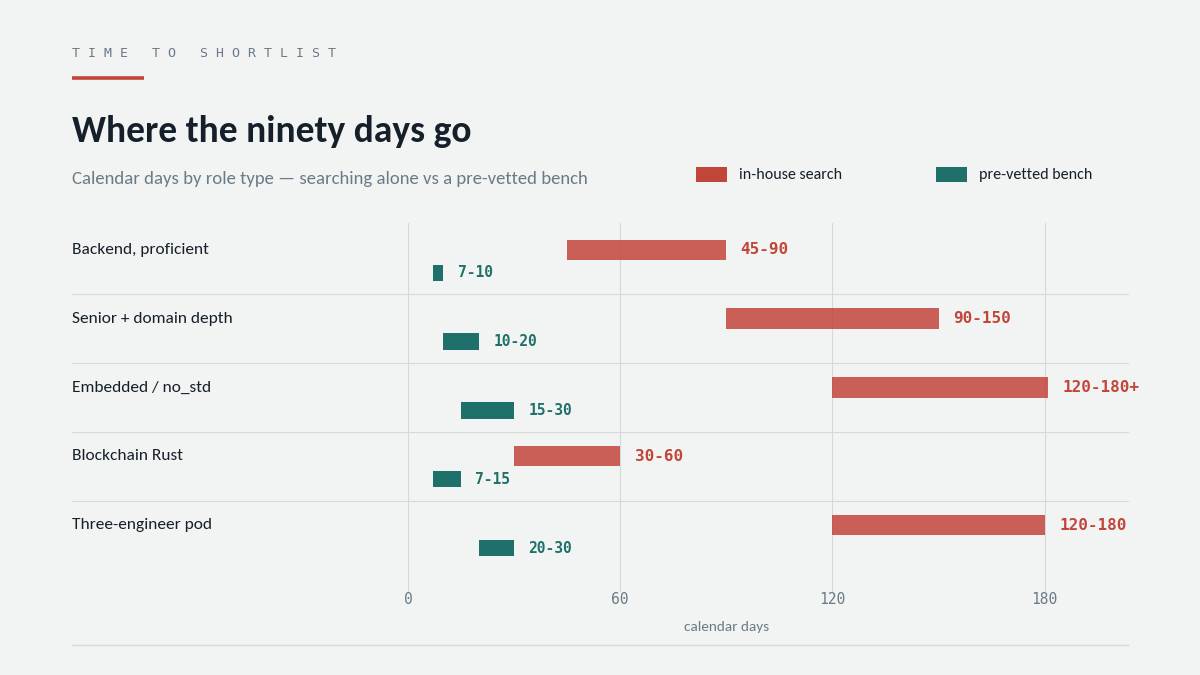
| Rust-proficient backend engineer | 45–90 days | 7–10 working days to interview-ready shortlist |
| Rust-senior with domain depth | 90–150 days | 10–20 working days |
| Embedded / no_std specialist | 120–180 days+ | 15–30 working days |
| Blockchain Rust (Solana/Polkadot) | 30–60 days | 7–15 working days |
| Three-engineer pod | 120–180 days | 20–30 working days |
The hidden cost line nobody budgets: your senior engineers’ interview time. A 90-day DIY search for one Rust role typically consumes 25–40 hours of senior engineering time in screening and interviews. At a fully loaded senior engineering cost, that is frequently larger than the placement fee it was meant to avoid. It also comes out of the same capacity that would have shipped the feature you’re hiring for.
Where to Take This Next
If you’re mid-decision, the most useful next step is not to open a requisition. Before you hire Rust developers, answer Phase 1’s six scoping questions and get a live comp band for your specific domain because those two inputs determine whether your search takes two weeks or four months, and both are answerable this week.
Three ways to move:
- Scoping only: run the Phase 1 checklist with your engineering lead and write down the six answers. Free, takes an hour, and prevents the most expensive mistake in this guide.
- Benchmark check: validate your intended band against live Rust offers in your domain before the requisition opens, not after two candidates decline.
- Shortlist: if the scope is settled and the date is real, a pre-vetted bench turns the 7–10 working day timeline into something you can plan against.
If it’s useful to pressure-test your requirement against what the market will actually deliver on your timeline, that’s a conversation worth having before you spend a quarter on it: Contact Us.
Frequently Asked Questions
Is it hard to hire Rust developers in 2026?
Harder than backend hiring, easier than it was two years ago. The pool is growing around 30% of surveyed Rust users started within the past month but professional depth lags interest badly, with roughly a quarter using it at work. Expect a longer search for embedded and protocol roles, and a relatively normal one for backend service work.
How much does it cost to hire Rust developers in India?
Plan on ₹18–35 lakh annually for a Rust-proficient engineer and ₹35–70 lakh for a senior, with blockchain and protocol roles running above that. Contract engagements typically fall between ₹1.8 and ₹6.5 lakh per month depending on seniority. Domain matters more than years of experience in setting the band.
Should I hire a Rust developer or retrain my C++ team?
Do both, in sequence. Bring in one senior Rust engineer on contract to set conventions and review code, then convert two C++ engineers alongside them over three to six months. Retraining without an experienced reviewer present is the version that fails the learning curve is manageable, the unsupervised learning curve is not.
How long does it take to hire a Rust developer?
An in-house search typically runs 45–90 days for a mid-level backend role and can exceed 150 days for embedded specialists. Working from a pre-vetted bench, an interview-ready shortlist in 7–10 working days is a realistic benchmark. The variable is almost never sourcing speed; it’s screening throughput.
What should a Rust developer job description include?
Name the domain, the crates, and the seniority floor in production terms. “Axum, SQLx, Tokio, Postgres, 18+ months shipping Rust to production” outperforms “Rust developer, 5+ years” by a wide margin on qualified-applicant rate, because it lets the wrong candidates disqualify themselves before they cost you screening time.
Can I hire Rust developers on a contract basis?
Yes, and for most first Rust hires it’s the better opening move. Contract and contract-to-hire let you validate fit inside a real codebase before committing to a permanent band in a market where you may not yet know what the right band is. Insist on a defined unsafe review clause and a 7–10 day replacement window.
What are the most important Rust developer skills to screen for?
Ownership and lifetime fluency is table stakes. What actually predicts output is production judgment: unsafe containment, dependency evaluation, async runtime behavior, and error-type design. Add one collaboration signal: can they review someone else’s Rust without rewriting it because your second Rust hire’s productivity depends on your first one’s review quality.
We have a compliance deadline. What’s the fastest responsible path?
Scope to a boundary rather than a rewrite: the parser, the network-facing service, the crypto layer. Staff it with one Rust-senior plus one Rust-proficient engineer through an augmentation model so you’re interviewing inside two weeks rather than two months, and keep architecture ownership in-house. If you want a second opinion on whether your scope is realistic against your date, a scoping call is usually a better use of an hour than another week of sourcing.
