

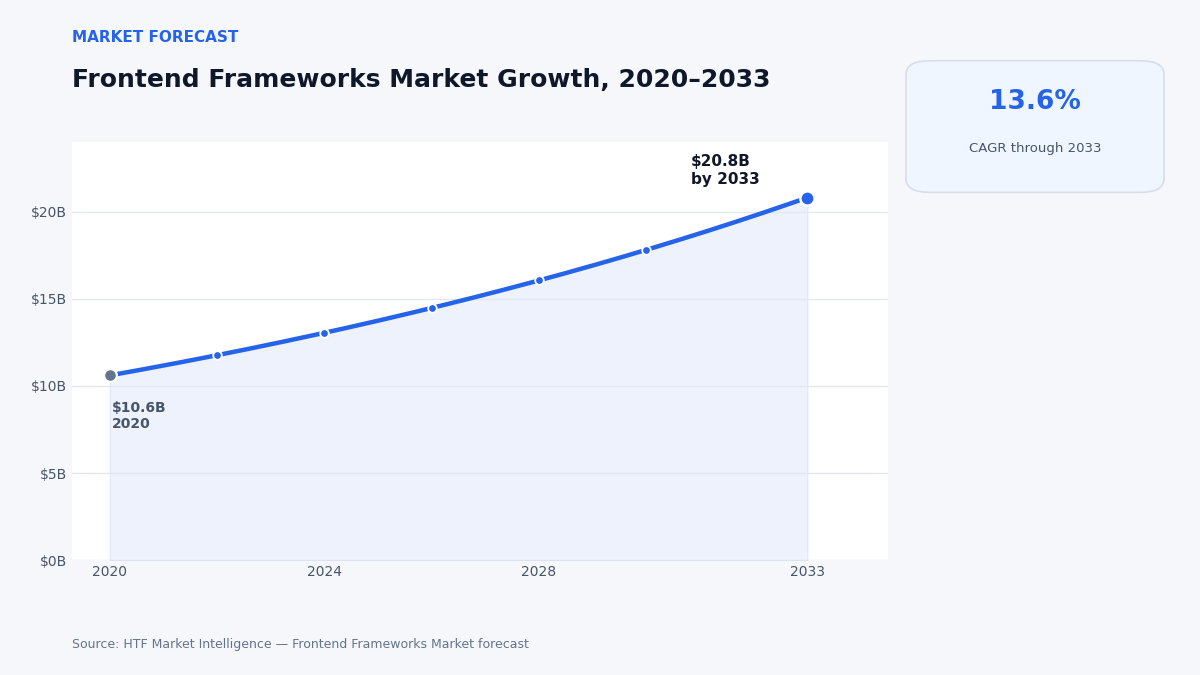
The global frontend frameworks market the layer of tooling React, Angular, and Vue all compete in is projected to grow at a 13.6% compound annual rate through 2033, expanding from roughly $10.6 billion to $20.8 billion. That kind of sustained growth doesn’t happen because frontend work is consolidating around one winner-take-all technology; it happens because more products, in more industries, keep needing interactive interfaces built and maintained by real developers, year over year.
Where a given framework sits inside that growing market determines how deep your hiring pool will stay over the next several hiring cycles, not just this one. That’s the forward-looking lens most “why React” articles skip. They’ll tell you React is popular today. They won’t tell you what that popularity does to your time-to-hire, your salary bands, or your risk of ending up with a developer who learned React from a bootcamp three months ago and calls themselves “expert level” on a resume. This guide is built around the practical side of that question: how to hire ReactJS frontend developers who can actually do the work, not just the technical case for the framework itself.
If you’re a CTO, engineering manager, or founder deciding how to staff a frontend build in-house, agency, or dedicated offshore team the technical case for React is the easy 20% of the decision. The other 80% is sourcing, vetting, contracting, and managing the person or team you hire. That’s where most guides stop being useful, and where this one starts.
TL;DR
This guide walks technical and semi-technical hiring decision-makers through the full process of hiring ReactJS frontend developers why React remains the dominant choice for frontend work, what it actually costs by region and seniority, how to vet real skill instead of resume keywords, and how to manage a React developer or team once they're onboarded. It's written for founders, CTOs, and engineering managers evaluating in-house hiring against staff augmentation or a dedicated offshore team.
The single number to hold onto: a properly run sourcing-to-shortlist process for a React developer should take 7-10 working days, not the 4-6 weeks most first-time buyers budget for. Everything past that timeline is usually a sign of an unfocused job description, not a thin talent pool.
By the end, you'll be able to write a realistic React hiring brief, run a technical screen that actually filters for skill, negotiate a fair engagement model and contract, and set up the reporting cadence that keeps a remote or dedicated team accountable without micromanaging them.
What Is ReactJS Frontend Development?
ReactJS frontend development is the practice of building a website or application’s user interface using React, a component-based JavaScript library maintained by Meta, where the UI is broken into reusable, independently testable pieces that manage their own state and re-render efficiently when data changes.
It is not the same as:
- React Native development is a related but separate discipline for building native mobile apps; the syntax overlaps, but the platform APIs, tooling, and hiring pool differ.
- Full-stack JavaScript development: a React developer focuses on the client-side interface; a full-stack engineer also owns backend logic, databases, and infrastructure. Some people are both, but the job descriptions and rate cards shouldn’t assume it.
- “Front-end development” in general HTML/CSS/vanilla JS work and React work require overlapping but distinct skill sets; a strong CSS developer isn’t automatically a strong React developer.
Why It Matters: The Business Case for Hiring ReactJS Developers
The decision to hire React specifically rather than Angular, Vue, or a framework-agnostic generalist has measurable downstream effects on cost, speed, and risk:
- Faster feature delivery through component reuse. A well-structured React component library lets teams assemble new screens from existing building blocks instead of writing UI code from scratch each time, which is the main reason component-based development speeds up mid-to-late-stage product work more than early-stage work.
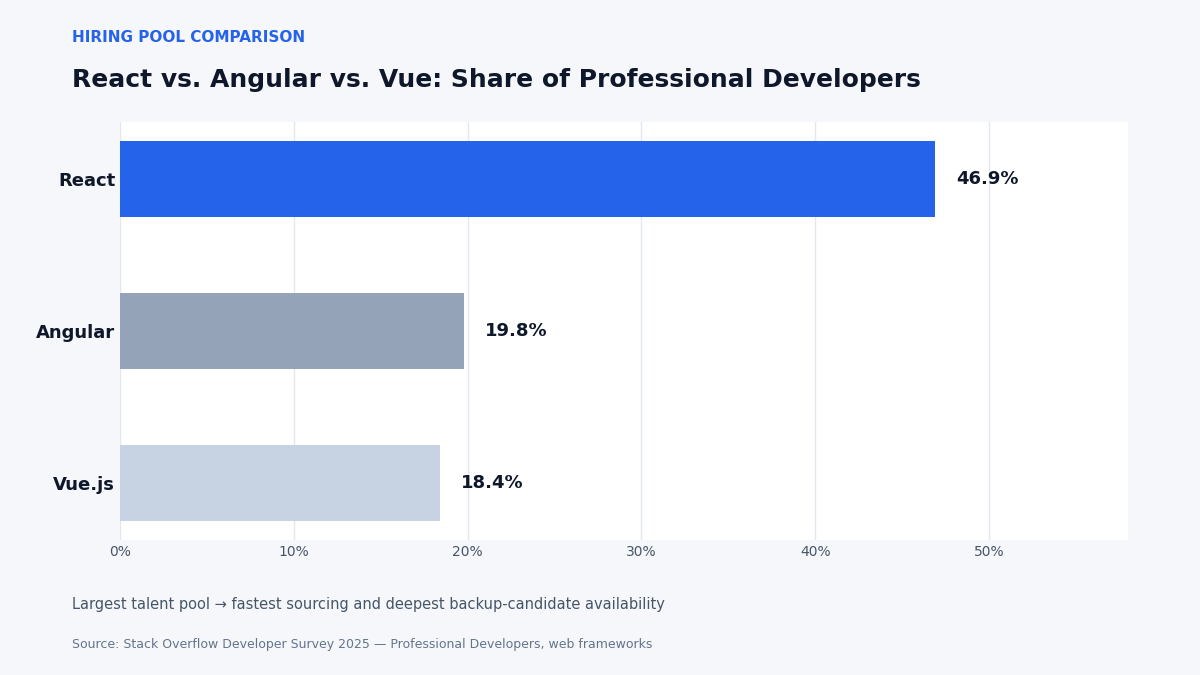
- Deeper hiring pool, faster sourcing. With React sitting well ahead of Angular (19.8%) and Vue.js (18.4%) among professional developers in the same survey data, sourcing timelines and backup-candidate availability are materially better than for smaller-pool frameworks.
- Lower onboarding cost for new hires. Because React’s ecosystem and conventions are widely taught and documented, a mid-level React hire typically ramps up on an existing codebase faster than on a framework with a smaller community and thinner Stack Overflow/GitHub coverage.
- Ecosystem depth reduces build-vs-buy decisions. Mature libraries for state management (Redux Toolkit, Zustand), data fetching (React Query), forms, testing (Jest, React Testing Library), and meta-frameworks (Next.js) mean fewer custom-built utilities and less in-house maintenance burden.
- Long-term maintainability. Component isolation and a unidirectional data flow model make it easier for a new developer including a replacement hire to understand and modify an existing codebase without full-team knowledge transfer.
None of this means React is “the best” framework in every case Vue has a gentler learning curve for smaller teams, and Angular’s opinionated structure suits some enterprise governance needs. It means that for most product and SaaS hiring scenarios, the combination of talent supply, ecosystem maturity, and reuse economics tips the decision toward React specifically, which is why it’s the default starting point for this guide.
The React Ecosystem: What You’re Actually Hiring For
When a job description says “React developer,” it rarely means just React itself. The React ecosystem, the surrounding tools, libraries, and conventions built around the core library is usually a bigger factor in whether a hire is productive than raw React knowledge alone. Understanding the ecosystem helps you write a job description that filters for the right person instead of a generic keyword match.
The pieces that matter most for hiring purposes:
- Meta-frameworks primarily Next.js. Plain React handles rendering; Next.js adds routing, server-side rendering, and increasingly, server components on top. A developer strong in plain React but with no Next.js exposure will need ramp-up time on any team that’s standardized on it, which is most product teams building anything with SEO or performance requirements today.
- State management libraries. Redux Toolkit remains common in larger, more complex applications; Zustand and React Query (for server-state specifically) have become common lighter-weight alternatives. Ask candidates which they’ve used and why they’d choose one over another for a given scenario. The reasoning matters more than the specific library.
- TypeScript. Increasingly treated as baseline rather than a bonus skill for mid-to-senior React roles, since typed components catch a meaningful class of runtime bugs before they ship. If your codebase is TypeScript-first, say so in the job description explicitly rather than listing it as a “nice to have.”
- Testing tooling. Jest and React Testing Library are the de facto standard for component-level testing. A candidate with no testing experience at all is a different hiring risk than one who’s simply used a different tool probe for the underlying testing discipline, not just tool familiarity.
- Design systems and component libraries. Teams using something like a shared internal component library, or common tools like Storybook for isolated component development, benefit from candidates who’ve worked inside that kind of structure before, since it changes how components get built day to day.
None of these are reasons to inflate a job description into an unrealistic wishlist. They’re reasons to be specific about which two or three ecosystem pieces actually matter for your codebase, and to test for those directly during vetting rather than assuming “knows React” covers all of them.
Component-Based Development: The Core Idea Behind React Hiring
Component-based development is the practice of building a UI as a tree of small, self-contained, reusable pieces each owning its own markup, styling, and logic rather than as one large, tightly coupled template. It’s the single architectural idea that explains most of React’s practical hiring advantages.
For a hiring manager, this matters in three concrete ways:
- It changes what “experience” should mean during vetting. A candidate who’s only ever worked in small, disposable projects may never have had to think about how components should be organized so that ten other developers can reuse them safely. That’s a different, and often missing, skill from simply knowing React’s syntax.
- It changes how you should structure a technical exercise. A strong take-home task doesn’t just ask a candidate to build a feature, it asks them to build it in a way that a teammate could extend without breaking it. Ask candidates to explain their component boundaries, not just show working code.
- It changes replacement risk. Because components are meant to be isolated, a new hire including a replacement after a failed first attempt can usually understand and modify one part of a well-structured React codebase without needing to understand the whole system first. That’s a real, practical reason component-based development lowers switching risk in a way that matters when you’re deciding between hiring models in Phase 3.
The Core Problem Most Buyers Face When Hiring React Developers
Most first-time buyers underestimate three things at once: how long real vetting takes, how wide React skill levels actually vary, and how much a bad hire costs to unwind.
- Skill-level variance is wider than the job title suggests. “React developer” covers everyone from someone who’s completed a 6-week bootcamp and built to-do-list apps, to a senior engineer who’s shipped server-rendered, performance-tuned production apps at scale. A resume alone rarely tells you which one you’re getting.
- Teams underestimate true vetting time by roughly 2-3x. A rushed 30-minute call plus a generic coding test catches maybe a third of the mismatches a structured technical + collaboration screen would catch the mismatches just surface later, during the first sprint, instead of during hiring.
- Costs balloon from rework, not rates. The expensive failure mode isn’t paying a slightly higher hourly rate for a stronger developer, it’s paying a lower rate for a weaker one and then re-architecting the component structure three months in because state management wasn’t handled correctly from day one.
- Contract ambiguity creates IP and continuity risk. Buyers who skip clear terms on IP ownership, notice periods, and replacement policy up front are the ones who end up renegotiating mid-project from a position of weakness, because the developer or vendor knows switching costs are now high.
The Walkthrough: From Deciding You Need a React Developer to Managing Delivery
This is the full lifecycle the part most guides compress into a single “here’s how to hire” paragraph. Each phase below includes at least one checklist you can use directly.
Phase 1 Defining Requirements
Before writing a job description or briefing a staffing partner, nail down four things in writing:
- Scope of work is this a single feature build, a full frontend rebuild, or ongoing product development? A one-off landing page and a multi-year SaaS dashboard need different hiring models entirely.
- Skill depth required junior (0-2 years, needs supervision on architecture decisions), mid-level (2-5 years, owns features independently), or senior (5+ years, owns architecture and mentors others).
- A fixed launch date changes the calculus toward a dedicated team over a single freelancer, since a single point of failure becomes riskier against a deadline.
- The budget band knows your range before you start interviewing, not after. Rough annual bands by seniority and region:
| Seniority | India (dedicated hire, ₹/year) | US/Western Europe (₹ equivalent/year) |
| Junior (0-2 yrs) | ₹6-10 lakhs | $65k-85k |
| Mid-level (2-5 yrs) | ₹10-18 lakhs | $85k-120k |
| Senior (5+ yrs) | ₹18-30 lakhs | $120k-160k+ |
Checklist before you post the role:
- Scope defined in one paragraph, not a wishlist of every framework you’ve heard of
- Seniority level matched to actual complexity of the work, not to what sounds impressive
- Timeline stress-tested against realistic sourcing windows (see Phase 2)
- Budget band set and shared internally before candidate conversations start
If backend work is part of the same build, this is also the point to decide whether you need a dedicated frontend specialist or someone who can hire Nodejs developers-style full-stack coverage. Mixing the two into one job description is one of the most common scoping mistakes.
Phase 2 Sourcing & Vetting
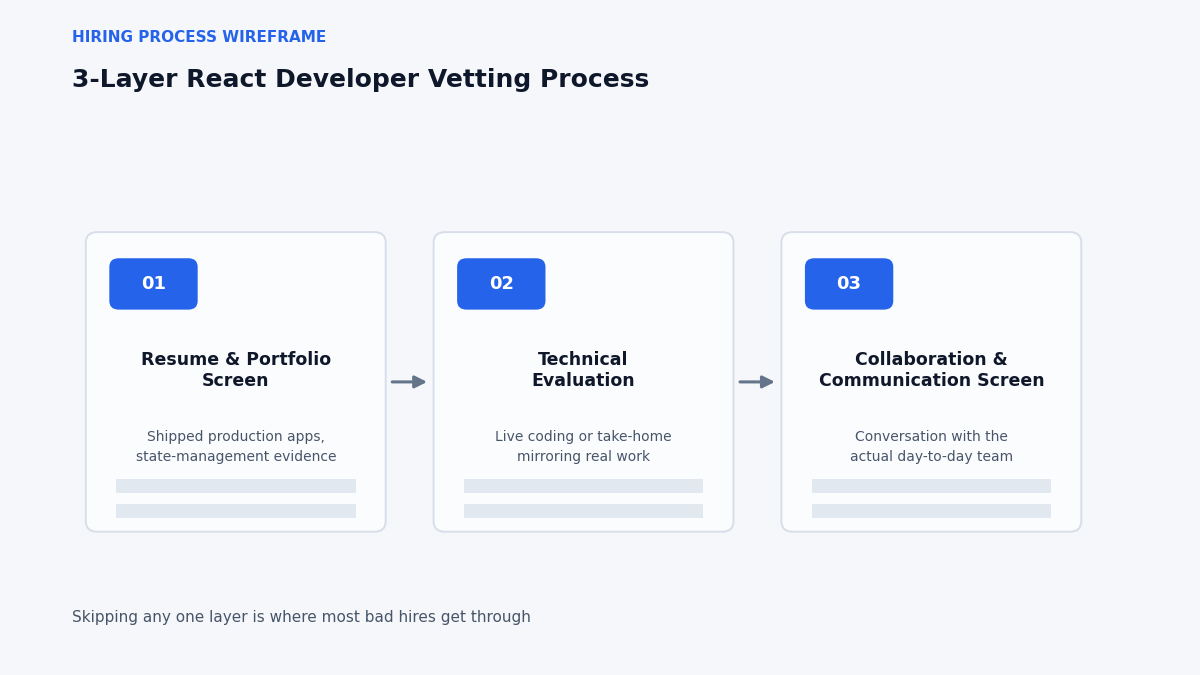
Good screening for a React role has three layers, and skipping any one of them is where most bad hires get through:
- Resume and portfolio screen look for shipped production apps (not just tutorials or personal projects), specific mention of state management approach, and any open-source or code-sample evidence.
- Technical evaluation is a live coding exercise or take-home task that mirrors real work: componentizing a small feature, handling async data, or debugging a deliberately broken component. Avoid abstract algorithm puzzles that don’t test React-specific judgment.
- Collaboration and communication screen a short conversation with whoever will actually work with this person day-to-day, not just a recruiter or hiring manager.
Red flags during vetting:
- Can’t explain why they chose a particular state management approach on past projects only that they used it
- No understanding of when re-renders happen or why they matter for performance
- Portfolio consists entirely of near-identical tutorial-style projects
- Can’t walk through a debugging approach out loud; only produces a final answer
Red flag, vendor-side: if a staffing partner can’t explain their own screening rubric what specifically gets a candidate rejected before you ever see them you’re being handed a resume-matching service, not a vetting service. AI-powered sourcing that filters for the top 2% of applicants only means something if the underlying rubric is disclosed, not just claimed. This is the same standard Supersourcing’s own screening process is built around: a disclosed rubric first, a shortlist second.
A realistic, well-run sourcing-to-shortlist cycle takes 7-10 working days from finalized job description to interview-ready candidates. If it’s taking 4+ weeks, the bottleneck is almost always an unclear brief (see Phase 1), not a shortage of candidates React’s talent pool is simply too deep for genuine scarcity to be the explanation in most markets.
React developer skills checklist what to actually verify, by seniority:
Junior (0-2 years):
- Can build a functional component with hooks (useState, useEffect) without looking up basic syntax
- Understands props vs. state and can explain the difference in plain language
- Has shipped at least one project beyond tutorial-following, even a small one
Mid-level (2-5 years):
- Has used at least one state management approach beyond local component state and can justify when to reach for it
- Understands common performance pitfalls (unnecessary re-renders, missing memoization where it matters)
- Has worked with a REST or GraphQL API integration end-to-end, including error and loading states
- Comfortable reading and modifying code they didn’t write
Senior (5+ years):
- Can explain architectural trade-offs when to reach for Next.js vs. plain React, when to split state locally vs. globally
- Has led or heavily influenced a component library or design system decision on a past team
- Can mentor and review other developers’ code against a stated rubric, not just personal preference
- Has experience with performance profiling and Core Web Vitals in a production context, not just theoretically
Phase 3 Engagement Models & Contracts
Three models cover most React hiring scenarios:
- Dedicated hire (staff augmentation) one developer, fully allocated to you, typically billed monthly. Best for ongoing product work where you need continuity and institutional knowledge to build over time.
- Project-based / fixed-bid a defined scope, defined price, defined timeline. Best for a bounded deliverable (a marketing site, an MVP) where requirements won’t shift mid-build.
- Freelance / contract-to-hire lower commitment, higher variance in availability and accountability. Best for short, well-defined tasks, not core product work.
Contract terms to get in writing before work starts:
- IP ownership all code and assets transfer to you on payment, with NDA coverage for anything proprietary discussed during the engagement
- Notice period for both sides, and what happens to work-in-progress if either party exits early
- Replacement policy what happens if the assigned developer isn’t a fit; a 7-10 day replacement window is a reasonable industry benchmark to ask for
- Reporting and communication cadence (covered in Phase 5)
- Rate structure hourly, monthly, or milestone-based, and what triggers a rate change
Dedicated bandwidth matters here too: a “dedicated” hire who’s secretly split across three client accounts isn’t dedicated, and that’s a fair, specific question to ask any staffing partner directly, not something you should have to infer after the first missed deadline.
Phase 4 Onboarding & Ramp-Up
The first two weeks determine whether a React hires ships in week three or week eight.
Week 1 checklist:
- Repository access, environment setup docs, and a working local build confirmed on day one not day three
- Codebase walkthrough with an existing team member, focused on component structure and state management conventions already in place
- First small, low-risk ticket assigned within the first 2-3 days to establish workflow, not to test them
- Communication tools and cadence explained explicitly (which channel for what, expected response windows)
Week 2 checklist:
- First independently-owned feature or bug fix, reviewed through your normal code review process
- Explicit feedback loop a short check-in specifically about what’s unclear in the codebase or process, not just “how’s it going”
Onboarding friction that shows up repeatedly in practice: a new React developer inherits a codebase with no documented component conventions, guesses at the existing patterns, and introduces a second, incompatible state management approach alongside the first which nobody catches until a code review three weeks later, by which point two features are built on each pattern. The fix is procedural, not technical: a one-page “how we structure components here” doc, written once, saves this every time.
Phase 5 Managing Delivery
Ongoing management for a remote or dedicated React developer should include:
- Reporting cadence daily async standups (written, not always a call) plus a weekly sync on priorities and blockers.
- KPIs that actually reflect frontend work story points or ticket throughput matter less than: features shipped without post-release bugs, code review turnaround time, and Core Web Vitals / performance metrics on shipped work where relevant.
- Account management structure for staff augmentation or dedicated-team models, there should be a named point of contact on the vendor side who isn’t the developer themselves, so escalations don’t depend on the one person who might be unavailable.
- Code review discipline every PR reviewed against a shared, written rubric (component structure, state management consistency, accessibility basics), not ad hoc.
The account management structure matters more than it sounds. In a dedicated hire or staff augmentation model, the developer’s day-to-day manager is usually you or your internal lead but the vendor-side account manager is who you escalate to if the relationship itself needs adjusting: a rate renegotiation, a scope change, a performance concern that hasn’t yet reached “replace this person” territory. Confirm who that person is and how to reach them before you need them, not during a crisis.
Checklist delivery health signals to track monthly:
- Ticket cycle time trending flat or down, not up
- Code review comments trending toward architecture discussion, not repeated basic corrections
- No unplanned rework tied to state management or component structure conflicts
- Communication response times within agreed windows
Phase 6 Scaling or Exiting
- Adding headcount brings a second React developer in only once the first has stable, documented conventions in place; adding two people to an undocumented codebase simultaneously multiplies the Phase 4 friction rather than dividing the workload.
- Offboarding code, credentials, and documentation handover should be a checklist item in the original contract (Phase 3), not something negotiated after the fact.
- Replacement, not renegotiation if a hire isn’t working out, a clear replacement guarantee (7-10 days is a reasonable industry standard) avoids the common trap of quietly tolerating underperformance because switching feels expensive.
If the product later needs mobile coverage, this is typically the point teams evaluate to hire React Native developers as a natural extension of an existing React team, since the component logic and team conventions carry over more easily than starting a mobile build from scratch with an unrelated stack.
Scaling decisions are also where the difference between a one-off freelance hire and a structured approach to hire dedicated React developers becomes most visible. A freelancer who’s done good work on a single feature doesn’t automatically scale into a second or third hire with the same conventions and quality bar that consistency has to come from documented standards (Phase 4) and a vendor or internal process that can reproduce the same vetting rigor (Phase 2) for hire number two, three, and beyond, not just the first one.
Case Studies: React Hiring in Practice
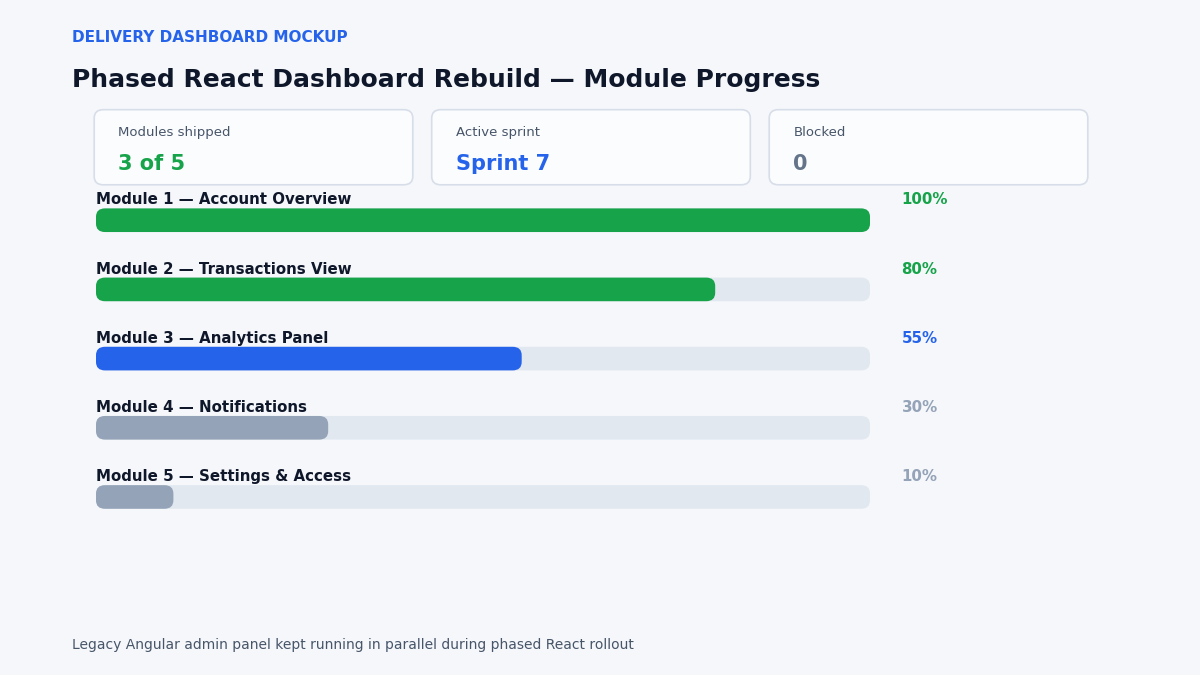
Fintech scale-up, dedicated React team. A fintech platform needed to rebuild a customer-facing dashboard while keeping a legacy Angular admin panel running in parallel. Rather than force one framework across both, the team hired a dedicated React unit for the customer-facing rebuild specifically, isolating the migration risk to one surface instead of a full-platform rewrite. The component-based structure lets the new dashboard ship in phases one module at a time instead of as a single big-bang release.
Healthtech SaaS, staff augmentation for a frontend backlog. A healthtech SaaS provider had a growing backlog of frontend feature requests but no in-house frontend lead. Adding two mid-level React developers through a staff-augmentation model, with one senior engineer retained in-house for architecture decisions, cleared the backlog without the multi-month delay of a full in-house senior hire, while keeping architectural ownership internal.
Fintech and healthtech client base, pattern across engagements. Across a client base spanning fintech, healthtech, and enterprise SaaS, Supersourcing’s delivery teams see the same failure mode repeatedly: teams that skip a codebase-specific technical screen in favor of a generic one end up discovering the mismatch during onboarding instead of during hiring, which costs roughly the same two-to-three weeks either way the only question is whether that time is spent before or after payroll starts.
E-commerce platform, replacement-guarantee scenario. An e-commerce team’s first dedicated React hire struggled with the existing component library within the first three weeks, a mismatch the technical screen had missed because the take-home task hadn’t mirrored the actual codebase’s complexity. A replacement was sourced and onboarded within the contracted window, and the incident became the reason the technical screen was rebuilt to include a codebase-specific debugging exercise rather than a generic coding test, a change that’s now standard practice for engagements like it.
React vs. Vue vs. Angular vs. Full In-House Build: A Decision Framework
| Factor | React (dedicated hire/team) | Vue | Angular | Full in-house hire |
| Talent pool size | Largest (46.9% of professional developers) | Smaller, growing | Smaller, enterprise-skewed | Depends entirely on local market |
| Time to productive hire | Fastest, due to pool depth | Moderate | Slower for senior roles | Slowest full recruiting cycle |
| Ecosystem maturity | Very high (Next.js, React Query, Redux Toolkit) | High, more opinionated defaults | Very high, more rigid structure | N/A |
| Best fit | Product/SaaS teams needing flexibility and speed | Smaller teams wanting gentler learning curve | Large enterprise teams needing strict structure | Long-term core product ownership |
| Cost control | High dedicated or project-based models scale up/down | Similar to React | Similar, often higher senior rates | Lowest short-term flexibility |
| Switching risk if hire underperforms | Lower large backup pool, fast replacement | Moderate | Moderate to high | Highest full rehire cycle |
How to use this table: if your priority is speed-to-hire and long-term flexibility, React’s talent-pool depth makes it the lower-risk default. If your team already has deep Angular expertise and strict architectural governance needs (common in some enterprise and government contexts), that existing expertise can outweigh React’s pool advantage. Vue is rarely the wrong choice technically it’s usually the wrong choice only when hiring speed and backup-candidate depth matter more than framework preference.
What Most Teams Get Wrong When Hiring React Developers
- They hire for the framework, not the surrounding stack. A candidate who’s strong in React but has never worked with your specific state management library, testing setup, or meta-framework (Next.js vs. plain React, for instance) will still need weeks of adjustment; the job description should name the actual stack, not just “React.”
- They treat the technical interview as a pass/fail gate instead of a diagnostic. The goal of a strong technical screen isn’t just to reject weak candidates, it’s to surface exactly what a borderline candidate would need support on, which shapes the onboarding plan (Phase 4) before day one.
- They assume “dedicated” means dedicated. Ask directly whether the developer or team is allocated solely to your account. Shared-bandwidth arrangements are common and not inherently bad, but they should be disclosed and priced accordingly not discovered after a missed sprint.
- They skip the replacement clause until they need it. By the time a mismatch is obvious, leverage has shifted. A replacement guarantee negotiated into the original contract rather than requested mid-engagement is one of the clearest markers of a staffing arrangement built for the buyer’s protection, not just the vendor’s convenience.
- They confuse React’s popularity with React’s difficulty. A large talent pool doesn’t mean every candidate in it is interchangeable, it means the range between weakest and strongest candidates is wider than for a smaller, more self-selected pool, which makes structured vetting (Phase 2) more important, not less.
Cost & Timeline Reality Check
Cost drivers what pushes rates up:
- Senior-level ownership of architecture decisions, not just feature implementation
- Next.js / server-component / SSR experience, which commands a premium over standard client-side React work
- TypeScript fluency combined with React, increasingly treated as a baseline rather than a bonus for mid-to-senior roles
- Domain-specific experience (fintech compliance UI, healthtech data density, high-traffic e-commerce performance tuning)
Cost drivers what brings rates down without sacrificing quality:
- Hiring through a dedicated offshore or nearshore model rather than local-market full-time hiring, where the cost difference is location-driven rather than skill-driven
- Project-based / fixed-bid contracts for well-scoped, bounded work instead of open-ended hourly billing
- Clear, upfront documentation that reduces onboarding time, which is billable time either way
Typical timelines by scenario:
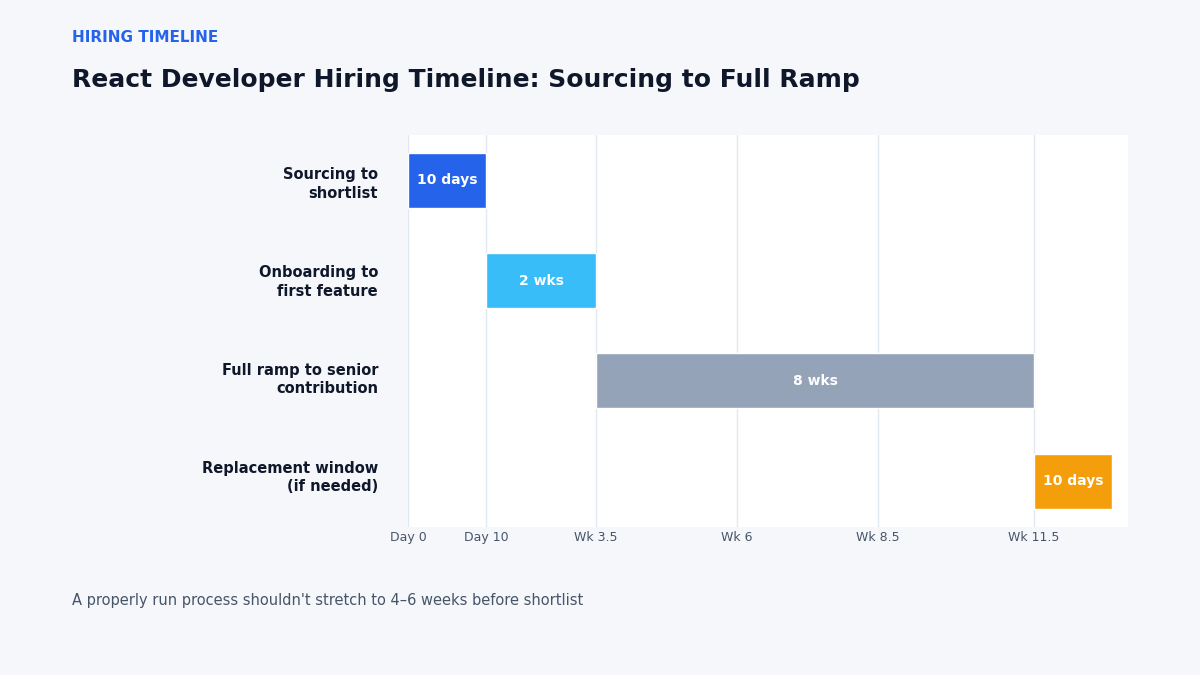
| Scenario | Realistic timeline |
| Sourcing to interview-ready shortlist | 7-10 working days |
| Onboarding to first independently-shipped feature | 2 weeks |
| Full ramp to senior-level architectural contribution | 4-8 weeks, seniority-dependent |
| Replacement, if a hire isn’t a fit | 7-10 working days from flagging the mismatch |
If any of these stretch to 2-3x the ranges above, the root cause is almost always upstream of an unclear brief, a skipped vetting layer, or missing onboarding documentation, not a shortage of React talent.
A note on comparing quotes across vendors: two staffing partners quoting the same monthly rate for a “senior React developer” are not necessarily offering the same thing. Ask what the rate includes a dedicated account manager, a replacement guarantee, NDA-backed IP protection because these terms, not the headline number, are usually where the real cost difference between offers shows up later in the engagement.
What To Do Next
If you’re mid-decision comparing React against another framework, or in-house hiring against a dedicated team the highest-leverage next step is usually getting your requirements and budget band (Phase 1) reviewed by someone who’s staffed this exact scenario before, rather than refining the job description alone for another week.
Supersourcing runs React hiring through the same structured process outlined in this guide: a 7-10 working day sourcing cycle, vetted candidates drawn from the top 2% of applicants, and a 7-10 day replacement window if a hire isn’t the right fit. If you want a second read on your requirements before you post the role, talk to the team.
FAQ
What makes React different from Angular and Vue?
React is a UI library focused specifically on the view layer, giving teams flexibility to choose their own tools for routing, state management, and data fetching. Angular is a full, opinionated framework with those decisions largely made for you. Vue sits between the two more structured than React, more flexible than Angular. The practical hiring difference is pool size and ecosystem maturity, where React currently leads by a wide margin.
Is React frontend or full stack?
React itself is a frontend library. Many React developers also work with Node.js on the backend (the “full-stack JavaScript” pairing), but that’s a separate skill set layered on top, not something React itself requires. Job descriptions should specify which one you actually need.
How much does it cost to hire a React developer?
It depends heavily on seniority and region roughly ₹6-10 lakhs/year for a junior developer in India up to $120k-160k+/year for a senior developer in the US or Western Europe, with dedicated offshore hiring typically landing well below local full-time equivalents for the same skill level. See the Cost & Timeline section above for full ranges.
How do I vet a React developer’s actual skill level?
Use a three-layer screen: portfolio and resume review, a hands-on technical exercise that mirrors real work (not abstract puzzles), and a collaboration conversation with the person they’ll actually work with. Watch for candidates who can explain why they made past technical decisions, not just what they built.
Should I hire a dedicated React developer or a full-stack engineer?
If the work is primarily UI-focused building and maintaining interfaces, component libraries, and client-side state a dedicated React specialist will typically move faster and go deeper than a generalist. If the same person also needs to own APIs and infrastructure, a full-stack hire makes more sense, but expect a smaller candidate pool and a higher rate.
What’s the difference between React and React Native for hiring purposes?
React builds web interfaces; React Native builds native mobile apps using similar syntax and concepts. The skill sets overlap but aren’t identical. A strong React web developer isn’t automatically a strong React Native developer, and vice versa. If your roadmap includes both, plan for two distinct (if related) hiring tracks.
How long does React developer onboarding typically take?
A realistic first independently-shipped feature lands around two weeks in, assuming repository access, environment setup, and a codebase walkthrough happen on day one. Full ramp to senior-level architectural contribution typically takes 4-8 weeks depending on seniority and codebase complexity.
What red flags show up in React interviews?
Inability to explain state management choices beyond “that’s what I used,” no grasp of why unnecessary re-renders hurt performance, and portfolios made up entirely of near-identical tutorial projects are the most common warning signs.
Is React going to stay relevant, or should I hire for a newer framework?
React’s usage share among professional developers has held its lead position through multiple survey cycles, and its ecosystem Next.js, React Query, the broader tooling layer continues to mature rather than stagnate. Newer frameworks like Svelte score well on developer sentiment but haven’t approached React’s hiring-pool depth, which matters more than sentiment when the question is “can I staff this.”
