

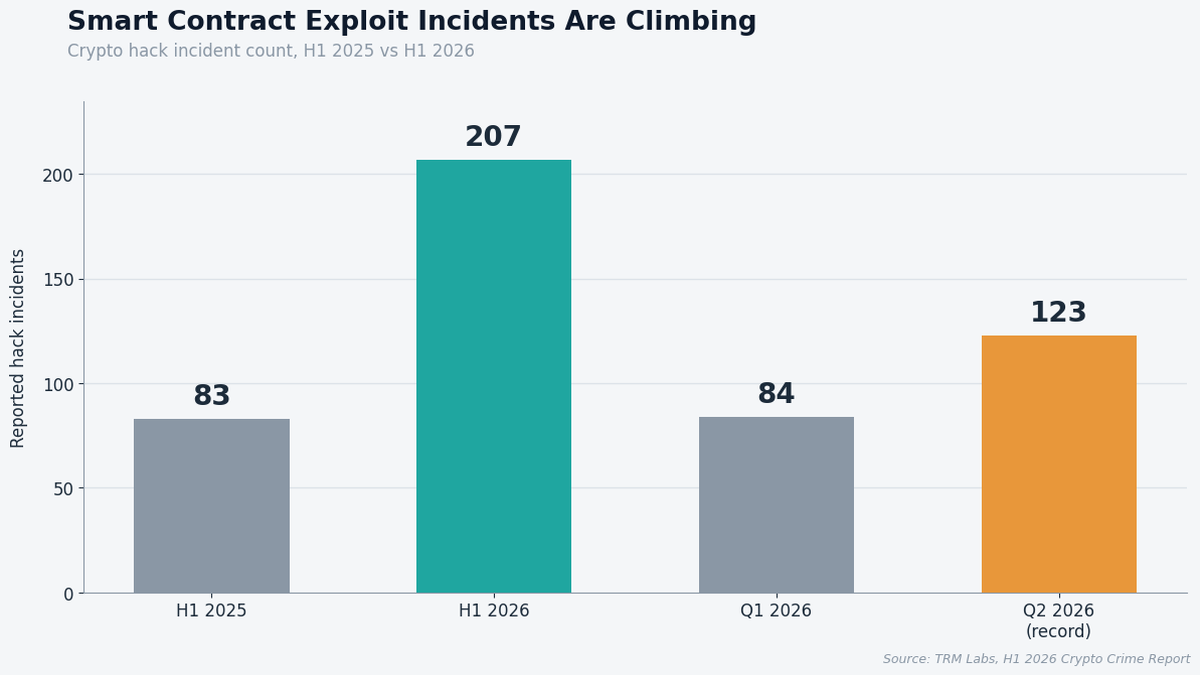
In the first half of 2026 alone, attackers pulled off 207 separate crypto hacks more than double the same period and smart contract exploits were behind the majority of those incidents by count, according to TRM Labs’ H1 2026 crypto crime report. Total dollars stolen actually fell versus last year, but that’s cold comfort if the exploited contract happens to be yours.
Per TRM Labs, Q2 2026 set a new record with 123 separate hack incidents, the highest quarterly count ever recorded even as large-scale losses became concentrated in a handful of catastrophic events rather than spread evenly across the ecosystem.
Here’s the uncomfortable part: most of those exploited contracts were written by developers who called themselves qualified. Some had “Solidity developer” on their resume for three years. A few had even shipped contracts that passed a cursory review. None of that stopped a reentrancy bug, a broken access-control check, or an unbounded loop from draining a treasury.
The problem isn’t a shortage of people who can write Solidity. It’s that most hiring teams don’t know how to tell the difference between someone who has written contracts and someone who can be trusted to write contracts that hold real money. If you’re trying to hire blockchain developers for smart contracts, this guide closes that gap — not with a generic skills checklist, but with a verification framework: how to read a GitHub history like an auditor would, how to confirm a claimed audit actually happened, how to run a live gas-optimization test in an interview, and what red flags actually predict failure six months into an engagement.
TL;DR
This guide walks technical and non-technical hiring managers through the complete process of evaluating and hiring blockchain developers for smart contracts from defining scope to managing delivery after the contract is live. It's built for engineering leads, founders, and procurement teams who need to move fast without gambling treasury funds on an unverified hire. Along the way it covers smart contract security vetting in enough depth to run your own technical screen even if you're not a Solidity engineer yourself.
The single number worth remembering: OWASP's Smart Contract Top 10 project found that access control failures and logic errors not exotic cryptography bugs accounted for the overwhelming share of smart contract losses, meaning most exploits were preventable with disciplined code review, not advanced research. That reframes the hiring question entirely: you're not hunting for a cryptography genius, you're hunting for someone who is boringly rigorous.
By the end of this guide, you'll have a repeatable evaluation framework, a set of interview questions that actually separate skill levels, a cost and timeline reality check in both ₹ and $, and a clear picture of what "well-managed" looks like after the hire is made.
What Is a Smart Contract Developer?
A smart contract developer is an engineer who designs, writes, tests, and deploys self-executing code on a blockchain (typically Solidity or Vyper on EVM-compatible chains, or Rust on Solana), with direct responsibility for the security and gas-efficiency of code that manages real financial value.
This role is often confused with:
- A general blockchain developer is someone who builds wallets, indexers, or dApp front-ends that interact with contracts but doesn’t necessarily write the contract logic itself.
- A Web3 full-stack developer competent at connecting a UI to a contract via Web3.js/Ethers.js, but not necessarily equipped to write or audit the underlying Solidity.
- A smart contract auditor is a security specialist who reviews someone else’s code; some developers are also auditors, but the skill sets and incentives are distinct, and conflating them is a common hiring mistake.
Why This Decision Matters More Than a Typical Hire
Getting this hire wrong doesn’t just cost you a bad sprint, it can cost you the product.
- Financial exposure is direct and irreversible. Unlike a bug in a typical web app, a smart contract bug that reaches mainnet often can’t be patched, funds are gone the moment the exploit executes.
- Audit costs compound bad code. A professional third-party audit for a mid-complexity DeFi contract typically runs $15,000–$60,000; every round of re-audit triggered by developer-introduced vulnerabilities adds that cost again.
- Reputational damage outlasts the fix. Users and investors remember which protocol got hacked; TVL that leaves after an exploit rarely fully returns, even after funds are recovered.
- Regulatory and insurance exposure is rising. As on-chain finance matures, more jurisdictions and insurers expect a documented, competent development and audit trail not just “it works.”
- Hiring the wrong person is slower to detect than in typical software roles. A contract can look functionally correct in testing and still be exploitable; the failure mode often only appears under adversarial conditions, months after deployment.
This is exactly why security-review capability needs to be built into the vetting process itself rather than bolted on afterward, a point the Supersourcing content and delivery team emphasizes with every client evaluating this role, because a technical screen that skips security judgment is testing the wrong thing.
The Core Problem Most Buyers Face
Most hiring teams, even technically strong ones, evaluate smart contract developers the way they’d evaluate a backend engineer: resume, a generic coding test, a culture-fit call. That approach misses the two things that actually matter in this domain: security judgment and verifiable track record, and it shows up in three predictable failure patterns.
- Portfolio inflation. Developers list contracts they “worked on” without clarifying whether they wrote the core logic, fixed a UI bug in a related repo, or simply forked an OpenZeppelin template with minor edits. Dedicated teams that don’t dig into commit-level attribution routinely overestimate a candidate’s actual contribution by 3–4x.
- Audit-claim inflation. “My code has been audited” gets stated as a blanket credential, when in reality the audit may have flagged 12 unresolved medium/high findings, or covered an earlier version of the contract that was substantially rewritten afterward.
- Gas-blindness. Contracts that pass functional tests but weren’t written with gas efficiency in mind can cost end users 30–60% more per transaction than a well-optimized equivalent, a cost that compounds across every transaction the contract ever processes and is invisible until you specifically test for it.
The pattern across all three: the failure isn’t a lack of Solidity knowledge, it’s a lack of a verification process on the hiring side. That’s what the rest of this guide fixes.
A pattern worth naming specifically: teams that have never run a security-focused technical screen tend to over-index on whether a candidate can explain a vulnerability class in the abstract (“what is reentrancy?”) and under-index on whether they can find one in unfamiliar code under mild time pressure.
The two skills correlate but aren’t identical. Plenty of developers can recite the definition of a reentrancy attack from a tutorial without ever having caught one in a live review. If your technical screen only tests the former, you’re filtering for interview preparation, not actual capability.
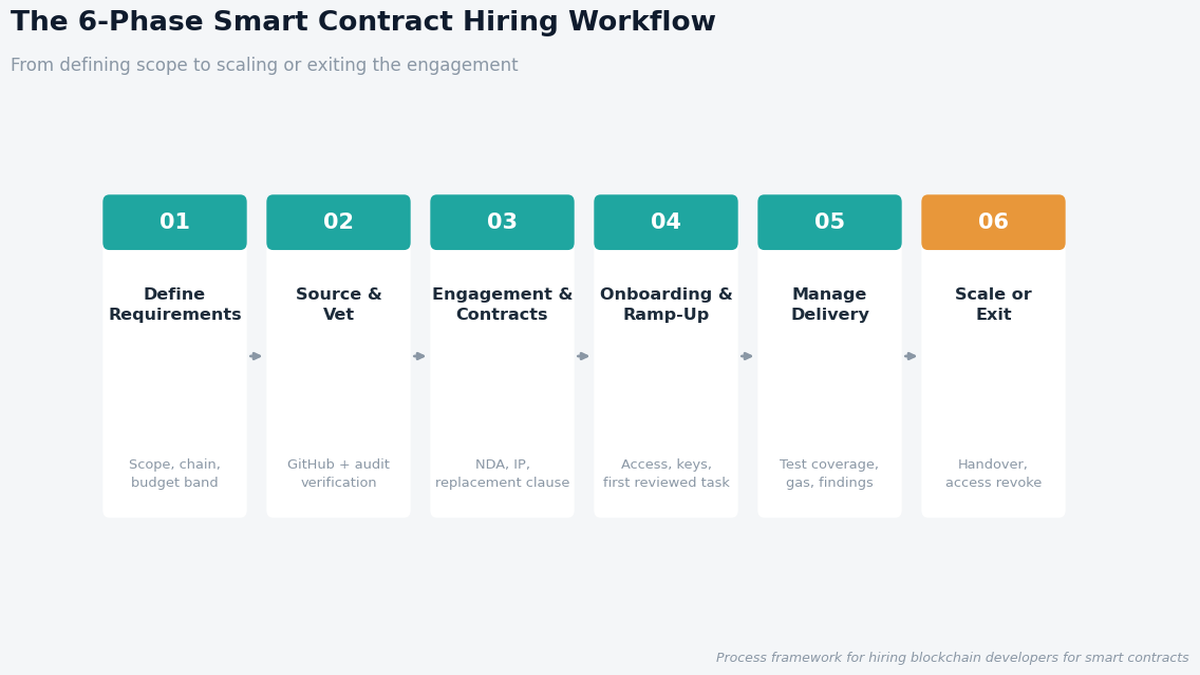
The Walkthrough: How to Hire Blockchain Developers for Smart Contracts, Step by Step
Phase 1 Defining Requirements
Before you look at a single resume, get specific about what “smart contract developer” means for your project. This phase alone prevents most later mismatches.
Define scope in writing:
- Chain and language. EVM-compatible (Solidity/Vyper), Solana (Rust), or another ecosystem that determines your entire candidate pool.
- Contract complexity tier. A simple ERC-20 token deployment is a different hire than a multi-contract DeFi protocol with cross-contract calls, oracles, and upgradeable proxies.
- Security posture required. Will this contract hold user funds directly (high stakes, mandatory third-party audit) or is it an internal tooling contract with limited exposure?
- Engagement duration. A one-off auditable deployment vs. an ongoing protocol that needs ownership over 12+ months changes whether you want a contractor or a dedicated hire.
Set realistic budget bands up front:
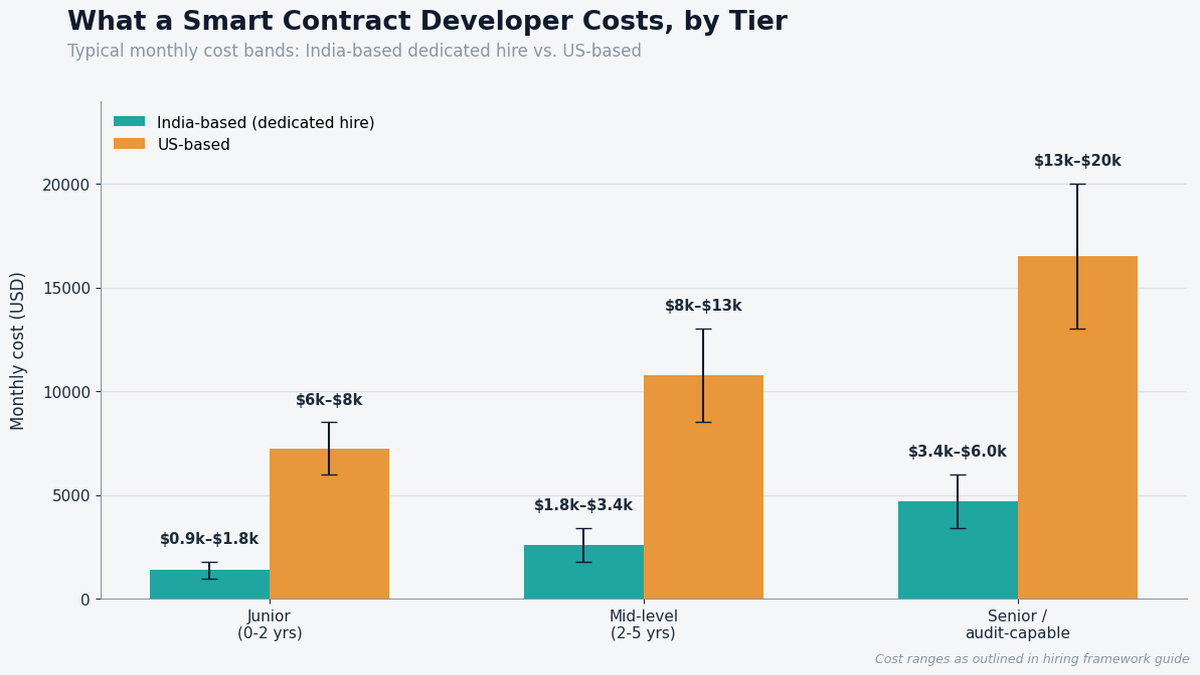
| Experience tier | Typical monthly cost (India-based dedicated hire) | Typical monthly cost (US-based) |
| Junior (0–2 yrs Solidity) | ₹80,000–₹1.5 lakh (~$950–$1,800) | $6,000–$8,500 |
| Mid-level (2–5 yrs, has shipped audited contracts) | ₹1.5–2.8 lakh (~$1,800–$3,400) | $8,500–$13,000 |
| Senior / audit-capable (5+ yrs, security-focused) | ₹2.8–5 lakh (~$3,400–$6,000) | $13,000–$20,000+ |
Budget bands vary by region and by whether the engagement is staff augmentation, project-based, or full-time but writing down a band before sourcing prevents both underpaying for critical security work and overpaying for a role that didn’t need a senior.
A scope-definition checklist to complete before sourcing begins:
- What is the maximum value the contract will hold or process at any point? This single number should drive your audit-tier decision more than anything else.
- Which specific standards apply (ERC-20, ERC-721, ERC-4626, or a custom mechanism)? Custom mechanisms require materially more senior talent and longer audit timelines than standard-compliant contracts.
- Will the contract be upgradeable (via a proxy pattern) or immutable once deployed? Upgradeable contracts introduce their own attack surface (proxy storage collisions, unauthorized upgrade calls) and require a developer specifically comfortable with that pattern.
- Does the project need ongoing feature work post-launch, or is this a single deployment with no planned iteration? This answer alone often decides whether you want a dedicated hire or a project-based engagement.
- Is there an existing codebase to inherit, or is this greenfield? Inheriting someone else’s unaudited contract is a materially different (and often harder) job than writing new code, and should be scoped and priced as such.
Phase 2 Sourcing & Vetting
This is where most hiring processes go wrong, because it’s where teams default to generic technical screening instead of domain-specific verification.
The GitHub verification pass (do this before any interview):
- Open the candidate’s repos and look at commit-level history, not just repo ownership; a repo can be “theirs” while 90% of meaningful commits came from a co-founder or teammate.
- Check whether contracts are original architecture or lightly modified OpenZeppelin/template code both are legitimate depending on the role, but candidates should be transparent about which is which.
- Looking for test coverage in the repo (Foundry or Hardhat test suites) a contract repo with no tests is a red flag regardless of how clean the Solidity looks.
- Search for the contract address on a block explorer if it’s deployed, verified, deployed, and battle-tested code is a stronger signal than code that only ever ran locally.
Verifying claimed audits a step most teams skip entirely:
- Ask for the actual audit report, not just a claim that “it was audited.” Legitimate audit firms (Trail of Bits, CertiK, OpenZeppelin, Halborn, Consensys Diligence, and similar) publish reports with a findings table (critical/high/medium/low) and a remediation status.
- Check whether critical and high findings were actually resolved before mainnet deployment, not just acknowledged.
- Confirm the audited version matches what was deployed; a common inflation tactic is to cite an audit performed on an earlier contract version that was materially changed afterward.
Technical screening a live, practical checklist:
- Give a real (simplified) contract snippet with an intentional vulnerability (reentrancy, unchecked external call, integer overflow in an older-style contract) and ask the candidate to find and fix it; this reveals security instinct far better than a trivia question.
- Ask them to walk through a gas optimization pass on a sample function and explain the tradeoffs (storage vs. memory, loop bounds, unnecessary external calls).
- Ask what static analysis tools they run by default (Slither, Mythril, or similar) and what their personal pre-deployment checklist looks like.
- Ask them to explain a time an audit or code review caught something they’d missed candidates who can’t produce a specific, honest example are often less experienced than their resume suggests.
Red flags worth walking away from:
- Cannot name a single static analysis tool or explain why testing coverage matters.
- Describes “the audit” as a one-time event rather than an iterative process with a firm.
- Gets defensive rather than curious when a reviewer questions their code.
- No public or verifiable deployed contract history at all, despite years of claimed experience.
A note on tooling literacy specifically, since it’s the fastest way to separate skill tiers in a short conversation:
- Slither is a static analysis framework that flags common vulnerability patterns automatically. A candidate who runs it as a matter of habit (not just when asked) signals a security-first workflow.
- Mythril performs symbolic execution to catch deeper logical flaws that pattern-matching tools miss knowing when to reach for it, versus when Slither alone is sufficient, and is itself a signal of experience.
- Foundry has become the dominant modern testing and fuzzing framework for Solidity; a candidate still exclusively using older tooling without fuzzing isn’t automatically wrong, but is worth asking about directly.
- Formal verification (mathematically proving a contract’s properties) is reserved for the highest-stakes contracts; a junior or mid-level candidate correctly saying “we didn’t need that here” shows better judgment than one who claims to use it on everything.
At this stage, teams that want a structured, security-literate vetting layer built into sourcing rather than reconstructing this checklist from scratch every time typically bring in a partner whose screening process already includes a security-review pass. This is one of the areas where Supersourcing’s hire blockchain developers engagement model earns its fee: candidates arrive pre-screened against a checklist very close to the one above, rather than a generic coding test that was never built for this domain.
Phase 3 Engagement Models & Contracts
Once you’ve identified a qualified candidate, the engagement structure matters almost as much as the skill assessment.
Choose the right model:
- Dedicated hire best for ongoing protocols with continuous feature development and security maintenance.
- Project-based / fixed scope best for a single, well-defined contract deployment with a clear audit milestone.
- Staff augmentation is best when you already have an in-house lead and need additional hands under your own technical direction; this is where IT staffing services models are typically structured, with the client retaining architectural control.
Contract terms that matter specifically for this role:
- NDA and IP assignment, executed before any code or architecture discussion, smart contract logic is often the core IP of the business.
- Explicit audit responsibility clauses specify whether the developer is responsible for pre-audit remediation, and whether audit cost is included in the engagement or billed separately.
- Post-deployment liability language what happens if a vulnerability is found after launch that traces to developer error.
- Replacement or remediation guarantee a defined window (commonly 7–10 working days) to bring in a replacement if the hire proves not to be a fit, rather than absorbing the cost of a bad match indefinitely.
Why the replacement clause matters more here than in most technical roles: a mismatched full-stack developer costs you a few weeks of below-par feature velocity. A mismatched smart contract developer who’s already touched production-bound code can leave behind vulnerabilities that surface only after they’re gone, and someone else has to audit their entire contribution before it’s safe to trust. Negotiating a firm replacement window and a clean handover requirement up front is cheaper than discovering this gap after the fact.
Phase 4 Onboarding & Ramp-Up
The first two weeks determine whether you get productive output or six weeks of context-gathering disguised as progress.
Week 1 checklist:
- Repository and environment access (read-only first, write access after a short supervised period for anything touching mainnet-bound code).
- Wallet and key-management protocol clearly never share private keys or seed phrases via chat tools; use a proper secrets manager or hardware wallet workflow from day one.
- Existing audit reports, architecture docs, and prior incident postmortems (if any) shared upfront so the new hire isn’t reverse-engineering decisions.
- A defined communication cadence (daily standup for the first two weeks minimum, even on async-first teams).
Week 2 checklist:
- First small, low-risk task shipped and reviewed not a “toy” task, but something real and reversible, to calibrate code-review quality before higher-stakes work begins.
- A joint walkthrough of your existing testing and static-analysis pipeline so the new hire’s code enters the same review gate as everyone else’s from day one.
Phase 5 Managing Delivery
Ongoing management for this role looks different from managing a typical feature team, because the cost of a missed defect is asymmetric.
Reporting cadence and KPIs that actually matter:
- Test coverage percentage on new contract code tracks it explicitly, don’t assume it.
- Static analysis findings per pull request trending toward zero unresolved high/critical findings before merge.
- Gas cost per key transaction type, benchmarked release over release, silent regression here is a real cost passed to your users.
- Time-to-remediation on any finding raised in review or audit a proxy for how seriously security feedback is taken.
Structural safeguards:
- No single developer should have unilateral mainnet deployment access on anything holding meaningful value requiring a second reviewer or multisig approval.
- Schedule periodic (not just pre-launch) security reviews; contracts that get modified post-launch need the same rigor as the original deployment.
- Maintain a living incident-response runbook who has pause/emergency-stop authority, and how fast can it be exercised.
A cadence worth adopting explicitly: treat security review as a recurring calendar item, not a pre-launch milestone that gets checked off once. A quarterly internal review, paired with a full external audit whenever the contract undergoes a material change, catches the slow accumulation of risk that comes from dependency upgrades, new integrations, and small “quick fix” patches that never went through the same rigor as the original build. Teams that skip this because the contract “already passed audit once” are the ones most likely to appear in next year’s breach statistics.
Phase 6 Scaling or Exiting
When scaling: Add headcount only once your review and testing pipeline can absorb the additional throughput adding a second developer before your code-review process is solid and multiplies risk rather than dividing work.
When exiting or replacing:
- Ensure a full, documented handover: architecture decisions, known technical debt, any deferred audit findings, and key-management transition.
- Revoke access systematically repository, deployment keys, multisig signer status, and any admin roles on the contract itself.
- If the engagement included a replacement guarantee, confirm the timeline (commonly 7–10 working days) and make sure onboarding for the replacement reuses the documentation from Phase 4 rather than starting cold.
Case Studies
A fintech protocol cuts audit-remediation cycles by catching issues pre-audit. A payments-focused client integrating on-chain settlement logic added a mandatory static-analysis and peer-review gate before any code reached their external auditor. The result: their second audit round returned zero critical findings, versus eleven in the first round before the gate existed. The fix wasn’t a better developer, it was a better process wrapped around the same team.
An early-stage DeFi team avoided a costly mis-hire by verifying claimed audit history. During screening, a candidate’s résumé referenced a contract “audited by a leading firm.” A direct request for the report revealed the audit covered a contract version predating a significant rewrite; the deployed code was materially different from what had actually been reviewed. The team passed on the candidate and tightened their audit-verification step for every subsequent hire.
A GCC-model engineering team standardized gas benchmarking across releases. A client building a token-issuance platform started tracking gas cost per transaction type as a release-over-release metric, similar to how they already tracked API latency. Within two quarters, average transaction cost for end users dropped by roughly 40%, driven entirely by catching regressions the team previously had no visibility into.
A staff-augmentation engagement caught a proxy-upgrade vulnerability before it shipped. A client running an upgradeable contract brought in a dedicated hire specifically because their existing team lacked deep proxy-pattern experience. During onboarding review (Phase 4 of the walkthrough above), the new hire flagged that the upgrade function lacked a timelock, meaning a compromised admin key could push a malicious upgrade with no delay for the community to react. The fix adding a 48-hour timelock took under a day to implement once identified, but would have been far more costly to discover after an incident. It’s a small, unglamorous example, but it’s exactly the kind of finding that separates a developer who’s actually worked with upgradeable systems from one who’s only read about the pattern.
Comparison / Decision Framework
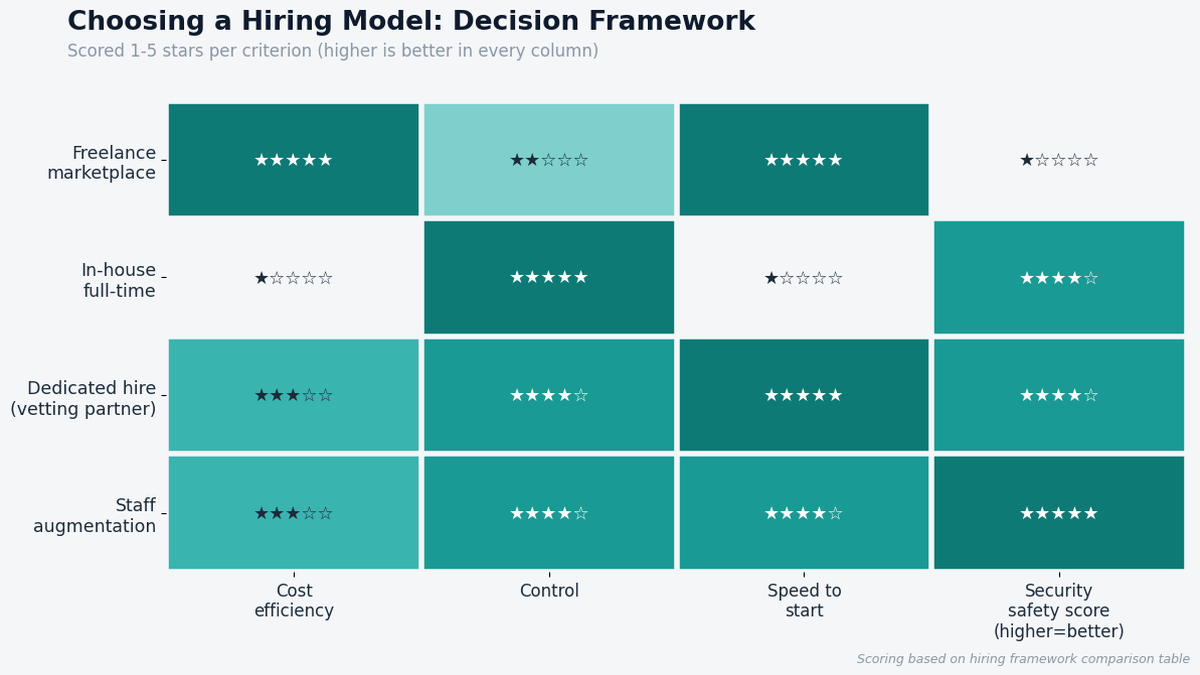
Use this framework to decide how to structure the hire once you’ve defined scope in Phase 1.
| Model | Cost | Control | Speed to Start | Security Risk |
| Freelance marketplace hire | Lowest upfront | Low limited oversight of process | Fast (days) | Highest vetting is on you alone |
| In-house full-time hire | Highest long-term (salary + benefits + hiring cost) | Highest | Slow (weeks to months) | Low, if hiring process is rigorous |
| Dedicated hire via a staffing/vetting partner | Mid no recruiting overhead, transparent monthly rate | High partner pre-vets, you direct the work | Fast (7–10 working days to shortlist) | Low, if the partner’s vetting includes a security-review layer |
| Staff augmentation | Mid, scoped to need | High sits under your existing architecture lead | Fast | Low, since your own senior reviews all output |
A simple rule of thumb: if the contract will hold real user funds at launch, do not default to the cheapest option in this table without an independent audit as a non-negotiable gate, regardless of which hiring model you choose.
How to use this table in practice: most teams don’t pick one row and stay there for the life of the project. A common pattern is starting with a dedicated hire via a vetting partner for the initial build and audit cycle, then shifting to staff augmentation once an in-house lead is confident enough to own architecture decisions directly. The table is a starting point for a conversation about risk tolerance and internal capability, not a one-time decision to get locked into.
What Most Teams Get Wrong
They treat “has written Solidity” as equivalent to “can be trusted with funds.” These are different skills. Plenty of developers can write syntactically correct, functionally passing Solidity that is nonetheless exploitable under adversarial conditions nobody thought to test for.
They skip the live security exercise and rely entirely on resume review. A candidate who explains reentrancy correctly in conversation but has never had to spot it in unfamiliar code under time pressure is a meaningfully different hire than one who’s demonstrated it live.
They don’t separate “wrote the contract” from “owns production risk.” In many teams, the person who wrote the original contract is long gone by the time an incident happens, and nobody currently on the team can explain a design decision from eighteen months ago. Documentation discipline is a hiring criterion, not an afterthought.
They under-invest in the interview’s technical rigor because the interviewer isn’t technical. If the hiring manager can’t personally evaluate a Solidity answer, the fix isn’t to lower the bar, it’s to bring in a technical evaluator or a vetting partner for that specific stage, the same way you would for any specialized infrastructure hire like DevOps engineers.
They assume a single audit is a permanent seal of approval. Contracts get upgraded, integrations change, and dependencies get patched. A contract audited once at launch and never reviewed again accumulates risk silently over time.
They confuse cheap sourcing with fast sourcing. Posting to a low-cost freelance marketplace and getting fifteen applicants in a day feels efficient, but every one of those applicants still needs the full GitHub and audit-verification pass from Phase 2 the sourcing volume didn’t remove the vetting work, it just moved the bottleneck. A pre-vetted shortlist of three qualified candidates, delivered in the same 7–10 working days, is almost always the fastest path to an actual hire.
They let the audit firm’s sign-off substitute for their own understanding of the contract. An audit report reduces risk, but it doesn’t transfer accountability. Teams that can’t explain, in their own words, what their contract’s biggest remaining risk is after auditing even a low-severity, accepted one have effectively outsourced their security judgment entirely, which becomes a problem the moment something changes and there’s no audit scheduled to catch it.
Cost & Timeline Reality Check
What drives cost up:
- Contract complexity (multi-contract systems, cross-chain logic, or novel mechanisms cost more to both build and audit than a standard token or vesting contract).
- Audit firm tier top-tier firms with strong track records command premium rates but reduce post-launch incident risk.
- Urgency compressed timelines typically increase both developer rate and audit-firm rush fees.
What drives cost down without cutting corners:
- Using well-audited, standardized libraries (OpenZeppelin) instead of custom-writing solved problems.
- Structuring a phased audit (a lighter internal review before the full paid audit) to reduce findings and therefore remediation cycles at the expensive stage.
- Hiring through a model that has already absorbed the sourcing and vetting cost, rather than paying recruiter fees and interview time per hire; for context on regional cost differences, see this breakdown of the cost to hire offshore developers in India.
Typical timelines:
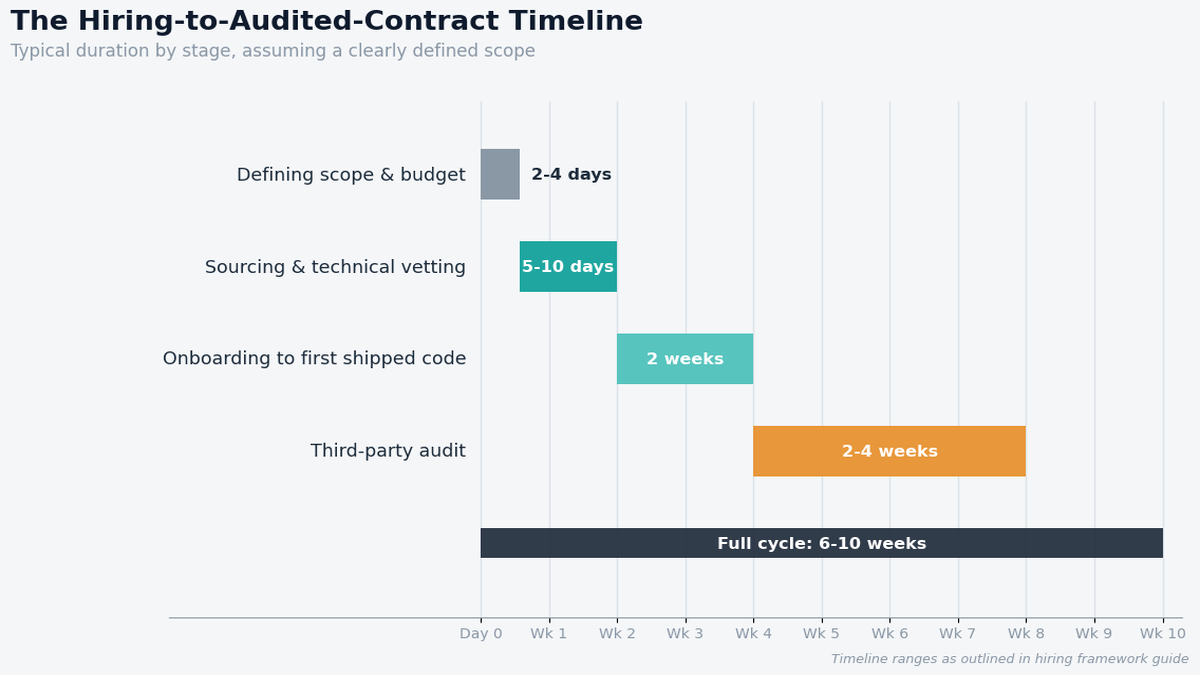
| Stage | Typical duration |
| Defining scope and budget band | 2–4 working days |
| Sourcing and technical vetting | 5–10 working days |
| Onboarding to first shipped, reviewed code | 2 weeks |
| Third-party audit (standard complexity contract) | 2–4 weeks |
| Full cycle: decision to production-ready, audited contract | 6–10 weeks |
These ranges assume a defined scope going in; undefined requirements are the single biggest cause of timelines slipping 2–3x beyond these bands.
A note on why the “7–10 working days to shortlist” number keeps appearing throughout this guide: it’s the same benchmark Supersourcing applies across its broader AI-driven talent acquisition process, not a number specific to blockchain roles. What changes for smart contract hiring isn’t the sourcing speed, it’s what happens inside that window. A generalist hiring pipeline spends those days matching keywords on a resume; a security-literate one spends them running the GitHub and audit-verification checks from Phase 2 before a candidate ever reaches an interview, which is why the shortlist that comes out the other end is meaningfully different even when the timeline looks the same on paper.
Where to Go From Here
If you’re currently staring at a stack of resumes that all claim “3+ years Solidity” and can’t tell which ones would actually survive an audit, the fastest next step isn’t more resumes it’s running the GitHub and audit-verification checks from Phase 2 against your current shortlist before you schedule another interview. If you’d rather have that screening done for you against exactly this framework, you can start a conversation here and get a shortlist built around your specific contract’s risk profile rather than a generic Solidity screen.
Frequently Asked Questions
What skills should a smart contract developer have?
Beyond Solidity or Vyper syntax, look for demonstrated security judgment spotting reentrancy, access-control gaps, and integer issues in unfamiliar code, not just defining them. Add fluency with testing frameworks like Foundry or Hardhat, comfort running static analysis tools such as Slither or Mythril by default, and practical gas-optimization experience. A candidate strong on all four is rarer, and worth more, than one who’s only memorized terminology.
How do you verify a developer’s claimed audit history?
Request the actual audit report rather than accepting the claim at face value. Confirm which critical and high findings were resolved before mainnet deployment, and cross-check that the audited contract version matches what’s actually live on-chain via a block explorer. It’s common for the audited version and the deployed version to differ after a late change; that gap is exactly what this check catches.
What’s the difference between a blockchain developer and a smart contract developer?
A blockchain developer often works across wallets, indexers, and front-end integrations that talk to a contract, without necessarily writing the contract’s core logic. A smart contract developer specifically writes and secures the on-chain code that manages funds or state. The roles overlap in practice, but conflating them during hiring is a common way to under-qualify a security-critical role.
How much does it cost to hire a smart contract developer?
Dedicated hires typically range from roughly ₹80,000/month for junior talent to ₹5 lakh+/month for senior, audit-capable engineers in India-based models, with US-based rates running roughly $6,000–$20,000+ monthly depending on seniority and contract complexity. Add a separate line item for third-party audit costs, typically $15,000–$60,000 for a mid-complexity contract, which is independent of the developer’s own rate.
What should I ask in a Solidity interview?
Ask them to find a planted vulnerability in a real code snippet under mild time pressure, walk through a live gas-optimization pass on a sample function, name the static-analysis tools they run by default, and describe a specific, honest example of a time a review caught something in their own code. Vague or purely theoretical answers to any of these are worth probing further.
How long does it take to hire a qualified blockchain developer?
With a clearly defined scope from Phase 1, sourcing and technical vetting typically takes 5–10 working days to reach an interview-ready shortlist. From there, onboarding to first shipped and reviewed code takes about two weeks, and the full cycle to a production-ready, audited contract usually spans 6–10 weeks depending on complexity.
What are common red flags in a smart contract developer’s portfolio?
No verifiable deployed contracts on-chain despite claimed years of experience, an inability to name a static analysis tool, treating “audited” as a one-time checkbox rather than an ongoing process tied to a specific contract version, and visible defensiveness rather than curiosity when their code is questioned during review.
Should I hire a freelancer or a dedicated team for smart contract work?
A freelancer can work for a narrow, well-scoped, one-off deployment with limited financial exposure. Any contract holding meaningful user funds benefits from a dedicated hire or staff-augmentation model with structured oversight, documented handover practices, and a mandatory independent audit as a non-negotiable gate before launch regardless of which staffing model you ultimately choose.
Do smart contract developers need a specific certification?
There’s no single industry-standard certification that reliably predicts skill in this field the way, say, a professional engineering license does in other industries. Verifiable deployed contracts, resolvable audit history, and live demonstrated security judgment are far stronger signals than any certificate treating certifications as a minor supporting data point, not a substitute for the verification steps in Phase 2.
