

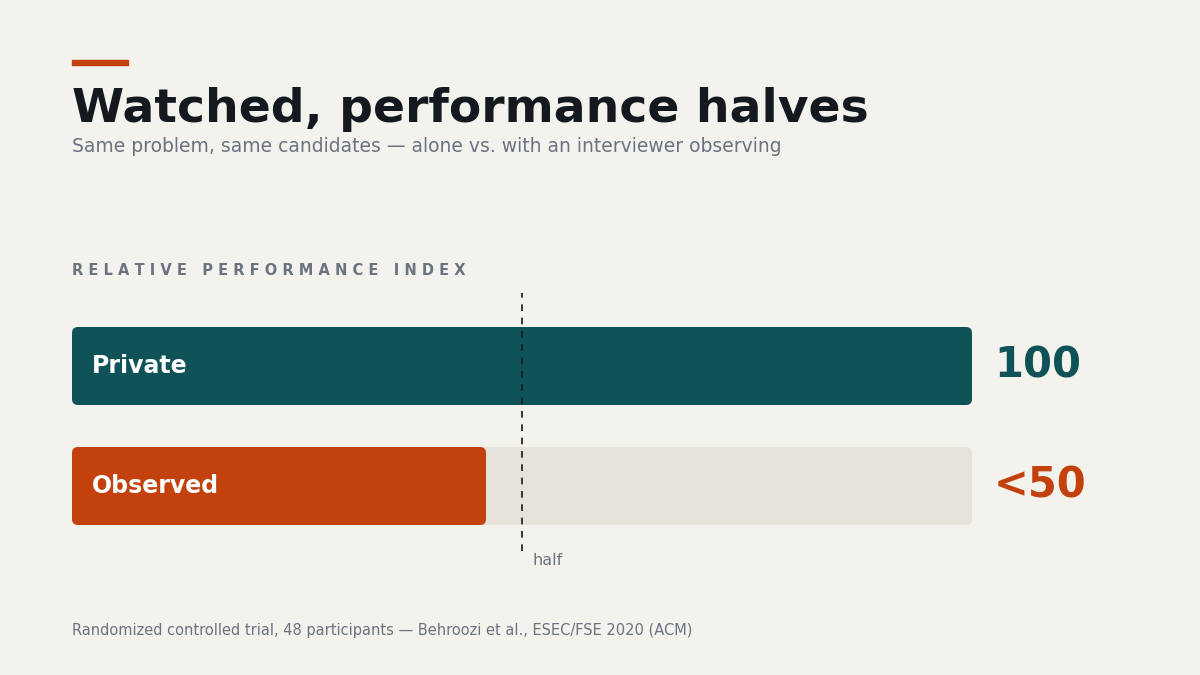
A randomized controlled trial run at North Carolina State University with Microsoft put 48 computer science students through the same programming problem in two settings: alone, and with an interviewer watching. Performance dropped by more than half in the watched condition. Not by a margin. By half.
That single finding should reframe how engineering leaders think about take home assignment vs live coding as a choice. The debate is usually framed as a preference: some teams like watching people think, others like reading finished work. It isn’t a preference. Each format introduces a specific, measurable distortion into your data, and the only real question is which distortion you can afford in the role you’re filling.
Live coding measures composure under observation alongside engineering ability, and it cannot separate the two. Take-homes measure output quality but tell you nothing about who produced it or how long it really took. Neither is neutral. Both are instruments with known error bars, and most hiring processes treat them as if they have none.
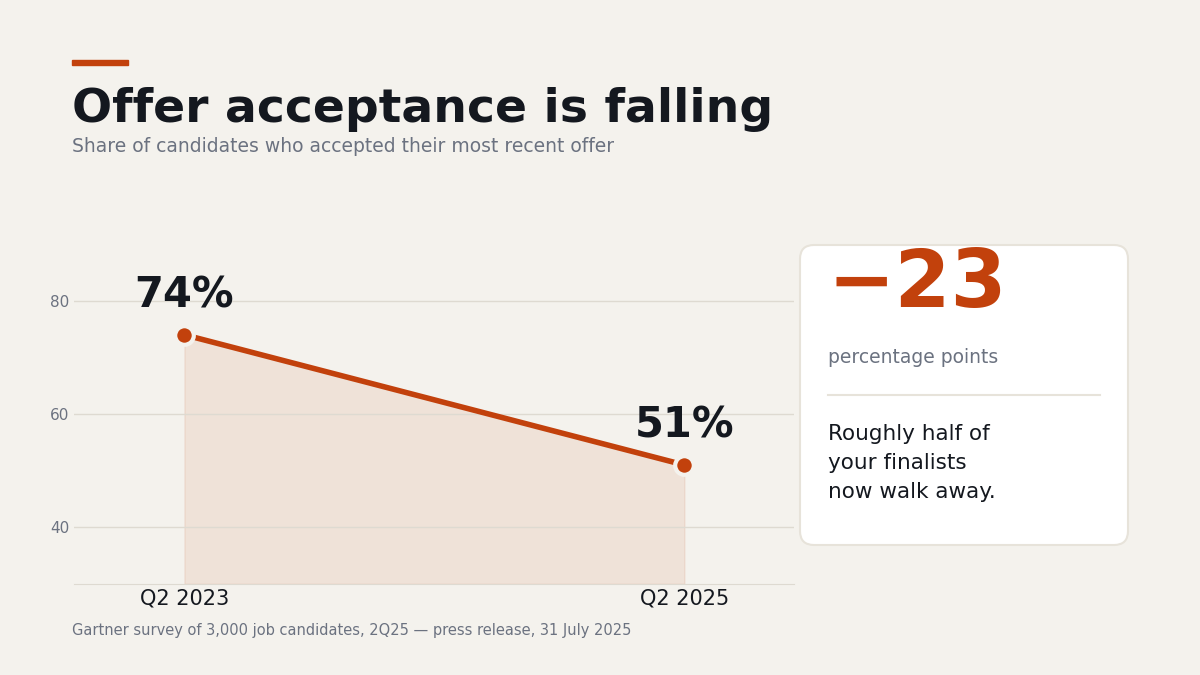
The stakes moved in 2025. Offer acceptance across the market fell from 74% in Q2 2023 to 51% in Q2 2025, according to Gartner’s candidate survey of 3,000 job seekers. Half of your finalists now walk. A bloated assessment isn’t just a screening cost anymore it’s a conversion event.
TL;DR
This guide is for engineering managers, founders, and talent leads deciding how to screen developers without burning their funnel. It settles the take home assignment vs live coding question by covering what each format actually measures, how to design one that survives AI assistance, and how to score it consistently across reviewers.
The number worth remembering: interview performance drops by more than half when a candidate is simply being watched. That means a large share of the people your live coding round rejects were rejected for stage fright, not for engineering.
By the end you'll have a five-step design sequence, a scoring rubric structure, and a decision table that tells you when a coding test vs take home is the right call for the seniority and stack you're hiring into. You'll be able to pick a format based on evidence instead of habit.
What is a take-home assignment, and what is live coding?
A take-home assignment is an asynchronous technical evaluation where a candidate builds a scoped deliverable in their own environment, typically over two to four hours, submitted as a repository.
Live coding is a synchronous session, usually 45 to 60 minutes, where a candidate writes or modifies code while an interviewer observes and questions their reasoning in real time.
The formats differ on three axes: who controls the clock, whether the reasoning is observable, and whether the work environment is real. Everything else in the take home assignment vs live coding debate follows from those three variables.
Coding test vs take home: the problem is signal loss, not format preference
Most dedicated development teams pick a format and then discover the failure mode six months later, when a hire who cleared every round can’t ship. The failure is rarely dramatic. It’s a slow realisation that the assessment measured something adjacent to the job.
Here’s the measurable version of the take home assignment vs live coding tradeoff. In a live session, you are observing a candidate under conditions the NC State trial showed cut performance in half so your pass rate is depressed by an effect that has nothing to do with the codebase they’d be working in. You are also, structurally, favouring fast recall over careful design. That’s a defensible tradeoff for an incident-response role and an indefensible one for a platform architect.
Take-homes invert the problem. Candidate drop-off is the tax, and it lands unevenly. In our own engagements, the drop-off pattern is consistent: assignments scoped past roughly four hours lose senior candidates first, because senior candidates are the ones holding competing offers and the ones least willing to spend a weekend proving a point. You end up with a funnel biased toward the people with the most free time, which is almost never the people with the most experience.
Technical assessment comparison: designing for signal instead of theatre
This is where most processes are salvageable. Framed as take home assignment vs live coding, the formats aren’t broken the designs are. Below is the architecture we use when standing up a screening process for a client team, whether that’s a six-person startup pod or a 60-engineer global capability center ramping in Bengaluru.
Live coding interview pros cons, stated honestly
The case for live coding is narrow but real. You see how someone navigates ambiguity, you can watch them respond to a changed requirement mid-problem, and identity fraud is materially harder when a person is on camera explaining a decision they made ninety seconds ago. It’s also the only format that reliably surfaces communication style before an offer.
The case against is equally concrete. It penalises methodical thinkers, it advantages candidates who recently drilled interview problems, and it produces the lowest inter-reviewer agreement of any format we’ve measured. Two interviewers watching the same session frequently disagree on the same candidate, because neither is scoring against a fixed rubric.
The resolution is not to abandon it. Read as take home assignment vs live coding, it’s to stop using live coding as a screening instrument and start using it as a verification instrument, which is a different job entirely.
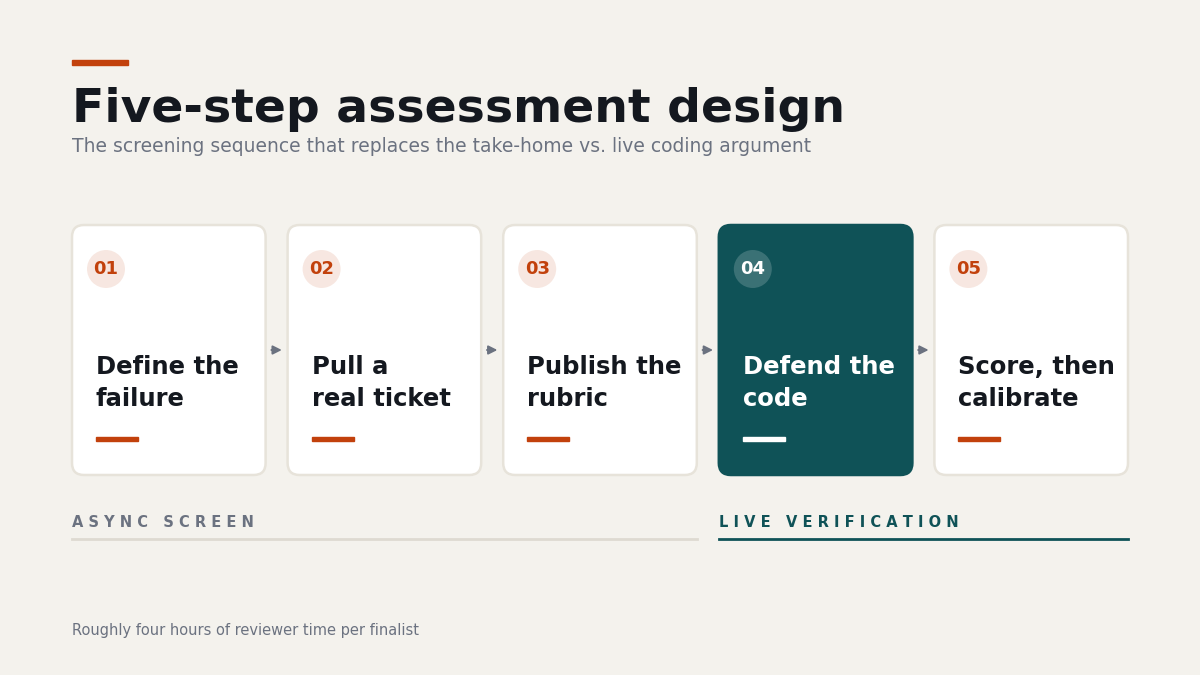
The five-step assessment design sequence
- Define the failure you’re screening for. Write down the specific way a bad hire in this role would fail shipping untested code, over-engineering, missing edge cases, poor API design. If you can’t name it in one sentence, you aren’t ready to design an assessment.
- Extract the task from your actual backlog. Take a ticket your team closed in the last quarter, strip the proprietary parts, and scope it to under three hours. Contrived puzzles correlate with nothing.
- Publish the rubric with the assignment. Four to six weighted criteria, each with a stated pass bar. Candidates should know how they’ll be scored before they start. This alone removes most rubric drift between reviewers.
- Run a 30-minute defence round on their own submission. Not new code. Ask why they chose that data structure, what breaks at 100x load, and where they’d refactor first. This is the round that does the real work.
- Score independently, then calibrate. Two reviewers score without seeing each other’s sheets, then reconcile. Disagreements above one point on a five-point scale mean your rubric is ambiguous, not that the candidate is borderline.
That sequence collapses take home assignment vs live coding into one loop and takes about four hours of reviewer time per finalist. Compare it to the cost of a mis-hire on a six-month contract and the arithmetic isn’t close.
How long should a take-home assignment be?
Three hours, capped, with a stated time limit and explicit permission to stop when the clock runs out. Anything longer converts your assessment into an endurance filter.
The enforcement detail matters more than the number. Tell candidates you’re scoring what they completed in three hours, not whether they finished then actually score it that way. Teams that state a limit and quietly reward the candidate who spent nine hours are running an unstated test, and word of that travels through developer networks faster than any employer brand campaign.
Paying for the assignment is worth considering above the three-hour mark. It changes the conversation from extraction to engagement, and in a market where half of finalists decline offers, that signal compounds.
How to prevent AI cheating on a take-home assignment
Detection tooling is a losing arms race. Design is not, and this is where the take home assignment vs live coding split matters most.
The most reliable defence we’ve found costs thirty minutes: hand the candidate back their own submission with a subtle bug injected, and ask them to find and fix it live. Someone who wrote the code or who genuinely reviewed and understood AI-assisted code locates it in minutes. Someone who pasted an output cannot navigate their own repository.
This connects to something the Stack Overflow data makes explicit. The single most-cited developer frustration, at 45%, is AI output that’s almost right but not quite. That’s precisely the failure mode a defence round exposes and a static code review misses. A submission can be clean, idiomatic, and subtly wrong in a way that only surfaces when someone has to explain it.
One red flag worth naming, because it recurs: a repository with an immaculate README, perfect commit hygiene, and a commit history clustered inside a twenty-minute window. That’s not a productivity signal. That’s a copy-paste signature.
What this looks like in delivery
Across 527+ delivered IT projects over the past decade, the pattern separating fast, low-regret hiring from slow, high-regret hiring is not how a client resolved to take home assignment vs live coding. It’s whether the assessment was scoped to the actual work.
Fintech platform team, contract roles. A client hiring backend engineers on rolling contracts had been running a 90-minute live algorithm round and losing candidates at the offer stage. Replacing it with a two-hour async task drawn from their own payments backlog plus a 30-minute defence round preserved the technical bar and moved the whole loop inside a single week. Across our contract placements, candidate drop-off after signing sits below 1%, and the joining rate across placements holds at 98% numbers that come from shortening the loop, not lowering the bar.
Healthtech team scaling QA. A team that needed to hire QA engineers quickly had been screening on scripting syntax in live sessions. Moving to a take-home that asked candidates to write a test plan against a deliberately under-specified feature spec then discussing the gaps they found surfaced judgment rather than syntax recall, which is what the role actually required. The typical cycle from job description to interview-ready shortlist runs 7-10 working days.
Developer assessment methods: a decision framework
Use this to pick a format against the role, not against your preference. The take home assignment vs live coding decision resolves differently for a staff engineer than for a junior contractor.
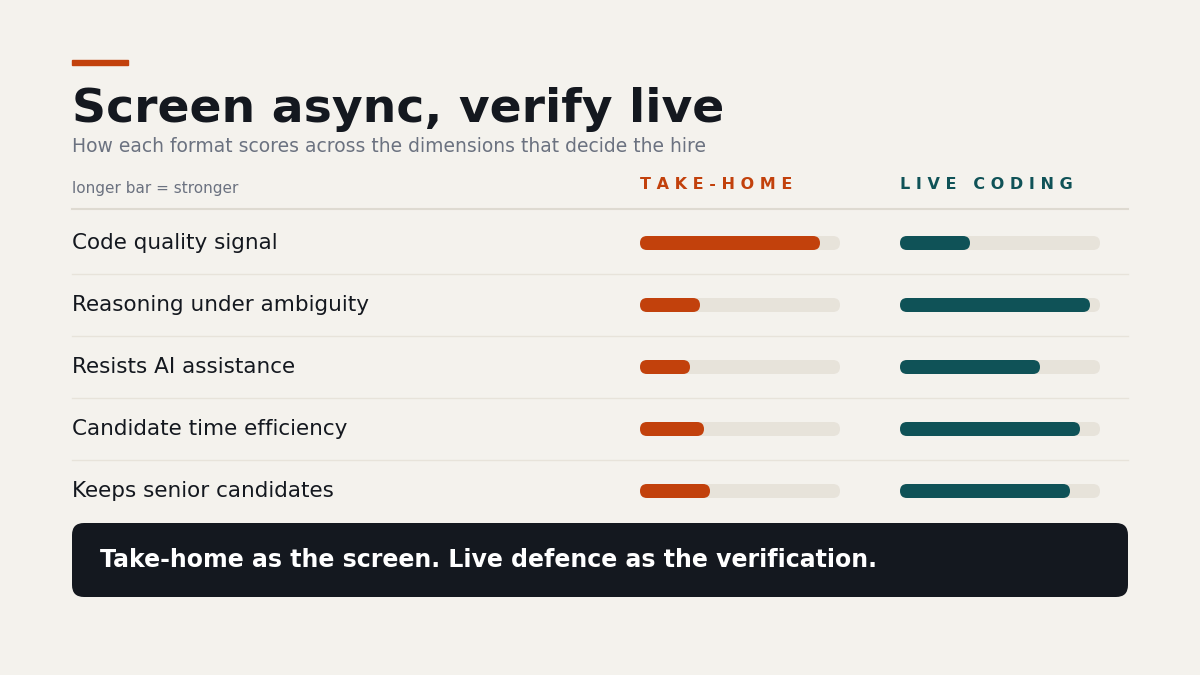
| Dimension | Take-home assignment | Live coding |
| Best-fit stage | Primary screen after recruiter call | Verification round before offer |
| What it measures well | Code quality, design judgment, testing discipline | Reasoning under ambiguity, communication, identity |
| Candidate time cost | 2-3 hours async | 45-60 minutes synchronous |
| Reviewer time cost | 45-60 min per submission | 60 min plus calibration |
| Resistance to AI assistance | Low on its own; high when paired with a defence round | Moderate; high with a screen-share and follow-up questioning |
| Main failure mode | Senior candidate drop-off | Rejects methodical engineers for stage fright |
The table resolves to a single recommendation for most teams: take-home as the screen, live defence as the verification. Running both as independent gates doubles your funnel cost and tests the same competency twice.
What most teams get wrong
The mistake isn’t losing the take home assignment vs live coding argument. It’s running an assessment with no rubric, then treating reviewer disagreement as candidate ambiguity. When two engineers score the same submission differently, the variance is almost always in the scoring instrument, not the candidate. Teams read that noise as a weak signal about the person and reject it, which is how strong engineers get filtered out of processes that look rigorous on paper.
The second recurring error is scoping the assessment to a stack the candidate will never touch. We’ve seen teams screen on algorithmic complexity for a role that turned out to be 80% integration work and API glue. The assessment was hard, the bar was high, and it measured the wrong thing which is worse than measuring nothing, because it produces false confidence.
The third is treating the take-home as a filter rather than a conversation starter. A submission that scores 3 out of 5 but reveals unusually clear thinking about failure modes is often a better hire than a flawless 5 with no visible reasoning. If your process can’t tell those apart, the format was never the problem.
Pressure-test your process before you scale it
If you’re resolving take-home assignments vs live coding for a rebuilt technical screen or standing up a hiring loop for a new team, a global capability center, or a set of contract roles, the format decision is the easy part. The hard part is the rubric, the calibration, and the drop-off math.
Supersourcing has run this process across 527+ delivered projects for teams including Swiggy, Razorpay, Chargebee, and Apollo Hospitals, through both IT staffing services and full recruitment process outsourcing engagements. The typical cycle from job description to interview-ready shortlist runs 7-10 working days, with a replacement guarantee inside the same window if a hire isn’t a fit. Teams looking to hire remote developers against a pre-vetted talent pool can skip most of the screening design entirely.
Send your current assessment and we’ll tell you what it’s actually measuring with no pitch attached. mayank@engineerbabu.com · supersourcing.com/contact-us
Frequently asked questions
Are take-home assignments better than live coding interviews?
Neither is universally better, and take home assignment vs live coding is the wrong frame for the question. Take-homes produce better signals on code quality and design judgment; live rounds produce better signals on reasoning and reduce identity fraud risk. The strongest processes use a short async task as the screen and a live defence of that same submission as verification, which captures most of the value of both at roughly half the total time cost.
How long should a take-home assignment be?
Cap it at three hours and state the cap explicitly. Beyond that, drop-off rises sharply among senior candidates, who typically hold competing offers. Score what was completed inside the window rather than rewarding candidates who overspent, and consider paying for anything above the three-hour mark.
Should you pay candidates for take-home assignments?
For assignments over three hours, or where the deliverable resembles billable work, yes. Payment reframes the exercise as a professional engagement and improves completion rates among experienced engineers. Below three hours, most candidates accept an unpaid task provided the scope is honest and the rubric is published upfront.
Is live coding still useful now that most candidates use AI?
Yes, but its job has changed. With 84% of developers using or planning to use AI tools, live rounds are no longer a good test of unaided coding speed. They are now the most practical way to verify that a candidate understands and can defend work they submitted, which is a more relevant competency than writing code from a blank file.
Do take-home assignments hurt candidate conversion?
Poorly scoped ones do. Assignments past roughly four hours lose senior candidates disproportionately, and with market offer acceptance down to 51%, that loss is expensive. Well-scoped assignments with published rubrics and stated time limits generally improve conversion, because candidates read them as evidence of a serious engineering culture.
What is the best technical assessment for senior engineers?
For staff and principal roles, a system design round plus a code review exercise usually outperforms both formats. Hand them a real pull request from your codebase and ask what they’d push back on. It tests judgment, standards, and communication in one session, and it’s the closest simulation of what the role involves day to day.
How do you keep scoring consistent across reviewers?
Publish a weighted rubric of four to six criteria, have reviewers score independently before discussing, and treat gaps larger than one point on a five-point scale as a rubric defect. Teams that adopt this typically see reviewer agreement improve within two hiring cycles. If you’d like a second opinion on your current rubric before rolling it out, that’s a conversation worth having early.
