

The $3.8M Oracle Program That Ran Two Platforms in Parallel
A US-based manufacturing company with $2.8B revenue, Oracle EBS R12.2 live across finance, procurement, and manufacturing decided to move to Oracle Fusion Cloud. The brief: Oracle Fusion Cloud Financials, Procurement, and Manufacturing (Oracle SCM Cloud) migration from EBS R12.2. Twenty months. Fifteen India-based Oracle consultants. $3.8M.
The vendor had Oracle partner credentials. Oracle EBS experience across multiple industries. Oracle Fusion Cloud migrations. The CVs listed Oracle certifications and implementation experience.
This is where hiring oracle EBS & fusion cloud consultants becomes a strategic decision rather than a routine sourcing task. Oracle EBS and Oracle Fusion Cloud are fundamentally different platforms, requiring distinct expertise across Financials, Procurement, and SCM modules.
The urgency is accelerating as cloud adoption becomes the default. Oracle highlights growing enterprise shift toward Fusion Cloud applications for finance and supply chain modernization, reflecting how organizations are actively moving away from legacy EBS toward cloud-native systems heading into 2026.
The vendor’s solution: run the Oracle EBS manufacturing module in parallel with Oracle Fusion Cloud Financials. A hybrid architecture. One company, two Oracle platforms. This was never in scope, never agreed, and created an integration complexity that would persist indefinitely.
The client’s Oracle program director brought in as an emergency hire terminated the hybrid approach. Oracle SCM Cloud manufacturing was deferred. A specialist Oracle SCM Cloud partner was engaged at premium rates for the manufacturing workstream. $940K in additional spend. The manufacturing migration was delayed by 14 months.
The root cause: Oracle EBS experience presented as Oracle Fusion Cloud capability. EBS and Fusion Cloud are different products on different architectures. The procurement gap was the same problem EBS procurement knowledge does not transfer to Fusion Cloud Procurement without specific retraining. The Oracle Fusion Cloud module specificity question (the verification in Section 8) would have surfaced both gaps before the first consultant was onboarded.
TL;DR 8 Answers Before You Read Further
| Question | Answer |
| What does a Senior Oracle Fusion Cloud Consultant cost from India? | $48–75/hr fully loaded. An Oracle Solution Architect runs $92–132/hr. Section 5 has the full rate stack. |
| What's the single most important verification? | Oracle EBS vs Oracle Fusion Cloud distinction. They are different products. EBS experience does not transfer to Fusion Cloud without specific retraining. Always verify which product the claimed experience is on. |
| Which Indian city has the deepest Oracle talent? | Chennai for Oracle EBS (the largest Oracle EBS pool in India). Bangalore and Hyderabad for Oracle Fusion Cloud. |
| What certification actually matters? | Oracle Fusion Cloud certifications specifically Oracle Fusion Cloud Applications Certified Implementation Specialist by module. Not Oracle EBS certifications for Fusion Cloud programs. |
| How many Oracle Fusion Cloud architects are in India? | Approximately 2,800 Oracle Fusion Cloud certified practitioners with production implementation experience. The EBS pool is much larger (approximately 28,000) but is not interchangeable with Fusion Cloud. |
| What's the most commonly misrepresented experience? | Oracle EBS R12 experience presented as Oracle Fusion Cloud capability. And generic "Oracle Financial" experience without specifying EBS version or Fusion Cloud module. |
| What's typical attrition for Oracle consultants? | 13–17% for Fusion Cloud specialists. Lower for EBS specialists (12–14%) because the EBS market is contracting as organisations migrate to Fusion Cloud. |
| What's the single biggest hiring mistake? | Not separating EBS from Fusion Cloud in the JD and sourcing brief. The pools are different, the products are different, and the rates are different. |
Are You Actually Ready for This?
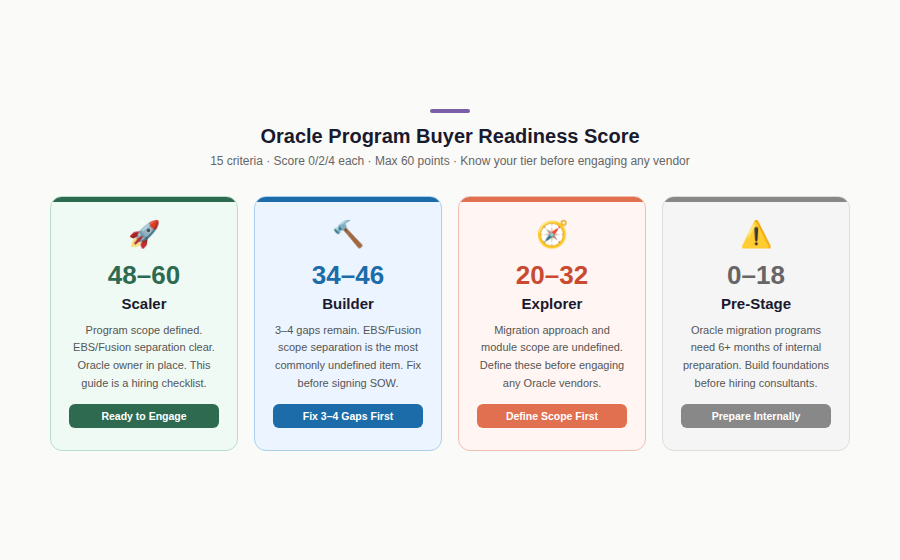
Oracle programs, particularly EBS-to-Fusion Cloud migrations, are among the most complex enterprise technology programs. Buyer readiness determines program outcomes as much as consultant quality. Score yourself.
Score each: 0 (not in place), 2 (partially), 4 (done).
| # | Criterion | Score |
| 1 | Named Oracle program owner with Oracle domain knowledge | 0/2/4 |
| 2 | EBS vs Fusion Cloud scope clearly separated which modules on which platform | 0/2/4 |
| 3 | Oracle Fusion Cloud module scope defined Financials, SCM, HCM, or combination | 0/2/4 |
| 4 | Migration approach confirmed big bang vs phased vs coexistence | 0/2/4 |
| 5 | Oracle EBS current state documented version, modules in use, customisations | 0/2/4 |
| 6 | Data migration strategy defined what migrates, what cutover approach | 0/2/4 |
| 7 | Integration scope documented which non-Oracle systems connect | 0/2/4 |
| 8 | Interview panel with Oracle Fusion Cloud domain experience available within 5 business days | 0/2/4 |
| 9 | Legal SLA under 15 days for MSA review | 0/2/4 |
| 10 | Oracle Fusion Cloud test environment provisioned for offshore team | 0/2/4 |
| 11 | KPIs defined: configuration completion, integration test pass rate, data migration accuracy | 0/2/4 |
| 12 | CISO signed off on offshore access to Oracle EBS and Fusion Cloud environments | 0/2/4 |
| 13 | Escalation path: vendor PM → your Oracle Program Director → your CIO/CFO | 0/2/4 |
| 14 | IP ownership for custom Oracle reports, integrations, and OTBI workbooks in MSA | 0/2/4 |
| 15 | Finance can process USD-denominated invoices within 30 days | 0/2/4 |
What your score means:
| Score | Tier | Reality Check |
| 48–60 | Scaler | Ready. This guide is a checklist. |
| 34–46 | Builder | 3–4 gaps. The EBS/Fusion Cloud scope separation is the most commonly undefined item. Fix before signing. |
| 20–32 | Explorer | Define the migration approach and module scope before engaging vendors. |
| 0–18 | Pre-Stage | Oracle migration programs require 6+ months of internal preparation. Build it first. |
From the deal floor: A UK utility company scored 16 on this checklist. The migration approach (criterion 4) was undefined; the client had not decided between big bang and phased migration. The offshore team spent 9 weeks in scope definition and stakeholder alignment. Nine weeks at £72/hr blended across 12 consultants: £311K spent on a decision that should have been made before the SOW was signed.
The Oracle Talent Market in India 2026
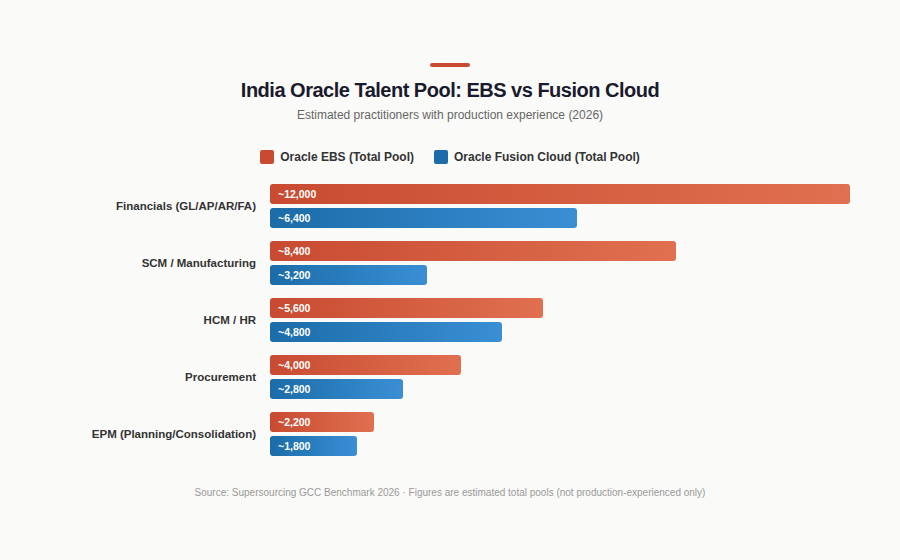
India has the largest Oracle talent pool outside the United States. Oracle EBS has been delivered from India for 25+ years TCS, Infosys, Wipro, HCL, and Cognizant have built entire Oracle practices around EBS R11, R12.1, and R12.2. Chennai is historically Oracle’s strongest city in India, with a talent concentration that mirrors Pune for SAP.
The transition challenge: Oracle is moving its customer base from EBS to Oracle Fusion Cloud. Oracle EBS goes end of extended support in 2035, with mainstream support already ended for older versions. As the EBS customer base migrates, the demand for Oracle Fusion Cloud consultants is growing rapidly while the supply of genuinely experienced Fusion Cloud practitioners is still catching up to demand.
The EBS vs Fusion Cloud pool:
| Product/Module | Estimated India Pool | Production-Experienced |
| Oracle EBS R12.2 (any module) | ~28,000 | ~14,000 |
| Oracle EBS Financials (GL, AP, AR, FA) | ~12,000 | ~6,000 |
| Oracle EBS SCM (OM, PO, INV, MFG) | ~8,400 | ~4,200 |
| Oracle EBS HRMS | ~5,600 | ~2,800 |
| Oracle Fusion Cloud Financials | ~6,400 | ~2,400 |
| Oracle Fusion Cloud SCM | ~3,200 | ~1,200 |
| Oracle Fusion Cloud HCM | ~4,800 | ~1,800 |
| Oracle Fusion Cloud Procurement | ~2,800 | ~1,000 |
| Oracle Fusion Cloud EPM (Planning, Consolidation) | ~1,800 | ~650 |
| Oracle Integration Cloud (OIC) | ~4,200 | ~1,600 |
| Oracle OTBI / Analytics Publisher | ~6,800 | ~2,800 |
| Oracle Database (DBA, Performance Tuning) | ~18,000 | ~8,000 |
The EBS-to-Fusion Cloud transition gap:
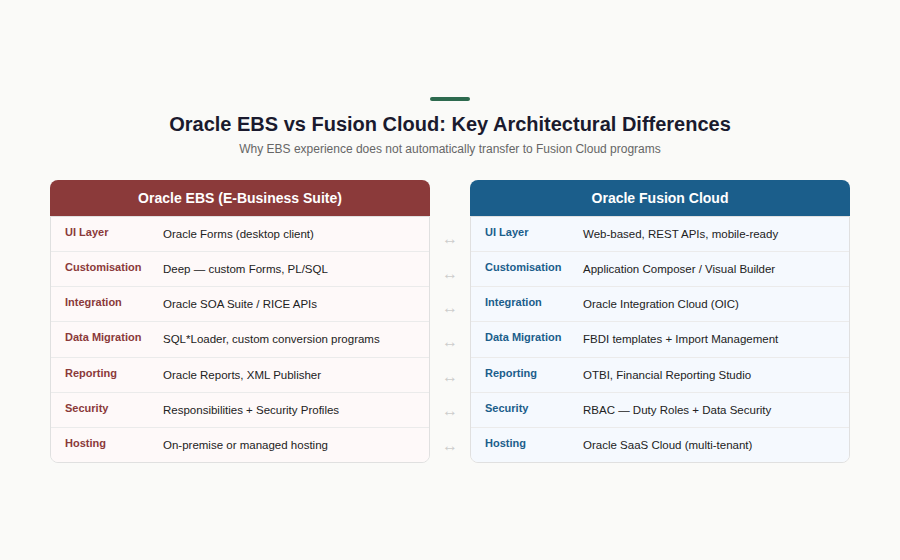
Oracle EBS and Oracle Fusion Cloud are architecturally different products. EBS is built on Oracle Forms and Oracle Database with a three-tier architecture. Fusion Cloud is built on Oracle’s SaaS infrastructure with a web-based UI, different business object model, different configuration approach, and different integration framework.
Key differences that matter for hiring:
- EBS uses Oracle Forms for UI customisation. Fusion Cloud uses Oracle Application Composer (for standard extensions) and Oracle Visual Builder (for advanced custom apps).
- EBS uses Oracle Workflow and Oracle Business Events for business process automation. Fusion Cloud uses Oracle Business Process Management (BPM) and Oracle Integration Cloud (OIC) for external integrations.
- EBS has deep customisation capability (personalisation, custom forms, custom reports). Fusion Cloud follows Oracle’s SaaS model customisation is limited to supported extension points.
- EBS modules have direct database table access for custom development. Fusion Cloud restricts database access; all custom development goes through Oracle’s published APIs.
An Oracle EBS Financials consultant with 10 years of R12.2 experience has deep Oracle accounting knowledge. They do not automatically have Oracle Fusion Cloud Financials configuration experience. The business objects are different, the configuration screens are different, and the extension approach is different. Retraining takes 3–5 months for a motivated senior consultant. It does not happen in a sprint.
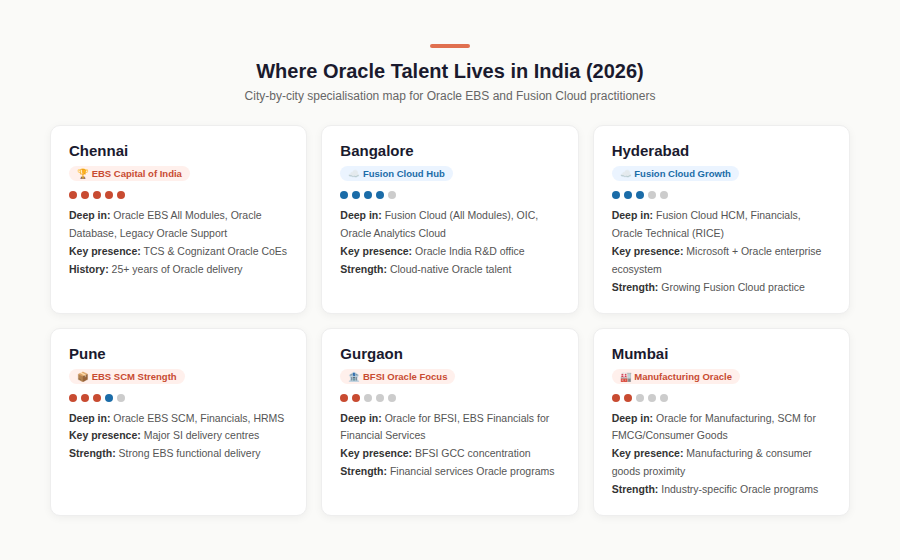
Where the talent lives:
| City | Dominant Oracle Specialisations | Why |
| Chennai | Oracle EBS (all modules), Oracle Database, legacy Oracle support | Largest Oracle EBS pool in India. TCS/Cognizant Oracle CoEs. 25+ years of Oracle delivery. |
| Bangalore | Oracle Fusion Cloud (all modules), Oracle Integration Cloud, Oracle Analytics Cloud | Cloud-native Oracle talent. Oracle India R&D presence. Fusion Cloud early adoption. |
| Hyderabad | Oracle Fusion Cloud HCM, Oracle Fusion Cloud Financials, Oracle technical (RICE) | Microsoft + Oracle enterprise ecosystem. Growing Fusion Cloud practice. |
| Pune | Oracle EBS SCM, Oracle EBS Financials, Oracle HRMS | SI delivery centers. Strong in EBS functional delivery. Transitioning to Fusion Cloud. |
| Gurgaon | Oracle for BFSI, Oracle EBS Financials for financial services | BFSI GCC concentration. Financial services Oracle programs. |
| Mumbai | Oracle for manufacturing, Oracle SCM for FMCG and consumer goods | Manufacturing and consumer goods industry proximity. |
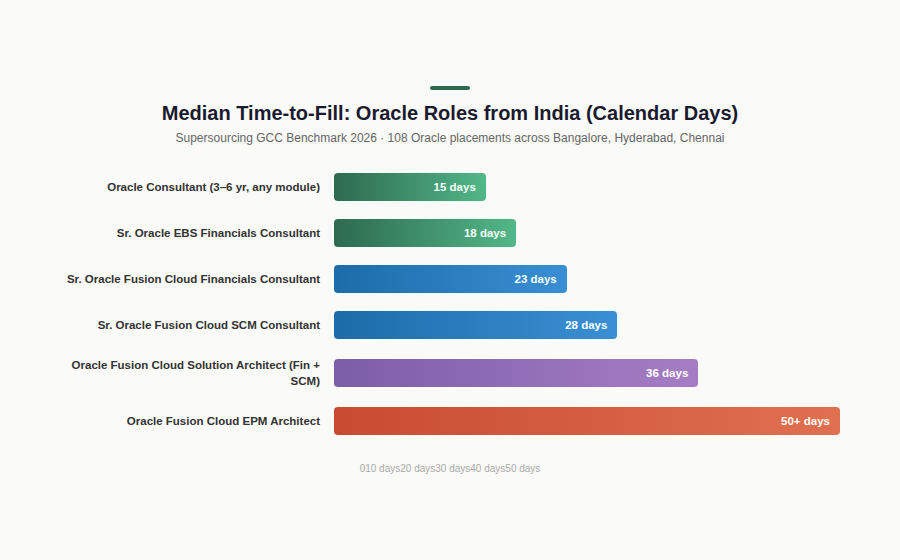
Supersourcing Index: Across 108 Oracle placements in the Supersourcing GCC Benchmark 2026, median time-to-fill for a Senior Oracle Fusion Cloud Financials Consultant in Bangalore was 23 calendar days. For an Oracle Fusion Cloud Solution Architect with Financials and SCM depth: 36 days. For an Oracle Fusion Cloud EPM Architect with Planning and Consolidation experience: 50 days.
Red flag: Any vendor presenting Oracle EBS certifications for an Oracle Fusion Cloud program without explicitly noting the EBS-to-Fusion gap. The certification names are different: Oracle EBS certifications reference “Oracle E-Business Suite” while Fusion Cloud certifications reference “Oracle Fusion Cloud Applications” or “Oracle Cloud.” Verify the specific certification name before scheduling any interview.
What You’re Really Paying
Rate Table by Level
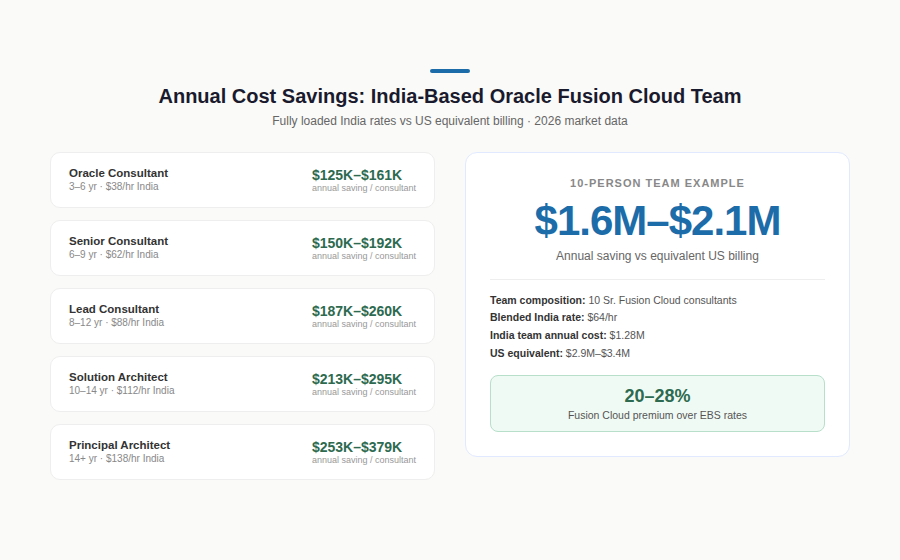
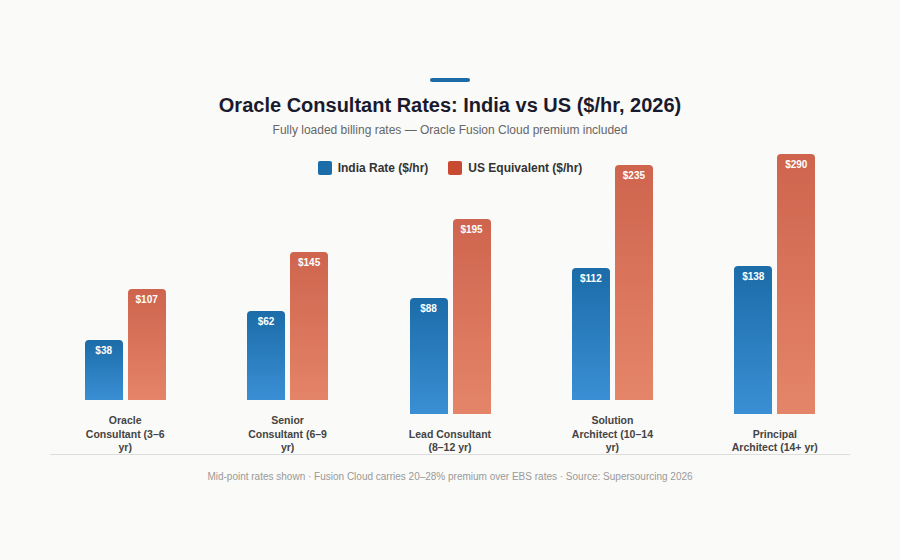
| Level | Experience | India Rate ($/hr) | US Equivalent ($/hr) | Annual Saving ($) |
| Oracle Consultant | 3–6 yr | $28–48 | $88–125 | $125K–$161K |
| Senior Consultant | 6–9 yr | $48–75 | $122–168 | $150K–$192K |
| Lead Consultant / Module Lead | 8–12 yr | $70–105 | $160–230 | $187K–$260K |
| Oracle Solution Architect | 10–14 yr | $92–132 | $195–275 | $213K–$295K |
| Principal Architect / Program Director | 14+ yr | $118–158 | $240–340 | $253K–$379K |
Product premiums:
- Oracle Fusion Cloud over EBS: 20–28% premium. Fusion Cloud practitioners are scarcer than EBS. The market is transitioning and Fusion Cloud experience is more current and more in demand.
- Oracle Fusion Cloud EPM: 22–30% premium over standard Financials. EPM (Enterprise Performance Management Planning, Budgeting, Forecasting, Consolidation) is a specialist product with a thin India pool.
- Oracle Integration Cloud (OIC): 15–20% premium. Technical integration on Oracle’s cloud middleware platform. Different from EBS RICE (Reports, Interfaces, Conversions, Enhancements) experience.
- Oracle SCM Cloud / Manufacturing: 18–24% premium. The thinnest Fusion Cloud module pool. Oracle Manufacturing Cloud is genuinely scarce in India.
The 4 Cost Layers
- Layer 1 Gross CTC Senior Oracle Fusion Cloud Consultant: ₹30–48 LPA. At ₹96.4/$1: $31K–$50K annually.
- Layer 2 Employer Burden: 22–28% on top of gross CTC.
- Layer 3 Vendor Margin: 20–26%.
- Layer 4 What Hits Your Invoice Senior Oracle Fusion Cloud Consultant: $48–75/hr. A 10-consultant team at blended $64/hr costs $1.28M annually. US equivalent: $2.9–3.4M. Annual saving: $1.6–2.1M.
The Certification Hierarchy What Actually Matters
- Oracle EBS Certifications (legacy valid for EBS programs only): Oracle Certified Implementation Specialist Oracle E-Business Suite [Module]. These certifications reference EBS specifically. Valid for EBS support, maintenance, and upgrade programs. Not transferable to Fusion Cloud programs.
- Oracle Fusion Cloud Certifications (currently required for Fusion Cloud programs): Oracle Fusion Cloud Applications Certified Implementation Specialist [Module]. Certifications for Financials, SCM, HCM, Procurement, and EPM each have separate certifications. The module name in the certification must match the program scope.
- Oracle Cloud Infrastructure Certifications: OCI Architect Associate, OCI Architect Professional for technical architecture on Oracle Cloud Infrastructure. Relevant for Oracle Cloud Platform and OCI deployments alongside Fusion Cloud.
- Oracle Integration Cloud (OIC) Certification: Oracle Cloud Platform Application Integration Certified Implementation Specialist for integration development on Oracle’s cloud middleware. Required for OIC development roles.
How to verify: Oracle certifications are verified through Oracle’s CertView portal at certview.oracle.com. Enter the candidate’s name or certification ID. Every active Oracle certification appears with the specific product name, version, and active/expired status. The product name in the certification tells you EBS vs Fusion Cloud these are listed separately. Verify before scheduling any interview.
The version trap: Oracle Fusion Cloud releases quarterly. Older Oracle Fusion Cloud certifications may reference earlier releases (e.g., Oracle Fusion Applications 11g certifications from 2014–2016) that predate the current Fusion Cloud architecture significantly. For current Fusion Cloud programs, require certifications from 2021 or later.
The RICE vs OIC distinction: Oracle EBS technical work uses RICE (Reports, Interfaces, Conversions, Enhancements) custom development using Oracle Reports, SQL/PL-SQL for interfaces and conversions, and Oracle Forms/APIs for enhancements. Oracle Fusion Cloud technical work uses Oracle Integration Cloud (OIC) for external integrations, Oracle Application Composer for simple extensions, and Oracle Visual Builder for custom apps. These require different technical skills. RICE experience does not automatically transfer to OIC development. Verify which technical approach the candidate has production experience on.
The JD That Attracts the Right Candidates
JD 1: Senior Oracle Fusion Cloud Financials Consultant (5–8 years)
Senior Oracle Fusion Cloud Financials Consultant Remote from India Engagement: Staff Augmentation | Duration: 18 months Rate: ₹30–48 LPA CTC equivalent | Billing: $48–75/hr (vendor-facing)
What you’ll own: Oracle Fusion Cloud Financials configuration across General Ledger, Accounts Payable, Accounts Receivable, and Fixed Assets for a manufacturing enterprise migration from Oracle EBS R12.2. You’ll configure a chart of accounts, ledger and accounting calendar setup, AP invoice and payment workflows, AR transaction types and collection management, and FA book and depreciation rules. Measured on configuration completeness, integration test accuracy, and parallel run reconciliation.
What we require:
- Oracle Fusion Cloud Applications Certified Implementation Specialist Financials (verified at certview.oracle.com before interview)
- 5–8 years Oracle experience, minimum 2 complete Oracle Fusion Cloud Financials go-lives (not EBS specify Fusion Cloud specifically)
- Chart of accounts design experience in Fusion Cloud value set configuration, segment structure, account hierarchy
- AP and AR workflow configuration invoice approval workflows using Oracle BPM, payment process profiles, AR collection rules
- Subledger Accounting (SLA) experience accounting method configuration, journal entry rules
- Oracle EBS R12 background useful context but Fusion Cloud production experience is the requirement
What disqualifies you:
- Oracle EBS Financials only experience presented as Fusion Cloud capability
- “Oracle Financials” without specifying EBS version or Fusion Cloud
- Oracle Fusion Cloud experience limited to training environments or Oracle cloud trials
- No Subledger Accounting configuration experience for a senior Financials role
Interview process: Technical screen (30 min) → Live Fusion Cloud Financials configuration scenario (90 min, Oracle Cloud demo instance access) → SLA and workflow design discussion (45 min)
JD 2: Oracle Fusion Cloud Solution Architect (12+ years)
Oracle Fusion Cloud Solution Architect India GCC or BOT Engagement: GCC Build or BOT | Duration: 24+ months CTC: ₹82–120 LPA | Billing: $95–132/hr (vendor-facing)
What you’ll own: End-to-end Oracle Fusion Cloud architecture across Financials and SCM for an EBS R12.2 migration program. You will own the migration approach design, chart of accounts strategy, data migration plan (FBDI/ADFDI approach), Oracle Integration Cloud architecture for external integrations, security role model design (RBAC), and the functional design documentation. Technical authority for a team of 12–18 Oracle consultants.
What we require:
- Oracle Fusion Cloud Certified Implementation Specialist Financials and SCM (both confirmed at certview.oracle.com)
- 12+ years Oracle experience, minimum 3 complete Oracle Fusion Cloud go-lives as architect of record
- EBS-to-Fusion Cloud migration experience can describe data migration approach using FBDI templates, cutover strategy, and coexistence period management
- Oracle Integration Cloud (OIC) architecture REST/SOAP integration design, adapters, scheduled integration patterns
- Security role model Oracle Fusion Cloud RBAC design, data security policies, role hierarchy
- Oracle Reporting OTBI report design, Financial Reporting Studio, Oracle Analytics Publisher
Interview process: Architecture scenario (60 min) → FBDI data migration design (45 min) → OIC integration architecture discussion (30 min) → Reference call with prior CIO or Oracle Program Director
What most enterprise JDs get wrong for Oracle:
They say “Oracle Financials experience required” which returns all 12,000 Oracle EBS Financials consultants alongside the 6,400 Fusion Cloud Financials pool. They don’t specify the EBS version or Fusion Cloud, the single most important filter. They list “Oracle technical experience” without specifying RICE vs OIC completely different skills. They require “Oracle implementation experience” without specifying go-live count or scale. And they treat Oracle EBS and Oracle Fusion Cloud as equivalent, the most expensive assumption in Oracle hiring.
How to Verify Experience Not Just Credentials
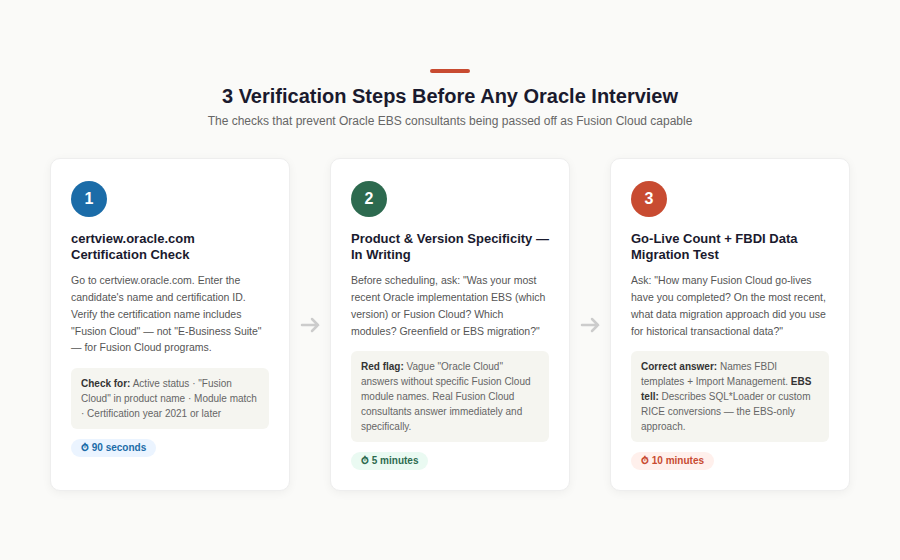
The 3 verification steps before any Oracle interview:
Step 1: certview.oracle.com certification verification
Go to certview.oracle.com, enter the candidate’s name and certification ID. Verify: the certification name includes “Fusion Cloud” (not “E-Business Suite”) for Fusion Cloud programs, the module matches the program scope, and the status is Active. An Oracle EBS certification for a Fusion Cloud program is a product mismatch. This takes 90 seconds.
Step 2: Product and version specificity in writing
Before scheduling, ask: “On your most recent Oracle implementation, was it Oracle EBS (which version) or Oracle Fusion Cloud? Which modules were in scope? Was it a greenfield implementation or migration from EBS?” Real Fusion Cloud consultants answer immediately and specifically. EBS consultants presenting as Fusion Cloud either name EBS versions or give vague “Oracle Cloud” answers without specific Fusion Cloud module names.
Step 3: Go-live count and data migration approach
Ask: “How many Oracle Fusion Cloud go-lives have you been part of? On the most recent Fusion Cloud go-live, what data migration approach did you use for historical transactional data?” Real Fusion Cloud consultants name specific go-live counts and describe FBDI (File-Based Data Import) templates Fusion Cloud’s standard data migration mechanism. EBS-only consultants describe SQL*Loader or custom RICE conversions the EBS approach that does not apply to Fusion Cloud.
The 5 interview questions that expose fake seniority:
Q1: Chart of Accounts Design in Fusion Cloud “Walk me through your chart of accounts design decisions for a multi-entity Oracle Fusion Cloud Financials deployment, your value set choices, segment structure, and how you handled the difference between Fusion Cloud’s primary and secondary ledger approach compared to EBS.”
Real answer: describes Fusion Cloud’s chart of accounts structure value sets for each segment (company, cost centre, account, intercompany, future use), the segment design decisions (how many segments, length, value set type), the ledger configuration (primary ledger for statutory reporting, secondary ledger for management reporting if required), and how this differs from EBS Fusion Cloud has a more flexible ledger architecture with accounting calendar and currency assigned at ledger level rather than at the set of books level as in EBS. They describe specific segment design decisions and their rationale.
EBS consultant describes the EBS chart of accounts with segments and set of books. Cannot describe Fusion Cloud’s value set types, ledger configuration, or primary/secondary ledger approach.
Q2: FBDI Data Migration “Describe how you’ve used FBDI (File-Based Data Import) to migrate Oracle EBS open AP invoices to Oracle Fusion Cloud, the template structure, the validation process, and how you handled multi-currency invoices with different payment terms.”
Real answer: describes the FBDI template structure for AP invoices (the specific FBDI spreadsheet templates Oracle provides, the required and optional columns, the file generation and upload process through Oracle’s Import Management), the validation report review (checking for errors before final import), and multi-currency handling populating the invoice currency, conversion rate type, and conversion rate columns specifically. They describe the specific FBDI template name and the Oracle Data Loader or Import Management tool used.
EBS consultant describes the EBS AP open invoice conversion using SQL*Loader and custom conversion programs. Cannot describe FBDI templates, Import Management, or the Fusion Cloud migration mechanics.
Q3: Subledger Accounting (SLA) Configuration “Explain how Oracle Fusion Cloud’s Subledger Accounting differs from EBS Subledger Accounting, and walk me through how you’ve configured a custom accounting rule for a specific business scenario.”
Real answer: describes Oracle Fusion Cloud SLA accounting methods, journal entry rule sets, account rules, and the event class/event type framework and how this differs from EBS SLA (similar concept but different configuration objects and more flexible derivation rules in Fusion Cloud). They describe a specific accounting rule configuration for example, a custom rule to derive the cost centre for AP invoices from the supplier site rather than the default business unit, using account derivation rules in the journal entry rule set.
EBS consultant describes EBS SLA correctly. Cannot describe Fusion Cloud SLA’s account derivation rule configuration or the differences in the accounting method framework.
Q4: Oracle Integration Cloud (OIC) “Walk me through how you’ve designed an OIC integration between Oracle Fusion Cloud Financials and a third-party treasury management system, the integration pattern, the Oracle Financials adapter configuration, and how you handled error processing.”
Real answer: describes the OIC integration pattern (scheduled or triggered, REST vs SOAP, Oracle Financials Cloud adapter vs file-based adapter), the Oracle Financials Cloud adapter configuration in OIC (connection setup, business object selection, filter criteria), the transformation using OIC’s mapper (XSLT mapping between Oracle Financials data model and treasury management system schema), and error processing fault handling in OIC, error notification, retry configuration. They name specific OIC components and design decisions.
EBS technical consultant describes EBS integration using custom PL/SQL programs, Oracle SOA Suite, or flat file interfaces using the EBS technical approach. Cannot describe OIC adapter configuration, OIC mapper, or OIC fault handling.
Q5: Oracle Fusion Cloud Security (RBAC) “Describe how you’ve designed a security model in Oracle Fusion Cloud for a global finance team with different access requirements in each country, the role hierarchy, data security policies, and how you prevented US finance users from seeing EMEA financial data.”
Real answer: describes Oracle Fusion Cloud’s RBAC model abstract roles (job roles), duty roles (function security), data roles (data security restricting access to specific data sets), and the role hierarchy. For country-specific data restriction: data security policies using the business unit or ledger as the data dimension US finance users assigned to data roles scoped to US business units/ledgers only. They describe specific role types and data security policy configuration.
EBS consultant describes EBS security using responsibilities, security profiles, and operating unit assignments in the EBS access control model. Cannot describe Fusion Cloud duty roles, data security policies, or business unit-based data restriction.
8 CV red flags:
- “Oracle Financials” without specifying EBS version or Fusion Cloud always a red flag
- Oracle EBS certifications listed for a Fusion Cloud program requirement
- “Oracle Cloud experience” without specifying Fusion Cloud vs OCI vs Oracle APEX Oracle has many cloud products
- “Data migration experience” using SQL*Loader or custom RICE conversions for a Fusion Cloud program these are EBS approaches
- “Oracle integration experience” using Oracle SOA Suite or custom APIs for a Fusion Cloud program OIC is the current approach
- Multiple Oracle “cloud” implementations listed without specifying which Oracle Cloud product (Fusion Cloud, OCI, Oracle APEX, Oracle Analytics Cloud are different)
- “Oracle Fusion implementation” on a project starting before 2018 early Oracle Fusion deployments (pre-2018) were on a different architecture than current Fusion Cloud
- “Oracle technical” experience that lists PL/SQL, Oracle Forms, and Oracle Reports as primary skills these are EBS technical tools, not Fusion Cloud tools
How to Source What’s Working, What Isn’t
What’s working in 2026:
Oracle partner network.
Oracle maintains a tiered partner ecosystem Oracle Platinum, Gold, and Silver partners. Oracle Fusion Cloud implementations must be delivered by Oracle-certified partners. An inquiry to 3–4 Oracle Platinum partners in India about available Fusion Cloud bench with module specificity yields verified candidates with active Oracle partner requirements.
Oracle User Group India (OAUG India).
Oracle Applications User Group has an active India chapter. Oracle CloudWorld (annual conference) and Oracle-organized regional events have strong India participation. Fusion Cloud practitioners who present at these events are identifiable, senior practitioners.
3 ready-to-use LinkedIn boolean search strings:
- String 1 (Oracle Fusion Cloud Financials): “Oracle Fusion Cloud” AND (“Financials” OR “General Ledger” OR “AP” OR “AR”) AND (“Senior” OR “Lead” OR “Architect”) AND (“Bangalore” OR “Hyderabad”)
- String 2 (Oracle SCM Cloud): “Oracle SCM Cloud” AND (“Supply Chain” OR “Manufacturing” OR “Procurement”) AND (“India” OR “Bangalore”)
- String 3 (Oracle Integration Cloud): “Oracle Integration Cloud” AND (“OIC” OR “integration”) AND (“Architect” OR “Lead”) AND “India”
Oracle ACE program.
Oracle recognizes community contributors through the Oracle ACE program ACE Associate, ACE, and ACE Director tiers. India has approximately 80–100 active Oracle ACEs across all Oracle product lines. Oracle ACEs in the Fusion Cloud space are identifiable senior practitioners with verifiable community contributions.
Supersourcing pre-vetted bench. For Senior Oracle Fusion Cloud Financials Consultants, median fill time 23 calendar days. For Solution Architects, 36 days with certification verified at certview.oracle.com before any CV submission.
What isn’t working:
“Oracle consultant” postings without product specification.
Returns the full 28,000-person India Oracle EBS pool plus Fusion Cloud practitioners. Without “Fusion Cloud” in the posting, you receive EBS consultants for Fusion Cloud programs at scale. Product specificity is non-negotiable.
Assuming EBS experience transfers to Fusion Cloud.
The most expensive assumption in Oracle hiring. EBS and Fusion Cloud are different products. A senior EBS consultant needs 3–5 months of structured Fusion Cloud training and a mentor implementation before they are productive on Fusion Cloud programs. Some organisations make this transition deliberately with strong results. Do not assume it happens automatically.
Treating Oracle technical as one pool.
Oracle EBS technical (RICE PL/SQL, Oracle Forms, Oracle Reports) and Oracle Fusion Cloud technical (OIC, Application Composer, OTBI) are different skill sets. Hire separately. Specify which in the JD.
The Contract Stack for Oracle Engagements
Clause 1: Individual Resource Approval with Product, Version, and Module Specification
SOW schedule must list: name, Oracle certification name with product (EBS or Fusion Cloud), go-live count and product versions, and module scope. “Oracle Fusion Cloud Financials, 3 go-lives, GL/AP/AR scope” is a contractual specification. A consultant substituted from EBS to Fusion Cloud scope is a material misrepresentation.
Clause 2: IP Assignment FBDI Templates, OIC Integrations, OTBI Reports, and Configuration
Must cover: custom FBDI data migration templates and programs, Oracle Integration Cloud integration flows and connections, OTBI (Oracle Transactional Business Intelligence) report workbooks and dashboards, Financial Reporting Studio reports, Oracle Analytics Publisher templates, and the functional design documentation (configuration workbooks, solution design documents). These are all valuable program IPs.
Clause 3: Data Migration Handover
Oracle migration programs produce significant data migration artifacts FBDI templates, conversion programs, validation scripts, reconciliation reports. Require formal handover of all data migration artifacts at engagement end, not just production system access. These artifacts are essential for future data corrections, additional country rollouts, and post-go-live data fixes.
Clause 4: OIC Integration Documentation
Every Oracle Integration Cloud integration must be documented before production deployment input/output schema, error handling approach, monitoring configuration, and restart/recovery procedure. OIC integrations without documentation are unmaintainable after the engagement ends. Require documentation as a delivery gate per integration.
Clause 5: Access Revocation 24 Hours
Oracle Fusion Cloud tenant access, Oracle Integration Cloud access, and any Oracle EBS system access must be revoked within 24 hours of engagement end. Oracle Cloud environments contain financial and operational data access hygiene at engagement end is both a security and a compliance requirement.
Running an Oracle Team at Scale
Functional design documentation discipline.
Every configuration decision should be documented in a functional design document before implementation of the business requirement, the Oracle Fusion Cloud feature used, the configuration approach, and the test acceptance criteria. Offshore dedicated teams under delivery pressure skip documentation. The result: configurations that nobody on the client team can maintain, and an audit trail that doesn’t exist when things go wrong.
OTBI report governance.
Oracle Fusion Cloud has a powerful reporting tool OTBI (Oracle Transactional Business Intelligence) that allows non-technical users to build reports. Offshore teams often build large numbers of ad-hoc OTBI reports during testing that accumulate in the production environment. Establish a report governance process only approved reports go to production, every production report has a named owner, and report proliferation is reviewed quarterly.
Data migration reconciliation.
Oracle migrations involve moving significant financial history, open balances, transaction history, and fixed asset history. Every data migration load must be reconciled against the source record count, total amounts, key balance sheet items. Reconciliation is not optional. Require a signed reconciliation sign-off for every FBDI load before cutover.
Release update management. Oracle Fusion Cloud releases quarterly updates. Each quarterly update may introduce UI changes, new functionality, and deprecated features. Offshore teams must maintain awareness of quarterly updates and their impact on configured business processes and integrations.
Early warning signals:
- Functional design documents not completed before configuration starts
- OTBI reports proliferating without governance
- Data migration reconciliation discrepancies not being investigated
- OIC integrations deployed without documentation
- LinkedIn activity Oracle Fusion Cloud certifications updated, Oracle partner connections increasing
Retention levers: Module expansion Fusion Cloud consultants who expand from Financials to EPM (Planning, Consolidation) or from SCM to Manufacturing on your program are building career depth. EPM and Manufacturing are the highest-value, most scarce Oracle Fusion Cloud skills. Certification sponsorship Oracle’s quarterly release certifications and new module certifications are funded by your engagement. The certification investment is small and the retention signal is real. Architecture ownership consultants who own the technical design of a major workstream don’t leave mid-design.
When Things Go Wrong
Pattern 1: The EBS-to-Fusion Capability Gap
Described in Section 1. Oracle EBS consultants presenting as Fusion Cloud capable. The FBDI data migration question (Q2 in Section 8) and the product specificity verification catch this in 5 minutes before any interview.
Pattern 2: The SLA Misconfiguration
A US retailer’s Oracle Fusion Cloud AP implementation had Subledger Accounting rules misconfigured. The cost centre derivation rule which should have populated the cost centre from the purchase order line was using the default business unit cost centre instead. The error only appeared in period-end reporting when management accounts showed all AP costs allocated to the headquarters cost centre rather than distributed across operating cost centres.
The misconfiguration had been in production for 5 months. Remediation: SLA rule correction (1 week), journal correction entries for 5 months (3 weeks), restatement of management accounts for the affected periods (2 weeks). $85K in accounting and finance team time. The SLA configuration question (Q3 in Section 8) would have verified the consultant’s SLA depth before the misconfiguration was created.
Pattern 3: The OIC Integration Failure
A UK manufacturing company’s Oracle Fusion Cloud SCM implementation included 8 OIC integrations to third-party systems. The offshore team delivered all 8 integrations without error handling or monitoring configuration. Integration 3 a scheduled import of supplier invoices from a third-party procurement portal failed silently for 3 weeks after go-live. No error notification. No monitoring alert. £340K of supplier invoices were not imported, not paid, and not visible in Fusion Cloud AP.
The discovery: a supplier called to ask about outstanding invoices. The fix: emergency OIC error handling configuration, backlog import, and manual reconciliation. £55K in remediation. The OIC integration documentation requirement in the contract and the OIC integration design question in Section 8 would have prevented this.
When India Is the Wrong Call
Scenario 1: Oracle Fusion Cloud EPM for complex multi-entity consolidation.
Oracle Fusion Cloud EPM, specifically Oracle Financial Consolidation and Close Cloud (FCCS) and Oracle Profitability and Cost Management (PCM) , has a very thin India pool. FCCS for complex multi-entity consolidation with elimination entries, minority interest, and multi-GAAP reporting requires practitioners with both Oracle EPM technical depth and deep consolidation accounting knowledge. Approximately 650 production-experienced EPM practitioners are in India. For complex global consolidation programs, consider whether the India pool has the accounting depth your program requires alongside the Oracle EPM technical skills.
Scenario 2: Oracle EBS programs with niche vertical modules.
Oracle EBS for public sector (Oracle Public Sector Financials), Oracle EBS for property management (Oracle Property Manager), or Oracle EBS for project accounting (Oracle Project Accounting) with complex revenue recognition requirements these vertical modules have thin India pools. The SI firms that delivered these modules extensively (Accenture, Deloitte for public sector) have some India delivery capability but not broad bench availability. For niche EBS vertical modules, verify availability before assuming the general India Oracle pool covers your requirement.
Scenario 3: Oracle programs requiring German language or DACH-specific configuration.
German tax law, Austrian and Swiss statutory reporting, and DACH-specific payroll complexity create language and domain knowledge requirements that narrow the India pool significantly for Oracle programs serving German-speaking organisations. Consider onshore or DACH-based Oracle consultants for the statutory compliance configuration and India-based consultants for the technical and non-statutory configuration layers.
The Supersourcing Vendor Scorecard Oracle Edition
Score your vendor before you sign. Maximum 100 points. Minimum threshold: 65.
Category 1: Product Specificity and Certification Accuracy (0–20 pts)
| Criterion | 0 | 10 | 20 |
| Can produce Fusion Cloud certification names from certview.oracle.com within 24 hours | Cannot | Some | All bench, all modules confirmed |
| EBS vs Fusion Cloud distinction acknowledged proactively | Conflates them | Distinguishes when asked | Proactively verified with go-live count |
| Go-live count and scope confirmed for all claimed Fusion Cloud bench | Not verified | Claimed | Verified with module and scale |
Category 2: Vetting Process (0–20 pts)
| Criterion | 0 | 10 | 20 |
| Fusion Cloud-specific technical assessment (not generic Oracle) | Generic Oracle | Fusion Cloud specific written | Live Oracle Cloud demo instance task |
| FBDI data migration knowledge tested | Not tested | Conceptual | Specific FBDI template and process |
| OIC integration design for technical roles | Not tested | Conceptual | Live OIC scenario required |
Category 3: Contract Readiness (0–20 pts)
| Criterion | 0 | 10 | 20 |
| IP Assignment covering OIC flows, OTBI reports, FBDI templates | Not available | Available on request | Standard, items named |
| Data migration reconciliation as delivery gate | Not present | Best effort | Contractual sign-off required |
| OIC integration documentation as delivery gate | Not present | End-of-project | Per-integration delivery gate |
Category 4: Oracle Delivery Track Record (0–20 pts)
| Criterion | 0 | 10 | 20 |
| Named Oracle Fusion Cloud go-live clients with modules specified | None | Logo only | Named contact + modules + go-live date |
| EBS-to-Fusion migration programs verified | None | Claimed | Verified with migration approach described |
| Attrition on Oracle programs | Unknown / >20% | 15–20% | <14% |
Category 5: Commercial Structure (0–20 pts)
| Criterion | 0 | 10 | 20 |
| Rate card by product (EBS vs Fusion Cloud) and module | Single Oracle rate | EBS/Fusion distinction | Full product and module matrix |
| Substitution clause with product and module equivalence | Not present | Available | Standard, Fusion Cloud module equivalence |
| SLA on replacement with product match | None | Best effort | Contractual 21-day SLA |
Score interpretation: 85–100 shortlist; 65–84 proceed with conditions; 45–64 significant risk; below 45 walk.
15 Questions Buyers Actually Ask
Q: What is the difference between Oracle EBS and Oracle Fusion Cloud?
Oracle EBS (E-Business Suite) is Oracle’s legacy on-premise ERP platform, running on Oracle Forms and Oracle Database with a three-tier architecture. Oracle Fusion Cloud (now marketed as Oracle Cloud Applications) is Oracle’s cloud-native SaaS ERP built on Oracle’s cloud infrastructure with a web-based UI, REST APIs, and Oracle’s SaaS delivery model. Key differences: EBS allows deep customisation through Oracle Forms and PL/SQL; Fusion Cloud restricts customisation to supported extension points (Application Composer, Visual Builder). EBS integrations use Oracle SOA Suite or custom RICE; Fusion Cloud integrations use Oracle Integration Cloud. The two are architecturally different and require different consultant experience.
Q: How do I verify an Oracle certification?
Go to certview.oracle.com and search by the candidate’s name. Every active Oracle certification appears with the specific product name and status. Verify that the certification name includes “Fusion Cloud” (or “Oracle Cloud”) rather than “E-Business Suite” for Fusion Cloud programs. Check the Active status expired certifications indicate the consultant has not maintained currency. Also verify the module Oracle Fusion Cloud Financials and Oracle Fusion Cloud SCM are separate certifications; confirm the module matches your program scope.
Q: Can Oracle EBS consultants work on Oracle Fusion Cloud programs?
With structured retraining yes, for standard module configuration. An experienced EBS Financials consultant who completes Oracle’s Fusion Cloud Financials training and works under a Fusion Cloud architect can become productive on Fusion Cloud in 3–5 months. For architect and lead roles on Fusion Cloud programs, require Fusion Cloud production go-live experience you cannot train your way to an architect. For large-scale migrations, plan for the ramp period when EBS consultants are transitioning budget for reduced productivity in the first 90 days for any EBS-background consultant on a Fusion Cloud program.
Q: What is FBDI and why does it matter?
FBDI (File-Based Data Import) is Oracle Fusion Cloud’s standard data import mechanism spreadsheet templates that define the structure for loading initial data into Fusion Cloud (chart of accounts, suppliers, customers, open balances). Every Oracle Fusion Cloud migration uses FBDI extensively. FBDI replaces the EBS data migration approach of custom SQLLoader programs and conversion APIs. A consultant who describes their data migration experience using SQLLoader or custom RICE conversions for a Fusion Cloud program has EBS migration experience, not Fusion Cloud migration experience. The distinction is specific and verifiable with a single direct question.
Q: What is Oracle Integration Cloud (OIC)?
Oracle Integration Cloud is Oracle’s cloud middleware platform for integration between Oracle Fusion Cloud and external systems. It provides visual integration design with pre-built Oracle adapters (Fusion Cloud, EBS, Salesforce, SAP, and others), a graphical mapper for data transformation, and a scheduler for batch integrations. OIC replaces Oracle SOA Suite (the EBS-era integration platform) for Fusion Cloud programs. OIC experience is required for technical roles on Fusion Cloud programs. EBS technical consultants with SOA Suite experience need specific OIC training before they are productive on Fusion Cloud integration programs.
Q: What is the realistic timeline to build a 15-person Oracle Fusion Cloud team in India?
For a team covering Financials, SCM, and technical (OIC) 1 solution architect, 3 Financials senior consultants, 3 SCM senior consultants, 2 OIC integration developers, 3 mid-level consultants, 2 OTBI report developers, 1 QA expect 45–60 days from JD sign-off to full team onboarded. The solution architect (36-day median fill) and SCM senior consultants (Oracle SCM Cloud pool is thinner 28-day median fill) are the critical path. Starting all sourcing simultaneously minimises total assembly time.
Q: What is Oracle Subledger Accounting (SLA) and why does it require verification?
Oracle Subledger Accounting is Oracle Fusion Cloud’s accounting engine that governs how business transactions (supplier invoices, customer receipts, inventory movements) generate accounting journal entries. SLA configuration determines account derivation (which accounts are debited and credited for each transaction type), journal rule sets, and accounting method. Misconfigured SLA produces incorrect financial statements entries posted to wrong accounts or with wrong amounts. SLA requires deep Oracle Financials knowledge and Fusion Cloud-specific configuration experience. The SLA question in Section 8 assesses this capability before any financial configuration begins.
Q: What is Oracle Fusion Cloud EPM?
Oracle Fusion Cloud EPM (Enterprise Performance Management) is Oracle’s cloud suite for financial planning, budgeting, forecasting, and consolidation. It includes Oracle Planning and Budgeting Cloud, Oracle Financial Consolidation and Close Cloud (FCCS), and Oracle Profitability and Cost Management Cloud. EPM is separate from Oracle Fusion Cloud Financials; it requires dedicated EPM-certified consultants. The India EPM pool is approximately 650 production-experienced practitioners, the thinnest module pool in Oracle Fusion Cloud. For EPM programs, expect longer sourcing timelines (50+ days for architects) and premium rates.
Q: Is India-based Oracle Fusion Cloud talent comparable to US talent?
For standard Financials and SCM module configuration: functionally equivalent for delivery roles. India’s Oracle practices have delivered Fusion Cloud implementations for Fortune 500 enterprises across the US, UK, and Europe. For Oracle EPM (Planning, Consolidation) and Oracle SCM Cloud Manufacturing the most complex and rarest Fusion Cloud modules the deepest expertise is distributed between Oracle’s home market (US), Europe (where many of the largest Fusion Cloud programs are managed), and India. For standard Financials and SCM configuration at current certification: India talent delivers at global quality standards.
Q: What’s the hardest Oracle Fusion Cloud profile to hire in India?
An Oracle Fusion Cloud Solution Architect with certified depth across Financials, SCM, and EPM, Oracle Integration Cloud architecture experience, and EBS-to-Fusion Cloud migration delivery at enterprise scale (10,000+ users, multi-country, multi-entity consolidation). This combination narrows the India pool to under 120 active practitioners. Median fill time: 50+ days. Competition from global Oracle programs for the same profiles.
Q: Is Supersourcing the right partner for a 4-consultant Oracle program?
Not our ideal engagement. For a 4-consultant Oracle program, an Oracle Platinum partner with a staff augmentation capability is a better fit. We’d rather tell you that than win a deal we’ll underserve.
Closing
Oracle Fusion Cloud hiring from India works. The certified talent is real, the implementation track record is deep, and the savings versus US and European hiring are substantial $125K to $379K per consultant per year.
The single filter that matters most: Oracle EBS vs Oracle Fusion Cloud. Three words in the JD and the sourcing brief “Oracle Fusion Cloud required” eliminate the 28,000-person EBS pool and focus sourcing on the 6,400-person Fusion Cloud pool where your program requires experience.
certview.oracle.com. 90 seconds. Every Oracle certification listed. Active or expired. EBS or Fusion Cloud. The product name tells you everything.
Book a 30-minute Oracle Talent Discovery Call → No deck. Just the numbers and the bench.
