

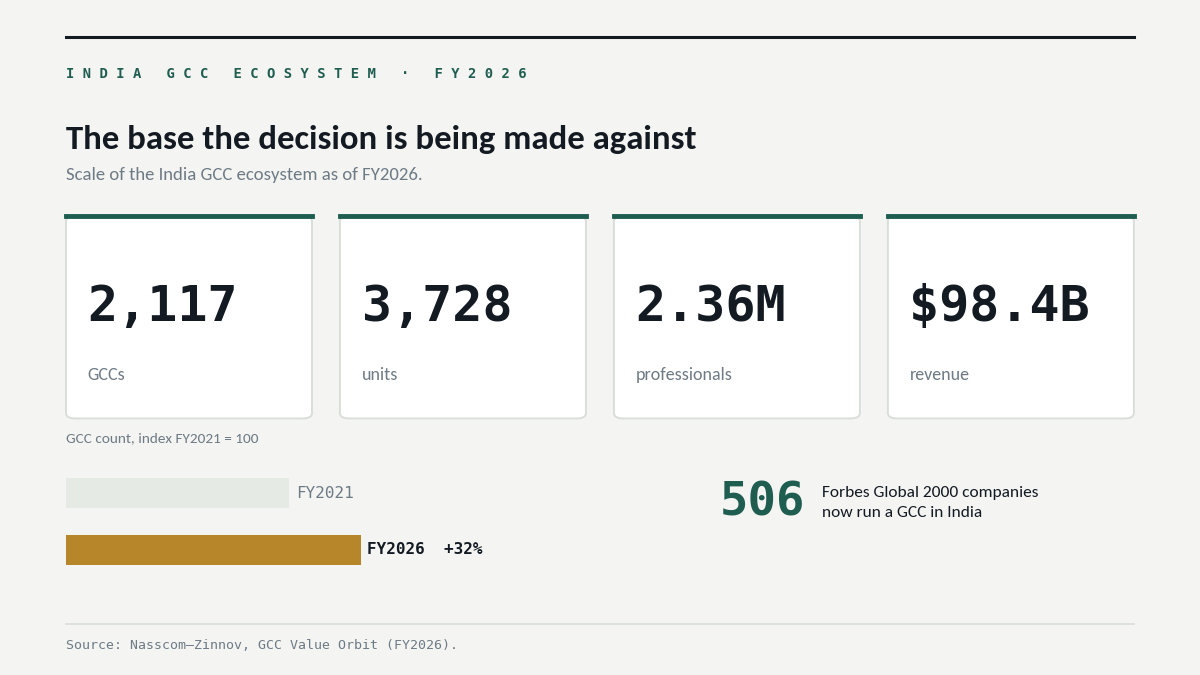
India crossed 2,100 global capability centres this year, and the number that matters more is the one underneath it: 3,728 individual units. Most enterprises did not open one centre. They opened a centre, then bolted a second structure onto it eighteen months later because the first one couldn’t hire fast enough, couldn’t hold IP cleanly, or couldn’t be unwound without a tax event.
That second structure is usually where the money goes. Picking the wrong model isn’t a strategy error you discover at the board review, it’s an operational error you discover when your India entity has 40 engineers, a landlord lease, a transfer pricing position you can’t defend, and a partner contract with a transfer clause nobody reads.
India now hosts 2,117 GCCs across 3,728 units, employing roughly 2.36 million professionals, with ecosystem revenue at $98.4 billion 32% growth in centre count.
This guide is gcc operating models explaining the way a delivery team would brief a CTO: five structures, what each actually costs, what each locks you into, and the specific contract terms that decide whether you keep the asset or rent it forever. No maturity curves, no transformation language.
The five models are not a progression. There are five different answers to two questions: who employs the people, and who owns the entity? A mid-market SaaS company and a regulated bank should almost never land on the same answer.
TL;DR
This guide covers the five ways enterprises structure an India capability centre: wholly owned subsidiary, build-operate-transfer, managed or virtual captive, hybrid, and joint venture. It is written for the CTO, COO or Head of Engineering who has already decided to build offshore and now has to choose a structure.
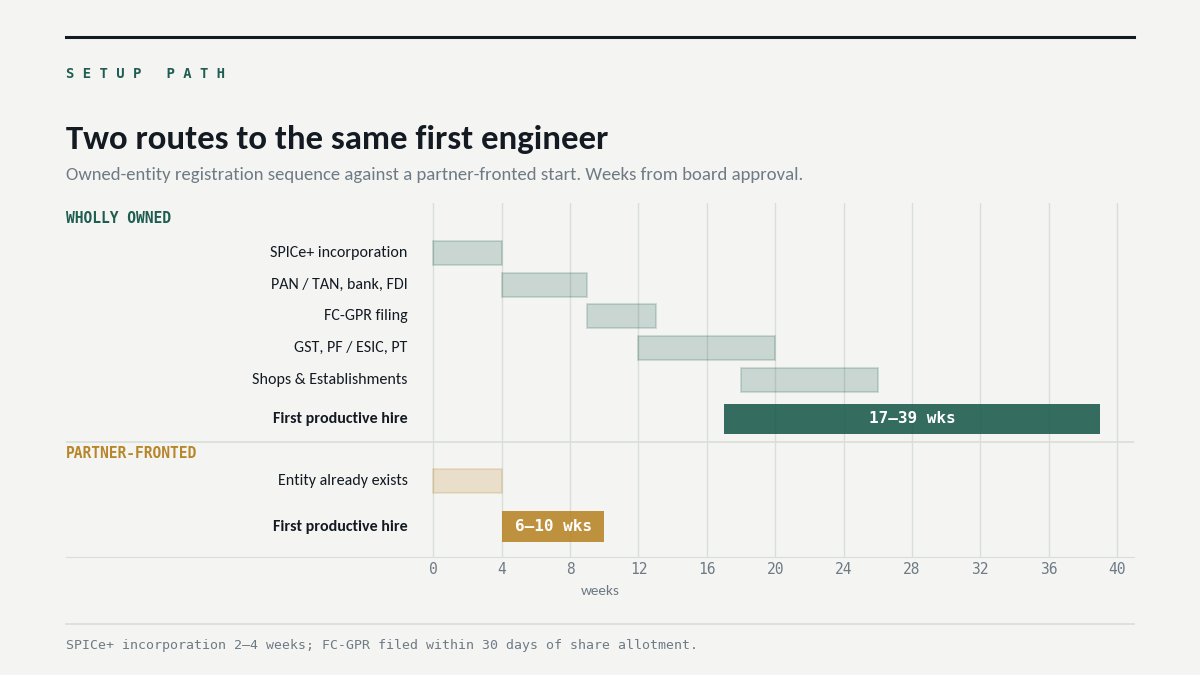
Here is the number that drives the decision: a wholly owned entity typically takes 4–9 months from board approval to first productive engineer, while a partner-fronted model can put a working team in place in 6–10 weeks. The gap is not efficient. It is who carries the incorporation, compliance and hiring risk during those months and you pay for that transfer either way.
By the end you will be able to match your headcount plan, IP sensitivity and exit horizon to one model, price it against a realistic cost band, and know which three clauses to negotiate before signing. That is the whole point of having types of global capability centers laid out side by side rather than pitched one at a time.
What a GCC operating model actually is
A global capability center (GCC) operating model is the legal, commercial and employment structure that determines who owns the offshore entity, who employs the talent, who carries compliance risk, and how (or whether) control transfers to the parent company over time. It defines ownership and liability not team size, location, or the type of work the centre performs.
That distinction matters because most vendor conversations blur it. “We’ll build your GCC” can mean four legally different things. Getting gcc operating models explained in ownership terms rather than service terms is the fastest way to compare two proposals that look identical on a slide.
Why the model choice breaks later, not now
The failure pattern is consistent and it is rarely visible in year one.
A company signs a partner-operated centre because it needs 15 engineers in a quarter. Eighteen months later headcount is 60, the work has drifted from maintenance into core product, and the parent decides it wants the entity. Now three things surface at once.
First, the transfer price. If the contract has no pre-agreed transfer formula, valuation becomes a negotiation from a weak position the partner knows your product knowledge lives in their payroll. In engagements we’ve run, the absence of a fixed transfer multiple is the single most expensive omission in gcc engagement models of this type.
Second, employment continuity. Indian employment contracts sit with the partner entity. Novating 60 employment agreements requires each employee to consent. Attrition during a transfer window of 8–12 weeks is routinely double the baseline, and the people most likely to leave are the ones with competing offers from your senior engineers.
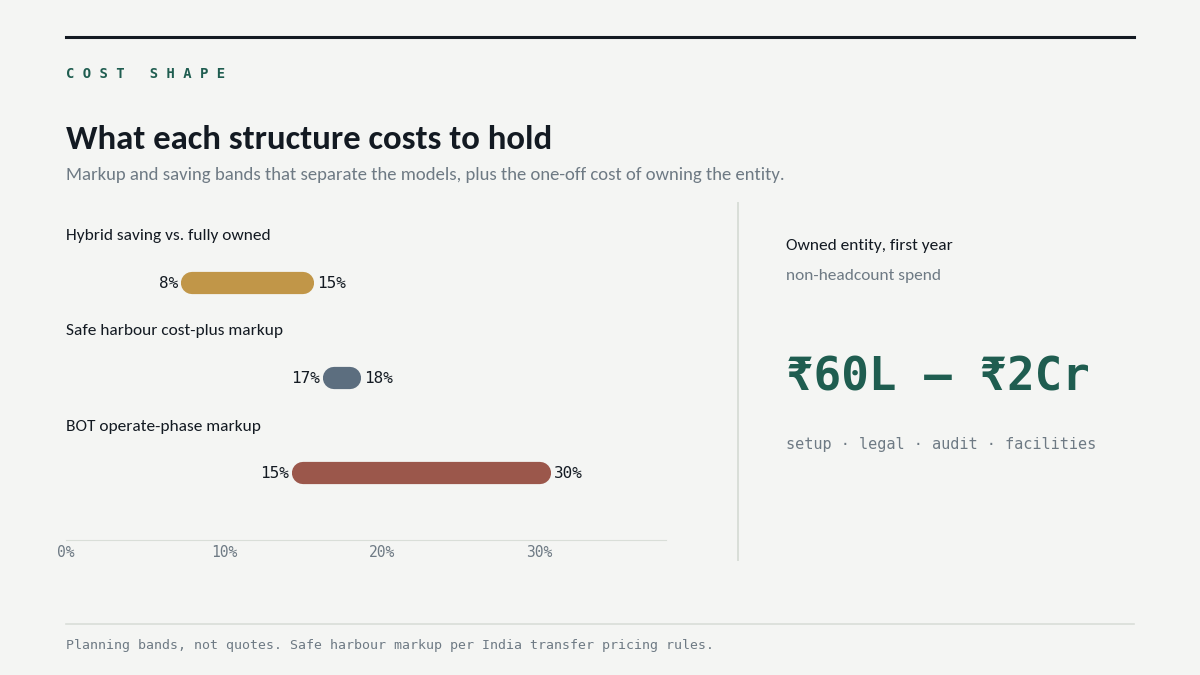
Third, the tax position. A transferred entity inherits its transfer pricing history. India’s safe harbour rules put cost-plus markups for software development services in roughly the 17–18% band, and a centre that has been billing on a different basis for two years creates a reconciliation problem your CFO will meet during assessment.
None of these are exotic. They are the standard consequences of choosing a structure for a 12-month need when the actual need was five years.
GCC operating models explained, model by model
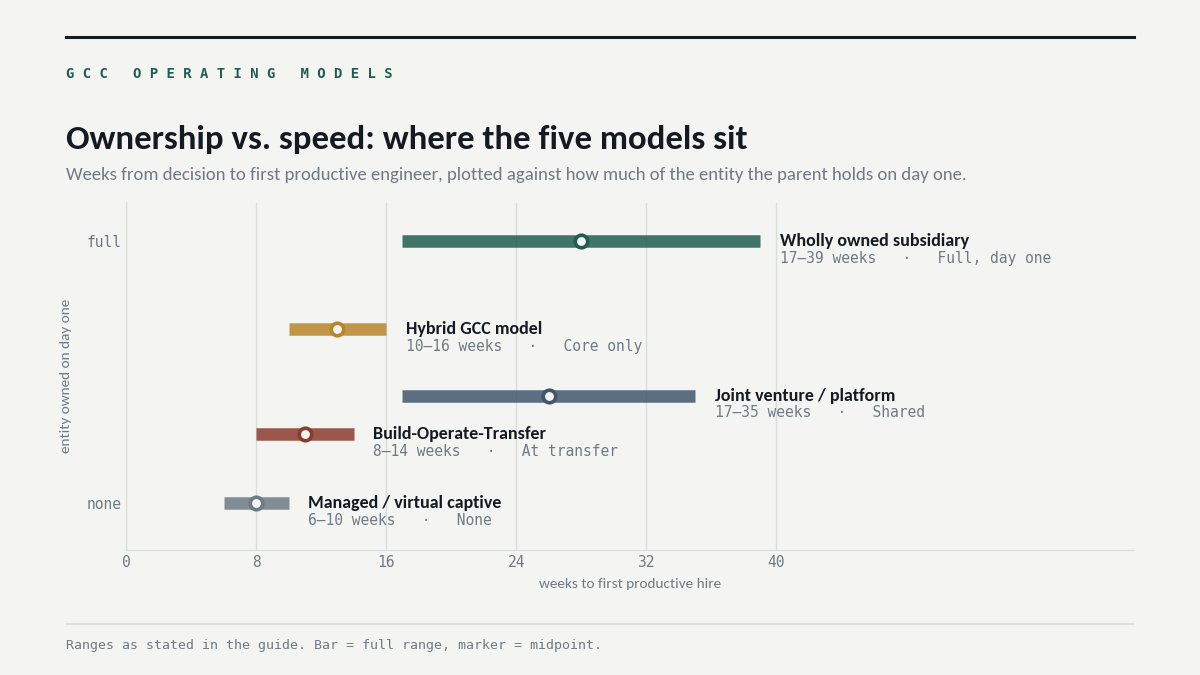
The five gcc delivery model types below are ordered by how much control the parent holds on day one from total to shared.
Model 1 Wholly owned subsidiary (greenfield captive)
The parent incorporates an Indian private limited company, employs everyone directly, signs its own lease, and runs its own payroll and compliance stack.
Setup sequence: name reservation and SPICe+ incorporation (2–4 weeks), PAN/TAN, bank account and FDI inward remittance, FC-GPR filing with the RBI within 30 days of share allotment, GST registration, PF/ESIC/professional tax registrations, then Shops & Establishments per state. Realistic board-approval-to-first-hire window: 4–9 months, and the variance is almost entirely banking and state registrations, not incorporation.
Cost shape: high fixed cost, lowest marginal cost. Planning range for first-year non-headcount spend entity setup, legal, statutory audit, facilities, and one-time infrastructure sits in the ₹60 lakh to ₹2 crore band depending on whether you take managed office space or a conventional lease. Treat that as a planning band, not a quote; state incentives and SEZ/STPI choices move it materially.
Choose it when: headcount trajectory exceeds ~100 within 24 months, the work touches regulated data, or IP ownership must be unambiguous from day one. Below 50 engineers the fixed cost per head rarely justifies it.
Model 2 Build-Operate-Transfer (BOT)
A partner incorporates and operates the centre, then transfers the entity to the parent at a pre-agreed trigger usually a headcount threshold, a date, or both.
BOT is the most commonly mis-signed of the types of global capability centers because the “T” is treated as a formality. It isn’t. The three terms that decide whether BOT works: the transfer trigger (date-based or headcount-based, never “at mutual agreement”), the transfer consideration (a fixed multiple of monthly run-rate, agreed at signing), and the knowledge transfer obligation (named roles, documented runbooks, a defined shadowing period).
Timeline: 8–14 weeks to a dedicated team; transfer typically executed at month 18–36. Cost shape: a markup of roughly 15–30% over fully loaded employee cost during the operating phase, plus a transfer fee.
Choose it when: you want the entity eventually but cannot absorb setup risk now, or you need to prove the offshore thesis to a board before committing capital.
Model 3 Managed or virtual captive
The partner owns the entity permanently. The parent gets a dedicated, badged, ring-fenced team with its own floor, its own manager and its own tooling but no legal entity and no transfer path.
This is not staff augmentation. The distinguishing features are dedication (no shared bandwidth across accounts), named account ownership, and the parent controlling hiring decisions, performance management and roadmap. Where gcc operating models explained in cost terms are concerned, this is the cheapest structure to enter and the most expensive to hold past year four, because the markup never amortises.
Timeline: 6–10 weeks. Choose it when: headcount is likely to plateau under 40, the work is non-core, or you’re operating in a market you may exit.
Model 4 Hybrid GCC model
The hybrid gcc model splits the centre: the parent owns a legal entity and directly employs a core architecture, security, product ownership, anything touching IP while a partner supplies the elastic layer around it under a separate contract.
This is the fastest-growing structure among mid-market enterprises, and the reasoning is straightforward. A 15-person owned core carries a fraction of the fixed cost of a 90-person owned entity while preserving IP control, and the surrounding 75 can flex with a roadmap without triggering a retrenchment process under Indian labour law.
The design decision is where you draw the line. Our rule: anything that would be a single point of failure if the partner contract ended tomorrow sits inside the owned entity. That usually means principal engineers, the security function, and whoever holds production access while QA, platform support and much of the delivery bench sits outside. If you’re standing up infrastructure this way, hire cloud engineers into the owned core, not the flexible layer.
Cost shape: blended. Owned-core fixed cost plus partner markup on the flexible layer in practice 8–15% below a fully owned equivalent at the same headcount, once you account for bench and ramp-down.
Model 5 Joint venture or platform-based GCC
Two or more parties co-own the entity, or a GCC platform provider holds the entity and the parent takes an equity position. Shared capex, shared governance, shared board.
The honest read: JVs are rare, and the ones that hold together tend to involve a strategic reason beyond cost market access, a regulatory requirement for local ownership, or a genuine technology partnership. Governance overhead is real, and deadlock provisions matter more than the commercial terms.
Choose it when: you have a strategic partner already, or you are entering a market where sole foreign ownership is constrained.
What this looks like in practice
A fintech scaling engineering capacity. A payments company needing senior backend and platform engineers used a dedicated-team structure rather than incorporating, moving from requirement to interview-ready shortlists in 7–10 working days per role. The relevant metric wasn’t cost per head; it was that a 98% joining rate and sub-1% drop-off on contract roles meant the hiring plan held, which is what determines whether a quarter ships. Enterprises including Razorpay, Swiggy and Chargebee have scaled offshore engineering on comparable dedicated-team structures.
An enterprise moving from staffing to a centre. A healthtech organisation that had run contract IT staffing for two years converted to an owned core plus flexible layer once headcount passed 40 and the work moved from integrations into core product. The trigger wasn’t a cost model; it was the first time a partner-employed engineer became load-bearing on a production system.
A decision framework you can run in an afternoon
Use this gcc operating model comparison to narrow to two candidates, then pressure-test with the questions below it.
| Model | Time to first hire | Parent owns entity | Best fit headcount | Primary risk |
| Wholly owned subsidiary | 4–9 months | Yes, day one | 100+ | Fixed cost before revenue |
| Build-Operate-Transfer | 8–14 weeks | Yes, at transfer | 50–200 | Weak transfer clause |
| Managed / virtual captive | 6–10 weeks | No | Under 40 | Markup never amortises |
| Hybrid GCC model | 10–16 weeks | Core only | 40–150 | Boundary drift |
| Joint venture / platform | 4–8 months | Shared | Situational | Governance deadlock |
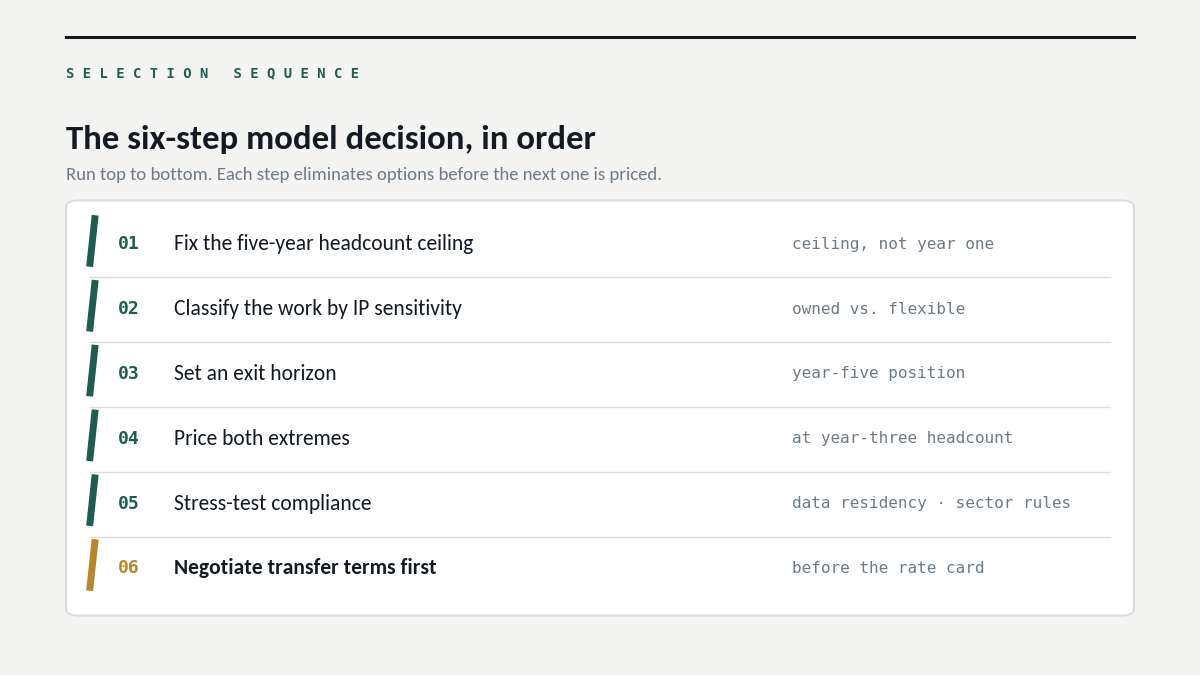
Then run the six-step sequence:
- Fix the five-year headcount range, not the year-one number. Model choice is driven by the ceiling.
- Classify the work by IP sensitivity. Anything that would appear in a patent filing or a security audit belongs in an owned entity.
- Set an exit horizon. If you cannot articulate what happens in year five, do not sign a structure without a transfer clause.
- Price both extremes. Fully owned and fully partnered, at year-three headcount. The answer is usually visibly one or the other.
- Stress-test compliance. Data residency, client contractual obligations, and sector regulation frequently eliminate two models outright.
- Negotiate the transfer terms before the commercial terms. Rate cards are easy to renegotiate. Exit clauses are not.
That sequence is gcc operating models explained as a decision process rather than a taxonomy and it is the part most vendor-authored comparisons leave out, because step 6 is where their leverage lives.
What most teams get wrong
Teams choose the model that fits the current hiring pressure, then discover the structure they need is the one that fits their IP boundary. Hiring pressure is a 90-day problem. Structure is a five-year commitment. The fix is inverting the order: decide what must be owned, then choose the model that protects it, then solve for speed inside that constraint.
Three specific patterns we see repeatedly:
Nobody prices the ramp-down. Every model is compared on cost-to-scale. Almost none are compared on cost-to-shrink. Under Indian labour law, reducing an owned entity’s headcount is slower and more procedurally constrained than reducing a partner-supplied layer. If your roadmap has any chance of contracting, that asymmetry should be in the model comparison; it is the strongest single argument for the hybrid structure.
“Dedicated” is asserted, not contracted. Ask for the clause. Real dedication means no shared bandwidth across accounts, named account management, and the right to interview and reject. If those aren’t written down, you have priced a captive and bought a staffing contract.
The knowledge transfer clause is written by the wrong people. Legal writes it, so it says “reasonable cooperation.” Delivery should write it, so it says: named roles, documented architecture decision records, a defined shadowing period, and a completion test the parent signs off on. This one clause is the difference between a transfer and a rebuild.
Before you sign anything
If you’re evaluating gcc operating models explained here against two vendor proposals that both claim to be “the flexible one,” the useful next step is to pressure-test the structure before the price, specifically the transfer trigger, the dedication clause, and the ramp-down terms.
Supersourcing has run GCC setup, IT consulting services and offshore team builds across 527+ delivered projects for companies including Paytm, Adani, Apollo Hospitals and Yellow.ai, and the same review takes about 45 minutes against your headcount plan and IP boundary.
Send the structure you’re considering to mayank@engineerbabu.com or start at supersourcing.com/contact-us. If the answer is that you should build it yourself, that’s a reasonable outcome of the conversation.
FAQ
What are the different GCC operating models?
There are five in practical use: wholly owned subsidiary, build-operate-transfer, managed or virtual captive, hybrid, and joint venture or platform-based. They differ on two axes: who owns the legal entity and who employs the talent. Everything else, including location, headcount and function mix, is a downstream decision that sits inside whichever structure you choose.
What is the difference between BOT and a captive GCC?
A captive is owned by the parent from day one. BOT is partner-owned during the build and operate phases, then transferred. Functionally the teams look identical; legally and commercially they are not. The distinction only becomes material at transfer, which is why the transfer trigger, consideration and knowledge-transfer obligations should be negotiated before the operate-phase rate card.
Which GCC model is best for a mid-market company?
Below roughly 50 engineers, a managed structure or a hybrid usually wins on total cost, because entity fixed costs don’t amortise across a small base. Above 100, an owned entity or a completed BOT typically wins. Between 50 and 100, the hybrid gcc model is the common landing point owned core, flexible periphery.
How long does it take to set up a GCC in India?
Incorporation itself is 2–4 weeks under SPICe+. The full path to a productive first team including bank account, FDI remittance and FC-GPR filing, GST, PF/ESIC and state registrations realistically runs 4–9 months for a wholly owned entity, versus 6–14 weeks under partner-fronted GCC setup services where the entity already exists.
Is a hybrid GCC model cheaper than a wholly owned subsidiary?
At equivalent headcount below about 150, usually yes commonly 8–15% lower once bench cost, ramp-down flexibility and entity fixed costs are included. Above that, the partner markup on the flexible layer starts to exceed the fixed cost you avoided. Model both at your year-three number rather than year one.
When should we move from staff augmentation to a GCC?
The trigger is functional, not numerical: the first time a contractor becomes load-bearing on a production system or holds knowledge that isn’t documented anywhere. If you’re already running recruitment process outsourcing or contract staffing at scale, that transition point is usually visible in your own attrition and onboarding data before it shows up in a cost model.
Do we need a legal entity to protect IP?
Not strictly IP assignment can be contracted through a partner entity with back-to-back employee assignment clauses. But enforcement is cleaner with direct employment, and some client contracts and sector regulations require it outright. Check your own customer MSAs before assuming you have a choice.
