

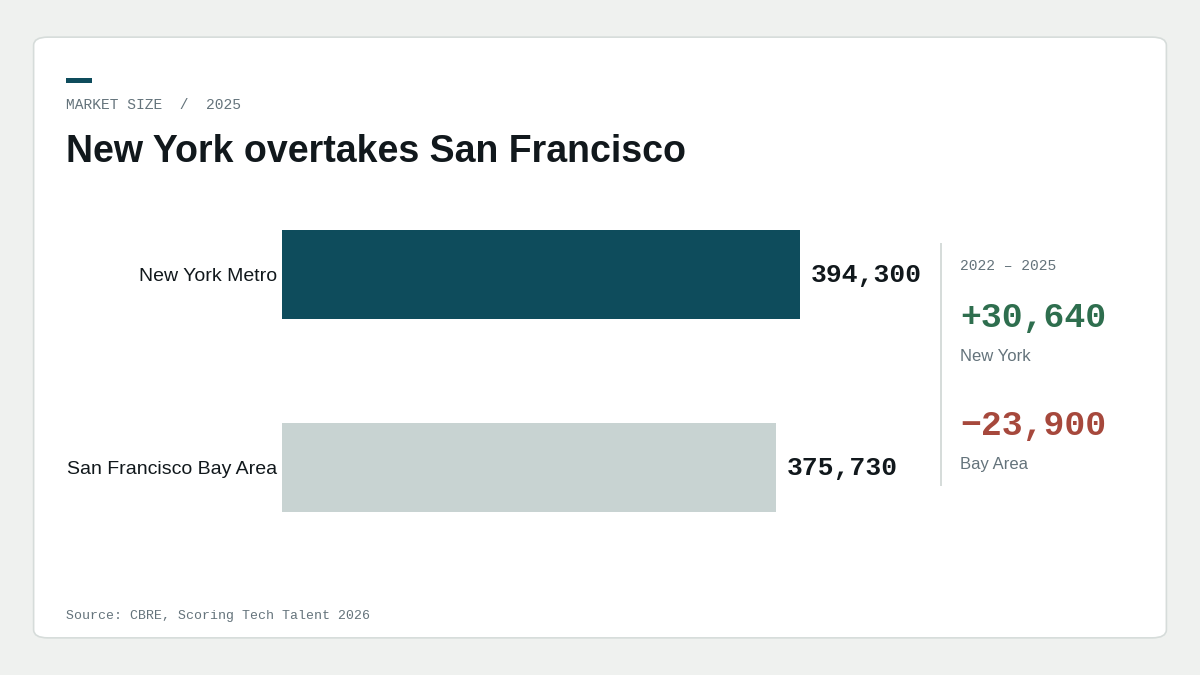
For the first time in the thirteen-year history of CBRE’s Scoring Tech Talent report, New York is the largest tech talent market in the United States. The New York tech talent market now holds 394,300 technology workers against the San Francisco Bay Area’s 375,730, a lead built by adding 30,640 workers between 2022 and 2025 while the Bay Area shed 23,900.
AI-skilled tech workers across the US and Canada grew 45% year over year to 751,000 as of mid-2026, and AI-related roles now make up roughly a third of all US tech job postings.
Here is the part most coverage skips. New York did not win by out-hiring Silicon Valley on product engineering. It won because banks, insurers, asset managers, and health systems started hiring engineers in volume. Fortune reported that New York and Dallas–Fort Worth are tied at the highest AI-specialty concentration within financial services, at 20% each.
That distinction changes your hiring problem entirely. A Series B founder in SoHo posting for a senior backend engineer is no longer competing against three other startups. They are competing against a hedge fund that can clear the offer in four days and pay above the band without a committee.
The rest of this guide is the operating manual: what the market actually costs, how long it actually takes, how to vet without wasting six weeks, which engagement model fits which situation, and where searches quietly fail.
TL;DR
This guide is for hiring managers, founders, and engineering leaders who need to add technical headcount in New York and want the numbers before the sales calls. It covers cost, timeline, vetting, contracts, onboarding, and the point at which a local hire stops being the right answer.
The single number worth holding onto: a senior engineering search in this market realistically runs 45 to 70 days from req approval to signed offer, and the fully burdened first-year cost of a $180,000 base salary lands closer to $255,000 once employer taxes, benefits, equipment, recruiting spend, and ramp-up are counted. Most plans budget the base salary and the calendar month. Both are wrong by a wide margin.
By the end you will be able to write a req that filters correctly, run a technical screen that takes hours instead of weeks, choose between in-house hiring and staff augmentation on evidence, and know precisely what "on track" looks like at day 14, day 45, and day 90. The NYC developer talent pool is deep. Reaching it is a process problem, not a scarcity problem.
What Is the New York Tech Talent Market?
The New York tech talent market is the metro-area labor pool of roughly 394,300 software, data, infrastructure, and AI professionals employed across financial services, media, healthtech, retail, and product companies. It is defined less by a single tech industry than by demand from every industry that now hires engineers which is why it leads the country by headcount.
Three clarifications, because this term gets used loosely:
- It is not “the NYC startup scene.” Startups are a minority employer here. The bulk of demand comes from finance, insurance, real estate, healthcare, and media sectors with different comp structures, longer approval chains, and stricter compliance requirements.
- It is not limited to the five boroughs. The CBRE definition spans the New York metro area, including Northern New Jersey and Westchester. Your candidate pool is a commuter-rail map, not a subway map.
- It is not the same as the remote US market. A New York posting carries New York pay-band expectations and New York disclosure obligations even when the role is fully remote and reports to a New York office.
Why This Market Matters to Your Hiring Plan
Every decision below is downstream of one fact. The New York tech talent market is now the most expensive and most contested engineering labor pool in the country, and the pressure is coming from buyers who are not technology companies.
The concrete business outcomes at stake:
- Wage floor. The BLS reports the New York–Newark–Jersey City metro average hourly wage at $41.50 versus $33.54 nationally across all occupations. Technical roles sit far above that baseline 2026 NYC salary guides place the average base for tech workers in the low $160,000s, with AI and ML roles clearing $200,000.
- Vacancy cost. An unfilled senior engineering seat on a four-person team removes roughly 25% of delivery capacity. On a $2M annual product budget, a 60-day vacancy is approximately $80,000–$100,000 of unrealized capacity, usually more than the recruiting fee that would have prevented it.
- Counter-offer exposure. In tight markets, offer-to-start is where searches die. Candidates in high-demand stacks routinely hold two live processes; a nine-day gap between verbal acceptance and signed paperwork is enough for a counter-offer to land.
- Compliance risk. New York requires a good-faith compensation range in postings. A range written wide enough to be meaningless invites scrutiny and, more practically, wastes your recruiters’ time screening out candidates anchored to the top of it.
- Speed as a differentiator. When a bank can close in four days, your five-round loop with a hiring committee is not thorough. It is a leak.
- Retention economics. Replacing a departed senior engineer costs roughly 1.5 — 2× their base salary once you count the vacancy, the re-run search, and the ramp-up of the replacement. Every hour spent making the first hire correct is cheaper than every hour spent making the second one.
The 3-day rule: if your interview-to-feedback loop exceeds three business days at any stage, assume you will lose your top-decile candidates before your last round. This is the single highest-leverage fix available to most teams and it costs nothing.
The Core Problem Most Buyers Face
Most dedicated teams underestimate two things by a factor of two to four: how long the search takes, and what the hire actually costs. Both errors are amplified by the new york tech talent market, where competing offers routinely move faster than internal approval chains. These are not small errors, they are the errors that turn a Q1 roadmap into a Q3 roadmap.
The timeline gap. Published benchmarks put median US time-to-fill in the high-30s to high-40s in days across all roles. Engineering runs materially longer, and senior engineers longer still plan on 45 to 70 days from req approval to signed offer, then add another 14 to 28 days for notice periods. A team that budgets “about a month” is off by roughly 60 days.
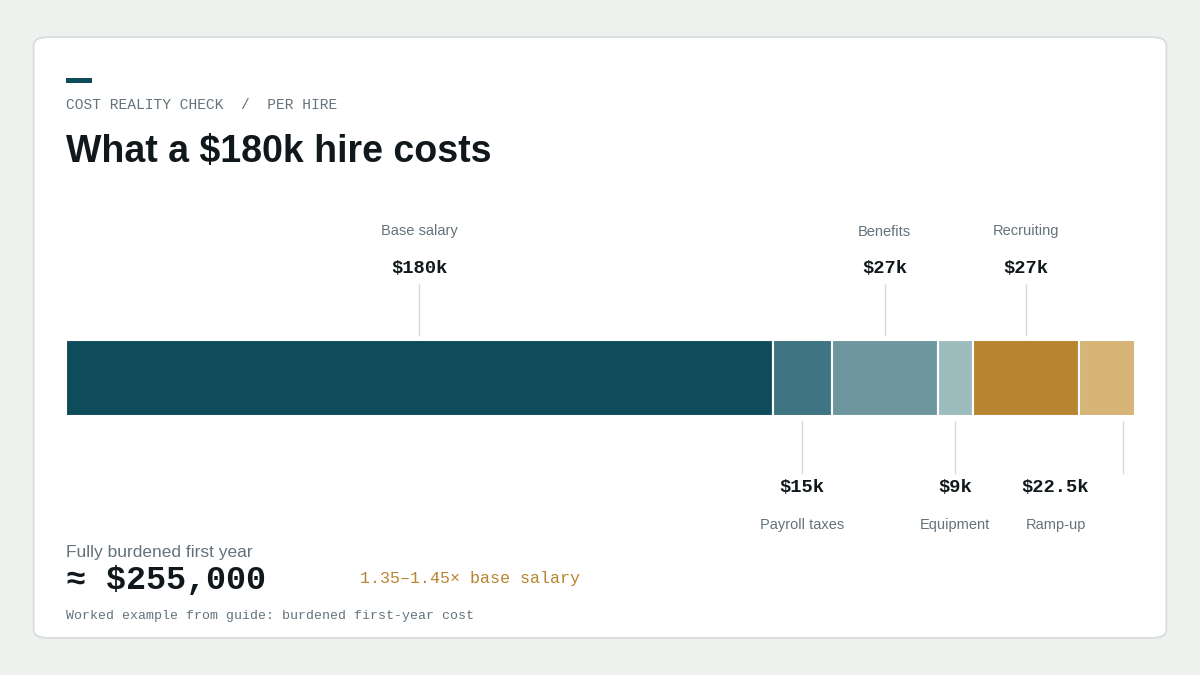
The cost gap. The number in the req is the base salary. The number on the P&L includes employer payroll taxes, benefits loading, equipment, software seats, recruiting spend, and the productivity discount during ramp-up. As a working rule, multiply base by 1.35–1.45 to reach fully burdened first-year cost.
Where the weeks actually disappear. In most stalled searches we have reviewed, the delay was not sourcing. It was internal:
- Req approval sitting with finance for 6–11 days.
- Disagreement over whether the role is backend, platform, or infrastructure resolved only after the first three candidates are rejected for the wrong reasons.
- Scheduling gaps between rounds, typically 4–7 days each in a four-round loop.
- A take-home assessment that adds 5–9 days and quietly drops your strongest candidates, who have offers elsewhere and no interest in unpaid weekend work.
- Offer approval requiring a comp-committee cycle that meets weekly.
Add those up and you have 30+ days of pure waiting inside a process that feels efficient from the inside.
Red flag: if your pipeline conversion from technical screen to onsite is below 25%, the problem is upstream in the job description, not in the candidates. You are screening for the wrong signal and paying interviewer time for it.
The Walkthrough: Hiring in New York, Start to Finish
This is the full lifecycle from the moment you decide you need someone through to scaling the team or winding the engagement down. If you have never run a technical search before, read the phases in order; each one assumes the previous was done properly. The sequence reflects how searches actually run in the new york tech talent market, not how process diagrams say they should.
Phase 1 Defining Requirements
More searches fail here than anywhere else, and the failure is invisible for four weeks. A vague req produces a vague pipeline, and nobody notices until the third rejected shortlist.
The requirements checklist complete every line before opening the req:
- Outcome, not headcount. Write the first ninety days as three deliverables. “Ship the payments reconciliation service to production” filters better than “strong backend engineer.”
- Must-have stack vs. nice-to-have. Cap must-haves at four. Every additional must-have shrinks the reachable pool by roughly 20–35% and adds days to the search.
- Seniority calibrated to the work, not the org chart. If the role has no ambiguity to resolve and no one to mentor, it is a mid-level role. Paying senior rates for mid-level scope is the most common budget leak we see.
- Compensation band, agreed in writing before posting. Not a ceiling you hope to avoid the number you will actually approve. New York requires a good-faith range in the ad, so an internally unagreed band becomes a public problem.
- Location and work model. Onsite three days in Manhattan, hybrid from New Jersey, and fully remote are three different candidate pools with three different pay expectations.
- Decision rights. Name the single person who can say yes to an offer, and their backup. If that person is unavailable for a week in the middle of your search, you have lost the search.
- Interview loop, capped. Three to four stages maximum, with named interviewers and pre-booked slots.
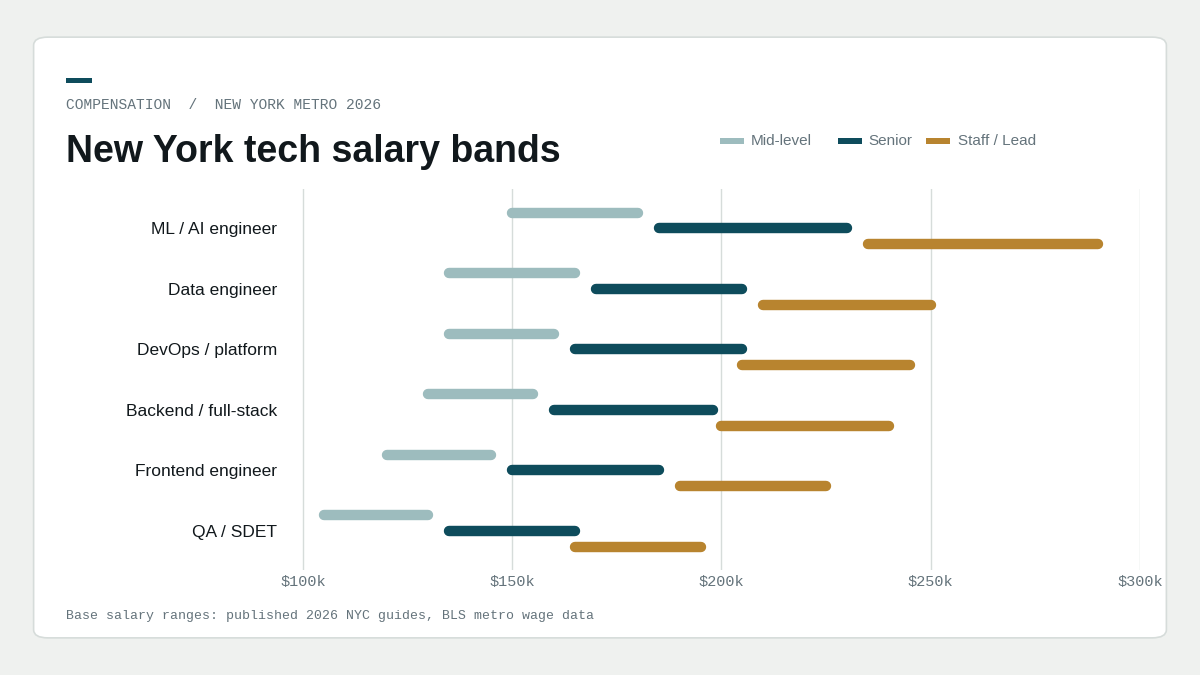
Budget bands to plan against (New York metro, 2026, base salary):
| Role | Mid-level | Senior | Staff / Lead |
| Backend / full-stack engineer | $130k–$155k | $160k–$198k | $200k–$240k |
| Frontend engineer | $120k–$145k | $150k–$185k | $190k–$225k |
| DevOps / platform engineer | $135k–$160k | $165k–$205k | $205k–$245k |
| Data engineer | $135k–$165k | $170k–$205k | $210k–$250k |
| ML / AI engineer | $150k–$180k | $185k–$230k | $235k–$290k |
| QA / SDET | $105k–$130k | $135k–$165k | $165k–$195k |
Ranges reflect published 2026 NYC salary guides and BLS metro wage data. Financial-services employers routinely pay above these bands; early-stage startups routinely pay below and offset with equity.
The stack-specificity rule: name the runtime, not the paradigm. A req that says “JavaScript backend” returns a pool three times wider and materially less qualified than one specifying Node.js with production experience in event-driven services. If that is your role, this is the point where a specialist pipeline, the kind used to hire Nodejs developers at speed, beats a generalist job board every time.
Red flag: if you cannot articulate why the last person in this role left or why the seat is new, pause. Reqs opened without that clarity tend to be re-scoped mid-search, which resets your pipeline to zero.
Phase 2 Sourcing and Vetting
Sourcing in this market is not a volume problem. Applications are plentiful and signal is scarce. The nyc engineering job market delivers high inbound volume to almost any recognizable employer, which is precisely why volume-driven screening fails here. Volume-driven inbound has also become actively hazardous, with fabricated résumés and interview-proxy fraud now a routine screening concern rather than an edge case.
What good screening looks like, in order:
- Recruiter screen (20–25 min). Motivation, comp expectations, notice period, work authorization, location reality. Kill mismatches here, not in round three.
- Asynchronous code review (30 min of candidate time). Send a real 200-line pull request from your codebase with three deliberate problems in it. Ask what they would change and why. This correlates with on-the-job performance far better than algorithm puzzles and takes a fraction of the time.
- Live technical session (60–75 min). Pair on an extension of that same PR. Watch how they navigate unfamiliar code, what they ask, and how they handle being wrong.
- System design or domain round (45–60 min). Scaled to seniority. For mid-level roles, skip it.
- Team and stakeholder conversation (30 min). Working style, communication cadence, how they handle disagreement.
Replace the take-home. A 72-hour assessment costs you your strongest candidates, who have other offers and will not spend a weekend on spec. A paid, time-boxed 90-minute paired session gets a better signal with a fraction of the drop-off.
Vetting red flags worth acting on:
- Résumé stated that no single career could produce eleven technologies at expert level in six years.
- Fluent architectural vocabulary paired with an inability to explain a trade-off they personally made.
- Reluctance to turn the camera on, or audio latency that does not match a live conversation.
- Reference contacts who are all peers, never a manager or a direct report.
- Comp expectations that shift upward more than once during the process are usually a signal of a parallel offer being used as leverage.
The specialist premium. Vetting quality diverges most sharply in scarce disciplines. Assessing an ML candidate on model architecture without probing deployment, monitoring, and drift handling produces hires who can prototype and cannot ship. Teams that consistently hire machine learning engineers successfully separate research capability from production capability at the screening stage, and pay for the one they actually need.
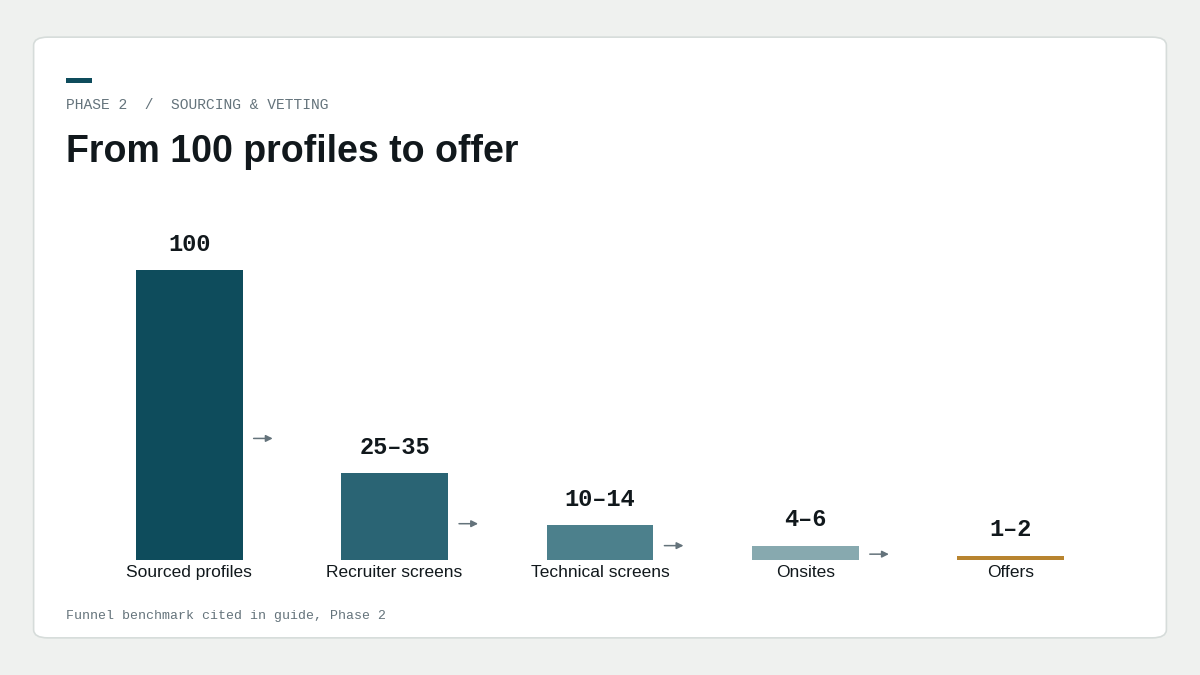
Benchmark to hold your funnel against: 100 sourced profiles → 25–35 recruiter screens → 10–14 technical screens → 4–6 onsites → 1–2 offers. If you deviate sharply at any stage, that stage is where the problem lives.
Phase 3 Engagement Models and Contracts
Choosing the wrong engagement model is a slower, more expensive mistake than choosing the wrong candidate, because it takes two quarters to become visible.
The four routes, and when each one is correct:
- Direct in-house hire. Correct when the role owns long-lived domain knowledge, sits on your core product, or manages people. Highest cost, slowest, highest retention ceiling.
- Staff augmentation / dedicated engineers. Correct when scope is clear, the need is 6–24 months, and you want capacity without permanent headcount. Fastest route to a working engineer. Managed through structured IT staffing services, this typically compresses a 45–70 day search into 7–10 working days to an interview-ready shortlist.
- Project-based / fixed-scope delivery. Correct when the deliverable is well-defined and you do not want to manage engineers day to day. Weakest fit for evolving product work.
- Offshore team or captive center. Correct at a sustained scale generally 15+ engineers with an 18-month-plus horizon.
Contract terms to negotiate before signing not after:
- IP assignment. A work product must vest in your entity on creation, not on final payment. Check the trigger language specifically; payment-triggered assignment is a genuine risk if a dispute arises.
- Confidentiality scope. NDA should cover the engineer, the vendor entity, and any subcontractor. Ask directly whether subcontracting is permitted.
- Replacement terms. A named window for a 7–10 day replacement commitment is a reasonable market standard with a defined trigger, not vendor discretion.
- Exclusivity of allocation. “No shared bandwidth” should be written down. An engineer split across three clients is a part-time engineer at a full-time rate.
- Notice and exit. 30 days is standard; anything above 60 for staff augmentation is a lock-in.
- Rate card mechanics. Fixed for the initial term, with a capped escalation clause. Uncapped annual increases compound badly on multi-year engagements.
- Data residency and access controls. Especially non-negotiable for fintech and healthtech buyers, where your own compliance obligations flow through to the vendor.
The negotiation point nobody raises: ask for the replacement guarantee to survive your own scope change. Most vendor contracts void the guarantee if the role’s requirements shift which is exactly when replacements are most often needed. Getting a carve-out for reasonable scope evolution is usually achievable and rarely requested.
Phase 4 Onboarding and Ramp-Up
Ramp-up is the most commonly skipped planning stage and the most reliable predictor of whether a hire works out. An engineer who ships nothing in week one is significantly likely to disengage by month three.
The first-14-days checklist:
- Day −3: Hardware shipped, accounts provisioned, repository access granted, first ticket assigned in writing.
- Day 1: Environment running locally before end of day. If setup takes more than four hours, your documentation is the problem and fixing it is a permanent win.
- Day 2: First pull request merged, however small. A README correction counts. The point is proving the pipeline works end to end.
- Day 3–5: Codebase walkthrough with the owning engineer; architecture decision records read, not explained.
- Day 5: Named onboarding buddy confirmed and meeting weekly.
- Day 7: First meaningful ticket in progress; first written check-in on blockers.
- Day 10: Access audit confirms nothing is still pending. Missing staging access discovered in week three costs a week.
- Day 14: Structured review against the ninety-day outcomes defined in Phase 1.
A hire who merges code in week one and owns a ticket in week two is on track. One who is still waiting on staging access in week three is already behind, and the cost of that lost fortnight lands on your roadmap, not the engineer’s.
Communication cadence that works for distributed teams:
- Daily asynchronous written standup, not a synchronous call.
- One 30-minute overlap window per day for anything requiring real-time discussion.
- Weekly 1:1 with the delivery manager, agenda owned by the engineer.
- Fortnightly written delivery summary shared with the business stakeholder.
The onboarding friction nobody plans for: in regulated environments, security and compliance provision routinely takes longer than every other onboarding step combined background checks, access reviews, and vendor security questionnaires can consume 10–20 working days. Start that process the day the offer is accepted, not the day the engineer starts. Teams that discover this in week one lose a fortnight of paid capacity.
Phase 5 Managing Delivery
Once the engineer is in, the risk shifts from hiring to management. This is where dedicated account structures earn their cost or fail to. In Supersourcing engagements that commitment is a named account manager carrying no shared bandwidth across clients whatever partner you use, insist on the equivalent, because rotating points of contact are where delivery context quietly leaks.
The KPI set worth tracking (and the ones to ignore):
| Track | Why | Ignore |
| Cycle time (first commit → production) | Detects process friction early | Lines of code |
| PR review turnaround | Leading indicator of team throughput | Commit frequency |
| Escaped defects per release | Quality signal that survives scrutiny | Hours logged |
| Sprint commitment accuracy | Estimation health, not velocity theater | Raw story points |
| Unplanned work percentage | Reveals hidden operational load | Ticket counts |
Reporting cadence that holds up:
- Weekly: Written delivery note shipped, in progress, blocked, decisions needed. Under 300 words.
- Fortnightly: Demo of working software to the business stakeholder.
- Monthly: Account review utilization, KPI trend, risks, upcoming capacity changes.
- Quarterly: Commercial review rate card, headcount plan, scope evolution.
Escalation path: define, on day one, who the engineer contacts when blocked for more than four hours, and who you contact when delivery slips two sprints running. Undefined escalation paths are why small problems become quarterly problems.
Phase 6 Scaling or Exiting
Every engagement ends in one of three ways: it grows, it converts, or it winds down. Plan for all three at the start.
Signals it is time to scale:
- Two consecutive quarters of a backlog growing faster than throughput.
- More than 30% of engineering time goes to unplanned operational work.
- A single engineer holding unshared knowledge of a production-critical system.
Signals it is time to change model rather than add heads:
- You are running three or more separate vendors for one product.
- Coordination overhead exceeds roughly 20% of delivery manager time.
- Sustained need for 15+ engineers on an 18-month-plus horizon the threshold at which a dedicated offshore entity usually beats vendor-based staffing on both cost and control.
At that scale, a global capability center becomes a legitimate structural option rather than a cost play. The Zinnov–Nasscom India GCC Landscape 2026 report counts 2,117 GCCs employing 2.36 million professionals, up 32% evidence that mid-market companies, not just Fortune 500s, now run this model successfully.
The offboarding checklist most teams improvise badly:
- Access revocation list prepared before the final week, executed on the last day.
- Knowledge transfer sessions recorded, minimum two, with the receiving engineer present.
- Documentation debt cleared as a condition of final invoice.
- Code ownership reassigned in CODEOWNERS before departure, not after.
- Written handover of in-flight decisions and open vendor conversations.
- Exit conversation focused on process failures, not personality.
Case Studies
These engagements were delivered in India for India-headquartered clients. They are included because the hiring mechanics funnel design, vetting depth, joining reliability are the same mechanics that determine whether a New York search succeeds. Metrics reflect Supersourcing’s delivered engagement data.
Hypergrowth marketplace scaling (Swiggy). Sustained engineering hiring during a hypergrowth phase, where the constraint was not sourcing volume but shortlist quality at speed. Working from a top-2% vetted pool with a 7–10 working day cycle from job description to interview-ready shortlist, the engagement held a 98% candidate joining rate, the metric that matters most when a roadmap depends on seats being filled, not offers being made.
Fintech engineering build-out (Paytm). More than 100 engineers hired across backend, data, and platform roles. At that volume, the binding constraint becomes offer-to-join reliability: a 10% drop-off across 100 hires is ten reopened searches and a quarter of lost delivery capacity. Structured vetting and dedicated account management held drop-off on contract roles below 1%.
Early-stage engineering hiring (OkCredit). Engineering hires made under early-stage conditions, where a single mis-hire consumes a disproportionate share of a small team’s capacity. The engagement prioritized depth of technical screening over funnel width, with a replacement commitment inside 7–10 days as the risk backstop relevant to any NYC startup weighing a first senior hire against a longer, safer search.
Decision Framework: Which Hiring Route Fits Your Situation
Do not start from “what do we prefer.” Start from what the work actually requires, then check the constraint you cannot move, usually time or budget. Every route below is viable in the new york tech talent market; the question is which one matches the constraint you are actually stuck with.
How to apply it in four questions:
- Will this work still exist, unchanged in shape, in two years? If not, do not hire in-house.
- Can you write the first ninety days as three concrete deliverables? If no, you are not ready to open any req.
- What breaks if the seat is empty for ninety more days? If the answer is “a revenue commitment,” speed outranks cost and staff augmentation wins.
- Are you hiring one person or building a function? One person is searching. A function is an operating model decision.
What Most Teams Get Wrong
The most expensive errors in this market are not candidate-selection errors. They are process errors that look like prudence.
Wrong: treating a longer interview loop as risk reduction. Beyond four stages, additional rounds add almost no predictive signal and materially increase drop-off among the strongest candidates, the ones with competing offers. A five-round loop does not select better engineers. It selects more available ones.
Wrong: budgeting the base salary. Base is roughly 70% of true first-year cost once employer taxes, benefits, equipment, tooling, recruiting spend, and the ramp-up productivity discount are counted. Teams that budget base and then discover the rest mid-year freeze hiring at precisely the wrong moment.
Wrong: writing a wide compensation band to preserve negotiating room. New York’s posting rules require a good-faith range, and a $120k–$220k band tells every candidate to anchor at $220k while telling your recruiter nothing. Wide bands do not preserve leverage. They destroy screening efficiency and invite compliance attention.
Wrong: assuming offshore is a cost decision. The teams that get durable value from offshore capacity treat it as a capability decision owning a domain, running a product line, holding on-call. The ones that treat it as an hourly-rate arbitrage get exactly what they paid for, and then conclude offshore does not work.
Wrong: measuring recruiters on submissions. Submission volume is the easiest metric to game and the least correlated with outcomes. Measure screen-to-onsite conversion and offer acceptance rate. Both are hard to fake and both tell you whether your pipeline is real.
The pattern underneath all five: teams optimize the part of the process they can see rounds, résumés, rates and ignore the part that actually determines the outcome, which is elapsed time and decision quality under it. In the new york tech talent market, the team that decides well in ten days consistently beats the team that decides perfectly in fifty.
Cost and Timeline Reality Check
Concrete numbers, so you can build a plan rather than a hope. Costs in the new york tech talent market become predictable the moment you stop budgeting the offer letter and start budgeting the seat.
Fully burdened cost of a New York engineering hire. Take a $180,000 base as the worked example:
| Cost component | Typical range | On $180k base |
| Base salary | $180,000 | |
| Employer payroll taxes | 8–10% | $15,000 |
| Benefits (health, retirement, insurance) | 12–18% | $27,000 |
| Equipment, software seats, workspace | $6k–$14k | $9,000 |
| Recruiting cost (agency or internal loaded) | 15–25% of base | $27,000 |
| Ramp-up productivity discount (first 90 days) | ~50% of one quarter | $22,500 |
| Fully burdened first-year total | 1.35–1.45× base | ≈$255,000 |
What drives cost up: AI/ML and security specializations; financial-services domain requirements; onsite-mandatory policies in Manhattan; security-cleared or regulated-environment experience; roles requiring both depth and breadth in one person.
What drives cost down: hybrid or remote flexibility; hiring in the New Jersey and Westchester commuter belt; mid-level scoping where mid-level work is what exists; a decision-maker who can approve an offer same-day; and structural routes staff augmentation, offshore pods, or recruitment process outsourcing where you buy the process rather than rebuild it.
Timeline by scenario:
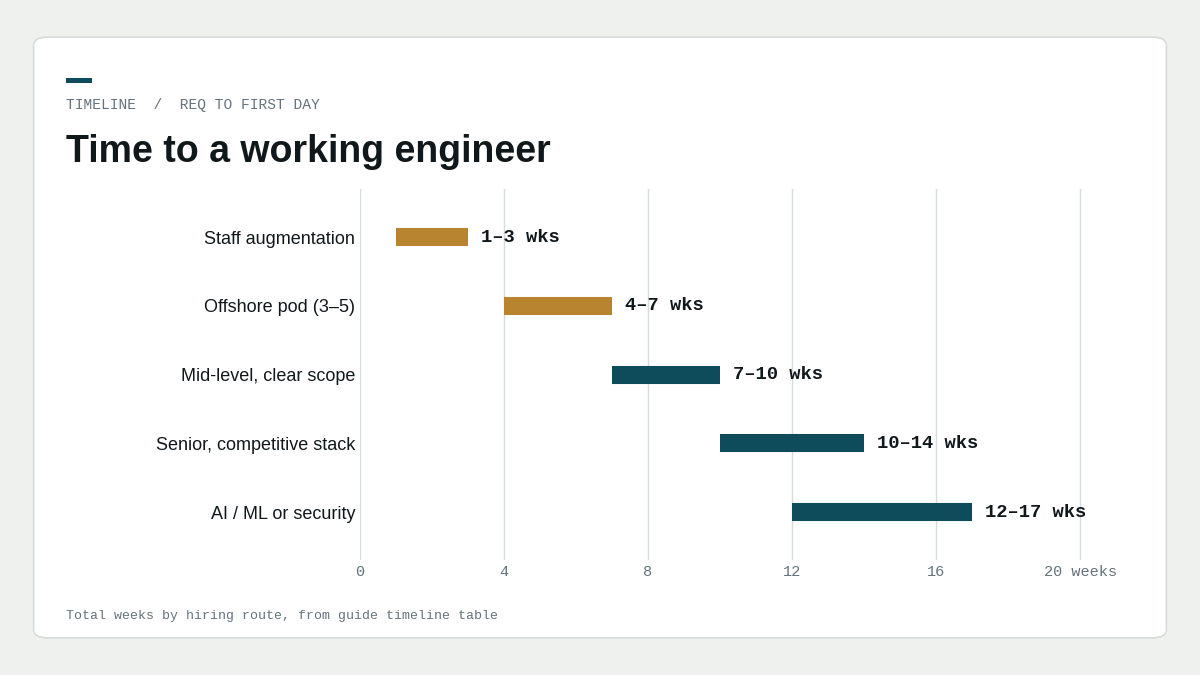
| Scenario | Req to signed offer | Signed to first day | Total |
| Mid-level engineer, hybrid, clear scope | 35–50 days | 14–21 days | 7–10 weeks |
| Senior engineer, competitive stack | 45–70 days | 21–28 days | 10–14 weeks |
| AI/ML or security specialist | 60–90+ days | 21–30 days | 12–17 weeks |
| Staff augmentation, defined scope | 7–14 days | 0–7 days | 1–3 weeks |
| Offshore pod (3–5 engineers) | 3–5 weeks | 1–2 weeks | 4–7 weeks |
| GCC entity setup and first cohort | 4–6 months |
The compounding cost of delay: a 60-day overrun on a single senior seat is roughly $30,000 in unrealized delivery capacity, plus interviewer time already spent, plus the opportunity cost of the roadmap item that did not ship. That number is usually larger than the fee for the route that would have avoided it, which is the calculation most teams never actually run.
Your Next Step
If you are mid-decision on a New York engineering hire, the useful next move is not choosing a vendor. It is pressure-testing the plan you already have against the numbers in this guide.
Take fifteen minutes and check three things: whether your compensation band matches the Phase 1 table for the seniority you are actually hiring, whether your interview loop can return feedback inside three business days at every stage, and whether your timeline assumes 45–70 days or one optimistic month. Most stalled searches fail one of those three, and all three are fixable before you spend another dollar on sourcing.
If the check surfaces a gap, a band that will not clear, a timeline that cannot hold, or a role you have already reopened twice bring the req to a scoping conversation. Expect a straight read on whether the role is fillable locally at your band given current conditions in the new york tech talent market, what the realistic calendar looks like, and whether a shortlist inside 7–10 working days would change the outcome. No obligation to proceed, and no pitch if the answer is that you should keep running it in-house.
Start here: https://supersourcing.com/contact-us/
FAQ
Is the New York tech job market growing or shrinking in 2026?
Growing, and outpacing its historical rival. CBRE’s 2026 analysis puts New York Metro at 394,300 tech workers versus San Francisco’s 375,730 the first time New York has led in thirteen years of the report. Growth is concentrated in AI and in financial-services technology rather than in traditional product companies.
How long does it take to fill an engineering role in New York?
Plan on 45 to 70 days from req approval to signed offer for a senior role, plus 14 to 28 days of notice period. Mid-level roles with clear scope run faster, at 35 to 50 days. Specialist AI, ML, and security searches routinely exceed 90 days. Staff augmentation compresses this to one to three weeks.
How much does a software engineer actually cost in NYC?
Senior base salaries in the New York metro typically run $160,000 to $198,000, with ML and AI roles reaching $230,000 and beyond. Fully burdened first-year cost lands 35–45% above base once payroll taxes, benefits, equipment, recruiting, and ramp-up are included. Budget the burdened number, not the offer letter.
Do I have to post a salary range on a job ad in New York?
Yes. New York State Labor Law §194-B requires employers with four or more employees to include a good-faith compensation range and a job description in postings, including remote roles reporting to a New York office. New York City’s Local Law 32 applies in parallel with its own penalties. Guidance is published by the New York State Department of Labor.
Is it cheaper to hire offshore than to hire in New York?
Per head, substantially but the comparison only holds if the work is genuinely portable. Offshore capacity performs best on well-scoped, ownership-bearing workstreams and worst on roles requiring constant real-time collaboration with US stakeholders. Treat it as a capability decision with a cost benefit, not a cost decision.
What is a realistic offer acceptance rate for NYC engineering roles?
Above 80% is healthy; below 60% signals a comp band misaligned with the market or a process too slow to hold candidate interest. Track offer-to-start separately acceptance means little if candidates take counter-offers before day one.
When does it make sense to set up a GCC instead of hiring locally?
The usual threshold is sustained demand for 15 or more engineers over an 18-month-plus horizon, where vendor coordination overhead has become material. Below that scale, staff augmentation or a dedicated pod delivers similar capacity without entity setup, statutory compliance, or fixed overhead.
Should we run this in-house or bring in a hiring partner?
Run it in-house if you have a dedicated technical recruiter, a decision-maker who can approve offers the same-week, and 8–12 weeks of runway. Bring in a partner if any of those three are missing which is the common case. If you are unsure which describes you, a scoping conversation is faster than three months of finding out.
