

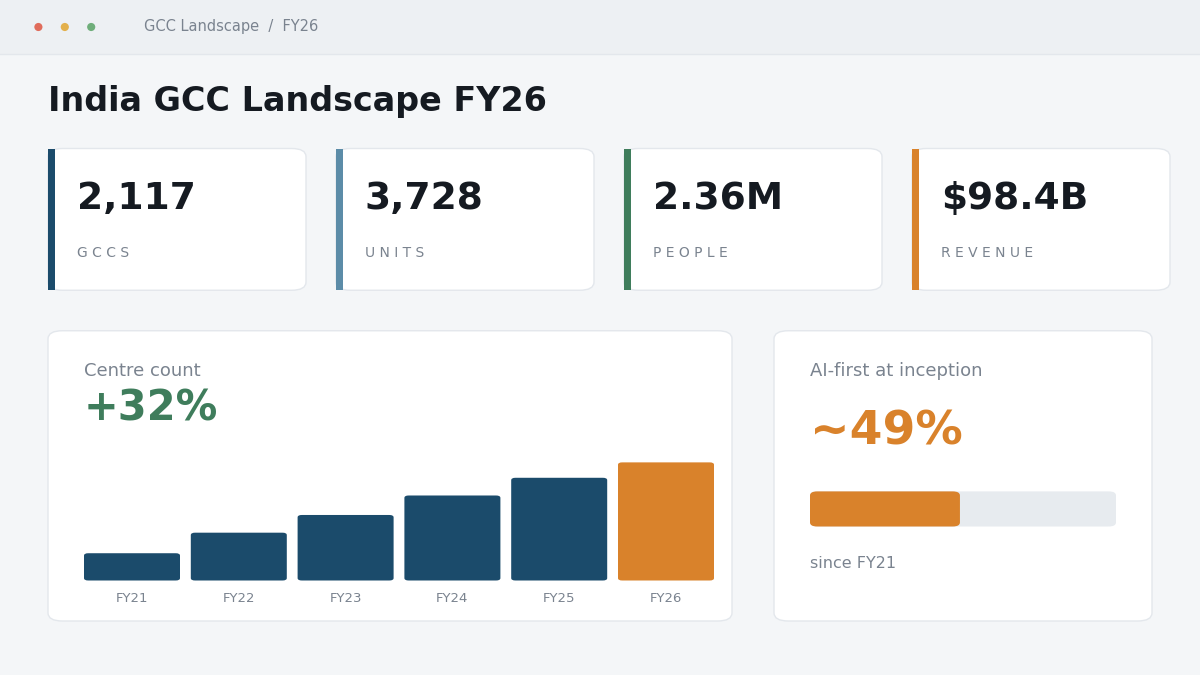
India crossed 2,117 Global Capability Centres in FY26 3,728 physical units, 2.36 million people, $98.4 billion in revenue. The more useful number sits underneath that headline: nearly half of every GCC established since FY2021 was designed AI-first from inception rather than retrofitted later.
That single shift is why the center of excellence vs gcc question suddenly appears on so many steering-committee agendas. Enterprises are no longer choosing between two options. They are discovering, usually a quarter or two late, that they already committed to one and never built the other.
India now hosts 2,117 GCCs operating across 3,728 units and employing roughly 2.36 million professionals as of FY26, with total market revenue of $98.4 billion up 32% in centre count since FY2021.
Here is the framing error we see most often. Leadership treats these as two competing destinations, evaluates them side by side, picks one, and funds it. But an entity and a governance construct are not comparable line items. One has a registered address, a payroll and a transfer-pricing file. The other has a charter and a named owner who can veto architecture decisions across regions.
Run the center of excellence vs gcc comparison as apples-to-apples and you get a centre full of engineers with no authority to standardise anything or a standards group with no delivery capacity to prove its standards work.
This guide breaks the center of excellence vs gcc decision into the four variables that actually differ: charter scope, funding model, staffing ratio and decision rights, drawing on enterprise builds where the failure modes surfaced in month four rather than month one.
TL;DR
This guide is for enterprise leaders asked to choose between a capability centre and a centre of excellence, who suspect the question is framed wrong. It covers charter design, funding, staffing, cost, compliance and governance.
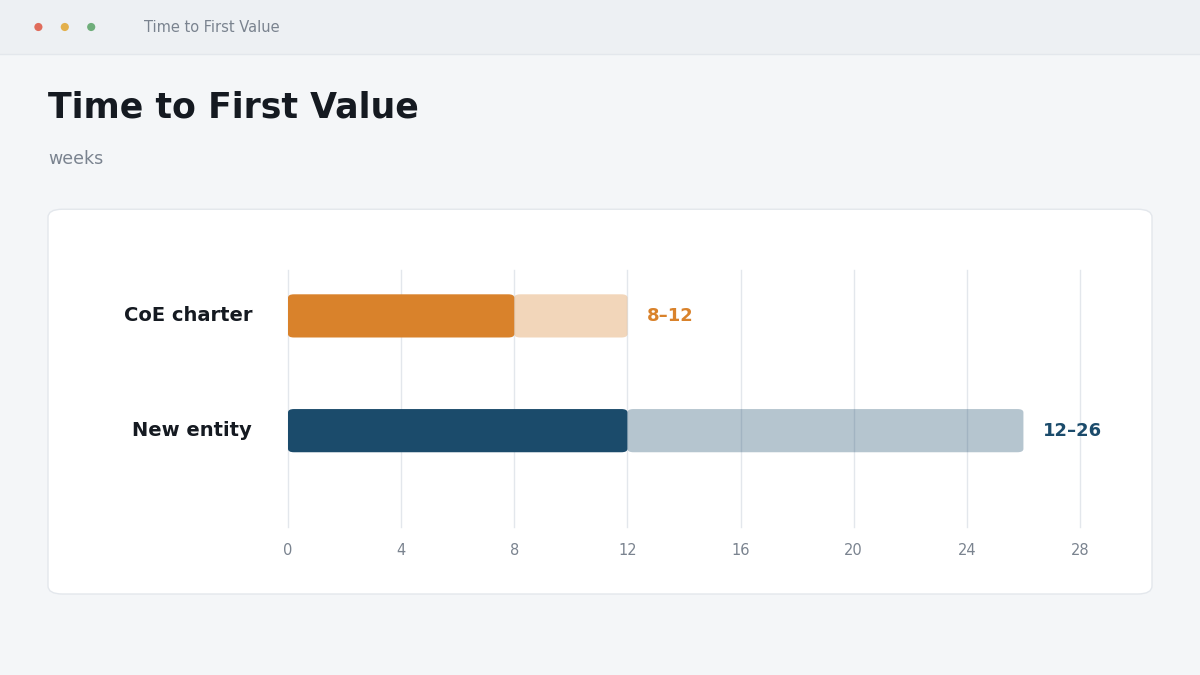
The single most useful thing to know: a CoE is not an alternative to a GCC. It is a layer that runs inside one. Read the center of excellence model as an authority question, not a headcount question. The center of excellence vs gcc split is about who holds veto rights on architecture, and a chartered CoE reaches first value in 8–12 weeks against three to six months for a new entity.
By the end you will be able to tell which of the two you actually have today, which one your business case is funding, and what the gap between those two answers is costing you in delivery velocity.
What a Center of Excellence Actually Is (CoE Meaning in IT)
A center of excellence is a chartered internal group that owns standards, tooling, reusable assets and skill development for one defined capability data engineering, cloud platform, QA automation and holds authority to set how that capability is practised across the wider organisation. It governs; it does not exist to deliver volume.
The distinction that trips up most org designs is authority, not activity, and it is the axis the center of excellence vs gcc debate keeps missing. A team publishing best-practice documents nobody must follow is a working group. A team whose sign-off is a gate in the deployment pipeline is a CoE.
In practice, the core meaning in its organisations converges on three deliverables: a reference architecture, a golden path (paved-road tooling that makes the right thing the easy thing), and a competency framework defining what “senior” means for that discipline.
Center of Excellence vs GCC: The Distinction Most Org Charts Get Backwards
A global capability center is a legal and operational entity. It has an incorporation, a lease, an employer of record, a country leadership team, and a transfer-pricing arrangement with the parent. Its unit of measure is capacity.
A CoE has none of that by default. It is a charter granted to a named owner, funded as an overhead or a levy rather than a cost-plus delivery line, and measured in adoption rather than throughput.
So the honest answer on center of excellence vs gcc is that the two sit on different axes. The entity answers where the work happens and who employs the people. The charter answers who decides how the work is done. You can have either without the other, and both failure modes are expensive.
The Real Problem: An Entity Cannot Substitute for a Discipline
Most enterprises underestimate the governance gap by two to three quarters. The centre gets stood up, hiring runs ahead of plan, and by month five 40 engineers are producing output nobody is empowered to standardise. Six regional teams, six CI pipelines, six opinions on observability.
The reverse pattern is quieter but more common in mature organisations. A CoE gets chartered with four architects and no delivery capacity. It ships a reference architecture in eight weeks, then spends eighteen months trying to persuade P&L owners to adopt it, unable to demonstrate the pattern at production scale.
Both failures share a root cause: the business case was written for one model and the operating model designed for the other. Framing center of excellence vs gcc as a selection problem invites exactly that mismatch, because it is a sequencing problem.
The cost shows up in two places. Rework first: duplicated platform builds across regions surface in year two, when consolidation is politically harder and more expensive than at month three.
Then attrition among the senior hires you fought hardest to land. Principal engineers who join to set direction and find they were hired into a capacity pool leave inside four quarters, and they leave loudly. Resolving center of excellence vs gcc early is largely a talent-retention decision.
Designing the Center of Excellence Model: Charter, Funding, Staffing, Governance
This is where the center of excellence vs gcc question stops being theoretical. Four design decisions determine whether the charter earns its overhead or becomes an internal consultancy nobody books.
Charter scope: narrow beats comprehensive
A charter should name one capability, three to five explicit decision rights, and at least one thing the CoE is not allowed to do. Charters that read “drive engineering excellence across the enterprise” have no enforcement surface and get quietly defunded.
The most useful clause we write in is the escalation path: when a dedicated team wants to deviate from the standard, who approves the exception, and within how many working days. Without a documented SLA on exceptions, teams route around the CoE rather than through it and adoption collapses with nobody reporting a problem. Charter ownership sits with one named individual, never a committee, and this is where most centres of excellence vs gcc business cases stay silent.
CoE vs shared services: the funding model diverges first
The core vs shared services distinction is easiest to see on the invoice. Shared services are funded per transaction or per FTE consumed by a chargeback model that rewards volume and penalises the business unit for using the service more.
A CoE funded that way dies. Charge business units per architecture review and they stop requesting reviews. Fund it as a central levy and adoption becomes free at the point of use the only funding shape that makes standards spread.
Shared services optimise unit cost. A CoE optimises expertise density: the ratio of people who set direction to people who execute. Those are opposing objectives, and the center of excellence vs gcc budget line that tries to serve both reliably starves the second.
Staffing ratio and cost reality
Planning heuristics we use when scoping these builds indicative, not published benchmarks, and worth validating against your own compensation bands:
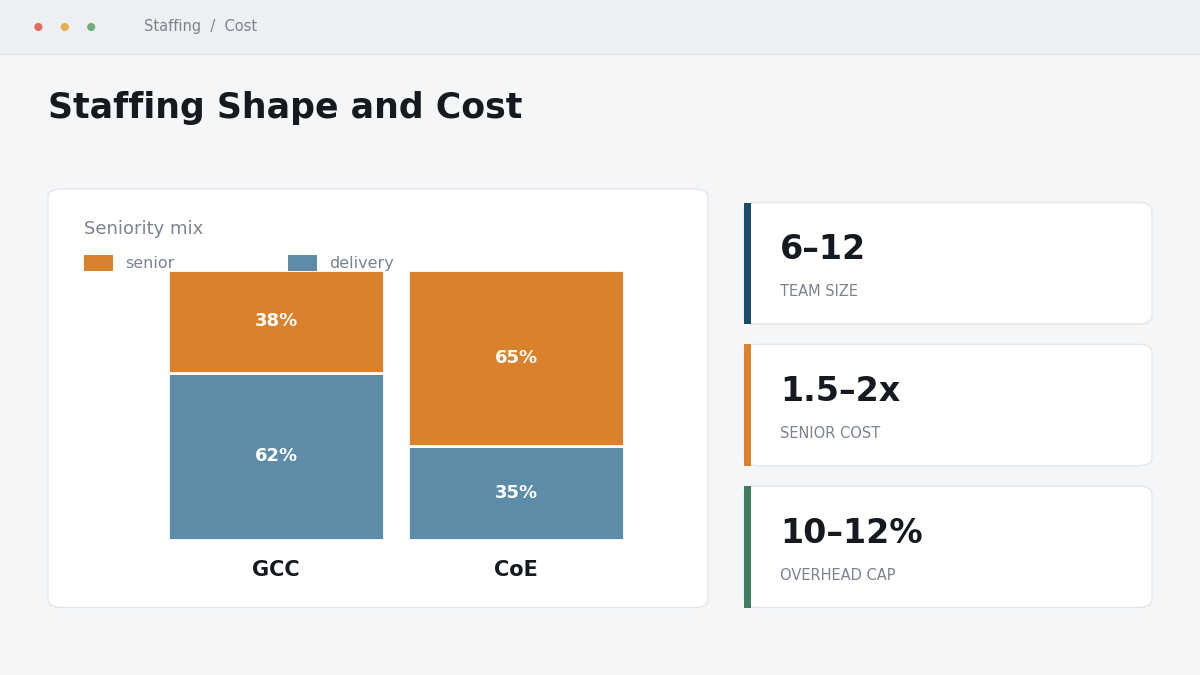
- A functioning CoE runs lean: 6–12 people for a single capability, 60–70% at senior or principal level. Invert that ratio and you have built a training team, not a standards body.
- Fully loaded cost per senior CoE hire in India typically runs 1.5–2x a comparable delivery engineer in the same city. You are buying judgment and market scarcity, not hours.
- Governance overhead the CoE’s run cost as a share of the delivery spend it governs should stay in single digits. Above roughly 10–12%, the model is over-scoped or under-adopted.
Where cost genuinely diverges in the center of excellence vs gcc comparison is at the top of the pyramid. Sourcing four principal-level platform engineers is a different exercise from sourcing forty mid-level ones, and it is the step most business cases under-resource.
AI-assisted sourcing that surfaces the top 2% of vetted talent compresses that timeline. Our shortlist window is 7–10 working days from job description to interview-ready candidates but the constraint is real and worth planning around.
Compliance, IP and the entity question
A CoE needs no separate legal entity; it inherits the one it sits inside. That is a real advantage, and it explains why the gcc to code evolution is far more common than the reverse sequence.
Standing up the entity is the heavier lift, and it is the asymmetry the center of excellence vs gcc timeline hinges on. Captive center setup India work involves incorporation, GST and PF/ESI registration, STPI or SEZ decisions where applicable, transfer-pricing documentation, and a data-residency review for regulated payloads. Realistic runway is three to six months before your first engineer is productive, and compliance is not the workstream to compress.
IP protection deserves early attention. If your CoE produces reusable assets consumed by multiple regional entities, the transfer-pricing treatment of that internal licensing is a month-one question for tax counsel, not a month-twelve one.
The six-step build sequence
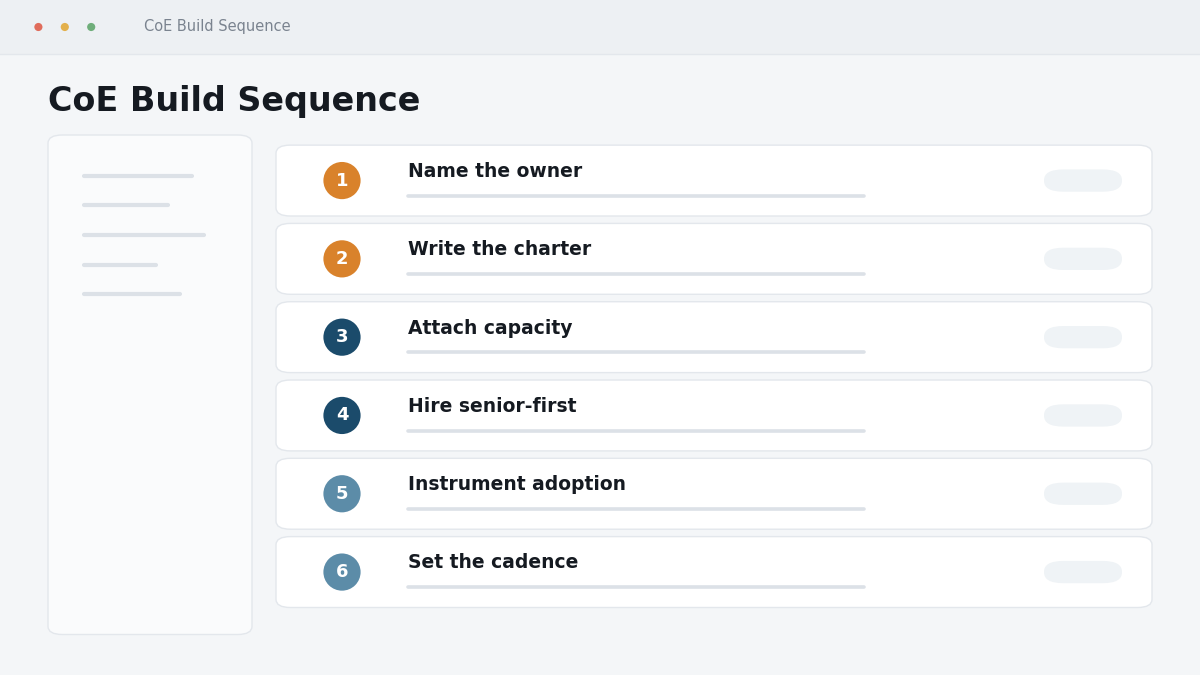
- Name the capability and the owner. One capability, one accountable individual with an existing internal reputation.
- Write the charter with decision rights and exclusions. Three to five things the CoE decides, one or two it explicitly does not, plus a documented exception SLA.
- Attach delivery capacity to the charter. Two to three engineers who build the golden path, not just document it. A CoE that cannot ship a reference implementation cannot prove its own standards.
- Hire senior-first, in that order. Principal hires set the patterns; mid-level hires scale them. Reversing the sequence bakes in the patterns you were replacing.
- Instrument adoption from week one. Services on the golden path, exception requests per quarter, time-to-first-deploy for a new team. Publish these where the CFO sees them.
- Set the governance cadence and the sunset test. Monthly architecture review, quarterly charter re-ratification. If adoption is flat two quarters running, the charter changes or the CoE closes.
Steps 3 and 4 are where most builds break, and where partnering on senior technical hiring whether you hire cloud engineers for platform work or hire machine learning engineers for an AI charter moves the timeline most.
GCC to CoE Evolution: Two Patterns From Real Builds
Evolution rarely looks like a strategy document. It looks like a capacity centre discovering that its most valuable output is standards, not throughput which is when the center of excellence vs gcc conversation finally gets specific.
Pattern one fintech, existing centre. An established India centre running payment integrations across three regional stacks carved a data-platform CoE out of existing headcount rather than hiring net-new. Four senior engineers moved from delivery to charter work, two backfilled inside the contract’s replacement window. The outcome was not cost: new market integrations stopped requiring a bespoke pipeline design each time.
Pattern two healthtech, greenfield. A regulated-data build inverted the usual center of excellence vs gcc order, chartering its data-governance CoE before hiring delivery headcount, because retrofitting audit trails into an existing codebase costs multiples of building them in. The pre-productive runway was longer than a standard capacity ramp; the trade was deliberate.
Across builds in fintech, healthtech, e-commerce and enterprise SaaS clients including Razorpay, Swiggy, Chargebee and Apollo Hospitals the pattern holds. Centres that chartered a standards layer before crossing roughly 50 engineers spent materially less on consolidation later.
A Decision Framework for Your Next Steering Committee
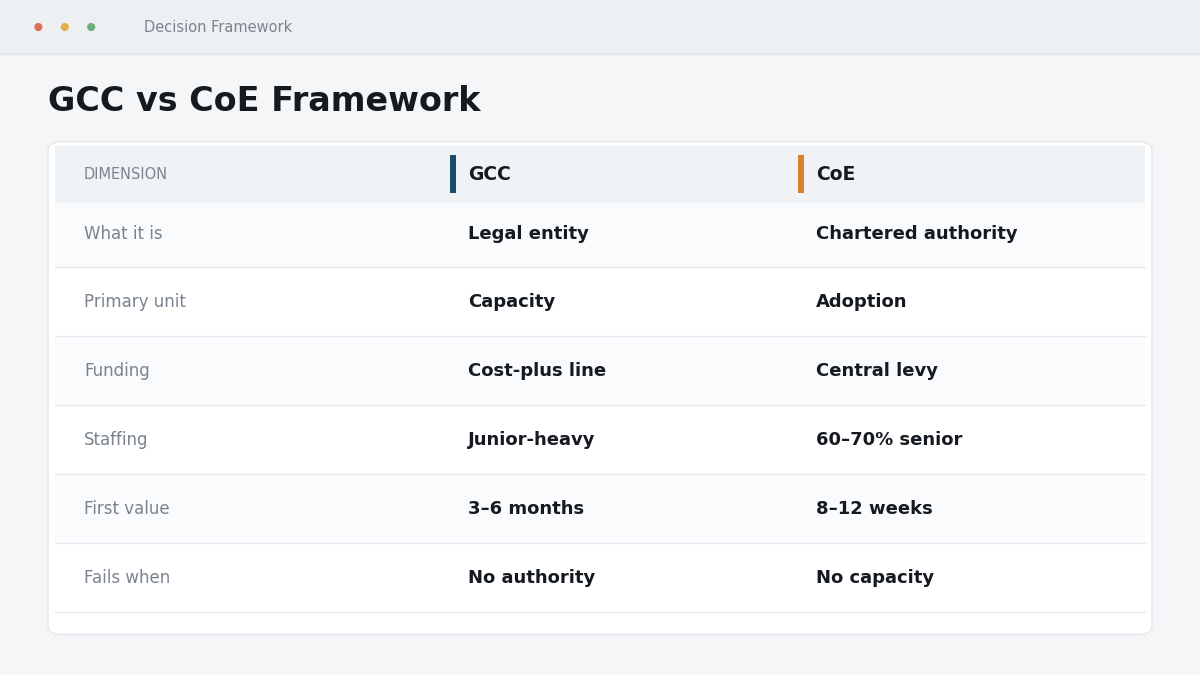
Use this to establish which model your business case is actually funding. Answers landing in both columns confirm a sequencing problem rather than a selection problem.
| Dimension | Global Capability Centre | Center of Excellence |
| What it is | Legal entity: payroll, lease, transfer pricing | Chartered authority inside an existing entity |
| Primary unit | Capacity (FTEs, functions owned) | Adoption (standards followed, assets reused) |
| Funding shape | Cost-plus delivery line | Central levy or platform overhead |
| Staffing shape | Pyramid, junior-heavy at scale | Inverted, 60–70% senior |
| Time to first value | 3–6 months (entity + ramp) | 8–12 weeks (charter + reference build) |
| Fails when | No standards authority attached | No delivery capacity attached |
Read through that table, center of excellence vs gcc resolves into a simple test. Need to employ people in a new geography? You need the entity. Need decisions to become consistent? You need the charter. Most enterprises at scale need both, in that order which makes center of excellence vs gcc a question of sequence and funding shape, not of picking a winner.
What Most Teams Get Wrong
The most consistent error is not structural, it is dated. Teams evaluate center of excellence vs gcc against a 2015 cost-arbitrage business case while pitching a 2026 value-creation mandate to the board. McKinsey’s framing notes that the definition of a GCC has moved well beyond cost arbitrage toward value creation yet the internal spreadsheet still models savings per FTE.
The red flag we look for in a first diligence conversation: ask who signs off on a deviation from the CoE standard, and how long that takes. If nobody in the room knows, the CoE has no teeth regardless of the org chart, and it will not survive the first budget cycle where a deadline collides with a standards requirement.
Second, less discussed: over-chartering. A CoE with authority over five capabilities has authority over none, lacking bench depth to defend a position in any of them. Narrow the charter until it looks almost trivially small, then expand once adoption metrics prove out.
Third: treating cost arbitrage and talent density as one business case. They imply different geographies, compensation bands and vendor structures. Conflating them inside a center of excellence vs gcc decision is how a centre lands in a city that cannot source the four principal engineers its charter depends on.
Before You Sign the Business Case
If you are working through the center of excellence vs gcc decision right now, the useful next step is not a vendor shortlist. It is a two-hour session pressure-testing your charter, staffing ratio and senior-hire timeline against the business case you already wrote.
Supersourcing has run GCC setup services and global capability center builds across 527+ delivered IT projects, with a 98% candidate joining rate and a 7–10 day replacement window on contract roles. To pressure-test a center of excellence vs gcc plan against those patterns before committing a budget, that conversation is available at supersourcing.com/contact-us or mayank@engineerbabu.com.
Bring the charter draft. That is the document the decision actually turns on.
FAQ
Is a center of excellence the same as a GCC?
No. A GCC is a legal and operational entity incorporation, payroll, leadership, transfer pricing whose unit of measure is capacity. A CoE is a chartered authority over how one capability is practised, and it can sit inside a GCC, inside a headquarters function, or across both. Treating center of excellence vs gcc as interchangeable is the most common source of failed capability-centre business cases.
Can you run a CoE inside an existing GCC?
Yes, and this is the most reliable sequence. The entity already carries the compliance and employment infrastructure, so the charter needs only an owner, decision rights and a small senior team. Carving it out of existing headcount usually beats hiring net-new, provided you backfill the delivery roles you vacate.
What is the difference between a CoE and shared services?
Funding and objective. Shared services are consumption-funded and optimise unit cost, which rewards volume. A CoE is centrally funded and optimises adoption of standards, which requires being free at the point of use. Charge per architecture review and reviews stop happening the model breaks on the invoice, not the org chart.
How long does it take to set up a center of excellence in India?
If the entity already exists, expect 8–12 weeks to a chartered CoE with a working reference implementation. If you are standing the entity up too, add three to six months for incorporation, statutory registrations and site readiness. That gap is the clearest practical argument in the center of excellence vs gcc sequencing question.
Do you need a legal entity to run a center of excellence?
Not a separate one. A CoE inherits the entity it sits inside, which is why it is the lighter of the two builds. You need a legal entity to employ people in a new country that is a captive center question, not a charter question.
When should we move from a GCC to a CoE model?
The trigger is duplication, not headcount. Once two or more teams have independently solved the same platform problem differently, the cost of having no standards layer already exceeds the cost of building one. In most builds that inflection lands between 40 and 80 engineers.
How do we pressure-test our operating model before committing to a vendor?
Ask any prospective partner to walk you through the exception-approval path, the senior-hire sourcing timeline, and the replacement terms in writing. Vague answers on any of the three predicted problems in month four. Sound IT consulting services engagements start with the charter, not the headcount plan.
