

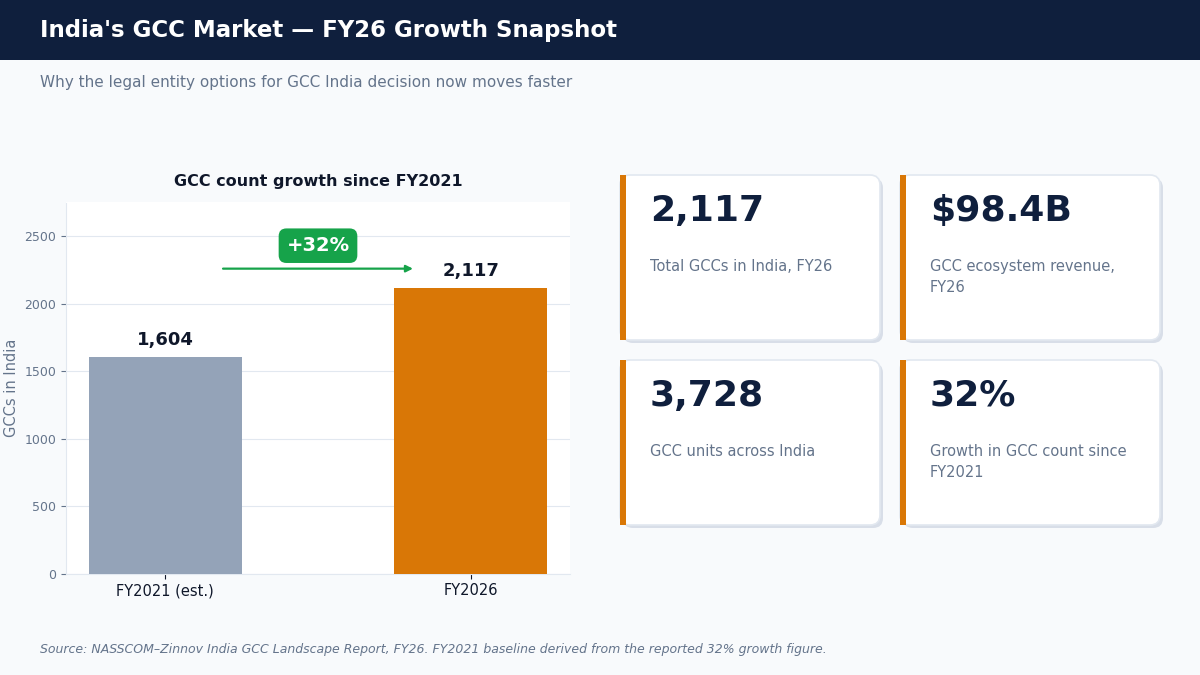
India now hosts 2,117 Global Capability Centers, and the number that should worry you isn’t the count; it’s the 32% growth rate since FY2021 that’s pushed entity registration queues, AD bank due diligence timelines, and company secretary bandwidth to their limits. Most GCC delays in 2026 aren’t caused by hiring or real estate. They’re caused by picking the wrong legal structure in week one and trying to fix it in month eight.
Enterprises evaluating legal entity options for GCC India usually default to whatever their tax advisor used for the last cross-border deal, without checking if it fits a 200-person engineering hub. That’s backwards. The entity you choose determines who owns your IP, whether you can issue ESOPs to retain your first 50 engineers, and whether your US or UK parent inherits a permanent establishment tax exposure it didn’t sign up for.
According to the NASSCOM–Zinnov India GCC Landscape Report, India’s GCC ecosystem generated an estimated $98.4 billion in revenue across 3,728 units in FY26, with growth increasingly coming from mid-market companies, not just Forbes Global 2000 names. That mid-market shift matters here: smaller parent companies have thinner legal teams and less room to absorb a bad entity decision.
This guide breaks down the three structures that actually get used for GCCs wholly owned subsidiary, LLP, and branch office and where each one quietly disqualifies itself.
TL;DR
This guide is for legal, finance, and HR leaders at mid-market and enterprise companies deciding how to legally set up a Global Capability Center in India. It compares the three real legal entity options for GCC India wholly owned subsidiary, LLP, and branch office on FDI eligibility, IP ownership, ESOP capability, and setup timeline.
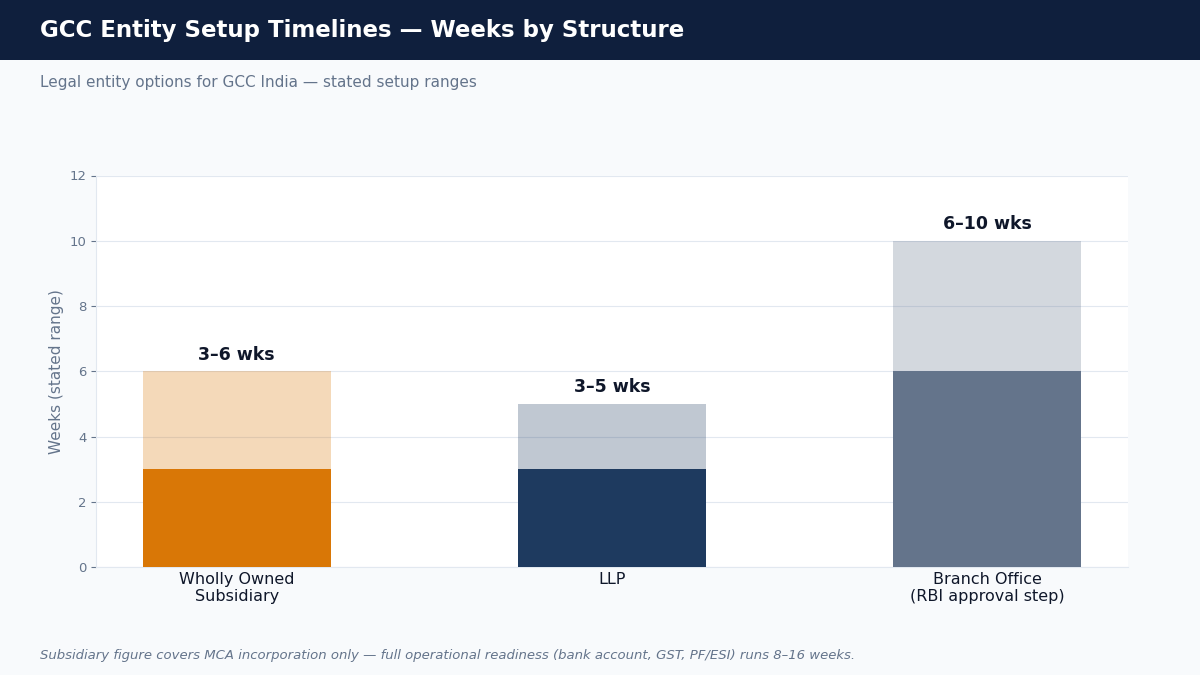
The single biggest number to know: a wholly owned subsidiary typically takes 3-6 weeks to incorporate through India's MCA21 3.0 system, but full operational readiness bank account, GST, PF, ESI, and office lease usually runs 8-16 weeks. A branch office, by contrast, needs RBI approval first and can take 6-10 weeks just for that step, before any ROC filing begins.
By the end, you'll be able to map your parent company's sector, funding plans, and headcount target to the one structure that won't need to be restructured 18 months in which, in our experience running these engagements, is the most expensive mistake on this list.
What Is a GCC Legal Entity Structure?
A GCC entity structure is the legal form a foreign parent company registers in India to own and operate its captive center, typically a wholly owned subsidiary, a limited liability partnership, or a branch office. The structure determines tax treatment, IP ownership, board governance, and how easily the company can hire, pay equity, and repatriate profits.
The Core Problem: Why This Decision Gets Made Too Fast
Most parent companies treat entity selection as a checkbox their law firm handles in a single email thread. That’s a mistake most teams underestimate by a wide margin not because the paperwork is hard, but because the wrong structure caps what the GCC can ever become.
A branch office, for instance, cannot issue equity. If your GCC roadmap includes retaining senior engineering leaders with an ESOP pool which most 100+ person tech GCCs eventually need, a branch office structurally blocks that outcome from day one, no matter how the compensation band is negotiated later.
Timelines get underestimated too, and so do the parallel hiring track teams that lean on IT staffing services to build a shortlist while the entity is still being registered and their first engineers weeks earlier than teams that wait for the Certificate of Incorporation before opening a single requisition.
A functioning GCC also needs a live bank account, a GST registration, PF and ESI codes, and a registered office lease before the first payroll can run. Real-world operational readiness for a subsidiary sits closer to 8-16 weeks, and can stretch past that when bank KYC for non-resident directors gets delayed, a friction point that shows up in nearly every first-time entity setup we’ve supported, regardless of parent company size.
Legal Entity Options for GCC India: The Three Real Choices
Four structures technically exist under the Indian law subsidiary, LLP, branch office, and liaison office. The liaison office can be dismissed immediately for GCC purposes: it cannot invoice, cannot earn revenue, and exists only for market representation. That leaves three worth comparing in depth.
Wholly Owned Subsidiary India: The Default for a Reason
A wholly owned subsidiary India entity is registered as a Private Limited Company under the Companies Act, 2013, through the MCA’s SPICe+ integrated form. It is a fully separate legal entity from the parent meaning the subsidiary, not the parent, bears Indian liability, owns Indian-developed IP, and enters Indian contracts in its own name.
This is why it’s the default structure for a global capability center: it supports 100% FDI under the automatic route in most IT, software, and consulting activities, it can issue shares and ESOPs, and it gives global boards the governance model they already understand a board of directors, statutory audits, and clean financial reporting lines back to the parent.
Minimum requirements are light by global standards: two directors (at least one resident in India for 182+ days in the preceding financial year), two shareholders, and no statutory minimum paid-up capital under current Companies Act rules. Most subsidiaries fund an initial paid-up capital between ₹1 lakh and ₹25 lakh depending on projected first-year burn.
LLP vs Private Limited India: Why LLPs Rarely Win for GCCs
An LLP vs private limited India comparison usually favors the LLP for small services firms, lighter compliance, pass-through taxation, and lower running costs. For a GCC, the calculus flips almost every time.
The disqualifying gap for most GCCs: an LLP cannot issue shares, which means no ESOP pool, no employee equity, and no clean path to a later IPO carve-out or private equity round involving the India entity. LLPs also cannot access External Commercial Borrowings or accept investment from FPIs and FVCIs.
LLPs still make sense in one narrow case worth naming: a small advisory, back-office, or research arm under 15-20 people, with no near-term equity compensation plans and no intention to raise capital at the India entity level.
Branch Office vs Subsidiary: The Structure That Looks Faster and Isn’t
A branch office vs subsidiary decision often starts with the assumption that a branch is quicker because “there’s no new company to incorporate.” In practice, it’s usually slower, because RBI approval has to clear before anything else starts.
The bigger risk is tax, not paperwork: because the branch has no separate legal identity, India’s tax authorities can attribute a permanent establishment (PE) to the parent, exposing global income connected to the Indian activity to Indian tax scrutiny.
This is the single most common reason dedicated teams walk mid-market clients away from a branch office once they understand it.
The Incorporation Process, Step by Step
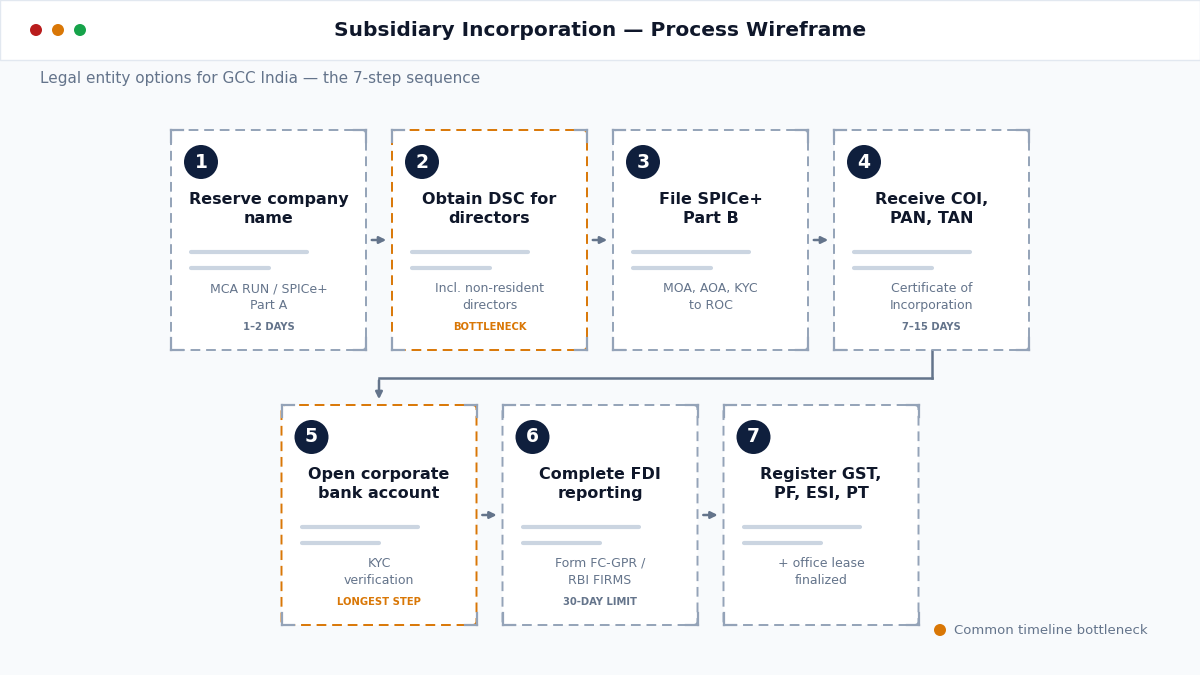
For the structure most GCCs actually choose the wholly owned subsidiary the process runs in a fairly fixed sequence:
- Reserve the company name via the MCA’s RUN or SPICe+ Part A service (1-2 days).
- Obtain Digital Signature Certificates (DSC) for proposed directors, including any non-resident directors this step is the most common bottleneck for foreign founders.
- File SPICe+ Part B with MOA, AOA, and director/shareholder KYC to the Registrar of Companies.
- Receive the Certificate of Incorporation, PAN, and TAN, typically within 7-15 working days of a clean filing.
- Open a corporate bank account and complete KYC, often the longest single step due to physical verification requirements for foreign directors.
- Complete FDI reporting via Form FC-GPR on the RBI’s FIRMS portal within 30 days of share allotment.
- Register for GST, PF, ESI, and Professional Tax, and finalize a registered office lease before running payroll.
Each step depends on the one before it, which is why parallel-tracking the office lease and initial hiring pipeline against steps 5-7 rather than waiting for full legal closure is what separates an 8-week setup from a 16-week one.
Case Studies: How This Plays Out in Practice
A US-headquartered fintech platform expanding into India initially scoped a branch office, assuming it would be faster to stand up a 40-person engineering pod. Once legal counsel flagged the PE exposure and the inability to issue ESOPs to the founding India engineering leads, the company switched to a wholly owned subsidiary before filing anything with RBI adding roughly three weeks to the front end of the timeline but avoiding a structural rebuild once it was time to hire dedicated developers for the founding team.
A mid-market SaaS company building a 15-person research and data-annotation team chose an LLP deliberately: no equity compensation was planned for that team, the sector qualified for 100% automatic-route FDI, and the lighter annual compliance load matched a team that size was expected to stay under indefinitely. Both outcomes were correct because the structure matched the headcount and equity plan, not the other way around.
Comparison Framework: Subsidiary vs LLP vs Branch
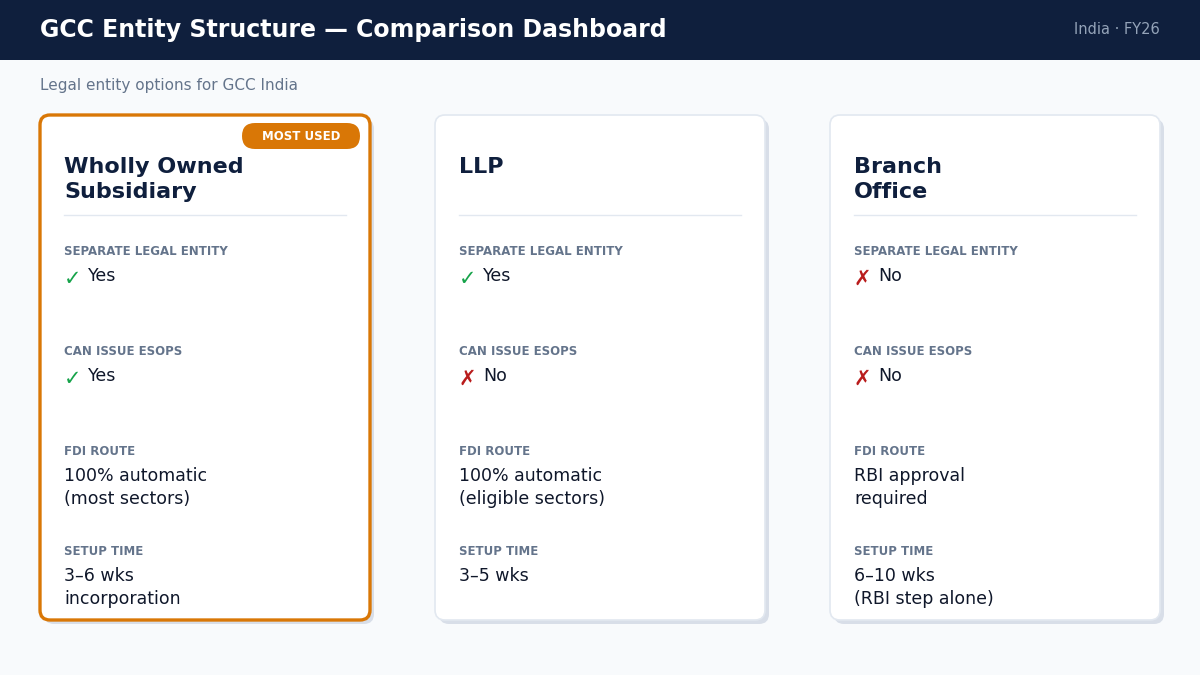
| Factor | Wholly Owned Subsidiary | LLP | Branch Office |
| Separate legal entity | Yes | Yes | No extension of parent |
| Can issue shares/ESOPs | Yes | No | No |
| FDI route | 100% automatic (most sectors) | 100% automatic (eligible sectors only) | RBI approval required (FEMA 22(R)) |
| Typical setup time | 3-6 weeks to incorporate; 8-16 weeks operational | 3-5 weeks | 6-10 weeks for RBI approval alone |
| Best fit | 50+ person GCC, long-term, equity plans | Small teams under ~20, no equity plans | Rarely recommended for GCCs |
What Most Teams Get Wrong
The most common mistake isn’t picking the wrong entity, it’s picking the right entity for the wrong headcount horizon. Companies size the structure for their year-one team of 25 and don’t revisit it at year three when the GCC has grown to 300 and needs a board seat structure, statutory audit committee, and formal transfer pricing documentation that a lean LLP was never built to carry.
The second pattern: treating GCC entity structure and hiring strategy as sequential instead of parallel. Legal teams wait for the Certificate of Incorporation before looping in talent acquisition, which burns 6-8 weeks that recruitment process outsourcing could have filled with a ready shortlist, defined compensation bands, and pre-cleared background checks all of which can start before the bank account is even live.
A third, quieter mistake: under-provisioning for the digital signature certificate and non-resident director KYC step. Foreign directors who haven’t dealt with Indian apostille and notarization requirements before routinely lose 2-3 weeks here simply because documents were couriered instead of pre-verified with the company secretary handling the filing.
If You’re Making This Call Right Now
Picking between these legal entity options for GCC India is a one-time decision that’s expensive to reverse restructuring an LLP into a subsidiary after year two means renegotiating employment contracts, re-filing IP assignments, and re-running FDI reporting from scratch. It’s worth getting right before the first hire, not after the fiftieth.
Supersourcing has supported GCC entities and hiring decisions across fintech, healthtech, and enterprise SaaS clients scaling India teams from first hire to full build-out, with dedicated account managers and NDA-backed IP protection built into every engagement. If you’re weighing subsidiary, LLP, or branch offices and want a second set of eyes before you file anything, reach out at mayank@engineerbabu.com or visit supersourcing.com/contact-us.
FAQs
What is the best legal entity for a GCC in India?
For most GCCs planning to cross 50 employees, issue equity, and operate long-term, a wholly owned subsidiary is the standard choice. It’s the only structure among the three that supports ESOPs, full IP ownership, and clean 100% FDI under the automatic route in most technology and services sectors.
Can a branch office run a full GCC in India?
Technically it can operate, but with real constraints: it can’t issue equity, it carries permanent establishment tax risk for the parent, and its permitted activities are restricted under FEMA 22(R)/2016. Most legal teams rule it out once a GCC plans to scale past a small, narrowly scoped pilot team.
Is an LLP a good structure for a GCC?
Only for small, equity-light teams typically under 15-20 people with no plans to issue stock options or raise India-level capital. Beyond that headcount, the inability to issue shares becomes a real constraint on talent retention.
How long does it take to register a subsidiary in India?
Incorporation itself typically takes 3-6 weeks through the MCA21 3.0 system, assuming clean documentation. Full operational readiness bank account, GST, PF/ESI, and office lease usually adds another 5-10 weeks on top of that.
Can a GCC be 100% foreign-owned in India?
Yes, for both a subsidiary and an eligible LLP, in sectors permitting 100% FDI under the automatic route with no performance conditions. IT services, software development, and most consulting activities qualify.
What’s the minimum net worth needed to open a branch office?
Under the current RBI framework, the applicant needs a net worth of at least USD 100,000 and a profit-making track record across the preceding five financial years in its home country.
Do I need government approval to set up a subsidiary for a GCC?
No, in most technology and services sectors. FDI up to 100% falls under the automatic route, meaning no prior approval from the government or RBI is required before incorporation, only post-investment reporting via Form FC-GPR.
