

Two companies decide to build engineering teams in India in the same quarter. Company A incorporates a wholly-owned subsidiary: name approval, board resolutions, GST registration, bank account, PF/ESI enrollment, office lease. Their first engineer starts in month eight. Company B signs a GCC as a service India agreement with a managed partner and makes its first three offers in week four. By the time Company A’s entity can legally run payroll, Company B has shipped two releases with a 22-person team.
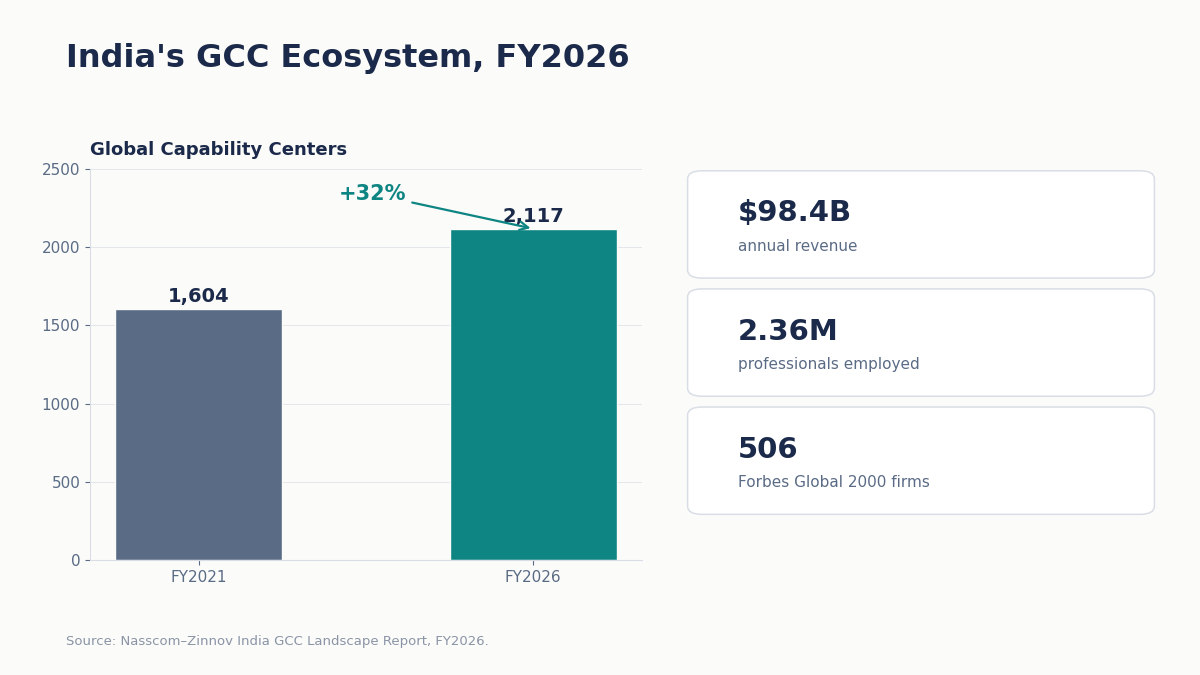
Nothing about Company B’s route is exotic anymore. It is how a growing share of mid-market and PE-backed companies now enter India and India is where global engineering capacity is consolidating. The country hosts 2,117 Global Capability Centers across 3,728 delivery units, employing 2.36 million professionals, and 506 of the Forbes Global 2000 already run one.
India’s GCC ecosystem generated $98.4 billion in revenue in FY2026 and has grown 32% since FY2021, with headcount projected to cross 2.5 million by 2030.
The catch is that almost all published advice assumes you will incorporate first. That assumption quietly adds 6–9 months and ₹50 lakh–₹1.5 crore of pre-revenue setup cost before a single line of code is written. This guide covers the other route end to end: what the fully managed model is, when to launch a GCC without an entity, what it costs per seat, how contracts should be structured so you keep your IP and your team, how the first 90 days actually run, and how if you choose you later flip the whole center into your own subsidiary.
Read it from start to finish and you should be able to run this process yourself: requirements, vendor evaluation, contracting, onboarding, governance, and exit. Every phase includes the numbers most vendors only share on a sales call.
TL;DR
GCC-as-a-Service lets you build a full engineering team in India without setting up a local entity. A managed partner hires, pays, and administers your team under their legal umbrella. You control the work, the roadmap, and the IP. No incorporation. No 6-9 month wait.
The numbers make the case on their own. Traditional entity setup takes 6-9 months and ₹50L-1.5Cr in upfront cost before you hire anyone. A managed GCC gets your first hires onboarded in 3-6 weeks, often for near-zero upfront capital. You still keep 40-60% cost savings over US/EU hiring, minus a 12-20% management fee.
This isn't outsourcing, and it isn't a shortcut. You interview every hire. Your team works exclusively on your product. And if you want to convert to your own entity later, a Build-Operate-Transfer (BOT) clause makes that a clean, pre-priced move — not a renegotiation from scratch. Here's exactly how the model works, what it costs, and how to launch in 90 days.
What Is GCC as a Service?
GCC as a Service is a fully managed operating model in which a local partner hires, employs, and administers your dedicated India team under the partner’s legal entity while you control the work, the roadmap, and the IP letting you launch a functioning capability center in 30–90 days without incorporating a subsidiary.
What it is not:
- Not outsourcing. An outsourcer sells you outcomes delivered by its own shared teams. In a managed GCC, the team is exclusively yours: you interview, select, and direct every hire; the partner runs the legal and administrative shell.
- Not a plain employer of record (EOR). An EOR only runs payroll and compliance for people you found yourself. A managed GCC partner also sources and vets talent, provides workspace and IT, and manages ongoing HR operations and retention.
- Not a body shop or staff augmentation. Staff augments you individuals on the vendor’s bench, often shared or short-tenure. A managed center is a persistent, branded team with your culture, your tools, and a path to transfer to your own entity later.
Why It Matters: The Business Case
The decision between a managed model and an owned entity is not philosophical. It changes four hard numbers:
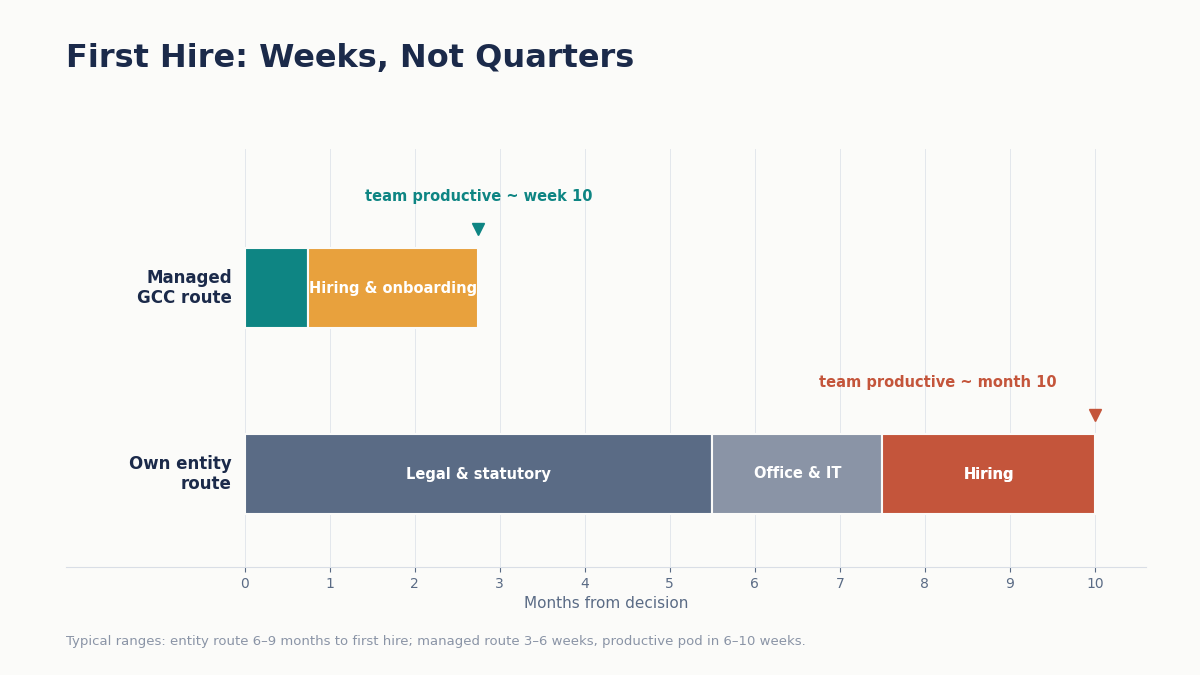
- Speed to first hire: 3–6 weeks vs. 6–9 months. Entity incorporation, tax registrations, bank accounts, and statutory enrollments in India routinely consume two to three quarters. A partner operating under its own entity can issue compliant offer letters immediately; this is the entire mechanism behind a GCC in 90 days.
- Pre-revenue capital: near zero vs. ₹50L–₹1.5Cr (~$60k–$180k). Owned setups front-load legal fees, office deposits (typically 6–10 months of rent in Indian metros), IT capex, and compliance retainers before hiring begins. Managed models convert nearly all of it into a monthly per-seat operating expense.
- Talent cost arbitrage preserved: 40–60% vs. comparable US/EU roles. A senior backend engineer in Bengaluru or Hyderabad typically costs ₹28–₹45 lakh/year (~$34k–$54k) fully loaded versus $150k–$220k loaded in the US. The managed layer adds 12–20%, which still leaves the arbitrage largely intact.
- Risk containment. No permanent establishment exposure from premature hiring, no orphaned entity if the experiment fails, and a contractual exit measured in 60–90 days instead of a 12–18 month entity wind-down.
There is a fifth, less quantifiable outcome: optionality. A managed center is reversible and transferable. An entity is a commitment you make before you have evidence the location, leadership, and talent strategy actually work for you.
The Core Problem: Why Most India Launches Slip by Two Quarters
Most first-time buyers budget 90 days for an India launch and deliver in 270. The pattern is consistent enough to be predictable, and it comes from underestimating three separate clocks that run sequentially, not in parallel.
Clock 1 Legal and statutory (typically 4–7 months). Incorporation under the Companies Act 2013 itself can be done in 2–4 weeks. What buyers miss is everything after: PAN/TAN, GST registration, a functioning corporate bank account (notoriously slow for foreign-owned entities), PF and ESI registration, professional tax, Shops & Establishments licensing, and if you want export benefits STPI or SEZ registration. Each has its own queue.
Clock 2 Infrastructure (2–4 months). Grade-A office space in Bengaluru, Hyderabad, or Pune requires 6–10 month deposits, fit-out lead times of 8–12 weeks, and procurement of laptops, networking, and access control that cannot legally be purchased until the entity and bank account exist. See Clock 1.
Clock 3 Hiring (the one that actually matters). India’s talent market moves fast at the top: strong engineers hold 2–4 competing offers, and notice periods run 30–90 days. Teams that start sourcing only after Clocks 1 and 2 finish discover that their real time-to-productive-team is 60–90 days on top of everything above. Offer drop-off rates of 30–50% are normal for companies with no local brand and no local HR muscle; disciplined vetting-and-engagement processes push joining rates above 90%.
The 3–4x rule: most teams underestimate total elapsed time by 3–4x because they model the three clocks as parallel when, in an owned-entity route, they are largely serial. The managed route exists precisely to collapse Clocks 1 and 2 to zero and start Clock 3 on day one.
The A-to-Z Walkthrough: From First Decision to Running Center
This is the full lifecycle of the managed GCC model, phase by phase. A first-time buyer should be able to execute every step below without prior India experience. Timelines assume a 15–40 person initial team; larger launches scale the hiring phase, not the setup phase.
Phase 1 Defining Requirements (Week 0–2)
Vague requirements are the single biggest cause of slow launches more than vendor speed, more than market conditions. Before you talk to any partner, lock these six inputs:
- Charter. One sentence: what this center owns in 12 months. “Owns the payments platform backend and its on-call” is a charter. “Extends engineering capacity” is not; it produces order-taker teams with 25%+ attrition.
- Roles and seniority mix. List exact titles and a pyramid. A healthy starting pod: 1 engineering manager, 2–3 senior engineers (8+ yrs), 4–6 mid-level (4–7 yrs), 2–3 juniors (1–3 yrs), plus QA/DevOps as needed. All-senior teams cost 60–70% more and are rarely necessary.
- Budget bands per role. Anchor to market, not to your home-country instincts divided by three. Typical Bengaluru/Hyderabad annual CTC bands in 2026: junior engineers ₹8–15 lakh ($10k–18k), mid-level ₹15–28 lakh ($18k–34k), senior ₹28–45 lakh ($34k–54k), engineering managers/architects ₹45–80 lakh ($54k–96k). Add 25–40% for niche AI/ML or platform-security profiles.
- Location and work mode. Bengaluru and Hyderabad have the deepest product-engineering pools; Pune, Chennai, and NCR follow; tier-2 cities (Indore, Jaipur, Coimbatore) offer 15–25% lower salary costs with narrower senior pools. Decide hybrid vs. office-first now it changes the candidate pool by 30%+.
- Timeline with a real anchor date. “First 10 engineers productive by <date>” forces every downstream decision.
- Transfer intent. Decide upfront whether you may want to move the team into your own entity in 18–36 months. It changes which contract you sign (see Phase 3).
Red flag at this stage: any partner willing to quote you a price before seeing your role matrix is quoting a rate card, not a plan.
Phase 2 Sourcing & Vetting (Week 1–6, overlaps Phase 1)
This phase determines whether you get a real capability center or an expensive bench. India’s market has extraordinary talent density and extraordinary noise. A disciplined funnel looks like this:
- Calibration sprint (days 1–3). The partner’s recruiters review your job descriptions against live market data, flag unrealistic combinations (a common one: senior Golang + Kubernetes + fintech domain at mid-level budget), and agree on 2–3 calibration profiles per role before mass sourcing begins.
- AI-assisted sourcing + human screening (days 3–7). Modern partners run AI-powered sourcing across talent databases to surface roughly the top 2% of matched, pre-vetted candidates rather than flooding you with keyword matches. Expect a first interview-ready shortlist in 7–10 working days per role, not 4–6 weeks.
- Technical evaluation (days 7–15). Minimum bar: a structured live coding or system-design round conducted by engineers (not recruiters), a work-sample or take-home aligned to your stack, and a background/employment verification. Pass rates from screened shortlist to offer should run 20–35% much higher means the screen is weak.
- Cultural and communication evaluation. A 30-minute conversation with your own team lead. Skipping this correlates strongly with first-90-day exits.
- Offer and engagement management (days 15–45). This is where launches die. The partner should manage counter-offer risk with weekly candidate touchpoints during notice periods, and where justified, negotiate notice-period buyouts (typically ₹1–3 lakh per candidate). Benchmarks worth demanding: 90%+ offer-to-join ratio and sub-1% early drop-off on contract roles best-in-class operators, Supersourcing among them, publish joining rates of 98%.
Red flags in vetting:
- Resumes arrive within 24 hours of the JD (recycled bench, not sourced talent)
- No engineer-led technical round in the partner’s own process
- Partner resists letting you take final interviews (you must always hold the final yes/no)
- “Immediate joiners only” pools in India, immediately available senior talent is a mixed signal
Phase 3 Engagement Models & Contracts (Week 2–4)
Three engagement structures dominate, and choosing wrong costs real money later:
- Fully managed / flexi GCC setup. A partner employs the team under its entity indefinitely; you pay salary pass-through plus a management fee (12–20% of CTC) or an all-in per-seat rate. Best for 10–75 seat teams and unproven India strategies.
- Build-Operate-Transfer (BOT) model. Same as above, but the contract pre-agrees a transfer: after 18–36 months, the team, assets, and operations move into your newly formed entity for a pre-defined transfer fee (commonly 1.5–3 months of team CTC, or a per-head fee of ₹1.5–4 lakh). Best when India is strategic but you want speed now.
- Hybrid / RPO. You incorporate in parallel while the partner runs recruitment process outsourcing and interim employment, migrating employees to your entity as it goes live. Fastest path to full ownership; more moving parts.
Non-negotiable contract clauses walk away from any partner who resists these:
- IP assignment. All work products are assigned to you at creation (“work made for hire” language), not at payment or transfer. Backed by NDAs signed by every individual team member, not just the partner entity.
- Team exclusivity. Named individuals work only on your account. No shared bandwidth, contractually.
- Right to transfer. Even in a non-BOT contract, secure a pre-priced option to hire the team into your own future entity. Without it, you’ll negotiate your own team’s release from a position of weakness.
- Replacement guarantee. A non-performing hire is replaced at no additional recruitment cost within a defined window 7–10 days to produce replacement candidates is a reasonable standard.
- Data protection & security. Compliance with India’s DPDP Act 2023, plus SOC 2 Type II or ISO 27001 if you handle regulated data; your right to audit annually.
- Exit terms. 60–90 day termination notice, transition assistance obligations, and explicit non-solicit carve-outs that permit you to hire the dedicated team on exit.
- Transparent pricing. Salary pass-through visible to you at the individual level. Opaque “blended rates” typically hide 25–40% margins and destroy your ability to benchmark.
Phase 4 Onboarding & Ramp-Up (Weeks 4–10)
The difference between a team that ships in week six and one that idles until week sixteen is almost entirely preparation you control. The partner handles Indian employment paperwork, payroll setup, workspace, and hardware; you own the productive side.
Before day one (your checklist):
- Provision accounts: SSO, repo access, CI/CD, cloud environments, ticketing, comms tested, not just requested
- Nominate an onboarding buddy per hire from your existing team
- Prepare a 2-week structured ramp plan per role: codebase tour, architecture docs, first “good first issues”
- Ship or locally procure hardware with security baseline (MDM, disk encryption) pre-imaged
- Schedule founder/leadership face-time in week one a 30-minute session measurably improves early retention
Weeks 1–2: environment setup, codebase walkthroughs, first small merged PR by day 7–10 (a genuinely useful health metric), and agreement on communication cadence. For US/EU overlap, fix a daily 60–120 minute synchronous window; India teams commonly shift to 11:00–20:00 or 12:00–21:00 IST to create 3–4 hours of overlap with European mornings or US East Coast.
Weeks 3–6: ramp to full sprint participation. Expect 60–70% of steady-state velocity by week 4 and 90%+ by week 8 for mid/senior hires. Slower than that is a signal to investigate access blockers first, skills second.
The 3-day rule: any new hire blocked on access or unclear ownership for more than 3 consecutive days should trigger an escalation to the account manager. Early idleness is the top predictor of 90-day attrition.
Phase 5 Managing Delivery (Ongoing)
A managed center still needs managing what changes are what you manage. You run the engineering; the partner runs employment, and a governance layer keeps both honest.
Governance cadence that works at 10–75 seats:
- Weekly: delivery standups inside your normal engineering rituals (the partner is not in these), plus a 30-minute ops sync with the dedicated account manager covering hiring pipeline, attrition risk, and blockers
- Monthly: KPI review against an agreed dashboard
- Quarterly: business review comp benchmarking, retention plan, growth forecast, and charter progress
KPIs worth tracking (and the bands that indicate health):
- Offer-to-join ratio: ≥90%
- Voluntary attrition: ≤12–15% annualized (India tech market average has ranged 15–20%+ in hot cycles)
- Time-to-fill per approved role: 25–40 days including notice periods
- Ramp time to full velocity: ≤8 weeks
- eNPS or equivalent engagement score, surveyed by the partner quarterly: 8+ on a 10-point scale is achievable
- Replacement turnaround when a hire misfires: candidates within 7–10 days
Red flag in steady state: an account manager who only surfaces problems you found first. The value of the managed layer is early warning comp drift versus market, flight-risk signals, visa/leave/compliance issues before they become resignations.
Phase 6 Scaling, Transferring, or Exiting (Month 6+)
Every managed center eventually reaches one of three forks:
Scaling. Adding headcount should reuse the Phase 2 machine: 7–10 working days to shortlist, 25–40 days to seat. Negotiate volume pricing at growth thresholds management fees commonly step down 2–4 percentage points past 25 and 50 seats. Re-verify your role pyramid at each doubling; teams that scale by cloning senior roles blow budgets, and teams that scale junior-heavy stalls on review capacity.
Transferring (the BOT execution or exercised transfer option). The realistic sequence and timeline:
- Incorporate your subsidiary and complete registrations 3–5 months, run in parallel with continued operations
- Sign the transfer agreement: employee novation terms, asset transfer, transfer fee settlement 4–6 weeks of negotiation if pre-priced, 3–6 months if not (this is why Phase 3 matters)
- Issue new offer letters preserving tenure, compensation, and benefits; India requires employee consent for transfer, so expect and plan retention conversations well-run transfers retain 90%+ of the team
- Migrate payroll, PF accounts, insurance, and devices over one payroll cycle
- Run 60–90 days of transition support from the partner post-cutover
Exiting. If the strategy changes, a clean contract gives you three options: wind down with 60–90 days notice, transfer the team to your entity anyway, or sometimes overlooked negotiate the partner absorbing strong performers onto other accounts, which converts severance exposure into goodwill.
Case Studies: What the Model Looks Like in Practice
All three examples below come from Supersourcing’s public delivery record, part of a base of 527+ completed IT projects across fintech, healthtech, and enterprise SaaS and each isolates a different failure mode the managed route is built to solve.
100+ engineers for a fintech leader at scale-up speed. When Paytm needed to expand engineering capacity across multiple product lines, the mandate was volume without dilution of bar: 100+ engineers hired through an AI-driven sourcing and vetting funnel, with interview-ready shortlists delivered in 7–10 working days per role and joining rates held near the 98% benchmark rather than the 50–70% typical of high-volume Indian hiring. The lesson for GCC buyers: the sourcing engine, not the entity, is the real bottleneck at scale.
Engineering depth for a high-growth fintech. OkCredit’s engineering recruitment push required senior and specialist profiles in one of India’s most competitive talent pockets, Bengaluru fintech. Structured technical vetting (engineer-led rounds plus work samples) kept shortlist-to-offer conversion in the healthy 20–35% band and early drop-off under 1% on contract roles, protecting sprint commitments during ramp. Depth hiring is where partner vetting quality shows; volume hiring merely tests speed.
Recruitment automation for a healthtech platform. Somnoware, a US healthtech company building in India, is the archetypal managed-model buyer: a focused product team, no appetite for a local entity, and compliance sensitivity around health data. Automating and outsourcing the recruitment process cut coordination overhead for its US leadership to a weekly cadence while the India-side partner handled sourcing, screening, and offer management end to end the operating pattern this entire guide describes.
(More detail on these engagements is available on the case studies page.)
Decision Framework: Managed GCC vs. BOT vs. Own Entity vs. Staff Augmentation
Use this table to place yourself, then pressure-test with the three questions below it.
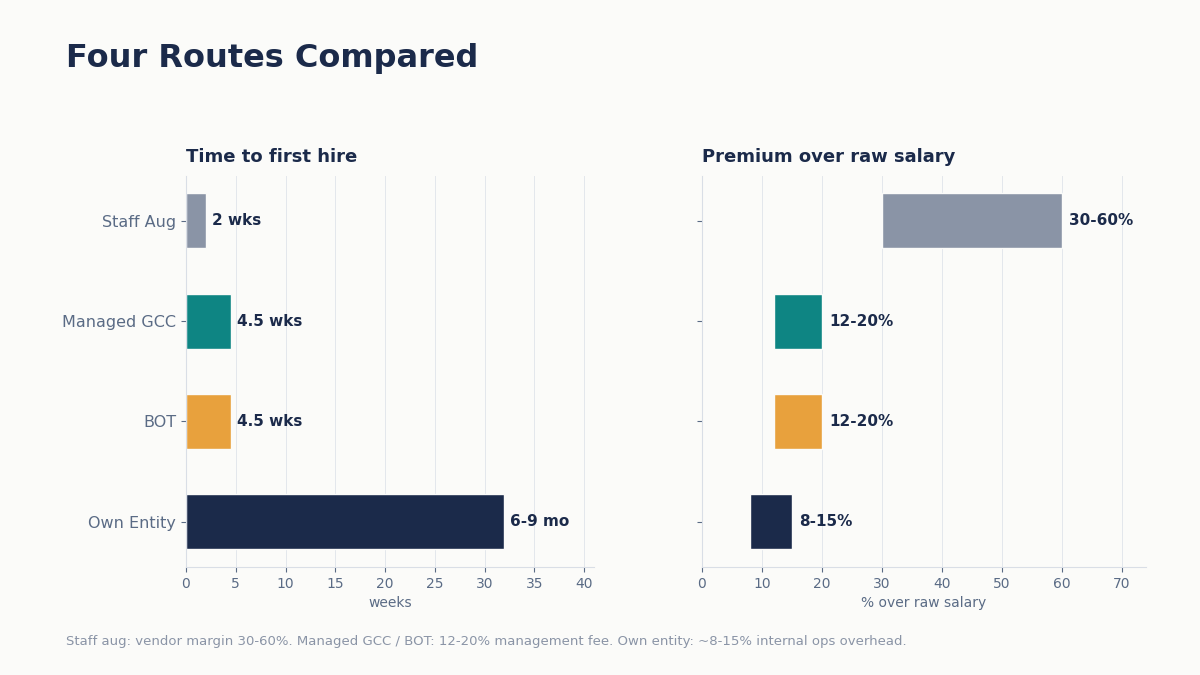
| Dimension | Managed GCC (GCCaaS) | BOT | Own Entity (DIY) | Staff Augmentation |
| Time to first hire | 3–6 weeks | 3–6 weeks | 6–9 months | 1–3 weeks |
| Upfront capital | Minimal (deposit/setup fee) | Minimal–moderate | ₹50L–1.5Cr before hire #1 | None |
| Ongoing premium over raw salary | 12–20% mgmt fee | 12–20% + transfer fee later | ~8–15% internal ops overhead | 30–60% vendor margin |
| Team exclusivity | Contractual, dedicated | Contractual, dedicated | Absolute | Often shared/bench |
| IP & data control | Strong (with Phase 3 clauses) | Strong | Absolute | Weakest |
| Path to ownership | Optional transfer clause | Pre-agreed, pre-priced | Already owned | None |
| Exit cost | 60–90 day notice | Transfer or notice | 12–18 month wind-down | Per-contract |
| Best at | 10–75 seats, unproven strategy | 20–150 seats, committed strategy | 150+ seats, permanent | <10 seats, short-term |
Three questions that resolve most edge cases:
- Is India proven for you? If you have never operated a team in India, buying reversibility for a 12–20% fee is cheap insurance. Entities are for validated strategies.
- What is your 24-month headcount? Below ~50 seats, the fully-loaded internal cost of running your own entity (finance, HR, compliance, admin typically 3–5 support hires plus retainers) usually exceeds the management fee. The crossover where DIY becomes clearly cheaper sits around 75–150 seats.
- Do you need the asset or the output? PE-backed companies planning a sale often want the entity (it’s a balance-sheet asset); product companies mostly want throughput. BOT serves first, GCCaaS second.
What Most Teams Get Wrong
Patterns repeat across hundreds of India launches, and the expensive mistakes are rarely the ones buyers worry about on day one.
They negotiate prices and ignore the transfer clause. Buyers grind for 2 points of management fee and sign contracts with no pre-priced right to hire their own team later. Eighteen months on, the leverage is entirely with the partner, and “release fees” of 4–6 months of CTC per employee appear. The transfer clause is worth more than any fee discount you will ever win.
They treat the center as a ticket-taker, then blame attrition. Centers chartered as “extra hands” see 20–30% attrition; centers that own a product area, run their own on-call, and present at company all-hands routinely hold attrition under 12%. Indian senior engineers leave boring mandates, not hard ones. Ownership is the retention program.
They map home-country salary instincts onto India in both directions. Lowballing loses every strong candidate in a market where seniors hold 2–4 offers. Overpaying by 30–40% “to be safe” quietly erases the arbitrage and creates internal equity problems at transfer time. The fix is boring: benchmark every role against live market data quarterly, not against last year’s spreadsheet.
They confuse an EOR with a managed GCC and buy the wrong product. An employer of record is a payroll wrapper; it does not source talent, run technical vetting, manage counter-offers through 60-day notice periods, or carry a replacement guarantee. Teams that buy EOR-plus-LinkedIn discover they’ve insourced the hardest part hiring in India with none of the local muscle.
They go silent during notice periods. The 30–90 day gap between offer acceptance and joining is where India hiring is won or lost; counter-offers arrive in weeks 2–6. Weekly structured touchpoints during notice are the single highest-ROI activity in the entire funnel, and most buyers (and weak partners) do zero of them.
They start governance after the first problem. The account-management cadence in Phase 5 feels like overhead in month one and like clairvoyance in month seven. Comp drift, flight risk, and compliance issues are all visible 6–8 weeks before they become resignations or penalties but only if someone is contractually obligated to look.
Cost & Timeline Reality Check: GCC as a Service Pricing in India
This is the section with the most competing content skips. All figures are 2026 market ranges for metro India (Bengaluru, Hyderabad, Pune); tier-2 locations run 15–25% lower on salaries and 30–40% lower on real estate.
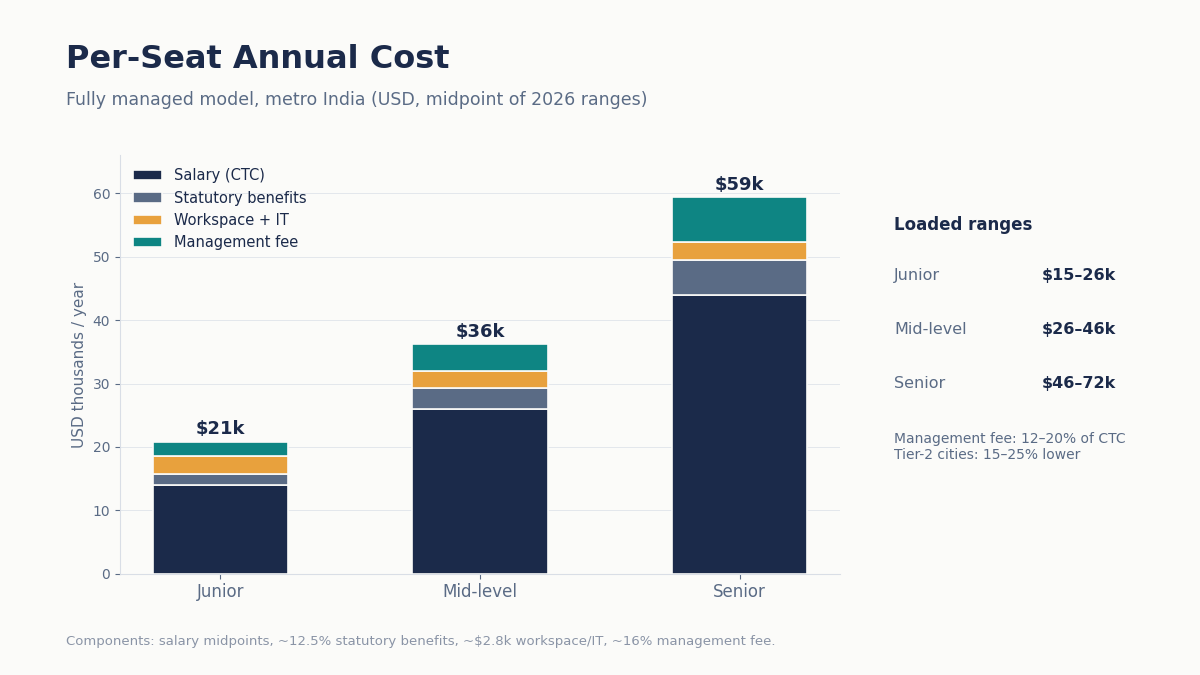
Per-seat economics, fully managed model (annual, per engineer):
| Component | Junior | Mid-level | Senior |
| Salary (CTC) | ₹8–15L / $10–18k | ₹15–28L / $18–34k | ₹28–45L / $34–54k |
| Statutory benefits & insurance | ~10–15% of CTC | ~10–15% | ~10–15% |
| Workspace + IT (per seat) | ₹1.5–3L / $2–3.6k | same | same |
| Management fee | 12–20% of CTC | 12–20% | 12–20% |
| All-in loaded cost | ~$15–26k | ~$26–46k | ~$46–72k |
One-time and situational costs:
- Setup/onboarding fee: ₹0–10L depending on partner and team size (many waive it above 15 seats)
- Notice-period buyouts where speed justifies it: ₹1–3L per candidate
- BOT transfer fee (if exercised): 1.5–3 months of team CTC, or ₹1.5–4L per head
- Recruitment fees: usually bundled into the management fee in true GCCaaS; standalone RPO runs 6–10% of CTC per hire
Timeline by scenario (contract signature → productive team):
- 10–15 person pod, common stack (Java/Python/React/Node): 6–10 weeks
- 25–40 person multi-pod center with managers and QA/DevOps: 10–16 weeks
- 50+ seats or niche profiles (AI/ML, embedded, security): 16–24 weeks, phased
- Same scope via own-entity route: add 5–8 months in front of every line above
What moves cost up: all-senior pyramids (+60–70%), AI/ML and security premiums (+25–40%), Bengaluru central business district real estate, sub-30-day launch pressure (buyouts), opaque blended-rate contracts.
What moves cost down: balanced role pyramids, tier-2 or hybrid location strategy, 25+ seat volume tiers on the management fee, and transparent salary pass-through that lets you benchmark every single offer.
A note of caution on comparing quotes: a “cheap” blended rate of $3,500/month per mid-level engineer sounds like $42k/year competitive until you learn the engineer’s actual salary is ₹14L (~$17k) and the spread is a 60%+ hidden margin funding a bench you don’t control. Insist on pass-through visibility; it is the fastest honesty test in this market.
Compliance, IP, and PE Risk: What You’re Actually Delegating
Speed is the visible benefit of the managed route; risk transfer is the quieter one. It’s worth understanding exactly which obligations sit with the partner’s entity, because this is where first-time buyers either sleep well or get surprised.
What the partner’s entity absorbs:
- Employment law compliance: PF, ESI, gratuity, professional tax, Shops & Establishments obligations, state-specific leave rules, and statutory bonus all under the partner’s registrations
- Payroll and tax withholding: TDS on salaries, Form 16 issuance, and payroll audits
- Termination exposure: Indian employment separations follow notice and severance norms that vary by state and tenure; the partner handles process and paperwork (though your contract should define who bears severance cost negotiate this explicitly)
What you must still own:
- Permanent establishment (PE) hygiene. A managed structure reduces but does not automatically eliminate PE risk. Two behaviors create exposure regardless of who signs payslips: giving India-based staff authority to conclude contracts on your behalf, and structures where the “service provider” is a pure façade. Keep commercial signing authority outside India, paper the arrangement as a genuine service agreement at arm’s-length pricing, and have your tax advisor review the structure once it’s a 2–4 hour exercise that prevents a multi-year dispute.
- IP chain of custody. Verify three links, not one: partner-to-you assignment in the master agreement, employee-to-partner assignment in every employment contract, and individual NDAs. Asking to see the partner’s standard employment contract before signing a missing invention-assignment clause at the employee layer breaks the whole chain.
- Data residency and security posture. If you process EU or US-regulated data, confirm DPDP Act 2023 compliance plus your specific regime (GDPR SCCs, HIPAA BAAs where relevant), device-level controls (MDM, DLP), and audit rights. SOC 2 Type II or ISO 27001 at the partner level is table stakes for regulated workloads.
Red flag: a partner who answers “don’t worry, we handle all compliance” without being able to show its registrations, a specimen employment contract, and its security certifications inside 48 hours. Genuine operators have this as a standing data-room folder.
The 90-Day Launch Plan at a Glance
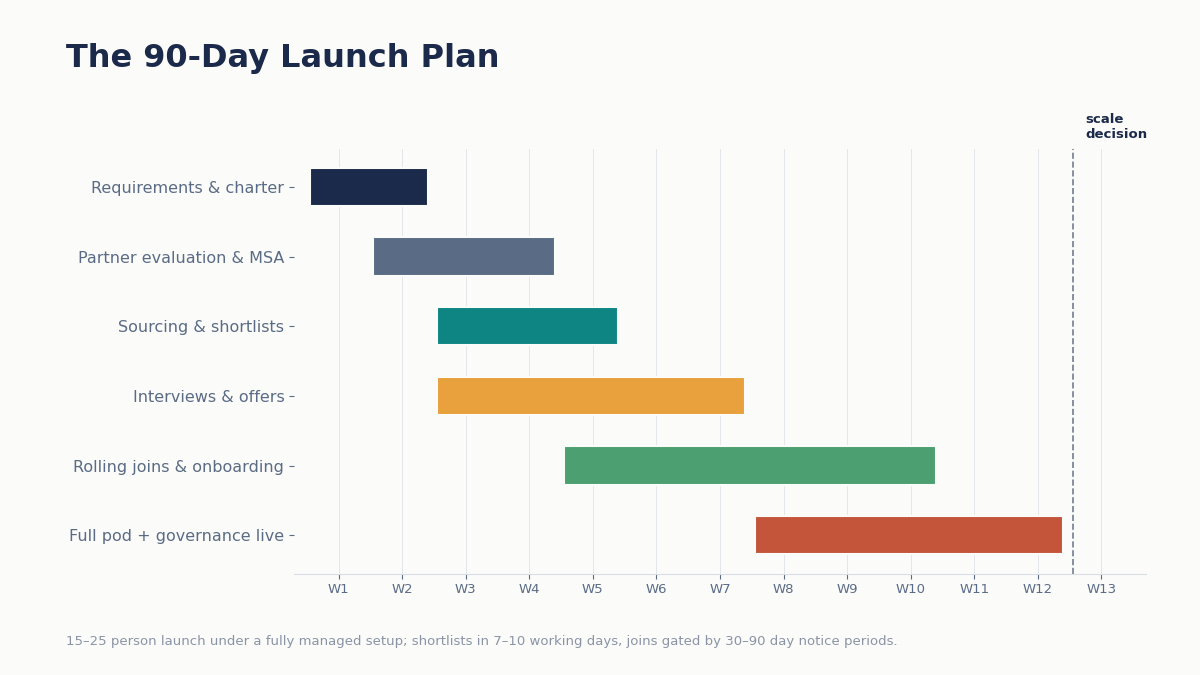
For readers who want the entire guide compressed into one executable block this is the realistic week-by-week shape of a 15–25 person launch under a flexi GCC setup, and it doubles as the HowTo schema backbone:
- Weeks 1–2: Finalize charter, role matrix, budget bands, and location (Phase 1). Shortlist 2–3 partners; request specimen contracts and compliance data rooms.
- Weeks 2–4: Run partner evaluation against the Phase 3 clause checklist. Sign master IT services agreement. Sourcing begins the day the calibration sprint ends and first shortlists land in 7–10 working days.
- Weeks 3–7: Interview loops and offers. Your team holds final interviews; partner manages offers, buyout decisions, and weekly notice-period touchpoints.
- Weeks 5–10: Rolling joins as notice periods complete. Onboarding checklist executed per hire; first merged PR within 10 days of each start date.
- Weeks 8–12: Full pod operational. Governance cadence live (weekly ops sync, monthly KPI review). First quarterly business review scheduled.
- Week 13+: Scale decision: hold, grow, or begin entity incorporation in parallel if transfer intent is confirmed.
Miss a window by more than two weeks and the culprit is almost always found in Phase 1 (requirements churn) or Phase 2 step 5 (unmanaged notice periods) not in the paperwork the model was designed to eliminate.
Your Next Step
If you’re mid-decision, don’t start with vendors, start with the Phase 1 worksheet: charter, role matrix, budget bands, location, anchor date, transfer intent. That one document turns every partner conversation from a pitch into a quote you can compare, and it takes an afternoon.
Then pressure-test it against reality. Supersourcing’s GCC team runs no-obligation scoping sessions where you leave with a role-by-role cost band, a week-by-week launch timeline for your specific stack, and an honest read on whether the managed route, BOT, or a parallel RPO build fits your 24-month plan including telling you if incorporating your own entity is genuinely the better call. Book it at supersourcing.com/contact-us, and bring the worksheet.
Frequently Asked Questions
Do I need a legal entity to hire employees in India?
No and this is the premise of the entire model. A foreign company cannot directly employ Indian staff without a local presence, but a partner’s Indian entity can employ your dedicated team under a services agreement while you direct the work. You gain compliant employment, payroll, and benefits from day one, with the option to incorporate later if the strategy proves out.
How is GCC-as-a-Service different from outsourcing?
Control and exclusivity. An outsourcer owns the team, the process, and often the roadmap, selling you deliverables from shared resources. In the managed-center model you interview and select every hire, the team works only on your products with your tools and rituals, IP assigned to you at creation, and a transfer path to your own entity can be contracted upfront. The partner supplies the legal shell and operations, not the engineering direction.
How much does a managed GCC cost per employee?
Plan on an all-in loaded cost of roughly $15–26k/year for junior engineers, $26–46k for mid-level, and $46–72k for senior profiles in metro India salary plus statutory benefits, workspace, IT, and a 12–20% management fee. Tier-2 cities run 15–25% cheaper. Always demand salary pass-through visibility so you can see exactly how the number decomposes.
How fast can I realistically launch?
A 10–15 person pod on a mainstream stack is productive in 6–10 weeks from contract signature; 25–40 person centers take 10–16 weeks. The gating factor is Indian notice periods (30–90 days), not setup which is why partners that manage candidates weekly through their notice, and can shortlist in 7–10 working days, compress timelines the most.
Who owns the IP if the partner employs my team?
You do, if the contract chain is built correctly: master-agreement assignment of all work products to you at creation, employee-level invention assignment in every employment contract, and individual NDAs. Verify all three layers before signing the employee layer is the one buyers forget to check and the one Indian disputes actually turn on.
What is the build-operate-transfer model, and when is it better?
BOT is the managed model with a pre-agreed ending: after 18–36 months, the team and operations transfer into your newly incorporated subsidiary for a pre-priced fee (typically 1.5 — 3 months of team CTC). Choose BOT when India is already a committed, long-term strategy; choose open-ended GCCaaS with a transfer option when you’re still validating.
When should I convert a managed center into my own entity?
The economic crossover typically arrives around 75–150 seats, when the management fee exceeds the cost of running your own finance/HR/compliance stack. Strategic triggers can arrive earlier: an upcoming funding round or sale where the entity is a balance-sheet asset, regulatory requirements, or a center that has become genuinely core to the product. Start incorporation 5–8 months before you want the switch flipped.
How do I evaluate whether a specific partner can actually deliver this?
Ask for five artifacts inside one week: a specimen employment contract (check invention assignment), compliance registrations and security certifications, verifiable joining-rate and drop-off metrics, two client references at your target team size, and a pre-priced transfer clause in their standard paper. Operators with a real track record think 500+ delivered projects, 98% joining rates, published NPS produce these without friction. If you’d rather pressure-test your specific scenario, a working session with a GCC setup specialist is the fastest way to get calibrated numbers for your role mix.
